- Base Value(2026): 2.5 Bn
- Estimated Value(2026): 2.5 Bn
- Forecast Value (2036): 4.8 Bn
- CAGR (2026 - 2036): 6.8%
Spora Face Oils Market Forecast and Outlook 2026 to 2036
Valuation of the global spora face oils market is projected to grow from USD 2.5 billion in 2026 to USD 4.8 billion by 2036, reflecting a compound annual growth rate of 6.8% over the period.
Key Takeaways from Spora Face Oils Market
- Spora Face Oils Market Value (2026): USD 2.5 billion
- Spora Face Oils Market Forecast Value (2036): USD 4.8 billion
- Spora Face Oils Market Forecast CAGR: 6.8%
- Leading Nature in Spora Face Oils Market: Organic (54.2%)
- Key Growth Countries in Spora Face Oils Market: China, India, Germany, Brazil, USA, UK, Japan
- Key Players in Spora Face Oils Market: Biossance, Spora Health, Herbivore Botanicals, True Botanicals, Indie Lee, Rituals Cosmetics, Youth To The People, Drunk Elephant, The Ordinary, Tata Harper
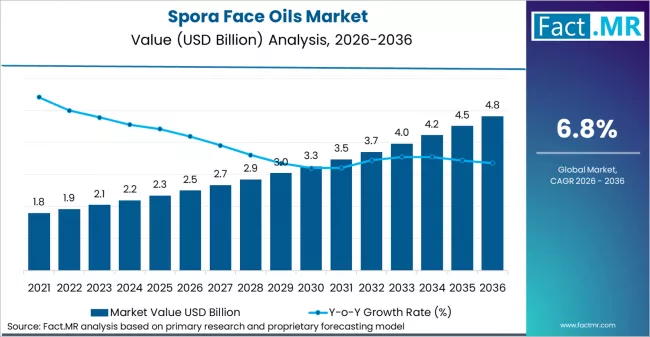
Spora Face Oils Market Market Value Analysis | Source: Fact.MR
Growth is driven by increasing adoption across China, India, Germany, Brazil, the United States, the United Kingdom, and Japan, where facial oils are increasingly incorporated into daily skincare routines for hydration, nourishment, and targeted treatment of specific concerns.
Product type segmentation identifies spore based functional oils as the leading category, reflecting strong consumer preference for bioactive formulations that combine antioxidant and restorative properties, followed by single ingredient face oils that emphasize simplicity and purity, and blended face oils that integrate multiple actives for comprehensive skin benefits.
Nature segmentation shows organic products as the dominant group, preferred for their plant-derived, minimally processed ingredients, while conventional variants continue to serve users seeking familiar formulations. Skin type segmentation highlights sensitive skin as the primary focus for product development, followed by dry, oily, combination, and normal skin, with formulations tailored to provide hydration, barrier support, and soothing effects across diverse consumer needs and climatic conditions.
Spora Face Oils Market
| Metric | Value |
|---|---|
| Market Value 2026 | USD 2.5 Billion |
| Market Forecast Value 2036 | USD 4.8 Billion |
| Forecast CAGR 2026 to 2036 | 6.8% |
Source: Fact.MR analysis. Updated Jan 29, 2026
Category
| Category | Segments |
|---|---|
| Product Type | Spore Based Functional Oils; Single Ingredient Face Oils; Blended Face Oils; Other |
| Nature | Organic; Conventional |
| Skin Type | Sensitive Skin; Dry Skin; Oily Skin; Combination Skin; Normal Skin |
| Region | North America; Europe; Asia Pacific; Latin America; Middle East & Africa |
Source: Fact.MR analysis. Updated Jan 29, 2026
Segmental Analysis
By Product Type, Which Segment Holds the Dominant Share in the Spora Face Oils Market?
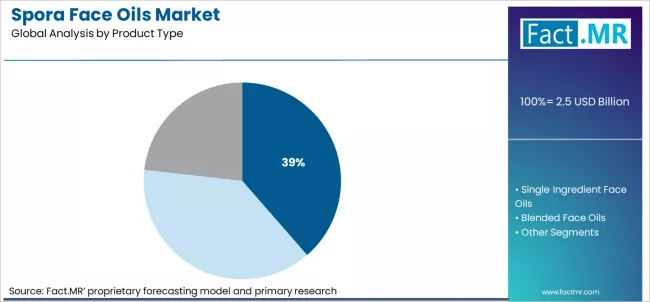
Spora Face Oils Market Analysis By Product Type | Source: Fact.MR
In the Spora Face Oils market, spore based functional oils account for the largest share at 38.6%. Growth is driven by consumer demand for functional oils that support the skin barrier and promote microbiome health. These oils are increasingly incorporated into daily skincare routines for their targeted effects on skin resilience and overall hydration.
- Manufacturers continue to launch spore-based functional oils with enhanced bioactive properties and specialized benefits.
- Consumer interest in differentiated and scientifically positioned face oil formats ensures spore-based functional oils remain the leading product category.
By Nature, Which Segment Registers the Highest Share in the Spora Face Oils Market?
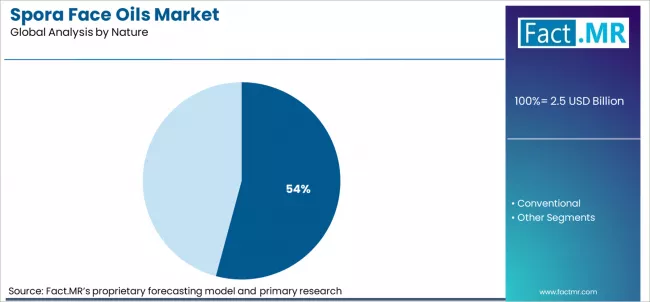
Spora Face Oils Market Analysis By Nature | Source: Fact.MR
Organic face oils hold the leading share at 54.2%, reflecting strong preference for naturally sourced, minimally processed ingredients. The segment benefits from consumer focus on clean formulations and transparency in ingredient sourcing.
- Brands are expanding organic-certified portfolios to meet growing demand for natural and plant-based solutions.
- Ingredient origin and perceived efficacy reinforce organic oils as the dominant nature segment in the market.
By Skin Type, Which Segment Commands the Largest Share in the Spora Face Oils Market?
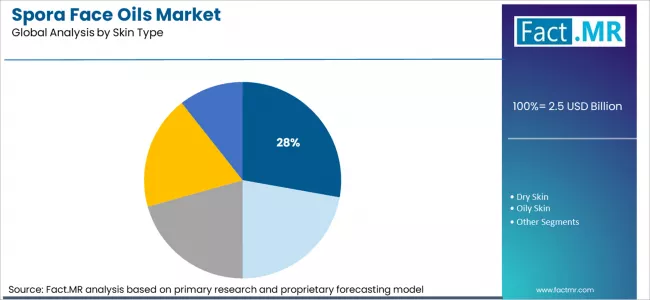
Spora Face Oils Market Analysis By Skin Type | Source: Fact.MR
Sensitive skin leads with a 27.8% share, reflecting consumer preference for gentle, low-irritation formulations. Products targeting sensitive skin are increasingly formulated to balance efficacy with tolerability, reducing potential for adverse reactions.
- Manufacturers position spora face oils with claims of minimal irritation and skin-soothing benefits.
- Sensitivity-driven product selection ensures sensitive skin remains the leading skin type segment in the market.
What are the Drivers, Restraints, and Key Trends of the Spora Face Oils Market?
- Drivers: Rising interest in spore-based functional oils and organic face oil solutions for sensitive and dry skin supports demand across online and specialty beauty retail channels.
- Restraint: Limited consumer awareness and constrained clinical validation for spore-derived ingredients restrict broader market acceptance.
- Trend 1: Growing preference for organic and single-ingredient face oil formulations positioned around skin barrier support and microbiome-friendly claims.
- Trend 2: Strong growth of online retail distribution supported by expanding direct-to-consumer brand strategies.
Analysis of the Spora Face Oils Market by Key Country
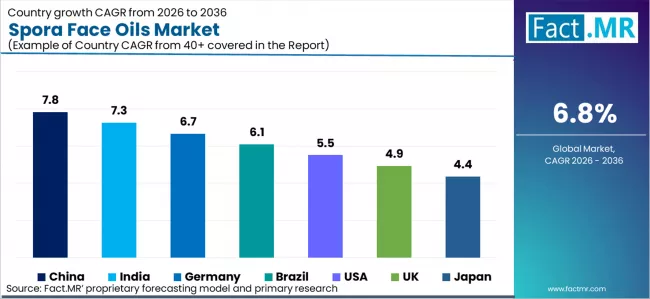
Spora Face Oils Market Cagr Analysis By Country | Source: Fact.MR
| Country | CAGR |
|---|---|
| China | 7.8% |
| India | 7.3% |
| Germany | 6.7% |
| Brazil | 6.1% |
| USA | 5.5% |
| UK | 4.9% |
| Japan | 4.4% |
Source: Fact.MR analysis. Updated Jan 29, 2026
The report covers an in-depth analysis of 7 countries; top-performing countries are highlighted below.
How Is Consumer Interest in Functional Oils Influencing Growth in China?
The Spora Face Oils market in China is projected to grow at a CAGR of 7.8% from 2026 to 2036. Rising demand for functional facial oils, growing preference for organic formulations, and adoption among sensitive and dry skin consumers are driving growth. Urban consumers increasingly favor spore-based ingredients and high-efficacy formulations. Expanding online retail presence enhances accessibility for niche and premium brands, while awareness of ingredient benefits supports broader adoption across metropolitan areas.
Why Is India Emerging as a High-Growth Market for Spora Face Oils?
Spora Face Oils adoption in India is projected to grow at a CAGR of 7.3% from 2026 to 2036. Strong interest in spore-based functional oils and organic formulations drives demand, particularly among urban consumers. Online retail platforms remain the primary sales channel, providing visibility for both emerging and premium brands. Rising disposable incomes and growing awareness of functional skincare solutions further support adoption, while urban populations increasingly seek ingredient-focused facial oils for hydration and skin wellness.
What Factors Are Shaping Spora Face Oils Demand in Germany?
Germany’s Spora Face Oils market is expected to expand at a CAGR of 6.7% from 2026 to 2036. Steady demand exists for single-ingredient and dry-skin-focused formulations, with consumers prioritizing high-quality, functional products. Specialty beauty stores provide key access points for premium oils, while awareness of organic and spore-based ingredients drives adoption. Urban consumers increasingly incorporate facial oils into daily skincare routines, supporting consistent market growth for multifunctional and professional-grade offerings.
How Are Pharmacy Channels Supporting Spora Face Oils Sales in Brazil?
Revenue from Spora Face Oils in Brazil is projected to grow at a CAGR of 6.1% from 2026 to 2036. Blended face oils and multifunctional formulations are increasingly adopted across oily and combination skin segments. Pharmacies, drug stores, and specialty retailers serve as key distribution channels. Urban consumer awareness of functional and hydrating facial oils drives steady adoption, while rising interest in premium and botanical formulations supports expansion across metropolitan and semi-urban markets.
Why Does the USA Remain a Key Market for Spora Face Oils?
The USA Spora Face Oils market is projected to grow at a CAGR of 5.5% from 2026 to 2036. Consumers increasingly adopt facial oils for combination and normal skin types, with preference for premium botanical and clean-label products. Supermarkets, hypermarkets, and specialty retailers provide broad accessibility. Awareness of functional ingredients and high-efficacy formulations supports consistent demand, while urban and professional channels facilitate adoption of both emerging and established facial oil brands.
What Is Supporting Spora Face Oils Adoption in the UK?
The UK Spora Face Oils market is projected to expand at a CAGR of 4.9% from 2026 to 2036. Steady demand exists among consumers with normal and combination skin, driven by preference for simple, minimal-ingredient formulations. Specialty beauty stores and online platforms provide key access points. Awareness of high-quality, functional skincare and growing interest in organic facial oils reinforce adoption, while urban consumers increasingly seek reliable, ingredient-focused solutions for daily skin wellness.
How Is Market Maturity Affecting Spora Face Oils Demand in Japan?
Japan’s Spora Face Oils market is projected to grow at a CAGR of 4.4% from 2026 to 2036. Stable demand exists for high-quality facial oils with safe and effective formulations. Consumers prioritize product reliability, ingredient transparency, and performance, while domestic and international brands dominate the market. Mature retail and professional channels ensure consistent accessibility, and urban populations increasingly adopt multifunctional oils that combine hydration, skin protection, and wellness benefits, supporting steady market growth in a competitive environment.
Competitive Landscape of the Spora Face Oils Market
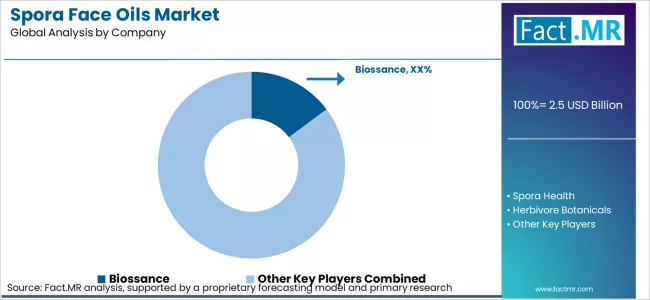
Spora Face Oils Market Analysis By Company | Source: Fact.MR
Competition in the Spora Face Oils Market is focused on product purity, ingredient sourcing, and formulation performance. Biossance and Spora Health lead with spore-based functional oils and single ingredient face oils, emphasizing organic formulations and clean beauty principles. Herbivore Botanicals and True Botanicals target blended face oils with plant-derived actives, addressing hydration, repair, and daily skincare needs.
Indie Lee, Rituals Cosmetics, Youth To The People, Drunk Elephant, The Ordinary, and Tata Harper differentiate through formulation transparency, ingredient traceability, and multi-functional benefits. Products are designed for sensitive, dry, oily, combination, and normal skin types. Distribution spans online retail, specialty beauty stores, pharmacies, drug stores, and supermarkets, targeting women, men, and unisex consumers. Competitive advantage derives from efficacy, ingredient quality, and brand trust. Buyers assess suppliers based on bioactive performance, safety, product versatility, and accessibility across consumer and professional channels.
Key Players in the Spora Face Oils Market
- Biossance
- Spora Health
- Herbivore Botanicals
- True Botanicals
- Indie Lee
- Rituals Cosmetics
- Youth To The People
- Drunk Elephant
- The Ordinary
- Tata Harper
Bibliography
- Food and Drug Administration. (2024). Cosmetics laws and regulations. USA Department of Health and Human Services.
- European Commission. (2023). Cosmetics regulation (EC) No 1223/2009. Publications Office of the European Union.
- National Institutes of Health. (2023). Skin microbiome and barrier function in dermatology. National Library of Medicine.
- World Health Organization. (2023). Guidelines on stability testing of cosmetic products. World Health Organization.
- International Trade Administration. (2024). Global cosmetics and personal care market overview. USA Department of Commerce.
Segmentation
Scope of the Report
| Items | Values |
|---|---|
| Quantitative Units (2026) | USD 2.5 Billion |
| Product Type | Spore Based Functional Oils, Single Ingredient Face Oils, Blended Face Oils, Other |
| Nature | Organic, Conventional, Other |
| Skin Type | Sensitive Skin, Dry Skin, Oily Skin, Combination Skin, Normal Skin, Other |
| Regions Covered | Asia Pacific, North America, Europe, Latin America, and Middle East & Africa |
| Countries Covered | China, India, Germany, Brazil, USA, UK, Japan |
| Key Companies Profiled | Biossance, Spora Health, Herbivore Botanicals, True Botanicals, Indie Lee, Rituals Cosmetics, Youth To The People, Drunk Elephant, The Ordinary, Tata Harper, and other leading skincare companies |
| Additional Attributes | Dollar revenue by product type, nature, skin type, distribution channel, end user, and region; regional demand trends, competitive landscape, innovations in spore derived bioactives, clean beauty positioning, premium face oil formulation strategies, and brand differentiation analysis |
Source: Fact.MR analysis. Updated Jan 29, 2026
Spora Face Oils Market by Segments
-
Product Type :
- Spore Based Functional Oils
- Single Ingredient Face Oils
- Blended Face Oils
-
Nature :
- Organic
- Conventional
-
Skin Type :
- Sensitive Skin
- Dry Skin
- Oily Skin
- Combination Skin
- Normal Skin
-
Region :
- North America
- USA
- Canada
- Mexico
- Europe
- Germany
- Italy
- UK
- France
- Spain
- Netherlands
- Switzerland
- Rest of Europe
- Asia Pacific
- Japan
- Australia
- South Korea
- China
- India
- Rest of Asia Pacific
- Latin America
- Brazil
- Argentina
- Rest of Latin America
- Middle East and Africa
- United Arab Emirates
- South Africa
- Rest of Middle East and Africa
- North America
Frequently Asked Questions
How big is the spora face oils market in 2026?
What will be the size of spora face oils market in 2036?
How much will be the spora face oils market growth between 2026 and 2036?
What are the key product types in the spora face oils market?
Which nature segment to contribute significant share in the spora face oils market in 2026?
Who worked on this report


Preview the report firsthand - request a free sample
Free SampleGet the brochure for pricing and purchase details
Download PDF