- Market Value (2025): USD 1.58 Bn
- Estimated Value (2026): USD 1.69 Bn
- Forecast Value (2036): USD 3.38 Bn
- CAGR (2026-2036): 7.2%
What is the Sterile Tissue Adhesive Market forecast to be worth by 2036?
USD 1.69 billion in 2026 to USD 3.38 billion by 2036, at a 7.18% CAGR.
- Sterile tissue adhesives generated an estimated USD 1.58 billion in revenue in 2025.
- Fact.MR forecasts USD 1.69 billion for 2026 and USD 3.38 billion by 2036.
- The 2026–2036 CAGR is 7.2%. Wider use of approved closure systems and repeat hospital purchasing underpin the projection.
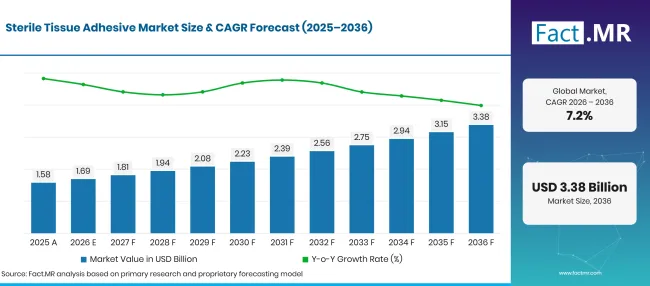
Factmr Sterile Tissue Adhesive Market Forecast Global | Source: Fact.MR
| Year | Basis | Market Value (USD billion) |
|---|---|---|
| 2025 | Historical estimate | 1.58 |
| 2026 | Estimate | 1.69 |
| 2036 | Forecast | 3.38 |
| CAGR 2026 to 2036 | Forecast period | 7.2% |
Source: Fact.MR analysis. Updated Oct 21, 2026
What are the defining numbers behind Sterile Tissue Adhesive Market growth?
The forecast adds USD 1.69 billion to annual revenue by 2036. Surgical Wound Closure accounts for 42.5% of application sales in 2026. Growth depends less on how many adhesives a hospital trials than on the procedures for which clinicians actually make one part of their routine.
- Demand Drivers in the Market
- Time spent closing an incision carries a cost even when the disposable product is inexpensive. A 2025 split-scar study of 58 patients found no significant difference in overall cosmetic outcomes between the tested adhesive and sutures on the trunk and extremities. [8] This supports a measured commercial discussion about suitable closure choices. The result does not establish superiority for every wound. Suppliers can build a stronger case by identifying the procedures in which their product offers acceptable outcomes with a useful change in staff time or follow-up requirements.
- Sterility and usable shelf life are part of the product's value. FDA guidance for topical skin adhesives addresses sterilisation alongside setting time and the stability of the final formulation. [11] An adhesive that becomes difficult to dispense creates an operational problem at the moment of use. Procurement teams therefore assess packaging and handling as well as the active chemistry. These requirements place tissue closure within the broader medical adhesives market while giving sterile clinical products a distinct approval and supply burden.
- Internal surgical sealing creates a different purchasing case from skin closure. In September 2025 FDA approved a TISSEEL supplement covering adult and paediatric patients for specified haemostatic and colonic-anastomosis uses. [14] The commercial opportunity is tied to those procedures and their approved conditions of use. A larger surgical workload alone does not establish demand for a particular adhesive. Suppliers gain more by helping hospitals identify appropriate cases and prepare the product consistently than by presenting every operation as a potential unit sale.
- Integrated closure systems are judged by more than the adhesive itself. CUTIVA PLUS combines a sterile 2-octyl cyanoacrylate applicator with mesh that helps align skin edges. Its August 2025 clearance concerned package-insert changes rather than a redesigned device. [13] Buyers comparing products in the next generation wound closure device market need to examine the complete application process and the indications for which it is approved.
- Key Segments Analyzed
- Cyanoacrylate holds 38.2% of Product Type revenue in 2026. Sterile single-use formulations serve topical closure and other specifically authorised tissue-adhesion applications.
- Surgical Wound Closure accounts for 42.5% of Application revenue in 2026. Repeat procedure protocols make adoption more predictable after clinical and purchasing approval.
- Hospitals contribute 58.7% of End-User revenue in 2026. Their operating theatres and specialist services create demand for multiple adhesive formats with different storage and preparation requirements.
- Analyst Opinion at Fact.MR
- Shambhu Nath Jha, Lead Consultant, Fact.MR
- A hospital rarely changes its closure practice on the strength of a product demonstration alone. Clinicians need an approved indication, straightforward application and confidence about patient aftercare. Procurement teams need predictable stock and a price that makes sense for the procedure. Suppliers should therefore build a case around specific operations, not make the broad claim that adhesives replace sutures. Internal sealants and skin adhesives belong to different clinical decisions, even when both appear in the same market total.
- Strategic Implications
- Build the cost comparison around a defined wound. A 2025 study compared outcomes across part of the same patient's surgical scar. [6] Such evidence can inform hospital decisions, but it cannot show that every incision benefits equally. Sales teams should specify the procedure, the closure method being replaced and the aftercare required. That makes a procurement discussion more useful than a generic claim about time saved.
- Distinguish a skin adhesive from an internal sealant in every tender. FDA's September 2025 TISSEEL supplement covered preparation and reconstitution changes for a fibrin product. [14] These products sit within the broader tissue glue and bio-adhesive sealant market, but their handling and approved uses differ. A supplier should bid the exact formulation and presentation required rather than treat all sterile adhesives as substitutes.
- Offer clinicians a complete closure choice, with the limits stated clearly. A wound suitable for adhesive strips may not need the same product as a deeper surgical incision. The surgical suture market remains relevant because many procedures still require sutures or a combined technique. Evidence for an adhesive can make the choice easier, provided the patient and procedure match the studied use. [9]
- Match pack size to the procedure. Japan's published Bolheal information lists several pack volumes, from small applications to larger surgical requirements. [7] Stocking every size in every theatre is expensive, but using an oversized pack for a small procedure wastes material. Suppliers can work with hospitals to identify a manageable selection that matches actual usage.
Japan leads the five-country forecast at 9.17%. Germany and the UK also show strong growth prospects. Their commercial routes differ from Brazil's tender-led opportunities and the USA's established product competition. Across all five markets the relevant unit of adoption is a suitable procedure within an approved care pathway.
How does the Sterile Tissue Adhesive Market break down by segment?
Product Type distinguishes the adhesive chemistry and format. Application identifies the closure task while End-User identifies the purchasing care setting. Biological sealants can perform several functions within surgery. Their revenue is included only where the covered product provides the tissue-adhesion or sealing function defined in this report.
Why does Cyanoacrylate lead the product mix?
Cyanoacrylate accounts for 38.2% of Product Type revenue in 2026.
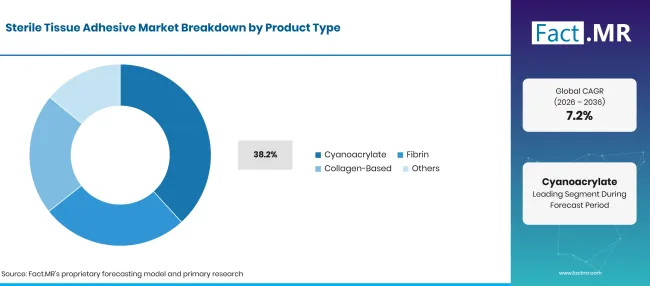
Factmr Sterile Tissue Adhesive Market Breakdown Product Type | Source: Fact.MR
| Product Type | Share (2026) |
|---|---|
| Cyanoacrylate | 38.2% |
| Other segments combined | 61.8% |
| Total | 100.0% |
Source: Fact.MR analysis. Updated Oct 21, 2026
Cyanoacrylate supports a compact application format that can suit repeated closure tasks. The product still needs to be assessed as a finished device with its dispensing system and intended use. CUTIVA's FDA summary describes sterile single-use applicators and distinguishes the liquid adhesive from its mesh-assisted system. [13] That difference affects how staff align and close the wound. Buyers should compare the complete application rather than assuming that a shared chemical family makes competing devices operationally interchangeable. The size of this segment also creates a clear differentiation challenge. A vendor needs an advantage that a clinician and purchasing team can recognise. Application control or a suitable pack size may matter more than another broad claim of convenience. Fibrin and other chemistries retain distinct roles where their approved function fits internal tissue sealing or a different clinical requirement.
How does Surgical Wound Closure support recurring demand?
Surgical Wound Closure represents 42.5% of Application revenue in 2026.
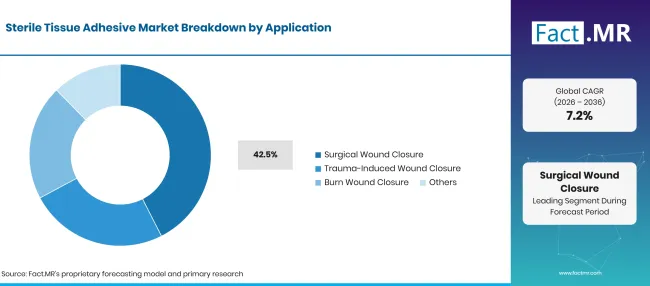
Factmr Sterile Tissue Adhesive Market Breakdown Application | Source: Fact.MR
| Application | Share (2026) |
|---|---|
| Surgical Wound Closure | 42.5% |
| Other segments combined | 57.5% |
| Total | 100.0% |
Source: Fact.MR analysis. Updated Oct 21, 2026
Scheduled surgery gives hospitals time to agree on closure materials and train the staff who will use them. Once an adhesive performs reliably for a defined procedure, it can become part of the routine stock list. A 2025 split-scar study illustrates the importance of comparing results in a specific wound population. [8] Evidence from one incision type should not be stretched into a claim about the hospital's entire surgery volume. Trauma closure is less predictable because wound condition varies at presentation. Burn Wound Closure also requires careful scope: this category covers eligible surgical closure or graft-related procedures. It does not imply routine use of topical cyanoacrylate on an open burn surface. That distinction protects the commercial definition and keeps general burn dressings outside tissue-adhesive revenue.
Why do Hospitals account for most sterile adhesive purchases?
Hospitals hold 58.7% of End-User revenue in 2026.
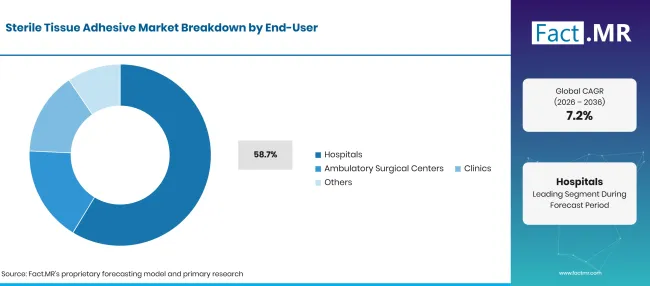
Factmr Sterile Tissue Adhesive Market Breakdown End User | Source: Fact.MR
| End-User | Share (2026) |
|---|---|
| Hospitals | 58.7% |
| Other segments combined | 41.3% |
| Total | 100.0% |
Source: Fact.MR analysis. Updated Oct 21, 2026
A hospital may purchase both small topical applicators and products that require preparation for specialist surgery. This makes stock availability and staff familiarity commercially important. Suppliers need to support each product's actual storage and handling requirements. FDA's TISSEEL supplement included changes to preparation and reconstitution instructions. [14] Even an established product can therefore require operational attention when its labelling changes. Reliable implementation helps a vendor remain in the account after the initial clinical evaluation has ended. Ambulatory centres generally perform a narrower mix of procedures than large hospitals. Their purchasing can therefore concentrate on a few applicator sizes, ordered frequently. Vendors that match deliveries to those schedules are easier to work with. A complex hospital-style contract can add little value for a centre that uses the same small group of products each week.
What is accelerating Sterile Tissue Adhesive Market adoption, and what is holding it back?
An approval or clinical trial does not guarantee steady purchasing. Adoption becomes visible when a theatre team uses an adhesive repeatedly and requests it through the normal stock system. Hospitals may need training and revised protocols before that happens. Routine skin-closure applications face more price comparison; specialised sealants can retain value where the indication and handling requirements are clearly established.
Drivers Impact Analysis
| DRIVER | (~) % IMPACT ON CAGR | GEOGRAPHIC RELEVANCE | IMPACT TIMELINE |
|---|---|---|---|
| Routine inclusion in selected surgical closure protocols | +1.3% | Hospitals in USA; Germany; Japan | Medium term (2 to 4 years) |
| Demand for sterile single-use application formats | +0.7% | Global | Short term (up to 2 years) |
| Procedure-specific expansion of internal sealing indications | +1.0% | USA; Europe; Japan | Medium term (2 to 4 years) |
| Outpatient pathways that value simplified follow-up | +0.8% | Germany; UK; USA | Medium term (2 to 4 years) |
| Wider procurement access through local clinical distributors | +0.6% | Brazil; selected Asian markets | Short term (up to 2 years) |
Source: Fact.MR analysis. Updated Oct 21, 2026
Opportunity Impact Analysis
| OPPORTUNITY | (~) % IMPACT ON CAGR | GEOGRAPHIC RELEVANCE | IMPACT TIMELINE |
|---|---|---|---|
| Complete long-incision closure systems | +0.9% | USA; Europe | Medium term (2 to 4 years) |
| Pack sizes fitted to individual procedure needs | +0.5% | Japan; hospital networks globally | Short term (up to 2 years) |
| Specialist tissue-sealing applications with clinical evidence | +1.2% | Major surgical centres | Long term (4 years or more) |
| Expansion through existing surgeon distribution networks | +0.4% | UK; continental Europe; Brazil | Medium term (2 to 4 years) |
Source: Fact.MR analysis. Updated Oct 21, 2026
Restraints Impact Analysis
| RESTRAINT | (~) % IMPACT ON CAGR | GEOGRAPHIC RELEVANCE | IMPACT TIMELINE |
|---|---|---|---|
| Adhesive intolerance and unsuitable wound presentations | -0.9% | Global clinical use | Short term (up to 2 years) |
| Limited economic benefit in some established closure pathways | -0.7% | Price-sensitive hospital systems | Medium term (2 to 4 years) |
| Expiry losses and unsuitable pack selection | -0.4% | Lower-throughput care settings | Short term (up to 2 years) |
| Clinical evaluation and indication-specific approval costs | -1.1% | Internal adhesives and new clinical uses | Long term (4 years or more) |
Source: Fact.MR analysis. Updated Oct 21, 2026
Which countries are scaling the Sterile Tissue Adhesive Market through 2036?
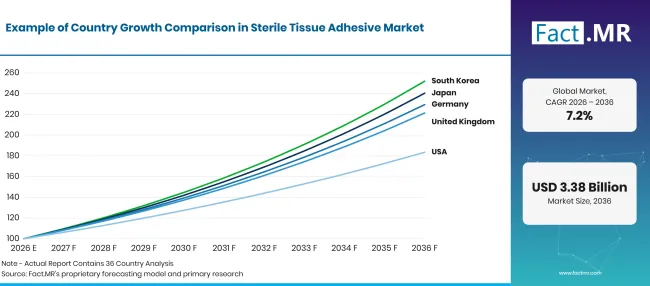
Factmr Sterile Tissue Adhesive Market Growth Index | Source: Fact.MR
| Country | CAGR (2026 to 2036) |
|---|---|
| Germany | 8.66% |
| Brazil | 5.14% |
| United States | 6.26% |
| United Kingdom | 8.27% |
| Japan | 9.17% |
Source: Fact.MR analysis. Updated Oct 21, 2026
How does Germany's move toward outpatient surgery affect adhesive selling?
8.66% CAGR. Products need an economic case that works within the treatment pathway.
Germany's outpatient surgery spending rose in 2025, with the Federal Ministry of Health linking part of the change to Hybrid-DRG payments. [2] This describes a shift in care delivery rather than a count of tissue adhesive procedures. It does, however, make discharge planning and predictable wound care more important to purchasing discussions.
Germany leads the five-country forecast at 8.66%. Suppliers need to show how a product fits a specific outpatient pathway, from closure to the patient's instructions at home. Hospitals may accept a higher unit cost when the clinical and operational benefits are demonstrated. The argument should rest on the actual procedure, not on the wider increase in healthcare spending.
What does Brazil's public procurement reveal about the addressable product?
5.14% CAGR. Precise tender specifications define the route into public-sector accounts.
A Tocantins tender for 2025–2026 specified 2,160 sterile 0.50 mL ampoules of n-butyl-2-cyanoacrylate, with bids opening in February 2026. [3] This gives a useful view of the Brazilian public buyer: pack volume, formulation and presentation are part of the requirement. The tender is not evidence that those units were ultimately purchased or that the same mix applies across Brazil.
Brazil's 5.14% forecast CAGR offers opportunities for suppliers that can meet these detailed bids and replenish them reliably. A distributor with the right registered product is more useful than one offering a broad list of nominally equivalent adhesives. Private surgical centres may require different pack sizes and ordering schedules.
Why will precise product claims matter in the USA?
6.26% CAGR. Established competition makes the approved use and application system central.
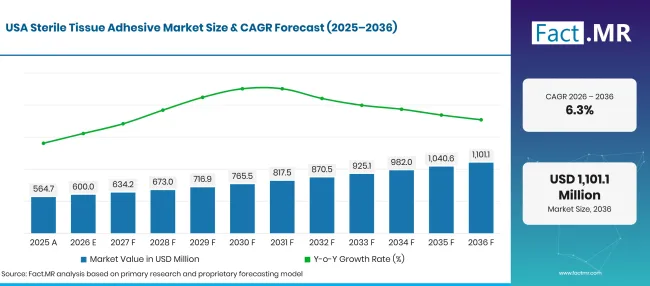
Factmr Sterile Tissue Adhesive Market Forecast Usa | Source: Fact.MR
The United States provides a reminder that changes to labelling are not the same as a new product. An August 2025 FDA clearance for CUTIVA concerned revised package inserts, with the device itself unchanged. [13] Purchasers must be told what is different and what remains within the existing approved use.
At 6.26% forecast growth, the U.S. opportunity is built on repeated clinical orders in a competitive market. A product may pass evaluation and still fail to become part of a hospital's regular procedure. Suppliers should track appropriate use, follow-up training and reordered stock rather than celebrate the first trial shipment.
How can UK suppliers make adhesive use easier after discharge?
8.27% CAGR. Clear care pathways support adoption in emergency and elective settings.
Leeds Teaching Hospitals' wound-care instructions, reviewed in June 2025, explain skin glue alongside sutures and adhesive strips and give patients different aftercare advice for each method. [5] A closure product therefore comes with a communication task. Clear instructions are important when patients leave soon after treatment.
The UK forecast CAGR is 8.27%. Minor-injury units and selected surgical services can offer steady demand, but their needs differ. Suppliers should align applicator size and replenishment with each setting and make the approved aftercare information easy for staff to use. Simpler closure is of limited help if a patient leaves confused about caring for the wound.
Why does Japan reward preparation discipline and an appropriate pack range?
9.17% CAGR. Specialist surgical use places value on predictable handling.
Japan's PMDA lists Bolheal tissue adhesive in volumes from 0.5 mL to 5 mL, with product information updated in April 2025. [7] The range demonstrates why one presentation may not suit every operation. Preparation time, expected usage and wastage influence what a theatre chooses to hold in stock.
Japan has the strongest forecast CAGR at 9.17%. Winning a surgical account still requires local approvals and training in the correct handling of each formulation. A focused range that hospitals use regularly can be more profitable than supplying every available size. Distributors also need to keep established users supplied without interruption.
Who leads the Sterile Tissue Adhesive Market?
Competition extends across topical closure and specialised internal products rather than one interchangeable adhesive category. Advanced Medical Solutions reported LiquiBand revenue of GBP 47.8 million for 2025 with 10% growth at reported currency. [1] That company result offers evidence of commercial activity within a defined product family. It should not be treated as a measurement of the entire sterile tissue adhesive market.
Ownership and distribution relationships change the practical supplier comparison. H.B. Fuller acquired Adhezion Biomedical in 2023. Advanced Medical Solutions' acquisition portfolio instead includes Connexicon and Peters Surgical. [4] [1] Hospitals should identify the legal supplier and the organisation responsible for manufacturing and regulatory support. Separate product brands may operate within the same group. The competitive advantage comes from the relevant approved portfolio and the route to the clinical customer.
Solventum became independent from 3M in April 2024 and represents the former 3M Health Care business in this review. [10] Its adjacent wound-care products should not be confused with liquid tissue adhesives. Cohera's TissuGlu is also assessed through its documented FDA approval for a defined internal tissue-approximation use. [12] That regulatory record establishes the product's historical position without establishing current availability in every market. Competitive shortlists should be built around the intended procedure and local commercial status.
Which companies are the key providers?
- Johnson & Johnson
- Solventum [10]
- Baxter International Inc.
- B. Braun Melsungen AG
- Medtronic plc
- Artivion Inc.
- Advanced Medical Solutions Group plc
- Cohera Medical Inc.
- Adhezion Biomedical LLC (H.B. Fuller)
- Chemence Medical Inc.
Bibliography
- [1] Advanced Medical Solutions Group plc. (2026). Annual report 2025.
- [2] Bundesministerium für Gesundheit. (2026). Finanzentwicklung der GKV im 1.-4. Quartal 2025 [Financial development of statutory health insurance in the first to fourth quarters of 2025].
- [3] Governo do Estado do Tocantins. (2026, February 3). Pregão eletrônico 90186/2025: Materiais hospitalares do grupo 8, material de sutura, 2025-2026 [Electronic tender notice]. Compras.gov.br.
- [4] H.B. Fuller Company. (2023, June 22). H.B. Fuller completes strategic acquisitions consistent with profitable growth strategy.
- [5] Leeds Teaching Hospitals NHS Trust. (2025, June 4). Wound care.
- [6] Nusrat, F., Scherz, L. A., Walkosak, C., Jennings, T., & Lawrence, N. (2026). Evaluation of N-butyl cyanoacrylate tissue adhesive for second intention healing following dermatologic surgery: A randomized controlled trial. Dermatologic Surgery. Advance online publication.
- [7] Pharmaceuticals and Medical Devices Agency. (2025, April 1). Bolheal tissue adhesive: Product information [Japanese prescribing information].
- [8] Renzi, M. A., Jr., Scherz, L. A., Papachristou, C., & Lawrence, N. (2025). Comparison of 5-0 polypropylene suture and N-butyl/2-octyl cyanoacrylate for closure of surgical wounds on the trunk and extremities: A split scar study. Dermatologic Surgery, 51(9), 864-868.
- [9] Rouhani, D. S., Rosenbloom, A., Zeng, S., Sun, A., Seradj, S. H., Moshrefi, C., Khoo, K., & Mofid, M. M. (2026). Systematic review and meta-analysis of allergic contact dermatitis from 2-octyl cyanoacrylate adhesives. Journal of the American College of Surgeons, 243(3), 682-694.
- [10] Solventum. (2024, April 1). Solventum begins trading on the New York Stock Exchange.
- [11] U.S. Food and Drug Administration. (2008). Tissue adhesive for the topical approximation of skin: Class II special controls guidance for industry and FDA staff.
- [12] U.S. Food and Drug Administration. (2015, February 3). Cohera Medical TissuGlu: P130023 [Premarket approval record].
- [13] U.S. Food and Drug Administration. (2025, August 4). CUTIVA topical skin adhesive and CUTIVA PLUS skin closure system: K250950 [510(k) clearance and summary]. [14] U.S. Food and Drug Administration. (2025, September 30). Supplement approval: TISSEEL, BL 103980/6252 [Approval letter].
This Report Answers
- Which closure tasks support recurring sterile adhesive purchases?
- Why do topical products and internal sealants require different commercial approaches?
- How do pack size and preparation affect hospital economics?
- What limits claims of improved healing or fewer complications?
- How do national care pathways and tender specifications change the sales route?
- Which corporate relationships affect supplier comparison?
What does the Sterile Tissue Adhesive Market cover?
The report examines sterile adhesive revenue across the stated product types and wound-closure applications through 2036. Five country forecasts connect the commercial opportunity with care delivery and procurement conditions. Hospitals are assessed separately from ambulatory surgical centres and clinics. Product eligibility follows the specific authorised indication rather than a general classification as medical glue.
What is included in the scope?
Included products comprise sterile cyanoacrylate adhesives and relevant fibrin or collagen-based adhesive systems. Other chemistries are covered when supplied for tissue bonding or adhesive surgical sealing. Integrated single-use application components are included in the finished product value. Burn-related coverage is limited to eligible surgical closure and graft-related applications within the stated product boundary.
What is excluded from the scope?
Excluded items include household adhesives and non-sterile industrial products. General adhesive dressings and tapes are also excluded. Routine burn dressings are outside scope. Sutures and staples are competing closure products rather than tissue-adhesive revenue. Haemostatic agents with no tissue-adhesion or sealing function and separately billed surgical services are excluded.
How Was the Analysis Built?
The analysis draws on 120+ sources, 35+ company portfolios, 25+ countries, and more than 20 industry interviews.
- Primary Research: Primary research includes discussions with manufacturers, service providers, technology developers, distributors, end users, and subject-matter experts. These conversations examine purchasing priorities, product adoption, operational challenges, approval requirements, competitive positioning, and the factors that influence wider market acceptance.
- Desk Research: Desk research covers government statistics, regulatory publications, company filings, trade data, technical studies, industry associations, standards, public policy, and other authoritative sources. Every source used in the analysis is documented in the bibliography.
- Market Sizing and Forecasting: Market estimates combine historical performance, demand indicators, pricing and volume trends, segment shares, company participation, country-level growth, adoption patterns, investment activity, and barriers to market expansion.
- Data Validation and Update Cycle: Findings are validated by comparing primary interviews with public data, company activity, regulatory changes, trade patterns, and industry developments. Regular updates review new product launches, capacity changes, partnerships, approvals, and shifts in commercial adoption.
Segmentation
What is the report’s scope and coverage?
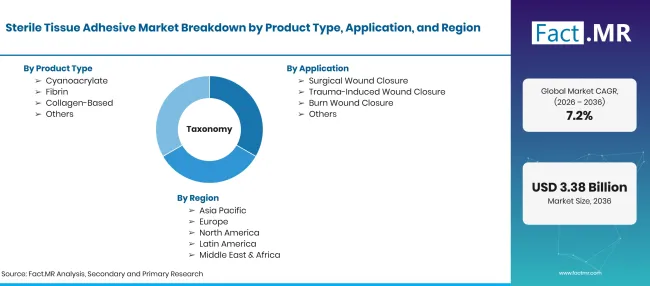
Factmr Sterile Tissue Adhesive Market Taxonomy | Source: Fact.MR
| Attribute | Details |
|---|---|
| Quantitative Units | USD billion in 2025, 2026 and 2036; CAGR for 2026 to 2036 |
| Market Definition | Sterile tissue adhesives are sterile clinical products that bond tissue or provide an adhesive seal in an authorised wound-closure or surgical application. The market includes topical cyanoacrylates and relevant internal biological or synthetic adhesive systems. Products used solely for dressing fixation or haemostasis without an adhesive tissue-sealing function are excluded. |
| Product Type | Cyanoacrylate; Fibrin; Collagen-Based; Others |
| Application | Surgical Wound Closure; Trauma-Induced Wound Closure; Burn Wound Closure; Others |
| End-User | Hospitals; Ambulatory Surgical Centers; Clinics; Others |
| Regions Covered | North America; Latin America; Western Europe; Eastern Europe; East Asia; South Asia & Pacific; Middle East & Africa |
| Countries Covered | Germany; Brazil; United States; United Kingdom; Japan |
| Companies Profiled | Johnson & Johnson; Solventum; Baxter International Inc.; B. Braun Melsungen AG; Medtronic plc; Artivion Inc.; Advanced Medical Solutions Group plc; Cohera Medical Inc.; Adhezion Biomedical LLC (H.B. Fuller); Chemence Medical Inc. |
| Forecast Period | 2026 to 2036 |
| Approach | Assessment of authorised clinical uses and procedure-level adoption across adhesive chemistries. Purchasing analysis considers clinical evidence and operational fit alongside pack selection and sterile-product supply through hospital and outpatient channels. |
Source: Fact.MR analysis. Updated Oct 21, 2026
How is the market segmented?
-
By Product Type
- Cyanoacrylate
- Fibrin
- Collagen-Based
- Others
-
By Application
- Surgical Wound Closure
- Trauma-Induced Wound Closure
- Burn Wound Closure
- Others
-
By End-User
- Hospitals
- Ambulatory Surgical Centers
- Clinics
- Others
-
By Region
- North America
- Latin America
- Western Europe
- Eastern Europe
- East Asia
- South Asia & Pacific
- Middle East & Africa
Frequently Asked Questions
What is the Sterile Tissue Adhesive Market value in 2026?
How much will the market be worth in 2036?
Which product type has the largest share?
Which application and end-user segments lead?
Which country has the fastest forecast growth?
Who worked on this report


Preview the report firsthand - request a free sample
Free SampleGet the brochure for pricing and purchase details
Download PDF