- Market Value (2025): USD 789.6 Mn
- Estimated Value (2026): USD 929.0 Mn
- Forecast Value (2036): USD 4723.9 Mn
- CAGR (2026-2036): 17.7%
What is the Strength-Boosting Graphene Masterbatches Market forecast to be worth by 2036?
USD 929.0 million in 2026 to USD 4723.9 million by 2036, at a 17.7% CAGR.
- The Strength-Boosting Graphene Masterbatches Market reached USD 789.6 million in 2025.
- Demand is projected to increase from USD 929.0 million in 2026 to USD 4723.9 million by 2036.
- The market is forecast to record 17.7% CAGR from 2026 to 2036 as film converters, recycled-polymer compounders and automotive material teams qualify graphene-enhanced concentrates.
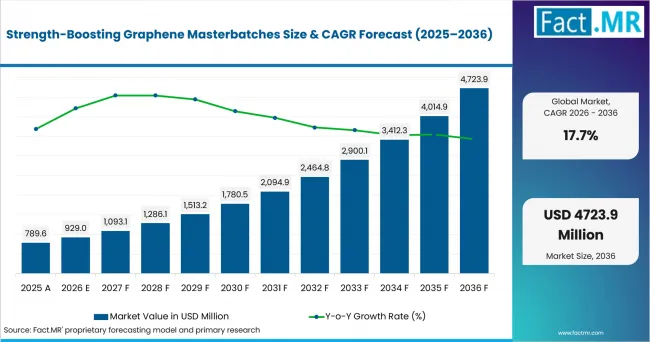
Strength Boosting Graphene Masterbatches Value Analysis | Source: Fact.MR
What are the defining numbers behind Strength-Boosting Graphene Masterbatches Market growth?
USD 3794.9 million absolute opportunity by 2036, led by graphene nanoplatelets, PE carriers and flexible-film use.
- Demand Drivers in the Market
- Flexible-film converters need higher puncture and tensile performance when downgauging reduces polymer use.
- Recycled-polymer compounders need reinforcement that restores usable mechanical performance when feedstock properties vary.
- Automotive material teams need lighter polymer parts that retain mechanical margins around housings and molded structures.
- Packaging developers need formulations that combine strength with barrier or antistatic performance.
- Key Segments Analyzed
- By Graphene Form: Graphene nanoplatelets are expected to hold 46.0% share in 2026 because platelet geometry supports reinforcement across film and compound formulations.
- By Host Polymer: PE is projected to account for 37.0% share in 2026 owing to its large film-processing base and compatibility with flexible-packaging conversion.
- By Mechanical Performance Target: Tensile / puncture strength is anticipated to capture 35.0% share in 2026 as converters use measurable strength retention to judge downgauging potential.
- By Application: Flexible film is estimated to represent 41.0% share in 2026 supported by high-volume extrusion and direct interest in thickness reduction without losing tear or puncture performance.
- Analyst Opinion at Fact.MR
- Shambhu Nath Jha, Principal Consultant at Fact.MR, states, “Commercial qualification depends on stable dispersion, repeatable strength after production-scale processing, and application-specific testing and loading guidance.”
- Strategic Implications
- Film converters should qualify strength retention at lower gauge before extending trials to barrier or antistatic claims.
- Recycled-resin compounders should compare masterbatch loading with incoming polymer variability and the required finished-part strength.
- Automotive material teams should request molded-part data that reflects the intended PP, PA or polyester base and the final processing temperature.
- Graphene suppliers should document dispersion, loading level and property retention in production-scale processing.
South Korea is forecast at 18.7% CAGR through 2036, followed by the USA at 17.9%. The UK is anticipated at 16.8%, Germany at 16.0%, and the Netherlands at 12.8%. Polymer qualification conditions differ across automotive, packaging and recycled-plastics applications.
How does the Strength-Boosting Graphene Masterbatches Market break down by segment?
Graphene nanoplatelets lead Graphene Form at 46.0%; Flexible film leads Application at 41.0%.
Which Graphene Form dominates?
Graphene nanoplatelets are expected to hold 46.0% share in 2026.
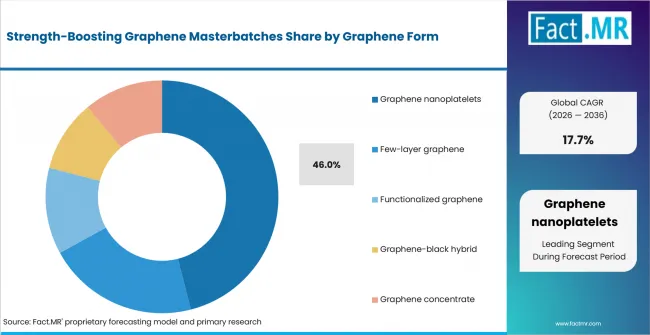
Strength Boosting Graphene Masterbatches Analysis By Graphene Form | Source: Fact.MR
Graphene nanoplatelets are expected to hold 46.0% because their platelet geometry supports reinforcement in films and compounds. Few-layer graphene is expected to suit formulations where a lower addition rate and controlled dispersion carry more weight. Functionalized graphene can address polymer systems that need stronger interfacial interaction. Graphene-black hybrids support applications where conductivity economics influence the formulation. Concentrates provide a separate route for custom let-down and polymer matching.
What leads the Host Polymer segment?
PE is projected to account for 37.0% share in 2026.
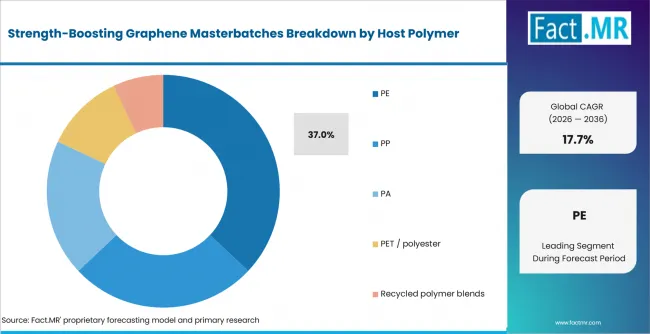
Strength Boosting Graphene Masterbatches Analysis By Host Polymer | Source: Fact.MR
PE is projected to account for 37.0% because flexible-film extrusion offers a direct route for masterbatch dosing and downgauging trials. PP is expected to remain relevant in molded packaging and automotive parts where stiffness and low density shape material selection. PA serves higher-temperature applications that demand stronger engineering performance. PET / polyester supports film and specialty processing. NanoXplore’s 2025 Sustainability Report states that Canuck Compounders has annual production capacity of 40 million pounds and supplies resin pellets that enable NanoXplore to produce most of its GrapheneBlack™ Masterbatch Pellets from recycled plastic.
How does Mechanical Performance Target shape demand?
Tensile / puncture strength is anticipated to capture 35.0% share in 2026.
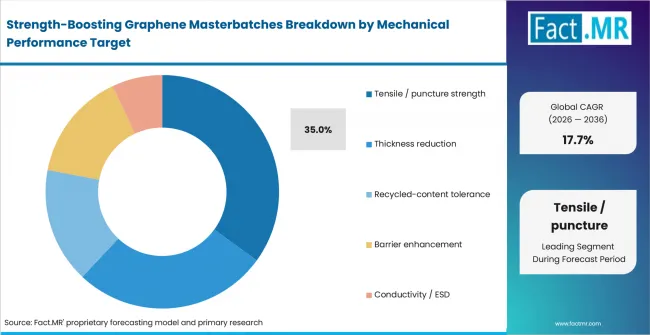
Strength Boosting Graphene Masterbatches Analysis By Mechanical Performance Target | Source: Fact.MR
Tensile / puncture strength is anticipated to capture 35.0% because converters can measure it directly during downgauging trials. Thickness reduction follows when equivalent performance is retained with less polymer. Recycled-content tolerance becomes relevant when a formulation must absorb variability from PCR feedstock. Barrier enhancement can add value in packaging structures that use one additive package for several functions. Graphene ESD additives create a separate route for conductivity-focused formulations.
What supports Flexible film within Application?
Flexible film is estimated to represent 41.0% share in 2026.
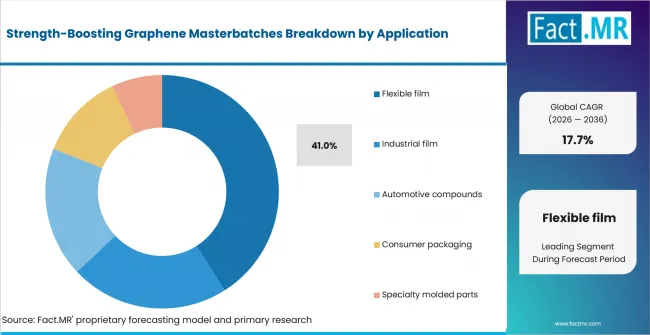
Strength Boosting Graphene Masterbatches Analysis By Application | Source: Fact.MR
Flexible film is estimated to represent 41.0% because processors can test graphene through familiar dosing and extrusion steps. Industrial film follows where puncture resistance or antistatic behavior has a clear operating value. Automotive plastic components create a separate qualification path for molded strength and lightweighting. Consumer packaging adds interest in downgauging and barrier performance. Specialty molded parts offer another route where low loading can support strength or conductivity without a major change to the base polymer.
What is accelerating Strength-Boosting Graphene Masterbatches Market adoption, and what is holding it back?
Film downgauging and recycled-resin performance support adoption; qualification cost and dispersion control restrain it.
Drivers Impact Analysis
| DRIVER | (~) % IMPACT ON CAGR | GEOGRAPHIC RELEVANCE | IMPACT TIMELINE |
|---|---|---|---|
| Film downgauging backed by tensile and puncture retention | +2.2% | North America, Europe, East Asia | Short term (<= 2 years) |
| Recycled-polymer strength recovery | +1.7% | North America, Europe | Medium term (2-4 years) |
| Automotive lightweight polymer compounds | +1.4% | Europe, East Asia, North America | Medium term (2-4 years) |
| Barrier and ESD multifunctionality | +1.0% | Global | Long term (>= 4 years) |
| Masterbatch handling that fits existing processing | +0.8% | Global | Short term (<= 2 years) |
Source: Fact.MR analysis. Updated Sep 21, 2026
Opportunity Impact Analysis
| OPPORTUNITY | (~) % IMPACT ON CAGR | GEOGRAPHIC RELEVANCE | IMPACT TIMELINE |
|---|---|---|---|
| PCR-compatible film masterbatches | +1.3% | Europe, North America | Medium term (2-4 years) |
| Graphene-black hybrid cost optimization | +1.0% | Global | Medium term (2-4 years) |
| Automotive ESD and molded parts | +0.8% | East Asia, Europe | Long term (>= 4 years) |
| Barrier-strength packaging | +0.7% | Global | Long term (>= 4 years) |
Source: Fact.MR analysis. Updated Sep 21, 2026
Restraints Impact Analysis
| RESTRAINT | (~) % IMPACT ON CAGR | GEOGRAPHIC RELEVANCE | IMPACT TIMELINE |
|---|---|---|---|
| Qualification time and repeatability | -0.9% | Global | Short term (<= 2 years) |
| Dispersion sensitivity | -0.7% | Global | Short term (<= 2 years) |
| Graphene cost versus conventional fillers | -0.6% | Global | Medium term (2-4 years) |
| Recycling and regulatory documentation burden | -0.4% | Europe, North America | Long term (>= 4 years) |
Source: Fact.MR analysis. Updated Sep 21, 2026
Which countries are scaling the Strength-Boosting Graphene Masterbatches Market fastest?
- The country comparison spans 5.9 percentage points and forms three practical growth bands across the forecast period.
- South Korea remains 0.8 percentage point above the USA through its automotive production base and demand for mechanically reinforced polymer compounds.
- The USA remains 1.1 percentage points above the UK as plastics and rubber manufacturing investment supports graphene-masterbatch qualification across film and molded-polymer applications.
- The UK remains 0.8 percentage point above Germany through recycled-content policy and demand for mechanical-performance retention in recycled-content packaging films.
- Germany remains 3.2 percentage points above the Netherlands as packaging recycling and material-efficiency requirements support qualification of strength-focused graphene masterbatches.
- The Netherlands closes the displayed range through automotive polymer applications where mechanical reinforcement and controlled conductivity support selective graphene-masterbatch use.
- Comparable CAGRs can create different entry conditions due to automotive manufacturing scale, plastics investment, recycled-content requirements, packaging qualification and application-specific reinforcement needs. Full report coverage includes North America, Latin America, Western Europe, Eastern Europe, East Asia, South Asia & Pacific, Middle East & Africa.
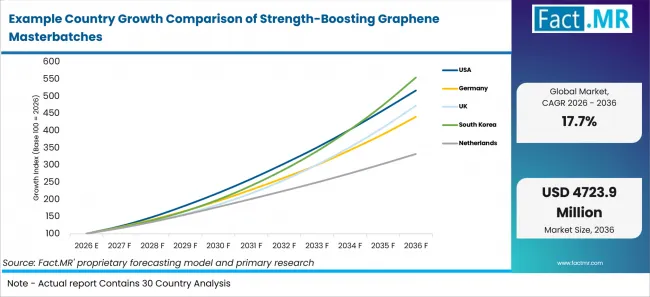
Example Country Growth Comparison Of Strength Boosting Graphene Masterbatches | Source: Fact.MR
| Country | CAGR (2026-2036) |
|---|---|
| South Korea | 18.7% |
| USA | 17.9% |
| UK | 16.8% |
| Germany | 16.0% |
| Netherlands | 12.8% |
Source: Fact.MR analysis. Updated Sep 21, 2026
What supports USA adoption?
17.9% CAGR, supported by plastics manufacturing investment and application-specific material qualification.
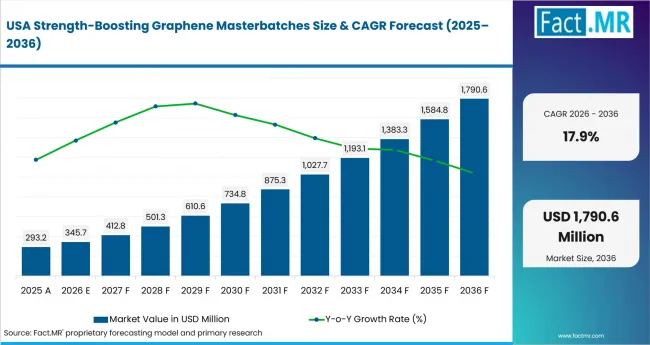
Strength Boosting Graphene Masterbatches Country Value Analysis | Source: Fact.MR
The U.S. Bureau of Economic Analysis reported USD 19.0 billion in new foreign direct investment expenditures for plastics and rubber products manufacturing in 2025. This manufacturing investment provides a strong base for graphene-masterbatch trials across flexible films and molded polymers where converters evaluate dispersion, strength improvement and processing compatibility.
What supports the United Kingdom’s growth?
16.8% CAGR, backed by recycled-content policy and performance-retention requirements.
HM Revenue & Customs reported that 51% of total plastic packaging tonnage declared in financial year 2025–2026 contained at least 30% recycled plastic and therefore met the recycled-content threshold under the Plastic Packaging Tax. This policy environment supports graphene reinforcement where converters need recycled-content films to retain tensile, puncture and other mechanical properties while meeting packaging-material efficiency requirements.
How is South Korea developing demand?
18.7% CAGR, driven by automotive production and polymer-material qualification.
South Korea’s Ministry of Trade, Industry and Resources reported 4.1 million automobiles produced domestically in 2025. This manufacturing scale supports graphene-masterbatch qualification across automotive polymer applications where PP, PA and polyester components require improved mechanical strength, lightweighting potential and repeatable performance under production-scale processing conditions.
What is supporting Germany’s adoption?
16.0% CAGR, supported by packaging recycling and material-efficiency requirements.
The German Environment Agency and Central Agency Packaging Register reported that around 5.5 million tonnes of packaging waste collected through dual systems were recovered in 2024. This material-circulation base supports graphene masterbatches where packaging converters need mechanical reinforcement, recycled-content tolerance and reliable performance in film or molded compounds.
How does the Netherlands perform?
12.8% CAGR, led by automotive polymer applications and electrified-vehicle activity.
Statistics Netherlands reported more than 2 million fully electric, hybrid or plug-in hybrid passenger cars at the start of 2026. This vehicle base creates selective opportunities for graphene masterbatches in polymer components requiring mechanical reinforcement, lightweighting or controlled conductivity while maintaining compatibility with established automotive material-processing routes.
Who leads the Strength-Boosting Graphene Masterbatches Market?
NanoXplore and Techmer PM are active through GrapheneBlack xGnP™ Masterbatch for high-performance plastic film applications. Directa Plus markets G+® graphene masterbatches for thermoplastics that can be processed through film extrusion, injection molding and extrusion molding, while Haydale provides graphene-enhanced thermoplastic masterbatch technologies for molded and other polymer applications.
Competitive differentiation across these suppliers includes compatibility with the target polymer, graphene dispersion quality, consistency after extrusion or molding, and technical support during scale-up from laboratory testing to commercial film or molded-part trials. Adjacent conductive plastic compounds provide additional context for applications where electrical, mechanical and processing performance are evaluated together.
Which companies are the key providers?
Key companies include NanoXplore; Techmer PM; First Graphene; Directa Plus; and Haydale.
- NanoXplore
- Techmer PM
- First Graphene
- Directa Plus
- Haydale
Bibliography
- NanoXplore Inc. (2026, June 15). NanoXplore and Techmer PM launch revolutionary GrapheneBlack xGnP™ masterbatch for high-performance plastic films.
- NanoXplore Inc. (2025, May 13). Interim management’s discussion and analysis for the three and nine-month periods ended March 31, 2025 and 2024.
- U.S. Bureau of Economic Analysis. (2026, June 10). New foreign direct investment in the United States, 2025.
- German Environment Agency, & Central Agency Packaging Register. (2026, January 27). Facts against myths: Packaging waste recycling in Germany is working.
- HM Revenue & Customs. (2026, August 27). Plastic Packaging Tax (PPT) statistics commentary.
- Ministry of Trade, Industry and Resources. (2026, January 20). 2025 auto industry takeaways.
- Statistics Netherlands. (2026, April 10). Almost a quarter more cars with an electric motor.
- HydroGraph Clean Power Inc. (2026, June 16). HydroGraph certifies Modern Dispersions as compounding partner for scale graphene masterbatch production in North America.
This Report Answers
- The report explains use across graphene form, host polymer, mechanical target and application.
- Segment analysis identifies the leading subsegments and explains why converters prioritize them during qualification.
- Country analysis compares country growth rates and links them to packaging, automotive and recycled-plastics conditions.
- Competitive analysis reviews the profiled companies against current first-party evidence of graphene, polymer or compounding activity.
- Application analysis assesses how strength, thickness reduction and recycled-content tolerance influence material selection.
What does the Strength-Boosting Graphene Masterbatches Market cover?
The market covers graphene-containing polymer masterbatches and concentrates used for mechanical reinforcement in extrusion and molding. It sits within the wider graphene market while focusing on polymer-carried formulations sold for controlled let-down and processing.
Coverage spans the listed graphene forms, host polymers, mechanical targets and applications. Graphene composites provide an adjacent material benchmark where reinforcement performance is evaluated beyond masterbatch delivery.
What is included in the scope?
The scope includes pelletized graphene masterbatches, polymer concentrates and custom compounds used for mechanical reinforcement in film extrusion and molding applications.
Related material areas include recycled polymer reinforcement, static-control compounds and specialty additive concentrates used in thermoplastic processing.
What is excluded from the scope?
The scope excludes loose graphene powder without a polymer carrier, finished plastic products without a masterbatch transaction and graphene used only in batteries, coatings, concrete or electronics.
Adjacent benchmarks include polymer composites, conductive compounds, recycled plastics, plastic film and automotive plastic components.
How Was the Analysis Built?
The analysis draws on 120+ sources, 35+ company portfolios, 25+ countries, and more than 20 industry interviews.
- Primary Research: Primary research includes discussions with manufacturers, service providers, technology developers, distributors, end users, and subject-matter experts. These conversations examine purchasing priorities, product adoption, operational challenges, approval requirements, competitive positioning, and the factors that influence wider market acceptance.
- Desk Research: Desk research covers government statistics, regulatory publications, company filings, trade data, technical studies, industry associations, standards, public policy, and other authoritative sources. Every source used in the analysis is documented in the bibliography.
- Market Sizing and Forecasting: Market estimates combine historical performance, demand indicators, pricing and volume trends, segment shares, company participation, country-level growth, adoption patterns, investment activity, and barriers to market expansion.
- Data Validation and Update Cycle: Findings are validated by comparing primary interviews with public data, company activity, regulatory changes, trade patterns, and industry developments. Regular updates review new product launches, capacity changes, partnerships, approvals, and shifts in commercial adoption.
Segmentation
What is the report’s scope and coverage?
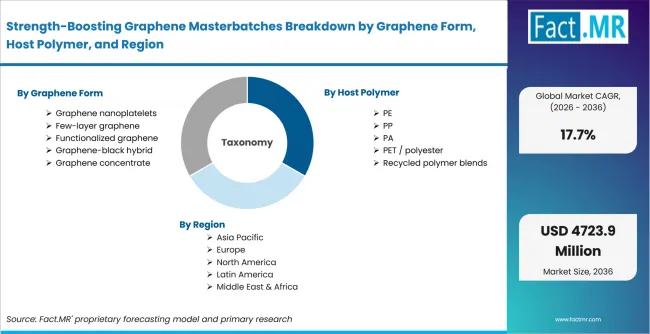
Strength Boosting Graphene Masterbatches Breakdown By Graphene Form, Host Polymer, And Region | Source: Fact.MR
| Attribute | Details |
|---|---|
| Quantitative Units | USD million |
| Market Definition | Graphene-containing polymer masterbatches formulated primarily to improve tensile, puncture or related mechanical performance in films, compounds and molded polymer parts. |
| Graphene Form | Graphene nanoplatelets; Few-layer graphene; Functionalized graphene; Graphene-black hybrid; Graphene concentrate |
| Host Polymer | PE; PP; PA; PET / polyester; Recycled polymer blends |
| Mechanical Performance Target | Tensile / puncture strength; Thickness reduction; Recycled-content tolerance; Barrier enhancement; Conductivity / ESD |
| Application | Flexible film; Industrial film; Automotive compounds; Consumer packaging; Specialty molded parts |
| Regions Covered | North America; Latin America; Western Europe; Eastern Europe; East Asia; South Asia & Pacific; Middle East & Africa |
| Countries Covered | USA; Germany; UK; South Korea; Netherlands |
| Key Companies Profiled | NanoXplore; Techmer PM; First Graphene; Directa Plus; Haydale |
| Forecast Period | 2026 to 2036 |
| Approach | Hybrid top-down and bottom-up approach using polymer-conversion demand, masterbatch qualification, end-use applications, segment shares, country growth and provider portfolio review. |
Source: Fact.MR analysis. Updated Sep 21, 2026
How is the market segmented?
-
By Graphene Form
- Graphene nanoplatelets
- Few-layer graphene
- Functionalized graphene
- Graphene-black hybrid
- Graphene concentrate
-
By Host Polymer
- PE
- PP
- PA
- PET / polyester
- Recycled polymer blends
-
By Mechanical Performance Target
- Tensile / puncture strength
- Thickness reduction
- Recycled-content tolerance
- Barrier enhancement
- Conductivity / ESD
-
By Application
- Flexible film
- Industrial film
- Automotive compounds
- Consumer packaging
- Specialty molded parts
-
By Region
- North America
- Latin America
- Western Europe
- Eastern Europe
- East Asia
- South Asia & Pacific
- Middle East & Africa
Frequently Asked Questions
How big is the strength-boosting graphene masterbatches market in 2026?
What is the CAGR of the strength-boosting graphene masterbatches market from 2026 to 2036?
Which graphene form leads the market?
Which host polymer leads the market?
Who are the companies profiled?
Who worked on this report


Preview the report firsthand - request a free sample
Free SampleGet the brochure for pricing and purchase details
Download PDF