- Market Value (2025): USD 3.6 Bn
- Estimated Value (2026): USD 3.9 Bn
- Forecast Value (2036): USD 8.3 Bn
- CAGR (2026-2036): 7.8%
What is the Sublimation Ink Market forecast to be worth by 2036?
USD 3.9 billion in 2026 to USD 8.3 billion by 2036, at a 7.8% CAGR.
- As per Fact.MR analysis, the sublimation ink market reached USD 3.6 billion in 2025.
- Sales are forecast to increase from USD 3.88 billion in 2026 to USD 8.26 billion by 2036.
- The market is projected to record a 7.8% CAGR between 2026 and 2036 as textile printers and product decorators expand digital printing work.
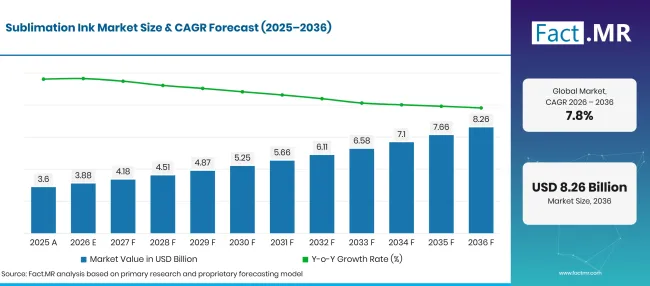
Factmr Sublimation Ink Market Forecast Global | Source: Fact.MR
| Year | Basis | Market Value (USD billion) |
|---|---|---|
| 2025 | Historical | 3.6 |
| 2026 | Estimate | 3.9 |
| 2036 | Forecast | 8.3 |
| CAGR 2026 to 2036 | Forecast period | 7.8% |
Source: Fact.MR analysis. Updated Oct 17, 2026
What are the defining numbers behind Sublimation Ink Market growth?
USD 4.4 billion in additional sales between 2026 and 2036, with textile printing and water-based formulations forming the main source of sales.
- Demand Drivers in the Market
- Textile printing businesses choose sublimation inks for polyester sportswear and decorative fabric because color must remain consistent across repeat production runs.
- Industrial print operators need stable ink supply when several machines share one color setup.
- Equipment resellers influence ink purchases by training decorators on paper handling and heat-press settings. A compatible ink package helps small operators limit wasted transfers during their first production runs.
- Key Segments Analyzed
- By Product Type: Water-Based Sublimation Ink accounts for 58.4% share in 2026, reflecting its use across polyester textile and transfer workflows.
- By Application: Textile Printing holds 52.3% share in 2026 as apparel decorators and roll-to-roll fabric printers place repeat ink orders.
- By End-User: Textile Industry represents 48.6% share in 2026 because production facilities use ink in recurring color runs.
- By Distribution Channel: Direct Sales hold 38.2% share in 2026, reflecting direct service relationships with industrial printing accounts.
- Analyst Opinion at Fact.MR
- Shambhu Nath Jha, Principal Consultant at Fact.MR, states, “Print consistency is a major consideration when businesses select sublimation ink. Large textile operators typically trial ink on their existing printer and transfer equipment before switching ink formulas.”
- Strategic Implications
- Ink makers should provide clear details about printer and printhead compatibility so textile plants can compare products before conducting production trials. Reliable guidance also reduces avoidable maintenance questions.
- Textile converters should test color fastness and transfer settings on their actual polyester fabrics before purchasing industrial quantities.
- Printer distributors should offer straightforward setup advice for transfer paper and press conditions. First-time decorators need this help when moving from samples to paid orders.
- Personalization businesses should measure ink use per saleable item and track rejected transfers. A low purchase price offers limited benefit when color corrections lead to repeated printing.
Germany is forecast to grow at 9.0% CAGR through 2036. Brazil follows at 8.2%, while the United States is projected to reach 7.4%. The United Kingdom has a 6.6% outlook and Japan records 5.9%, reflecting differences in textile production and the scale of personalization work.
How does the Sublimation Ink Market break down by segment?
Water-Based Sublimation Ink 58.4%; Textile Printing 52.3%; Textile Industry 48.6%; Direct Sales 38.2% in 2026.
Which Product Type dominates?
Water-Based Sublimation Ink holds 58.4% share in 2026.
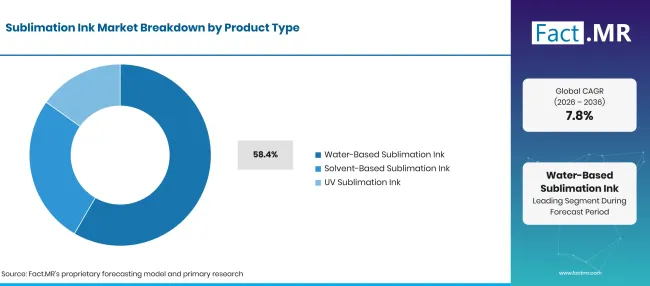
Factmr Sublimation Ink Market Breakdown Product Type | Source: Fact.MR
| Product Type | Share (2026) |
|---|---|
| Water-Based Sublimation Ink (Leading segment) | 58.4% |
| Other segments combined | 41.6% |
| Total | 100.0% |
Source: Fact.MR analysis. Updated Oct 17, 2026
Water-based dispersions suit the transfer workflow used by many polyester decorators, making them useful when operators need stable jetting and consistent color. Solvent-based formulations appear in some specialist printing arrangements where compatible hardware and process settings permit their use. UV-curable printing is a separate ink technology, so UV sublimation terminology needs careful product-level definition before individual products are grouped together.
What leads the Application segment?
Textile Printing accounts for 52.3% share in 2026.
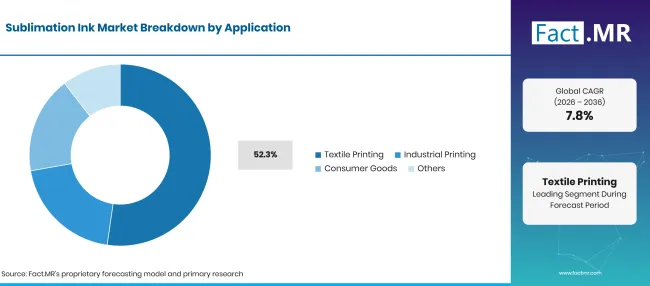
Factmr Sublimation Ink Market Breakdown Application | Source: Fact.MR
| Application | Share (2026) |
|---|---|
| Textile Printing (Leading segment) | 52.3% |
| Other segments combined | 47.7% |
| Total | 100.0% |
Source: Fact.MR analysis. Updated Oct 17, 2026
Textile printers use sublimation inks for polyester garments and rolls of fabric where repeated designs need a consistent appearance. Industrial printing includes compatible signs and decorated surfaces that accept heat-transferred dye. Consumer goods work centers on selected personalized articles such as coated cups and gift items. Epson received a 2025 industry product award for its SureColor F11070 industrial dye-sublimation printer, confirming continued commercial equipment development for textile production [3].
How does End-User purchasing shape sales?
Textile Industry leads with 48.6% share in 2026.
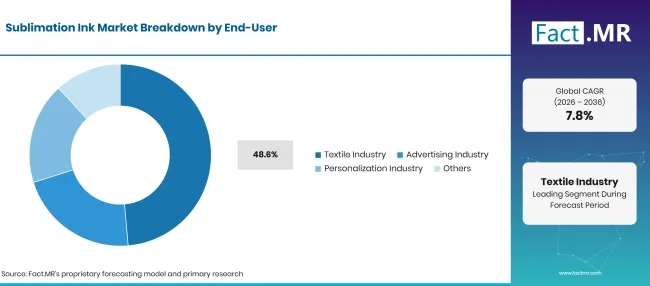
Factmr Sublimation Ink Market Breakdown End User | Source: Fact.MR
| End-User | Share (2026) |
|---|---|
| Textile Industry (Leading segment) | 48.6% |
| Other segments combined | 51.4% |
| Total | 100.0% |
Source: Fact.MR analysis. Updated Oct 17, 2026
Textile manufacturers buy ink against production schedules and approved fabric specifications. Advertising businesses use dye sublimation for suitable polyester signs and display materials, while personalization workshops focus on shorter runs and frequent design changes.
Which Distribution Channel serves the largest share?
Direct Sales capture 38.2% share in 2026.
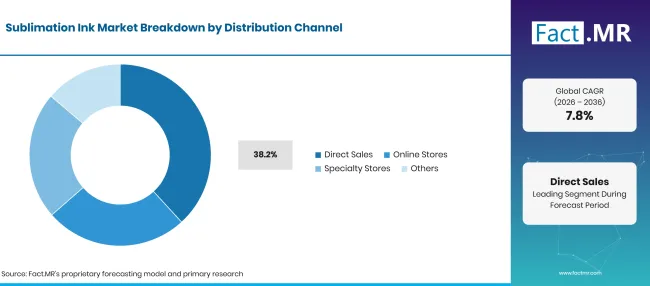
Factmr Sublimation Ink Market Breakdown Distribution Channel | Source: Fact.MR
| Distribution Channel | Share (2026) |
|---|---|
| Direct Sales (Leading segment) | 38.2% |
| Other segments combined | 61.8% |
| Total | 100.0% |
Source: Fact.MR analysis. Updated Oct 17, 2026
Direct sales appeal to textile facilities running several printers because manufacturer support can cover color profiles and recurring ink orders. Online stores help smaller decorators replenish standard ink packages when the product is already approved for their equipment.
What is accelerating Sublimation Ink Market adoption, and what is holding it back?
Short textile printing runs and personalized products support ink sales, while fabric compatibility and color matching add to costs.
Drivers Impact Analysis
| FACTOR | (~) % IMPACT ON CAGR | GEOGRAPHIC RELEVANCE | IMPACT TIMELINE |
|---|---|---|---|
| Polyester textile printing | +1.0% | Global | Medium term (2–4 years) |
| Personalized merchandise | +0.8% | North America, Europe | Medium term (2–4 years) |
| Industrial printer upgrades | +0.7% | Global | Long term (4+ years) |
| Direct color support | +0.5% | Europe, Japan | Short term (up to 2 years) |
| Soft signage orders | +0.4% | Global | Medium term (2–4 years) |
Source: Fact.MR analysis. Updated Oct 17, 2026
Opportunity Impact Analysis
| FACTOR | (~) % IMPACT ON CAGR | GEOGRAPHIC RELEVANCE | IMPACT TIMELINE |
|---|---|---|---|
| Printer-compatible ink sets | +0.8% | Global | Medium term (2–4 years) |
| Smaller custom orders | +0.6% | North America, Europe | Short term (up to 2 years) |
| Polyester fabric qualification | +0.5% | Asia, Europe | Medium term (2–4 years) |
| Recurring supply agreements | +0.4% | Global | Long term (4+ years) |
Source: Fact.MR analysis. Updated Oct 17, 2026
Restraints Impact Analysis
| FACTOR | (~) % IMPACT ON CAGR | GEOGRAPHIC RELEVANCE | IMPACT TIMELINE |
|---|---|---|---|
| Substrate limitations | -0.8% | Global | Short term (up to 2 years) |
| Energy used in heat transfer | -0.6% | Global | Medium term (2–4 years) |
| Ink and head compatibility | -0.5% | Global | Medium term (2–4 years) |
| Color requalification | -0.4% | Europe, Japan | Short term (up to 2 years) |
Source: Fact.MR analysis. Updated Oct 17, 2026
Which countries are scaling the Sublimation Ink Market through 2036?
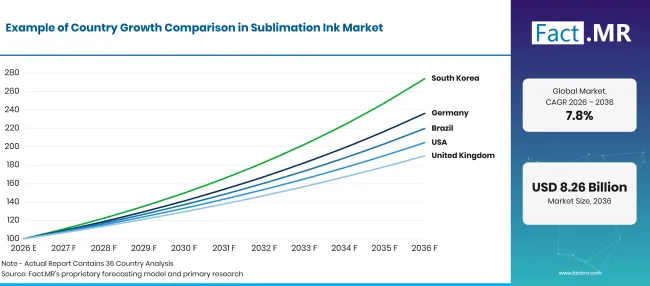
Factmr Sublimation Ink Market Growth Index | Source: Fact.MR
| Country | CAGR (2026–2036) |
|---|---|
| Germany | 9.0% |
| Brazil | 8.2% |
| United States | 7.4% |
| United Kingdom | 6.6% |
| Japan | 5.9% |
Source: Fact.MR analysis. Updated Oct 17, 2026
Why is Germany leading sublimation ink adoption?
9.0% CAGR, linked to established technical-textile production and careful color qualification.
German textile businesses assess color consistency before introducing sublimation inks into polyester printing lines. The Federal Statistical Office's manufacturing data record 647 textile manufacturing establishments in 2025 [4]. That established production base gives ink suppliers a clear customer base for technical trials and repeat contracts. Print operators also consider whether existing equipment can reproduce an approved shade across later orders.
How is Brazil expanding sublimation ink use?
8.2% CAGR, shaped by apparel manufacturing and sportswear decoration.
Brazilian garment decorators use sublimation inks for compatible polyester sportswear and short-run printed products. The Brazilian Institute of Geography and Statistics reported a 4.7% increase in clothing and accessory production in May 2026 compared with the previous month [6]. Apparel activity offers a route for ink sales when manufacturers select polyester styles that suit heat transfer.
What supports sublimation ink sales in the United States?
7.4% CAGR, linked to product customization and established printing equipment channels.
Small customization businesses in the United States often buy sublimation ink alongside compatible printers and coated blanks. In September 2026, Epson announced the SureColor F370 dye-sublimation printer and a primer for selected cotton garments, with availability scheduled for November 2026 [1]. The announcement points to supplier efforts to widen the range of projects that decorators can handle using their existing production process.
How is the United Kingdom developing sublimation ink purchases?
6.6% CAGR, influenced by print-service specialization and textile production.
British textile printers serve local orders for polyester sportswear and promotional fabric that need clear color reproduction. The Office for National Statistics reported total UK manufacturers’ product sales of GBP 452.0 billion for 2025 in its July 2026 release [5]. Textile decorators form a specialist part of that wider manufacturing and print-service economy.
Why is Japan maintaining steady sublimation ink growth?
5.9% CAGR, supported by exacting print specifications and specialized production.
Japanese print businesses serving specialized textile orders often place careful color checks ahead of a change in ink supplier. Suitable polyester fabric allows decorators to reproduce designs for apparel and soft signs using controlled heat transfer. Shops handling repeat orders can keep approved color profiles and press settings to reduce trial work between batches.
Who leads the Sublimation Ink Market?
Sawgrass, Epson, Mimaki, JK Group (Kiian Digital and J-Teck3), and DuPont have relevant sublimation ink or printing-system offerings.
Sawgrass focuses on purpose-built sublimation inks for personalization workflows, while Epson and Mimaki combine ink supply with printer systems and operating guidance.
DuPont lists water-based Artistri sublimation inks for polyester textiles and roll-to-roll printing [2]. Kornit Digital offers digital textile printing through its NeoPigment technology, which is separate from conventional dye-sublimation inks.
Which companies are the key providers?
Key companies include Sawgrass Technologies; Seiko Epson Corporation; Mimaki Engineering Co., Ltd.; JK Group (Kiian Digital and J-Teck3); InkTec Co., Ltd.; Nazdar Company; DuPont de Nemours Inc.
- Sawgrass Technologies
- Seiko Epson Corporation
- Mimaki Engineering Co., Ltd.
- JK Group (Kiian Digital and J-Teck3)
- InkTec Co., Ltd.
- Nazdar Company
- DuPont de Nemours Inc.
Bibliography
- [1] Epson America, Inc. (2026, September 23). Epson introduces SureColor F370 and new cotton primer solution to help creators and small businesses personalize more products with dye-sublimation.
- [2] DuPont. (n.d.). Artistri® dye sublimation inks for textile roll to roll.
- [3] Epson America, Inc. (2025, July 30). Epson honored with five 2025 PRINTING United Alliance Pinnacle Product Awards.
- [4] Statistisches Bundesamt (Destatis). (n.d.). Produktion im Verarbeitenden Gewerbe: Deutschland, Jahre, Güterverzeichnis (2-/4-Steller) [Data table 42131-0003].
- [5] Office for National Statistics. (2026, July 24). UK manufacturers’ sales by product: 2025.
- [6] Instituto Brasileiro de Geografia e Estatística. (2026, July 3). Produção industrial varia -0,2% em maio.
This Report Answers
- The report examines sublimation ink use in polyester textile printing and compatible coated goods.
- Product analysis compares water-based inks with the other specified formulation categories.
- Application analysis explains how textile printing differs from industrial and consumer decoration orders.
- Country outlook compares Germany, Brazil, the United States, the United Kingdom and Japan.
- Competitive coverage distinguishes dedicated sublimation ink suppliers from adjacent digital textile printing companies.
- Distribution analysis considers direct supply agreements alongside specialist retailers and online repeat orders.
What does the Sublimation Ink Market cover?
The market covers inks formulated for heat-transfer dye sublimation onto compatible polyester fabrics or specially coated items. Uses include sportswear printing and soft signage. Related Fact.MR analysis covers digital textile printing inks and digital-print-optimized textile substrates. Related Fact.MR coverage of digital textile printing inks distinguishes sublimation dye from other textile color systems.
What is included in the scope?
Ink used in approved dye-sublimation printer and transfer workflows is included where the finished job relies on heat to move dye into a compatible surface.
Both industrial textile production and smaller decoration services fall within the application boundary. The choice of suitable digital-print textile substrates influences whether heat-transfer printing can meet the finished item's requirements.
What is excluded from the scope?
Conventional direct-to-garment pigment ink and reactive textile dyes are excluded from the sublimation ink definition.
Printer hardware and blank coated merchandise are also outside ink revenue. Broader printing ink formulations include technologies outside dye sublimation and are assessed separately.
How Was the Analysis Built?
The analysis draws on 120+ sources, 35+ company portfolios, 25+ countries, and more than 20 industry interviews.
- Primary Research: Primary research includes discussions with manufacturers, service providers, technology developers, distributors, end users, and subject-matter experts. These conversations examine purchasing priorities, product adoption, operational challenges, approval requirements, competitive positioning, and the factors that influence wider market acceptance.
- Desk Research: Desk research covers government statistics, regulatory publications, company filings, trade data, technical studies, industry associations, standards, public policy, and other authoritative sources. Every source used in the analysis is documented in the bibliography.
- Market Sizing and Forecasting: Market estimates combine historical performance, demand indicators, pricing and volume trends, segment shares, company participation, country-level growth, adoption patterns, investment activity, and barriers to market expansion.
- Data Validation and Update Cycle: Findings are validated by comparing primary interviews with public data, company activity, regulatory changes, trade patterns, and industry developments. Regular updates review new product launches, capacity changes, partnerships, approvals, and shifts in commercial adoption.
Segmentation
What is the report’s scope and coverage?
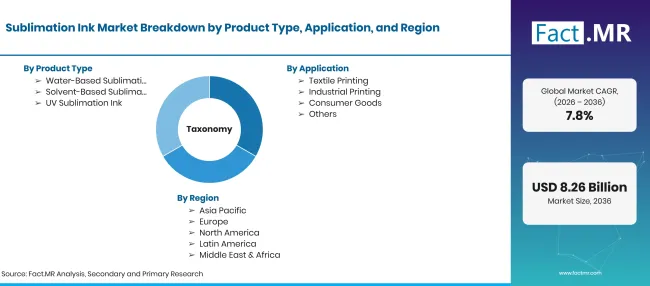
Factmr Sublimation Ink Market Taxonomy | Source: Fact.MR
| Attribute | Details |
|---|---|
| Quantitative Units | USD billion |
| Market Definition | Sublimation ink sold for compatible polyester textile printing and coated hard-goods decoration. |
| Product Type | Water-Based Sublimation Ink; Solvent-Based Sublimation Ink; UV Sublimation Ink |
| Application | Textile Printing; Industrial Printing; Consumer Goods; Others |
| End-User | Textile Industry; Advertising Industry; Personalization Industry; Others |
| Distribution Channel | Direct Sales; Online Stores; Specialty Stores; Others |
| Regions Covered | North America; Latin America; Western Europe; Eastern Europe; East Asia; South Asia and Pacific; Middle East and Africa |
| Countries Covered | Germany; Brazil; United States; United Kingdom; Japan |
| Companies Profiled | Sawgrass Technologies; Seiko Epson Corporation; Mimaki Engineering Co., Ltd.; JK Group (Kiian Digital and J-Teck3); InkTec Co., Ltd.; Nazdar Company; DuPont de Nemours Inc. |
| Forecast Period | 2026 to 2036 |
| Approach | Product compatibility review, end-user purchasing analysis, public manufacturing figures and company product checks |
Source: Fact.MR analysis. Updated Oct 17, 2026
How is the market segmented?
-
By Product Type
- Water-Based Sublimation Ink
- Solvent-Based Sublimation Ink
- UV Sublimation Ink
-
By Application
- Textile Printing
- Industrial Printing
- Consumer Goods
- Others
-
By End-User
- Textile Industry
- Advertising Industry
- Personalization Industry
- Others
-
By Distribution Channel
- Direct Sales
- Online Stores
- Specialty Stores
- Others
-
By Region
- North America
- Latin America
- Western Europe
- Eastern Europe
- East Asia
- South Asia and Pacific
- Middle East and Africa
Frequently Asked Questions
How big is the sublimation ink market in 2026?
What is the CAGR from 2026 to 2036?
Which product type leads?
Which application leads?
Who are the main companies in the sublimation ink market?
Who worked on this report


Preview the report firsthand - request a free sample
Free SampleGet the brochure for pricing and purchase details
Download PDF