- Market Value (2025): USD 1.1 Bn
- Estimated Value (2026): USD 1.2 Bn
- Forecast Value (2036): USD 2.9 Bn
- CAGR (2026-2036): 9.5%
What is the Sulfate-Free Rheology Modifiers Market forecast to be worth by 2036?
USD 1.2 billion in 2026 to USD 2.9 billion by 2036 at a 9.5% CAGR.
- As per Fact.MR analysis, the Sulfate-Free Rheology Modifiers Market reached USD 1.1 billion in 2025.
- Demand is projected to increase from USD 1.2 billion in 2026 to USD 2.9 billion by 2036.
- The market is forecast to record 9.5% CAGR from 2026 to 2036.
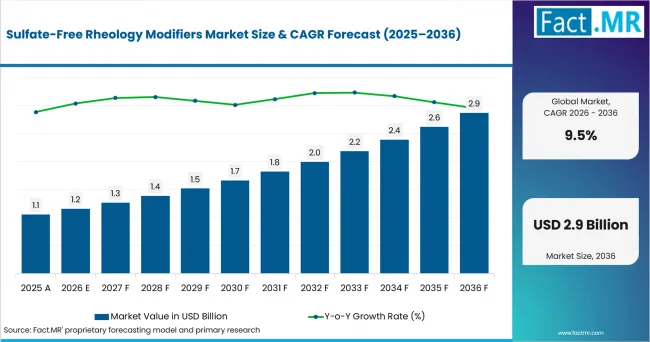
Sulfate Free Rheology Modifiers Market Value Analysis | Source: Fact.MR
What are the defining numbers behind Sulfate-Free Rheology Modifiers Market growth?
USD 1.8 billion absolute opportunity by 2036, led by cellulosics, sulfate-free positioning and shampoo systems.
- Demand Drivers in the Market
- Hair-care companies need ingredients that keep mild shampoos at the right thickness. In April 2025, BASF launched Lamesoft® OP Plus for products that use alternatives to sulfate surfactants.
- Body wash and facial cleanser makers need ingredients that keep oils and other ingredients evenly mixed during storage.
- Natural product brands need ingredients made from renewable materials that break down naturally. Cleansers should also remain easy to pour and rinse.
- Production teams need ingredients that mix easily in large batches without using too much time or heat.
- Key Segments Analyzed
- By Rheology Chemistry: Cellulosics are expected to hold a 37.0% share in 2026 because they help keep mild cleansers at the right thickness.
- By Cleanser System: Shampoo is projected to account for 33.0% share in 2026 because sulfate-free shampoos need good foam, flow, and conditioning.
- By Rheology Need: Viscosity is anticipated to represent 31.0% share in 2026 because liquid cleansers need the right thickness for easy pouring and use.
- By Positioning: Sulfate-free is estimated to capture 36.0% share in 2026 because these products need other ingredients to control thickness.
- Analyst Opinion at Fact.MR
- Shambhu Nath Jha, Principal Consultant at Fact.MR, states, “Sulfate-free cleansers need ingredients that keep the right thickness and flow during production. Suppliers with clear product information and ingredients that break down naturally are more likely to be tested in new products.”
- Strategic Implications
- Ingredient suppliers should test their products with common sulfate-free cleansers and provide clear results. In April 2025, Evonik presented RHEANCE® D50, made from renewable materials for certified natural cosmetics.
- Personal care brands should decide the required thickness and foam before choosing ingredients for each cleanser.
- Contract manufacturers should keep backup thickeners for sulfate-free cleansers. This helps manage formula changes when ingredients are unavailable.
- Distributors should provide sample formulas and clear usage levels because cellulose, gums, and other polymers can work differently in large batches.
The UK leads at 10.5% CAGR due to growing use of sulfate-free cleansers. Japan follows at 9.7% due to demand for premium hair care and mild cleansers. The USA reaches 9.4% as companies develop more cosmetic products. Germany records 9.1% due to its strong chemical industry, while France reaches 8.8% due to growth in cosmetics.
How does the Sulfate-Free Rheology Modifiers Market break down by segment?
Cellulosics lead Rheology Chemistry at 37.0%; sulfate-free positioning leads Positioning at 36.0%.
Which Rheology Chemistry dominates?
Cellulosics are expected to hold 37.0% share in 2026.
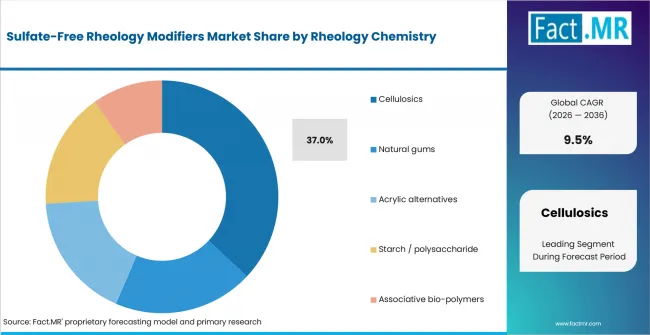
Sulfate Free Rheology Modifiers Market Analysis By Rheology Chemistry | Source: Fact.MR
Cellulosics are expected to lead with a 37.0% share because they help keep cleansers at the right thickness. They are widely used in personal care products and give consistent results. Natural gums are used for plant-based products, while acrylic options help control thickness and keep products clear. Starch and other natural polymers offer more choices for product feel and natural content. The choice depends on the cleanser ingredients, required thickness, and production method.
In March 2025, Lubrizol pre-launched Carbopol® BioSense, a cellulose-based ingredient with more than 98% natural content that can break down naturally.
What leads the Cleanser System segment?
Shampoo is projected to account for 33.0% share in 2026.
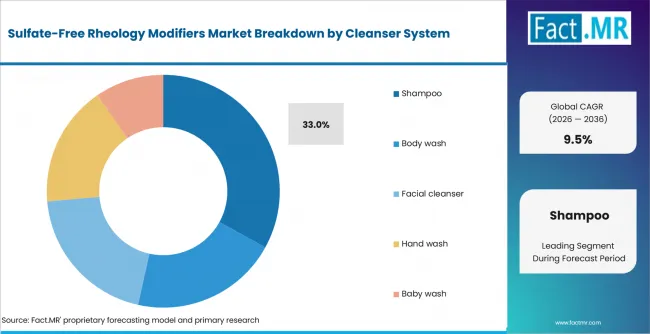
Sulfate Free Rheology Modifiers Market Analysis By Cleanser System | Source: Fact.MR
Shampoo is expected to hold a 33.0% share because sulfate-free shampoos need the right thickness and good foam. Thickeners must also work well with other shampoo ingredients. Body wash has similar needs but may contain more oils and added ingredients. Facial cleansers and baby washes focus more on mild cleaning and easy rinsing.
How does Rheology Need shape demand?
Viscosity is anticipated to represent 31.0% share in 2026.
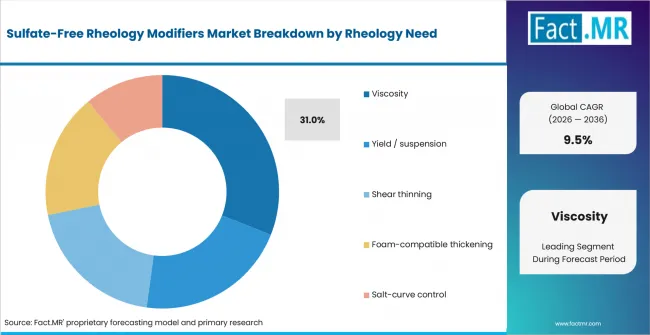
Sulfate Free Rheology Modifiers Market Analysis By Rheology Need | Source: Fact.MR
Viscosity is expected to hold a 31.0% share because it controls the thickness and flow of liquid cleansers. Cleansers that are too thin can flow too fast, while very thick cleansers can be hard to pump and spread. Ingredients should stay evenly mixed during use and storage. Salt levels also need control because they can change the thickness of mild cleansers.
What supports sulfate-free Positioning?
Sulfate-free is estimated to hold 36.0% share in 2026.
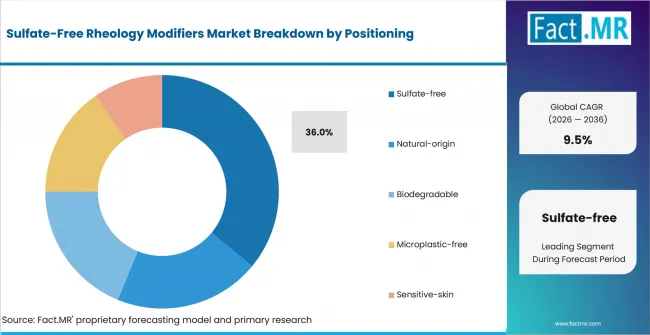
Sulfate Free Rheology Modifiers Market Analysis By Positioning | Source: Fact.MR
Sulfate-free products are expected to hold a 36.0% share because they need different ingredients to control thickness. Salt, fragrance, and conditioning ingredients can affect the thickness. Natural and biodegradable products need suitable ingredients, while sensitive-skin products need mild ingredients that rinse easily. These ingredients should keep the right thickness during production and use.
What is accelerating Sulfate-Free Rheology Modifiers Market adoption, and what is holding it back?
Demand for mild cleansers increases use, while limited ingredient flexibility can slow growth.
Drivers Impact Analysis
| DRIVER | (~) % IMPACT ON CAGR | GEOGRAPHIC RELEVANCE | IMPACT TIMELINE |
|---|---|---|---|
| Sulfate-free shampoo and cleanser reformulation | +1.6% | Global | Short term (<= 2 years) |
| Biodegradable and natural-origin functional ingredients | +1.2% | Europe, North America | Medium term (2-4 years) |
| Need for stable viscosity in mild surfactant blends | +1.0% | Global | Short term (<= 2 years) |
| Low-temperature and formulation-efficiency targets | +0.7% | Europe, Asia | Medium term (2-4 years) |
Source: Fact.MR analysis. Updated Oct 6, 2026
Opportunity Impact Analysis
| OPPORTUNITY | (~) % IMPACT ON CAGR | GEOGRAPHIC RELEVANCE | IMPACT TIMELINE |
|---|---|---|---|
| Cellulose and starch based modifiers that can break down naturally | +1.1% | Global | Medium term (2-4 years) |
| Sensitive-skin cleanser systems | +0.9% | Europe, Japan, USA | Short term (<= 2 years) |
| Formulation tools and supplier co-development | +0.6% | Global | Medium term (2-4 years) |
Source: Fact.MR analysis. Updated Oct 6, 2026
Restraints Impact Analysis
| RESTRAINT | (~) % IMPACT ON CAGR | GEOGRAPHIC RELEVANCE | IMPACT TIMELINE |
|---|---|---|---|
| Surfactant-specific fit and salt-curve sensitivity | -0.7% | Global | Short term (<= 2 years) |
| Cost premium for specialty options that can break down naturally | -0.5% | Global | Medium term (2-4 years) |
| Claim and regulatory documentation burden | -0.4% | Europe, USA | Long term (>= 4 years) |
Source: Fact.MR analysis. Updated Oct 6, 2026
Which countries are scaling the Sulfate-Free Rheology Modifiers Market through 2036?
- The country comparison spans 1.7 percentage points across the forecast period.
- The UK remains 0.8 percentage point above Japan as sulfate-free cleanser reformulation expands.
- Japan remains 0.3 percentage point above the USA through premium hair-care formulation and mild-cleansing demand.
- The USA remains 0.3 percentage point above Germany as a large cosmetics base supports repeated formulation work.
- Germany remains 0.3 percentage point above France through specialty-chemical capability and personal-care ingredient development.
Comparable CAGRs can create different entry conditions due to formula practice, regulation and local manufacturing. Full report coverage includes North America, Latin America, Western Europe, Eastern Europe, East Asia, South Asia & Pacific, Middle East & Africa.
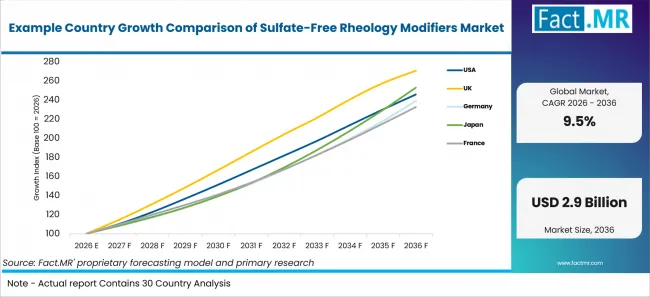
Example Country Growth Comparison Of Sulfate Free Rheology Modifiers Market | Source: Fact.MR
| Country | CAGR (2026-2036) |
|---|---|
| United Kingdom | 10.5% |
| Japan | 9.7% |
| United States | 9.4% |
| Germany | 9.1% |
| France | 8.8% |
Source: Fact.MR analysis. Updated Oct 6, 2026
What supports United Kingdom adoption?
10.5% CAGR through 2036, supported by personal-care manufacturing and formula activity.
The UK is expected to grow at 10.5% CAGR through 2036. In September 2026, the Office for National Statistics reported that the 2025 export price index for perfumes and toilet products was 133.5, based on 2015 equal to 100 [1]
How is Japan scaling demand?
9.7% CAGR through 2036, supported by premium hair care and consumer spending.
Japan is expected to grow at 9.7% CAGR through 2036. In February 2026, the Statistics Bureau of Japan reported that households with two or more people spent an average of JPY 314,001 per month in 2025 [2]. Suppliers can benefit from ingredients that keep sulfate-free shampoos at a steady thickness.
What supports the United States outlook?
9.4% CAGR through 2036, supported by a broad cosmetics formulation base.
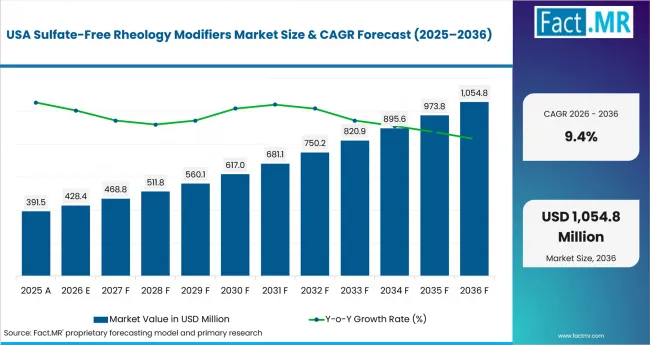
Sulfate Free Rheology Modifiers Market Country Value Analysis | Source: Fact.MR
The United States is expected to grow at 9.4% CAGR through 2036. FDA data updated in September 2026 showed 1,298,361 active cosmetic product listings as of June 30, 2026 [3]. Ingredients that keep a steady thickness and work with mild cleansers can be used in many cosmetic products.
What underpins Germany growth?
9.1% CAGR through 2036, supported by specialty-chemical manufacturing capability.
Germany is expected to grow at 9.1% CAGR through 2036. In June 2026, Destatis reported that industry, including energy, added EUR 239.41 billion to the economy in the fourth quarter of 2025 [4]. Germany’s strong industrial base supports the development of specialty chemicals and personal care ingredients.
How is France developing demand?
8.8% CAGR through 2036, supported by active cosmetics oversight and formulation depth.
France is expected to grow at 8.8% CAGR through 2036. In February 2026, DGCCRF reported checks at 147 cosmetic businesses during its review of product information files [5]. These checks make clear ingredient records and product information important for selling cosmetics in the market.
Who leads the Sulfate-Free Rheology Modifiers Market?
BASF and Lubrizol lead direct rheology coverage, while Ashland, Clariant, Evonik and Nouryon broaden personal-care formulation options.
BASF offers ingredients for shampoos and shower gels. Lubrizol offers ingredients that control thickness and keep products stable. Ashland offers cellulose-based ingredients for cleansers, while Clariant offers mild ingredients for shampoos, body washes, and facial cleansers.
Evonik offers ingredients for cleansing, conditioning, and thickness control. Nouryon offers ingredients for cleansing and conditioning. In April 2025, Nouryon launched Armocare® Aqua 12, a biodegradable conditioning ingredient that works with traditional and sulfate-free shampoos and conditioners.
Buyers can compare thickness, stability, biodegradability, production needs, and use with mild cleansers. Consistent results and product support help brands make stable shampoos, body washes, and facial cleansers.
Which companies are the key providers?
BASF and Lubrizol are key providers. Ashland, Clariant, Evonik and Nouryon are also profiled.
- BASF
- Lubrizol
- Ashland
- Clariant
- Evonik
- Nouryon
Bibliography
- [1] Office for National Statistics. (2026, September 16). PPI INDEX EXPORT TOTAL - C2042 Perfumes and toilet preparations 2015=100.
- [2] Statistics Bureau of Japan. (2026, February 6). Family Income and Expenditure Survey: 2025 yearly average.
- [3] U.S. Food and Drug Administration. (2026, September 9). Registration & Listing of Cosmetic Product Facilities and Products.
- [4] Federal Statistical Office (Destatis). (2026, May 22). Gross value added by selected industries, at current prices.
- [5] Direction générale de la concurrence, de la consommation et de la répression des fraudes. (2026, February 2). Cosmétiques : des TPE nouvelles dans le secteur qui méconnaissent trop souvent la réglementation.
- [6] BASF. (2025, April 3). BASF launches natural-based innovations for personal care at in-cosmetics Global 2025.
- [7] Evonik. (2025, April 8). in-cosmetics® global 2025: Evonik meets growing customer demand for high-performance, eco-friendly solutions.
- [8] Lubrizol. (2025, March 28). Lubrizol partners with Suzano for pre-launch of Carbopol® BioSense in Brazil, advancing biodegradable solutions.
- [9] Nouryon. (2025, April 8). Introducing Armocare® Aqua 12: An ISCC PLUS certified, sustainable, biodegradable surfactant for hair care.
This Report Answers
- The report covers sulfate-free texture modifiers by chemistry, cleanser system, rheology need and positioning.
- Segment analysis explains the listed leading shares and the formulation reasons behind them.
- Country analysis compares the five listed CAGRs with relevant official evidence.
- Competitive analysis reviews BASF, Lubrizol, Ashland, Clariant, Evonik and Nouryon.
- Application analysis covers viscosity, suspension, foam and sensory effects in sulfate-free cleansers.
What does the Sulfate-Free Rheology Modifiers Market cover?
The market covers texture modifiers used for viscosity, yield, suspension and flow control in sulfate-free rinse-off personal care. Related Fact.MR coverage includes natural texture modifiers and personal care surfactants, which provide adjacent context for ingredient and surfactant selection.
Hair-care formulation context is covered in the hair-care surfactants and shampoo bar category. These adjacent categories help explain cleanser-format changes while the sizing boundary remains focused on texture modifiers.
What is included in the scope?
The scope includes cellulosics, natural gums, acrylic alternatives, starch or polysaccharide systems and associative biopolymers used in sulfate-free cleansers. Related texture chemistry is covered in Fact.MR analysis of hydroxypropyl starch phosphates.
Included formats are shampoo, body wash, facial cleanser, hand wash and baby wash. Each format uses the texture modifier to control handling, dispensing, suspension or sensory feel within a sulfate-free or sulfate-alternative cleansing system.
What is excluded from the scope?
The sizing boundary stays with ingredients whose main commercial role is rheology control in sulfate-free personal cleansing. Standalone surfactants, conditioners and emulsifiers are treated as adjacent formulation inputs when their primary function sits outside viscosity, yield, suspension or flow control.
Mild surfactants are treated as context when they shape the behavior of the cleanser base. The market count stays focused on texture modifiers, so adjacent cleansing ingredients enter the analysis only to explain formulation conditions and product design.
The analysis draws on 120+ sources, 35+ company portfolios, 25+ countries, and more than 20 industry interviews.
- Primary Research: Primary research includes discussions with manufacturers, service providers, technology developers, distributors, end users, and subject-matter experts. These conversations examine purchasing priorities, product adoption, operational challenges, approval requirements, competitive positioning, and the factors that influence wider market acceptance.
- Desk Research: Desk research covers government statistics, regulatory publications, company filings, trade data, technical studies, industry associations, standards, public policy, and other authoritative sources. Every source used in the analysis is documented in the bibliography.
- Market Sizing and Forecasting: Market estimates combine historical performance, demand indicators, pricing and volume trends, segment shares, company participation, country-level growth, adoption patterns, investment activity, and barriers to market expansion.
- Data Validation and Update Cycle: Findings are validated by comparing primary interviews with public data, company activity, regulatory changes, trade patterns, and industry developments. Regular updates review new product launches, capacity changes, partnerships, approvals, and shifts in commercial adoption.
Segmentation
What is the report’s scope and coverage?
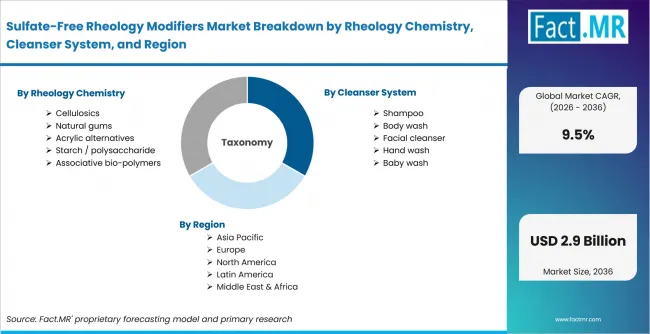
Sulfate Free Rheology Modifiers Market Breakdown By Rheology Chemistry, Cleanser System, And Region | Source: Fact.MR
| Attribute | Details |
|---|---|
| Quantitative Units | USD billion |
| Market Definition | Functional texture modifiers used to build viscosity, yield, suspension and flow control in sulfate-free or sulfate-alternative personal cleansing systems. |
| Rheology Chemistry | Cellulosics; Natural gums; Acrylic alternatives; Starch or polysaccharide; Associative biopolymers |
| Cleanser System | Shampoo; Body wash; Facial cleanser; Hand wash; Baby wash |
| Rheology Need | Viscosity; Yield or suspension; Shear thinning; Foam-compatible thickening; Salt-curve control |
| Positioning | Sulfate-free; Natural-origin; Biodegradable; Microplastic-free; Sensitive-skin |
| Regions Covered | North America; Latin America; Western Europe; Eastern Europe; East Asia; South Asia & Pacific; Middle East & Africa |
| Countries Covered | United States; United Kingdom; Germany; Japan; France |
| Key Companies Profiled | BASF; Lubrizol; Ashland; Clariant; Evonik; Nouryon |
| Forecast Period | 2026 to 2036 |
| Approach | Hybrid top-down and bottom-up assessment using cleanser formulation demand, rheology chemistry use, official manufacturing indicators, company portfolio verification and country-level adoption conditions. |
Source: Fact.MR analysis. Updated Oct 6, 2026
How is the market segmented?
-
By Rheology Chemistry:
- Cellulosics
- Natural gums
- Acrylic alternatives
- Starch / polysaccharide
- Associative bio-polymers
-
By Cleanser System:
- Shampoo
- Body wash
- Facial cleanser
- Hand wash
- Baby wash
-
By Rheology Need:
- Viscosity
- Yield / suspension
- Shear thinning
- Foam-compatible thickening
- Salt-curve control
-
By Positioning:
- Sulfate-free
- Natural-origin
- Biodegradable
- Microplastic-free
- Sensitive-skin
-
By Region:
- North America
- Latin America
- Western Europe
- Eastern Europe
- East Asia
- South Asia & Pacific
- Middle East & Africa
Frequently Asked Questions
How big is the Sulfate-Free Rheology Modifiers Market in 2026?
What is the CAGR of the Sulfate-Free Rheology Modifiers Market from 2026 to 2036?
Which rheology chemistry leads the Sulfate-Free Rheology Modifiers Market?
Which cleanser system leads the Sulfate-Free Rheology Modifiers Market?
Who are the leading companies in the Sulfate-Free Rheology Modifiers Market?
Who worked on this report


Preview the report firsthand - request a free sample
Free SampleGet the brochure for pricing and purchase details
Download PDF