Surplus and Imperfect Produce Retail Market (2026 - 2036)

Surplus and Imperfect Produce Retail Market is segmented by Product Type (Imperfect Fruits, Imperfect Vegetables, Surplus Mixed Produce Boxes, Processed Imperfect Produce Products, and Ugly Produce Snack Products), Business Model (Direct to Consumer Subscription Boxes, Retail Supermarket Programs, Online Surplus Produce Marketplaces, and Foodservice Surplus Sourcing Programs), Distribution Channel (Online Retail Platforms, Supermarkets and Hypermarkets, Specialty Grocery Stores, and Farm Direct Sales Channels), and Region. Forecast for 2026 to 2036.

Core Findings

    Surplus and Imperfect Produce Retail Market Forecast By Fact.MR

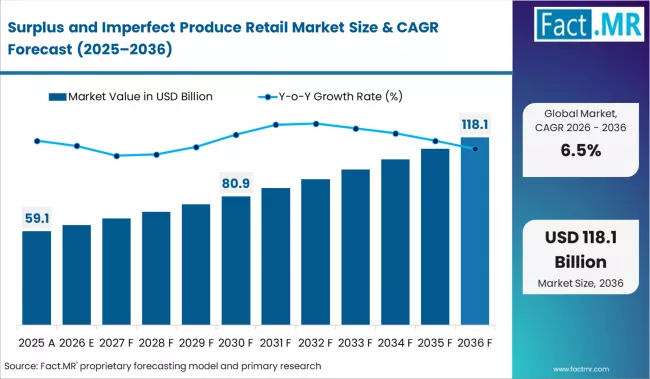
    Valuation of the surplus and imperfect produce retail market stood at USD 58.6 billion in 2025. According to Fact MR, demand for surplus and imperfect produce retail is expected to reach USD 62.9 billion in 2026 and USD 118.4 billion by 2036. A CAGR of 6.5% is projected for the forecast timeline.
    Surplus And Imperfect Produce Retail Market Market Value Analysis

    Summary of the Surplus and Imperfect Produce Retail Market

    • Market Definition
      • The market includes retail sale of fruits and vegetables that are cosmetically irregular, misshaped, undersized, or surplus to standard retail demand but remain safe for consumption. These products are distributed through online platforms, supermarkets, subscription delivery services, and farm-direct channels to improve inventory utilization and reduce agricultural waste across supply chains. Surplus produce retail systems enable commercialization of secondary-grade agricultural output through alternative pricing structures and flexible merchandising formats.
    • Demand Drivers
      • Increasing retailer focus on improving inventory utilization through commercialization of cosmetically imperfect produce
      • Expansion of digital grocery platforms supporting aggregation and redistribution of surplus agricultural supply
      • Growing consumer acceptance of lower-priced fresh produce alternatives with equivalent nutritional characteristics
      • Development of subscription-based produce delivery models supporting predictable distribution of seasonal surplus volumes
    • Key Segments Analyzed
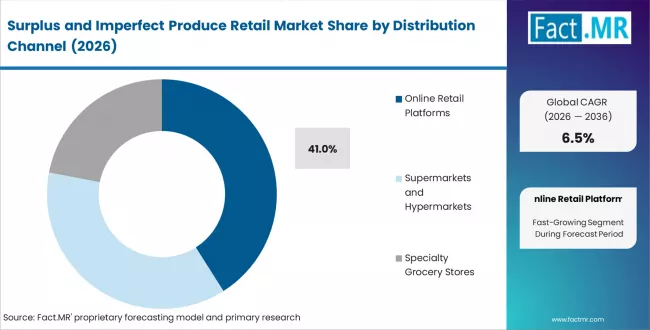
      • Distribution Channel: Online retail platforms account for approximately 41% share supported by flexible inventory allocation and direct-to-consumer fulfillment models
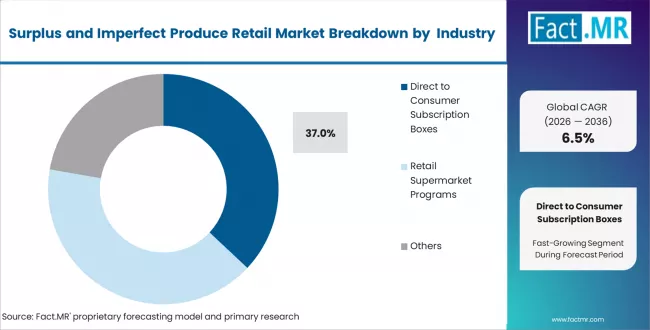
      • Business Model: Direct-to-consumer subscription boxes represent nearly 37% share driven by recurring delivery formats aligned with seasonal harvest variability
      • Product Type: Imperfect fruits and vegetables remain primary categories supported by supply chain diversion of secondary-grade produce
      • Geography: Europe demonstrates structured adoption supported by established retail waste reduction initiatives
    • Analyst Opinion at Fact MR
      • Shambhu Nath Jha, Principal Consultant, Fact MR, opines, "In this updated edition of the Surplus and Imperfect Produce Retail Market report, industry participants will observe steady commercialization of cosmetically irregular agricultural output through alternative retail channels. Supply chain participants increasingly utilize secondary-grade produce streams to improve inventory recovery rates and reduce post-harvest losses. Companies that optimize sourcing networks, grading systems, and distribution logistics are expected to maintain operational efficiency advantages through 2036."
    • Strategic Implications Executive Takeaways
      • Develop sourcing partnerships with farms to improve recovery of secondary-grade produce volumes across harvest cycles
      • Strengthen digital retail capabilities supporting flexible pricing and dynamic inventory allocation for surplus produce assortments
      • Optimize logistics coordination systems enabling efficient distribution of perishable products across geographically dispersed consumer demand centers
      • Expand private-label product lines incorporating imperfect produce within structured retail merchandising strategies
    • Methodology
      • Primary interviews conducted with agricultural producers, produce aggregators, online grocery platforms, and retail procurement specialists
      • Desk research based on agricultural production statistics, food waste studies, retail inventory data, and company disclosures related to surplus produce commercialization
      • Market sizing developed using hybrid top-down fresh produce market evaluation combined with bottom-up assessment of secondary-grade produce distribution volumes
      • Data validation performed through cross verification of supply chain participation data and internal analytical review aligned with Fact MR research standards

    Surplus and Imperfect Produce Retail Market

    Metric Details
    Industry Size (2026E) USD 62.9 billion
    Industry Value (2036F) USD 118.4 billion
    CAGR (2026 to 2036) 6.5%

    A CAGR of 6.5% indicates moderate expansion, reflecting steady normalization of cosmetically imperfect produce within value-oriented retail assortments and waste reduction programs. Growth momentum is supported by retailer margin recovery on secondary-grade supply and supply chain optimization for surplus inventory utilization, while structural limits persist due to quality perception sensitivity, logistics complexity in grading consistency, and pricing pressure relative to standard fresh produce categories.

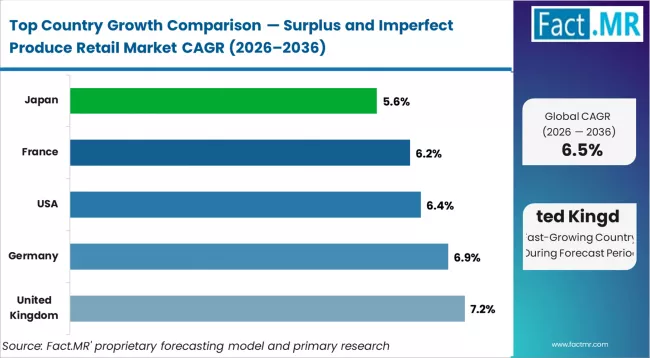
    The United Kingdom leads with a projected CAGR of 7.2%, supported by expansion of retail programs focused on redistribution of cosmetically imperfect fruits and vegetables. Germany follows with a CAGR of 6.9%, driven by increasing integration of surplus produce within discount retail assortments. The United States records a CAGR of 6.4%, reflecting steady demand for lower-cost fresh produce across organized retail distribution channels. France shows a CAGR of 6.2%, supported by gradual expansion of retail initiatives targeting reduction of food supply chain waste. Japan records the slowest growth at 5.6%, reflecting a mature market where demand is largely tied to replacement purchasing cycles within established fresh produce retail formats. Mature markets generate a significant share of replacement demand as retail participation remains influenced by supply chain standardization and consumer acceptance of non-standard produce appearance.

    Segmental Analysis

    Surplus and Imperfect Produce Retail Market Analysis by Distribution Channel
    Surplus And Imperfect Produce Retail Market Analysis By Distribution Channel

    • Market Overview: Based on Fact MR assessment, online retail platforms are projected to account for 41% share of the surplus and imperfect produce retail market in 2026. Digital grocery platforms are utilized to distribute cosmetically irregular fruits and vegetables diverted from conventional retail grading systems. E-commerce fulfillment models enable aggregation of surplus agricultural output across regional farms and distribution hubs requiring alternative sales channels. Product assortment variability is accommodated through dynamic inventory listing structures reflecting seasonal harvest fluctuations and supply inconsistency across fresh produce categories affected by size, shape, and surface appearance deviations.
    • Demand Drivers:
      • Inventory Redistribution Efficiency: Online retail systems support allocation of surplus produce volumes across geographically distributed consumer demand pools requiring flexible order fulfillment mechanisms.
      • Supply Chain Optimization Requirements: Agricultural producers utilize digital platforms to reduce post-harvest losses associated with cosmetic grading exclusions applied within conventional retail procurement frameworks.
      • Price Accessibility Factors: Online channels enable positioning of imperfect produce assortments within structured pricing tiers aligned with consumer preference for reduced cost fresh produce options.

    Surplus and Imperfect Produce Retail Market Analysis by Business Model
    Surplus And Imperfect Produce Retail Market Analysis By Business Model

    • Market Overview: Direct to consumer subscription box models are estimated to hold 37% share of the surplus and imperfect produce retail market in 2026, supported by recurring delivery structures enabling predictable distribution of seasonal agricultural surplus volumes. Subscription frameworks are structured around periodic delivery schedules incorporating mixed produce assortments based on harvest availability and crop variability. Packaging and logistics coordination systems are configured to support weekly or monthly dispatch cycles aligned with farm output planning and fulfillment route optimization across regional delivery networks.
    • Demand Drivers:
      • Recurring Demand Structure: Subscription delivery systems enable consistent offtake of irregular produce volumes across agricultural producers managing fluctuating harvest output levels.
      • Logistics Coordination Efficiency: Consolidated delivery routes support distribution cost management across perishable produce requiring controlled transportation timelines.
      • Product Assortment Flexibility: Subscription box composition adapts to seasonal crop variation enabling redistribution of produce volumes affected by grading exclusions within standardized retail supply chains.

    Key Dynamics of Surplus and Imperfect Produce Retail Market

    Surplus and Imperfect Produce Retail Market Drivers, Restraints, and Opportunities
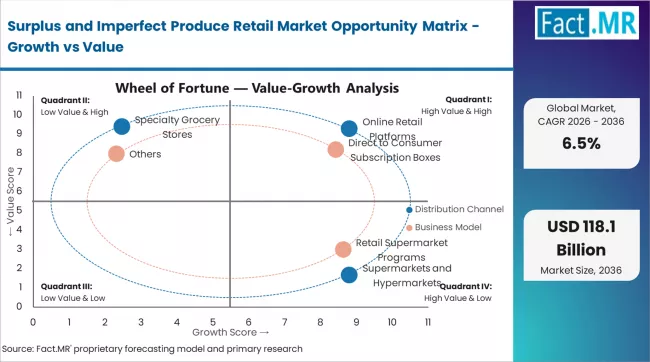
    Surplus And Imperfect Produce Retail Market Opportunity Matrix Growth Vs Value

    Fact MR analysis indicates that the surplus and imperfect produce retail market developed from agricultural supply chains where fruits and vegetables not meeting visual grading standards were diverted from mainstream retail channels. Historically, produce with cosmetic irregularities was directed toward processing industries or discarded due to strict appearance requirements in retail distribution systems. The current market valuation reflects emerging retail models that commercialize cosmetically imperfect produce through discount channels and direct-to-consumer distribution formats. Demand persists because imperfect produce provides price advantages while maintaining comparable nutritional value to visually standardized products.

    A structural shift is occurring as conventional produce grading standards face operational adjustment through alternative retail channels designed to reduce food waste. Standardized produce remains dominant in supermarkets where visual consistency influences consumer purchasing behavior. Retailers and distributors increasingly introduce separate product lines for surplus or visually irregular produce that would otherwise remain underutilized within supply chains. These offerings typically involve lower price points but improved supply chain utilization and reduced waste handling costs. Even with lower per-unit pricing, expanded distribution channels support gradual market value growth through higher sell-through volumes.

    • Food Waste Reduction: Retailers introduce product lines that commercialize cosmetically imperfect fruits and vegetables that do not meet conventional visual grading standards.
    • Food Labeling Compliance: Standards such as Codex Alimentarius fresh produce grading guidelines influence classification and labeling of fruits and vegetables within retail distribution systems.
    • Europe Retail Programs: France and the United Kingdom maintain established supermarket initiatives offering discounted imperfect produce to reduce agricultural waste.

    Regional Analysis

    The surplus and imperfect produce retail market is assessed across North America, Europe, Asia Pacific, Latin America, and Middle East & Africa, segmented by country-level retail redistribution models, food waste reduction initiatives, and alternative produce supply chains. Regional demand reflects circular retail participation, price-sensitive consumer segments, and supply optimization strategies. The full report offers market attractiveness analysis.

    Top Country Growth Comparison Surplus And Imperfect Produce Retail Market Cagr (2026 2036)

    Country CAGR (2026-2036)
    United Kingdom 7.2%
    Germany 6.9%
    United States 6.4%
    France 6.2%
    Japan 5.6%

    Surplus And Imperfect Produce Retail Market Cagr Analysis By Country

    Source: Fact MR analysis, based on proprietary forecasting model and primary research

    Europe
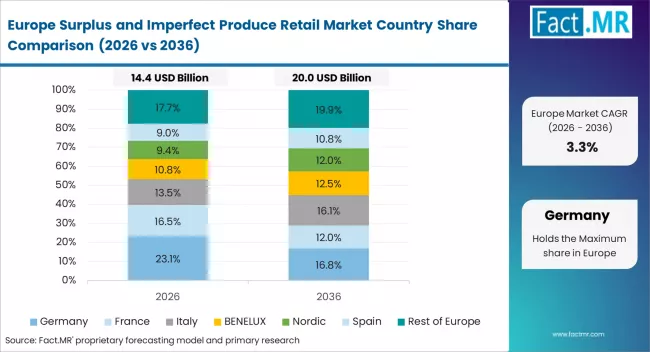
    Surplus And Imperfect Produce Retail Market Europe Country Market Share Analysis, 2026 & 2036

    Europe functions as the global food waste reduction regulatory laboratory, supported by structured redistribution policies and retailer participation in imperfect produce sales channels. Tesco PLC strengthens surplus produce retail initiatives. Carrefour S.A. expands imperfect produce distribution programs. Ahold Delhaize supports food waste reduction retail strategies.

    • United Kingdom: Demand for surplus and imperfect produce retail in United Kingdom is projected to rise at 7.2% CAGR through 2036. The UK Resources and Waste Strategy update (Department for Environment, Food & Rural Affairs, 2021) supports redistribution of surplus food. Tesco PLC expanded imperfect produce retail initiatives (March 2023), supporting market growth.
    • Germany: Demand for surplus and imperfect produce retail in Germany is projected to rise at 6.9% CAGR through 2036. The German National Programme for Sustainable Consumption update (Federal Ministry for the Environment, 2021) supports food waste reduction initiatives. Ahold Delhaize expanded imperfect produce supply channels (February 2023), supporting adoption.
    • France: Demand for surplus and imperfect produce retail in France is projected to rise at 6.2% CAGR through 2036. The Anti-Food Waste Law update (French Government, 2020) supports redistribution of unsold food products. Carrefour S.A. expanded surplus produce retail programs (January 2023), supporting market penetration.

    North America
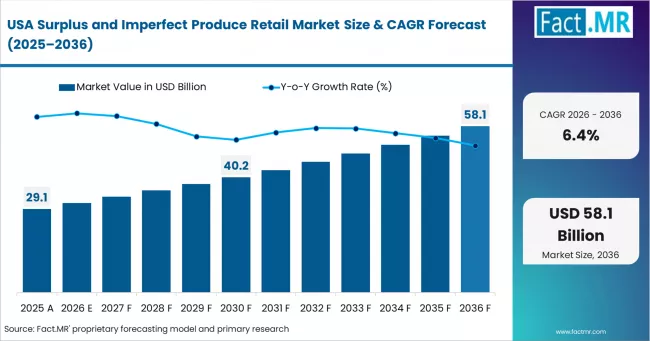
    Surplus And Imperfect Produce Retail Market Country Value Analysis

    North America functions as the retail-driven surplus food redistribution and discount produce supply hub, supported by retailer-led initiatives and consumer demand for value-based food purchases. Walmart Inc. strengthens surplus food distribution capabilities. Kroger Co. expands imperfect produce product lines. Imperfect Foods, Inc. supports direct-to-consumer surplus produce sales.

    • United States: Demand for surplus and imperfect produce retail in United States is projected to rise at 6.4% CAGR through 2036. The U.S. Food Recovery Act initiatives (Environmental Protection Agency, updated 2021) support food waste reduction programs. Imperfect Foods, Inc. expanded surplus produce subscription services (April 2023), supporting adoption.

    Asia Pacific
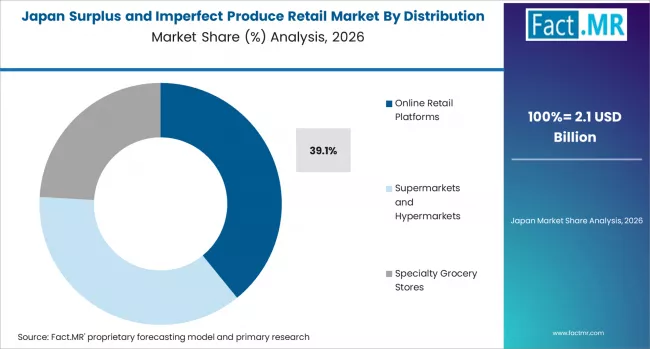
    Surplus And Imperfect Produce Retail Market Japan Market Share Analysis By Distribution Channel

    Asia Pacific serves as the structured food redistribution and supply optimization market, supported by food waste reduction frameworks and retail efficiency initiatives. Aeon Co., Ltd. strengthens imperfect produce retail offerings. Seven & i Holdings Co., Ltd. expands discounted produce distribution models. Rakuten Group, Inc. supports surplus food distribution platforms.

    • Japan: Demand for surplus and imperfect produce retail in Japan is projected to rise at 5.6% CAGR through 2036. The Food Loss Reduction Promotion Act update (Consumer Affairs Agency, 2021) supports redistribution of unsold produce. Aeon Co., Ltd. expanded imperfect produce retail offerings (May 2023), supporting market development.

    Fact MR's analysis of surplus and imperfect produce retail market in global regions consists of country-wise assessment that includes United Kingdom, Germany, United States, France, and Japan. Readers can find food redistribution trends, retail participation patterns, regulatory developments, and competitive positioning across key markets.

    Key Players of the Surplus and Imperfect Produce Retail Market

    • Imperfect Foods Inc.
    • Misfits Market Inc.
    • Oddbox Delivery Ltd
    • Hungry Harvest LLC
    • The Ugly Company Inc.
    • Rubies in the Rubble Ltd
    • Full Harvest Technologies Inc.
    • Rebellyous Foods (surplus sourcing partnerships)
    • Kromkommer BV
    • Farmdrop Ltd

    Bibliographies

    • [1] United Nations Environment Programme (UNEP). (2021). Food Waste Index Report 2021: Global food waste in households, food service, and retail sectors. United Nations Environment Programme.
    • [2] European Commission. (2019). Fighting food waste: Towards a more sustainable food system-Communication on food waste reduction and redistribution. European Commission.
    • [3] Babbitt, C. G., Pariseault, M. P., and Gerven, G. (2019). Understanding consumer acceptance of "ugly" fruits and vegetables. Journal of Food Products Marketing, 25(5), 411-427.
    • [4] U.S. Environmental Protection Agency (EPA). (2021). Food Recovery Hierarchy and Food Waste Reduction Programs. U.S. Environmental Protection Agency.
    • [5] WRAP (Waste and Resources Action Programme, UK). (2020). Food surplus and waste in the UK-key facts. Waste and Resources Action Programme.

    This Report Addresses

    • Market size estimation and revenue forecasts for the Surplus and Imperfect Produce Retail Market from 2026 to 2036, supported by secondary-grade agricultural supply utilization trends and retail redistribution benchmarks across fresh produce supply chains.
    • Growth opportunity mapping across imperfect fruits, imperfect vegetables, surplus mixed produce boxes, processed imperfect produce products, and ugly produce snack products aligned with alternative merchandising strategies for cosmetically irregular agricultural output.
    • Segment and regional revenue forecasts covering business models, distribution channels, and major retail markets including United Kingdom, Germany, United States, France, and Japan.
    • Competition strategy assessment of key companies such as Imperfect Foods Inc., Misfits Market Inc., Oddbox Delivery Ltd, Hungry Harvest LLC, and Full Harvest Technologies Inc., including sourcing network capability benchmarking and digital distribution infrastructure evaluation.
    • Regulatory impact analysis covering food waste reduction policy frameworks, Codex Alimentarius produce grading guidelines, and national food redistribution initiatives influencing commercialization of cosmetically irregular produce.
    • Market report delivery in PDF, Excel, PPT, and interactive dashboard formats designed for retail channel strategy evaluation, agricultural surplus utilization assessment, and pricing structure benchmarking.
    • Supply chain vulnerability assessments examining grading standard variability, seasonal supply fluctuations, logistics coordination complexity, pricing pressure relative to premium grade produce, and consumer acceptance sensitivity influencing market penetration.

    Surplus and Imperfect Produce Retail Market Definition

    Surplus and Imperfect Produce Retail Market Definition Paragraph

    The Surplus and Imperfect Produce Retail Market includes the sale of fruits and vegetables that are excess, cosmetically irregular, undersized, or misshaped but remain safe and suitable for consumption, supplied through retail, online platforms, and food distribution programs to reduce food waste and improve inventory utilization.

    Surplus and Imperfect Produce Retail Market Inclusions

    The report includes global and regional market size estimates, forecast analysis, and segmentation by produce type, sales channel, sourcing model, end user category, pricing structure, and supply chain redistribution systems.

    Surplus and Imperfect Produce Retail Market Exclusions

    The scope excludes processed food made from surplus produce, food waste recycling operations, animal feed derived from rejected produce, and donation based distribution programs that do not involve retail transactions.

    Surplus and Imperfect Produce Retail Market Research Methodology

    • Primary Research: Interviews were conducted with fresh produce retailers, wholesalers, digital grocery platforms, farm aggregators, and food waste reduction program operators.
    • Desk Research: Public sources included agricultural supply statistics, retail inventory reports, government food waste studies, and company disclosures on surplus distribution initiatives.
    • Market-Sizing and Forecasting: A hybrid model combining top-down fresh produce market evaluation and bottom-up analysis of surplus inventory commercialization was applied.
    • Data Validation and Update Cycle: Estimates were validated through cross comparison of supply chain data, stakeholder inputs, and periodic review of retail participation trends.

    Report Scope of Surplus and Imperfect Produce Retail Market

    Surplus And Imperfect Produce Retail Market Breakdown By Distribution Channel, Business Model, And Region

    Metric Value
    Quantitative Units USD 62.9 billion (2026) to USD 118.4 billion (2036), at a CAGR of 6.5%
    Market Definition The surplus and imperfect produce retail market includes commercial sale of fruits and vegetables that deviate from standard cosmetic specifications or originate from excess agricultural supply, marketed through alternative retail channels to reduce food waste and improve supply chain efficiency.
    Product Type Segmentation Imperfect fruits, Imperfect vegetables, Surplus mixed produce boxes, Processed imperfect produce products, Ugly produce snack products
    Business Model Segmentation Direct to consumer subscription boxes, Retail supermarket programs, Online surplus produce marketplaces, Foodservice surplus sourcing programs
    Distribution Channel Segmentation Online retail platforms, Supermarkets and hypermarkets, Specialty grocery stores, Farm direct sales channels
    Regions Covered North America, Latin America, Europe, East Asia, South Asia, Oceania, Middle East and Africa
    Countries Covered United States, Canada, Mexico, Brazil, Argentina, United Kingdom, Germany, France, Netherlands, Spain, Italy, China, India, Japan, South Korea, Australia, New Zealand, South Africa, and 40+ countries
    Key Companies Profiled Imperfect Foods Inc., Misfits Market Inc., Oddbox Delivery Ltd, Hungry Harvest LLC, The Ugly Company Inc., Rubies in the Rubble Ltd, Full Harvest Technologies Inc., Rebellyous Foods, Kromkommer BV, Farmdrop Ltd
    Forecast Period 2026 to 2036
    Approach Hybrid top-down and bottom-up market estimation based on agricultural surplus volume analysis, retail channel penetration of cosmetically imperfect produce, food waste reduction initiatives, pricing discount benchmarks, and validation through primary interviews with produce distributors, digital grocery platforms, and foodservice procurement providers.

    Surplus and Imperfect Produce Retail Market Key Segments

    • Product Type :

      • Imperfect Fruits
      • Imperfect Vegetables
      • Surplus Mixed Produce Boxes
      • Processed Imperfect Produce Products
      • Ugly Produce Snack Products
    • Business Model :

      • Direct to Consumer Subscription Boxes
      • Retail Supermarket Programs
      • Online Surplus Produce Marketplaces
      • Foodservice Surplus Sourcing Programs
    • Distribution Channel :

      • Online Retail Platforms
      • Supermarkets and Hypermarkets
      • Specialty Grocery Stores
      • Farm Direct Sales Channels
    • Region :

      • North America
        • USA
        • Canada
        • Mexico
      • Europe
        • Germany
        • UK
        • France
        • Italy
        • Spain
        • Nordic Countries
        • BENELUX
        • Rest of Europe
      • Asia Pacific
        • China
        • Japan
        • South Korea
        • India
        • Australia
        • Rest of Asia Pacific
      • Latin America
        • Brazil
        • Argentina
        • Rest of Latin America
      • Middle East and Africa
        • Kingdom of Saudi Arabia
        • United Arab Emirates
        • South Africa
        • Rest of Middle East and Africa
      • Other Regions
        • Oceania
        • Central Asia
        • Other Markets

    Table of Content

    1. Executive Summary
      • Global Market Outlook
      • Demand to side Trends
      • Supply to side Trends
      • Technology Roadmap Analysis
      • Analysis and Recommendations
    2. Market Overview
      • Market Coverage / Taxonomy
      • Market Definition / Scope / Limitations
    3. Research Methodology
      • Chapter Orientation
      • Analytical Lens and Working Hypotheses
        • Market Structure, Signals, and Trend Drivers
        • Benchmarking and Cross-market Comparability
        • Market Sizing, Forecasting, and Opportunity Mapping
      • Research Design and Evidence Framework
        • Desk Research Programme (Secondary Evidence)
          • Company Annual and Sustainability Reports
          • Peer-reviewed Journals and Academic Literature
          • Corporate Websites, Product Literature, and Technical Notes
          • Earnings Decks and Investor Briefings
          • Statutory Filings and Regulatory Disclosures
          • Technical White Papers and Standards Notes
          • Trade Journals, Industry Magazines, and Analyst Briefs
          • Conference Proceedings, Webinars, and Seminar Materials
          • Government Statistics Portals and Public Data Releases
          • Press Releases and Reputable Media Coverage
          • Specialist Newsletters and Curated Briefings
          • Sector Databases and Reference Repositories
          • Fact.MR Internal Proprietary Databases and Historical Market Datasets
          • Subscription Datasets and Paid Sources
          • Social Channels, Communities, and Digital Listening Inputs
          • Additional Desk Sources
        • Expert Input and Fieldwork (Primary Evidence)
          • Primary Modes
            • Qualitative Interviews and Expert Elicitation
            • Quantitative Surveys and Structured Data Capture
            • Blended Approach
          • Why Primary Evidence is Used
          • Field Techniques
            • Interviews
            • Surveys
            • Focus Groups
            • Observational and In-context Research
            • Social and Community Interactions
          • Stakeholder Universe Engaged
            • C-suite Leaders
            • Board Members
            • Presidents and Vice Presidents
            • R&D and Innovation Heads
            • Technical Specialists
            • Domain Subject-matter Experts
            • Scientists
            • Physicians and Other Healthcare Professionals
          • Governance, Ethics, and Data Stewardship
            • Research Ethics
            • Data Integrity and Handling
        • Tooling, Models, and Reference Databases
      • Data Engineering and Model Build
        • Data Acquisition and Ingestion
        • Cleaning, Normalisation, and Verification
        • Synthesis, Triangulation, and Analysis
      • Quality Assurance and Audit Trail
    4. Market Background
      • Market Dynamics
        • Drivers
        • Restraints
        • Opportunity
        • Trends
      • Scenario Forecast
        • Demand in Optimistic Scenario
        • Demand in Likely Scenario
        • Demand in Conservative Scenario
      • Opportunity Map Analysis
      • Product Life Cycle Analysis
      • Supply Chain Analysis
      • Investment Feasibility Matrix
      • Value Chain Analysis
      • PESTLE and Porter’s Analysis
      • Regulatory Landscape
      • Regional Parent Market Outlook
      • Production and Consumption Statistics
      • Import and Export Statistics
    5. Global Market Analysis 2021 to 2025 and Forecast, 2026 to 2036
      • Historical Market Size Value (USD Million) Analysis, 2021 to 2025
      • Current and Future Market Size Value (USD Million) Projections, 2026 to 2036
        • Y to o to Y Growth Trend Analysis
        • Absolute $ Opportunity Analysis
    6. Global Market Pricing Analysis 2021 to 2025 and Forecast 2026 to 2036
    7. Global Market Analysis 2021 to 2025 and Forecast 2026 to 2036, By Distribution Channel
      • Introduction / Key Findings
      • Historical Market Size Value (USD Million) Analysis By Distribution Channel, 2021 to 2025
      • Current and Future Market Size Value (USD Million) Analysis and Forecast By Distribution Channel, 2026 to 2036
        • Online Retail Platforms
        • Supermarkets and Hypermarkets
        • Specialty Grocery Stores
      • Y to o to Y Growth Trend Analysis By Distribution Channel, 2021 to 2025
      • Absolute $ Opportunity Analysis By Distribution Channel, 2026 to 2036
    8. Global Market Analysis 2021 to 2025 and Forecast 2026 to 2036, By Business Model
      • Introduction / Key Findings
      • Historical Market Size Value (USD Million) Analysis By Business Model, 2021 to 2025
      • Current and Future Market Size Value (USD Million) Analysis and Forecast By Business Model, 2026 to 2036
        • Direct to Consumer Subscription Boxes
        • Retail Supermarket Programs
        • Others
      • Y to o to Y Growth Trend Analysis By Business Model, 2021 to 2025
      • Absolute $ Opportunity Analysis By Business Model, 2026 to 2036
    9. Global Market Analysis 2021 to 2025 and Forecast 2026 to 2036, By Region
      • Introduction
      • Historical Market Size Value (USD Million) Analysis By Region, 2021 to 2025
      • Current Market Size Value (USD Million) Analysis and Forecast By Region, 2026 to 2036
        • North America
        • Latin America
        • Western Europe
        • Eastern Europe
        • East Asia
        • South Asia and Pacific
        • Middle East & Africa
      • Market Attractiveness Analysis By Region
    10. North America Market Analysis 2021 to 2025 and Forecast 2026 to 2036, By Country
      • Historical Market Size Value (USD Million) Trend Analysis By Market Taxonomy, 2021 to 2025
      • Market Size Value (USD Million) Forecast By Market Taxonomy, 2026 to 2036
        • By Country
          • USA
          • Canada
          • Mexico
        • By Distribution Channel
        • By Business Model
      • Market Attractiveness Analysis
        • By Country
        • By Distribution Channel
        • By Business Model
      • Key Takeaways
    11. Latin America Market Analysis 2021 to 2025 and Forecast 2026 to 2036, By Country
      • Historical Market Size Value (USD Million) Trend Analysis By Market Taxonomy, 2021 to 2025
      • Market Size Value (USD Million) Forecast By Market Taxonomy, 2026 to 2036
        • By Country
          • Brazil
          • Chile
          • Rest of Latin America
        • By Distribution Channel
        • By Business Model
      • Market Attractiveness Analysis
        • By Country
        • By Distribution Channel
        • By Business Model
      • Key Takeaways
    12. Western Europe Market Analysis 2021 to 2025 and Forecast 2026 to 2036, By Country
      • Historical Market Size Value (USD Million) Trend Analysis By Market Taxonomy, 2021 to 2025
      • Market Size Value (USD Million) Forecast By Market Taxonomy, 2026 to 2036
        • By Country
          • Germany
          • UK
          • Italy
          • Spain
          • France
          • Nordic
          • BENELUX
          • Rest of Western Europe
        • By Distribution Channel
        • By Business Model
      • Market Attractiveness Analysis
        • By Country
        • By Distribution Channel
        • By Business Model
      • Key Takeaways
    13. Eastern Europe Market Analysis 2021 to 2025 and Forecast 2026 to 2036, By Country
      • Historical Market Size Value (USD Million) Trend Analysis By Market Taxonomy, 2021 to 2025
      • Market Size Value (USD Million) Forecast By Market Taxonomy, 2026 to 2036
        • By Country
          • Russia
          • Poland
          • Hungary
          • Balkan & Baltic
          • Rest of Eastern Europe
        • By Distribution Channel
        • By Business Model
      • Market Attractiveness Analysis
        • By Country
        • By Distribution Channel
        • By Business Model
      • Key Takeaways
    14. East Asia Market Analysis 2021 to 2025 and Forecast 2026 to 2036, By Country
      • Historical Market Size Value (USD Million) Trend Analysis By Market Taxonomy, 2021 to 2025
      • Market Size Value (USD Million) Forecast By Market Taxonomy, 2026 to 2036
        • By Country
          • China
          • Japan
          • South Korea
        • By Distribution Channel
        • By Business Model
      • Market Attractiveness Analysis
        • By Country
        • By Distribution Channel
        • By Business Model
      • Key Takeaways
    15. South Asia and Pacific Market Analysis 2021 to 2025 and Forecast 2026 to 2036, By Country
      • Historical Market Size Value (USD Million) Trend Analysis By Market Taxonomy, 2021 to 2025
      • Market Size Value (USD Million) Forecast By Market Taxonomy, 2026 to 2036
        • By Country
          • India
          • ASEAN
          • Australia & New Zealand
          • Rest of South Asia and Pacific
        • By Distribution Channel
        • By Business Model
      • Market Attractiveness Analysis
        • By Country
        • By Distribution Channel
        • By Business Model
      • Key Takeaways
    16. Middle East & Africa Market Analysis 2021 to 2025 and Forecast 2026 to 2036, By Country
      • Historical Market Size Value (USD Million) Trend Analysis By Market Taxonomy, 2021 to 2025
      • Market Size Value (USD Million) Forecast By Market Taxonomy, 2026 to 2036
        • By Country
          • Kingdom of Saudi Arabia
          • Other GCC Countries
          • Turkiye
          • South Africa
          • Other African Union
          • Rest of Middle East & Africa
        • By Distribution Channel
        • By Business Model
      • Market Attractiveness Analysis
        • By Country
        • By Distribution Channel
        • By Business Model
      • Key Takeaways
    17. Key Countries Market Analysis
      • USA
        • Pricing Analysis
        • Market Share Analysis, 2025
          • By Distribution Channel
          • By Business Model
      • Canada
        • Pricing Analysis
        • Market Share Analysis, 2025
          • By Distribution Channel
          • By Business Model
      • Mexico
        • Pricing Analysis
        • Market Share Analysis, 2025
          • By Distribution Channel
          • By Business Model
      • Brazil
        • Pricing Analysis
        • Market Share Analysis, 2025
          • By Distribution Channel
          • By Business Model
      • Chile
        • Pricing Analysis
        • Market Share Analysis, 2025
          • By Distribution Channel
          • By Business Model
      • Germany
        • Pricing Analysis
        • Market Share Analysis, 2025
          • By Distribution Channel
          • By Business Model
      • UK
        • Pricing Analysis
        • Market Share Analysis, 2025
          • By Distribution Channel
          • By Business Model
      • Italy
        • Pricing Analysis
        • Market Share Analysis, 2025
          • By Distribution Channel
          • By Business Model
      • Spain
        • Pricing Analysis
        • Market Share Analysis, 2025
          • By Distribution Channel
          • By Business Model
      • France
        • Pricing Analysis
        • Market Share Analysis, 2025
          • By Distribution Channel
          • By Business Model
      • India
        • Pricing Analysis
        • Market Share Analysis, 2025
          • By Distribution Channel
          • By Business Model
      • ASEAN
        • Pricing Analysis
        • Market Share Analysis, 2025
          • By Distribution Channel
          • By Business Model
      • Australia & New Zealand
        • Pricing Analysis
        • Market Share Analysis, 2025
          • By Distribution Channel
          • By Business Model
      • China
        • Pricing Analysis
        • Market Share Analysis, 2025
          • By Distribution Channel
          • By Business Model
      • Japan
        • Pricing Analysis
        • Market Share Analysis, 2025
          • By Distribution Channel
          • By Business Model
      • South Korea
        • Pricing Analysis
        • Market Share Analysis, 2025
          • By Distribution Channel
          • By Business Model
      • Russia
        • Pricing Analysis
        • Market Share Analysis, 2025
          • By Distribution Channel
          • By Business Model
      • Poland
        • Pricing Analysis
        • Market Share Analysis, 2025
          • By Distribution Channel
          • By Business Model
      • Hungary
        • Pricing Analysis
        • Market Share Analysis, 2025
          • By Distribution Channel
          • By Business Model
      • Kingdom of Saudi Arabia
        • Pricing Analysis
        • Market Share Analysis, 2025
          • By Distribution Channel
          • By Business Model
      • Turkiye
        • Pricing Analysis
        • Market Share Analysis, 2025
          • By Distribution Channel
          • By Business Model
      • South Africa
        • Pricing Analysis
        • Market Share Analysis, 2025
          • By Distribution Channel
          • By Business Model
    18. Market Structure Analysis
      • Competition Dashboard
      • Competition Benchmarking
      • Market Share Analysis of Top Players
        • By Regional
        • By Distribution Channel
        • By Business Model
    19. Competition Analysis
      • Competition Deep Dive
        • Imperfect Foods Inc.
          • Overview
          • Product Portfolio
          • Profitability by Market Segments (Product/Age /Sales Channel/Region)
          • Sales Footprint
          • Strategy Overview
            • Marketing Strategy
            • Product Strategy
            • Channel Strategy
        • Misfits Market Inc.
        • Oddbox Delivery Ltd
        • Hungry Harvest LLC
        • The Ugly Company Inc.
        • Rubies in the Rubble Ltd
    20. Assumptions & Acronyms Used

    List Of Table

    • Table 1: Global Market Value (USD Million) Forecast by Region, 2021 to 2036
    • Table 2: Global Market Value (USD Million) Forecast by Distribution Channel, 2021 to 2036
    • Table 3: Global Market Value (USD Million) Forecast by Business Model, 2021 to 2036
    • Table 4: North America Market Value (USD Million) Forecast by Country, 2021 to 2036
    • Table 5: North America Market Value (USD Million) Forecast by Distribution Channel, 2021 to 2036
    • Table 6: North America Market Value (USD Million) Forecast by Business Model, 2021 to 2036
    • Table 7: Latin America Market Value (USD Million) Forecast by Country, 2021 to 2036
    • Table 8: Latin America Market Value (USD Million) Forecast by Distribution Channel, 2021 to 2036
    • Table 9: Latin America Market Value (USD Million) Forecast by Business Model, 2021 to 2036
    • Table 10: Western Europe Market Value (USD Million) Forecast by Country, 2021 to 2036
    • Table 11: Western Europe Market Value (USD Million) Forecast by Distribution Channel, 2021 to 2036
    • Table 12: Western Europe Market Value (USD Million) Forecast by Business Model, 2021 to 2036
    • Table 13: Eastern Europe Market Value (USD Million) Forecast by Country, 2021 to 2036
    • Table 14: Eastern Europe Market Value (USD Million) Forecast by Distribution Channel, 2021 to 2036
    • Table 15: Eastern Europe Market Value (USD Million) Forecast by Business Model, 2021 to 2036
    • Table 16: East Asia Market Value (USD Million) Forecast by Country, 2021 to 2036
    • Table 17: East Asia Market Value (USD Million) Forecast by Distribution Channel, 2021 to 2036
    • Table 18: East Asia Market Value (USD Million) Forecast by Business Model, 2021 to 2036
    • Table 19: South Asia and Pacific Market Value (USD Million) Forecast by Country, 2021 to 2036
    • Table 20: South Asia and Pacific Market Value (USD Million) Forecast by Distribution Channel, 2021 to 2036
    • Table 21: South Asia and Pacific Market Value (USD Million) Forecast by Business Model, 2021 to 2036
    • Table 22: Middle East & Africa Market Value (USD Million) Forecast by Country, 2021 to 2036
    • Table 23: Middle East & Africa Market Value (USD Million) Forecast by Distribution Channel, 2021 to 2036
    • Table 24: Middle East & Africa Market Value (USD Million) Forecast by Business Model, 2021 to 2036

    List Of Figures

    • Figure 1: Global Market Pricing Analysis
    • Figure 2: Global Market Value (USD Million) Forecast 2021 to 2036
    • Figure 3: Global Market Value Share and BPS Analysis by Distribution Channel, 2026 and 2036
    • Figure 4: Global Market Y-o-Y Growth Comparison by Distribution Channel, 2026 to 2036
    • Figure 5: Global Market Attractiveness Analysis by Distribution Channel
    • Figure 6: Global Market Value Share and BPS Analysis by Business Model, 2026 and 2036
    • Figure 7: Global Market Y-o-Y Growth Comparison by Business Model, 2026 to 2036
    • Figure 8: Global Market Attractiveness Analysis by Business Model
    • Figure 9: Global Market Value (USD Million) Share and BPS Analysis by Region, 2026 and 2036
    • Figure 10: Global Market Y-o-Y Growth Comparison by Region, 2026 to 2036
    • Figure 11: Global Market Attractiveness Analysis by Region
    • Figure 12: North America Market Incremental Dollar Opportunity, 2026 to 2036
    • Figure 13: Latin America Market Incremental Dollar Opportunity, 2026 to 2036
    • Figure 14: Western Europe Market Incremental Dollar Opportunity, 2026 to 2036
    • Figure 15: Eastern Europe Market Incremental Dollar Opportunity, 2026 to 2036
    • Figure 16: East Asia Market Incremental Dollar Opportunity, 2026 to 2036
    • Figure 17: South Asia and Pacific Market Incremental Dollar Opportunity, 2026 to 2036
    • Figure 18: Middle East & Africa Market Incremental Dollar Opportunity, 2026 to 2036
    • Figure 19: North America Market Value Share and BPS Analysis by Country, 2026 and 2036
    • Figure 20: North America Market Value Share and BPS Analysis by Distribution Channel, 2026 and 2036
    • Figure 21: North America Market Y-o-Y Growth Comparison by Distribution Channel, 2026 to 2036
    • Figure 22: North America Market Attractiveness Analysis by Distribution Channel
    • Figure 23: North America Market Value Share and BPS Analysis by Business Model, 2026 and 2036
    • Figure 24: North America Market Y-o-Y Growth Comparison by Business Model, 2026 to 2036
    • Figure 25: North America Market Attractiveness Analysis by Business Model
    • Figure 26: Latin America Market Value Share and BPS Analysis by Country, 2026 and 2036
    • Figure 27: Latin America Market Value Share and BPS Analysis by Distribution Channel, 2026 and 2036
    • Figure 28: Latin America Market Y-o-Y Growth Comparison by Distribution Channel, 2026 to 2036
    • Figure 29: Latin America Market Attractiveness Analysis by Distribution Channel
    • Figure 30: Latin America Market Value Share and BPS Analysis by Business Model, 2026 and 2036
    • Figure 31: Latin America Market Y-o-Y Growth Comparison by Business Model, 2026 to 2036
    • Figure 32: Latin America Market Attractiveness Analysis by Business Model
    • Figure 33: Western Europe Market Value Share and BPS Analysis by Country, 2026 and 2036
    • Figure 34: Western Europe Market Value Share and BPS Analysis by Distribution Channel, 2026 and 2036
    • Figure 35: Western Europe Market Y-o-Y Growth Comparison by Distribution Channel, 2026 to 2036
    • Figure 36: Western Europe Market Attractiveness Analysis by Distribution Channel
    • Figure 37: Western Europe Market Value Share and BPS Analysis by Business Model, 2026 and 2036
    • Figure 38: Western Europe Market Y-o-Y Growth Comparison by Business Model, 2026 to 2036
    • Figure 39: Western Europe Market Attractiveness Analysis by Business Model
    • Figure 40: Eastern Europe Market Value Share and BPS Analysis by Country, 2026 and 2036
    • Figure 41: Eastern Europe Market Value Share and BPS Analysis by Distribution Channel, 2026 and 2036
    • Figure 42: Eastern Europe Market Y-o-Y Growth Comparison by Distribution Channel, 2026 to 2036
    • Figure 43: Eastern Europe Market Attractiveness Analysis by Distribution Channel
    • Figure 44: Eastern Europe Market Value Share and BPS Analysis by Business Model, 2026 and 2036
    • Figure 45: Eastern Europe Market Y-o-Y Growth Comparison by Business Model, 2026 to 2036
    • Figure 46: Eastern Europe Market Attractiveness Analysis by Business Model
    • Figure 47: East Asia Market Value Share and BPS Analysis by Country, 2026 and 2036
    • Figure 48: East Asia Market Value Share and BPS Analysis by Distribution Channel, 2026 and 2036
    • Figure 49: East Asia Market Y-o-Y Growth Comparison by Distribution Channel, 2026 to 2036
    • Figure 50: East Asia Market Attractiveness Analysis by Distribution Channel
    • Figure 51: East Asia Market Value Share and BPS Analysis by Business Model, 2026 and 2036
    • Figure 52: East Asia Market Y-o-Y Growth Comparison by Business Model, 2026 to 2036
    • Figure 53: East Asia Market Attractiveness Analysis by Business Model
    • Figure 54: South Asia and Pacific Market Value Share and BPS Analysis by Country, 2026 and 2036
    • Figure 55: South Asia and Pacific Market Value Share and BPS Analysis by Distribution Channel, 2026 and 2036
    • Figure 56: South Asia and Pacific Market Y-o-Y Growth Comparison by Distribution Channel, 2026 to 2036
    • Figure 57: South Asia and Pacific Market Attractiveness Analysis by Distribution Channel
    • Figure 58: South Asia and Pacific Market Value Share and BPS Analysis by Business Model, 2026 and 2036
    • Figure 59: South Asia and Pacific Market Y-o-Y Growth Comparison by Business Model, 2026 to 2036
    • Figure 60: South Asia and Pacific Market Attractiveness Analysis by Business Model
    • Figure 61: Middle East & Africa Market Value Share and BPS Analysis by Country, 2026 and 2036
    • Figure 62: Middle East & Africa Market Value Share and BPS Analysis by Distribution Channel, 2026 and 2036
    • Figure 63: Middle East & Africa Market Y-o-Y Growth Comparison by Distribution Channel, 2026 to 2036
    • Figure 64: Middle East & Africa Market Attractiveness Analysis by Distribution Channel
    • Figure 65: Middle East & Africa Market Value Share and BPS Analysis by Business Model, 2026 and 2036
    • Figure 66: Middle East & Africa Market Y-o-Y Growth Comparison by Business Model, 2026 to 2036
    • Figure 67: Middle East & Africa Market Attractiveness Analysis by Business Model
    • Figure 68: Global Market - Tier Structure Analysis
    • Figure 69: Global Market - Company Share Analysis

    - Frequently Asked Questions -

    How large is the demand for Surplus and Imperfect Produce Retail in the global market in 2026?

    Demand for Surplus and Imperfect Produce Retail in the global market is estimated to be valued at USD 62.9 billion in 2026.

    What will be the market size of the Surplus and Imperfect Produce Retail market by 2036?

    The Surplus and Imperfect Produce Retail market is projected to reach USD 118.4 billion by 2036.

    What is the expected demand growth for the Surplus and Imperfect Produce Retail market between 2026 and 2036?

    Demand for Surplus and Imperfect Produce Retail is expected to grow at a CAGR of 6.5% between 2026 and 2036.

    Which company is identified as a leading participant in the Surplus and Imperfect Produce Retail market?

    Imperfect Foods Inc. is identified as a leading participant due to its online distribution model focused on surplus and visually imperfect agricultural produce.

    Which distribution channel is projected to dominate Surplus and Imperfect Produce Retail sales by 2026?

    Online retail platforms are expected to account for approximately 41% of total market share in 2026 due to direct to consumer supply models and optimized inventory management.

    Why are online retail platforms important for surplus and imperfect produce distribution?

    Digital platforms enable aggregation of surplus inventory, flexible pricing structures, and efficient delivery logistics for perishable products.

    What is driving demand for Surplus and Imperfect Produce Retail in the United Kingdom?

    Expansion of digital grocery purchasing behavior and increased availability of discounted produce assortments are supporting market growth.

    What is the growth outlook for the Surplus and Imperfect Produce Retail market in the United Kingdom?

    The United Kingdom is projected to expand at a CAGR of 7.2% during 2026 to 2036 supported by adoption of online grocery procurement models.

    Why is Germany an important market for surplus produce retail models?

    Established retail logistics infrastructure and expansion of alternative produce supply models contribute to market development.

    What is the growth outlook for the Surplus and Imperfect Produce Retail market in Germany?

    Germany is projected to grow at a CAGR of 6.9% between 2026 and 2036 supported by structured digital retail supply chains.

    How is demand for Surplus and Imperfect Produce Retail evolving in the United States?

    Demand is supported by development of subscription based produce delivery models and increasing retail diversification strategies.

    What is the growth outlook for the Surplus and Imperfect Produce Retail market in the United States?

    The United States is projected to expand at a CAGR of 6.4% during 2026 to 2036 supported by expansion of direct to consumer distribution formats.

    What is the growth outlook for the Surplus and Imperfect Produce Retail market in France?

    France is projected to grow at a CAGR of 6.2% between 2026 and 2036 supported by adoption of alternative fresh produce distribution models.

    How is Japan positioned in the Surplus and Imperfect Produce Retail market?

    Japan demonstrates steady demand supported by optimization of agricultural supply chain utilization and structured retail distribution systems.

    What is the growth outlook for the Surplus and Imperfect Produce Retail market in Japan?

    Japan is projected to expand at a CAGR of 5.6% during 2026 to 2036 supported by demand for diversified fresh produce procurement channels.

    What is surplus and imperfect produce retail and what is it mainly used for?

    Surplus and imperfect produce retail refers to commercial distribution of fruits and vegetables that deviate from cosmetic standards but remain suitable for consumption.

    What does the Surplus and Imperfect Produce Retail market include in this report?

    The market includes sourcing, distribution, and retail sale of surplus agricultural produce supplied through online and offline retail channels.

    What applications are included in the scope of the Surplus and Imperfect Produce Retail market?

    Scope covers direct to consumer produce delivery, retail grocery supply, subscription produce boxes, and alternative produce merchandising formats.

    What is excluded from the scope of the Surplus and Imperfect Produce Retail market report?

    Conventional premium graded produce supply chains and food waste processing operations are excluded unless linked to retail distribution models.

    What does market forecast mean in the Surplus and Imperfect Produce Retail market report?

    Market forecast represents a structured projection based on alternative produce distribution adoption trends and retail channel expansion indicators.

    How is the Surplus and Imperfect Produce Retail market forecast developed in this report?

    Forecast modeling is based on analysis of agricultural surplus availability, retail distribution platform growth, and supply chain participation indicators.

    What does primary validation indicate in the Surplus and Imperfect Produce Retail market analysis?

    Primary validation involves assessment of retailer participation rates, supply chain integration indicators, and consumer purchasing patterns supporting forecast assumptions.

    Surplus and Imperfect Produce Retail Market