- Base Value(2025): 9.8 Bn
- Estimated Value(2026): 10.5 Bn
- Forecast Value (2036): 18.9 Bn
- CAGR (2026 - 2036): 6.0%
OOG and Project Cargo Engineering and Logistics Management Market Forecast and Outlook (2026 to 2036)
- In 2025, the OOG and project cargo engineering and logistics management market was valued at USD 9.8 billion.
- Based on Fact.MR analysis, demand for OOG and project cargo engineering and logistics management is estimated to grow to USD 10.5 billion in 2026 and USD 18.9 billion by 2036.
- Fact.MR projects a CAGR of 6.0% during the forecast period.
.webp "Image (1)")
Image (1) | Source: Fact.MR
| Metric | Details |
|---|---|
| Industry Size (2026) | USD 10.5 billion |
| Industry Value (2036) | USD 18.9 billion |
| CAGR (2026 to 2036) | 6.0% |
Source: Fact.MR analysis. Updated May 7, 2026
Summary of OOG and Project Cargo Engineering and Logistics Management Market
- Market Definition
- The market includes engineering and logistics management services for OOG, heavy-lift, and project-critical cargo that requires route planning, specialized equipment, chartering, technical supervision, and coordinated delivery to industrial or infrastructure sites.
- Demand Drivers
- Energy, industrial, and infrastructure projects still generate cargo that cannot move through standard freight workflows.
- Shipping disruption and longer trade routes increase the value of pre-engineered transport planning for abnormal loads.
- Buyers increasingly prefer providers that can combine engineering, customs timing, and site execution under one management structure.
- Customs efficiency and corridor reliability remain important because oversized cargo has less flexibility to absorb border or release delays than conventional freight.
- Key Segments Analyzed
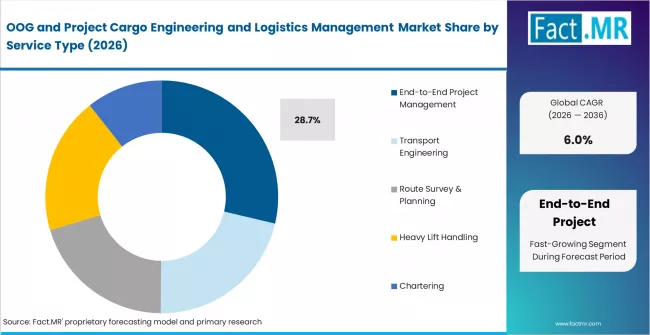
- By Service Type, End-to-End Project Management is expected to hold 28.7% share in 2026, supported by the need to align engineering, transport sequencing, and site delivery under one accountability structure.
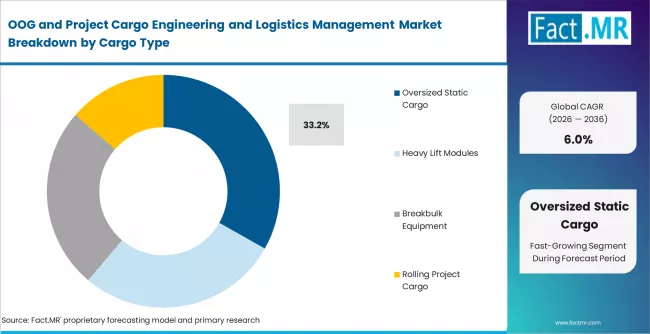
- By Cargo Type, Oversized Static Cargo is projected to account for 33.2% share in 2026 because large fabricated units, process equipment, and plant components generate recurring abnormal-load demand.
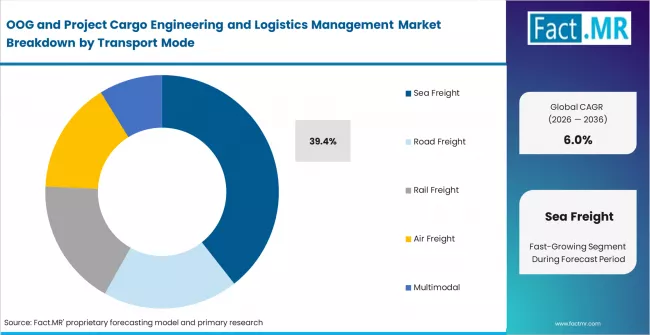
- By Transport Mode, Sea Freight is likely to capture 39.4% share in 2026 due to the role of breakbulk vessels, heavy-lift ships, barges, and charter solutions in long-distance project cargo moves.
- By End Use, Oil & Gas is estimated to represent 26.9% share in 2026 because refinery, petrochemical, LNG, and offshore-related cargo still require intensive engineering-led transport execution.
- Analyst Opinion at Fact.MR
- Shambhu Nath Jha, Senior Analyst at Fact.MR, states that this market is frequently misunderstood as a premium freight niche. In practice, it behaves more like a risk-transfer service. Clients do not buy project logistics merely to move large cargo. They buy it to reduce the chance that route assumptions, port constraints, lift planning, or customs timing will derail a much larger capital project. That is why commercial advantage stays with operators that can prove engineering discipline and execution governance, not just equipment access.
- Strategic Implications
- Providers should deepen engineering and route-risk capabilities instead of competing on freight coordination alone.
- EPC and industrial buyers need partners that can lock in chartering, customs sequencing, and site-delivery planning earlier in the project cycle.
- Operators with multimodal engineering depth are better positioned to win complex energy-transition, mining, and process-plant work.
- Methodology
- Focus on decision-makers controlling project cargo execution, lift planning, and heavy transport governance.
- Uses maritime, customs, and logistics-performance sources plus current operator capability disclosures.
- Connects industrial capex-linked cargo demand with engineering-led logistics value per movement.
- Cross-checks service structures against public operator offerings in heavy-lift and project logistics.
The market is projected to generate USD 8.4 billion between 2026 and 2036. Growth is steady but structurally selective. Standard freight demand does not define this market. Expansion comes from projects where cargo dimensions, lift weights, route limitations, site conditions, and schedule penalties make engineering-led logistics commercially necessary.
India leads with a projected CAGR of 8.2% through 2036, driven by rising adoption of customs-managed logistics and increasing demand for duty deferral and flexible inventory positioning near major trade gateways. China follows at 7.8%, supported by large-scale manufacturing trade and deeply integrated cross-border distribution networks. The United Arab Emirates grows at 7.6%, underpinned by re-export activity and strong free-zone ecosystems enabling regional redistribution. The United States records 6.9%, with growth anchored in established FTZ frameworks and steady demand for customs-managed inventory handling. Germany grows at 6.4%, driven by compliance-focused logistics execution and industrial trade requirements.
Segmental Analysis
OOG and Project Cargo Engineering and Logistics Management Market Analysis by Service Type
Oog And Project Cargo Engineering And Logistics Management Market Analysis By Service Type | Source: Fact.MR
End-to-End Project Management is expected to account for 28.7% share in 2026. Its lead reflects a simple commercial reality. Abnormal cargo rarely fails because one truck, vessel, or crane is missing. It fails because engineering assumptions, route timing, customs release, lift execution, and site access were not aligned early enough. That is why clients increasingly prefer a single manager that can coordinate the technical sequence from supplier pickup to final handover. DHL Industrial Projects describes large-scale project logistics around safety, agility, and on-time delivery. DB Schenker positions project logistics around end-to-end transportation of equipment and materials to the jobsite. CEVA frames project logistics as customized multimodal cross-border engineering and transportation solutions. Together, those offerings show why management-led services sit above standalone freight in value capture. [2]
- Sequence control: One lead manager reduces the chance that engineering, transport, and site teams work from different assumptions.
- Accountability: Clients prefer clear responsibility when delay costs can spill into wider construction and commissioning schedules.
- Risk reduction: The strongest providers solve conflicts between route feasibility, handling windows, and customs timing before cargo starts moving.
OOG and Project Cargo Engineering and Logistics Management Market Analysis by Cargo Type
Oog And Project Cargo Engineering And Logistics Management Market Analysis By Cargo Type | Source: Fact.MR
Oversized Static Cargo is projected to hold 33.2% share in 2026, as fixed-dimension modules, pressure vessels, transformers, reactors, fabricated skids, and large industrial assemblies create recurring engineering demands across energy, mining, and processing projects. These units may not always be the heaviest cargo, though they often create the tightest route constraints because they cannot be disassembled easily without cost or technical risk. Kuehne+Nagel positions its project logistics around heavy and oversized cargo requiring engineering, risk management, and chartering. Mammoet’s heavy transport positioning also reinforces how large static objects call for specialized equipment, route treatment, and controlled load movement instead of normal freight handling. [3]
- Route pressure: Oversized static cargo stresses roads, bridges, ports, and site access points more than standard freight.
- Fabrication logic: Large modules are often moved in near-finished form because on-site assembly can be slower, costlier, or riskier.
- Handling intensity: These loads require tighter supervision across lifting, securing, and final placement because geometry matters as much as weight.
OOG and Project Cargo Engineering and Logistics Management Market Analysis by Transport Mode
Oog And Project Cargo Engineering And Logistics Management Market Analysis By Transport Mode | Source: Fact.MR
Sea Freight is likely to account for 39.4% share in 2026. Large industrial components, heavy process modules, wind and energy equipment, and abnormal fabricated units are often better suited to heavy-lift vessels, multipurpose ships, barges, or chartered marine solutions than to road-only movement. UNCTAD continues to position maritime transport as the backbone of world trade, and project logistics providers consistently build their offering around marine engineering, breakbulk handling, and port-to-site coordination. Sea freight does not solve the entire movement, though it often anchors the most critical leg in international project cargo execution. [4]
- Distance advantage: Marine transport remains the most practical option for many oversized units crossing continents or reaching coastal industrial sites.
- Charter relevance: Project cargo often relies on tailored vessel or barge solutions rather than fixed scheduled services.
- Port dependency: Marine dominance increases the value of load-out engineering, terminal readiness, and synchronized inland follow-on transport.
Drivers, Restraints, and Opportunities
Oog And Project Cargo Engineering And Logistics Management Market Opportunity Matrix Growth Vs Value | Source: Fact.MR
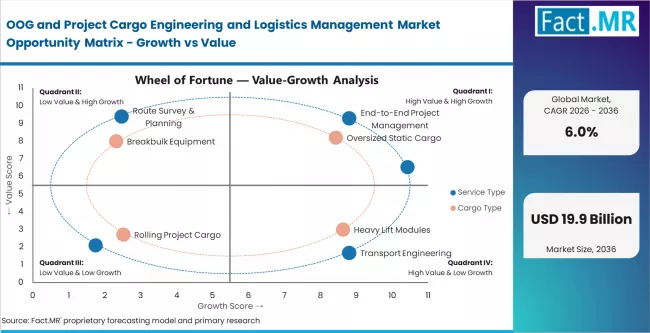
A core driver is the continued need to deliver industrial and infrastructure cargo that does not fit standardized logistics networks. Trade facilitation rules aim to speed movement and clearance of goods, yet that benefit becomes even more important when a shipment is oversized, chartered, or bound for a site that cannot tolerate delay. Project logistics providers win where they can connect freight movement with engineering, customs control, and site-readiness planning instead of leaving those functions fragmented. Trade remains substantial and maritime transport remains central, which helps sustain the underlying base of international project cargo demand.
The main restraint is not demand uncertainty alone. It is execution fragility. OOG and heavy-lift movements depend on permits, route windows, infrastructure clearance, handling equipment, escort planning, marine weather, and customs timing. One missed approval can disrupt the entire sequence. Longer shipping routes and corridor volatility make this harder because abnormal cargo cannot be rerouted as easily as containerized freight. That raises the threshold for operator competence and slows market expansion relative to the underlying industrial project pipeline.
Opportunities in the OOG and Project Cargo Engineering and Logistics Management Market
- Energy-transition cargo: Wind, grid, process-equipment, and decarbonization projects create fresh demand for engineered transport and heavy-lift delivery. DSV explicitly references project-related transport for over-dimensioned and heavy cargo such as wind turbines. [6]
- Integrated heavy-lift capability: Operators that combine forwarding with equipment, engineering, and installation depth can move up the value chain. CEVA’s 2026 acquisition of Fagioli directly expands its end-to-end engineering and heavy transport capabilities. [7]
- Emerging industrial corridors: Countries improving logistics performance, customs speed, and infrastructure quality become more attractive for project cargo execution. The World Bank LPI continues to track customs, infrastructure, and timeliness as core logistics dimensions.
Regional Analysis
Based on the regional analysis, the OOG and Project Cargo Engineering and Logistics Management Market is segmented into Asia Pacific, North America, Europe, Latin America, and Middle East & Africa across 40 plus countries.
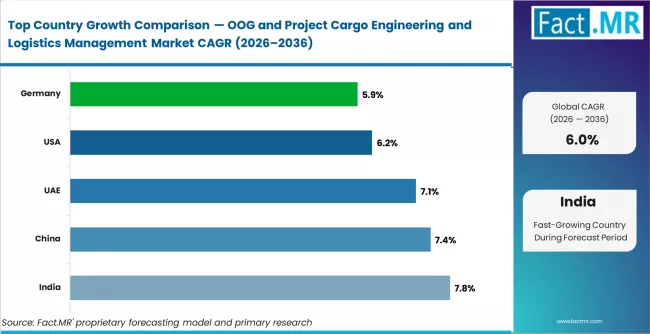
.webp "Top Country Growth Comparison Oog And Project Cargo Engineering And Logistics Management Market Cagr (2026 2036)")
Top Country Growth Comparison Oog And Project Cargo Engineering And Logistics Management Market Cagr (2026 2036) | Source: Fact.MR
| Country | CAGR (2026 to 2036) |
|---|---|
| India | 7.8% |
| China | 7.4% |
| United Arab Emirates | 7.1% |
| United States | 6.2% |
| Germany | 5.9% |
Source: Fact.MR analysis. Updated May 7, 2026
Source: Fact.MR analysis, based on proprietary forecasting model and primary research.
Oog And Project Cargo Engineering And Logistics Management Market Cagr Analysis By Country | Source: Fact.MR
Asia Pacific OOG and Project Cargo Engineering and Logistics Management Market Analysis
Asia Pacific leads growth because it combines industrial build-out, manufacturing depth, infrastructure expansion, and large-scale energy equipment movement. Project cargo demand here is rarely generic. It tends to be tied to process plants, grid assets, heavy industrial equipment, fabrication exports, and major construction packages that need engineered routing and multimodal coordination. India and China stand out for different reasons. India benefits from rising infrastructure ambition and improving logistics capability, while China combines industrial output, fabrication scale, and dense maritime connectivity. The World Bank’s LPI and India’s 2024 government commentary on that ranking both point to improving logistics capability, which matters because oversized cargo execution depends heavily on customs, infrastructure, and shipment timeliness.
- India: Demand for OOG and project cargo engineering and logistics management in India is projected to grow at 7.8% CAGR through 2036 as infrastructure build-out, industrial equipment movement, and improving logistics capability create stronger demand for route engineering and abnormal-load execution. deugro’s earlier investment in specialized heavy-lift equipment in India also reflects the country’s attractiveness for engineered cargo handling.
- China: The China market is expected to advance at 7.4% CAGR through 2036 because fabrication depth, export-linked industrial cargo, and large project movements keep oversized and heavy-lift logistics commercially important. deugro’s project work in China illustrates the presence of technically demanding industrial cargo movements in this environment.
Fact.MR’s Asia Pacific analysis also includes South Korea, ASEAN, and Australia, where industrial and energy-linked cargo flows keep project logistics relevant even when growth is more project-specific than broad-based.
Middle East and Africa OOG and Project Cargo Engineering and Logistics Management Market Analysis
This region remains one of the most engineering-sensitive project cargo environments because refinery, petrochemical, energy, and infrastructure developments create large critical-path movements with tight schedule dependence. The UAE stands out as both a project market and an execution hub, while Saudi Arabia remains important because industrial-scale developments continue to require specialized cargo handling. Mammoet’s long-standing UAE presence underlines the importance of local heavy-lift and transport capability in the region. Buyers here place a premium on providers that can combine engineering rigor with regional execution knowledge.
- United Arab Emirates: The UAE is likely to record 7.1% CAGR through 2036, supported by regional hub status, project cargo transshipment advantages, and continued demand for engineering-led delivery in industrial and energy sectors.
Fact.MR’s regional view also covers other Gulf markets and selected African mining and energy corridors where heavy-lift and project logistics demand tends to follow capital project cycles closely.
North America, Europe, and Latin America OOG and Project Cargo Engineering and Logistics Management Market Analysis
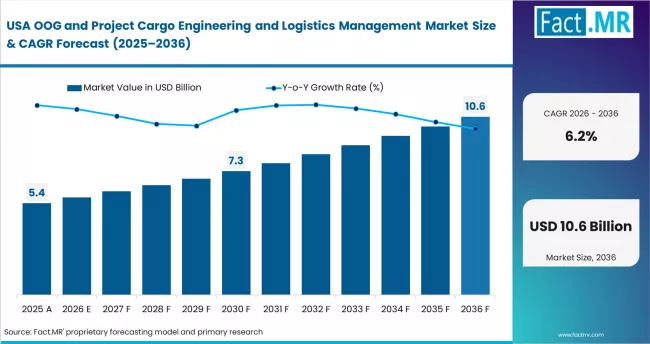
Oog And Project Cargo Engineering And Logistics Management Market Country Value Analysis | Source: Fact.MR
North America remains a mature but important project cargo region because industrial equipment movement, power-sector activity, and energy-related cargo keep demand steady. Europe remains engineering-led, with buyers placing high value on planning accuracy, route control, and specialized heavy-lift execution. Latin America retains relevance where mining, refining, and industrial plant cargo require difficult inland moves and corridor management. Mammoet’s completed refinery project in Colombia and its long-distance OOG transport case in Kazakhstan, while outside Latin America and Europe respectively, illustrate how the market rewards providers that can manage extended and technically difficult overland movements rather than relying on freight coordination alone.
- United States: The U.S. market is expected to expand at 6.2% CAGR through 2036, supported by energy, industrial, and infrastructure cargo demand, though growth is moderated by market maturity and more disciplined capex cycles.
- Germany: Germany is likely to grow at 5.9% CAGR through 2036 because of its role in industrial equipment, engineering-intensive exports, and project logistics planning depth.
Fact.MR’s broader regional coverage also includes Canada, Mexico, the Nordics, and selected Andean markets where project cargo demand follows industrial investment and route complexity more than generalized freight growth.
Competitive Aligners for Market Players
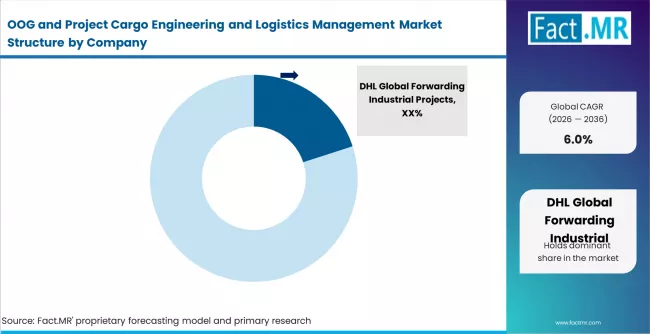
Oog And Project Cargo Engineering And Logistics Management Market Analysis By Company | Source: Fact.MR
The market is moderately fragmented, though not open-ended. Large players matter because project cargo requires global networks, engineering capacity, HSE discipline, charter access, and local execution reach. DHL Industrial Projects, deugro, Kuehne+Nagel, DB Schenker, CEVA Logistics, DSV, and Mammoet are all active in overlapping parts of this space, but they do not compete on identical terms. Some are stronger in forwarding and global coordination. Others are stronger in heavy-lift equipment, marine engineering, or site execution. That mix keeps the market competitive without making it interchangeable.
Competitive advantage is defined by engineering credibility and execution governance. Buyers want proof that a provider can survey the route, design the method, secure the right equipment, sequence customs correctly, and deliver to site without shifting risk back to the client. CEVA’s heavy-lift engineering positioning, Kuehne+Nagel’s engineering language, and DHL’s project-engineer roles all show that the market is moving toward deeper technicalization rather than toward simple freight commoditization.
Key Players in OOG and Project Cargo Engineering and Logistics Management Market
- DHL Global Forwarding Industrial Projects
- deugro
- Kuehne+Nagel
- DB Schenker
- CEVA Logistics
- DSV
- Mammoet
Bibliography
- [1] UN Trade and Development. Review of Maritime Transport 2024
- [2] DHL Global Forwarding. DHL Industrial Projects.
- [3] Kuehne+Nagel. Project Logistics: Engineering for heavy-lift and oversized cargo.
- [4] UN Trade and Development. Review of Maritime Transport 2025 overview.
- [5] World Trade Organization. Agreement on Trade Facilitation.
- [6] DSV. Annual report references to project-related transport services for over dimensioned and/or heavy cargo.
- [7] CEVA Logistics. Project Logistics solutions.
This Report Addresses
- Strategic outlook for engineering-led OOG and project cargo logistics demand.
- Forecast trajectory from USD 10.5 billion in 2026 to USD 18.9 billion by 2036.
- The role of route engineering, chartering, and jobsite delivery in value creation.
- Segment analysis by service type, cargo type, transport mode, and end use.
- Regional demand differences across Asia Pacific, the Gulf, North America, Europe, and Latin America.
- Competitive positioning of major project logistics and heavy-lift operators.
- The effect of trade facilitation, shipping-route disruption, and infrastructure quality on abnormal-load execution.
- Why project cargo behaves as a risk-transfer and engineering service rather than as premium freight alone.
OOG and Project Cargo Engineering and Logistics Management Market Definition
The market covers engineering-led logistics services used to move out-of-gauge, heavy-lift, breakbulk, and project-critical cargo that cannot be handled through conventional freight processes alone. It includes cargo planning, route and method engineering, equipment selection, chartering, lift execution, transport supervision, customs coordination, and final jobsite delivery for oversized or exceptionally heavy cargo.
OOG and Project Cargo Engineering and Logistics Management Market Inclusions
Market scope includes over-dimensional cargo planning, heavy-lift engineering, transport method statements, route surveys, bridge and road assessments, vessel or barge chartering, port handling supervision, load-out and load-in operations, multimodal coordination, and project cargo management for industrial, energy, mining, infrastructure, and manufacturing projects. It covers cargo that requires abnormal transport treatment because of size, weight, shape, sensitivity, or project criticality.
OOG and Project Cargo Engineering and Logistics Management Market Exclusions
The scope excludes ordinary containerized freight, general breakbulk forwarding without engineering-led execution, standard contract logistics without abnormal-load requirements, and cargo-insurance or consulting services sold without transport management responsibility. It also excludes pure equipment rental where no logistics or engineering service is delivered as part of the movement.
OOG and Project Cargo Engineering and Logistics Management Market Research Methodology
- Primary Research:Interviews with project logistics managers, heavy-lift engineers, route survey specialists, chartering managers, EPC supply chain leaders, and industrial procurement teams.
- Desk Research:Review of WTO trade facilitation rules, UNCTAD maritime transport reporting, World Bank logistics performance benchmarks, and current project-logistics service disclosures from major operators. [1]
- Market-Sizing and Forecasting:Hybrid model based on engineering-led project logistics exposure, heavy industrial capex-linked cargo demand, and service-value layering across oversized and heavy-lift movements.
- Data Validation and Update Cycle:Validation against public operator capabilities, current project-logistics positioning, customs and corridor constraints, and the infrastructure and timeliness indicators used in trade-logistics benchmarking.
Segmentation
Scope of the Report
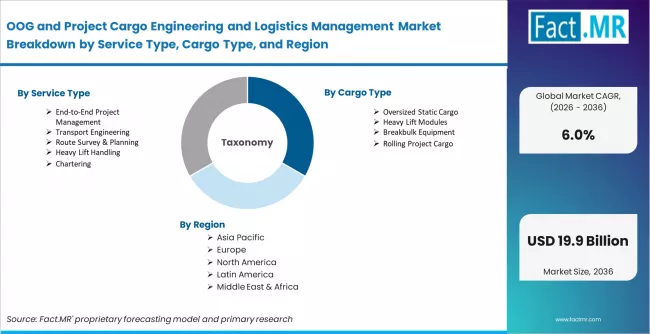
Oog And Project Cargo Engineering And Logistics Management Market Breakdown By Service Type, Cargo Type, And Region | Source: Fact.MR
| Attribute | Details |
|---|---|
| Quantitative Units | USD 10.5 billion (2026) to USD 18.9 billion (2036), at a CAGR of 6.0% |
| Market Definition | Engineering-led logistics services for OOG, heavy-lift, breakbulk, and project-critical cargo requiring route planning, specialized handling, chartering, transport supervision, and site delivery |
| Service Type Segmentation | Transport Engineering, Route Survey & Planning, Heavy Lift Handling, Chartering, End-to-End Project Management |
| Cargo Type Segmentation | Oversized Static Cargo, Heavy Lift Modules, Breakbulk Equipment, Rolling Project Cargo |
| Transport Mode Segmentation | Sea Freight, Road Freight, Rail Freight, Air Freight, Multimodal |
| End Use Segmentation | Oil & Gas, Power & Energy, Mining & Metals, Industrial Manufacturing, Infrastructure, Others |
| Regions Covered | Asia Pacific, North America, Europe, Latin America, Middle East & Africa |
| Countries Covered | India, China, United Arab Emirates, United States, Germany, Saudi Arabia, Brazil, and 40+ countries |
| Key Companies Profiled | DHL Global Forwarding Industrial Projects, deugro, Kuehne+Nagel, DB Schenker, CEVA Logistics, DSV, Mammoet |
| Forecast Period | 2026 to 2036 |
| Approach | Hybrid sizing based on industrial project cargo intensity, engineering-led logistics value capture, heavy-lift execution requirements, and current operator capability validation |
Source: Fact.MR analysis. Updated May 7, 2026
Frequently Asked Questions
How large is the OOG and project cargo engineering and logistics management market in 2025?
What will the market size be in 2026?
What is the projected market size by 2036?
What is the expected CAGR from 2026 to 2036?
Which service type is poised to lead the market?
Which cargo type holds the largest share?
Which transport mode dominates the market?
Which end-use segment leads the market?
Which country shows the fastest growth?
What is driving demand in this market?
What is the key challenge in this market?
Who worked on this report


Preview the report firsthand - request a free sample
Free SampleGet the brochure for pricing and purchase details
Download PDF