Tablet-activated face masks market (2026 - 2036)
Tablet-activated face masks market Size and Share Forecast Outlook 2026 to 2036
Core Findings
Tablet-Activated Face Masks Market Forecast and Outlook 2026 to 2036
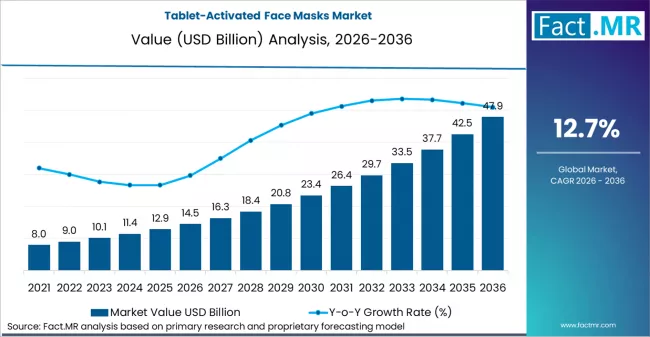
Global demand for tablet-activated face masks is entering a phase of accelerated expansion, with market value forecast to rise from about USD 14.5 billion in 2026 to nearly USD 47.9 billion by 2036, representing a strong CAGR of 12.7%. This growth is closely tied to the broader shift toward waterless beauty, as well as consumer appetite for lightweight, travel-friendly skincare that avoids preservatives and excess packaging. Tablet masks resonate with users who want control over what goes onto their skin, allowing them to activate dry compressed sheets with their own serums, floral waters, or treatment boosters, effectively turning masking into a personalized ritual rather than a fixed, one-size-fits-all product.
Key Takeaways for Tablet-Activated Face Masks Market
- Tablet-Activated Face Masks Market Value (2026): USD 14.5 billion
- Tablet-Activated Face Masks Market Forecast Value (2036): USD 47.9 billion
- Tablet-Activated Face Masks Market Forecast CAGR (2026 to 2036): 12.7%
- Leading Product Type: Compressed Mask Tablets (42.6%)
- Leading Market Participants: L’Oréal, Estée Lauder, Unilever, Shiseido, P&G, Beiersdorf
- Key Growth Regions: Asia Pacific, North America, Europe
At a strategic level, tablet-activated masks reflect a deeper change in how value is created within the masking category. Brands are moving away from shipping water and single-use saturated materials and toward selling concentrated, anhydrous formats that deliver potency only at the moment of use. This transition is reinforced by tightening sustainability regulations in Europe and rising logistics costs globally, which make dry, compact formats far more attractive operationally.
Lighter weight and smaller volume significantly reduce transportation emissions and storage costs, while the absence of water enables preservative-free positioning and better protection of sensitive actives. As a result, tablet masks are increasingly viewed not as a niche innovation, but as a structurally efficient, customizable, and environmentally aligned solution that is reshaping the future of facial masking across both mature and emerging beauty markets.
Tablet-Activated Face Masks Market
| Metric | Value |
|---|---|
| Estimated Value in (2026E) | USD 14.5 billion |
| Forecast Value in (2036F) | USD 47.9 billion |
| Forecast CAGR (2026 to 2036) | 12.7 % |
Category
| Category | Segments |
|---|---|
| Product Type | Compressed Mask Tablets, Powder Mask Tablets, Multi-Actives / Enzyme Tablets |
| Function/Benefit | Hydrating Masks, Brightening / Tone-Evening, Detox / Purifying MasksAnti-Aging / Firming, Acne / Oil Control |
| Skin Type | Combination Skin, Normal Skin, Dry Skin, Oily Skin, Sensitive Skin |
| End User | Women, Men, Unisex |
| Distribution Channel | Online Retailers, Supermarkets & Hypermarkets, Drugstores & Pharmacies, Specialty Beauty Stores |
| Region | North America; Europe; Asia Pacific; Latin America; Middle East & Africa |
Segmental Analysis
How are compressed mask tablets emerging as the preferred delivery format in the Mask Tablets Market?
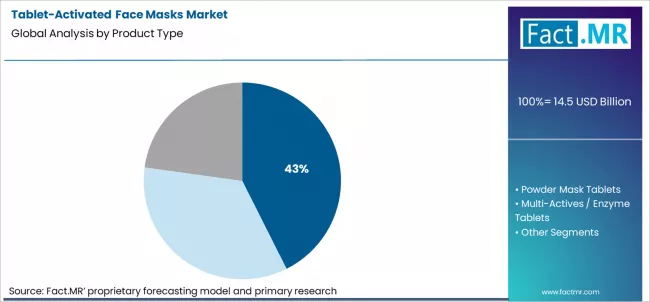
Compressed mask tablets account for 42.6% of the market because they align with a growing preference for controlled dosing, portability, and reduced formulation stress. Brand formulation strategies increasingly favor dry compression over pre-soaked masks to eliminate preservative dependency and extend shelf life. This format allows activation only at the point of use, improving ingredient stability and minimizing irritation risk. The ability to pair tablets with customized liquids such as toners or essences has positioned compressed tablets as adaptable platforms rather than fixed-use products, supporting repeat adoption across hydration, calming, and recovery routines.
Why are hydrating masks the dominant functional application within mask tablet formats?
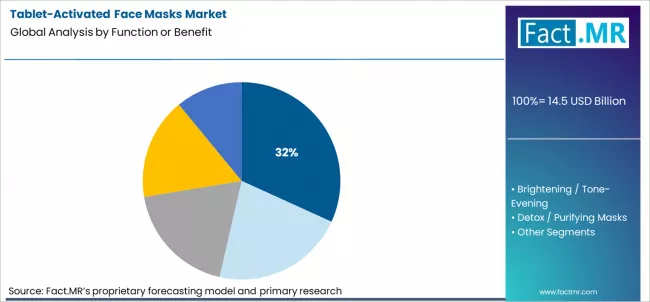
Hydrating masks hold a 31.8% share as they address the most universal and recurrent skin concern across climates, routines, and skin types. Market behavior shows hydration positioned as a daily maintenance function rather than an occasional treatment, favoring formats suitable for frequent use. Tablet-based hydration masks enable lightweight humectant delivery without occlusive overload, supporting barrier repair while avoiding residue. Their compatibility with hyaluronic acid, glycerin, and botanical infusions has reinforced adoption as a baseline skincare step, making hydration the anchor function around which other benefits are layered.
What are the Drivers, Restraints, and Key Trends in the Tablet-activated face masks market?
- Drivers: The strongest momentum behind tablet-activated face masks comes from a clear industry shift toward water-free performance. Major beauty groups are increasingly designing products that keep potent actives dormant until the moment of use. Dry tablet formats protect sensitive ingredients from oxidation and degradation, allowing brands to offer fresher, more effective treatments without relying on heavy preservative systems. This approach resonates with consumers who associate “freshly activated” skincare with clinical credibility and gentler skin interaction. Operational efficiency reinforces this demand. Tablet masks dramatically reduce shipping weight and storage volume compared to pre-soaked sheet masks. Brands adopting this format are lowering transport emissions, simplifying packaging, and improving margins at a time when sustainability regulations and logistics costs are rising globally. Compact, mono-material packaging also fits clean-beauty expectations and retailer pressure to reduce waste.
- Restraints: Adoption is constrained by the added activation step. Some consumers still prefer immediate, no-effort application, making tablets less appealing in fast routines. Technical challenges also persist around moisture sensitivity, as tablets require high-barrier packaging to prevent premature activation, increasing production complexity and cost.
- Key Trends:
Shift Toward Mix-and-Match Skincare Systems: Tablet-activated masks are increasingly being positioned as modular skincare tools rather than fixed, single-use products. Brands are encouraging consumers to activate tablets with customized liquids such as toners, essences, or serums tailored to daily skin conditions. This mix-and-match approach reflects a broader move toward personalized routines, where users actively control concentration and function.The trend supports higher engagement, repeat usage, and premium pricing by transforming masks from passive treatments into interactive skincare steps. - Integration of Clinical and Bio-Engineered Actives: Manufacturers are embedding tablet formats into clinically oriented skincare strategies. Dry compression allows incorporation of advanced bio-engineered ingredients that remain stable without water, including fermented extracts, probiotics, and next-generation barrier-repair compounds. This has shifted tablet masks toward professional-grade positioning, often linked to post-procedure care or intensive treatment cycles. The result is a convergence of spa, dermatology, and at-home skincare, reinforcing tablets as high-performance formats rather than novelty alternatives to sheet masks.
Analysis of the Tablet-Activated Face Masks Market by Key Country
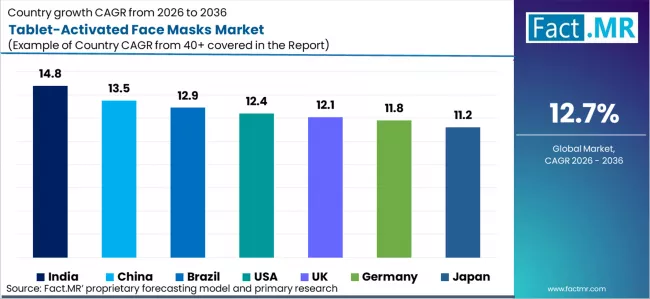
| Country | CAGR 2026 to 2036 |
|---|---|
| India | 14.8% |
| China | 13.5% |
| Brazil | 12.9% |
| USA | 12.4% |
| UK | 12.1% |
| Germany | 11.8% |
| Japan | 11.2% |
How is India becoming the fastest-expanding market for tablet-activated face masks through controlled activation and climate resilience?
With an expected CAGR of 14.8% between 2026 and 2036, India stands out as the fastest-growing market, shaped by structural and environmental realities rather than trend adoption alone. Inconsistent cold-chain infrastructure and prolonged exposure to heat and humidity accelerate the breakdown of pre-soaked sheet masks during storage and transit. Tablet-activated formats solve this by remaining inert until use, allowing consumers to activate masks with purified water, floral hydrosols, or targeted essences. This control preserves potency and reduces contamination risk. Dermatology-led domestic brands and multinational portfolios have scaled waterless booster systems positioned around hard-water stress, pollution exposure, and barrier repair. As a result, tablet masks are increasingly perceived as functional climate-adaptive skincare tools rather than discretionary premium add-ons.
Why is regulatory tightening accelerating adoption of tablet-activated masks in China?
China’s tablet-activated face mask market is advancing at a projected 13.5% CAGR, driven primarily by regulatory and compliance dynamics. Rising scrutiny of synthetic stabilizers and preservatives in high-humidity urban regions has shifted brand formulation strategies toward dry-state systems. Tablet masks maintain ingredient stability without reliance on chemical preservation, aligning with both regulatory expectations and consumer demand for transparency. National reforms emphasizing intrinsic skin health and product efficacy have further legitimized compressed formats. Global and domestic brands are reallocating innovation pipelines toward dry activation models distributed through livestream-driven e-commerce channels, accelerating penetration at scale while meeting tightening clean beauty standards.
What is driving Brazil’s rapid uptake of tablet-activated face masks despite infrastructure complexity?
Brazil is forecast to expand at a 12.9% CAGR, supported by regulatory pressure rather than distribution efficiency. Amendments to the National Solid Waste Policy and the adoption of IFRS sustainability disclosures have increased financial and reputational risk associated with single-use plastic packaging. Tablet-plus-booster systems materially reduce packaging volume and enable refill logic, making them attractive compliance solutions. At the same time, Brazil’s biodiversity-centric beauty culture supports acceptance of concentrated, waterless formats paired with botanical activators. Despite logistical challenges related to climate and regional infrastructure, regulatory cost pressure continues to favor tablet masks as the most viable pathway for sustainable facial masking.
How is the United States scaling tablet-activated masks through beauty-tech integration?
In the United States, the tablet-activated face mask market is expanding at a 12.4% CAGR, shaped by technology-led personalization rather than regulation. Demand is anchored in TSA compliance, hygiene consciousness, and data-driven skincare routines. Beauty-tech platforms linking skin diagnostics to customized activation have repositioned tablets as precision treatment tools rather than convenience substitutes for sheet masks. This integration supports preservative-free positioning while enabling mass-premium scalability across specialty retail and omni channel platforms. Capital allocation following beauty-tech showcases and acquisitions has accelerated consumer normalization of tablet masks as part of connected skincare ecosystems.
How are environmental levies reshaping the tablet mask market in the United Kingdom?
The UK market is on track to grow at a 12.1% CAGR, driven by fiscal rather than behavioral change. Packaging Extended Producer Responsibility reforms have sharply increased the cost burden of liquid-saturated, multi-material sheet masks. Retailers have responded by proactively shifting assortments toward dry tablet masks packaged in mono-material cardboard formats to reduce modulated fee exposure. This retailer-led transition has moved tablet-activated masks from sustainability pilots into core private-label and branded offerings. As cost avoidance becomes a strategic priority, tablet formats are increasingly embedded into mainstream facial care ranges.
Why is Germany adopting tablet-activated masks through a compliance-first pathway?
Germany is projected to record a 11.8% CAGR, reflecting a disciplined, regulation-anchored adoption curve. EU Omnibus regulations and the Net Zero 2045 roadmap have institutionalized demand for biodegradable and circular single-use alternatives. Bio-cellulose and compressed tablet masks provide a compliant substitute for non-recyclable sheet masks while meeting stringent safety and labeling standards. Extensive validation requirements slow rollout speed, yet reinforce trust and repeat usage. Adoption in Germany is less about novelty and more about structural alignment with long-term regulatory and consumer expectations.
What explains Japan’s innovation-led but measured growth in tablet-activated face masks?
Japan’s market is expected to grow at a 11.2% CAGR, reflecting innovation discipline over rapid expansion. Cultural preference for freshness, enzymatic activation, and minimal waste naturally supports dry-to-wet formats. National resource circulation mandates have reinforced investment in refillable and anhydrous systems, while centralized R&D structures ensure that tablet masks meet exceptionally high sensorial and performance benchmarks. Although these standards slow mass-market rollout, they support durable credibility and long-term category stability, positioning tablet-activated masks as premium functional skincare rather than transient trends.
Competitive Landscape of the Tablet-Activated Face Masks Market
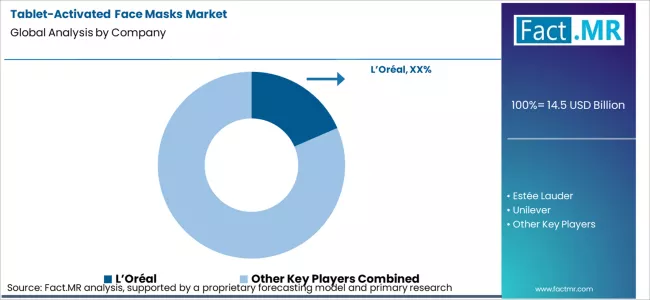
The tablet-activated face masks market has quietly but decisively moved out of its early novelty phase. In the years leading up to 2024, compressed dry masks were treated as peripheral accessories rather than serious skincare formats. They were commonly positioned as low-cost, travel-friendly add-ons meant to be paired with leftover toners or serums. Large beauty groups largely deprioritized the category, keeping R&D spend minimal and limiting innovation to basic cotton or nonwoven substrates. Prestige investment remained concentrated in pre-soaked sheet masks, which were viewed as the primary vehicle for efficacy and sensorial appeal.
That perception changed sharply in 2025. Leading global players began reframing the tablet not as a passive carrier, but as a controlled activation platform. Capital and talent shifted toward material science, with compressed masks engineered from bio-cellulose, bamboo fiber, and hybrid matrices designed to absorb and release actives with precision. Strategic disclosures from major groups signal a broader repositioning of tablets as part of beauty-tech systems rather than standalone consumables. The focus has moved from hydration toward targeted delivery, personalization, and integration with diagnostic and activation technologies.
Competition is consolidating around experience ownership rather than volume. Conglomerates are pairing tablets with proprietary boosters, devices, and refill ecosystems that smaller brands struggle to replicate. Basic compressed masks are becoming commoditized, while high-performance tablet systems are emerging as defensible platforms. The category has evolved into a professional-grade treatment model built on waterless efficiency, controlled activation, and long-term consumer engagement.
Key Players in Tablet-Activated Face Masks Market
- L’Oréal
- Estée Lauder
- Unilever
- Shiseido
- P&G
- Beiersdorf
Scope of Report
| Items | Values |
|---|---|
| Quantitative Units (2026) | USD 14.5 Billion |
| Product Type | Compressed Mask Tablets, Powder Mask Tablets, Multi-Actives / Enzyme Tablets |
| Function/Benefit | Hydrating Masks, Brightening / Tone-Evening, Detox / Purifying MasksAnti-Aging / Firming, Acne / Oil Control |
| Skin Type | Combination Skin, Normal Skin, Dry Skin, Oily Skin, Sensitive Skin |
| End User | Women, Men, Unisex |
| Distribution Channel | Online Retailers, Supermarkets & Hypermarkets, Drugstores & Pharmacies, Specialty Beauty Stores |
| Regions Covered | North America, Europe, Asia Pacific, Latin America, Middle East & Africa |
| Countries Covered | U.S., Canada, Germany, Italy, UK, France, Japan, Australia, and other countries |
| Key Companies Profiled | L’Oréal, Estée Lauder, Unilever, Shiseido, P&G, Beiersdorf |
| Additional Attributes | Dollar revenue in the tablet-activated face masks market is segmented by product type, formulation, distribution channel, price tier, and region. Regional demand is being shaped by growing preference for waterless and travel-friendly skincare, rising adoption of targeted and high-potency treatments, premiumization of facial care routines, and expanding penetration of online, specialty beauty, and portability-driven retail channels. |
Tablet-Activated Face Masks Market by Segments
-
Product Type :
- Compressed Mask Tablets
- Powder Mask Tablets
- Multi-Actives / Enzyme Tablets
-
Functions/ Benefit :
- Hydrating Masks
- Brightening / Tone-Evening
- Detox / Purifying Masks
- Anti-Aging / Firming
- Acne / Oil Control
-
Skin Type :
- Combination Skin
- Normal Skin
- Dry Skin
- Oily Skin
- Sensitive Skin
-
End User :
- Women
- Men
- Unisex
-
Distribution Channel :
- Online Retailers
- Supermarkets & Hypermarkets
- Drugstores & Pharmacies
- Specialty Beauty Stores
-
Region :
- Asia Pacific
- Japan
- South Korea
- China
- Australia
- New Zealand
- Rest of Asia Pacific
- North America
- United States
- Canada
- Mexico
- Europe
- France
- Italy
- Spain
- Norway
- UK
- Rest of Europe
- Latin America
- Chile
- Peru
- Argentina
- Rest of Latin America
- Asia Pacific
Bibliography
- International Organization for Standardization. 2023. Cosmetics and personal care products: Safety assessment and formulation standards for solid and waterless facial skincare products. ISO Technical Report. International Organization for Standardization, Geneva.
- European Commission. 2022. Cosmetic Products Regulation: Ingredient safety, labeling, and compliance requirements. European Commission, Brussels.
- International Federation of Societies of Cosmetic Chemists. 2024. Advances in solid, dry-state, and tablet-activated facial skincare formulation science. IFSCC Publications, London.
- Journal of Cosmetic Science. 2024. Tablet-activated and anhydrous facial mask innovations: Performance, stability, and skin compatibility. Journal of Cosmetic Science, Vol. 75.
- Personal Care Products Council. 2023. Trends in premium facial care, waterless beauty formats, and sustainable skincare delivery systems. PCPC, Washington, DC.
Table of Content
- Executive Summary
- Global Market Outlook
- Demand to side Trends
- Supply to side Trends
- Technology Roadmap Analysis
- Analysis and Recommendations
- Market Overview
- Market Coverage / Taxonomy
- Market Definition / Scope / Limitations
- Research Methodology
- Chapter Orientation
- Analytical Lens and Working Hypotheses
- Market Structure, Signals, and Trend Drivers
- Benchmarking and Cross-market Comparability
- Market Sizing, Forecasting, and Opportunity Mapping
- Research Design and Evidence Framework
- Desk Research Programme (Secondary Evidence)
- Company Annual and Sustainability Reports
- Peer-reviewed Journals and Academic Literature
- Corporate Websites, Product Literature, and Technical Notes
- Earnings Decks and Investor Briefings
- Statutory Filings and Regulatory Disclosures
- Technical White Papers and Standards Notes
- Trade Journals, Industry Magazines, and Analyst Briefs
- Conference Proceedings, Webinars, and Seminar Materials
- Government Statistics Portals and Public Data Releases
- Press Releases and Reputable Media Coverage
- Specialist Newsletters and Curated Briefings
- Sector Databases and Reference Repositories
- FMR Internal Proprietary Databases and Historical Market Datasets
- Subscription Datasets and Paid Sources
- Social Channels, Communities, and Digital Listening Inputs
- Additional Desk Sources
- Expert Input and Fieldwork (Primary Evidence)
- Primary Modes
- Qualitative Interviews and Expert Elicitation
- Quantitative Surveys and Structured Data Capture
- Blended Approach
- Why Primary Evidence is Used
- Field Techniques
- Interviews
- Surveys
- Focus Groups
- Observational and In-context Research
- Social and Community Interactions
- Stakeholder Universe Engaged
- C-suite Leaders
- Board Members
- Presidents and Vice Presidents
- R&D and Innovation Heads
- Technical Specialists
- Domain Subject-matter Experts
- Scientists
- Physicians and Other Healthcare Professionals
- Governance, Ethics, and Data Stewardship
- Research Ethics
- Data Integrity and Handling
- Primary Modes
- Tooling, Models, and Reference Databases
- Desk Research Programme (Secondary Evidence)
- Data Engineering and Model Build
- Data Acquisition and Ingestion
- Cleaning, Normalisation, and Verification
- Synthesis, Triangulation, and Analysis
- Quality Assurance and Audit Trail
- Market Background
- Market Dynamics
- Drivers
- Restraints
- Opportunity
- Trends
- Scenario Forecast
- Demand in Optimistic Scenario
- Demand in Likely Scenario
- Demand in Conservative Scenario
- Opportunity Map Analysis
- Product Life Cycle Analysis
- Supply Chain Analysis
- Investment Feasibility Matrix
- Value Chain Analysis
- PESTLE and Porter’s Analysis
- Regulatory Landscape
- Regional Parent Market Outlook
- Production and Consumption Statistics
- Import and Export Statistics
- Market Dynamics
- Global Market Analysis 2021 to 2025 and Forecast, 2026 to 2036
- Historical Market Size Value (USD Million) Analysis, 2021 to 2025
- Current and Future Market Size Value (USD Million) Projections, 2026 to 2036
- Y to o to Y Growth Trend Analysis
- Absolute $ Opportunity Analysis
- Global Market Pricing Analysis 2021 to 2025 and Forecast 2026 to 2036
- Global Market Analysis 2021 to 2025 and Forecast 2026 to 2036, By Product Type
- Introduction / Key Findings
- Historical Market Size Value (USD Million) Analysis By Product Type, 2021 to 2025
- Current and Future Market Size Value (USD Million) Analysis and Forecast By Product Type, 2026 to 2036
- Compressed Mask Tablets
- Powder Mask Tablets
- Multi-Actives / Enzyme Tablets
- Compressed Mask Tablets
- Y to o to Y Growth Trend Analysis By Product Type, 2021 to 2025
- Absolute $ Opportunity Analysis By Product Type, 2026 to 2036
- Global Market Analysis 2021 to 2025 and Forecast 2026 to 2036, By Function or Benefit
- Introduction / Key Findings
- Historical Market Size Value (USD Million) Analysis By Function or Benefit, 2021 to 2025
- Current and Future Market Size Value (USD Million) Analysis and Forecast By Function or Benefit, 2026 to 2036
- Hydrating Masks
- Brightening / Tone-Evening
- Detox / Purifying Masks
- Anti-Aging / Firming
- Acne / Oil Control
- Hydrating Masks
- Y to o to Y Growth Trend Analysis By Function or Benefit, 2021 to 2025
- Absolute $ Opportunity Analysis By Function or Benefit, 2026 to 2036
- Global Market Analysis 2021 to 2025 and Forecast 2026 to 2036, By Skin Type
- Introduction / Key Findings
- Historical Market Size Value (USD Million) Analysis By Skin Type, 2021 to 2025
- Current and Future Market Size Value (USD Million) Analysis and Forecast By Skin Type, 2026 to 2036
- Combination Skin
- Normal Skin
- Dry Skin
- Oily Skin
- Sensitive Skin
- Combination Skin
- Y to o to Y Growth Trend Analysis By Skin Type, 2021 to 2025
- Absolute $ Opportunity Analysis By Skin Type, 2026 to 2036
- Global Market Analysis 2021 to 2025 and Forecast 2026 to 2036, By Distribution Channel
- Introduction / Key Findings
- Historical Market Size Value (USD Million) Analysis By Distribution Channel, 2021 to 2025
- Current and Future Market Size Value (USD Million) Analysis and Forecast By Distribution Channel, 2026 to 2036
- Online Retail / E-Commerce
- Beauty Specialty Stores
- Mass Retailers / Supermarkets
- Pharmacies / Drug Stores
- Online Retail / E-Commerce
- Y to o to Y Growth Trend Analysis By Distribution Channel, 2021 to 2025
- Absolute $ Opportunity Analysis By Distribution Channel, 2026 to 2036
- Global Market Analysis 2021 to 2025 and Forecast 2026 to 2036, By End-User
- Introduction / Key Findings
- Historical Market Size Value (USD Million) Analysis By End-User, 2021 to 2025
- Current and Future Market Size Value (USD Million) Analysis and Forecast By End-User, 2026 to 2036
- Women
- Men
- Unisex
- Women
- Y to o to Y Growth Trend Analysis By End-User, 2021 to 2025
- Absolute $ Opportunity Analysis By End-User, 2026 to 2036
- Global Market Analysis 2021 to 2025 and Forecast 2026 to 2036, By Region
- Introduction
- Historical Market Size Value (USD Million) Analysis By Region, 2021 to 2025
- Current Market Size Value (USD Million) Analysis and Forecast By Region, 2026 to 2036
- North America
- Latin America
- Western Europe
- Eastern Europe
- East Asia
- South Asia and Pacific
- Middle East & Africa
- Market Attractiveness Analysis By Region
- North America Market Analysis 2021 to 2025 and Forecast 2026 to 2036, By Country
- Historical Market Size Value (USD Million) Trend Analysis By Market Taxonomy, 2021 to 2025
- Market Size Value (USD Million) Forecast By Market Taxonomy, 2026 to 2036
- By Country
- USA
- Canada
- Mexico
- By Product Type
- By Function or Benefit
- By Skin Type
- By Distribution Channel
- By End-User
- By Country
- Market Attractiveness Analysis
- By Country
- By Product Type
- By Function or Benefit
- By Skin Type
- By Distribution Channel
- By End-User
- Key Takeaways
- Latin America Market Analysis 2021 to 2025 and Forecast 2026 to 2036, By Country
- Historical Market Size Value (USD Million) Trend Analysis By Market Taxonomy, 2021 to 2025
- Market Size Value (USD Million) Forecast By Market Taxonomy, 2026 to 2036
- By Country
- Brazil
- Chile
- Rest of Latin America
- By Product Type
- By Function or Benefit
- By Skin Type
- By Distribution Channel
- By End-User
- By Country
- Market Attractiveness Analysis
- By Country
- By Product Type
- By Function or Benefit
- By Skin Type
- By Distribution Channel
- By End-User
- Key Takeaways
- Western Europe Market Analysis 2021 to 2025 and Forecast 2026 to 2036, By Country
- Historical Market Size Value (USD Million) Trend Analysis By Market Taxonomy, 2021 to 2025
- Market Size Value (USD Million) Forecast By Market Taxonomy, 2026 to 2036
- By Country
- Germany
- UK
- Italy
- Spain
- France
- Nordic
- BENELUX
- Rest of Western Europe
- By Product Type
- By Function or Benefit
- By Skin Type
- By Distribution Channel
- By End-User
- By Country
- Market Attractiveness Analysis
- By Country
- By Product Type
- By Function or Benefit
- By Skin Type
- By Distribution Channel
- By End-User
- Key Takeaways
- Eastern Europe Market Analysis 2021 to 2025 and Forecast 2026 to 2036, By Country
- Historical Market Size Value (USD Million) Trend Analysis By Market Taxonomy, 2021 to 2025
- Market Size Value (USD Million) Forecast By Market Taxonomy, 2026 to 2036
- By Country
- Russia
- Poland
- Hungary
- Balkan & Baltic
- Rest of Eastern Europe
- By Product Type
- By Function or Benefit
- By Skin Type
- By Distribution Channel
- By End-User
- By Country
- Market Attractiveness Analysis
- By Country
- By Product Type
- By Function or Benefit
- By Skin Type
- By Distribution Channel
- By End-User
- Key Takeaways
- East Asia Market Analysis 2021 to 2025 and Forecast 2026 to 2036, By Country
- Historical Market Size Value (USD Million) Trend Analysis By Market Taxonomy, 2021 to 2025
- Market Size Value (USD Million) Forecast By Market Taxonomy, 2026 to 2036
- By Country
- China
- Japan
- South Korea
- By Product Type
- By Function or Benefit
- By Skin Type
- By Distribution Channel
- By End-User
- By Country
- Market Attractiveness Analysis
- By Country
- By Product Type
- By Function or Benefit
- By Skin Type
- By Distribution Channel
- By End-User
- Key Takeaways
- South Asia and Pacific Market Analysis 2021 to 2025 and Forecast 2026 to 2036, By Country
- Historical Market Size Value (USD Million) Trend Analysis By Market Taxonomy, 2021 to 2025
- Market Size Value (USD Million) Forecast By Market Taxonomy, 2026 to 2036
- By Country
- India
- ASEAN
- Australia & New Zealand
- Rest of South Asia and Pacific
- By Product Type
- By Function or Benefit
- By Skin Type
- By Distribution Channel
- By End-User
- By Country
- Market Attractiveness Analysis
- By Country
- By Product Type
- By Function or Benefit
- By Skin Type
- By Distribution Channel
- By End-User
- Key Takeaways
- Middle East & Africa Market Analysis 2021 to 2025 and Forecast 2026 to 2036, By Country
- Historical Market Size Value (USD Million) Trend Analysis By Market Taxonomy, 2021 to 2025
- Market Size Value (USD Million) Forecast By Market Taxonomy, 2026 to 2036
- By Country
- Kingdom of Saudi Arabia
- Other GCC Countries
- Turkiye
- South Africa
- Other African Union
- Rest of Middle East & Africa
- By Product Type
- By Function or Benefit
- By Skin Type
- By Distribution Channel
- By End-User
- By Country
- Market Attractiveness Analysis
- By Country
- By Product Type
- By Function or Benefit
- By Skin Type
- By Distribution Channel
- By End-User
- Key Takeaways
- Key Countries Market Analysis
- USA
- Pricing Analysis
- Market Share Analysis, 2025
- By Product Type
- By Function or Benefit
- By Skin Type
- By Distribution Channel
- By End-User
- Canada
- Pricing Analysis
- Market Share Analysis, 2025
- By Product Type
- By Function or Benefit
- By Skin Type
- By Distribution Channel
- By End-User
- Mexico
- Pricing Analysis
- Market Share Analysis, 2025
- By Product Type
- By Function or Benefit
- By Skin Type
- By Distribution Channel
- By End-User
- Brazil
- Pricing Analysis
- Market Share Analysis, 2025
- By Product Type
- By Function or Benefit
- By Skin Type
- By Distribution Channel
- By End-User
- Chile
- Pricing Analysis
- Market Share Analysis, 2025
- By Product Type
- By Function or Benefit
- By Skin Type
- By Distribution Channel
- By End-User
- Germany
- Pricing Analysis
- Market Share Analysis, 2025
- By Product Type
- By Function or Benefit
- By Skin Type
- By Distribution Channel
- By End-User
- UK
- Pricing Analysis
- Market Share Analysis, 2025
- By Product Type
- By Function or Benefit
- By Skin Type
- By Distribution Channel
- By End-User
- Italy
- Pricing Analysis
- Market Share Analysis, 2025
- By Product Type
- By Function or Benefit
- By Skin Type
- By Distribution Channel
- By End-User
- Spain
- Pricing Analysis
- Market Share Analysis, 2025
- By Product Type
- By Function or Benefit
- By Skin Type
- By Distribution Channel
- By End-User
- France
- Pricing Analysis
- Market Share Analysis, 2025
- By Product Type
- By Function or Benefit
- By Skin Type
- By Distribution Channel
- By End-User
- India
- Pricing Analysis
- Market Share Analysis, 2025
- By Product Type
- By Function or Benefit
- By Skin Type
- By Distribution Channel
- By End-User
- ASEAN
- Pricing Analysis
- Market Share Analysis, 2025
- By Product Type
- By Function or Benefit
- By Skin Type
- By Distribution Channel
- By End-User
- Australia & New Zealand
- Pricing Analysis
- Market Share Analysis, 2025
- By Product Type
- By Function or Benefit
- By Skin Type
- By Distribution Channel
- By End-User
- China
- Pricing Analysis
- Market Share Analysis, 2025
- By Product Type
- By Function or Benefit
- By Skin Type
- By Distribution Channel
- By End-User
- Japan
- Pricing Analysis
- Market Share Analysis, 2025
- By Product Type
- By Function or Benefit
- By Skin Type
- By Distribution Channel
- By End-User
- South Korea
- Pricing Analysis
- Market Share Analysis, 2025
- By Product Type
- By Function or Benefit
- By Skin Type
- By Distribution Channel
- By End-User
- Russia
- Pricing Analysis
- Market Share Analysis, 2025
- By Product Type
- By Function or Benefit
- By Skin Type
- By Distribution Channel
- By End-User
- Poland
- Pricing Analysis
- Market Share Analysis, 2025
- By Product Type
- By Function or Benefit
- By Skin Type
- By Distribution Channel
- By End-User
- Hungary
- Pricing Analysis
- Market Share Analysis, 2025
- By Product Type
- By Function or Benefit
- By Skin Type
- By Distribution Channel
- By End-User
- Kingdom of Saudi Arabia
- Pricing Analysis
- Market Share Analysis, 2025
- By Product Type
- By Function or Benefit
- By Skin Type
- By Distribution Channel
- By End-User
- Turkiye
- Pricing Analysis
- Market Share Analysis, 2025
- By Product Type
- By Function or Benefit
- By Skin Type
- By Distribution Channel
- By End-User
- South Africa
- Pricing Analysis
- Market Share Analysis, 2025
- By Product Type
- By Function or Benefit
- By Skin Type
- By Distribution Channel
- By End-User
- USA
- Market Structure Analysis
- Competition Dashboard
- Competition Benchmarking
- Market Share Analysis of Top Players
- By Regional
- By Product Type
- By Function or Benefit
- By Skin Type
- By Distribution Channel
- By End-User
- Competition Analysis
- Competition Deep Dive
- L’Oréal
- Overview
- Product Portfolio
- Profitability by Market Segments (Product/Age /Sales Channel/Region)
- Sales Footprint
- Strategy Overview
- Marketing Strategy
- Product Strategy
- Channel Strategy
- Estée Lauder
- Unilever
- Shiseido
- P&G
- Beiersdorf
- L’Oréal
- Competition Deep Dive
- Assumptions & Acronyms Used
List Of Table
- Table 1: Global Market Value (USD Million) Forecast by Region, 2021 to 2036
- Table 2: Global Market Value (USD Million) Forecast by Product Type, 2021 to 2036
- Table 3: Global Market Value (USD Million) Forecast by Function or Benefit, 2021 to 2036
- Table 4: Global Market Value (USD Million) Forecast by Skin Type, 2021 to 2036
- Table 5: Global Market Value (USD Million) Forecast by Distribution Channel, 2021 to 2036
- Table 6: Global Market Value (USD Million) Forecast by End-User, 2021 to 2036
- Table 7: North America Market Value (USD Million) Forecast by Country, 2021 to 2036
- Table 8: North America Market Value (USD Million) Forecast by Product Type, 2021 to 2036
- Table 9: North America Market Value (USD Million) Forecast by Function or Benefit, 2021 to 2036
- Table 10: North America Market Value (USD Million) Forecast by Skin Type, 2021 to 2036
- Table 11: North America Market Value (USD Million) Forecast by Distribution Channel, 2021 to 2036
- Table 12: North America Market Value (USD Million) Forecast by End-User, 2021 to 2036
- Table 13: Latin America Market Value (USD Million) Forecast by Country, 2021 to 2036
- Table 14: Latin America Market Value (USD Million) Forecast by Product Type, 2021 to 2036
- Table 15: Latin America Market Value (USD Million) Forecast by Function or Benefit, 2021 to 2036
- Table 16: Latin America Market Value (USD Million) Forecast by Skin Type, 2021 to 2036
- Table 17: Latin America Market Value (USD Million) Forecast by Distribution Channel, 2021 to 2036
- Table 18: Latin America Market Value (USD Million) Forecast by End-User, 2021 to 2036
- Table 19: Western Europe Market Value (USD Million) Forecast by Country, 2021 to 2036
- Table 20: Western Europe Market Value (USD Million) Forecast by Product Type, 2021 to 2036
- Table 21: Western Europe Market Value (USD Million) Forecast by Function or Benefit, 2021 to 2036
- Table 22: Western Europe Market Value (USD Million) Forecast by Skin Type, 2021 to 2036
- Table 23: Western Europe Market Value (USD Million) Forecast by Distribution Channel, 2021 to 2036
- Table 24: Western Europe Market Value (USD Million) Forecast by End-User, 2021 to 2036
- Table 25: Eastern Europe Market Value (USD Million) Forecast by Country, 2021 to 2036
- Table 26: Eastern Europe Market Value (USD Million) Forecast by Product Type, 2021 to 2036
- Table 27: Eastern Europe Market Value (USD Million) Forecast by Function or Benefit, 2021 to 2036
- Table 28: Eastern Europe Market Value (USD Million) Forecast by Skin Type, 2021 to 2036
- Table 29: Eastern Europe Market Value (USD Million) Forecast by Distribution Channel, 2021 to 2036
- Table 30: Eastern Europe Market Value (USD Million) Forecast by End-User, 2021 to 2036
- Table 31: East Asia Market Value (USD Million) Forecast by Country, 2021 to 2036
- Table 32: East Asia Market Value (USD Million) Forecast by Product Type, 2021 to 2036
- Table 33: East Asia Market Value (USD Million) Forecast by Function or Benefit, 2021 to 2036
- Table 34: East Asia Market Value (USD Million) Forecast by Skin Type, 2021 to 2036
- Table 35: East Asia Market Value (USD Million) Forecast by Distribution Channel, 2021 to 2036
- Table 36: East Asia Market Value (USD Million) Forecast by End-User, 2021 to 2036
- Table 37: South Asia and Pacific Market Value (USD Million) Forecast by Country, 2021 to 2036
- Table 38: South Asia and Pacific Market Value (USD Million) Forecast by Product Type, 2021 to 2036
- Table 39: South Asia and Pacific Market Value (USD Million) Forecast by Function or Benefit, 2021 to 2036
- Table 40: South Asia and Pacific Market Value (USD Million) Forecast by Skin Type, 2021 to 2036
- Table 41: South Asia and Pacific Market Value (USD Million) Forecast by Distribution Channel, 2021 to 2036
- Table 42: South Asia and Pacific Market Value (USD Million) Forecast by End-User, 2021 to 2036
- Table 43: Middle East & Africa Market Value (USD Million) Forecast by Country, 2021 to 2036
- Table 44: Middle East & Africa Market Value (USD Million) Forecast by Product Type, 2021 to 2036
- Table 45: Middle East & Africa Market Value (USD Million) Forecast by Function or Benefit, 2021 to 2036
- Table 46: Middle East & Africa Market Value (USD Million) Forecast by Skin Type, 2021 to 2036
- Table 47: Middle East & Africa Market Value (USD Million) Forecast by Distribution Channel, 2021 to 2036
- Table 48: Middle East & Africa Market Value (USD Million) Forecast by End-User, 2021 to 2036
List Of Figures
- Figure 1: Global Market Pricing Analysis
- Figure 2: Global Market Value (USD Million) Forecast 2021 to 2036
- Figure 3: Global Market Value Share and BPS Analysis by Product Type, 2026 and 2036
- Figure 4: Global Market Y to o to Y Growth Comparison by Product Type, 2026 to 2036
- Figure 5: Global Market Attractiveness Analysis by Product Type
- Figure 6: Global Market Value Share and BPS Analysis by Function or Benefit, 2026 and 2036
- Figure 7: Global Market Y to o to Y Growth Comparison by Function or Benefit, 2026 to 2036
- Figure 8: Global Market Attractiveness Analysis by Function or Benefit
- Figure 9: Global Market Value Share and BPS Analysis by Skin Type, 2026 and 2036
- Figure 10: Global Market Y to o to Y Growth Comparison by Skin Type, 2026 to 2036
- Figure 11: Global Market Attractiveness Analysis by Skin Type
- Figure 12: Global Market Value Share and BPS Analysis by Distribution Channel, 2026 and 2036
- Figure 13: Global Market Y to o to Y Growth Comparison by Distribution Channel, 2026 to 2036
- Figure 14: Global Market Attractiveness Analysis by Distribution Channel
- Figure 15: Global Market Value Share and BPS Analysis by End-User, 2026 and 2036
- Figure 16: Global Market Y to o to Y Growth Comparison by End-User, 2026 to 2036
- Figure 17: Global Market Attractiveness Analysis by End-User
- Figure 18: Global Market Value (USD Million) Share and BPS Analysis by Region, 2026 and 2036
- Figure 19: Global Market Y to o to Y Growth Comparison by Region, 2026 to 2036
- Figure 20: Global Market Attractiveness Analysis by Region
- Figure 21: North America Market Incremental Dollar Opportunity, 2026 to 2036
- Figure 22: Latin America Market Incremental Dollar Opportunity, 2026 to 2036
- Figure 23: Western Europe Market Incremental Dollar Opportunity, 2026 to 2036
- Figure 24: Eastern Europe Market Incremental Dollar Opportunity, 2026 to 2036
- Figure 25: East Asia Market Incremental Dollar Opportunity, 2026 to 2036
- Figure 26: South Asia and Pacific Market Incremental Dollar Opportunity, 2026 to 2036
- Figure 27: Middle East & Africa Market Incremental Dollar Opportunity, 2026 to 2036
- Figure 28: North America Market Value Share and BPS Analysis by Country, 2026 and 2036
- Figure 29: North America Market Value Share and BPS Analysis by Product Type, 2026 and 2036
- Figure 30: North America Market Y to o to Y Growth Comparison by Product Type, 2026 to 2036
- Figure 31: North America Market Attractiveness Analysis by Product Type
- Figure 32: North America Market Value Share and BPS Analysis by Function or Benefit, 2026 and 2036
- Figure 33: North America Market Y to o to Y Growth Comparison by Function or Benefit, 2026 to 2036
- Figure 34: North America Market Attractiveness Analysis by Function or Benefit
- Figure 35: North America Market Value Share and BPS Analysis by Skin Type, 2026 and 2036
- Figure 36: North America Market Y to o to Y Growth Comparison by Skin Type, 2026 to 2036
- Figure 37: North America Market Attractiveness Analysis by Skin Type
- Figure 38: North America Market Value Share and BPS Analysis by Distribution Channel, 2026 and 2036
- Figure 39: North America Market Y to o to Y Growth Comparison by Distribution Channel, 2026 to 2036
- Figure 40: North America Market Attractiveness Analysis by Distribution Channel
- Figure 41: North America Market Value Share and BPS Analysis by End-User, 2026 and 2036
- Figure 42: North America Market Y to o to Y Growth Comparison by End-User, 2026 to 2036
- Figure 43: North America Market Attractiveness Analysis by End-User
- Figure 44: Latin America Market Value Share and BPS Analysis by Country, 2026 and 2036
- Figure 45: Latin America Market Value Share and BPS Analysis by Product Type, 2026 and 2036
- Figure 46: Latin America Market Y to o to Y Growth Comparison by Product Type, 2026 to 2036
- Figure 47: Latin America Market Attractiveness Analysis by Product Type
- Figure 48: Latin America Market Value Share and BPS Analysis by Function or Benefit, 2026 and 2036
- Figure 49: Latin America Market Y to o to Y Growth Comparison by Function or Benefit, 2026 to 2036
- Figure 50: Latin America Market Attractiveness Analysis by Function or Benefit
- Figure 51: Latin America Market Value Share and BPS Analysis by Skin Type, 2026 and 2036
- Figure 52: Latin America Market Y to o to Y Growth Comparison by Skin Type, 2026 to 2036
- Figure 53: Latin America Market Attractiveness Analysis by Skin Type
- Figure 54: Latin America Market Value Share and BPS Analysis by Distribution Channel, 2026 and 2036
- Figure 55: Latin America Market Y to o to Y Growth Comparison by Distribution Channel, 2026 to 2036
- Figure 56: Latin America Market Attractiveness Analysis by Distribution Channel
- Figure 57: Latin America Market Value Share and BPS Analysis by End-User, 2026 and 2036
- Figure 58: Latin America Market Y to o to Y Growth Comparison by End-User, 2026 to 2036
- Figure 59: Latin America Market Attractiveness Analysis by End-User
- Figure 60: Western Europe Market Value Share and BPS Analysis by Country, 2026 and 2036
- Figure 61: Western Europe Market Value Share and BPS Analysis by Product Type, 2026 and 2036
- Figure 62: Western Europe Market Y to o to Y Growth Comparison by Product Type, 2026 to 2036
- Figure 63: Western Europe Market Attractiveness Analysis by Product Type
- Figure 64: Western Europe Market Value Share and BPS Analysis by Function or Benefit, 2026 and 2036
- Figure 65: Western Europe Market Y to o to Y Growth Comparison by Function or Benefit, 2026 to 2036
- Figure 66: Western Europe Market Attractiveness Analysis by Function or Benefit
- Figure 67: Western Europe Market Value Share and BPS Analysis by Skin Type, 2026 and 2036
- Figure 68: Western Europe Market Y to o to Y Growth Comparison by Skin Type, 2026 to 2036
- Figure 69: Western Europe Market Attractiveness Analysis by Skin Type
- Figure 70: Western Europe Market Value Share and BPS Analysis by Distribution Channel, 2026 and 2036
- Figure 71: Western Europe Market Y to o to Y Growth Comparison by Distribution Channel, 2026 to 2036
- Figure 72: Western Europe Market Attractiveness Analysis by Distribution Channel
- Figure 73: Western Europe Market Value Share and BPS Analysis by End-User, 2026 and 2036
- Figure 74: Western Europe Market Y to o to Y Growth Comparison by End-User, 2026 to 2036
- Figure 75: Western Europe Market Attractiveness Analysis by End-User
- Figure 76: Eastern Europe Market Value Share and BPS Analysis by Country, 2026 and 2036
- Figure 77: Eastern Europe Market Value Share and BPS Analysis by Product Type, 2026 and 2036
- Figure 78: Eastern Europe Market Y to o to Y Growth Comparison by Product Type, 2026 to 2036
- Figure 79: Eastern Europe Market Attractiveness Analysis by Product Type
- Figure 80: Eastern Europe Market Value Share and BPS Analysis by Function or Benefit, 2026 and 2036
- Figure 81: Eastern Europe Market Y to o to Y Growth Comparison by Function or Benefit, 2026 to 2036
- Figure 82: Eastern Europe Market Attractiveness Analysis by Function or Benefit
- Figure 83: Eastern Europe Market Value Share and BPS Analysis by Skin Type, 2026 and 2036
- Figure 84: Eastern Europe Market Y to o to Y Growth Comparison by Skin Type, 2026 to 2036
- Figure 85: Eastern Europe Market Attractiveness Analysis by Skin Type
- Figure 86: Eastern Europe Market Value Share and BPS Analysis by Distribution Channel, 2026 and 2036
- Figure 87: Eastern Europe Market Y to o to Y Growth Comparison by Distribution Channel, 2026 to 2036
- Figure 88: Eastern Europe Market Attractiveness Analysis by Distribution Channel
- Figure 89: Eastern Europe Market Value Share and BPS Analysis by End-User, 2026 and 2036
- Figure 90: Eastern Europe Market Y to o to Y Growth Comparison by End-User, 2026 to 2036
- Figure 91: Eastern Europe Market Attractiveness Analysis by End-User
- Figure 92: East Asia Market Value Share and BPS Analysis by Country, 2026 and 2036
- Figure 93: East Asia Market Value Share and BPS Analysis by Product Type, 2026 and 2036
- Figure 94: East Asia Market Y to o to Y Growth Comparison by Product Type, 2026 to 2036
- Figure 95: East Asia Market Attractiveness Analysis by Product Type
- Figure 96: East Asia Market Value Share and BPS Analysis by Function or Benefit, 2026 and 2036
- Figure 97: East Asia Market Y to o to Y Growth Comparison by Function or Benefit, 2026 to 2036
- Figure 98: East Asia Market Attractiveness Analysis by Function or Benefit
- Figure 99: East Asia Market Value Share and BPS Analysis by Skin Type, 2026 and 2036
- Figure 100: East Asia Market Y to o to Y Growth Comparison by Skin Type, 2026 to 2036
- Figure 101: East Asia Market Attractiveness Analysis by Skin Type
- Figure 102: East Asia Market Value Share and BPS Analysis by Distribution Channel, 2026 and 2036
- Figure 103: East Asia Market Y to o to Y Growth Comparison by Distribution Channel, 2026 to 2036
- Figure 104: East Asia Market Attractiveness Analysis by Distribution Channel
- Figure 105: East Asia Market Value Share and BPS Analysis by End-User, 2026 and 2036
- Figure 106: East Asia Market Y to o to Y Growth Comparison by End-User, 2026 to 2036
- Figure 107: East Asia Market Attractiveness Analysis by End-User
- Figure 108: South Asia and Pacific Market Value Share and BPS Analysis by Country, 2026 and 2036
- Figure 109: South Asia and Pacific Market Value Share and BPS Analysis by Product Type, 2026 and 2036
- Figure 110: South Asia and Pacific Market Y to o to Y Growth Comparison by Product Type, 2026 to 2036
- Figure 111: South Asia and Pacific Market Attractiveness Analysis by Product Type
- Figure 112: South Asia and Pacific Market Value Share and BPS Analysis by Function or Benefit, 2026 and 2036
- Figure 113: South Asia and Pacific Market Y to o to Y Growth Comparison by Function or Benefit, 2026 to 2036
- Figure 114: South Asia and Pacific Market Attractiveness Analysis by Function or Benefit
- Figure 115: South Asia and Pacific Market Value Share and BPS Analysis by Skin Type, 2026 and 2036
- Figure 116: South Asia and Pacific Market Y to o to Y Growth Comparison by Skin Type, 2026 to 2036
- Figure 117: South Asia and Pacific Market Attractiveness Analysis by Skin Type
- Figure 118: South Asia and Pacific Market Value Share and BPS Analysis by Distribution Channel, 2026 and 2036
- Figure 119: South Asia and Pacific Market Y to o to Y Growth Comparison by Distribution Channel, 2026 to 2036
- Figure 120: South Asia and Pacific Market Attractiveness Analysis by Distribution Channel
- Figure 121: South Asia and Pacific Market Value Share and BPS Analysis by End-User, 2026 and 2036
- Figure 122: South Asia and Pacific Market Y to o to Y Growth Comparison by End-User, 2026 to 2036
- Figure 123: South Asia and Pacific Market Attractiveness Analysis by End-User
- Figure 124: Middle East & Africa Market Value Share and BPS Analysis by Country, 2026 and 2036
- Figure 125: Middle East & Africa Market Value Share and BPS Analysis by Product Type, 2026 and 2036
- Figure 126: Middle East & Africa Market Y to o to Y Growth Comparison by Product Type, 2026 to 2036
- Figure 127: Middle East & Africa Market Attractiveness Analysis by Product Type
- Figure 128: Middle East & Africa Market Value Share and BPS Analysis by Function or Benefit, 2026 and 2036
- Figure 129: Middle East & Africa Market Y to o to Y Growth Comparison by Function or Benefit, 2026 to 2036
- Figure 130: Middle East & Africa Market Attractiveness Analysis by Function or Benefit
- Figure 131: Middle East & Africa Market Value Share and BPS Analysis by Skin Type, 2026 and 2036
- Figure 132: Middle East & Africa Market Y to o to Y Growth Comparison by Skin Type, 2026 to 2036
- Figure 133: Middle East & Africa Market Attractiveness Analysis by Skin Type
- Figure 134: Middle East & Africa Market Value Share and BPS Analysis by Distribution Channel, 2026 and 2036
- Figure 135: Middle East & Africa Market Y to o to Y Growth Comparison by Distribution Channel, 2026 to 2036
- Figure 136: Middle East & Africa Market Attractiveness Analysis by Distribution Channel
- Figure 137: Middle East & Africa Market Value Share and BPS Analysis by End-User, 2026 and 2036
- Figure 138: Middle East & Africa Market Y to o to Y Growth Comparison by End-User, 2026 to 2036
- Figure 139: Middle East & Africa Market Attractiveness Analysis by End-User
- Figure 140: Global Market - Tier Structure Analysis
- Figure 141: Global Market - Company Share Analysis
- FAQs -
How big is the tablet-activated face masks market in 2026?
The global tablet-activated face masks market is estimated to be valued at USD 14.5 billion in 2026.
What will be the size of tablet-activated face masks market in 2036?
The market size for the tablet-activated face masks market is projected to reach USD 47.9 billion by 2036.
How much will be the tablet-activated face masks market growth between 2026 and 2036?
The tablet-activated face masks market is expected to grow at a 12.7?GR between 2026 and 2036.
What are the key product types in the tablet-activated face masks market?
The key product types in tablet-activated face masks market are compressed mask tablets, powder mask tablets and multi-actives / enzyme tablets.
Which function or benefit segment to contribute significant share in the tablet-activated face masks market in 2026?
In terms of function or benefit, hydrating masks segment to command 31.8% share in the tablet-activated face masks market in 2026.