- Market Value (2025): USD 128.4 Bn
- Estimated Value (2026): USD 133.9 Bn
- Forecast Value (2036): USD 203.6 Bn
- CAGR (2026-2036): 4.3%
What is the TFT Flat Panel Display Market forecast to be worth by 2036?
USD 133.89 billion in 2026 to USD 203.56 billion by 2036, at a 4.28% CAGR.
- TFT flat panel displays generated an estimated USD 128.4 billion in 2025.
- The market is valued at USD 133.9 billion in 2026 and forecast to reach USD 203.6 billion in 2036.
- The 2026–2036 CAGR is 4.3%. More display area and better-specified panels support revenue, although standard configurations remain price competitive.
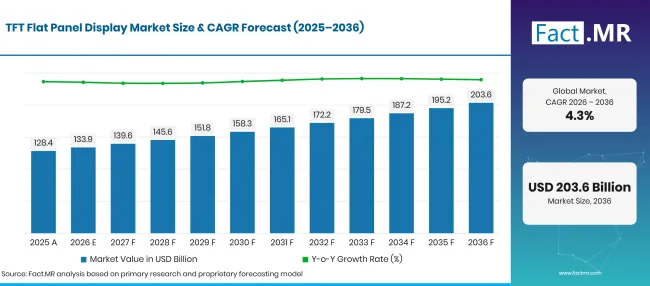
Factmr Tft Flat Panel Display Market Forecast Global | Source: Fact.MR
| Year | Basis | Market Value (USD billion) |
|---|---|---|
| 2025 | Historical estimate | 128.4 |
| 2026 | Estimate | 133.9 |
| 2036 | Forecast | 203.6 |
| CAGR 2026 to 2036 | Forecast period | 4.3% |
Source: Fact.MR analysis. Updated Oct 22, 2026
What are the defining numbers behind TFT Flat Panel Display Market growth?
The forecast adds USD 69.67 billion to annual revenue by 2036. LCD accounts for 62.3% of 2026 sales, or about USD 83.61 billion, and Consumer Electronics contributes 50.0% of application demand. Panel makers have to balance upgrades in viewing quality with the cost and yield of making those panels.
- Demand Drivers in the Market
- Panel improvements can preserve LCD's place in a premium product. BOE's 2025 annual report records mass production of automotive mini-LED backlight products using local dimming. Such designs let the finished display control illumination across different screen regions. Within the Large Area LCD Display Market, the sales case depends on the picture improvement obtained within the customer's thermal limit. Adding more light sources is useful only when the completed module delivers a result worth paying for. [3]
- Refresh behaviour creates another route to reducing operating power. A 2025 university paper proposed a gate-driver circuit that could run selected panel regions between 60 Hz and 1 Hz. The results were simulations rather than proof of commercial shipment. They nevertheless identify a practical direction for development in the Display Driver Market. A screen containing both moving content and static information may benefit from treating those regions differently instead of refreshing the entire image at one rate. [11]
- Automotive display orders require evidence that the panel will continue to operate under sustained stress. Xu and colleagues reported a 12.3-inch automotive LCD whose integrated gate-driver circuitry passed more than 1,000 hours of operation at 85°C. The 2025 work supports a concrete engineering discussion about oxide TFT reliability. It does not represent certification of every related commercial product. Suppliers that can support the customer's full operating specification have a stronger case for entering a vehicle programme. [15]
- Healthcare display purchases have to account for how an image is reviewed, not just whether a screen turns on. AAPM's 2025 mammography workstation guidance covers the viewing environment and continuing quality checks. [12] For equipment makers, stable image behaviour and the ability to test it are relevant design requirements. This is a specialist display opportunity, not evidence that every hospital monitor needs the same panel.
- Key Segments Analyzed
- By Technology: LCD holds 62.3% of 2026 revenue. Backlight and pixel-control improvements sustain its range of commercial uses.
- By Application: Consumer Electronics contributes 50.0% in 2026. Device replacement and specification choices determine the scale of panel orders.
- By Size: Medium (5-10 inches) represents 38.7% of sales in 2026. Portable viewing formats support a large market within tight space and power limits.
- By End-User: Residential accounts for 45.0% in 2026. Commercial and industrial deployment provide separate purchasing requirements for the remaining demand.
- Analyst Opinion at Fact.MR
- Shambhu Nath Jha, Lead Consultant, Fact.MR
- A technically impressive panel is not always the most profitable one. Higher brightness, more pixels or lower power can justify a premium, but each feature affects manufacturing cost and the design of the product around it. The better order is one where the customer has a specific viewing problem to solve and can repeat the specification at volume. Display suppliers should judge a proposed improvement against what it changes for the finished television, vehicle or industrial device.
- Strategic Implications
- For vehicle interiors, start with the view and the space available rather than the proposed screen diagonal. Hohmann's 2025 work examines curved and concealed display concepts and their engineering challenges. [6] Customers in the Center Information Display Market must fit a panel around controls, cameras and cabin surfaces. A striking prototype only matters commercially when the design can enter a production vehicle.
- Quote power savings under stated test conditions. Asagi and colleagues examined light transmission and low-voltage driving in FFS LCDs, including behaviour at lower refresh rates. [1] The result is relevant when those gains hold at the brightness and temperature the customer actually uses. Quoting the best laboratory figure without its conditions makes product comparisons less useful.
- Specialist displays are sold with service obligations. Buyers in the Embedded Display Market may need a screen that can be checked or replaced after installation. Medical-display guidance from AAPM illustrates the importance of continuing performance checks in demanding applications. [12] Suppliers should find out who will maintain the unit and how its image quality will be assessed over time.
- Confirm where a qualified panel will be made. LG Display completed the sale of its Guangzhou large LCD facility in April 2025 while continuing to position itself across differentiated LCD and OLED products. [10] A manufacturing change can affect continuity of supply even when the catalogue description stays the same. Equipment makers should establish the intended facility and product roadmap before agreeing to a long-life panel.
The United States has the highest forecast growth among the five markets. Japan follows through a mix of specialised display engineering and product renewal. Brazil's opportunity is sensitive to finished-device affordability. Germany places demanding requirements on automotive integration while the United Kingdom combines replacement purchasing with visible energy information.
How does the TFT Flat Panel Display Market break down by segment?
TFT describes the transistor backplane used to address pixels. It is not another name for LCD. This report includes TFT-controlled LCD and active-matrix OLED products. The technology categories distinguish mobile AMOLED modules from other active-matrix OLED applications to keep revenue mutually exclusive.
How does LCD retain the largest technology share?
LCD represents 62.3% of 2026 revenue as suppliers continue improving the performance of an established panel architecture.
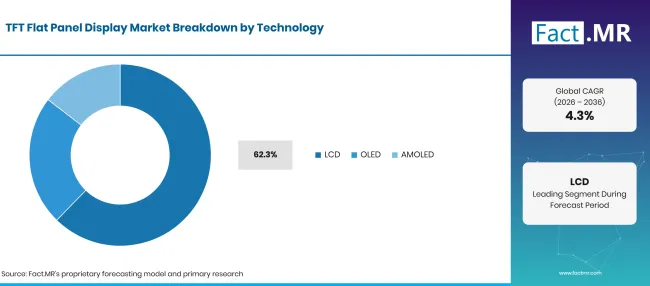
Factmr Tft Flat Panel Display Market Breakdown Technology | Source: Fact.MR
| Technology | Share (2026) |
|---|---|
| LCD | 62.3% |
| Other segments combined | 37.7% |
| Total | 100.0% |
Source: Fact.MR analysis. Updated Oct 22, 2026
LCD remains capable of supporting products above the lowest price tiers. AUO's 2025 annual report identifies low-power LCD and curved automotive display development among its higher-value activities. These offers show how a mature technology can compete through a more specific product configuration. OLED adoption will redistribute revenue within the TFT market rather than automatically reduce the market's total size. The buyer's actual display specification determines which technology receives the order. [2] For segmentation the AMOLED category covers mobile active-matrix OLED modules. The OLED category covers other active-matrix OLED panel applications. AMOLED is a form of OLED, so no panel is counted in both groups. LCD includes mini-LED backlit variants because the liquid-crystal layer still produces the image.
Why does consumer electronics account for half of panel revenue?
Consumer Electronics holds 50.0% of the market in 2026 across personal devices and home viewing equipment.
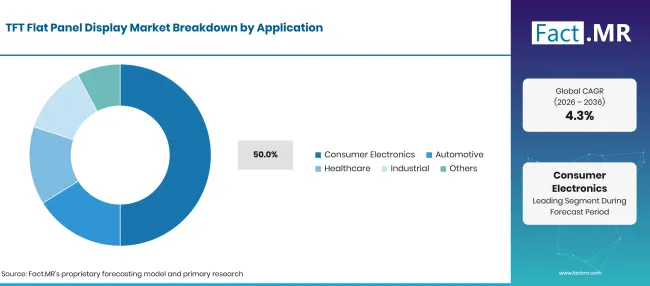
Factmr Tft Flat Panel Display Market Breakdown Application | Source: Fact.MR
| Application | Share (2026) |
|---|---|
| Consumer Electronics | 50.0% |
| Other segments combined | 50.0% |
| Total | 100.0% |
Source: Fact.MR analysis. Updated Oct 22, 2026
The consumer-electronics application combines compact devices with larger viewing formats. Samsung's 2025 half-year business report describes OLED panel activity across mobile devices and IT products. A supplier can therefore compete for several screen configurations within the same broad customer group. The commercial requirements still vary. A portable device places a different value on thickness and battery demand from a product intended to remain connected to power. [13] Automotive and healthcare applications are assessed separately from consumer electronics. Their orders can reward a product that meets a narrower operating requirement. Expanding into these applications also changes qualification and service expectations. A panel that is attractive in a consumer device is not automatically ready for another use merely because the diagonal size matches.
What gives the 5-10-inch group its commercial weight?
Medium (5-10 inches) accounts for 38.7% of 2026 revenue by combining substantial portable-device demand with considerable panel content per unit.
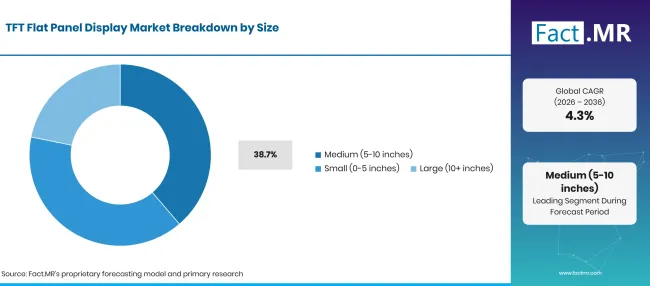
Factmr Tft Flat Panel Display Market Breakdown Size | Source: Fact.MR
| Size | Share (2026) |
|---|---|
| Medium (5-10 inches) | 38.7% |
| Other segments combined | 61.3% |
| Total | 100.0% |
Source: Fact.MR analysis. Updated Oct 22, 2026
This size group gives the device designer enough area to display useful content while retaining a portable format. Its economics depend on usable image area and the complete module thickness. Product breadth matters because a supplier may need to serve several device layouts. Innolux's published company profile identifies both TFT manufacturing and overseas module operations. That distinction reflects the work needed to turn a panel into an assembly suitable for a finished product. [7] The bands use display diagonal. The medium group includes 5.0 through 10.0 inches. Smaller panels fall below 5.0 inches and larger panels exceed 10.0 inches. Screen area and revenue do not rise in a fixed proportion to diagonal because the aspect ratio and panel specification also matter.
What separates residential purchasing from commercial display deployment?
Residential use contributes 45.0% of 2026 revenue. The remaining share serves commercial and industrial use settings.
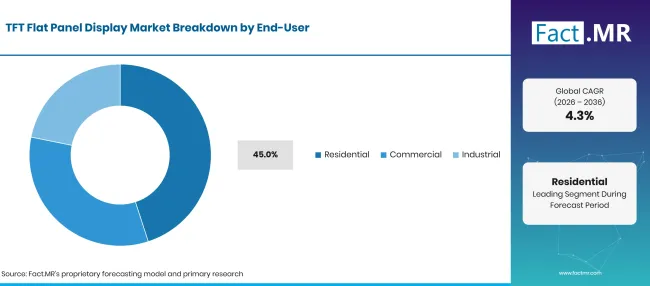
Factmr Tft Flat Panel Display Market Breakdown End User | Source: Fact.MR
| End-User | Share (2026) |
|---|---|
| Residential | 45.0% |
| Other segments combined | 55.0% |
| Total | 100.0% |
Source: Fact.MR analysis. Updated Oct 22, 2026
Residential purchasing places the display inside a finished product chosen for household use. Commercial buyers may instead need to specify a fleet of monitors or signage screens. The U.S. Department of Energy's purchasing guidance addresses efficiency requirements for those two display groups and treats them separately from televisions. Their procurement process can therefore reward a panel and finished-device combination that satisfies an operating-cost specification. [14] Application and end-user classifications answer different questions. A consumer-electronics product deployed by a business can sit within the commercial end-user view. Its panel is still counted once. Industrial use adds another context where a display forms part of equipment operation and its replacement must suit the installed machine.
What is accelerating TFT Flat Panel Display Market adoption, and what is holding it back?
A larger panel or a better display specification can lift revenue per finished product even if the number of televisions, vehicles or monitors barely changes. Manufacturers still have to absorb production costs and maintain acceptable yields. The market's 4.28% growth projection therefore includes an important mix effect. The most sustainable upgrades are those that buyers can recognise and manufacturers can deliver consistently.
Drivers Impact Analysis
| DRIVER | (~) % IMPACT ON CAGR | GEOGRAPHIC RELEVANCE | IMPACT TIMELINE |
|---|---|---|---|
| Additional useful display area in finished products | +1.2% | Consumer electronics and vehicle platforms | Medium term (2 to 4 years) |
| Higher-value LCD backlight and optical configurations | +0.7% | Global premium display programmes | Short term (up to 2 years) |
| Automotive panels meeting demanding operating conditions | +0.9% | Germany, Japan and United States | Medium term (2 to 4 years) |
| Renewal of personal and business viewing equipment | +0.6% | United States, Brazil and United Kingdom | Short term (up to 2 years) |
| Specialised image-quality requirements | +0.3% | Healthcare and industrial equipment | Long term (4 years or more) |
Source: Fact.MR analysis. Updated Oct 22, 2026
Opportunity Impact Analysis
| OPPORTUNITY | (~) % IMPACT ON CAGR | GEOGRAPHIC RELEVANCE | IMPACT TIMELINE |
|---|---|---|---|
| Local-dimming LCD modules with controlled heat output | +0.6% | Premium automotive and home displays | Medium term (2 to 4 years) |
| Selective refresh for mixed static and moving content | +0.4% | Portable and embedded screens | Long term (4 years or more) |
| Display integration with defined viewing and service conditions | +0.7% | Specialist commercial installations | Medium term (2 to 4 years) |
| Supported replacement formats for installed equipment | +0.2% | Industrial and professional customers | Long term (4 years or more) |
Source: Fact.MR analysis. Updated Oct 22, 2026
Restraints Impact Analysis
| RESTRAINT | (~) % IMPACT ON CAGR | GEOGRAPHIC RELEVANCE | IMPACT TIMELINE |
|---|---|---|---|
| Standard-panel price competition | -0.8% | Global commodity display supply | Short term (up to 2 years) |
| Delayed replacement of usable consumer devices | -0.5% | Mature household electronics markets | Short term (up to 2 years) |
| Production cost of demanding premium configurations | -0.4% | Advanced LCD and OLED fabrication | Medium term (2 to 4 years) |
| Long validation cycles and field-performance requirements | -0.3% | Automotive and medical display programmes | Medium term (2 to 4 years) |
Source: Fact.MR analysis. Updated Oct 22, 2026
Which countries are scaling the TFT Flat Panel Display Market through 2036?
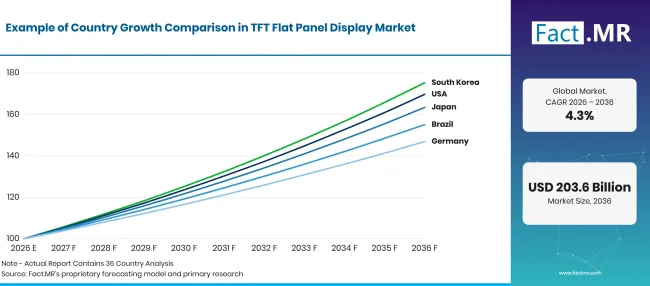
Factmr Tft Flat Panel Display Market Growth Index | Source: Fact.MR
| Country | CAGR (2026 to 2036) |
|---|---|
| Germany | 3.92% |
| Brazil | 4.49% |
| United States | 5.43% |
| United Kingdom | 3.41% |
| Japan | 5.03% |
Source: Fact.MR analysis. Updated Oct 22, 2026
Why is interior integration central to Germany's display opportunity?
3.92% CAGR. Vehicle display value depends on what the installed screen allows occupants to do.
German carmakers are exploring display concepts that go well beyond a larger central screen. Hohmann's 2025 paper discusses concealed curved displays and cameras placed behind OLED panels, alongside the engineering difficulties involved. [6] The opportunity for a TFT supplier depends on whether it can meet the needs of a particular cabin design.
Germany is forecast to grow 3.92% annually. Vehicle makers face limits on dashboard space, cost and the driver's field of view. Display suppliers can win by solving one of these problems in a production programme; exhibition concepts alone will not translate into recurring orders.
How should display suppliers approach Brazil's finished-device economics?
4.49% CAGR. A panel upgrade must remain compatible with the price and operating characteristics of the finished product.
Brazil's Inmetro published a 2025 television table under its energy-labelling programme. [8] It shows why a panel upgrade must be judged as part of the complete TV. Screen size and brightness can change power demand and the retail price the assembler must charge.
Brazil's forecast CAGR is 4.49%. Assemblers serving several price points may prefer dependable families of panel sizes over a succession of expensive one-off upgrades. Suppliers that can offer an attractive picture within realistic power and cost limits have a clearer route to repeat orders.
Where does U.S. procurement put a value on display efficiency?
5.43% CAGR. Fleet purchasing makes operating performance commercially visible alongside the purchase price.
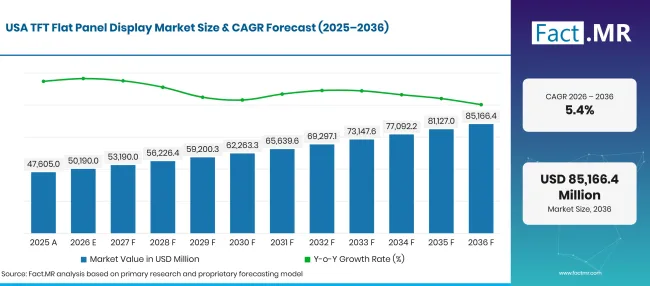
Factmr Tft Flat Panel Display Market Forecast Usa | Source: Fact.MR
The U.S. TFT display market is estimated at USD 50.19 billion in 2026. Federal procurement guidance gives a useful example of the attention paid to operating costs: a 27-inch ENERGY STAR monitor is illustrated at 52 kWh a year versus 72 kWh for a less-efficient comparison model. [14] These are examples, not energy figures for every screen of that size.
At a 5.43% CAGR, U.S. demand will include equipment replacement and better-specified monitors. Public and corporate buyers may look beyond the initial purchase price to the cost of running a large fleet. Panel makers can help their customers meet those requirements, but power savings must be assessed for the finished device and its likely hours of use.
How does visible energy information affect the UK sales proposition?
3.41% CAGR. Replacement products need a persuasive viewing benefit and a clear energy description.
UK rules for energy information cover televisions and electronic displays, including labels shown to customers in stores and through distance selling. [4] The finished-product brand carries those obligations, but its ability to meet them depends partly on the panel it selects.
The UK's 3.41% CAGR reflects a mature replacement market. A screen with a visibly better picture and a reasonable energy rating can make a stronger offer than a model that maximises a single specification. Makers of televisions and monitors need configurations that customers can compare without a complicated explanation.
What can Japan's low-power display work contribute to commercial growth?
5.03% CAGR. Combining optical efficiency with dependable image behaviour gives suppliers a focused development route.
Asagi and colleagues reported a 2025 FFS LCD design addressing uniformity, operating temperature and lower-power performance. [1] For Japanese panel engineering, the significance lies in making a laboratory improvement usable in manufactured equipment. The study does not itself establish a rise in industry shipments.
Japan's display market is projected to expand 5.03% annually. Japan Display announced a reorganisation effective October 2025, separating a dedicated AutoTech function from other display activities and discussing further changes as plans. [9] Customers should follow which business remains responsible for a chosen panel. Continued supply and practical product development will shape the outcome more than research announcements alone.
Who leads the TFT Flat Panel Display Market?
The competitive field contains several routes to value. Samsung's display business spans mobile OLED and other premium formats. LG Display is pursuing differentiated LCD alongside OLED while changing its large-panel manufacturing exposure. These are product-specific strategies. A corporate revenue comparison alone will not show which supplier is best placed for a particular automotive or portable display programme. [13] [10]
AUO's 2025 annual report describes closer automotive-customer access following its BHTC acquisition. BOE reports development across active-matrix panels and mini-LED backlighting. Integration capability can strengthen a supplier's account position but also expands the work it must deliver. Buyers should distinguish the price of the panel from the value of the complete cockpit or display system when assessing competing offers. [2] [3]
E Ink Holdings is considered as an adjacent display-ecosystem participant. Its 2025 business report centres on ePaper applications. Electrophoretic products sit outside the LCD and OLED revenue boundary used here. They can still influence supplier partnerships and the choice of display technology for particular tasks. Their presence in the wider industry does not make their revenue directly comparable with the TFT panel segments in this report. [5]
Which companies are the key providers?
- Samsung Electronics
- LG Display
- BOE Technology Group
- AUO Corporation
- Innolux
- Sharp
- Japan Display
- Tianma Microelectronics
- E Ink Holdings
Bibliography
- [1] Asagi, H., Minami, D., Matsumoto, K., Kawahira, Y., Sakai, A., & Minoura, K. (2025). 23-1: Invited paper: Ultra-low power FFS LCD with high transmittance, low-voltage and low-refresh-rate driving. SID Symposium Digest of Technical Papers, 56(1), 290-293.
- [2] AUO Corporation. (2026). 2025 annual report.
- [3] BOE Technology Group Co., Ltd. (2026). Annual report 2025. CNINFO.
- [4] Department for Energy Security and Net Zero, & Office for Product Safety and Standards. (2026, April 8). Regulations: Energy information. UK Government.
- [5] E Ink Holdings Inc. (2026). 2025 business report: Letter to shareholders.
- [6] Hohmann, K. (2025). 50-1: Invited paper: Novel automotive display experiences beyond large display areas. SID Symposium Digest of Technical Papers, 56(1), 665-668.
- [7] Innolux Corporation. (n.d.). About Innolux [Corporate profile].
- [8] Instituto Nacional de Metrologia, Qualidade e Tecnologia. (2026, June 10). Televisores (2025) [Brazilian Labelling Programme product table].
- [9] Japan Display Inc. (2025, September 30). New organizational structure effective October 1, 2025.
- [10] LG Display Co., Ltd. (2025, April 24). Form 6-K: Q1 2025 earnings results. U.S. Securities and Exchange Commission.
- [11] Liu, P.-T., Zheng, G.-T., Chih, W.-H., Huang, C.-C., & Liu, Y.-C. (2025). P-221: Late-news poster: Multi-frequency gate driver in the controllable region for low power TFT-LCD application. SID Symposium Digest of Technical Papers, 56(1), 1471-1474.
- [12] Milman, R., Bevins, N. B., Alhamami, M., Busse, N., Dohatcu, A., Hulme, K. W., Jafari, M. E., LaFontaine, S. M., Nawfel, R. D., Nelson, J. S., Russ, M. K., Silosky, M., & Wait, J. M. (2025). AAPM Medical Physics Practice Guideline MPPG 17.a: Quality management for mammography review workstation displays. Journal of Applied Clinical Medical Physics, 26(4), e14625. [13] Samsung Electronics Co., Ltd. (2025, August 29). 2025 half-year business report.
- [14] U.S. Department of Energy. (2024, December). Purchasing energy-efficient displays and monitors. Federal Energy Management Program.
- [15] Xu, C., Tian, P., Ding, Y., & Qin, F. (2025). P-19.8: Highly reliable BCE structured IGZO thin-film transistors for automotive LCD applications. SID Symposium Digest of Technical Papers, 56(S1), 1859-1861.
This Report Answers
- Which LCD improvements can justify a higher panel price?
- How does selective refresh affect the development opportunity?
- What separates automotive reliability requirements from a laboratory demonstration?
- How should buyers compare mobile AMOLED and other active-matrix OLED products?
- Why do medical and commercial displays require different purchasing criteria?
- How do panel-supplier strategies affect continuity of supply?
What does the TFT Flat Panel Display Market cover?
Coverage follows TFT panel revenue across technology and application. The size view uses display diagonal while the end-user view identifies the deployment setting. Forecasts span 2026 to 2036 and compare five country markets. Competitive analysis separates core panel suppliers from adjacent display technologies.
What is included in the scope?
The market includes TFT-controlled LCD and active-matrix OLED panels supplied for the listed applications. LCD modules with mini-LED backlighting remain included. Mobile AMOLED and other active-matrix OLED categories are mutually exclusive. A panel incorporated into a module contributes revenue once at the defined sale boundary.
What is excluded from the scope?
Finished televisions and complete electronic devices are excluded beyond their panel or module content. Standalone drivers and separate backlights do not add another revenue layer. Electrophoretic displays and passive-matrix OLED products are outside scope. Direct-view LED products without the covered TFT panel architecture are also excluded.
How Was the Analysis Built?
The analysis draws on 120+ sources, 35+ company portfolios, 25+ countries, and more than 20 industry interviews.
- Primary Research: Primary research includes discussions with manufacturers, service providers, technology developers, distributors, end users, and subject-matter experts. These conversations examine purchasing priorities, product adoption, operational challenges, approval requirements, competitive positioning, and the factors that influence wider market acceptance.
- Desk Research: Desk research covers government statistics, regulatory publications, company filings, trade data, technical studies, industry associations, standards, public policy, and other authoritative sources. Every source used in the analysis is documented in the bibliography.
- Market Sizing and Forecasting: Market estimates combine historical performance, demand indicators, pricing and volume trends, segment shares, company participation, country-level growth, adoption patterns, investment activity, and barriers to market expansion.
- Data Validation and Update Cycle: Findings are validated by comparing primary interviews with public data, company activity, regulatory changes, trade patterns, and industry developments. Regular updates review new product launches, capacity changes, partnerships, approvals, and shifts in commercial adoption.
Segmentation
What is the report’s scope and coverage?
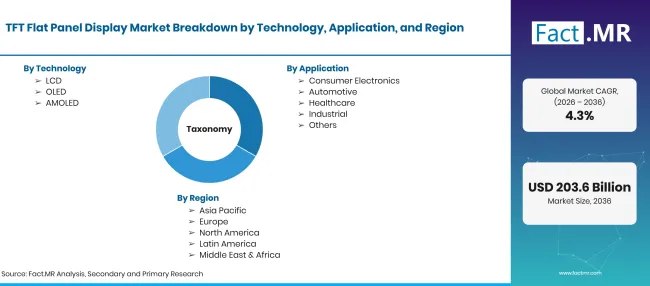
Factmr Tft Flat Panel Display Market Taxonomy | Source: Fact.MR
| Attribute | Details |
|---|---|
| Quantitative Units | USD billion in 2025, 2026 and 2036; CAGR for 2026 to 2036 |
| Market Definition | TFT-controlled LCD and active-matrix OLED display panels and modules. Mobile AMOLED modules form one reporting group and other active-matrix OLED uses form another. Electrophoretic displays and passive-matrix products are excluded. Panel and module sales are counted once. |
| Technology | LCD; OLED; AMOLED |
| Application | Consumer Electronics; Automotive; Healthcare; Industrial; Others |
| Size | Medium (5-10 inches); Small (0-5 inches); Large (10+ inches) |
| End-User | Residential; Commercial; Industrial |
| Regions Covered | North America; Latin America; Western Europe; Eastern Europe; East Asia; South Asia & Pacific; Middle East & Africa |
| Countries Covered | Germany; Brazil; United States; United Kingdom; Japan |
| Companies Profiled | Samsung Electronics; LG Display; BOE Technology Group; AUO Corporation; Innolux; Sharp; Japan Display; Tianma Microelectronics; E Ink Holdings |
| Forecast Period | 2026 to 2036 |
| Approach | Assessment of display-area requirements and operating performance alongside optical design, panel technology choices and the supply arrangements needed for repeat customer programmes. |
Source: Fact.MR analysis. Updated Oct 22, 2026
How is the market segmented?
-
By Technology
- LCD
- OLED
- AMOLED
-
By Application
- Consumer Electronics
- Automotive
- Healthcare
- Industrial
- Others
-
By Size
- Medium (5-10 inches)
- Small (0-5 inches)
- Large (10+ inches)
-
By End-User
- Residential
- Commercial
- Industrial
-
By Region
- North America
- Latin America
- Western Europe
- Eastern Europe
- East Asia
- South Asia & Pacific
- Middle East & Africa
Frequently Asked Questions
What is the TFT Flat Panel Display Market worth in 2026?
What growth rate is forecast through 2036?
Which technology has the largest share?
Why are OLED and AMOLED listed separately?
Which country records the highest forecast CAGR?
Who worked on this report


Preview the report firsthand - request a free sample
Free SampleGet the brochure for pricing and purchase details
Download PDF