- Base Value(2026): 585.7 Mn
- Forecast Value (2036): 2018.6 Mn
- CAGR (2036): 13.2%
AMRs for Cold Chain Warehousing Market Forecast and Outlook By Fact.MR
The AMRs for cold chain warehousing market reached USD 512.4 million in 2025. Fact MR estimates the market will expand to USD 585.7 million in 2026 and attain USD 2,018.6 million by 2036. The market is forecast to register a CAGR of 13.2% across the assessment period.
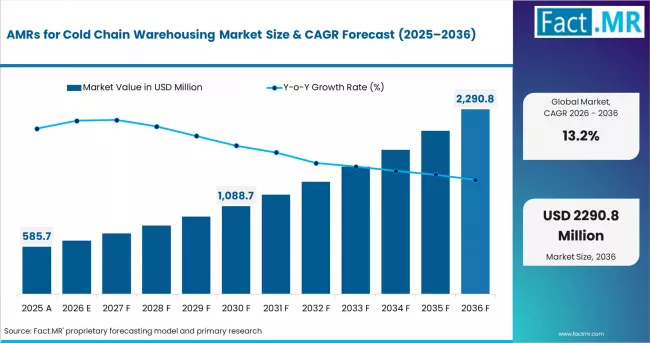
AMRs For Cold Chain Warehousing Market Market Value Analysis | Source: Fact.MR
Summary of the AMRs for Cold Chain Warehousing Market
- Market Definition
- The market comprises autonomous mobile robots designed to transport, pick, sort, and manage temperature sensitive goods within refrigerated and frozen warehouse environments supporting automated inventory movement, order fulfillment, and material handling across pharmaceutical, food, biotechnology, and chemical cold chain logistics operations.
- Demand Drivers
- Increasing demand for automated material handling improving throughput efficiency in temperature controlled warehouse environments.
- Rising need to reduce worker exposure to low temperature conditions across cold storage logistics operations.
- Expansion of pharmaceutical cold chain infrastructure requiring accurate inventory movement and handling precision.
- Growing integration of warehouse automation technologies supporting real time inventory tracking and workflow optimization.
- Increasing requirement for continuous operation supporting reduced downtime in refrigerated distribution facilities.
- Adoption of robotics improving order accuracy and minimizing product handling variability across cold logistics networks.
- Key Segments Analyzed
- Application: Pallet transport and picking lead due to high frequency material movement requirements in cold storage workflows.
- Payload Capacity: Up to 100 kg leads with 36% share due to suitability for cartons, insulated containers, and small pallet loads.
- End Use Industry: Pharma cold chain leads with 38% share driven by demand for precision handling of temperature sensitive pharmaceuticals.
- Technology Role: Sorting, inventory movement, and packaging support enhance automation efficiency across cold warehouse operations.
- Geography: Asia Pacific leads adoption supported by expanding refrigerated logistics infrastructure, while North America and Europe maintain strong value share.
- Analyst Opinion at Fact MR
- Shambhu Nath Jha, Principal Consultant, Fact MR, opines, 'In this updated edition of the AMRs for Cold Chain Warehousing Market report, adoption trends reflect increasing reliance on autonomous robotic systems supporting temperature controlled material handling efficiency. Market participants observe strong deployment growth aligned with cold storage infrastructure expansion, operational safety requirements, and logistics automation strategies supporting performance optimization through 2036.'
- Strategic Implications/Executive Takeaways
- Develop AMR systems optimized for low temperature operation supporting consistent navigation accuracy in cold storage environments.
- Focus on compact payload robots supporting flexible deployment across narrow aisle refrigerated warehouse layouts.
- Strengthen integration capabilities with warehouse management systems supporting real time inventory visibility.
- Expand modular fleet configurations supporting scalability across pharmaceutical and food cold chain logistics facilities.
- Improve robotic hardware durability supporting performance stability across frozen and chilled storage conditions.
- Monitor capital investment cycles influencing automation adoption across temperature controlled logistics infrastructure.
- Methodology
- Primary interviews conducted with robotics manufacturers, logistics providers, cold storage operators, and warehouse automation integrators.
- Benchmarked against cold chain infrastructure expansion indicators influencing robotic deployment across refrigerated facilities.
- Evaluated automation demand across pharmaceutical cold storage, food distribution, and biotechnology inventory handling environments.
- Hybrid modeling applied combining top down logistics automation assessment with bottom up AMR deployment analysis.
- Validation conducted using supplier shipment data, warehouse automation adoption indicators, and robotics integration trends.
- Peer review applied using Fact MR analytical frameworks linking robotics manufacturing capacity with cold chain logistics demand.
AMRs for Cold Chain Warehousing Market
| Metric | Details |
|---|---|
| Industry Size (2026E) | USD 585.7 million |
| Industry Value (2036F) | USD 2,018.6 million |
| CAGR (2026 to 2036) | 13.2% |
Source: Fact.MR analysis. Updated Apr 11, 2026
A CAGR of 13.2% indicates transformational expansion with variability linked to capital investment cycles in temperature-controlled logistics automation. Growth is supported by demand for throughput efficiency and labor risk reduction in cold environments, while volatility persists due to integration costs, warehouse retrofitting complexity, and sensitivity to logistics sector capital expenditure cycles.
China leads with a projected CAGR of 14.4%, supported by rapid expansion of automated cold storage infrastructure across food and pharmaceutical distribution networks. India follows with a CAGR of 13.9%, driven by increasing integration of robotic material handling systems across temperature-controlled logistics facilities. The United Kingdom records a CAGR of 13.6%, reflecting steady deployment of autonomous navigation systems across refrigerated warehouse operations. Germany shows a CAGR of 13.4%, supported by stable adoption of robotic handling technologies across precision cold chain logistics environments. The United States records the slowest growth at 13.2%, reflecting a relatively mature automation ecosystem where demand is largely tied to replacement cycles within existing warehouse robotics infrastructure. Mature markets generate a significant share of replacement demand as system upgrades remain aligned with efficiency optimization, handling accuracy, and temperature-controlled logistics performance requirements.
Segmental Analysis
AMRs for Cold Chain Warehousing Market Analysis by End Use Industry
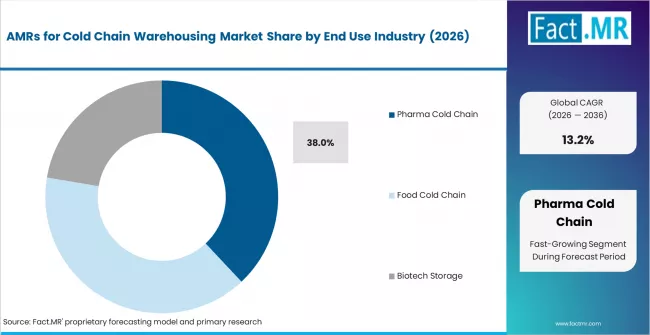
AMRs For Cold Chain Warehousing Market Analysis By End Use Industry | Source: Fact.MR
- Market Overview:
- Based on Fact MR assessment, pharma cold chain is projected to account for 38% share of the AMRs for cold chain warehousing market in 2026. Autonomous mobile robots are deployed across temperature controlled storage environments requiring precise handling of vaccines, biologics, and temperature sensitive pharmaceutical products. Automated navigation systems operate within refrigerated warehouse layouts supporting inventory transport between storage racks, staging zones, and packaging stations. Material handling automation enables reduction of manual exposure to low temperature conditions while supporting controlled product movement aligned with defined storage compliance requirements applied across pharmaceutical cold chain logistics workflows.
- Demand Drivers:
- Temperature Controlled Logistics Requirements: AMRs support movement of pharmaceutical inventory across refrigerated storage zones requiring minimized temperature deviation exposure.
- Handling Accuracy Parameters: Autonomous navigation systems support controlled pallet transport across storage environments requiring consistent positioning precision.
- Operational Continuity Needs: Automated material handling supports continuous warehouse operation across extended cold storage handling cycles.
AMRs for Cold Chain Warehousing Market Analysis by Payload Capacity
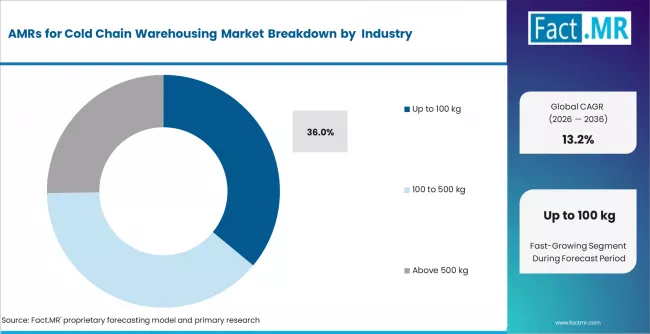
AMRs For Cold Chain Warehousing Market Analysis By Payload Capacity | Source: Fact.MR
- Market Overview:
- Payload capacity up to 100 kg is estimated to hold 36% share of the AMRs for cold chain warehousing market in 2026, supported by requirement for transport of insulated containers, cartons, and small pallet loads across temperature controlled logistics facilities. Medium payload capacity systems support efficient movement of pharmaceutical products across short distance internal warehouse routes requiring stable load balance and controlled acceleration parameters. Equipment design supports maneuverability across narrow aisles and compact storage layouts requiring precise navigation performance within structured cold chain warehouse infrastructure.
- Demand Drivers:
- Load Handling Requirements: AMRs with moderate payload capacity support transport of pharmaceutical cartons and insulated packaging units across cold storage environments.
- Navigation Precision Parameters: Medium capacity robotic systems support movement across narrow aisle warehouse layouts requiring controlled maneuverability.
- Workflow Compatibility Needs: Payload optimized AMRs support integration across picking, staging, and packing workflows within pharmaceutical cold chain logistics operations.
Key Dynamics
AMRs for Cold Chain Warehousing Market Drivers, Restraints, and Opportunities
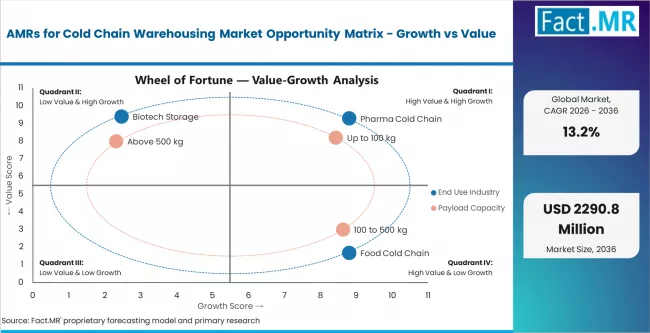
AMRs For Cold Chain Warehousing Market Opportunity Matrix Growth Vs Value | Source: Fact.MR
Fact MR analysis indicates that the AMRs for cold chain warehousing market developed from logistics automation systems designed to maintain consistent throughput in temperature-controlled storage environments handling pharmaceuticals, biologics, and perishable foods. Historically, cold storage operations relied on manual material handling where worker productivity declined due to extreme low-temperature environments and strict compliance requirements. The current market valuation reflects increasing deployment of autonomous mobile robots capable of operating in chilled and frozen conditions while maintaining precision inventory movement. Demand persists because cold chain logistics requires uninterrupted temperature control and accurate handling of temperature-sensitive products across storage and distribution stages.
A structural shift is occurring as conventional labor-intensive cold storage operations transition toward robotic material handling platforms designed to maintain operational efficiency under temperature-controlled conditions. Manual warehouse handling remains widely used in smaller facilities where automation investment cycles remain gradual. AMRs operate continuously and reduce exposure of human labor to extreme temperatures while improving inventory accuracy and throughput efficiency. These robotic systems involve higher capital expenditure due to sensor integration, navigation software, and cold-resistant hardware components. Even with moderate deployment volumes, higher-value automation systems support steady market value expansion in pharmaceutical and food cold chain logistics.
- Temperature Controlled Automation: Logistics operators deploy AMRs capable of operating in chilled and frozen storage environments to maintain continuous material flow and inventory accuracy.
- Pharmaceutical Handling Compliance: Standards such as Good Distribution Practice (GDP) and WHO cold chain storage guidelines influence adoption of automated handling systems ensuring temperature integrity.
- Asia Cold Storage Expansion: China, India, and Southeast Asia maintain expanding pharmaceutical distribution and frozen food logistics infrastructure adopting warehouse automation technologies.
Regional Analysis
The AMRs for cold chain warehousing market is assessed across North America, Europe, Asia Pacific, Latin America, and Middle East & Africa, segmented by country-level demand for autonomous mobile robots, temperature-controlled logistics automation, and warehouse material handling optimization. Regional demand reflects pharmaceutical cold storage expansion, automated fulfillment requirements, and supply chain digitalization initiatives. The full report offers market attractiveness analysis.
.webp "Top Country Growth Comparison — AMRs For Cold Chain Warehousing Market CAGR (2026–2036)")
Top Country Growth Comparison — AMRs For Cold Chain Warehousing Market CAGR (2026–2036) | Source: Fact.MR
| Country | CAGR (2026-2036) |
|---|---|
| China | 14.4% |
| India | 13.9% |
| United Kingdom | 13.6% |
| Germany | 13.4% |
| United States | 13.2% |
Source: Fact.MR analysis. Updated Apr 11, 2026
Source: Fact MR analysis, based on proprietary forecasting model and primary research
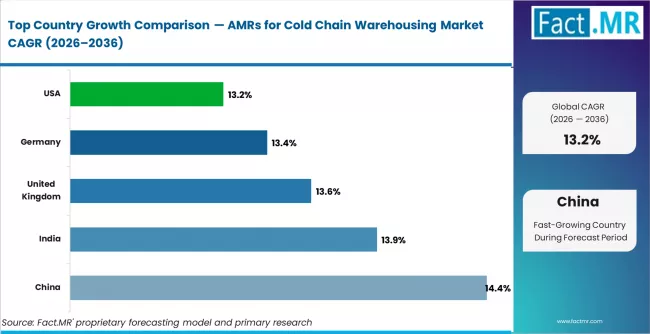
AMRs For Cold Chain Warehousing Market CAGR Analysis By Country | Source: Fact.MR
Asia Pacific
Asia Pacific functions as the logistics automation and cold chain infrastructure deployment hub, supported by expanding pharmaceutical distribution capacity and warehouse robotics adoption. Geekplus Technology Co., Ltd. strengthens autonomous mobile robot deployment capabilities. Daifuku Co., Ltd. expands cold storage material handling automation solutions. Hikrobot Co., Ltd. supports warehouse robotics integration.
- China: Demand for AMRs for cold chain warehousing in China is projected to rise at 14.4% CAGR through 2036. The Smart Logistics Development Plan (Ministry of Transport, 2021) supports warehouse automation adoption. Geekplus Technology Co., Ltd. expanded autonomous mobile robot deployment capabilities (April 2023), supporting market growth.
- India: Demand for AMRs for cold chain warehousing in India is projected to rise at 13.9% CAGR through 2036. The National Logistics Policy implementation (Ministry of Commerce and Industry, 2022) supports cold storage automation investment. Daifuku Co., Ltd. expanded automated warehouse solutions deployment (March 2023), supporting adoption.
Europe
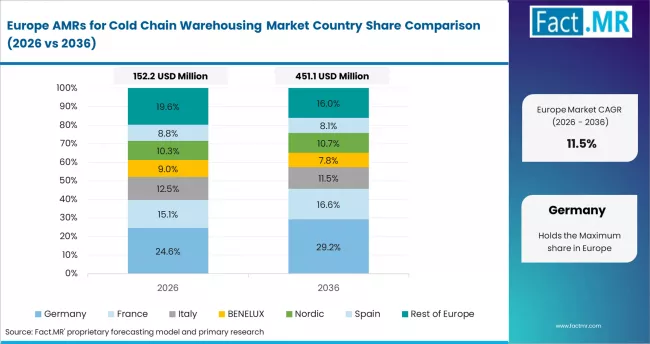
AMRs For Cold Chain Warehousing Market Europe Country Market Share Analysis, 2026 & 2036 | Source: Fact.MR
Europe functions as the automated logistics regulatory laboratory for temperature-controlled warehouse robotics, supported by structured pharmaceutical distribution frameworks and advanced automation engineering ecosystems. SSI Schaefer Group strengthens automated warehouse system capabilities. KUKA AG expands logistics robotics deployment portfolio. Dematic GmbH supports warehouse automation integration technologies.
- United Kingdom: Demand for AMRs for cold chain warehousing in United Kingdom is projected to rise at 13.6% CAGR through 2036. The UK Cold Chain Strategy update (Department for Environment, Food and Rural Affairs, 2021) supports automated temperature-controlled logistics. Dematic GmbH expanded automated cold storage solutions (February 2023), supporting supply growth.
- Germany: Demand for AMRs for cold chain warehousing in Germany is projected to rise at 13.4% CAGR through 2036. The Industry 4.0 Strategy update (Federal Ministry for Economic Affairs and Climate Action, ongoing) supports logistics robotics adoption. SSI Schaefer Group expanded warehouse automation technologies (January 2023), supporting market demand.
North America
North America serves as the automated warehouse robotics commercialization and cold chain logistics innovation hub, supported by strong pharmaceutical distribution infrastructure and advanced supply chain automation technologies. Locus Robotics Corporation strengthens autonomous warehouse robot deployment capabilities. Honeywell International Inc. expands logistics automation solutions portfolio. Zebra Technologies Corporation supports warehouse digitization and robotics integration.
- United States: Demand for AMRs for cold chain warehousing in United States is projected to rise at 13.2% CAGR through 2036. The FDA Drug Supply Chain Security Act implementation (U.S. FDA, ongoing) supports temperature-controlled logistics traceability. Locus Robotics Corporation expanded autonomous warehouse robotics deployment (May 2023), supporting market adoption.
Fact MR's analysis of AMRs for cold chain warehousing market in global regions consists of country-wise assessment that includes China, India, United Kingdom, Germany, and United States. Readers can find warehouse robotics adoption trends, cold chain automation developments, regulatory frameworks, and competitive positioning across key markets.
Competitive Landscape
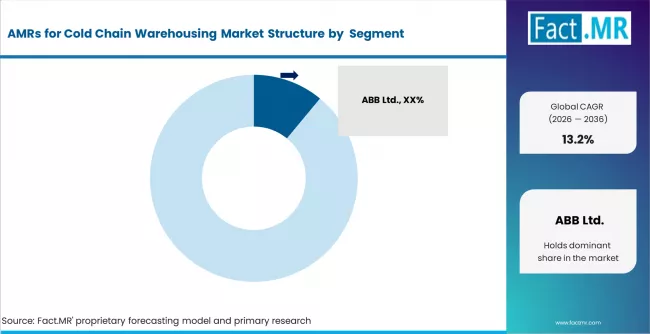
AMRs For Cold Chain Warehousing Market Analysis By Company | Source: Fact.MR
Competitive Structure and Buyer Dynamics in the AMRs for Cold Chain Warehousing Market
The competitive structure of the AMRs for Cold Chain Warehousing Market is moderately concentrated, with industrial automation providers and robotics companies controlling a significant share of deployments. Companies such as ABB Ltd., KUKA AG, FANUC Corporation, Omron Corporation, Daifuku Co. Ltd., and Murata Machinery Ltd. maintain strong positions through established warehouse automation capabilities and robotics engineering expertise. Technology focused firms including Geekplus Technology Co. Ltd., Locus Robotics Corporation, Fetch Robotics Inc., and SSI Schaefer AG contribute through autonomous navigation platforms and fleet management software optimized for logistics environments. Competition is primarily influenced by navigation accuracy, system reliability, temperature tolerance, and integration with warehouse management systems.
Several companies maintain structural advantages through integrated robotics engineering capabilities and established relationships with logistics operators. Firms such as Daifuku Co. Ltd. and SSI Schaefer AG benefit from experience in automated storage and retrieval systems used in temperature controlled facilities. ABB Ltd. and KUKA AG maintain advantages through strong industrial automation expertise and global service infrastructure. Warehouse operators typically adopt multi vendor automation strategies to reduce dependence on a single robotics provider and maintain operational flexibility. Procurement decisions evaluate suppliers based on system durability, fleet scalability, and long term service support, moderating supplier pricing leverage across cold chain logistics environments.
Key Players of the AMRs for Cold Chain Warehousing Market
- ABB Ltd.
- KUKA AG
- FANUC Corporation
- Omron Corporation
- Geekplus Technology Co. Ltd.
- Locus Robotics Corporation
- Fetch Robotics Inc.
- Daifuku Co. Ltd.
- SSI Schaefer AG
- Murata Machinery Ltd.
Report Scope
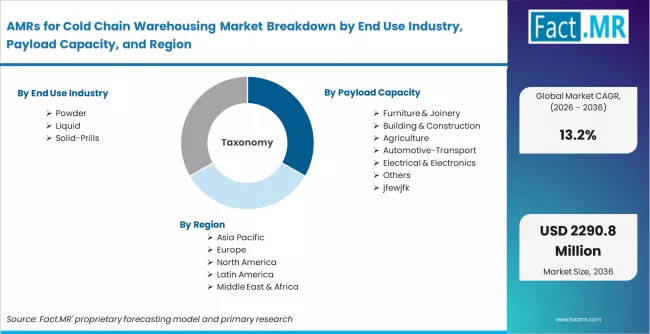
Amrs For Cold Chain Warehousing Market Breakdown By End Use Industry, Payload Capacity, And Region | Source: Fact.MR
| Metric | Value |
|---|---|
| Quantitative Units | USD 585.7 million (2026) to USD 2,018.6 million (2036), at a CAGR of 13.2% |
| Market Definition | The AMRs for cold chain warehousing market includes autonomous mobile robots designed to operate in temperature-controlled environments to automate pallet movement, order picking, inventory transport, and packaging workflows across cold storage logistics facilities. |
| Application Segmentation | Pallet transport, Picking, Sorting, Inventory movement, Packaging support |
| Payload Capacity Segmentation | Up to 100 kg, 100 to 500 kg, Above 500 kg |
| End Use Industry Segmentation | Pharma cold chain, Food cold chain, Biotech storage, Chemical storage |
| Regions Covered | North America, Latin America, Europe, East Asia, South Asia, Oceania, Middle East and Africa |
| Countries Covered | United States, Canada, Mexico, Germany, France, United Kingdom, Netherlands, Italy, Spain, China, Japan, South Korea, India, Singapore, Australia, United Arab Emirates, Saudi Arabia, and 40+ countries |
| Key Companies Profiled | ABB Ltd., KUKA AG, FANUC Corporation, Omron Corporation, Geekplus Technology Co. Ltd., Locus Robotics Corporation, Fetch Robotics Inc., Daifuku Co. Ltd., SSI Schaefer AG, Murata Machinery Ltd. |
| Forecast Period | 2026 to 2036 |
| Approach | Hybrid top-down and bottom-up market estimation based on cold storage automation adoption rates, warehouse robotics deployment analysis, temperature-controlled logistics demand benchmarking, material handling productivity metrics, and validation through primary interviews with robotics manufacturers, logistics providers, and cold chain infrastructure operators. |
Source: Fact.MR analysis. Updated Apr 11, 2026
AMRs for Cold Chain Warehousing Market Key Segments
-
Application :
- Pallet Transport
- Picking
- Sorting
- Inventory Movement
- Packaging Support
-
Payload Capacity :
- Up to 100 kg
- 100 to 500 kg
- Above 500 kg
-
End Use Industry :
- Pharma Cold Chain
- Food Cold Chain
- Biotech Storage
- Chemical Storage
-
Region :
- North America
- USA
- Canada
- Mexico
- Europe
- Germany
- UK
- France
- Italy
- Spain
- Nordic Countries
- BENELUX
- Rest of Europe
- Asia Pacific
- China
- Japan
- South Korea
- India
- Australia
- Rest of Asia Pacific
- Latin America
- Brazil
- Argentina
- Rest of Latin America
- Middle East and Africa
- Kingdom of Saudi Arabia
- United Arab Emirates
- South Africa
- Rest of Middle East and Africa
- Other Regions
- Oceania
- Central Asia
- Other Markets
- North America
Bibliographies
- [1] International Institute of Refrigeration. (2024). Automation in pharmaceutical cold chain logistics: Guidelines on AMRs, GMP, and GDP-aligned temperature-controlled material handling (Technical Report No. TR-2024-02). International Institute of Refrigeration.
- [2] World Health Organization. (2023). Good distribution practice (GDP) for pharmaceutical products: 2023 update – Role of automated material handling and autonomous mobile robots in cold chain integrity (WHO Technical Report Series 1042). World Health Organization.
- [3] ABB Ltd. (2023). Autonomous mobile robots for temperature-controlled warehousing: Application note on cold-chain pallet transport and pharma-logistics use cases. ABB Warehousing and Logistics Automation.
- [4] Geekplus Technology Co., Ltd. (2024). AMRs for cold chain warehousing: Case studies on autonomous carton and pallet handling in refrigerated pharmaceutical and food distribution centers. Geekplus Logistics Automation Portfolio.
- [5] Dematic GmbH. (2023). Automated cold storage and AMR integration for food and pharma warehouses: Technical whitepaper on navigation, fleet management, and temperature-integrity compliance. Dematic Warehouse Automation.
This Report Addresses
- Market size forecasts for 2026 to 2036 based on cold chain automation deployment benchmarks.
- Opportunity mapping across pallet transport, picking, sorting, inventory movement, and packaging workflows.
- Segment and regional forecasts covering low, mid, and high payload AMR systems.
- Competition assessment based on navigation software capability and fleet integration performance.
- Regulatory review covering GDP compliance and temperature controlled logistics traceability requirements.
- Report delivery in PDF, Excel, PPT, and dashboard formats for automation planning teams.
- Supply chain risk analysis covering battery reliability, sensor stability, and robotics software integration dependencies.
AMRs for Cold Chain Warehousing Market Definition
AMRs for Cold Chain Warehousing Market Definition Paragraph
The AMRs for Cold Chain Warehousing Market includes autonomous mobile robots designed to transport, pick, and manage temperature sensitive goods in refrigerated and frozen storage environments, enabling automated material movement, inventory tracking, and order fulfillment across pharmaceutical, food, and biotechnology cold storage logistics operations.
AMRs for Cold Chain Warehousing Market Inclusions
The report includes global and regional market size estimates, forecast analysis, and segmentation by robot type, payload capacity, navigation technology, temperature operating range, application area, end use industry, pricing structure, and warehouse automation integration.
AMRs for Cold Chain Warehousing Market Exclusions
The scope excludes automated guided vehicles dependent on fixed navigation infrastructure, conventional warehouse robots not designed for low temperature environments, cold chain monitoring sensors without robotic mobility, and manual material handling equipment.
AMRs for Cold Chain Warehousing Market Research Methodology
- Primary Research: Interviews were conducted with robotics manufacturers, cold storage operators, logistics providers, pharmaceutical distributors, and warehouse automation integrators.
- Desk Research: Public sources included robotics technology publications, cold chain logistics reports, company technical documentation, regulatory standards, and supply chain automation studies.
- Market-Sizing and Forecasting: A hybrid model combining top-down cold chain logistics demand evaluation and bottom-up analysis of AMR deployment across refrigerated warehousing environments was applied.
- Data Validation and Update Cycle: Outputs were validated through cross comparison of supplier data, expert consultation, and periodic monitoring of automation adoption trends in temperature controlled logistics.
Frequently Asked Questions
How large is the demand for Autonomous Mobile Robots (AMRs) for Cold Chain Warehousing in the global market in 2026?
What will be the market size of AMRs for Cold Chain Warehousing in the global market by 2036?
What is the expected demand growth for AMRs for Cold Chain Warehousing in the global market between 2026 and 2036?
Which company is identified as a leading manufacturer in the AMRs for Cold Chain Warehousing market?
Which end use industry is projected to dominate AMR adoption by 2026?
Why are AMRs widely used in cold chain warehouse operations?
What is driving demand for AMRs for cold chain warehousing in China?
What is the growth outlook for the AMRs for Cold Chain Warehousing market in China?
Why is India an important market for cold chain warehouse automation technologies?
What is the growth outlook for the AMRs for Cold Chain Warehousing market in India?
How is demand for AMRs evolving in the United Kingdom cold chain logistics sector?
What is the growth outlook for the AMRs for Cold Chain Warehousing market in the United Kingdom?
What is the growth outlook for the AMRs for Cold Chain Warehousing market in Germany?
How is the United States positioned in the AMRs for Cold Chain Warehousing market?
What is the growth outlook for the AMRs for Cold Chain Warehousing market in the United States?
What are AMRs for cold chain warehousing and what are they mainly used for?
What does the AMRs for Cold Chain Warehousing market include in this report?
What applications are included in the scope of the AMRs for Cold Chain Warehousing market?
What is excluded from the scope of the AMRs for Cold Chain Warehousing market report?
What does market forecast mean in the AMRs for Cold Chain Warehousing market report?
How is the AMRs for Cold Chain Warehousing market forecast developed in this report?
What does primary validation indicate in the AMRs for Cold Chain Warehousing market analysis?
Who worked on this report


Preview the report firsthand - request a free sample
Free SampleGet the brochure for pricing and purchase details
Download PDF