- Base Value(2026): 1.3 Bn
- Estimated Value(2026): 1.3 Bn
- Forecast Value (2036): 3.0 Bn
- CAGR (2026 - 2036): 8.9%
Thoracentesis and Paracentesis Kits and Drainage Systems Market Forecast and Outlook 2026 to 2036
The thoracentesis and paracentesis kits and drainage systems market records USD 1.3 billion in 2026 and advances to USD 3.0 billion by 2036 at an 8.9% CAGR.
Thoracentesis and Paracentesis Kits and Drainage Systems Market Key Takeaways
- Thoracentesis and Paracentesis Kits and Drainage Systems Market Value (2026): USD 1.3 billion
- Thoracentesis and Paracentesis Kits and Drainage Systems Market Forecast Value (2036): USD 3.0 billion
- Thoracentesis and Paracentesis Kits and Drainage Systems Market Forecast CAGR 2026 to 2036: 8.9%
- Leading Product Type in Thoracentesis and Paracentesis Kits and Drainage Systems Market: Large-volume paracentesis kits
- Key Growth Regions in Thoracentesis and Paracentesis Kits and Drainage Systems Market: Asia Pacific, Latin America, North America, Europe, Middle East & Africa
- Top Players in Thoracentesis and Paracentesis Kits and Drainage Systems Market: Becton Dickinson, Teleflex, B. Braun, Cook Medical, Merit Medical
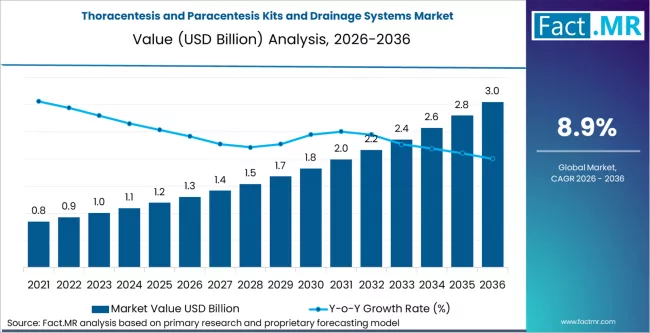
Thoracentesis And Paracentesis Kits And Drainage Systems Market Market Value Analysis | Source: Fact.MR
The path to the current scale appears in earlier reference levels at USD 0.8 billion, USD 1.0 billion, USD 1.2 billion, USD 1.4 billion, and USD 1.7 billion, which indicates steady incorporation into routine care rather than episodic purchasing. These kits function as complete procedural sets that simplify preparation, reduce variation, and support consistent outcomes across wards and outpatient settings.
Hospital teams favor configurations that standardize steps, limit setup time, and fit existing tray systems. Once a kit format is approved, it becomes part of standing protocols tied to training, documentation, and inventory lists. Usage tracks procedure volumes and care pathway coverage. Growth follows wider adoption across departments and care settings, not frequent redesign of kit contents or short cycle product replacement.
Thoracentesis and Paracentesis Kits and Drainage Systems Market
| Metric | Value |
|---|---|
| Market Value (2026) | USD 1.3 billion |
| Forecast Value (2036) | USD 3.0 billion |
| Forecast CAGR 2026 to 2036 | 8.9% |
Source: Fact.MR analysis. Updated Jan 23, 2026
Category
| Category | Segments |
|---|---|
| Product Type | Paracentesis kits (large-volume); Thoracentesis kits (needle or catheter); Vacuum bottle drainage systems; Closed drainage bag systems; Needle or catheter accessory sets; Ultrasound-guided procedure kits |
| Application or Use Case | Ascites drainage; Pleural effusion drainage; Diagnostic sampling; Palliative recurrent drainage; Emergency decompression; Other |
| End User or Sales Channel | Hospitals; ASCs and outpatient procedure centers; Interventional radiology labs; Emergency departments; Distributor channels; Home care providers |
| Region | North America; Europe; Asia Pacific; Latin America; Middle East & Africa |
Source: Fact.MR analysis. Updated Jan 23, 2026
Segmental Analysis
Why Do Large-Volume Paracentesis Kits Set the Reference for Product Selection in This Market?
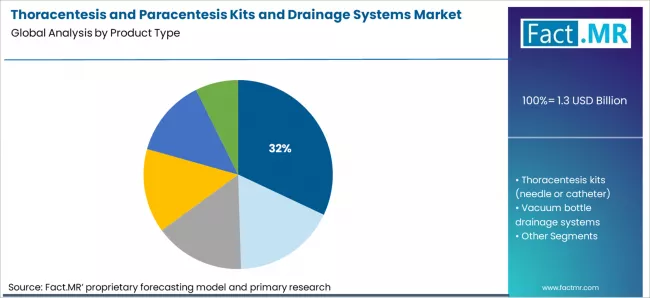
Thoracentesis And Paracentesis Kits And Drainage Systems Market Analysis By Product Type | Source: Fact.MR
Procedure carts in many hospitals place large-volume paracentesis kits at the center of stocking plans, giving this category a 32.00% share by product type in the thoracentesis and paracentesis kits and drainage systems market. These kits support extended fluid removal sessions that follow standardized ward and outpatient routines. Component layouts cover access, drainage control, and closure steps in a single package, which simplifies preparation and reduces variation between operators. Training materials and competency checklists often use these kits as the primary teaching format. Inventory planning also favors complete kits over mixed accessory sets. Thoracentesis kits, vacuum bottles, and bag systems serve defined purposes. Day to day service volume keeps large-volume paracentesis kits as the main planning anchor.
Why Does Ascites Drainage Account for The Largest Share of Use in Clinical Practice?
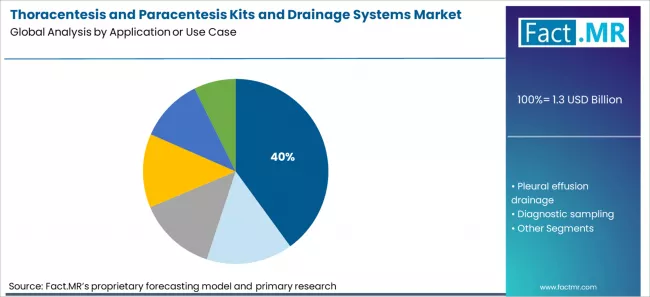
Thoracentesis And Paracentesis Kits And Drainage Systems Market Analysis By Application Or Use Case | Source: Fact.MR
Case mix in this market shows ascites drainage representing 40.00% of application volume. Many patients require repeated fluid removal over long care cycles, which creates a steady flow of scheduled procedures. Ward protocols and day care units allocate regular slots for these sessions, keeping utilization consistent throughout the year. Documentation and monitoring steps also repeat with each visit, adding to overall activity counts. Procedure rooms and mobile teams both contribute to this workload. Pleural effusion drainage, diagnostic sampling, and palliative care uses remain active. The frequency and routine nature of ascites management place it at the center of overall kit and system consumption across facilities.
What are the Drivers, Restraints, and Key Trends of the Thoracentesis and Paracentesis Kits and Drainage Systems Market?
- Drivers: Increasing prevalence of pleural effusion, ascites, and other fluid-related conditions, along with rising numbers of minimally invasive procedures, are boosting demand for thoracentesis and paracentesis kits and drainage systems in hospitals and outpatient care settings.
- Restraint: Reimbursement variability for procedural kits, cost considerations in budget-limited facilities, and clinician preference for familiar legacy systems restrict rapid adoption of newer, integrated solutions.
- Trend 1: Development of comprehensive procedure kits that include imaging guidance aids and safety features to support standardized workflows.
- Trend 2: Expansion of drainage systems with enhanced ergonomic design and patient comfort features to improve clinical handling and outcomes.
Analysis of the Thoracentesis and Paracentesis Kits and Drainage Systems Market by Key Country
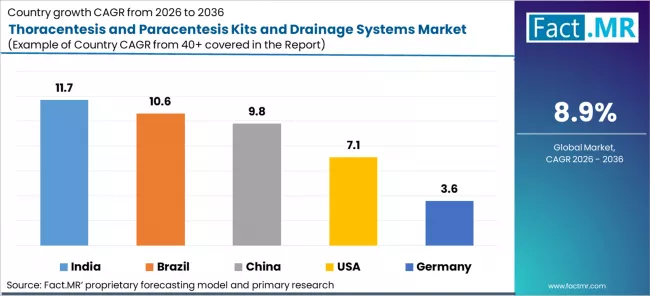
Thoracentesis And Paracentesis Kits And Drainage Systems Market Cagr Analysis By Country | Source: Fact.MR
| Country | CAGR 2026 to 2036 |
|---|---|
| USA | 7.1% |
| Brazil | 10.6% |
| China | 9.8% |
| India | 11.7% |
| Germany | 3.6% |
Source: Fact.MR analysis. Updated Jan 23, 2026
The report covers an in-depth analysis of 40+ countries; top-performing countries are highlighted below.
How Are Procedure Volumes in USA Shaping Use of Thoracentesis and Paracentesis Systems?
Growth in USA runs at about 7.1% per year currently. Use follows procedure volumes in pulmonology oncology and care settings. Hospitals prioritize reliability flow control and compatibility with drainage kits. Purchasing decisions sit with central supply teams using framework agreements. Switching suppliers happens slowly because protocols and training remain embedded. Distribution remains centered on large distributors serving multi-site systems. Volume increases track imaging guided procedures and bedside interventions today. Inventory policies favor steady replenishment rather than opportunistic stocking spikes. Contract renewals depend on service levels delivery reliability and quality. Demand patterns remain stable with incremental growth tied to throughput.
What Is Driving Faster Expansion of Thoracentesis and Paracentesis Systems in Brazil?
Growth in Brazil runs at about 10.6% per year currently. Demand rises from hospitals expanding oncology pulmonology and emergency procedures. Many facilities continue upgrading interventional suites which increases baseline consumption. Purchasing balances price availability and distributor coverage across diverse regions. Stocking policies include buffers because regional supply reliability varies widely. Volume growth follows imaging suite expansion and trauma caseloads. Distribution relies on regional suppliers serving multi-site hospital groups. Contract wins depend on delivery performance credit terms and support. Utilization increases as more clinicians receive certification and procedural experience. Market development remains tied to investment cycles rather than reform.
What Is Supporting Wider Adoption of Thoracentesis and Paracentesis Systems in China?
Growth in China runs at about 9.8% per year currently. Hospital capacity growth and procedure volumes shape demand across departments. Use concentrates in oncology respiratory and general surgery wards today. Procurement aligns with centralized purchasing plans and annual budget cycles. Standardization programs influence specifications and supplier shortlists across networks nationally. Rollouts occur in phases tied to hospital expansion projects frequently. Local manufacturing presence and service coverage affect supplier choice decisions. Volume growth follows bed additions and rising procedure counts closely. Inventory planning remains conservative within many public hospital systems today. Market development stays linked to capacity buildout rather than substitution.
How Are Multi Site Hospital Networks in India Changing Use of Thoracentesis and Paracentesis Systems?
Growth in India runs at about 11% per year currently. Expansion of private hospital chains and imaging capacity drives demand. Standard procedure kits increasingly include drainage components raising baseline usage. Purchasing decisions emphasize unit cost availability and distributor reach nationally. Inventory policies favor frequent replenishment because storage space remains limited. Volume growth tracks interventional suite utilization and bed occupancy rates. Distribution depends on regional suppliers servicing chain hospital accounts nationally. Contract awards follow network level negotiations and framework purchasing agreements. Training availability influences adoption speed across newly opened facilities directly. Market growth remains driven by capacity expansion rather than change.
What Is Defining Demand Patterns for Thoracentesis and Paracentesis Systems in Germany?
Growth in Germany runs at about 3% per year currently. Utilization remains stable due to mature infrastructure and procedure volumes. Procurement follows strict tender processes and detailed compliance requirements consistently. Product specifications remain conservative and focused on reliability and materials. Supplier changes occur infrequently because training and protocol updates cost. Volume trends reflect demographics and case mix rather than expansion. Distribution remains concentrated among established national medical supply groups today. Hospitals prioritize continuity and risk management in vendor selection processes. Inventory levels stay optimized for efficiency rather than growth targets. Market development stays incremental and tied to efficiency programs nationally.
How Do Kit Standardization and Departmental Protocols Shape Competition in the Thoracentesis and Paracentesis Kits and Drainage Systems Market?
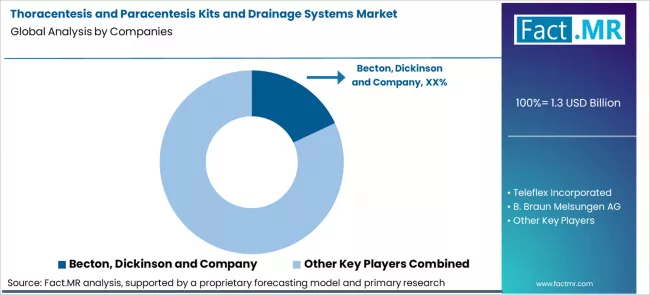
Thoracentesis And Paracentesis Kits And Drainage Systems Market Analysis By Company | Source: Fact.MR
Procedure design committees usually fix kit contents, drainage volumes, and safety steps before any vendor discussion starts. Those decisions govern access to the thoracentesis and paracentesis kits and drainage systems market more than unit pricing. Becton, Dickinson, Teleflex, B. Braun, Cook Medical, and Cardinal Health compete by aligning complete kits to ward, radiology, and bedside workflows.
Supply managers value consistency of pack configuration, labeling clarity, and availability across sites. Clinicians compare systems using ease of setup, flow control, and complication management features. Once a kit is standardized, usage follows admission volumes and service coverage. Supplier changes tend to occur after protocol revisions, safety reviews, or contract renewal cycles.
Key Players in Thoracentesis and Paracentesis Kits and Drainage Systems Market
- Becton, Dickinson and Company
- Teleflex Incorporated
- B. Braun Melsungen AG
- Cook Medical LLC
- Merit Medical Systems, Inc.
References
- World Health Organization. (2023). WHO global report on infection prevention and control. World Health Organization.
- U.S. Food and Drug Administration. (2023). Class II special controls guidance document: Percutaneous drainage and fluid management catheters. U.S. Department of Health and Human Services.
- European Commission, Medical Device Coordination Group. (2023). Guidance on classification of medical devices under Regulation (EU) 2017/745 (MDR). European Commission.
- International Organization for Standardization. (2023). ISO 13485: Medical devices - Quality management systems - Requirements for regulatory purposes. ISO.
Segmentation
Scope of the Report
| Items | Values |
|---|---|
| Quantitative Units (2026) | USD billion |
| Product Type | Paracentesis kits (large-volume), thoracentesis kits (needle or catheter), vacuum bottle drainage systems, closed drainage bag systems, needle or catheter accessory sets, ultrasound-guided procedure kits |
| Application or Use Case | Ascites drainage, pleural effusion drainage, diagnostic sampling, palliative recurrent drainage, emergency decompression, other |
| End User or Sales Channel | Hospitals, ASCs and outpatient procedure centers, interventional radiology labs, emergency departments, distributor channels, home care providers |
| Regions Covered | Asia Pacific, Europe, North America, Latin America, Middle East & Africa |
| Countries Covered | United States, Canada, Mexico, Germany, United Kingdom, France, Italy, Spain, Nordics, BENELUX, China, Japan, South Korea, India, Australia & New Zealand, ASEAN, Brazil, Chile, Saudi Arabia, Turkey, South Africa, and other regional markets |
| Key Companies Profiled | Becton, Dickinson and Company, Teleflex Incorporated, B. Braun Melsungen AG, Cook Medical LLC, Merit Medical Systems, Inc. |
| Additional Attributes | Dollar sales by product type, application, and end user; kit standardization, protocol integration, and tray system compatibility; demand driven by procedure volumes, care pathway coverage, and departmental adoption |
Source: Fact.MR analysis. Updated Jan 23, 2026
Thoracentesis and Paracentesis Kits and Drainage Systems Market Segmentation
-
Product Type :
- Paracentesis kits (large-volume)
- Thoracentesis kits (needle or catheter)
- Vacuum bottle drainage systems
- Closed drainage bag systems
- Needle or catheter accessory sets
- Ultrasound-guided procedure kits
-
Application or Use Case :
- Ascites drainage
- Pleural effusion drainage
- Diagnostic sampling
- Palliative recurrent drainage
- Emergency decompression
- Other
-
End User or Sales Channel :
- Hospitals
- ASCs & outpatient procedure centers
- Interventional radiology labs
- Emergency departments
- Distributor channels
- Home care providers
-
Region :
- Asia Pacific
- China
- Japan
- South Korea
- India
- Australia & New Zealand
- ASEAN
- Rest of Asia Pacific
- Europe
- Germany
- United Kingdom
- France
- Italy
- Spain
- Nordic
- BENELUX
- Rest of Europe
- North America
- United States
- Canada
- Mexico
- Latin America
- Brazil
- Chile
- Rest of Latin America
- Middle East & Africa
- Kingdom of Saudi Arabia
- Other GCC Countries
- Turkey
- South Africa
- Other African Union
- Rest of Middle East & Africa
- Asia Pacific
Frequently Asked Questions
How big is the thoracentesis and paracentesis kits and drainage systems market in 2026?
What will be the size of thoracentesis and paracentesis kits and drainage systems market in 2036?
How much will be the thoracentesis and paracentesis kits and drainage systems market growth between 2026 and 2036?
What are the key product types in the thoracentesis and paracentesis kits and drainage systems market?
Which application or use case segment to contribute significant share in the thoracentesis and paracentesis kits and drainage systems market in 2026?
Who worked on this report


Preview the report firsthand - request a free sample
Free SampleGet the brochure for pricing and purchase details
Download PDF