- Forecast Value (2035): 20.4 Bn
- CAGR (2035): 14.0%
Ticket Scanners Market Outlook 2025 to 2035
The global ticket scanners market is expected to reach USD 20.4 Billion by 2035, up from estimated value of USD 5.6 Billion in 2025. During the forecast period (2025 to 2035), the industry is projected to expand at a CAGR of 13.8%.
The ticket scanners market is being driven by increasing demand of contactless and mobile based ticket validation due to the preference of the passengers towards smooth and safe transit. Modernization and growth of urban transit, the development of new metro, rail, and airport networks contribute to infrastructure improvement, whereas the implementation of biometric and IoT-intelligible systems increases the efficiency and safety of operations. Also, the emphasis of regulation on the cashless and sustainable solutions contributes to the extensive implementation in the transportation and entertainment industries.
Quick Stats for Ticket Scanners Market
- Industry Value (2025): USD 5.6 Billion
- Projected Value (2035): USD 20.4 Billion
- Forecast CAGR (2025 to 2035): 13.8%
- Leading Segment (2025): Mobile-Based Ticket Scanners (integrated with smartphones/tablets) (40% Market Share)
- Fastest Growing Country (2025-2035): China (14.1% CAGR)
- Top Key Players: are Zebra Technologies Corporation, Honeywell International Inc., Datalogic S.p.A., Cognex Corporation, and HID Global
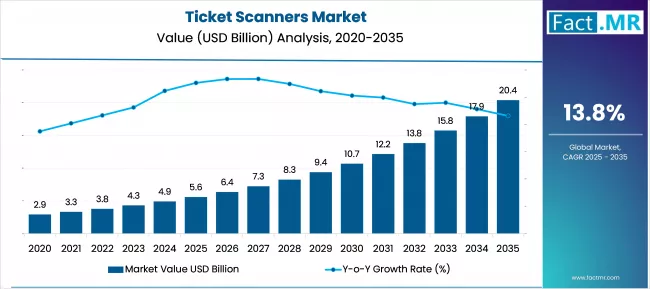
Ticket Scanners Market Market Value Analysis | Source: Fact.MR
What are the key factors driving growth in the Ticket Scanners Market?
One of the major forces is the increasing need to acquire contactless and mobile-based ticketing solutions in the transportation and entertainment industries. The goals of the operators are to improve passenger convenience, lessen the queuing time, and curtail operation inefficiencies. The need to keep up with digital change, programs of smart cities, and implementation of IoT-enabled infrastructure promotes the implementation of advanced ticket scanners.
It is further enhanced by integration with mobile wallets, wearable devices, and biometric systems to enhance adoption. The advantageous regulatory requirements of safe, secure and cashless operations also spur investment in automated ticket verification technology, which is causing market growth across the world.
What are the key trends driving growth in the Ticket Scanners market?
The upcoming trends in the market are the use of AI in scanners to generate predictive analytics, real-time tracking, and enhanced security. High security locations are currently moving towards biometric-enabled ticketing, whereas mobile and cloud-based ticketing scanners are favored to integrate well with apps and digital wallets.
Energy efficient and sustainable devices are also coming in place to help facilitate environmentally friendly transit infrastructure. Multilingualism and interoperability with different ticketing platforms make the user more comfortable. The hardware and software convergence is allowing the operators to provide smarter, automated, and highly reliable ticket validation systems.
What factors hinder the growth of the Ticket Scanners market?
The existence of high start-up capital and integration barriers may limit market adoption especially in smaller transit operators. The problem with retrofitting existing systems is legacy infrastructure and differences in standards between regions. The use of digital and biometric ticketing systems may be restricted by security concerns pertaining to the privacy of data as well.
Technical problems like maintenance of devices, compatibility of the software, and downtime also affect reliability. The adoption of technology in some segments of users and regulations in some countries also hinder the growth of the market, although the use of an advanced ticket scanning solution is in high demand.
What are the key regional trends driving the Ticket Scanners Market growth?
North America
North America is the most progressive in terms of the use of mobile-based, NFC, and biometric ticket scanners at airports and metros as well as event venues. The state of the market in the U.S. and Canada is driven by the strong level of R&D, smart city programs, and focus on contactless, energy-saving solutions.
East Asia
The rapid growth in East Asia is because of urbanization, growing metro systems, massive modernization of the public transportation systems in China, Japan and South Korea. The combination of AI, cloud-based solutions, and multilingual services improves the experience of commuters.
Western Europe
The Western Europe is oriented towards sustainable, modular and IoT based ticket scanners. Germany, France, and UK are investing in smart transit and automated fare collection to enhance the efficiency, reduce the congestion and provide comfort to the passengers.
Country-wise Outlook
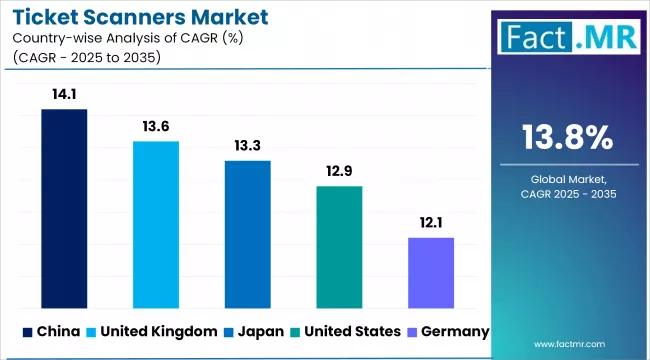
Ticket Scanners Market Cagr Analysis By Country | Source: Fact.MR
Technological Innovation and Passenger Experience Drive the United States’ Ticket Scanners Market
The U.S. ticket scanners market is developing at a high pace with the concerns of transit operators on digital ticketing and smooth passenger experiences. Airports, metro systems and bus terminals are incorporating handheld, fixed, and mobile scanners to revise contactless validation and smart fare collection.
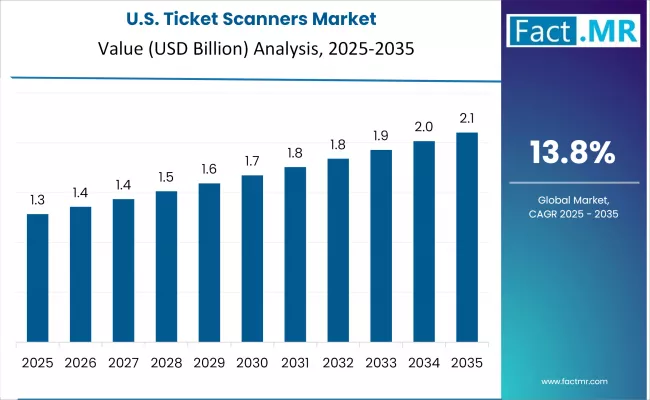
Ticket Scanners Market Country Value Analysis | Source: Fact.MR
Innovation is fueled by the emphasis on IoT-based systems and mobile-based scanning, as well as sustainability efforts. The firm has robust research and development, compliance with regulations, and the use of efficient and efficient lasting ticket readers that ascertain high commuter comfort, protection, and performance in the key transport centers in the United States.
Sustainability and Engineering Expertise Propel Germany’s Ticket Scanners Market
The market of ticket scanners in Germany is thriving with transit authorities adopting high-performance environmentally-friendly validation systems. Precision engineering, modular systems, as well as IoT-enabled monitoring are utilized to optimize operations at the metro, railway, and airport in the country. The operators are interested in durable and efficient devices with the ability to withstand high volumes of passengers without compromising safety and environmental requirements. The cooperation between local and global enterprises is a catalyst to innovation and this way, Germany will be at the frontline of a modern and sustainable infrastructure in terms of ticket scanning in Europe.
Urbanization and Smart Infrastructure Fuel China’s Ticket Scanners Market
The market of ticket scanners in China has witnessed tremendous growth as a result of urbanization, metro and the increasing need to have digital transit infrastructure. The mobile, fixed and kiosk-based scanners are rapidly adopted through government investments in smart cities, automated fare systems, and so on. Local producers can compare scale, whereas the international companies can cooperate to offer the high capacity, durable, and technologically advanced equipment. The incorporation of AI, multilingual, and automation make it convenient to passengers in high-populated regions, and China is now a corner of mass implementation and innovation in the ticket scanners system.
Category-Wise Market Outlook
Mobile-Based Ticket Scanners Surge with Digital Ticketing Convenience
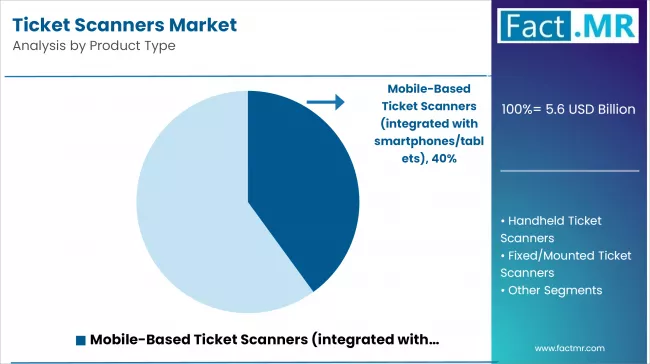
Ticket Scanners Market Analysis By Product Type | Source: Fact.MR
The most rapidly expanding type of product is the mobile based ticket scanners, because of the rising popularity of smartphones when traveling or entering events. They are very versatile with the integration with e-wallets, applications, and QR/NFC-based systems. They decrease the reliance upon paper tickets and physical infrastructure, offer a versatile, contactless and environmentally friendly solution. Widespread use of scanners based on mobile technology as a method of validating tickets is quickly gaining preference due to the ease of implementation by operators operating in the transportation and entertainment industry.
NFC Scanners Lead with Tap-and-Go Efficiency
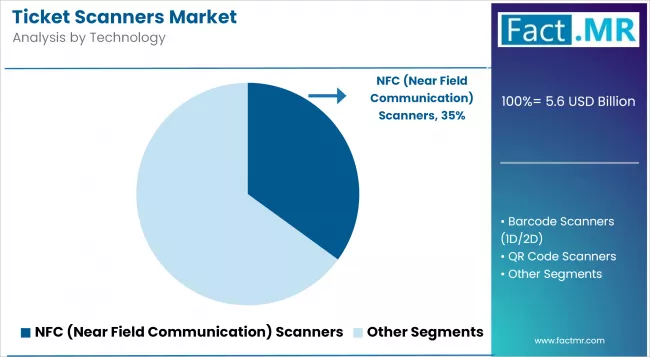
Ticket Scanners Market Analysis By Technology | Source: Fact.MR
NFC scanners are experiencing the most intense technology penetration as they will enable the validation of the tickets in a quick, secure, and contactless manner. They also promote smart cards, wearables and mobile payments, which allow smooth flow of passengers at the busy gates. Their applicability in transit facilities and entertainment spots are also in line with smart city efforts, as well as the need to go cashless globally. NFC ticket scanners are becoming very popular with both operators and commuters due to their short transaction time and high security provisions.
Transportation Sector Dominates with Smart Transit Transformation
In the end-use segments, transportation is developing at an accelerating rate, especially in metro transport, railroads, and airports. The increasing number of passengers and the growth of urban transport is driving the need to have automated validation of tickets to reduce congestion and improve operational efficiency. Modern scanners with IoT, biometrics and NFC functionality are being invested by governments and transit authorities to allow smart ticketing infrastructure. This will facilitate the smooth travels, less waiting time, less dangerous but more comfortable commuter experience and make transportation the most potent booster of growth.
Competitive Analysis
Competitive Outlook: Ticket Scanners Market
The ticket scanners market is very competitive, as multinational companies and niche solution providers influence the use among transit and entertainment industries. Mobile Barcode and Imaging companies like Zebra Technologies, Honeywell International, Datalogic and Cognex Corporation boast about their experience and practices in barcode and imaging technologies and have been able to provide high-performance handheld and fixed-mount scanners.
HID Global and Nedap N.V. are market leaders in RFID and NFC-based transit and access management validators, whereas Unitech Electronics and Opticon Sensors are specialized in ruggedized handheld and field and on-site devices. The innovations in the mobile scanning platform can be found in Newland AIDC and Scandit AG, with Scandit being a master of smartphone and tablet software-based mobile scanning solutions.
Specialty providers are also crucial when it comes to market growth. Advantech Co., Ltd. and KIOSK Information Systems offer a complete self-service kiosk system, whereas Suprema Inc. is distinguished by a biometric-based ticket validation to obtain access.
The strategies focused on product durability, contactless validation, IoT integration, and mobile interoperability are competitive strategies. As the world continues to accelerate investing in smart cities and modernizing transit, these companies are paying attention to scalable, sustainable and intelligent ticket scanning solutions in order to seize upon the emerging opportunities.
Key players in the Ticket Scanners market are Zebra Technologies Corporation, Honeywell International Inc., Datalogic S.p.A., Cognex Corporation, HID Global (an ASSA ABLOY Group brand), Nedap N.V., Unitech Electronics Co., Ltd., Opticon Sensors Europe B.V., Newland AIDC, Scandit AG, Advantech Co., Ltd., Suprema Inc., KIOSK Information Systems.
Recent Development:
- In June 2025, Telpo unveiled several new hardware solutions at the UITP Summit 2025, including the T20 and T10 ticket validators, and the Android-powered P9 and P9 PDA devices. These units support open-loop contactless payments and are ruggedized for both onboard and station-based transit ticketing.
- In March 2025, RTscan rolled out the RT830C fixed-mount embedded barcode scanner across Argentina’s SUBE public transit system, enabling passengers to use mobile phones for scanning in buses, speeding up boarding and reducing reliance on legacy payment hardware.
Fact.MR has provided detailed information about the price points of key manufacturers of Ticket Scanners market positioned across regions, sales growth, production capacity, and speculative technological expansion, in the recently published report
Methodology and Industry Tracking Approach
The Fact.MR survey study on the Ticket Scanners Market as of 2025 involved over 10,000 investors of 30 countries, each country bringing not less than 250 individuals on board. Almost two-thirds of the sample were end-users (transit authorities, metro operators, airport managers and commercial facility providers). The other third was industry experts like urban planners, equipment designers, regulatory specialists and sustainability consultants.
The study, held in the period between September 2024 and August 2025, gathered knowledge on adoption tendencies, integration of technology, regulatory reforms as well as innovations in support of smart and sustainable transit infrastructure. To add to the primary research, more than 250 secondary sources (patents, product launches, policy frameworks, sustainability reports) were examined with the help of sophisticated modeling and trend forecasting.
Fact.MR has been monitoring consumer adoption, regulatory changes, and maturity of technology in transit solutions, specifically ticket scanners since 2018. Such knowledge base will make the 2025 report to provide plausible ideas and practical suggestions. It is a strategic tool that can be used by the stakeholders with informed planning, investment decisions, and a sustainable development in the vibrant Ticket Scanners Market.
Segmentation
Segmentation of Ticket Scanners Market Research
-
By Product Type :
- Handheld Ticket Scanners
- Fixed/Mounted Ticket Scanners
- Mobile-Based Ticket Scanners (integrated with smartphones/tablets)
- Self-Service/Automated Kiosk Ticket Scanners
-
By Technology :
- Barcode Scanners (1D/2D)
- QR Code Scanners
- NFC (Near Field Communication) Scanners
- RFID Scanners
- Biometric-Integrated Ticket Scanners
-
By End Use :
- Transportation (Airports, Railways, Bus Terminals, Metro)
- Sports & Entertainment Venues (stadiums, arenas)
- Theaters & Cinemas
- Amusement Parks & Attractions
- Corporate Events & Conferences
-
By Distribution Channel :
- Online Sales (E-commerce, Direct Company Websites)
- Offline Sales (Distributors, Retailers, Specialty Stores)
-
By Region :
- North America
- Latin America
- Western Europe
- Eastern Europe
- East Asia
- South Asia & Pacific
- Middle East & Africa
Frequently Asked Questions
What was the Global Ticket Scanners Market Size Reported by Fact.MR for 2025?
Who are the Major Players Operating in the Ticket Scanners Market?
What is the Estimated Valuation of the Ticket Scanners Market in 2035?
What Value CAGR did the Ticket Scanners Market Exhibit Over the Last Five Years?
Who worked on this report


Preview the report firsthand - request a free sample
Free SampleGet the brochure for pricing and purchase details
Download PDF