- Market Value (2025): USD 425.3 Mn
- Estimated Value (2026): USD 450.0 Mn
- Forecast Value (2036): USD 790.8 Mn
- CAGR (2026-2036): 5.8%
What is the Tire Derived Fuel Market forecast to be worth by 2036?
USD 450.0 million in 2026 to USD 790.8 million by 2036 at 5.8% CAGR.
- The tire derived fuel market reached USD 425.3 million in 2025.
- Demand is projected to increase from USD 450.0 million in 2026 to USD 790.8 million by 2036.
- The market is forecast to record 5.8% CAGR from 2026 to 2036 owing to scrap tire recovery needs and cement manufacturing use.
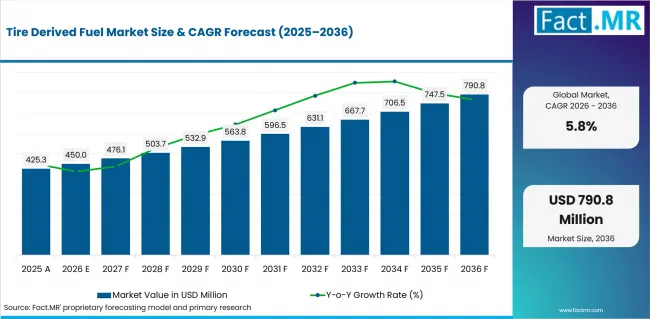
Tire Derived Fuel Market Value Analysis | Source: Fact.MR
What are the defining numbers behind Tire Derived Fuel Market growth?
USD 340.8 million absolute opportunity by 2036.
- Demand Drivers in the Market
- Cement kilns need prepared tire fuel that burns consistently and fits existing material-handling systems.
- Shredded tire derived fuel helps procurement teams test size, wire content and heat value before longer contracts expand.
- Mechanical shredding is expected to remain central since whole tires must be reduced before fuel sizing becomes workable.
- Key Segments Analyzed
- By Fuel Type: Shredded Tire Derived Fuel is projected to hold 39.8% share in 2026 since it gives fuel users a manageable and testable input form.
- By End Use Industry: Cement Manufacturing is expected to account for 34.8% share in 2026 because kilns offer the clearest high-temperature route.
- By Processing Method: Mechanical Shredding is anticipated to capture 52.5% share in 2026 through its role as the first controlled sizing step.
- By Source: Passenger Vehicle Tires are estimated to represent 44.7% share in 2026 due to steady replacement flows from the wider tire pool.
- By Distribution Channel: Direct Supply Contracts are forecast to hold 40.2% share in 2026 where customers require assured volume and delivery timing.
- Analyst Opinion at Fact.MR
- Shambhu Nath Jha, Sr. Consultant at Fact.MR, opines, “Tire derived fuel adoption depends on whether operators can prove the fuel stream is prepared and compatible with the kiln or boiler. The stronger commercial case is expected to come from providers that connect collection work with direct supply terms and permitted industrial use.”
- Strategic Implications
- Recycling operators should build fuel contracts around sizing and moisture control before pricing discussions begin.
- Industrial fuel providers can improve account conversion by explaining how shredded tire fuel fits kiln feed and storage needs.
- Investors should separate energy recovery from material recovery before reading demand signals.
USA is projected to record a 7.5% CAGR from 2026 to 2036 where cement users compare documentation and delivered cost. Germany is estimated at 6.9% through fuel quality review. UK is anticipated at 6.2% through regulated recovery channels. France is forecast at 5.5%. Japan is projected at 4.8% through selective use and tight quality expectations. Canada is expected to record a 4.1% CAGR.
How does the Tire Derived Fuel Market break down by segment?
Shredded Tire Derived Fuel is expected to lead Fuel Type at 39.8% share in 2026. Cement Manufacturing is projected to lead End Use Industry at 34.8% share in 2026.
Which fuel type dominates?
Shredded Tire Derived Fuel is projected to account for 39.8% share in 2026.
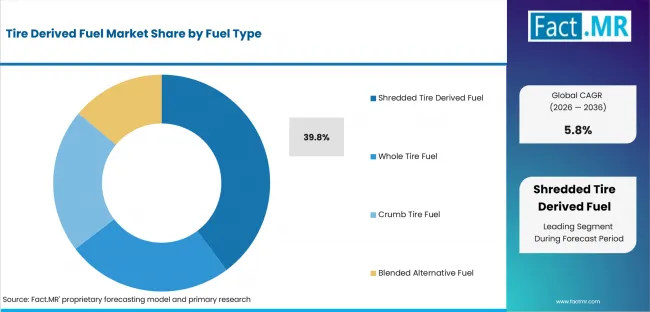
Tire Derived Fuel Market Analysis By Fuel Type | Source: Fact.MR
Shredded fuel leads when customers need a prepared input that can be sampled before routine use. Primary shreds and secondary shreds serve customers with different size needs.
What leads the End Use Industry segment?
Cement Manufacturing is expected to hold 34.8% share in 2026.
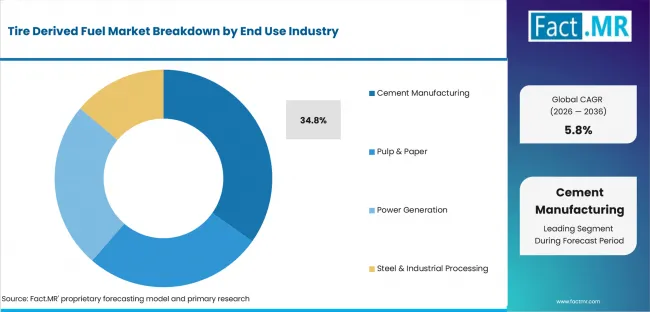
Tire Derived Fuel Market Analysis By End Use Industry | Source: Fact.MR
Cement plants give tire derived fuel its clearest industrial route because kilns operate at high temperatures. Portland cement demand remains relevant when producers examine alternative fuel compatibility. Other industries retain demand where site approvals match the fuel form.
How does Processing Method shape demand?
Mechanical Shredding is anticipated to lead with 52.5% share in 2026.
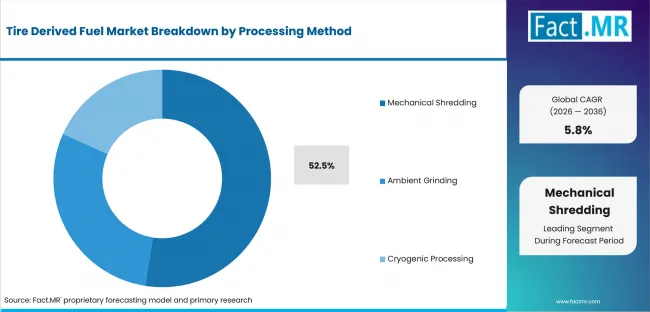
Tire Derived Fuel Market Analysis By Processing Method | Source: Fact.MR
Mechanical shredding gives processors the first controlled step from whole tires to usable fuel chips. Secondary shredding and size classification improve consistency before delivery.
What supports Passenger Vehicle Tires within Source?
Passenger Vehicle Tires are estimated to represent 44.7% share in 2026.
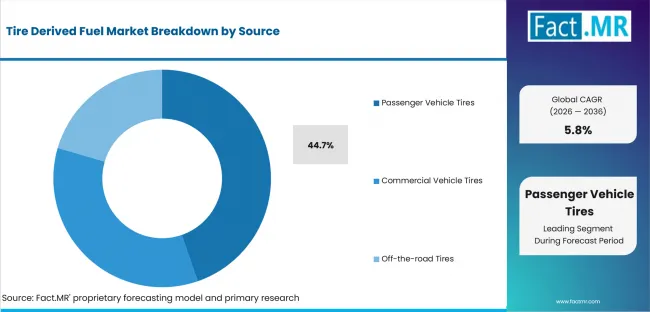
Tire Derived Fuel Market Analysis By Source | Source: Fact.MR
Passenger vehicle tire replacement creates the broadest feedstock stream. Passenger car tires demand is therefore relevant to collection volume. Commercial vehicle and off-the-road tires remain useful where processors can handle heavier casings.
What supports Direct Supply Contracts within Distribution Channel?
Direct Supply Contracts are forecast to hold 40.2% share in 2026.
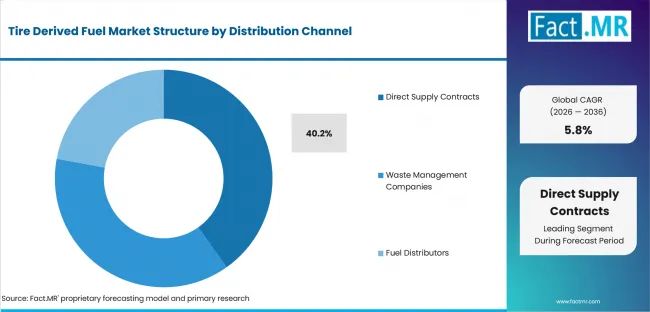
Tire Derived Fuel Market Analysis By Distribution Channel | Source: Fact.MR
Direct contracts lead when industrial users need predictable volume and quality responsibility. Collection companies and fuel distributors remain useful where local density affects delivered cost.
What is accelerating Tire Derived Fuel Market adoption, and what is holding it back?
Demand will grow through reliable fuel preparation and cement kiln use. Growth may be limited by permit delays, transport costs and uneven tire collection quality.
Drivers Impact Analysis
| DRIVER | (~) % IMPACT ON CAGR | GEOGRAPHIC RELEVANCE | IMPACT TIMELINE |
|---|---|---|---|
| Shredded fuel specification control | +1.4% | Canada, USA | Short term (<= 2 years) |
| Cement manufacturing offtake | +1.1% | USA, Germany, France | Short term (<= 2 years) |
| Collection and preprocessing scale | +0.9% | Canada and UK | Medium term (2-4 years) |
| Mechanical shredding reliability | +0.7% | Europe and Japan | Medium term (2-4 years) |
| Direct contract supply security | +0.5% | North America and Europe | Long term (>= 4 years) |
Source: Fact.MR analysis. Updated Jul 30, 2026
- Shredded fuel specification control: Customers are expected to place more weight on chip size and metal removal before accepting wider use.
- Cement manufacturing offtake: Kiln operators are expected to remain the main account group since high-temperature use gives prepared tire fuel a clear route.
- Collection and preprocessing scale: Demand improves when tire volumes move into processing lines at predictable cost.
Opportunity Impact Analysis
| OPPORTUNITY | (~) % IMPACT ON CAGR | GEOGRAPHIC RELEVANCE | IMPACT TIMELINE |
|---|---|---|---|
| Cement kiln fuel packages | +0.8% | USA and Canada | Medium term (2-4 years) |
| Tire collection partnerships | +0.6% | Canada and UK | Medium term (2-4 years) |
| Shredded fuel sizing services | +0.5% | Germany and France | Long term (>= 4 years) |
| Industrial boiler account conversion | +0.4% | Japan and selected industrial sites | Long term (>= 4 years) |
Source: Fact.MR analysis. Updated Jul 30, 2026
- Cement kiln fuel packages: Providers that combine sizing, transport and documentation are expected to win more offtake discussions with cement accounts.
- Tire collection partnerships: Partnerships with collection networks are expected to improve feedstock visibility and help processors plan shredding capacity.
- Shredded fuel sizing services: Custom sizing creates an opening where customers need fuel chips that fit conveyors and combustion conditions.
Restraints Impact Analysis
| RESTRAINT | (~) % IMPACT ON CAGR | GEOGRAPHIC RELEVANCE | IMPACT TIMELINE |
|---|---|---|---|
| Site-specific engineering approval | -0.9% | Global | Short term (<= 2 years) |
| Emission and permit review | -0.6% | USA, Canada, Europe | Short term (<= 2 years) |
| Freight and storage economics | -0.5% | Large-area markets | Medium term (2-4 years) |
| Competition from material recovery | -0.4% | Europe and Japan | Long term (>= 4 years) |
Source: Fact.MR analysis. Updated Jul 30, 2026
- Site-specific engineering approval: Each kiln or boiler must confirm fuel handling and combustion fit before routine buying expands.
- Emission and permit review: Adoption slows when operators cannot document combustion and ash effects clearly enough for approval.
- Freight and storage economics: Long transport distance and covered storage raise delivered cost for low-density tire fuel streams.
Which countries are scaling Tire Derived Fuel Market fastest?
The country comparison is led by the USA, followed by Germany and the UK. France and Japan form the next tier, while Canada shows the slowest listed CAGR. The spread between the USA and Canada is 3.4 percentage points.
- USA leads through cement kiln offtake, documentation requirements, and delivered-cost comparison.
- Germany follows as industrial process review and fuel quality proof support account expansion.
- UK tracks close to Germany through regulated recovery channels and compact logistics.
- France expands through channel coordination and compliance discipline.
- Japan grows selectively because customers place high weight on quality consistency and storage fit.
- Canada remains in the comparison, but long collection routes and service coverage keep the listed CAGR below the other markets.
The full report provides country-level CAGR analysis across North America; Latin America; Europe; East Asia; South Asia and Pacific; and the Middle East and Africa.
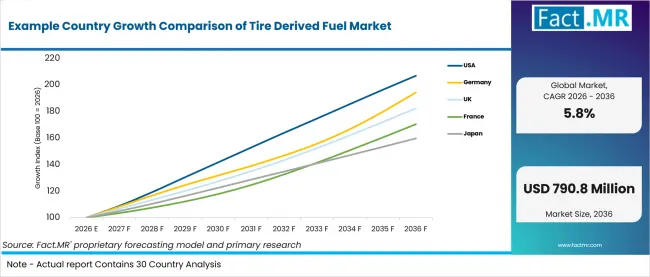
Example Country Growth Comparison Of Tire Derived Fuel Market | Source: Fact.MR
| Country | CAGR (2026-2036) |
|---|---|
| USA | 7.5% |
| Germany | 6.9% |
| UK | 6.2% |
| France | 5.5% |
| Japan | 4.8% |
| Canada | 4.1% |
Source: Fact.MR analysis. Updated Jul 30, 2026
How is USA scaling demand?
7.5% CAGR, driven by cement kiln offtake and documentation requirements.
USA demand is tied to cement manufacturing where fuel users compare delivered cost with handling proof. Contract discipline remains important even when feedstock availability is high.
How is Germany developing demand?
6.9% CAGR, driven by industrial process review and fuel quality expectations.
Germany's outlook reflects careful approval before regular tire fuel deliveries. The market rewards providers that maintain stable fuel preparation records.
What is driving UK growth from 2026 to 2036?
6.2% CAGR, backed by regulated recovery channels and compact logistics.
UK growth is shaped by shorter movement distances and tighter recovery routes. Account growth depends on proof that prepared tire fuel remains predictable.
How does France perform?
5.5% CAGR, led by channel coordination and compliance discipline.
France is expected to expand through account-by-account approval. Channel coordination creates a measured growth path with more focus on execution than speed.
What supports Japan's growth?
4.8% CAGR, backed by quality review and compact industrial logistics.
Japan's growth reflects selective demand where customers value consistent material preparation. Providers that show stable sizing and clean handling gain the clearest entry route.
What supports Canada adoption?
4.1% CAGR, supported by collection geography and service coverage.
Canada's growth reflects long movement distances between tire collection points and industrial fuel users. Route planning and covered storage are expected to remain part of the commercial case.
Who leads the Tire Derived Fuel Market?
Liberty Tire Recycling and Lakin Tire are relevant through tire collection and recycling activity, while ResourceCo Pty Ltd. and Emanuel Tire LLC strengthen the wider tire-processing and fuel-supply landscape.
Liberty Tire Recycling supports the market through tire collection, processing and fuel preparation for industrial users. Lakin Tire contributes end-of-life tire recovery and material handling across commercial channels. ResourceCo Pty Ltd. adds alternative-fuel processing capabilities for cement kilns and other industrial facilities. Emanuel Tire LLC strengthens the field through tire recycling, collection and prepared fuel supply.
Which companies are the key providers?
Key companies include Liberty Tire Recycling; Lakin Tire; ResourceCo Pty Ltd.; Emanuel Tire LLC.
- Liberty Tire Recycling
- Lakin Tire
- ResourceCo Pty Ltd.
- Emanuel Tire LLC
Bibliography
- Environment Agency. (2025, August 1). The Environment Agency’s regulation of waste pneumatic tyres and their export. GOV.UK.
- U.S. Environmental Protection Agency. (2026, March 20). EPA releases proposal to help cleanup of millions of abandoned tires, promote energy dominance.
- Scandinavian Enviro Systems AB. (2024, February 12). The construction of Enviro’s plant in Uddevalla has received starting notice.
- ResourceCo. (2024, May 6). Officially open—Tyrecycle’s newest recycling facility.
This Report Answers
- The report provides strategic intelligence on Fuel Type and End Use Industry choices.
- Segment analysis covers Shredded Tire Derived Fuel and Cement Manufacturing as the share leaders within the 2026 market.
- Country outlook evaluates the USA, Germany, the UK, France, Japan, and Canada.
- Competitive analysis profiles Liberty Tire Recycling alongside Lakin Tire and ResourceCo Pty Ltd.
- Processing assessment covers Mechanical Shredding and direct supply routes.
What does the Tire Derived Fuel Market cover?
Tire derived fuel covers processed end-of-life tires used as an industrial fuel input where site acceptance and fuel preparation define commercial use.
The Tire Derived Fuel Market covers fuel forms used by cement plants and paper sites. Power plants and industrial users are included where prepared tire fuel can meet site acceptance rules.
The market differs from general tire recycling because commercial value comes from energy recovery. Molded rubber products and standalone pyrolysis routes remain outside the boundary.
What is included in the scope?
Tire derived fuel is used across cement plants and paper mills. Power boilers and selected industrial boilers are included when approval routes fit the fuel form.
The scope includes Fuel Type and End Use Industry alongside Processing Method, Source and Distribution Channel. Passenger vehicle tires and commercial vehicle tires are included when they enter fuel preparation.
What is excluded from the scope?
General waste management activity and unrelated rubber product manufacturing remain outside the scope of this market.
The scope excludes tire collection that does not move into fuel preparation. Rubberized asphalt and molded rubber goods are excluded unless they influence fuel sourcing. Pyrolysis oil and recovered carbon black revenue remain outside direct market value.
How Was the Analysis Built?
The analysis draws on 120+ sources, 35+ company portfolios, 25+ countries, and more than 20 industry interviews.
- Primary Research: Primary research includes discussions with manufacturers, service providers, technology developers, distributors, end users, procurement teams, and subject-matter experts. These conversations examine purchasing priorities, product adoption, operational challenges, approval requirements, competitive positioning, and the factors that influence wider market acceptance.
- Desk Research: Desk research covers government statistics, regulatory publications, company filings, trade data, technical studies, industry associations, standards, public policy, and other authoritative sources. Every source used in the analysis is documented in the bibliography.
- Market Sizing and Forecasting: Market estimates combine historical performance, demand indicators, pricing and volume trends, segment shares, company participation, country-level growth, adoption patterns, investment activity, and barriers to market expansion.
- Data Validation and Update Cycle: Findings are validated by comparing primary interviews with public data, company activity, regulatory changes, trade patterns, and industry developments. Regular updates review new product launches, capacity changes, partnerships, approvals, procurement trends, and shifts in commercial adoption.
Segmentation
What is the report’s scope and coverage?
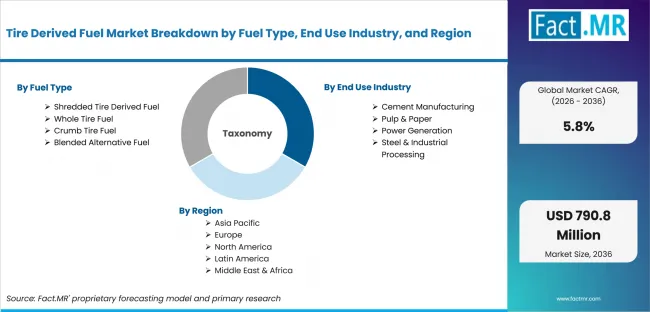
Tire Derived Fuel Market Breakdown By Fuel Type, End Use Industry, And Region | Source: Fact.MR
| Attribute | Details |
|---|---|
| Quantitative Units | USD 450.0 million in 2026 to USD 790.8 million by 2036 at a 5.8% CAGR |
| Market Definition | Processed end-of-life tire material used as an approved industrial fuel input where sizing, handling quality and site acceptance determine regular use |
| Fuel Type | Shredded Tire Derived Fuel; Primary Shreds; Secondary Shreds; Chip Fuel; Whole Tire Fuel; Baled Tires; Unprocessed Whole Tires; Oversized Tire Fuel; Crumb Tire Fuel; Fine Rubber Crumb; Medium Rubber Crumb; Coarse Rubber Granules; Blended Alternative Fuel; TDF with Biomass; TDF with RDF; Custom Fuel Blends |
| End Use Industry | Cement Manufacturing; Rotary Kilns; Precalciner Kilns; Integrated Cement Plants; Pulp & Paper; Power Boilers; Paper Mills; Cogeneration Plants; Power Generation; Industrial Power Plants; Utility Boilers; Captive Power Plants; Steel & Industrial Processing; Steel Mills; Lime Production; Chemical Processing Plants |
| Processing Method | Mechanical Shredding; Primary Shredding; Secondary Shredding; Size Classification; Ambient Grinding; Coarse Grinding; Fine Grinding; Rubber Granulation; Cryogenic Processing; Liquid Nitrogen Processing; Cryogenic Pulverization; Ultra-fine Powder Production |
| Source | Passenger Vehicle Tires; Car Tires; Light Truck Tires; Crossover Vehicle Tires; Commercial Vehicle Tires; Truck Tires; Bus Tires; Trailer Tires; Off-the-road Tires; Mining Equipment Tires; Agricultural Tires; Construction Equipment Tires |
| Distribution Channel | Direct Supply Contracts; Cement Plant Contracts; Industrial User Contracts; Long-term Supply Agreements; Waste Management Companies; Tire Collection Companies; Recycling Companies; Municipal Waste Operators; Fuel Distributors; Industrial Fuel Suppliers; Energy Traders; Regional Distributors |
| Regions Covered | North America; Latin America; Europe; East Asia; South Asia and Pacific; Middle East and Africa |
| Countries Covered | Canada; USA; UK; Germany; France; Japan |
| Key Companies Profiled | Liberty Tire Recycling; Lakin Tire; ResourceCo Pty Ltd.; Emanuel Tire LLC |
| Forecast Period | 2026 to 2036 |
| Approach | Hybrid top-down and bottom-up approach using tire recovery demand; cement kiln offtake; fuel-type mix; source availability; mechanical processing activity; direct supply contracts; transport and storage economics; site approvals; country adoption patterns and company participation |
Source: Fact.MR analysis. Updated Jul 30, 2026
How is the market segmented?
-
By Fuel Type
- Shredded Tire Derived Fuel
- Primary Shreds
- Secondary Shreds
- Chip Fuel
- Whole Tire Fuel
- Baled Tires
- Unprocessed Whole Tires
- Oversized Tire Fuel
- Crumb Tire Fuel
- Fine Rubber Crumb
- Medium Rubber Crumb
- Coarse Rubber Granules
- Blended Alternative Fuel
- TDF with Biomass
- TDF with RDF
- Custom Fuel Blends
- Shredded Tire Derived Fuel
-
By End Use Industry
- Cement Manufacturing
- Rotary Kilns
- Precalciner Kilns
- Integrated Cement Plants
- Pulp & Paper
- Power Boilers
- Paper Mills
- Cogeneration Plants
- Power Generation
- Industrial Power Plants
- Utility Boilers
- Captive Power Plants
- Steel & Industrial Processing
- Steel Mills
- Lime Production
- Chemical Processing Plants
- Cement Manufacturing
-
By Processing Method
- Mechanical Shredding
- Primary Shredding
- Secondary Shredding
- Size Classification
- Ambient Grinding
- Coarse Grinding
- Fine Grinding
- Rubber Granulation
- Cryogenic Processing
- Liquid Nitrogen Processing
- Cryogenic Pulverization
- Ultra-fine Powder Production
- Mechanical Shredding
-
By Source
- Passenger Vehicle Tires
- Car Tires
- Light Truck Tires
- Crossover Vehicle Tires
- Commercial Vehicle Tires
- Truck Tires
- Bus Tires
- Trailer Tires
- Off-the-road Tires
- Mining Equipment Tires
- Agricultural Tires
- Construction Equipment Tires
- Passenger Vehicle Tires
-
By Distribution Channel
- Direct Supply Contracts
- Cement Plant Contracts
- Industrial User Contracts
- Long-term Supply Agreements
- Waste Management Companies
- Tire Collection Companies
- Recycling Companies
- Municipal Waste Operators
- Fuel Distributors
- Industrial Fuel Suppliers
- Energy Traders
- Regional Distributors
- Direct Supply Contracts
-
By Region
- North America
- Latin America
- Europe
- East Asia
- South Asia and Pacific
- Middle East and Africa
Frequently Asked Questions
Which Fuel Type leads the market?
Which End Use Industry leads the market?
Which Processing Method category leads the market?
Which Source leads the market?
Which Distribution Channel leads the market?
Which country records the highest listed CAGR?
What is the primary driver in this market?
What is the main restraint?
Why does cement manufacturing lead demand?
Who worked on this report


Preview the report firsthand - request a free sample
Free SampleGet the brochure for pricing and purchase details
Download PDF