- Market Value (2025): USD 1.3 Bn
- Estimated Value (2026): USD 1.4 Bn
- Forecast Value (2036): USD 2.9 Bn
- CAGR (2026-2036): 7.8%
What is the Traceable Premix Feed Additives Market forecast to be worth by 2036?
USD 1.4 Billion in 2026 to USD 2.9 Billion by 2036 at a 7.8% CAGR.
- The Traceable Premix Feed Additives Market reached USD 1.3 Billion in 2025.
- Demand is projected to increase from USD 1.4 Billion in 2026 to USD 2.9 Billion by 2036.
- The market is forecast to record 7.8% CAGR from 2026 to 2036 as feed mills, premix blenders and integrators strengthen batch records.
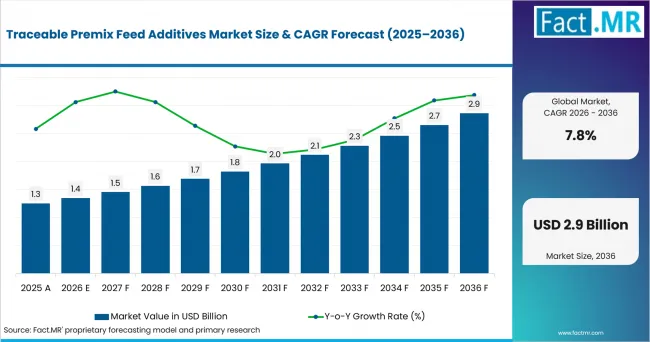
Traceable Premix Feed Additives Market Value Analysis | Source: Fact.MR
What are the defining numbers behind Traceable Premix Feed Additives Market growth?
USD 1.51 Billion absolute opportunity by 2036, led by vitamin-mineral premix, ERP and batch genealogy, and poultry.
- Demand Drivers in the Market
- Feed safety managers need additive lot records linked to formulation and dispatch because recalls move faster when mills connect incoming materials to finished premix batches.
- Premix formulators need supplier certificates inside ERP genealogy so vitamin and mineral changes stay visible during batch release.
- Integrated poultry producers need serialized premix records as USDA ERS projected broiler availability at 105.6 pounds per U.S. consumer in 2026.
- European feed suppliers need clean product records after the European Commission estimates that around 450 million tonnes of animal feed are required in the EU each year.
- Audit teams need QR and batch genealogy for additives moving across feed mills, contract farms and export customer files.
- Key Segments Analyzed
- By Premix Type: Vitamin-mineral premix is expected to hold 41.00% share in 2026 due to routine inclusion across animal diets and repeat batch movement.
- By Traceability Architecture: ERP and batch genealogy is projected to account for 36.00% share in 2026 supported by direct links with formulation, receiving and dispatch records.
- By Livestock: Poultry is anticipated to capture 34.00% share in 2026 owing to integrated feed programs and frequent flock-stage changes.
- By Compliance Driver: Feed safety and recall readiness is estimated to represent 35.00% share in 2026, shaped by audit plans and hazard-control records.
- Analyst Opinion at Fact.MR
- Shambhu Nath Jha, Principal Consultant at Fact.MR, states, “Traceability is becoming an operating discipline for premix suppliers. Demand is expected to favor vendors that connect formulation control with supplier files and batch-release proof. Effective providers combine premix science, ERP discipline and practical audit support.”
- Strategic Implications
- Premix manufacturers should map each additive lot to formulation, batch and customer-dispatch records inside a single review trail.
- ERP vendors should design feed-specific genealogy fields for vitamins, minerals, additives, carryover checks and supplier certificate storage.
- Testing laboratories should attach analytical results to serialized lot IDs, helping quality teams join lab proof with batch release.
France is projected to record 9.6% CAGR through 2036 driven by feed-control plans. The USA is expected to post 8.3% CAGR supported by preventive controls. Brazil is anticipated to advance at 7.8% CAGR through poultry and swine scale. The Netherlands is estimated to reach 7.0%, while the UK is forecast to hold 5.6% CAGR.
How does the Traceable Premix Feed Additives Market break down by segment?
Vitamin-mineral premix leads Premix Type at 41.0%; ERP and batch genealogy leads Traceability Architecture at 36.0%.
Which Premix Type dominates?
Vitamin-mineral premix is expected to hold 41.0% share in 2026.
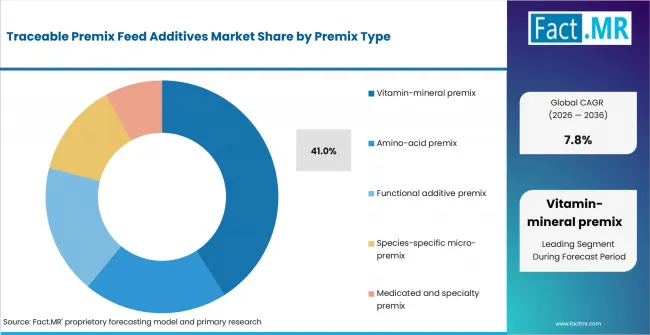
Traceable Premix Feed Additives Market Analysis By Premix Type | Source: Fact.MR
Vitamin-mineral premix is expected to lead Premix Type due to routine use across poultry, swine, dairy and beef programs. Amino-acid premix carries traceability needs where nutrient balancing is closely reviewed. Functional additive premix is tied to specialty claims. Species-specific micro-premix serves tighter formulation windows, while medicated and specialty premix requires deeper release evidence.
What leads the Traceability Architecture segment?
ERP and batch genealogy is projected to account for 36.0% share in 2026.
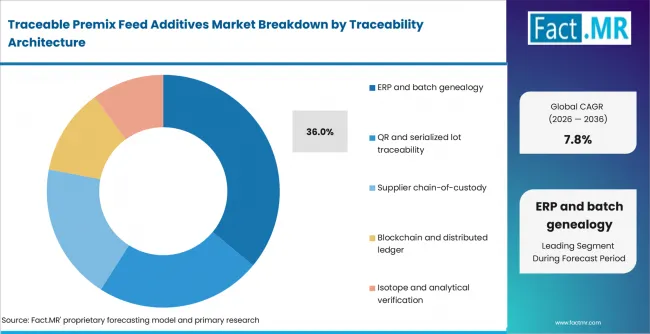
Traceable Premix Feed Additives Market Analysis By Traceability Architecture | Source: Fact.MR
ERP and batch genealogy is projected to lead Traceability Architecture because mills already use production systems to manage recipes, inventory and dispatch. QR and serialized lot traceability adds a customer-facing layer for labels and certificates. Chain-of-custody tools connect additive lots with origin documents. Analytical verification is used when claims need lab proof.
How does Livestock shape demand?
Poultry is anticipated to capture 34.0% share in 2026.
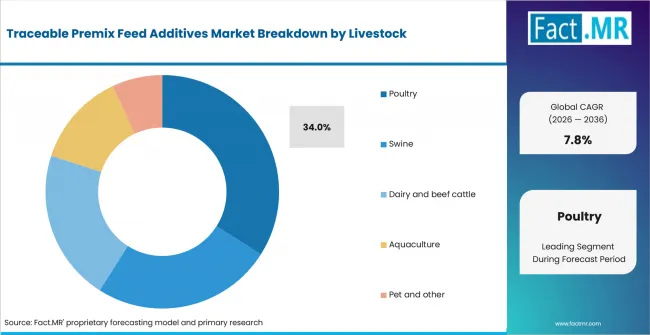
Traceable Premix Feed Additives Market Analysis By Livestock | Source: Fact.MR
Poultry is anticipated to lead Livestock owing to integrated feed programs and frequent flock-stage changes. Swine creates demand for amino-acid and mineral records tied to performance diets. Dairy and beef cattle need specialty premix records for residue controls. USDA NASS reported in February 2026 that federally inspected poultry live weight reached 5.91 billion pounds in January 2026.
What supports Compliance Driver demand?
Feed safety and recall readiness is estimated to represent 35.0% share in 2026.
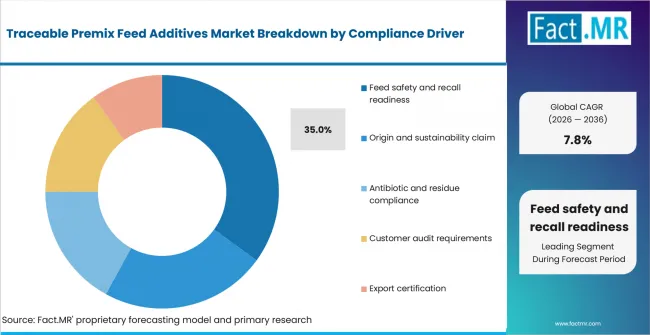
Traceable Premix Feed Additives Market Analysis By Compliance Driver | Source: Fact.MR
Feed safety and recall readiness is estimated to lead Compliance Driver because quality teams need fast links from additive receipt to finished premix release. Origin claims need supplier certificates that survive customer audits. Residue compliance depends on authorization files and analytical records. The FSA reported in 2025 that the GB register of feed additives contained 1,631 entries.
What is accelerating Traceable Premix Feed Additives Market adoption, and what is holding it back?
Feed safety and recall readiness drives it; supplier data gaps restrain it.
Drivers Impact Analysis
| DRIVER | (~) % IMPACT ON CAGR | GEOGRAPHIC RELEVANCE | IMPACT TIMELINE |
|---|---|---|---|
| Feed safety and recall readiness | +1.4% | Global | Short term (<= 2 years) |
| ERP and batch genealogy adoption | +1.1% | North America, Europe | Medium term (2-4 years) |
| Export customer audit pressure | +0.9% | Europe, Latin America | Short term (<= 2 years) |
| Origin and sustainability claim evidence | +0.7% | Europe, North America | Medium term (2-4 years) |
| Analytical verification of additives | +0.5% | Global | Long term (>= 4 years) |
- Feed safety and recall readiness: Recall preparedness is increasing demand for systems that connect additive intake, batch release, and customer dispatch records. Strong traceability allows feed manufacturers to identify affected material quickly and support more efficient internal investigations, customer communication, and corrective actions.
- ERP and batch genealogy adoption: ERP-linked batch genealogy is gaining importance where feed mills already manage recipes, inventory, weighing, and dispatch digitally. Feed-specific traceability fields can reduce duplicate data entry and create a clearer record from ingredient receipt through finished-batch release.
- Export customer audit pressure: Export-oriented feed programs increasingly require rapid access to additive origin, formulation, and release documentation. Traceable digital records help suppliers respond to customer audits, formulation reviews, and residue-related inquiries with greater consistency.
- Origin and sustainability claim evidence: Origin and sustainability documentation is becoming more relevant where animal-protein customers connect feed inputs with broader environmental and sourcing requirements. Traceability platforms can strengthen these programs by linking ingredient origin, batch records, and sustainability-related information.
- Analytical verification of additives: Laboratory verification can support feed programs that require stronger evidence of additive identity, quality, or composition. Testing records become more useful when they are linked directly to lot numbers, batch genealogy, and release documentation.
Opportunity Impact Analysis
| OPPORTUNITY | (~) % IMPACT ON CAGR | GEOGRAPHIC RELEVANCE | IMPACT TIMELINE |
|---|---|---|---|
| Farm-to-feed traceability platforms | +0.8% | Global | Medium term (2-4 years) |
| QR-linked lot records | +0.6% | North America, Europe | Medium term (2-4 years) |
| Analytics tied to residue and additive checks | +0.5% | Europe, North America | Long term (>= 4 years) |
| Aquaculture and pet premix traceability | +0.4% | Global | Long term (>= 4 years) |
- Farm-to-feed traceability platforms: Platform suppliers can benefit from projects that connect feed inputs, nutrition records, and farm-level data. Integrated traceability helps users follow ingredient movement and feeding information across the value chain while supporting quality, sustainability, and operational documentation.
- QR-linked lot records: QR-based systems can expand adoption among mid-sized feed mills that need a simple customer-facing traceability layer. Serialized labels can connect certificates, batch files, test records, and release documentation, giving buyers faster access to relevant lot information.
- Analytics tied to residue and additive checks: Traceability analytics can help quality teams compare additive and residue-testing results across suppliers and batches. Repeated patterns can support supplier reviews, targeted testing, and earlier identification of recurring quality issues.
- Aquaculture and pet premix traceability: Aquaculture and pet nutrition create additional opportunities for traceable premix documentation. Suppliers can differentiate through clear ingredient-origin records, batch genealogy, analytical verification, and release documentation tailored to specialized nutrition programs.
Restraints Impact Analysis
| RESTRAINT | (~) % IMPACT ON CAGR | GEOGRAPHIC RELEVANCE | IMPACT TIMELINE |
|---|---|---|---|
| Supplier certificate gaps | -0.5% | Global | Short term (<= 2 years) |
| Integration cost in smaller mills | -0.4% | Latin America, Europe | Medium term (2-4 years) |
| Mixed paper and digital records | -0.3% | Global | Short term (<= 2 years) |
| Feed additive authorization changes | -0.2% | United Kingdom, Europe | Medium term (2-4 years) |
- Supplier certificate gaps: Incomplete supplier certificates can limit traceability when additive lots arrive without sufficient origin, quality, or compliance documentation. Feed manufacturers may therefore place greater emphasis on vendor document quality, data consistency, and digital record capability during supplier qualification.
- Integration cost in smaller mills: Smaller feed mills that still rely on paper-based batch records can face higher barriers when adopting integrated traceability systems. Staged implementation, modular software, and gradual digitization can reduce disruption and make adoption more manageable for resource-constrained facilities.
- Mixed paper and digital records: Traceability benefits can remain limited when batch evidence is split across paper files, spreadsheets, and software systems. Adoption improves when each lot record consolidates certificates, test results, formulation data, and customer-release information in one accessible record.
- Feed additive authorization changes: Changes in feed-additive authorization requirements can create additional review and documentation work for manufacturers and suppliers. Traceability systems that connect regulatory status with specific ingredients, lots, and formulations can help quality teams manage updates more efficiently.
Which countries are scaling the Traceable Premix Feed Additives Market through 2036?
- The country comparison spans 3.95 percentage points and creates three practical growth bands across the forecast period.
- France remains 1.25 percentage points above the USA through feed-control plans and meat-chain traceability.
- The USA remains 0.55 percentage point above Brazil as preventive controls support additive genealogy in large livestock systems.
- Brazil remains 0.78 percentage point above the Netherlands through poultry and swine scale.
- The Netherlands remains 1.37 percentage points above the UK through dense livestock operations and feed-record discipline.
- The UK closes the displayed range as GB register reforms support steady traceability adoption.
Comparable CAGRs create entry conditions due to livestock density, feed regulation and documentation depth. Report coverage includes North America, Latin America, Western Europe, Eastern Europe, East Asia, South Asia & Pacific, Middle East & Africa.
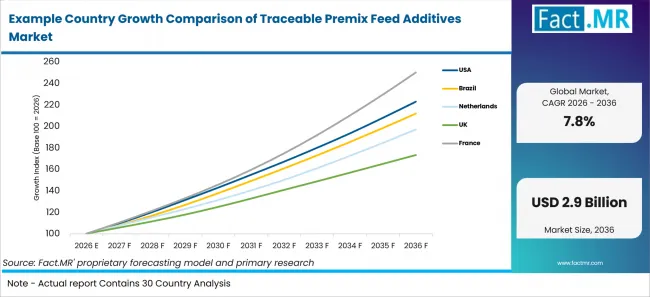
Example Country Growth Comparison Of Traceable Premix Feed Additives Market | Source: Fact.MR
| Country | CAGR (2026-2036) |
|---|---|
| France | 9.6% |
| United States | 8.3% |
| Brazil | 7.8% |
| Netherlands | 7.0% |
| United Kingdom | 5.6% |
What is powering France adoption?
9.6% CAGR through 2036, driven by feed-control plans and meat-chain traceability.
French premix plants work inside feed-hygiene systems where additive records stay linked to finished feed. France to record a 9.6% CAGR through 2036. Agreste reported on July 8, 2026 that total meat consumption in France increased 1.3% in 2025. Mill customers value batch records that connect premix inputs to meat-chain quality files.
What supports the United States outlook?
8.3% CAGR through 2036, supported by preventive controls and livestock scale.
U.S. feed mills operate under FSMA animal-food controls near hazard analysis. The USA to post an 8.3% CAGR through 2036. USDA NASS reported in January 2026 that the United States had 86.2 million cattle and calves. Traceable premix systems can link additive lots with finished batches across large production systems.
How is Brazil scaling traceable premix feed additives?
7.8% CAGR through 2036, driven by livestock scale and reporting discipline.
Brazilian poultry and swine integrators need traceable premix records across animal-health and export files. Brazil to advance at a 7.8% CAGR through 2036. IBGE reported in March 2026 that 6.69 billion chickens were slaughtered in Brazil in 2025. High-volume batch flow favors ERP genealogy during customer reviews.
What underpins Netherlands growth?
7.0% CAGR through 2036, shaped by livestock density and feed traceability rules.
Dutch livestock systems combine dense animal production with strict feed records. The Netherlands to reach a 7.0% CAGR through 2036. CBS reported in July 2025 that the pig population in the Netherlands fell by 5.1% to 9.96 million in 2025. The NVWA states that feed producers need a traceability system recording raw-material and feed flows so they can demonstrate from whom products were received and to whom products were supplied.
How does the United Kingdom perform?
5.6% CAGR through 2036, backed by compound-feed activity and GB register reforms.
The UK feed market is shifting after GB feed-additive register changes created a direct authorization reference point. The UK to hold a 5.6% CAGR through 2036. GOV.UK’s August 2026 productivity data show that animal-feed volume rose 5.7% in 2025. Demand centers on additive records aligned with feed activity.
Who leads the Traceable Premix Feed Additives Market?
DSM-Firmenich and Cargill lead direct premix coverage, while ADM and Nutreco strengthen feed formulation and nutrition services.
DSM-Firmenich’s Animal Nutrition & Health business is active through premixes, vitamins, feed additives and data-driven Precision Services supporting sustainability measurement. Cargill participates through its Provimi business, including micronutrient premixes, feed additives and specialty nutrition solutions.
ADM supports the market through premix services, feed additives and dairy nutrition solutions. Nutreco participates through Trouw Nutrition premixes and its Selko feed-additive portfolio. De Heus announced its Rajpura, Punjab animal-feed factory on September 28, 2025, with the official inauguration ceremony scheduled for October 1, 2025. Vilofoss adds direct specialization in industrial premixes and vitamin-and-mineral nutrition.
Which companies are the key providers?
Key companies include DSM-Firmenich, Cargill, ADM, Nutreco, De Heus, and Vilofoss.
- DSM-Firmenich
- Cargill
- ADM
- Nutreco
- De Heus
- Vilofoss
Bibliography
- Service de la statistique et de la prospective (SSP), & FranceAgriMer. (2026, July 8). En 2025, une hausse de la consommation de viande en France et une dépendance croissante aux importations.
- dsm-firmenich. (2025, September 18). dsm-firmenich and FarmTrace unite to simplify farm-level sustainability tracking.
- Brazilian Institute of Geography and Statistics. (2026, March 18). In 2025, Brazil registers the highest production of milk, leather and eggs in history; slaughter of cattle, chickens and pigs also hits record.
- Cargill. (2025, November 4). Cargill Animal Nutrition & Health increases micronutrition production capacity to meet growing customer demand.
- Department for Environment, Food & Rural Affairs. (2026, July 29). Chapter 5: Productivity. GOV.UK.
- U.S. Department of Agriculture, National Agricultural Statistics Service. (2026, February 20). Poultry slaughter.
- De Heus. (2025, September 28). De Heus opens new animal feed factory in Punjab, India.
- dsm-firmenich. (2025, August 30). dsm-firmenich opens new Animal Nutrition & Health plant in Jadcherla, India.
- European Commission. (2026, February 23). Safety in the EU: No safe food without safe feed [Fact sheet].
- Food Standards Agency. (2025, September 5). Animal feed. GOV.UK.
- Nutreco. (2025, February 11). Nutreco receives Dutch grant to develop on-farm solutions to target nitrogen emissions.
- Statistics Netherlands. (2025, July 21). Pig population falls below 10 million for the first time in 45 years.
- Grossen, G. (2026, June 4). Animal protein continues to be plentiful for U.S. consumers. Economic Research Service, U.S. Department of Agriculture.
- U.S. Department of Agriculture, National Agricultural Statistics Service. (2026, January 30). United States cattle inventory down slightly.
- Vilofoss. (2026, June 30). Vilofoss and partners break ground on new production plant in Uzbekistan.
This Report Answers
- The report explains where traceable premix feed additives are used across Premix Type and Traceability Architecture.
- Segment analysis identifies vitamin-mineral premix and ERP and batch genealogy as the main 2026 reference points.
- Country analysis examines France, the United States, Brazil, the Netherlands and the United Kingdom.
- Competitive analysis reviews DSM-Firmenich, Cargill, ADM, Nutreco, De Heus and Vilofoss.
- Technology assessment covers serialized lot systems, chain-of-custody tools and analytical verification.
- Application analysis reviews poultry, swine, dairy and beef cattle, aquaculture, and pet and other uses.
- The forecast is supported by official statistics, regulator pages, company developments and provider portfolio checks.
What does the Traceable Premix Feed Additives Market cover?
Vitamin-mineral, amino-acid, functional and specialty premixes used for traceable animal nutrition.
The market covers premix feed additives sold with batch, lot, supplier and compliance records. It includes traceability layers attached to vitamin-mineral, amino-acid, functional and species-specific premixes.
The scope is narrower than wider feed premix workflows because it focuses on additive-level genealogy and customer audit evidence. Adjacent specialty feed additives enter the scope only when they are sold as traceable premix inputs with release and origin records.
What is included in the scope?
Traceable premix systems used in livestock feed formulation, batching, release and customer audit records.
The scope includes vitamin-mineral, amino-acid, functional and medicated specialty premixes when records trace each lot from formulation to dispatch. It also includes ERP genealogy, QR labels and lab-linked checks for poultry, swine, cattle and aquaculture. Related feed software workflows are included only when they support premix batch genealogy.
Additives such as feed mycotoxin detoxifiers, mineral feed records and feed micronutrients are included inside documented premix programs. Traceable feed ingredients and animal nutrition organic acids are covered when blended into premix systems with lot-specific release evidence.
What is excluded from the scope?
General compound feed and standalone livestock software are outside the scope.
Ordinary compound feed stays outside the scope when additive-level genealogy is absent. Standalone software that records recipes without batch-level premix evidence remains outside the market boundary.
Animal feed mixer systems and zootechnical feed additives are adjacent categories unless they include traceable premix data and serialized lots.
How Was the Analysis Built?
The analysis draws on 120+ sources, 35+ company portfolios, 25+ countries, and more than 20 industry interviews.
- Primary Research: Primary research includes discussions with manufacturers, service providers, technology developers, distributors, end users, and subject-matter experts. These conversations examine purchasing priorities, product adoption, operational challenges, approval requirements, competitive positioning, and the factors that influence wider market acceptance.
- Desk Research: Desk research covers government statistics, regulatory publications, company filings, trade data, technical studies, industry associations, standards, public policy, and other authoritative sources. Every source used in the analysis is documented in the bibliography.
- Market Sizing and Forecasting: Market estimates combine historical performance, demand indicators, pricing and volume trends, segment shares, company participation, country-level growth, adoption patterns, investment activity, and barriers to market expansion.
- Data Validation and Update Cycle: Findings are validated by comparing primary interviews with public data, company activity, regulatory changes, trade patterns, and industry developments. Regular updates review new product launches, capacity changes, partnerships, approvals, and shifts in commercial adoption.
What is the report’s scope and coverage?
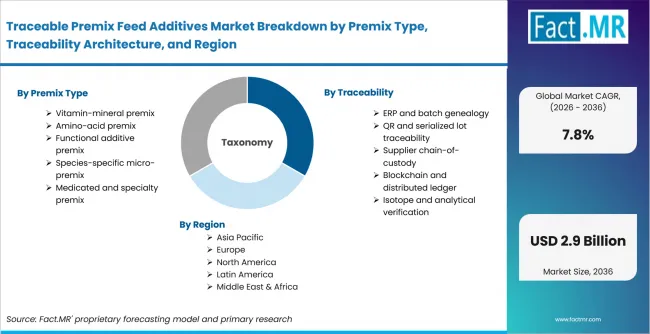
Traceable Premix Feed Additives Market Breakdown By Premix Type, Traceability Architecture, And Region | Source: Fact.MR
| Attribute | Details |
|---|---|
| Quantitative Units | USD Billion in 2026 to USD Billion by 2036 at a CAGR |
| Market Definition | Premix feed additives sold with lot, batch, supplier and compliance records that connect additive receipt with formulation, mixing, release and customer audit files. |
| Premix Type | Vitamin-mineral premix; Amino-acid premix; Functional additive premix; Species-specific micro-premix; Medicated and specialty premix |
| Traceability Architecture | ERP and batch genealogy; QR and serialized lot traceability; Supplier chain-of-custody; Blockchain and distributed ledger; Isotope and analytical verification |
| Livestock | Poultry; Swine; Dairy and beef cattle; Aquaculture; Pet and other |
| Compliance Driver | Feed safety and recall readiness; Origin and sustainability claim; Antibiotic and residue compliance; Customer audit requirements; Export certification |
| Regions Covered | North America; Latin America; Western Europe; Eastern Europe; East Asia; South Asia & Pacific; Middle East & Africa |
| Countries Covered | United States; Brazil; Netherlands; United Kingdom; France |
| Key Companies Profiled | DSM-Firmenich; Cargill; ADM; Nutreco; De Heus; Vilofoss |
| Forecast Period | 2026 to 2036 |
| Approach | Hybrid top-down and bottom-up approach using livestock scale, feed-additive controls, premix type mix, traceability architecture, compliance drivers and provider portfolio review. |
How is the market segmented?
-
By Premix Type
- Vitamin-mineral premix
- Amino-acid premix
- Functional additive premix
- Species-specific micro-premix
- Medicated and specialty premix
-
By Traceability Architecture
- ERP and batch genealogy
- QR and serialized lot traceability
- Supplier chain-of-custody
- Blockchain and distributed ledger
- Isotope and analytical verification
-
By Livestock
- Poultry
- Swine
- Dairy and beef cattle
- Aquaculture
- Pet and other
-
By Compliance Driver
- Feed safety and recall readiness
- Origin and sustainability claim
- Antibiotic and residue compliance
- Customer audit requirements
- Export certification
-
By Region
- North America
- Latin America
- Western Europe
- Eastern Europe
- East Asia
- South Asia & Pacific
- Middle East & Africa