- Market Value (2025): USD 87.0 Mn
- Estimated Value (2026): USD 94.0 Mn
- Forecast Value (2036): USD 202.9 Mn
- CAGR (2026-2036): 8.0%
What is the Esophageal Stents Market forecast to be worth by 2036?
USD 94.0 million in 2026 to USD 202.9 million by 2036 at an 8.0% CAGR.
- The market reached USD 87.0 million in 2025.
- Demand is projected to increase from USD 94.0 million in 2026 to USD 202.9 million by 2036.
- The market is forecast to expand at an 8.0% CAGR from 2026 to 2036 as hospitals maintain demand for malignant-obstruction relief and specialist teams evaluate stents for selected recurrent strictures and fistulas.
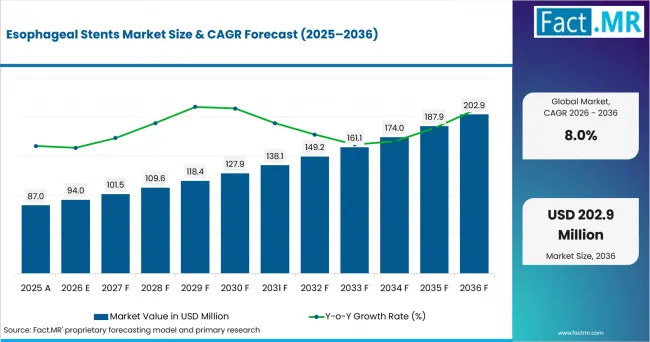
Esophageal Stents Market Value Analysis | Source: Fact.MR
What are the defining numbers behind Esophageal Stents Market growth?
The market offers USD 108.9 million in absolute opportunity between 2026 and 2036.
- Demand Drivers in the Market
- Malignant dysphagia gives hospitals a defined indication for stent purchasing. The NCI identifies self-expandable metal stenting as a method for palliating swallowing difficulty in esophageal cancer. This links demand to patients needing luminal relief, rather than to every person diagnosed with the disease.
- Specialist teams need devices that can seal selected esophageal fistulas as well as address obstruction. ESGE guidance supports covered metal stents for malignant tracheoesophageal or bronchoesophageal fistulas. These cases create demand for the appropriate covering and dimensions within the broader gastrointestinal stents category.
- Difficult benign strictures can generate repeated dilation visits and motivate evaluation of temporary or biodegradable stenting. Japan's National Cancer Center reported regulatory approval of the ELLA-BD stent for refractory benign esophageal strictures in 2025, creating an additional product pathway for a carefully selected patient group.
- Endoscopy departments need a range of sizes and delivery configurations because lesion location and length affect placement. Manufacturers' product documentation describes deployment and positioning features intended for this task. A functioning service therefore requires an appropriate device inventory alongside its endoscopy devices.
- Key Segments Analyzed
- Self-expandable Metallic Stents hold 69.2% of Product in 2026, supported by their established use in malignant dysphagia and the availability of covered configurations.
- Metal represents 45.3% of Material in 2026. Expansion characteristics and luminal support make metallic structures relevant to the mechanical task performed by the device.
- Hospitals account for 55.2% of End User in 2026 as stent placement brings together endoscopy, oncology, anaesthesia and management of complications.
- Esophageal Cancer Treatment captures 74.2% of Application in 2026, reflecting demand for relief of malignant obstruction within cancer-care pathways.
- Analyst Opinion at Fact.MR
- Shambhu Nath Jha, Principal Consultant, Fact.MR
- The commercial test for an esophageal stent is how well it fits the patient's anatomy and treatment plan, including what happens after deployment. A device that is easy to place still needs appropriate coverage, stability and follow-up. Suppliers can strengthen their position by helping endoscopy teams select the right configuration and maintain reliable access to the sizes they need.
- Strategic Implications
- Manufacturers should connect design claims with the specific clinical task, such as obstruction relief, sealing or planned removal, rather than promote one configuration for every case.
- Hospitals should assess the expected episode of care, including deployment, monitoring and possible reintervention, when comparing device prices.
- Distributors need size-specific stock and clear product identification so endoscopy teams can obtain the appropriate stent without substituting an unsuitable configuration.
- Clinical teams and suppliers developing benign-stricture applications should distinguish a selective treatment opportunity from routine first-line use.
How does the Esophageal Stents Market break down by segment?
The market is segmented by Product, Material, End User and Application.
Why do Self-expandable Metallic Stents lead Product?
Self-expandable Metallic Stents hold 69.2% of Product in 2026.
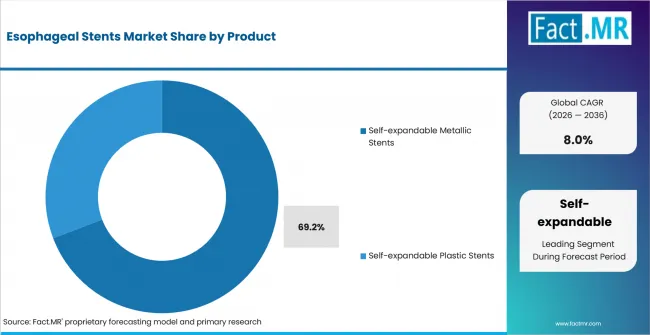
Esophageal Stents Market Analysis By Product | Source: Fact.MR
A self-expandable metallic structure can be delivered in a constrained form and then expand across the narrowing. Fully covered, partially covered and uncovered designs allow different approaches to the balance between tissue interaction, sealing and removability.
ESGE recommends partially or fully covered metal stents for palliation of malignant dysphagia. This clinical position supports an established purchasing pathway in appropriate patients, while preserving the need to select the particular design for the case.
Boston Scientific's WallFlex documentation describes fully and partially covered variants, different sizes and features intended to support anchoring and deployment. For buyers, breadth of configuration matters because an endoscopy unit encounters different obstruction lengths and locations.
Why does Metal lead Material?
Metal holds 45.3% of Material in 2026.
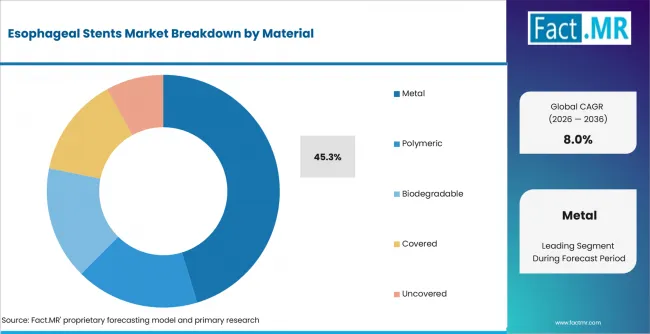
Esophageal Stents Market Analysis By Material | Source: Fact.MR
The material must support the mechanical requirements of placement and continued luminal patency. Nitinol and stainless steel sit within the metal category, while polymeric and biodegradable materials offer different design possibilities.
ENDO-FLEX's instructions describe a self-expanding stent intended to restore an open lumen through radial expansion. This illustrates why material behaviour and device construction are evaluated together. The cost of the implant is only one part of the purchasing decision when inadequate support or poor anatomical fit can lead to further intervention.
Covering is another design attribute. A coating can change tissue ingrowth and sealing behaviour without replacing the underlying frame, so material and coverage descriptions must be read together rather than treated as interchangeable clinical specifications.
Why do Hospitals lead End User?
Hospitals hold 55.2% of End User in 2026.
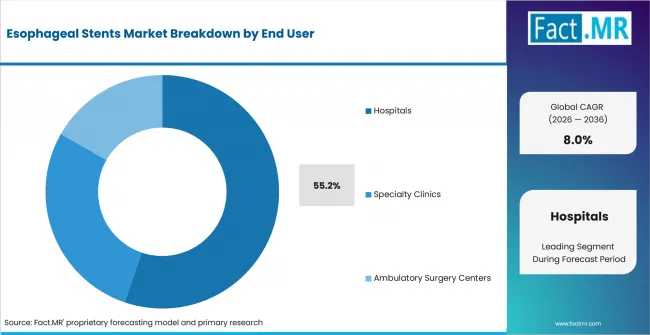
Esophageal Stents Market Analysis By End User | Source: Fact.MR
Hospital placement services can draw on imaging, therapeutic endoscopy and support for patients whose cancer or nutritional status complicates care. Procurement therefore sits within a broader clinical pathway that includes assessment, procedural capacity and management after placement.
Specialty clinics and ambulatory centres can participate where their staffing, facilities and patient-selection arrangements support the intervention. Hospitals remain important because complex obstruction and fistula cases may require coordinated input from several services.
Device availability also interacts with nutrition planning. Teams may evaluate oral intake and alternatives involving enteral nutrition, but nutrition products and stent devices create separate revenue streams.
Why does Esophageal Cancer Treatment lead Application?
Esophageal Cancer Treatment holds 74.2% of Application in 2026.
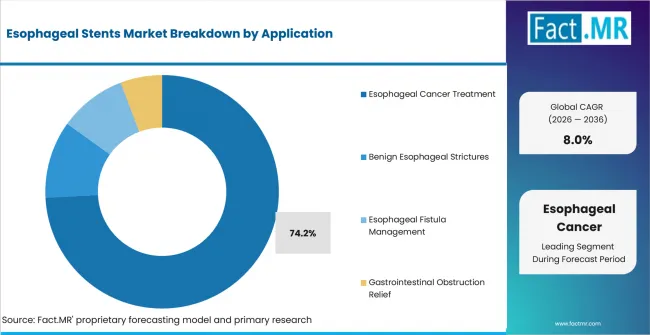
Esophageal Stents Market Analysis By Application | Source: Fact.MR
Malignant narrowing can make swallowing difficult and create an immediate need for palliation. Stenting serves that functional need within the cancer pathway; the implant is not itself a systemic cancer treatment.
The NCI describes expandable metal stents as a means of keeping a tumour-obstructed esophagus open. Device demand is therefore linked to obstruction, symptoms and the chosen treatment plan, rather than to cancer incidence alone.
What is accelerating Esophageal Stents Market adoption, and what is holding it back?
The market benefits from a clear functional need: maintaining esophageal patency in patients who require obstruction relief or selected forms of sealing.
Drivers Impact Analysis
| Factor | (~) % Impact on CAGR | Geographic Relevance | Impact Timeline |
|---|---|---|---|
| Stenting for malignant swallowing obstruction | +0.7% | All five countries | 2026-2031 |
| Covered devices for selected malignant fistulas | +0.3% | USA, Germany and France | 2026-2032 |
| Specialist endoscopy procedure capacity | +0.3% | Japan, Germany and Italy | 2027-2033 |
Source: Fact.MR analysis. Updated Sep 7, 2026
Malignant obstruction provides the principal demand mechanism, while fistula management creates a more specialized requirement. Hospitals need to connect the choice of implant with an available procedure slot, trained staff and appropriate follow-up.
Opportunity Impact Analysis
| Factor | (~) % Impact on CAGR | Geographic Relevance | Impact Timeline |
|---|---|---|---|
| Biodegradable stents for refractory benign strictures | +0.4% | Japan and Germany | 2027-2034 |
| Delivery systems supporting controlled placement | +0.3% | All five countries | 2026-2031 |
| Size-specific stock and responsive distribution | +0.2% | France and Italy | 2026-2030 |
Source: Fact.MR analysis. Updated Sep 7, 2026
Growth can come from more suitable devices for difficult anatomy and selective benign applications. Stenting is part of the wider movement toward minimally invasive surgery and intervention, but each application still requires its own clinical justification.
Restraints Impact Analysis
| Factor | (~) % Impact on CAGR | Geographic Relevance | Impact Timeline |
|---|---|---|---|
| Migration and recurrent obstruction | -0.6% | All five countries | 2026-2036 |
| Clinical limits on routine benign-stricture use | -0.4% | All five countries | 2026-2036 |
| Procedure cost and competing palliation options | -0.3% | USA, France and Italy | 2026-2031 |
Source: Fact.MR analysis. Updated Sep 7, 2026
ESGE advises against metal stents as first-line treatment for benign esophageal strictures and recommends careful selection for temporary stenting in refractory cases. Persistent swallowing difficulty may also require nutritional support, including enteral feeding, without generating another stent purchase.
Which countries are scaling the Esophageal Stents Market through 2036?
- USA: Established cancer-palliation pathways and specialist endoscopy services sustain purchasing for malignant obstruction and related complications.
- Japan: A newly approved biodegradable option extends the choices available for refractory benign strictures in a specialist endoscopy setting.
- Germany: A substantial late-stage disease burden supports continued need for symptom-relief procedures alongside cancer treatment.
- France: Cancer-care pathways explicitly address restoration of oral intake, linking stent demand to swallowing impairment and individualized supportive care.
- Italy: Cancer and gastroenterology services need selective obstruction-relief options alongside nutrition and other supportive interventions.
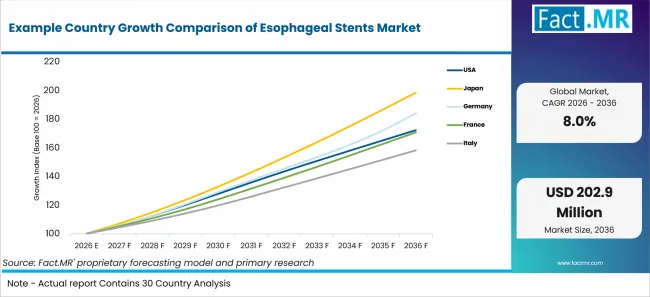
Example Country Growth Comparison Of Esophageal Stents Market | Source: Fact.MR
| Country | CAGR, 2026-2036 |
|---|---|
| USA | 5.6% |
| Japan | 7.1% |
| Germany | 6.3% |
| France | 5.5% |
| Italy | 4.7% |
Source: Fact.MR analysis. Updated Sep 7, 2026
What is driving USA's growth through 2036?
The USA is forecast to expand at a 5.6% CAGR from 2026 to 2036.
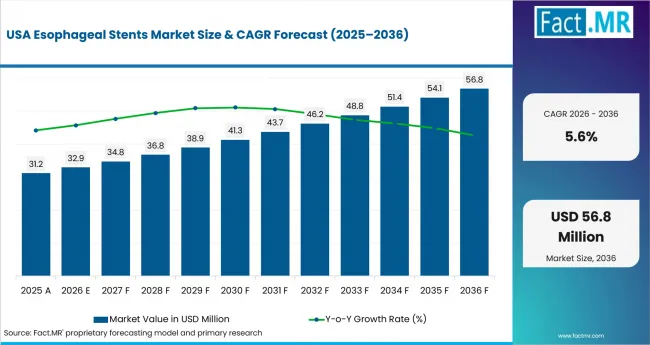
Esophageal Stents Market Country Value Analysis | Source: Fact.MR
The NCI's esophageal-cancer treatment guidance identifies stenting within the palliation pathway. For US hospitals, this anchors demand to a clinically defined group of patients with swallowing obstruction rather than the whole cancer population.
Endoscopy teams need access to different stent lengths, diameters and covering options, together with reliable deployment support. Purchasing decisions can therefore favour a product portfolio and service arrangement that accommodates case variation without excessive inventory.
What is driving Japan's growth through 2036?
Japan is forecast to expand at a 7.1% CAGR from 2026 to 2036.
Japan's National Cancer Center announced in June 2025 that the ELLA-BD stent had received approval on March 7, 2025 for refractory benign esophageal strictures. The polydioxanone device is designed to degrade, avoiding the need for a removal procedure. The announcement described reimbursement procedures as the next step, rather than reporting nationwide funded adoption.
This creates a specific commercial route after difficult post-treatment narrowing. Expansion depends on appropriate use, procurement access and the treatment pathway, and should not be extrapolated to all benign strictures.
What is driving Germany's growth through 2036?
Germany is forecast to expand at a 6.3% CAGR from 2026 to 2036.
The Robert Koch Institute reports that only about one-third of esophageal tumours are diagnosed at an early stage. This creates a continuing need for advanced-disease assessment and symptom management, although not every patient will be suitable for a stent.
German hospitals can evaluate devices within established gastroenterology and oncology services. The purchasing requirement combines anatomical fit, implantation control and the capacity to manage complications, giving specialist product knowledge practical value.
What is driving France's growth through 2036?
France is forecast to expand at a 5.5% CAGR from 2026 to 2036.
The French National Cancer Institute's patient guidance describes an esophageal prosthesis as a metal or plastic tube used to keep the esophagus open and permit feeding. This places the device within a functional care objective that matters to patients and clinical teams.
Commercial demand follows centres that can provide the intervention and coordinate nutrition and follow-up. Product selection remains connected to tumour characteristics and the broader care plan, while distributors can support timely access to the required configuration.
What is driving Italy's growth through 2036?
Italy is forecast to expand at a 4.7% CAGR from 2026 to 2036.
AIOM's esophageal-cancer guidance includes stenting among the approaches to substantial dysphagia, while its 2025 cancer report describes the continuing burden of esophageal disease. These sources support a care-pathway view of demand rather than a simple conversion from incidence to device sales.
Hospital teams need to balance symptom relief, the anticipated treatment course and the possibility of repeat intervention. Suppliers can address those needs through dependable local availability, a useful size range and practical support for the endoscopy service.
Who Leads the Esophageal Stents Market?
Key players in the Esophageal Stents Market include Boston Scientific Corporation, Cook Group Incorporated, Merit Medical Systems Inc., M.I.Tech, Ella CS, s.r.o. and Endo-Flex GmbH, with BVM Medical Limited participating through product supply and distribution. Their roles span metallic, covered and biodegradable designs as well as the commercial support needed to place the appropriate product in an endoscopy unit.
Boston Scientific offers WallFlex esophageal stents, Cook supplies the Evolution controlled-release system, and Merit markets EndoMAXX and ALIMAXX-ES products. M.I.Tech's HANAROSTENT documentation includes multiple esophageal configurations. These portfolios show why length, diameter, covering and deployment behaviour influence supplier selection.
Ella CS, s.r.o. supplies biodegradable technology as well as other gastrointestinal devices, while Endo-Flex GmbH markets self-expandable esophageal stents. BVM Medical Limited's EGIS offering illustrates the distributor route to hospital purchasing. Manufacturer sales and downstream distribution of the same device must be treated as one product-revenue chain.
C.R. Bard (BD) reflects corporate heritage: BD completed the acquisition of Bard in 2017. Andratec GmbH's public portfolio focuses on vascular and other interventional devices. These identities provide corporate and adjacent-device context; they should not be interpreted as equivalent to a current esophageal-stent product franchise.
Hospitals assess more than purchase price. A useful portfolio must offer the right configuration, consistent product identification, dependable supply and support for the delivery system. A distributor can influence availability without owning the implant technology, while a manufacturer must support the device's specific claims and instructions.
Which companies are the key providers?
Esophageal-stent providers include Boston Scientific Corporation, Cook Group Incorporated, Merit Medical Systems Inc., M.I.Tech, Ella CS, s.r.o. and Endo-Flex GmbH, with BVM Medical Limited supplying devices through distribution; C.R. Bard (BD) is a legacy corporate identity and Andratec GmbH participates in adjacent interventional-device categories.
- Boston Scientific Corporation
- Cook Group Incorporated
- Merit Medical Systems Inc.
- M.I.Tech
- Ella CS, s.r.o.
- Endo-Flex GmbH
- BVM Medical Limited
- C.R. Bard (BD)
- Andratec GmbH
Bibliography
- European Society of Gastrointestinal Endoscopy. (2021). Esophageal Stenting for Benign and Malignant Disease: Guideline Update 2021. Endoscopy.
- National Cancer Institute. (2025). Esophageal Cancer Treatment PDQ: Health Professional Version. National Institutes of Health.
- Boston Scientific Corporation. (n.d.). WallFlex Esophageal Stents. Boston Scientific.
- Cook Medical. (n.d.). Evolution Controlled-Release Stent. Cook Medical.
- Merit Medical Systems. (n.d.). Gastroenterology Stricture Management. Merit Medical.
- National Cancer Center Japan. (2025). Regulatory Approval of the ELLA-BD Stent PX for Refractory Benign Esophageal Stricture. National Cancer Center Japan.
- Robert Koch Institute. (n.d.). Speiseroehrenkrebs: Oesophageal Cancer. German Centre for Cancer Registry Data.
- Institut National du Cancer. (2015). Les traitements des cancers de l'oesophage. Institut National du Cancer.
- Associazione Italiana di Oncologia Medica. (2019, 2025). Tumori dell'esofago: Linee Guida; I numeri del cancro in Italia 2025. AIOM.
- M.I.Tech. (n.d.). Patient Information Leaflet: Esophageal Stent with Delivery System. M.I.Tech.
- ELLA-CS. (n.d.). BD Stent. ELLA-CS.
- ENDO-FLEX. (2023). Operating Instruction: Self Expandable Esophageal Stents SU. ENDO-FLEX.
- BVM Medical. (n.d.). EGIS Oesophageal Stent. BVM Medical.
- Becton, Dickinson and Company. (2017). BD Completes Bard Acquisition. BD.
- AndraTec. (n.d.). Medical Devices Product Portfolio. AndraTec.
This Report Answers
- Why does malignant obstruction account for most application demand?
- How do covering, material and delivery behaviour affect stent choice?
- Which benign conditions create selective opportunities for temporary or biodegradable devices?
- How do hospital capabilities and country care pathways influence purchasing?
- What separates current implant manufacturers, distributors and legacy corporate identities?
What does the Esophageal Stents Market cover?
The Esophageal Stents Market covers commercial revenue from stents placed in the esophagus to maintain luminal patency or manage selected fistulas and related conditions. Revenue includes the stent and its integral delivery system. Demand is examined across product, material, end-user and application classifications, with cancer-related obstruction providing the principal application base.
What is included in the scope?
Products include self-expandable metallic and plastic stents, with fully covered, partially covered and uncovered configurations. Material analysis includes metal, polymeric and biodegradable options, together with covering attributes. Applications encompass malignant obstruction, post-surgical cancer management, selected benign strictures, fistula management and other esophageal uses within gastrointestinal obstruction relief. Hospital, specialty-clinic and ambulatory purchasing are included where facilities provide the relevant intervention.
What is excluded from the scope?
Coronary, peripheral vascular, biliary, ureteral and colorectal stents are excluded. General endoscopes, standalone guidewires, dilation balloons, feeding tubes, nutrition products and professional procedure fees do not form part of esophageal-stent revenue. Gastrointestinal Obstruction Relief applies here only to esophageal placement; it does not extend the market to every upper-GI implant. An application category does not imply that stenting is a routine or approved treatment for every patient within it.
How Was the Analysis Built?
- Primary Research: Relevant respondent groups are therapeutic endoscopists, upper-GI surgeons, oncology teams, hospital procurement specialists, stent manufacturers and medical-device distributors. Their expertise addresses anatomical selection, deployment, removability, inventory and follow-up requirements.
- Desk Research: Clinical guidelines, cancer-agency publications, device instructions, approval announcements and supplier product portfolios support the interpretation of indications, patient pathways and current commercial roles.
- Market Sizing and Forecasting: The product-revenue framework considers eligible placement procedures, replacement or repeat interventions, device price, covering and material mix, and the purchasing setting. Cancer incidence is a contextual measure rather than a direct count of stent procedures.
- Data Validation and Update Cycle: Reviews distinguish esophageal devices from stents for other anatomical sites, check current product indications and separate manufacturers from distributors. Updates account for clinical recommendations, approvals, delivery-system changes and corporate history. Directional impact estimates describe changes in purchasing conditions without being summed into the forecast.
Segmentation
What is the report's scope and coverage?
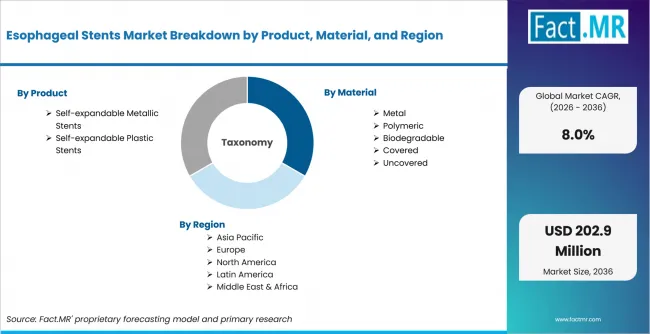
Esophageal Stents Market Breakdown By Product, Material, And Region | Source: Fact.MR
| Attribute | Details |
|---|---|
| Quantitative Units | USD million |
| Market Definition | The Esophageal Stents Market covers commercial revenue from stents placed in the esophagus to maintain luminal patency or manage selected fistulas and related conditions. |
| Segments Covered | Product; Material; End User; Application |
| Countries Covered | USA; Japan; Germany; France; Italy |
| Key Companies Profiled | Boston Scientific Corporation; Cook Group Incorporated; C.R. Bard (BD); Merit Medical Systems Inc.; M.I.Tech; Andratec GmbH; Ella CS, s.r.o.; Endo-Flex GmbH; BVM Medical Limited |
| Historical Period | 2021 to 2025 |
| Forecast Period | 2026 to 2036 |
| Base Year | 2025 |
| Market Value, 2025 | USD 87.0 million |
| Market Value, 2026 | USD 94.0 million |
| Market Value, 2036 | USD 202.9 million |
| CAGR, 2026-2036 | 8.0% |
| Absolute Opportunity | USD 108.9 million |
| Approach | Placement-procedure revenue analysis using indication, device configuration, repeat intervention, product price and endoscopy-service purchasing conditions. |
Source: Fact.MR analysis. Updated Sep 7, 2026
How is the market segmented?
-
By Product
- Self-expandable Metallic Stents
- Fully Covered Metallic Stents
- Partially Covered Metallic Stents
- Uncovered Metallic Stents
- Self-expandable Plastic Stents
- Polyester Stents
- Polyurethane Stents
- Self-expandable Metallic Stents
-
By Material
- Metal
- Nitinol
- Stainless Steel
- Polymeric
- Polyester
- Polyurethane
- Biodegradable
- Polydioxanone
- Other Biodegradable Materials
- Covered
- Fully Covered
- Partially Covered
- Uncovered
- Metallic Uncovered Stents
- Metal
-
By End User
- Hospitals
- Public Hospitals
- Private Hospitals
- Specialty Clinics
- Gastroenterology Clinics
- Oncology Clinics
- Ambulatory Surgery Centers
- Hospital-affiliated Centers
- Independent Centers
- Hospitals
-
By Application
- Esophageal Cancer Treatment
- Malignant Esophageal Obstruction
- Post Surgical Cancer Management
- Benign Esophageal Strictures
- Peptic Strictures Treatment
- Post Procedural Strictures
- Esophageal Fistula Management
- Tracheoesophageal Fistula
- Esophageal Perforation Treatment
- Gastrointestinal Obstruction Relief
- Upper GI Obstruction
- Motility Disorder Management
- Esophageal Cancer Treatment
-
By Region
- North America
- Latin America
- Western Europe
- Eastern Europe
- East Asia
- South Asia and Pacific
- Middle East & Africa
Frequently Asked Questions
What is the Esophageal Stents Market value in 2026?
At what CAGR is the market projected to grow?
What is the projected market value by 2036?
Which product segment leads the market?
Which material segment leads the market?
Which end-user segment leads the market?
Which application segment leads the market?
Which companies provide products in this market?
Who worked on this report


Preview the report firsthand - request a free sample
Free SampleGet the brochure for pricing and purchase details
Download PDF