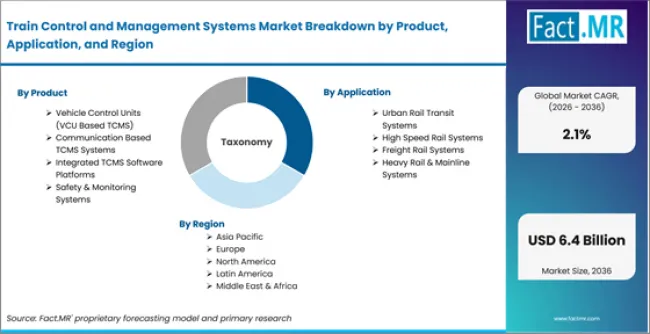
Train Control and Management Systems Market Size, Share, Growth and Forecast (2026 - 2036)
Train Control and Management Systems Market is segmented by Product (Vehicle Control Units (VCU Based TCMS), Communication Based TCMS Systems, Integrated TCMS Software Platforms, Safety & Monitoring Systems), Application (Urban Rail Transit Systems, High Speed Rail Systems, Freight Rail Systems, Heavy Rail & Mainline Systems), End Use (Rail Operators, Metro & Urban Transit Authorities, Rail Infrastructure Companies, Rolling Stock Manufacturers), and Region. Forecasts from 2026 to 2036.
Train Control and Management Systems Market Analysis and Forecast by Fact.MR
- The Train Control and Management Systems Market is expected to grow from USD 5.2 billion in 2026 to USD 6.4 billion by 2036, at a 2.1% CAGR.
- driven by urban rail network expansion programs requiring CBTC and TCMS integration on new rolling stock, ongoing fleet modernization that replaces legacy control systems with standardized digital platforms, and rising adoption of predictive maintenance and condition
- Monitoring through onboard data analytics, with VCU-based TCMS accounting for 66.8% share and urban rail transit contributing 41.6% share as operators prioritize interoperability, lifecycle cost reduction, and operational efficiency.
Summary of Train Control and Management Systems Market
- Market Snapshot
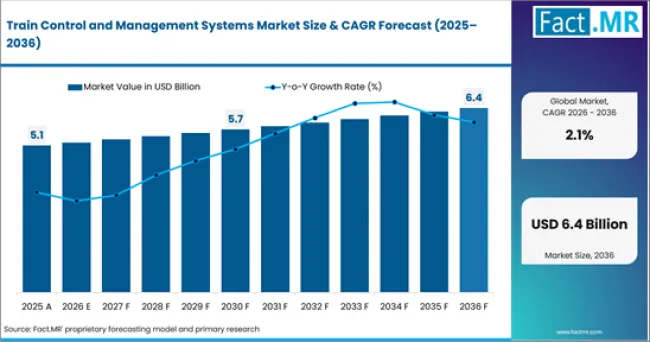
- In 2025, the global Train Control and Management Systems Market was valued at approximately USD 5.1 billion.
- The market is estimated to reach USD 5.2 billion in 2026 and is projected to attain USD 6.4 billion by 2036.
- The TCMS market is likely to expand at a CAGR of 2.1% during the forecast period.
- The market is anticipated to create an absolute dollar opportunity of USD 1.2 billion between 2026 and 2036.
- VCU-based TCMS account for 66.8% of product segment share in 2026.
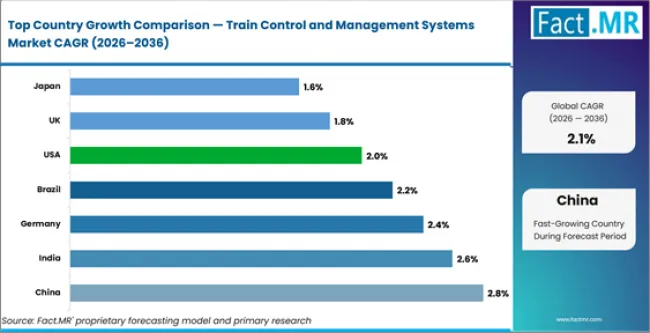
- China (2.8%) and India (2.6%) are the key growth markets during the forecast period.
- Demand and Growth Drivers
- Urban metro and light rail network expansion programs across China, India, Southeast Asia, and the Middle East are generating new rolling stock orders that require integrated TCMS platforms as standard onboard systems.
- Legacy fleet modernization in Europe and North America is replacing aging relay-based control systems with standardized digital TCMS platforms that support remote diagnostics and condition-based maintenance.
- Grade of automation (GoA) upgrades on urban transit lines, moving from GoA 1 and GoA 2 to semi-automated and fully automated operations, require advanced TCMS integration with signaling and platform screen door systems.
- Predictive maintenance adoption is driving TCMS data analytics capability requirements, as operators seek to reduce unplanned downtime by monitoring subsystem health through onboard sensor networks.
- Interoperability standards, including IEC 61375 for train communication networks, are encouraging modular TCMS architectures that reduce lifecycle costs and enable multi-vendor equipment integration.
- Product and Segment View
- VCU-based TCMS account for 66.8% of the product segment in 2026, serving as the central onboard computer that integrates propulsion, braking, door control, HVAC, and passenger information subsystems.
- Urban rail transit systems represent 41.6% of the application segment in 2026, driven by metro, light rail, and monorail network expansion and modernization programs.
- Rail operators account for 57.9% of end-use demand in 2026, reflecting the dominance of transit authority and national railway procurement in total TCMS spending.
- Key segmentation includes:
- Product: Vehicle Control Units (VCU-Based TCMS), Gateway Units, Display and HMI Systems, Sensor and Diagnostic Modules
- Application: Urban Rail Transit Systems, High-Speed Rail Networks, Mainline Passenger Rail, Freight Rail Operations
- End Use: Rail Operators, Rolling Stock Manufacturers, Retrofit and Modernization Contractors, Government Transport Authorities
- Distribution Channel: Direct OEM Contracts, System Integrator Partnerships, Government Procurement Programs
- These systems enable:
- Centralized monitoring and control of all onboard train subsystems through a unified digital platform
- Real-time diagnostic data collection for predictive maintenance and fleet health management
- Interoperable communication between train subsystems using standardized network protocols
- Geography and Competitive Outlook
- Europe remains the largest market, anchored by extensive rail network modernization programs, ERTMS deployment, and high-speed rail operations requiring advanced TCMS integration.
- Asia Pacific is growing steadily, with China at 2.8% and India at 2.6% supported by metro expansion, high-speed rail development, and new rolling stock orders.
- North America shows moderate growth at 2.0% for the USA, driven by transit agency fleet modernization and CBTC deployment on urban metro systems.
- Key players include Siemens AG, ABB, General Electric, Hitachi Ltd., Mitsubishi Electric Corporation, Alstom SA, Knorr-Bremse AG, Toshiba, and Wabtec Corporation.
- Analyst Opinion
- Shambhu Nath Jha, Principal Consultant at Fact.MR, says 'The TCMS market is mature in terms of technology but growing through fleet modernization and network expansion cycles. The value proposition is shifting from basic train control to integrated data platforms that support predictive maintenance, energy optimization, and grade-of-automation upgrades. Metro expansion in Asia Pacific provides the largest new-build demand, while European and North American retrofit programs generate replacement revenue. The competitive landscape favors large system integrators like Siemens, Alstom, and Hitachi that can deliver TCMS as part of broader rolling stock and signaling packages, limiting standalone TCMS supplier penetration.'
Key Growth Drivers, Constraints, and Opportunities
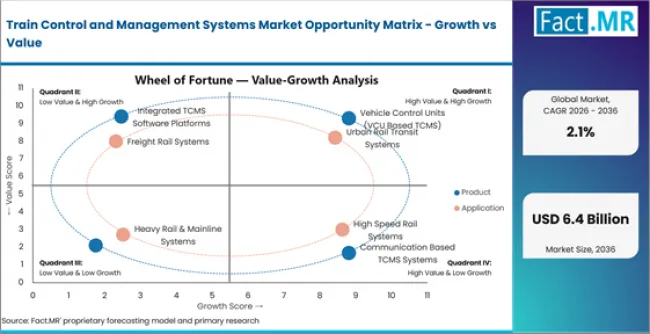
Key Factors Driving Growth
- Metro network expansion across China, India, Saudi Arabia, and Southeast Asia is generating multi-year rolling stock orders that include integrated TCMS as standard onboard equipment, creating sustained new-build demand.
- Fleet modernization programs in Europe and North America are replacing 20 to 30 year old relay-based control systems with digital TCMS platforms that support remote diagnostics and data-driven maintenance.
- Grade-of-automation upgrades on existing urban transit lines require TCMS integration with CBTC signaling, platform screen doors, and automatic train operation systems, generating retrofit and software upgrade demand.
Key Market Constraints
- Long procurement cycles in the rail industry, typically 3 to 7 years from tender to commissioning, create revenue visibility but limit the ability of TCMS suppliers to respond quickly to demand changes.
- Proprietary system architectures from leading OEMs create lock-in effects that limit transit operator flexibility in subsequent fleet expansions and upgrades.
- Budget constraints in public transit authorities, particularly in emerging markets, can delay fleet modernization and TCMS upgrade programs.
Key Opportunity Areas
- Predictive maintenance platforms that use TCMS data analytics to forecast subsystem failures and optimize maintenance scheduling are creating software-as-a-service revenue streams alongside hardware sales.
- Open-standard TCMS architectures based on IEC 61375 and related standards are enabling transit operators to reduce vendor lock-in and source subsystem upgrades from multiple suppliers.
- Autonomous train operation (GoA 3 and GoA 4) deployment on new metro lines creates demand for advanced TCMS integration with perception, decision, and control systems.
Segment-wise Analysis of the Train Control and Management Systems Market
- VCU-based TCMS will account for 66.8% of the product segment in 2026, acting as the central processing platform for all onboard subsystem integration and control.
- By application, urban rail transit systems are the most dominant segment, with 41.6% in 2026, driven by the expansion and modernization of metro, light rail, and monorail networks.
- Centralized control architecture accounts for 53.4% of the technology segment as it is the standard approach where all subsystems communicate via a central vehicle control unit.
The TCMS market is segmented by product type, application, end use, technology, formulation, distribution channel, and region. VCU-based systems dominate because they serve as the mandatory central control computer on all modern rolling stock platforms.
Which Product Segment Dominates the Train Control and Management Systems Market?
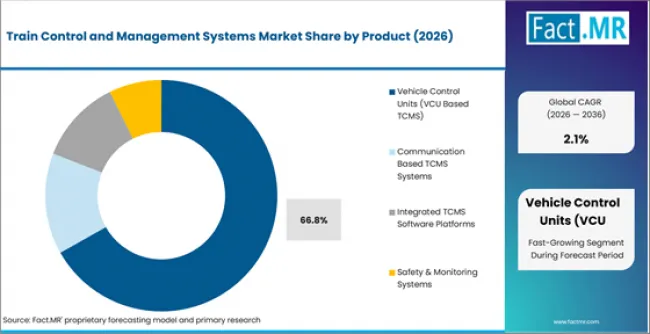
TCMS with VCU will represent 66.8% of the product segment in 2026. The vehicle control unit is the central onboard computer. It combines control of the propulsion, braking, door operation, HVAC control, passenger information, and diagnostic data collection. The VCU is the fundamental hardware building block of the TCMS platform. Every modern train requires at least one VCU.
Gateway units, HMI displays, sensor and diagnostic modules complement each other within the overall architecture of the TCMS. Gateway units manage the transfer of data between the train-level and consist-level networks. HMI displays offer interfaces for driver and maintenance personnel. Diagnostic modules collect health information of the subsystem for condition monitoring and predictive maintenance. VCUs are expected to continue their dominant role as the core processing platform for all TCMS functions.
Which Application Segment Dominates the Train Control and Management Systems Market?
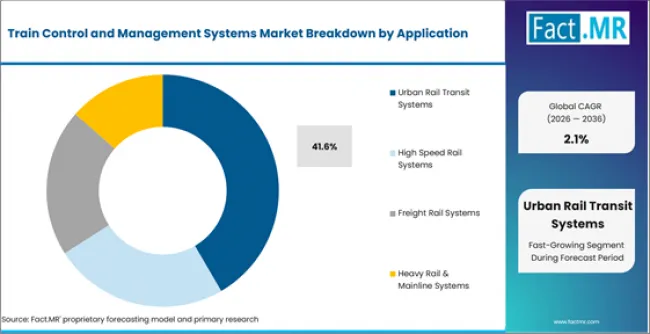
Urban rail transit systems hold the biggest share of 41.6% in 2026. Light rail, monorail, and metro networks are the largest deployment category for TCMS, driven by new line openings, fleet expansion on existing networks, and modernization of aging train fleets. Urban transit systems also have the most aggressive automation adoption profiles, where the GoA 3 and GoA 4 operations require advanced TCMS integration.
High-speed rail networks are the second largest segment, with TCMS providing the backbone for safety-critical control functions at speeds above 300 km/h. Mainline passenger rail and freight operations add additional demand, with freight TCMS focused on reliability and energy management rather than passenger-facing functions.
Which Product Trend is Shaping the Next Phase of Growth in the Train Control and Management Systems Market?
The most important product development in the market is the open architecture TCMS platforms based on IEC 61375 and Ethernet-based train communication networks. Traditional TCMS platforms relied on proprietary communication protocols that locked transit operators into single-vendor supply chains for the life of the rolling stock. Open-architecture systems employ standardized interfaces, which enable transit operators to obtain subsystem upgrades, software patches, and peripheral equipment from a variety of vendors without endangering system integration.
The commercial impact on both operators and suppliers is significant. Transit authorities get procurement flexibility and lifecycle cost control. TCMS suppliers have to compete on performance and service rather than proprietary lock-in. For the overall market, open architecture hastens modernization cycles because transit operators can modernize individual subsystems without needing to replace the entire TCMS platform. This generates more frequent upgrade opportunities and sustains demand beyond the initial new-build installation.
Regional Outlook Across Key Markets
.webp)
- China leads growth at 2.8% on the back of metro network expansion in tier-1 and tier-2 cities, additions to the high-speed rail fleet and domestic TCMS manufacturing driven by CRRC and its signaling subsidiaries.
- India at 2.6% is reflecting metro construction programs in Delhi, Mumbai, Bangalore, Chennai and emerging tier-2 cities with rolling stock orders requiring modern TCMS integration.
- Germany at 2.4% is propelled by Deutsche Bahn fleet modernization, ERTMS deployment and EU interoperability directives requiring standardized control system architectures.
- USA at 2.0% reflects transit authority fleet modernization and CBTC deployment on metro systems in New York, San Francisco and other major cities.
| Country | CAGR (%) |
|---|---|
| China | 2.8% |
| India | 2.6% |
| Germany | 2.4% |
| Brazil | 2.2% |
| USA | 2.0% |
Source: Fact.MR analysis, based on proprietary forecasting model and primary research.
Market Outlook for Train Control and Management Systems in the United States
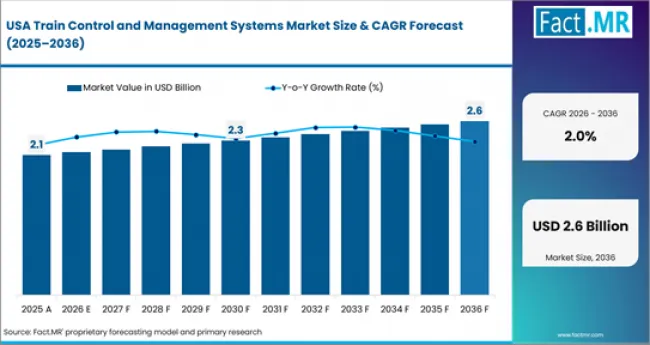
The U.S. TCMS market is projected to grow at a CAGR of 2.0% through 2036. Transit authority fleet modernization is the primary demand driver, with agencies in New York, San Francisco, Chicago, and Washington D.C. replacing aging rolling stock with modern trainsets equipped with integrated TCMS platforms. CBTC deployment on existing metro lines generates demand for TCMS upgrades that interface with new signaling systems.
- Federal Transit Administration grant programs support fleet modernization procurement that includes TCMS as standard onboard equipment.
- CBTC deployment on legacy metro lines creates retrofit demand for TCMS upgrades compatible with communication-based train control signaling.
China Train Control and Management Systems Market Growth Assessment
China at a 2.8% CAGR through 2036 1. Metro network expansion in 40+ cities CRRC and its signaling subsidiaries are the dominant domestic TCMS suppliers, enjoying government procurement preferences for domestic technology. High-speed rail fleets and new urban rail lines add sustained demand for new build TCMS with multi-year order visibility.
- Metro construction programs in tier-2 cities are driving new rolling stock orders that require standardized TCMS integration as mandatory onboard equipment.
- Domestic TCMS suppliers benefit from government technology self-sufficiency programs; CRRC-affiliated companies own most of the market share.
India Train Control and Management Systems Demand Trends
Metro construction programs authorized under the Government of India’s Metro Rail Policy are driving rolling stock orders, which demand modern TCMS integration, supporting the market at a 2.6% CAGR through 2036. Make in India provisions in metro procurement contracts are encouraging international TCMS suppliers to set up joint ventures and technology transfer arrangements with Indian partners. The largest individual procurement programmes are in the Delhi, Mumbai and Bangalore metro extensions.
- Metro procurement contracts with Make in India provisions require increased local content resulting in TCMS supplier investment in Indian assembly and integration facilities.
- PLI scheme incentives for manufacturing of electronic systems are creating conditions for domestic production of TCMS components and development of software.
Germany Train Control and Management Systems Market Analysis
EU interoperability directives and ERTMS deployment requirements define TCMS specifications for the German market, projected at a 2.4% CAGR through 2036. Deutsche Bahn fleet modernization and regional rail operator rolling stock procurement generate recurring TCMS demand. Siemens Mobility maintains a strong domestic position through its Trainguard and Desiro platform TCMS offerings. Industrie 4.0 data analytics integration is pushing TCMS platforms toward predictive maintenance and energy optimization capabilities.
- ERTMS deployment across the German rail network requires TCMS integration with European Train Control System (ETCS) onboard units.
- Industrie 4.0 data analytics integration is expanding TCMS functionality from basic train control to fleet-level performance optimization and energy management.
Brazil Train Control and Management Systems Market Opportunity Analysis
Brazil TCMS market is supported by metro expansion programs in Sao Paulo, Rio de Janeiro and other major cities at a CAGR of 2.2% during 2023-2036. Procurement patterns are characterized by import dependence on TCMS platforms from European and Chinese suppliers with gradual development of domestic assembly and integration capacity. National infrastructure investment programs are expanding urban rail networks into underserved metro corridors.
- Sao Paulo metro expansion is the biggest single TCMS procurement programme in Latin America, with rolling stock orders for modern, integrated control platforms.
- Import dependency for TCMS hardware brings long lead times and procurement complexities that transit operators must manage within tight project delivery schedules.
Competitive Benchmarking and Company Positioning
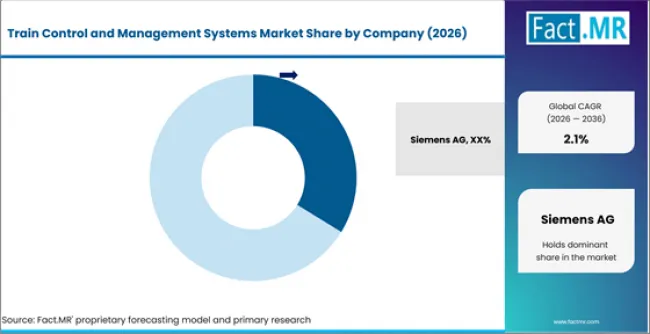
Train Control and Management Systems Market Analysis By Company
- The global TCMS market is dominated by Siemens AG, Alstom SA and Hitachi Ltd., which together hold a market share of over 50%, offering integrated rolling stock and signaling packages in which TCMS is integrated into the system.
- ABB, Mitsubishi Electric and Knorr-Bremse compete in certain subsystem categories and regional markets with strengths in power electronics, braking control and door management integration.
- TCMS bundled with rolling stock and signalling contracts create a high barrier to entry for suppliers of standalone TCMS, as transit operators prefer integrated system packages from major OEMs.
The competitive landscape is highly consolidated with Siemens, Alstom and Hitachi dominating the market. These companies are capable of supplying TCMS as part of integrated rolling stock platforms. Alstom acquired Bombardier Transportation, and with it, its TCMS platform Mitrac, which was added to the Alstom TCMS portfolio. Siemens competes by means of the Trainguard and Desiro platforms.
Standalone TCMS specialists such as EKE-Electronics and Selectron Systems operate in niche markets for retrofits and upgrades, but they are facing increasing competition from larger OEMs which offer lifecycle support packages that integrate TCMS with rolling stock maintenance contracts.
Key Companies in the Train Control and Management Systems Market
- Siemens AG, Alstom SA, Hitachi Ltd., and ABB are among the leading players, supported by integrated rolling stock and signaling capabilities, global transit authority relationships, and lifecycle support offerings.
- General Electric, Mitsubishi Electric, Knorr-Bremse AG, Toshiba, Wabtec Corporation, and EKE-Electronics compete across specific subsystem categories, regional markets, and modernization and retrofit programs.
Recent Industry Developments
- Hitachi Rail, Contract Award, San Francisco Muni TCMS (February 2025)
- In February 2025, Hitachi Rail secured a contract with the San Francisco Municipal Transportation Agency to modernize the Muni transit network through advanced train control technology, supporting deployment of integrated onboard control and signaling systems.
- Siemens Mobility, Technology Deployment, Trainguard MT CBTC (2025)
- Siemens Mobility continued expanding deployment of its Trainguard MT CBTC technology across metro modernization projects, supporting integration between signaling, train control, and onboard management systems.
- Alstom, Technology Development, Cityflo CBTC Integration (2025)
- Alstom continued enhancing interoperability between its Cityflo CBTC signaling platform and onboard TCMS architectures, supporting demand for integrated signaling and train management solutions across urban rail networks.
Leading Companies Shaping the Train Control and Management Systems Market
- Alstom SA
- Siemens AG
- Hitachi Ltd.
- Wabtec Corporation
- Mitsubishi Electric Corporation
Sources and Research References
- Hitachi Rail Official Website. (2025, February). Hitachi Rail awarded contract to modernize San Francisco Muni transit network with advanced train control technology. Hitachi Rail.
- Siemens Mobility Official Website. (2025). Trainguard MT communication-based train control (CBTC) technology and metro automation solutions. Siemens Mobility GmbH.
- Alstom. (2026, May 5). Alstom to modernise Lausanne's m2 metro with new CBTC system and fleet mid-life upgrade.
This bibliography is provided for reader reference and is not exhaustive. The full report contains the complete reference list and detailed citations.
Key Questions This Report Addresses
- What is the current and future size of the Train Control and Management Systems Market?
- How fast is the TCMS Market expected to grow between 2026 and 2036?
- Which product type is likely to lead the market by 2026?
- Which application segment is expected to account for the highest demand by 2026?
- What factors are driving demand for TCMS globally?
- How are open-architecture platforms reshaping TCMS procurement and lifecycle management?
- Why are China and India the fastest-growing markets?
- How is grade-of-automation upgrading influencing TCMS demand on urban transit systems?
- Which countries are projected to show the fastest growth through 2036?
- Who are the key companies active in the TCMS Market?
- How does Fact.MR estimate and validate the market forecast?
Train Control and Management Systems Market Definition
The train control and management systems market covers onboard digital platforms that integrate, monitor, and control train subsystems including propulsion, braking, doors, HVAC, passenger information, and communication systems. It includes vehicle control units, gateway modules, HMI displays, and diagnostic systems deployed across urban rail, high-speed rail, mainline passenger, and freight applications.
Train Control and Management Systems Market Inclusions
- The scope covers global and regional market size and forecasts for 2026 to 2036 across product type, application, end use, technology, formulation, distribution channel, and region.
- It includes regional demand analysis based on rolling stock orders, fleet modernization programs, metro expansion timelines, and signaling system deployment.
- The report covers pricing analysis across new-build TCMS packages, retrofit and modernization programs, and lifecycle support contracts.
Train Control and Management Systems Market Exclusions
- The scope excludes wayside signaling equipment, interlocking systems, and centralized traffic management platforms not installed as onboard train systems.
- It excludes standalone passenger WiFi and entertainment systems not integrated with the TCMS platform.
- The report excludes rail infrastructure construction, track equipment, and station systems not directly linked to onboard train control functionality.
Train Control and Management Systems Market Research Methodology
- The methodology combines secondary research, primary interviews, and forecast modelling.
- It draws on 100+ secondary sources and benchmarks 40+ company product portfolios.
- Market sizing covers 30+ countries through a demand-side model, supported by top-down validation.
- Key inputs include rolling stock order backlogs, metro expansion program timelines, fleet age profiles, and signaling deployment schedules.
- The model cross-checks demand with OEM order announcements, transit authority procurement records, and retrofit contract values.
- Primary validation includes 20+ interviews across TCMS suppliers, rolling stock OEMs, transit operators, and system integrators.
- Final estimates go through fleet-lifecycle analysis, procurement-cycle validation, and sensitivity testing.
Scope of Analysis

| Parameter | Details |
|---|---|
| Quantitative Units | USD 5.2 billion to USD 6.4 billion, at a CAGR of 2.1% |
| Market Definition | The Train Control and Management Systems Market covers onboard digital platforms that integrate, monitor, and control train subsystems across urban rail, high-speed rail, mainline passenger, and freight applications. |
| Regions Covered | North America, Latin America, Europe, East Asia, South Asia and Pacific, Middle East and Africa |
| Countries Covered | USA, China, India, Germany, Brazil, 30 plus countries |
| Key Companies | Siemens AG, ABB, General Electric, Hitachi Ltd., Mitsubishi Electric, Alstom SA, Knorr-Bremse AG, Toshiba, Wabtec Corporation, EKE-Electronics |
| Forecast Period | 2026 to 2036 |
| Approach | Hybrid demand-side and top-down methodology built on rolling stock order backlogs, metro expansion timelines, fleet age profiles, signaling deployment schedules, and primary interviews across TCMS suppliers, rolling stock OEMs, and transit operators |
Train Control and Management Systems Market Segmentation
-
Train Control and Management Systems Market Segmented by Product:
- Vehicle Control Units (VCU Based TCMS)
- Central Train Control Units
- Master Control Processing Units
- Redundant Control Architecture Units
- Distributed Control Modules
- Car Level Control Nodes
- Subsystem Interface Controllers
- Central Train Control Units
- Communication Based TCMS Systems
- Wired Communication Systems
- Train Bus Communication Modules
- Vehicle Network Interface Systems
- Wireless Communication Systems
- Train-to-Ground Communication Units
- Onboard Wireless Gateway Systems
- Wired Communication Systems
- Integrated TCMS Software Platforms
- Real Time Control Software
- Train Operation Management Software
- Diagnostics Control Software Modules
- Predictive Maintenance Software
- Condition Monitoring Algorithms
- Failure Prediction Engines
- Real Time Control Software
- Safety & Monitoring Systems
- Train Safety Control Units
- Emergency Brake Control Systems
- Speed Supervision Systems
- Operational Monitoring Systems
- Driver Assistance Monitoring Units
- Event Recording Systems
- Train Safety Control Units
- Vehicle Control Units (VCU Based TCMS)
-
Train Control and Management Systems Market Segmented by Application:
- Urban Rail Transit Systems
- Metro Rail Systems
- Underground Metro Operations
- Elevated Metro Networks
- Light Rail Transit Systems
- Tram Based Transit Systems
- City Surface Rail Networks
- Metro Rail Systems
- High Speed Rail Systems
- Intercity Rail Networks
- Bullet Train Operations
- Express Rail Corridors
- Long Distance Rail Systems
- Cross Country Rail Operations
- High Speed Corridor Management
- Intercity Rail Networks
- Freight Rail Systems
- Cargo Transport Rail Networks
- Bulk Freight Operations
- Container Rail Logistics
- Industrial Rail Operations
- Mining Rail Transport Systems
- Port Rail Connectivity Systems
- Cargo Transport Rail Networks
- Heavy Rail & Mainline Systems
- National Rail Networks
- Passenger Intercity Rail Systems
- Mixed Traffic Rail Operations
- Regional Rail Systems
- Commuter Rail Networks
- Suburban Rail Corridors
- National Rail Networks
- Urban Rail Transit Systems
-
Train Control and Management Systems Market Segmented by End Use:
- Rail Operators
- Public Rail Operators
- Government Railway Corporations
- National Rail Authorities
- Private Rail Operators
- Private Passenger Rail Companies
- Freight Rail Operators
- Public Rail Operators
- Metro & Urban Transit Authorities
- City Transport Agencies
- Municipal Metro Operators
- Urban Rail Management Bodies
- Regional Transit Authorities
- Multi City Transit Operators
- Suburban Rail Authorities
- City Transport Agencies
- Rail Infrastructure Companies
- Rail Network Owners
- Track Management Companies
- Signal System Operators
- Rail System Integrators
- Rolling Stock Integrators
- Rail Electronics Integrators
- Rail Network Owners
- Rolling Stock Manufacturers
- Train OEM Manufacturers
- Passenger Train Builders
- Freight Wagon Manufacturers
- Subsystem Manufacturers
- Control System Suppliers
- Propulsion System Manufacturers
- Train OEM Manufacturers
- Rail Operators
-
Train Control and Management Systems Market Segmented by Technology:
- Centralized Control Architecture
- Master Control Systems
- Train Wide Control Processors
- Central Command Units
- Redundant Control Systems
- Fail Safe Control Architectures
- Backup Processing Systems
- Master Control Systems
- Distributed Control Architecture
- Onboard Distributed Networks
- Car Level Control Networks
- Subsystem Communication Layers
- Modular Control Nodes
- Independent Control Modules
- Expandable Control Units
- Onboard Distributed Networks
- Real Time Communication Technology
- Train Communication Networks
- High Speed Data Buses
- Ethernet Based Rail Networks
- Wireless Communication Systems
- 5G Rail Communication Modules
- Satellite Assisted Rail Links
- Train Communication Networks
- Safety Critical Systems
- Fail Safe Mechanisms
- Emergency Brake Control Logic
- Automatic Train Protection Systems
- Monitoring Systems
- Real Time Fault Detection Systems
- System Health Monitoring Platforms
- Fail Safe Mechanisms
- Centralized Control Architecture
-
Train Control and Management Systems Market Segmented by Formulation:
- Integrated TCMS Platforms
- Hardware Software Integrated Systems
- Embedded Control Hardware Units
- Software Defined Train Systems
- Modular TCMS Architecture
- Upgradeable Control Modules
- Plug and Play Train Systems
- Hardware Software Integrated Systems
- Distributed TCMS Systems
- Multi Node Control Systems
- Car Level Distributed Controllers
- Network Based Control Layers
- Edge Based Processing Systems
- Onboard Edge Controllers
- Real Time Edge Analytics Systems
- Multi Node Control Systems
- Cloud Connected TCMS Systems
- Remote Monitoring Platforms
- Cloud Based Diagnostics Systems
- Fleet Wide Data Platforms
- Hybrid TCMS Architectures
- Onboard Cloud Hybrid Systems
- Dual Layer Control Systems
- Remote Monitoring Platforms
- Integrated TCMS Platforms
-
Train Control and Management Systems Market Segmented by Distribution Channel:
- Direct OEM Contracts
- Rolling Stock OEM Sales
- Train Manufacturer Agreements
- Subsystem Supplier Contracts
- Rail Operator Contracts
- National Rail Procurement Deals
- Metro Authority Supply Agreements
- Rolling Stock OEM Sales
- System Integrators
- Rail Technology Integrators
- Signaling System Integrators
- Control System Integrators
- Engineering Contractors
- Rail Infrastructure EPC Firms
- Turnkey Rail Solution Providers
- Rail Technology Integrators
- Industrial Distributors
- Rail Equipment Distributors
- Rail Electronics Suppliers
- Control System Distributors
- Regional Distributors
- Local Rail Equipment Suppliers
- Maintenance Service Distributors
- Rail Equipment Distributors
- Digital Procurement Platforms
- Rail Equipment E Procurement Systems
- OEM Digital Ordering Portals
- B2C Rail Marketplaces
- Rail Equipment E Procurement Systems
- OEM Digital Ordering Portals
- Rail Equipment E Procurement Systems
- Direct OEM Contracts
-
Train Control and Management Systems Market by Region:
- North America
- USA
- Canada
- Mexico
- Latin America
- Brazil
- Chile
- Rest of Latin America
- Western Europe
- Germany
- UK
- Italy
- Spain
- France
- Nordic
- BENELUX
- Rest of Western Europe
- Eastern Europe
- Russia
- Poland
- Hungary
- Balkan & Baltic
- Rest of Eastern Europe
- East Asia
- China
- Japan
- South Korea
- South Asia and Pacific
- India
- ASEAN
- Australia & New Zealand
- Rest of South Asia and Pacific
- Middle East & Africa
- Kingdom of Saudi Arabia
- Other GCC Countries
- Turkiye
- South Africa
- Other African Union
- Rest of Middle East & Africa
- North America
- Frequently Asked Questions -
How big is the train control and management systems market in 2026?
The global train control and management systems market is estimated to be valued at USD 5.2 billion in 2026.
What will be the size of the train control and management systems market in 2036?
The market size for the train control and management systems market is projected to reach USD 6.4 billion by 2036.
How much will be the train control and management systems market growth between 2026 and 2036?
The train control and management systems market is expected to grow at a 2.1% CAGR between 2026 and 2036.
What are the key products in the train control and management systems market?
The key products in the train control and management systems market are Vehicle Control Units (VCU-Based TCMS), Communication-Based TCMS Systems, Integrated TCMS Software Platforms, and Safety & Monitoring Systems.
Which application segment is expected to contribute significant share in the train control and management systems market in 2026?
In terms of application, urban rail transit systems segment is expected to command 41.6% share in the train control and management systems market in 2026.
Table of Content
- Key Takeaways
- Market Size and CAGR
- Top Growth Driver
- Fastest Growing Segment
- Leading Region
- Key Companies
- Emerging Opportunities
- Executive Summary
- Global Market Outlook
- Demand-side Trends
- Supply-side Trends
- Technology Roadmap Analysis
- Analysis and Recommendations
- Analyst Perspective (What is happening? Why now? What should investors know?)
- Key Questions Answered
- How large is the market?
- What is the CAGR?
- What are key trends?
- Which region dominates?
- Who are the leaders?
- Market Overview
- Market Coverage / Taxonomy
- Market Definition / Scope / Limitations
- Research Methodology
- Chapter Orientation
- Analytical Lens and Working Hypotheses
- Market Structure, Signals, and Trend Drivers
- Benchmarking and Cross-market Comparability
- Market Sizing, Forecasting, and Opportunity Mapping
- Research Design and Evidence Framework
- Desk Research Programme (Secondary Evidence)
- Expert Input and Fieldwork (Primary Evidence)
- Tooling, Models, and Reference Databases
- Data Engineering and Model Build
- Quality Assurance and Audit Trail
- Market Background
- Market Dynamics (Drivers, Restraints, Opportunity, Trends)
- Scenario Forecast (Optimistic, Likely, Conservative)
- Impact Analysis
- AI Impact
- Sustainability Impact
- Regulatory Impact
- Technology Impact
- Consumer / Buyer Analysis
- Purchase Drivers
- Adoption Barriers
- Buyer Journey
- Opportunity Map Analysis
- Product Life Cycle Analysis
- Supply Chain Analysis
- Investment Feasibility Matrix
- Value Chain Analysis
- PESTLE and Porter's Analysis
- Regulatory Landscape
- Regional Parent Market Outlook
- Production and Consumption Statistics
- Import and Export Statistics
- Global Market Analysis and Forecast, 2021 to 2036
- Historical Market Size Value (USD Million) Analysis, 2021 to 2025
- Current and Future Market Size Value (USD Million) Projections, 2026 to 2036
- Y-o-Y Growth Trend Analysis
- Absolute $ Opportunity Analysis
- Global Market Pricing Analysis, 2021 to 2036
- Global Market Analysis and Forecast, By Product, 2021 to 2036
- Introduction / Key Findings
- Historical Market Size Value (USD Million) Analysis By Product, 2021 to 2025
- Current and Future Market Size Value (USD Million) Analysis and Forecast By Product, 2026 to 2036
- Vehicle Control Value (USD Million)s (VCU Based TCMS)
- Central Train Control Value (USD Million)s
- Distributed Control Modules
- Communication Based TCMS Systems
- Wired Communication Systems
- Wireless Communication Systems
- Integrated TCMS Software Platforms
- Real Time Control Software
- Predictive Maintenance Software
- Safety & Monitoring Systems
- Train Safety Control Value (USD Million)s
- Operational Monitoring Systems
- Vehicle Control Value (USD Million)s (VCU Based TCMS)
- Y-o-Y Growth Trend Analysis By Product, 2021 to 2025
- Absolute $ Opportunity Analysis By Product, 2026 to 2036
- Global Market Analysis and Forecast, By Application, 2021 to 2036
- Introduction / Key Findings
- Historical Market Size Value (USD Million) Analysis By Application, 2021 to 2025
- Current and Future Market Size Value (USD Million) Analysis and Forecast By Application, 2026 to 2036
- Urban Rail Transit Systems
- Metro Rail Systems
- Light Rail Transit Systems
- High Speed Rail Systems
- Intercity Rail Networks
- Long Distance Rail Systems
- Freight Rail Systems
- Cargo Transport Rail Networks
- Industrial Rail Operations
- Heavy Rail & Mainline Systems
- National Rail Networks
- Regional Rail Systems
- Urban Rail Transit Systems
- Y-o-Y Growth Trend Analysis By Application, 2021 to 2025
- Absolute $ Opportunity Analysis By Application, 2026 to 2036
- Global Market Analysis and Forecast, By End Use, 2021 to 2036
- Introduction / Key Findings
- Historical Market Size Value (USD Million) Analysis By End Use, 2021 to 2025
- Current and Future Market Size Value (USD Million) Analysis and Forecast By End Use, 2026 to 2036
- Rail Operators
- Public Rail Operators
- Private Rail Operators
- Metro & Urban Transit Authorities
- City Transport Agencies
- Regional Transit Authorities
- Rail Infrastructure Companies
- Rail Network Owners
- Rail System Integrators
- Rolling Stock Manufacturers
- Train OEM Manufacturers
- Subsystem Manufacturers
- Rail Operators
- Y-o-Y Growth Trend Analysis By End Use, 2021 to 2025
- Absolute $ Opportunity Analysis By End Use, 2026 to 2036
- Global Market Analysis and Forecast, By Technology, 2021 to 2036
- Introduction / Key Findings
- Historical Market Size Value (USD Million) Analysis By Technology, 2021 to 2025
- Current and Future Market Size Value (USD Million) Analysis and Forecast By Technology, 2026 to 2036
- Centralized Control Architecture
- Master Control Systems
- Redundant Control Systems
- Distributed Control Architecture
- Onboard Distributed Networks
- Modular Control Nodes
- Real Time Communication Technology
- Train Communication Networks
- Wireless Communication Systems
- Safety Critical Systems
- Fail Safe Mechanisms
- Monitoring Systems
- Centralized Control Architecture
- Y-o-Y Growth Trend Analysis By Technology, 2021 to 2025
- Absolute $ Opportunity Analysis By Technology, 2026 to 2036
- Global Market Analysis and Forecast, By Formulation, 2021 to 2036
- Introduction / Key Findings
- Historical Market Size Value (USD Million) Analysis By Formulation, 2021 to 2025
- Current and Future Market Size Value (USD Million) Analysis and Forecast By Formulation, 2026 to 2036
- Integrated TCMS Platforms
- Hardware Software Integrated Systems
- Modular TCMS Architecture
- Distributed TCMS Systems
- Multi Node Control Systems
- Edge Based Processing Systems
- Cloud Connected TCMS Systems
- Remote Monitoring Platforms
- Hybrid TCMS Architectures
- Integrated TCMS Platforms
- Y-o-Y Growth Trend Analysis By Formulation, 2021 to 2025
- Absolute $ Opportunity Analysis By Formulation, 2026 to 2036
- Global Market Analysis and Forecast, By Distribution Channel
- Introduction / Key Findings
- Historical Market Size Value (USD Million) Analysis By Distribution Channel, 2021 to 2025
- Current and Future Market Size Value (USD Million) Analysis and Forecast By Distribution Channel, 2026 to 2036
- Direct OEM Contracts
- Rolling Stock OEM Sales
- Rail Operator Contracts
- System Integrators
- Rail Technology Integrators
- Engineering Contractors
- Industrial Distributors
- Rail Equipment Distributors
- Regional Distributors
- Digital Procurement Platforms
- B2B Rail Marketplaces
- B2C Rail Marketplaces
- Direct OEM Contracts
- Y-o-Y Growth Trend Analysis By Distribution Channel, 2021 to 2025
- Absolute $ Opportunity Analysis By Distribution Channel, 2026 to 2036
- Global Market Analysis and Forecast, By Region, 2021 to 2036
- Introduction
- Historical Market Size Value (USD Million) Analysis By Region, 2021 to 2025
- Current Market Size Value (USD Million) Analysis and Forecast By Region, 2026 to 2036
- North America
- Latin America
- Western Europe
- Eastern Europe
- East Asia
- South Asia and Pacific
- Middle East & Africa
- Market Attractiveness Analysis By Region
- North America Market Analysis and Forecast, By Country, 2021 to 2036
- Historical Market Size Value (USD Million) Trend Analysis By Market Taxonomy, 2021 to 2025
- Market Size Value (USD Million) Forecast By Market Taxonomy, 2026 to 2036
- By Country
- USA
- Canada
- Mexico
- By Product
- By Application
- By End Use
- By Technology
- By Formulation
- By Distribution Channel
- By Country
- Market Attractiveness Analysis
- By Country
- By Product
- By Application
- By End Use
- By Technology
- By Formulation
- By Distribution Channel
- Key Takeaways
- Latin America Market Analysis and Forecast, By Country
- Historical Market Size Value (USD Million) Trend Analysis By Market Taxonomy, 2021 to 2025
- Market Size Value (USD Million) Forecast By Market Taxonomy, 2026 to 2036
- By Country
- Brazil
- Chile
- Rest of Latin America
- By Product
- By Application
- By End Use
- By Technology
- By Formulation
- By Distribution Channel
- By Country
- Market Attractiveness Analysis
- By Country
- By Product
- By Application
- By End Use
- By Technology
- By Formulation
- By Distribution Channel
- Key Takeaways
- Western Europe Market Analysis and Forecast, By Country
- Historical Market Size Value (USD Million) Trend Analysis By Market Taxonomy, 2021 to 2025
- Market Size Value (USD Million) Forecast By Market Taxonomy, 2026 to 2036
- By Country
- Germany
- UK
- Italy
- Spain
- France
- Nordic
- BENELUX
- Rest of Western Europe
- By Product
- By Application
- By End Use
- By Technology
- By Formulation
- By Distribution Channel
- By Country
- Market Attractiveness Analysis
- By Country
- By Product
- By Application
- By End Use
- By Technology
- By Formulation
- By Distribution Channel
- Key Takeaways
- Eastern Europe Market Analysis and Forecast, By Country
- Historical Market Size Value (USD Million) Trend Analysis By Market Taxonomy, 2021 to 2025
- Market Size Value (USD Million) Forecast By Market Taxonomy, 2026 to 2036
- By Country
- Russia
- Poland
- Hungary
- Balkan & Baltic
- Rest of Eastern Europe
- By Product
- By Application
- By End Use
- By Technology
- By Formulation
- By Distribution Channel
- By Country
- Market Attractiveness Analysis
- By Country
- By Product
- By Application
- By End Use
- By Technology
- By Formulation
- By Distribution Channel
- Key Takeaways
- East Asia Market Analysis and Forecast, By Country
- Historical Market Size Value (USD Million) Trend Analysis By Market Taxonomy, 2021 to 2025
- Market Size Value (USD Million) Forecast By Market Taxonomy, 2026 to 2036
- By Country
- China
- Japan
- South Korea
- By Product
- By Application
- By End Use
- By Technology
- By Formulation
- By Distribution Channel
- By Country
- Market Attractiveness Analysis
- By Country
- By Product
- By Application
- By End Use
- By Technology
- By Formulation
- By Distribution Channel
- Key Takeaways
- South Asia and Pacific Market Analysis and Forecast, By Country
- Historical Market Size Value (USD Million) Trend Analysis By Market Taxonomy, 2021 to 2025
- Market Size Value (USD Million) Forecast By Market Taxonomy, 2026 to 2036
- By Country
- India
- ASEAN
- Australia & New Zealand
- Rest of South Asia and Pacific
- By Product
- By Application
- By End Use
- By Technology
- By Formulation
- By Distribution Channel
- By Country
- Market Attractiveness Analysis
- By Country
- By Product
- By Application
- By End Use
- By Technology
- By Formulation
- By Distribution Channel
- Key Takeaways
- Middle East & Africa Market Analysis and Forecast, By Country
- Historical Market Size Value (USD Million) Trend Analysis By Market Taxonomy, 2021 to 2025
- Market Size Value (USD Million) Forecast By Market Taxonomy, 2026 to 2036
- By Country
- Kingdom of Saudi Arabia
- Other GCC Countries
- Turkiye
- South Africa
- Other African Union
- Rest of Middle East & Africa
- By Product
- By Application
- By End Use
- By Technology
- By Formulation
- By Distribution Channel
- By Country
- Market Attractiveness Analysis
- By Country
- By Product
- By Application
- By End Use
- By Technology
- By Formulation
- By Distribution Channel
- Key Takeaways
- Key Countries Market Analysis
- USA
- Pricing Analysis
- Market Share Analysis, 2025
- By Product
- By Application
- By End Use
- By Technology
- By Formulation
- By Distribution Channel
- Canada
- Pricing Analysis
- Market Share Analysis, 2025
- By Product
- By Application
- By End Use
- By Technology
- By Formulation
- By Distribution Channel
- Mexico
- Pricing Analysis
- Market Share Analysis, 2025
- By Product
- By Application
- By End Use
- By Technology
- By Formulation
- By Distribution Channel
- Brazil
- Pricing Analysis
- Market Share Analysis, 2025
- By Product
- By Application
- By End Use
- By Technology
- By Formulation
- By Distribution Channel
- Chile
- Pricing Analysis
- Market Share Analysis, 2025
- By Product
- By Application
- By End Use
- By Technology
- By Formulation
- By Distribution Channel
- Germany
- Pricing Analysis
- Market Share Analysis, 2025
- By Product
- By Application
- By End Use
- By Technology
- By Formulation
- By Distribution Channel
- UK
- Pricing Analysis
- Market Share Analysis, 2025
- By Product
- By Application
- By End Use
- By Technology
- By Formulation
- By Distribution Channel
- Italy
- Pricing Analysis
- Market Share Analysis, 2025
- By Product
- By Application
- By End Use
- By Technology
- By Formulation
- By Distribution Channel
- Spain
- Pricing Analysis
- Market Share Analysis, 2025
- By Product
- By Application
- By End Use
- By Technology
- By Formulation
- By Distribution Channel
- France
- Pricing Analysis
- Market Share Analysis, 2025
- By Product
- By Application
- By End Use
- By Technology
- By Formulation
- By Distribution Channel
- India
- Pricing Analysis
- Market Share Analysis, 2025
- By Product
- By Application
- By End Use
- By Technology
- By Formulation
- By Distribution Channel
- ASEAN
- Pricing Analysis
- Market Share Analysis, 2025
- By Product
- By Application
- By End Use
- By Technology
- By Formulation
- By Distribution Channel
- Australia & New Zealand
- Pricing Analysis
- Market Share Analysis, 2025
- By Product
- By Application
- By End Use
- By Technology
- By Formulation
- By Distribution Channel
- China
- Pricing Analysis
- Market Share Analysis, 2025
- By Product
- By Application
- By End Use
- By Technology
- By Formulation
- By Distribution Channel
- Japan
- Pricing Analysis
- Market Share Analysis, 2025
- By Product
- By Application
- By End Use
- By Technology
- By Formulation
- By Distribution Channel
- South Korea
- Pricing Analysis
- Market Share Analysis, 2025
- By Product
- By Application
- By End Use
- By Technology
- By Formulation
- By Distribution Channel
- Russia
- Pricing Analysis
- Market Share Analysis, 2025
- By Product
- By Application
- By End Use
- By Technology
- By Formulation
- By Distribution Channel
- Poland
- Pricing Analysis
- Market Share Analysis, 2025
- By Product
- By Application
- By End Use
- By Technology
- By Formulation
- By Distribution Channel
- Hungary
- Pricing Analysis
- Market Share Analysis, 2025
- By Product
- By Application
- By End Use
- By Technology
- By Formulation
- By Distribution Channel
- Kingdom of Saudi Arabia
- Pricing Analysis
- Market Share Analysis, 2025
- By Product
- By Application
- By End Use
- By Technology
- By Formulation
- By Distribution Channel
- Turkiye
- Pricing Analysis
- Market Share Analysis, 2025
- By Product
- By Application
- By End Use
- By Technology
- By Formulation
- By Distribution Channel
- South Africa
- Pricing Analysis
- Market Share Analysis, 2025
- By Product
- By Application
- By End Use
- By Technology
- By Formulation
- By Distribution Channel
- USA
- Market Structure Analysis
- Competition Dashboard
- Competition Benchmarking
- Market Share Analysis of Top Players
- By Regional
- By Product
- By Application
- By End Use
- By Technology
- By Formulation
- By Distribution Channel
- Emerging Startups
- Innovation Benchmarking
- Competition Analysis
- Competition Deep Dive
- Siemens AG
- Overview
- Product Portfolio
- Profitability by Market Segments (Product/Age /Sales Channel/Region)
- Sales Footprint
- Strategy Overview
- Marketing Strategy
- Product Strategy
- Channel Strategy
- Alstom SA
- Siemens AG
- Hitachi Ltd.
- Wabtec Corporation
- Mitsubishi Electric Corporation
- Siemens AG
- Competition Deep Dive
- Case Studies
- Success Stories
- Recent Developments
- Assumptions & Acronyms Used
List Of Table
- Table 1: Global Market Value (USD Million) Forecast by Region, 2021 to 2036
- Table 2: Global Market Value (USD Million) Forecast by Product, 2021 to 2036
- Table 3: Global Market Value (USD Million) Forecast by Application, 2021 to 2036
- Table 4: Global Market Value (USD Million) Forecast by End Use, 2021 to 2036
- Table 5: Global Market Value (USD Million) Forecast by Technology, 2021 to 2036
- Table 6: Global Market Value (USD Million) Forecast by Formulation, 2021 to 2036
- Table 7: Global Market Value (USD Million) Forecast by Distribution Channel, 2021 to 2036
- Table 8: Global Market rma_anu Forecast by rma_anu, 2021 to 2036
- Table 9: North America Market Value (USD Million) Forecast by Country, 2021 to 2036
- Table 10: North America Market Value (USD Million) Forecast by Product, 2021 to 2036
- Table 11: North America Market Value (USD Million) Forecast by Application, 2021 to 2036
- Table 12: North America Market Value (USD Million) Forecast by End Use, 2021 to 2036
- Table 13: North America Market Value (USD Million) Forecast by Technology, 2021 to 2036
- Table 14: North America Market Value (USD Million) Forecast by Formulation, 2021 to 2036
- Table 15: North America Market Value (USD Million) Forecast by Distribution Channel, 2021 to 2036
- Table 16: Latin America Market Value (USD Million) Forecast by Country, 2021 to 2036
- Table 17: Latin America Market Value (USD Million) Forecast by Product, 2021 to 2036
- Table 18: Latin America Market Value (USD Million) Forecast by Application, 2021 to 2036
- Table 19: Latin America Market Value (USD Million) Forecast by End Use, 2021 to 2036
- Table 20: Latin America Market Value (USD Million) Forecast by Technology, 2021 to 2036
- Table 21: Latin America Market Value (USD Million) Forecast by Formulation, 2021 to 2036
- Table 22: Latin America Market Value (USD Million) Forecast by Distribution Channel, 2021 to 2036
- Table 23: Western Europe Market Value (USD Million) Forecast by Country, 2021 to 2036
- Table 24: Western Europe Market Value (USD Million) Forecast by Product, 2021 to 2036
- Table 25: Western Europe Market Value (USD Million) Forecast by Application, 2021 to 2036
- Table 26: Western Europe Market Value (USD Million) Forecast by End Use, 2021 to 2036
- Table 27: Western Europe Market Value (USD Million) Forecast by Technology, 2021 to 2036
- Table 28: Western Europe Market Value (USD Million) Forecast by Formulation, 2021 to 2036
- Table 29: Western Europe Market Value (USD Million) Forecast by Distribution Channel, 2021 to 2036
- Table 30: Eastern Europe Market Value (USD Million) Forecast by Country, 2021 to 2036
- Table 31: Eastern Europe Market Value (USD Million) Forecast by Product, 2021 to 2036
- Table 32: Eastern Europe Market Value (USD Million) Forecast by Application, 2021 to 2036
- Table 33: Eastern Europe Market Value (USD Million) Forecast by End Use, 2021 to 2036
- Table 34: Eastern Europe Market Value (USD Million) Forecast by Technology, 2021 to 2036
- Table 35: Eastern Europe Market Value (USD Million) Forecast by Formulation, 2021 to 2036
- Table 36: Eastern Europe Market Value (USD Million) Forecast by Distribution Channel, 2021 to 2036
- Table 37: East Asia Market Value (USD Million) Forecast by Country, 2021 to 2036
- Table 38: East Asia Market Value (USD Million) Forecast by Product, 2021 to 2036
- Table 39: East Asia Market Value (USD Million) Forecast by Application, 2021 to 2036
- Table 40: East Asia Market Value (USD Million) Forecast by End Use, 2021 to 2036
- Table 41: East Asia Market Value (USD Million) Forecast by Technology, 2021 to 2036
- Table 42: East Asia Market Value (USD Million) Forecast by Formulation, 2021 to 2036
- Table 43: East Asia Market Value (USD Million) Forecast by Distribution Channel, 2021 to 2036
- Table 44: South Asia and Pacific Market Value (USD Million) Forecast by Country, 2021 to 2036
- Table 45: South Asia and Pacific Market Value (USD Million) Forecast by Product, 2021 to 2036
- Table 46: South Asia and Pacific Market Value (USD Million) Forecast by Application, 2021 to 2036
- Table 47: South Asia and Pacific Market Value (USD Million) Forecast by End Use, 2021 to 2036
- Table 48: South Asia and Pacific Market Value (USD Million) Forecast by Technology, 2021 to 2036
- Table 49: South Asia and Pacific Market Value (USD Million) Forecast by Formulation, 2021 to 2036
- Table 50: South Asia and Pacific Market Value (USD Million) Forecast by Distribution Channel, 2021 to 2036
- Table 51: Middle East & Africa Market Value (USD Million) Forecast by Country, 2021 to 2036
- Table 52: Middle East & Africa Market Value (USD Million) Forecast by Product, 2021 to 2036
- Table 53: Middle East & Africa Market Value (USD Million) Forecast by Application, 2021 to 2036
- Table 54: Middle East & Africa Market Value (USD Million) Forecast by End Use, 2021 to 2036
- Table 55: Middle East & Africa Market Value (USD Million) Forecast by Technology, 2021 to 2036
- Table 56: Middle East & Africa Market Value (USD Million) Forecast by Formulation, 2021 to 2036
- Table 57: Middle East & Africa Market Value (USD Million) Forecast by Distribution Channel, 2021 to 2036
List Of Figures
- Figure 1: Global Market Pricing Analysis
- Figure 2: Global Market Value (USD Million) Forecast 2021 to 2036
- Figure 3: Global Market Value Share and BPS Analysis by Product, 2026 and 2036
- Figure 4: Global Market Y-o-Y Growth Comparison by Product, 2026 to 2036
- Figure 5: Global Market Attractiveness Analysis by Product
- Figure 6: Global Market Value Share and BPS Analysis by Application, 2026 and 2036
- Figure 7: Global Market Y-o-Y Growth Comparison by Application, 2026 to 2036
- Figure 8: Global Market Attractiveness Analysis by Application
- Figure 9: Global Market Value Share and BPS Analysis by End Use, 2026 and 2036
- Figure 10: Global Market Y-o-Y Growth Comparison by End Use, 2026 to 2036
- Figure 11: Global Market Attractiveness Analysis by End Use
- Figure 12: Global Market Value Share and BPS Analysis by Technology, 2026 and 2036
- Figure 13: Global Market Y-o-Y Growth Comparison by Technology, 2026 to 2036
- Figure 14: Global Market Attractiveness Analysis by Technology
- Figure 15: Global Market Value Share and BPS Analysis by Formulation, 2026 and 2036
- Figure 16: Global Market Y-o-Y Growth Comparison by Formulation, 2026 to 2036
- Figure 17: Global Market Attractiveness Analysis by Formulation
- Figure 18: Global Market Value Share and BPS Analysis by Distribution Channel, 2026 and 2036
- Figure 19: Global Market Y-o-Y Growth Comparison by Distribution Channel, 2026 to 2036
- Figure 20: Global Market Attractiveness Analysis by Distribution Channel
- Figure 21: Global Market Value (USD Million) Share and BPS Analysis by Region, 2026 and 2036
- Figure 22: Global Market Y-o-Y Growth Comparison by Region, 2026 to 2036
- Figure 23: Global Market Attractiveness Analysis by Region
- Figure 24: North America Market Incremental Dollar Opportunity, 2026 to 2036
- Figure 25: Latin America Market Incremental Dollar Opportunity, 2026 to 2036
- Figure 26: Western Europe Market Incremental Dollar Opportunity, 2026 to 2036
- Figure 27: Eastern Europe Market Incremental Dollar Opportunity, 2026 to 2036
- Figure 28: East Asia Market Incremental Dollar Opportunity, 2026 to 2036
- Figure 29: South Asia and Pacific Market Incremental Dollar Opportunity, 2026 to 2036
- Figure 30: Middle East & Africa Market Incremental Dollar Opportunity, 2026 to 2036
- Figure 31: North America Market Value Share and BPS Analysis by Country, 2026 and 2036
- Figure 32: North America Market Value Share and BPS Analysis by Product, 2026 and 2036
- Figure 33: North America Market Y-o-Y Growth Comparison by Product, 2026 to 2036
- Figure 34: North America Market Attractiveness Analysis by Product
- Figure 35: North America Market Value Share and BPS Analysis by Application, 2026 and 2036
- Figure 36: North America Market Y-o-Y Growth Comparison by Application, 2026 to 2036
- Figure 37: North America Market Attractiveness Analysis by Application
- Figure 38: North America Market Value Share and BPS Analysis by End Use, 2026 and 2036
- Figure 39: North America Market Y-o-Y Growth Comparison by End Use, 2026 to 2036
- Figure 40: North America Market Attractiveness Analysis by End Use
- Figure 41: North America Market Value Share and BPS Analysis by Technology, 2026 and 2036
- Figure 42: North America Market Y-o-Y Growth Comparison by Technology, 2026 to 2036
- Figure 43: North America Market Attractiveness Analysis by Technology
- Figure 44: North America Market Value Share and BPS Analysis by Formulation, 2026 and 2036
- Figure 45: North America Market Y-o-Y Growth Comparison by Formulation, 2026 to 2036
- Figure 46: North America Market Attractiveness Analysis by Formulation
- Figure 47: North America Market Value Share and BPS Analysis by Distribution Channel, 2026 and 2036
- Figure 48: North America Market Y-o-Y Growth Comparison by Distribution Channel, 2026 to 2036
- Figure 49: North America Market Attractiveness Analysis by Distribution Channel
- Figure 50: Latin America Market Value Share and BPS Analysis by Country, 2026 and 2036
- Figure 51: Latin America Market Value Share and BPS Analysis by Product, 2026 and 2036
- Figure 52: Latin America Market Y-o-Y Growth Comparison by Product, 2026 to 2036
- Figure 53: Latin America Market Attractiveness Analysis by Product
- Figure 54: Latin America Market Value Share and BPS Analysis by Application, 2026 and 2036
- Figure 55: Latin America Market Y-o-Y Growth Comparison by Application, 2026 to 2036
- Figure 56: Latin America Market Attractiveness Analysis by Application
- Figure 57: Latin America Market Value Share and BPS Analysis by End Use, 2026 and 2036
- Figure 58: Latin America Market Y-o-Y Growth Comparison by End Use, 2026 to 2036
- Figure 59: Latin America Market Attractiveness Analysis by End Use
- Figure 60: Latin America Market Value Share and BPS Analysis by Technology, 2026 and 2036
- Figure 61: Latin America Market Y-o-Y Growth Comparison by Technology, 2026 to 2036
- Figure 62: Latin America Market Attractiveness Analysis by Technology
- Figure 63: Latin America Market Value Share and BPS Analysis by Formulation, 2026 and 2036
- Figure 64: Latin America Market Y-o-Y Growth Comparison by Formulation, 2026 to 2036
- Figure 65: Latin America Market Attractiveness Analysis by Formulation
- Figure 66: Latin America Market Value Share and BPS Analysis by Distribution Channel, 2026 and 2036
- Figure 67: Latin America Market Y-o-Y Growth Comparison by Distribution Channel, 2026 to 2036
- Figure 68: Latin America Market Attractiveness Analysis by Distribution Channel
- Figure 69: Western Europe Market Value Share and BPS Analysis by Country, 2026 and 2036
- Figure 70: Western Europe Market Value Share and BPS Analysis by Product, 2026 and 2036
- Figure 71: Western Europe Market Y-o-Y Growth Comparison by Product, 2026 to 2036
- Figure 72: Western Europe Market Attractiveness Analysis by Product
- Figure 73: Western Europe Market Value Share and BPS Analysis by Application, 2026 and 2036
- Figure 74: Western Europe Market Y-o-Y Growth Comparison by Application, 2026 to 2036
- Figure 75: Western Europe Market Attractiveness Analysis by Application
- Figure 76: Western Europe Market Value Share and BPS Analysis by End Use, 2026 and 2036
- Figure 77: Western Europe Market Y-o-Y Growth Comparison by End Use, 2026 to 2036
- Figure 78: Western Europe Market Attractiveness Analysis by End Use
- Figure 79: Western Europe Market Value Share and BPS Analysis by Technology, 2026 and 2036
- Figure 80: Western Europe Market Y-o-Y Growth Comparison by Technology, 2026 to 2036
- Figure 81: Western Europe Market Attractiveness Analysis by Technology
- Figure 82: Western Europe Market Value Share and BPS Analysis by Formulation, 2026 and 2036
- Figure 83: Western Europe Market Y-o-Y Growth Comparison by Formulation, 2026 to 2036
- Figure 84: Western Europe Market Attractiveness Analysis by Formulation
- Figure 85: Western Europe Market Value Share and BPS Analysis by Distribution Channel, 2026 and 2036
- Figure 86: Western Europe Market Y-o-Y Growth Comparison by Distribution Channel, 2026 to 2036
- Figure 87: Western Europe Market Attractiveness Analysis by Distribution Channel
- Figure 88: Eastern Europe Market Value Share and BPS Analysis by Country, 2026 and 2036
- Figure 89: Eastern Europe Market Value Share and BPS Analysis by Product, 2026 and 2036
- Figure 90: Eastern Europe Market Y-o-Y Growth Comparison by Product, 2026 to 2036
- Figure 91: Eastern Europe Market Attractiveness Analysis by Product
- Figure 92: Eastern Europe Market Value Share and BPS Analysis by Application, 2026 and 2036
- Figure 93: Eastern Europe Market Y-o-Y Growth Comparison by Application, 2026 to 2036
- Figure 94: Eastern Europe Market Attractiveness Analysis by Application
- Figure 95: Eastern Europe Market Value Share and BPS Analysis by End Use, 2026 and 2036
- Figure 96: Eastern Europe Market Y-o-Y Growth Comparison by End Use, 2026 to 2036
- Figure 97: Eastern Europe Market Attractiveness Analysis by End Use
- Figure 98: Eastern Europe Market Value Share and BPS Analysis by Technology, 2026 and 2036
- Figure 99: Eastern Europe Market Y-o-Y Growth Comparison by Technology, 2026 to 2036
- Figure 100: Eastern Europe Market Attractiveness Analysis by Technology
- Figure 101: Eastern Europe Market Value Share and BPS Analysis by Formulation, 2026 and 2036
- Figure 102: Eastern Europe Market Y-o-Y Growth Comparison by Formulation, 2026 to 2036
- Figure 103: Eastern Europe Market Attractiveness Analysis by Formulation
- Figure 104: Eastern Europe Market Value Share and BPS Analysis by Distribution Channel, 2026 and 2036
- Figure 105: Eastern Europe Market Y-o-Y Growth Comparison by Distribution Channel, 2026 to 2036
- Figure 106: Eastern Europe Market Attractiveness Analysis by Distribution Channel
- Figure 107: East Asia Market Value Share and BPS Analysis by Country, 2026 and 2036
- Figure 108: East Asia Market Value Share and BPS Analysis by Product, 2026 and 2036
- Figure 109: East Asia Market Y-o-Y Growth Comparison by Product, 2026 to 2036
- Figure 110: East Asia Market Attractiveness Analysis by Product
- Figure 111: East Asia Market Value Share and BPS Analysis by Application, 2026 and 2036
- Figure 112: East Asia Market Y-o-Y Growth Comparison by Application, 2026 to 2036
- Figure 113: East Asia Market Attractiveness Analysis by Application
- Figure 114: East Asia Market Value Share and BPS Analysis by End Use, 2026 and 2036
- Figure 115: East Asia Market Y-o-Y Growth Comparison by End Use, 2026 to 2036
- Figure 116: East Asia Market Attractiveness Analysis by End Use
- Figure 117: East Asia Market Value Share and BPS Analysis by Technology, 2026 and 2036
- Figure 118: East Asia Market Y-o-Y Growth Comparison by Technology, 2026 to 2036
- Figure 119: East Asia Market Attractiveness Analysis by Technology
- Figure 120: East Asia Market Value Share and BPS Analysis by Formulation, 2026 and 2036
- Figure 121: East Asia Market Y-o-Y Growth Comparison by Formulation, 2026 to 2036
- Figure 122: East Asia Market Attractiveness Analysis by Formulation
- Figure 123: East Asia Market Value Share and BPS Analysis by Distribution Channel, 2026 and 2036
- Figure 124: East Asia Market Y-o-Y Growth Comparison by Distribution Channel, 2026 to 2036
- Figure 125: East Asia Market Attractiveness Analysis by Distribution Channel
- Figure 126: South Asia and Pacific Market Value Share and BPS Analysis by Country, 2026 and 2036
- Figure 127: South Asia and Pacific Market Value Share and BPS Analysis by Product, 2026 and 2036
- Figure 128: South Asia and Pacific Market Y-o-Y Growth Comparison by Product, 2026 to 2036
- Figure 129: South Asia and Pacific Market Attractiveness Analysis by Product
- Figure 130: South Asia and Pacific Market Value Share and BPS Analysis by Application, 2026 and 2036
- Figure 131: South Asia and Pacific Market Y-o-Y Growth Comparison by Application, 2026 to 2036
- Figure 132: South Asia and Pacific Market Attractiveness Analysis by Application
- Figure 133: South Asia and Pacific Market Value Share and BPS Analysis by End Use, 2026 and 2036
- Figure 134: South Asia and Pacific Market Y-o-Y Growth Comparison by End Use, 2026 to 2036
- Figure 135: South Asia and Pacific Market Attractiveness Analysis by End Use
- Figure 136: South Asia and Pacific Market Value Share and BPS Analysis by Technology, 2026 and 2036
- Figure 137: South Asia and Pacific Market Y-o-Y Growth Comparison by Technology, 2026 to 2036
- Figure 138: South Asia and Pacific Market Attractiveness Analysis by Technology
- Figure 139: South Asia and Pacific Market Value Share and BPS Analysis by Formulation, 2026 and 2036
- Figure 140: South Asia and Pacific Market Y-o-Y Growth Comparison by Formulation, 2026 to 2036
- Figure 141: South Asia and Pacific Market Attractiveness Analysis by Formulation
- Figure 142: South Asia and Pacific Market Value Share and BPS Analysis by Distribution Channel, 2026 and 2036
- Figure 143: South Asia and Pacific Market Y-o-Y Growth Comparison by Distribution Channel, 2026 to 2036
- Figure 144: South Asia and Pacific Market Attractiveness Analysis by Distribution Channel
- Figure 145: Middle East & Africa Market Value Share and BPS Analysis by Country, 2026 and 2036
- Figure 146: Middle East & Africa Market Value Share and BPS Analysis by Product, 2026 and 2036
- Figure 147: Middle East & Africa Market Y-o-Y Growth Comparison by Product, 2026 to 2036
- Figure 148: Middle East & Africa Market Attractiveness Analysis by Product
- Figure 149: Middle East & Africa Market Value Share and BPS Analysis by Application, 2026 and 2036
- Figure 150: Middle East & Africa Market Y-o-Y Growth Comparison by Application, 2026 to 2036
- Figure 151: Middle East & Africa Market Attractiveness Analysis by Application
- Figure 152: Middle East & Africa Market Value Share and BPS Analysis by End Use, 2026 and 2036
- Figure 153: Middle East & Africa Market Y-o-Y Growth Comparison by End Use, 2026 to 2036
- Figure 154: Middle East & Africa Market Attractiveness Analysis by End Use
- Figure 155: Middle East & Africa Market Value Share and BPS Analysis by Technology, 2026 and 2036
- Figure 156: Middle East & Africa Market Y-o-Y Growth Comparison by Technology, 2026 to 2036
- Figure 157: Middle East & Africa Market Attractiveness Analysis by Technology
- Figure 158: Middle East & Africa Market Value Share and BPS Analysis by Formulation, 2026 and 2036
- Figure 159: Middle East & Africa Market Y-o-Y Growth Comparison by Formulation, 2026 to 2036
- Figure 160: Middle East & Africa Market Attractiveness Analysis by Formulation
- Figure 161: Middle East & Africa Market Value Share and BPS Analysis by Distribution Channel, 2026 and 2036
- Figure 162: Middle East & Africa Market Y-o-Y Growth Comparison by Distribution Channel, 2026 to 2036
- Figure 163: Middle East & Africa Market Attractiveness Analysis by Distribution Channel
- Figure 164: Global Market - Tier Structure Analysis
- Figure 165: Global Market - Company Share Analysis