- Base Value(2026): 49.2 Bn
- Estimated Value(2026): 49.2 Bn
- Forecast Value (2036): 76.4 Bn
- CAGR (2026 - 2036): 4.5%
Trawler Boat Market Forecast and Outlook 2026 to 2036
In 2025, the trawler boat market surpassed a valuation of USD 47.1 billion. Based on Fact.MR analysis, demand for trawler boats is estimated to grow to USD 49.2 billion in 2026 and USD 76.4 billion by 2036. Fact.MR projects a CAGR of 4.5% during the forecast period.
Between 2026 and 2036, the trawler boat market is projected to generate absolute dollar opportunity of USD 27.2 billion, reflecting a near-doubling of incremental value over the forecast period. This sustained expansion is anchored by fleet replacement cycles in Asia Pacific and North Atlantic fishing nations, government subsidies for fuel-efficient vessel construction, and rising demand for larger stern and freezer trawlers capable of deep-sea and distant-water fishing operations. Growth is tempered by strict EU Common Fisheries Policy quotas and rising new build construction costs driven by steel price volatility and specialised marine engine supply constraints.
Mark Richards, CEO of Grand Banks, said: “We recorded an encouraging first half, as we continue to secure new orders and grow our sales pipeline. We have upgraded and expanded our yard in Pasir Gudang as well as our footprint across the USA, including our flagship marina at Newport. This year has been one of the most significant in the company’s history as we further strengthen our business foundation whilst ensuring we are well positioned to capture new business opportunities and enhance our brands’ awareness globally.”
Country growth reflects fishing fleet age profiles, government renewal subsidies, and aquaculture integration. China leads at 6.5% CAGR, driven by its Distant Water Fishing programme expansion and domestic fleet renovation subsidies under successive Five-Year Plans. India follows at 6.0% supported by the Pradhan Mantri Matsya Sampada Yojana fleet modernisation fund disbursements. The United States registers 5.7% underpinned by replacement demand for Gulf of Mexico and Alaska pollock trawler fleets and Jones Act domestic shipbuilding requirements. Germany grows at 5.0% anchored by North Sea sustainable fishing certification investment and EU Blue Economy fund access. Brazil posts 4.5% supported by federal fisheries infrastructure investment in the Amazon River basin and coastal zone fleet renewal.
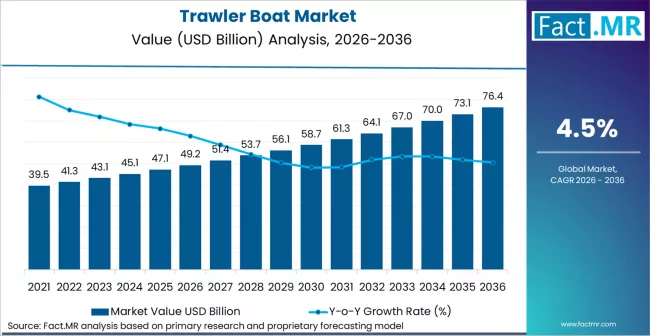
Trawler Boat Market Market Value Analysis | Source: Fact.MR
| Metric | Value |
|---|---|
| Estimated Value in 2026 | USD 49.2 billion |
| Forecast Value in 2036 | USD 76.4 billion |
| Forecast CAGR (2026 to 2036) | 4.5% |
Source: Fact.MR analysis. Updated Feb 26, 2026
Market Definition
The trawler boat market covers purpose-built commercial fishing vessels and multi-use marine craft that deploy trawl nets through bottom trawling or mid-water trawling methods to harvest demersal and pelagic fish species at commercial scale. These vessels range from small inshore boats under 12 metres to large factory-equipped stern trawlers and freezer trawlers exceeding 60 metres.
Market Inclusions
The report provides global and regional revenue forecasts from 2026 to 2036. Coverage spans all trawler vessel types including outrigger, beam, otter, pair, side, stern, freezer, wet fish trawlers, trawler/purse seiners, and naval trawlers. Segmentation by usage, vessel size, engine configuration, and water level is included. Country analysis covers China, India, the United States, Germany, Brazil, Norway, Japan, and other major fishing nations.
Market Exclusions
The scope excludes aquaculture cage and pond equipment, seafood processing facilities onshore, passive fishing vessels using fixed nets or traps, and pure recreational sailboats or powerboats not configured for trawl gear. Naval vessels used exclusively for non-fisheries purposes are excluded. The focus remains on vessels commercially or recreationally operating trawl gear in marine and large inland water environments.
Research Methodology
- Primary Research: Interviews were conducted with commercial fishing fleet operators, marine vessel brokers, shipyard procurement managers, government fisheries authority officials, and recreational trawler dealers across Asia Pacific, Europe, and North America.
- Desk Research: Sources included FAO global fishing fleet statistics, national fisheries ministry fleet renewal programme documents, IMO marine emissions regulatory filings, shipbuilding industry association reports, and vessel classification society databases.
- Market Sizing and Forecasting: A hybrid top-down and bottom-up model was used. Top-down inputs drew on FAO global fishing vessel fleet census data by category and region. Bottom-up inputs incorporated average vessel prices by type and size, replacement cycle assumptions by fishing method, and new fleet growth from government procurement programmes and aquaculture sector interviews.
- Data Validation and Update Cycle: Outputs were cross-validated against shipbuilding industry association revenue disclosures, maritime classification society registration data, and national fisheries authority fleet audit reports. Forecasts are reviewed annually to reflect regulatory, commodity-price, and fleet-construction-capacity shifts.
Summary
- Market Definition
- Trawler boats are purpose-built commercial and multi-use marine fishing vessels that deploy trawl nets in bottom or mid-water configurations to harvest demersal and pelagic species at commercial scale, spanning small coastal craft to large factory stern and freezer trawlers used across commercial, recreational, and naval applications.
- Demand Drivers
- Government-backed fleet modernisation programmes in Asia Pacific, including China's Distant Water Fishing vessel subsidy scheme and India's Pradhan Mantri Matsya Sampada Yojana, are funding systematic replacement of ageing single-engine bottom trawlers with fuel-efficient dual-engine and eco-certified new builds.
- Stricter International Maritime Organization emissions standards under IMO 2020 and the Carbon Intensity Indicator framework, fully enforced since January 2023, are compelling fleet owners in Europe and North America to retire high-emission vessels and invest in compliant new build trawlers ahead of escalating carbon penalty schedules.
- Rapid growth of global aquaculture output beyond 94 million tonnes annually, as recorded in the FAO 2024 State of World Fisheries report, is generating sustained demand for specialised small and medium trawlers configured for nearshore aquaculture site monitoring, harvesting support, and offshore cage maintenance operations.
- Key Segments Analyzed
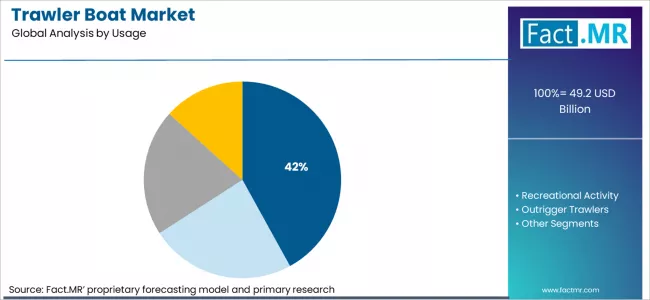
- By Usage: Fishing accounts for the leading share at 42%, driven by commercial fleet operators in Asia Pacific and North Atlantic who use purpose-built trawlers for deep-sea and coastal demersal fish harvesting, operating alongside specialised sub-types including otter, stern, freezer, and pair trawlers tailored for specific catch profiles and fishing zones.
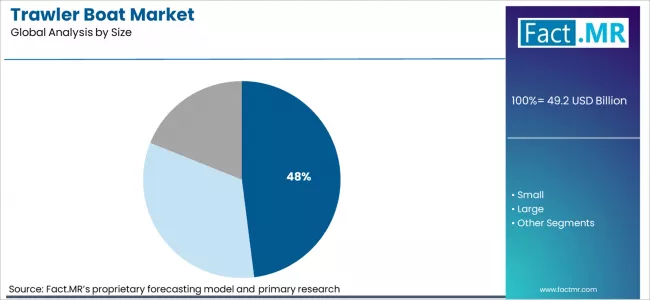
- By Size: Medium Trawler Boats hold 48% share, balancing cargo capacity and maneuverability for coastal and offshore fishing operations, making them the preferred choice for both commercial fleet modernisation programmes and recreational offshore trawling activity in North America and Europe.
- By Number of Engine: Single Engine trawlers represent 58% of total market volume, reflecting the established cost structure of coastal and artisanal commercial fishing fleets in Asia Pacific and Latin America, with dual-engine configurations gaining share in larger stern and freezer trawler new builds requiring greater power redundancy for distant-water operations.
- By Geography: Asia Pacific commands the highest growth trajectory driven by China's Distant Water Fishing programme expansion, India's government fleet renewal funding, and Southeast Asian aquaculture sector demand.
- Analyst Opinion at FACT.MR
- Shambhu Nath Jha, Principal Consultant at FACT.MR, opines, ‘CXOs will find this report indispensable for mapping where trawler boat investment is shifting from low-margin artisanal fleet replacement toward high-value, regulation-compliant stern trawler and freezer trawler newbuilds. The operators who invest early in IMO-compliant dual-engine vessels and sustainable fishing certification will command superior access to premium seafood export markets and government fleet subsidy programmes through 2036.’
- Strategic Implications
- Manufacturers should develop fuel-efficient medium trawlers for Asia Pacific aquaculture zones backed by government fleet contracts.
- Brokers and financiers should align loan structures with subsidy cycles in India and China to improve order conversion.
- European and North American operators should invest in IMO CII-compliant dual-engine stern trawlers to avoid port and eco-label restrictions.
- Methodology
- Sizing used FAO fleet census data combined with demand modelling across fishing, recreational, and naval segments, validated by shipyard and classification records.
- Adoption tracked through fleet renewal disbursements and government tender disclosures.
- Forecasts incorporated FAO production data, emissions timelines, fuel price outlooks, and recreational fishing statistics.
Drivers, Restraints, and Opportunities
FACT.MR estimates the trawler boat market at USD 47.1 billion in 2025. The industry is mature but entering a regulatory-driven renewal phase. IMO carbon rules, fisheries quota systems, and national subsidy schemes are accelerating replacement of ageing fleets. Fish remains a primary protein source across Asia Pacific, Europe, and Latin America, keeping baseline demand stable. Subsidy-backed fleet upgrades in China, India, Norway, and Japan provide visibility to newbuild pipelines.
The market is splitting in two. Older single-engine coastal trawlers face phase-out pressure. Meanwhile, compliant dual-engine stern and freezer trawlers aligned with CII and sustainability standards command significantly higher prices. Shipyards offering integrated propulsion, onboard processing, and digital tracking systems hold a pricing edge.
- The IMO Carbon Intensity Indicator (CII), enforced from January 2023 and tightening through 2030, is pushing retirement of high-emission vessels. EU MRV carbon rules expanded in January 2024, further accelerating European fleet upgrades. [2]
- India’s PMMSY scheme and China’s 14th Five-Year Fisheries Plan are funding mechanised and distant-water trawler newbuilds, sustaining order books. [3]
- Recreational trawler demand remains firm. The 2024 Recreational Boating Industry Association report showed 30-foot-plus powerboat sales holding above pre-pandemic levels. [4]
Segmental Analysis
Trawler Boat Market Analysis by Usage
Trawler Boat Market Analysis By Usage | Source: Fact.MR
Fishing is projected to hold 42% share in 2026. Global seafood supply chains depend heavily on trawler-harvested species such as cod, pollock, shrimp, and squid. Quota systems reinforce demand for specific vessel classes.
- China operated 2,701 distant-water fishing vessels in 2024 and reaffirmed subsidies for fuel-efficient freezer stern trawlers in January 2025. [5]
- Nordhavn expanded its Asia Pacific dealer network in 2024, targeting long-range recreational trawler buyers. [6]
- The North East Atlantic Fisheries Commission maintained quotas in 2024. Norway’s fleet invested NOK 2.1 billion in 2024, with otter trawlers leading transactions. [1]
Trawler Boat Market Analysis by Size
Trawler Boat Market Analysis By Size | Source: Fact.MR
Medium trawlers are expected to hold 48% share in 2026. Vessels between 20 and 45 metres balance capacity and operating efficiency. They are widely supported under fleet renewal schemes.
- India’s PMMSY disbursed INR 6,000 crore between 2023 and 2025 for mechanised vessels, including medium trawlers. Tamil Nadu approved 340 new builds in FY2024-2025. [3]
- Selene Yachts delivered 22 vessels in its 42-55-foot range in 2024 and announced hybrid propulsion integration from 2026. [7]
- Indonesia reviewed 215 medium trawler newbuilds in 2024 under aquaculture support budgets. [8]
Regional Analysis
The trawler boat market is analysed across Asia Pacific, Europe, North America, Latin America, and Middle East & Africa, covering over 30 countries. The full report also offers market attractiveness analysis based on regional regulatory, demand, and fleet renewal dynamics.
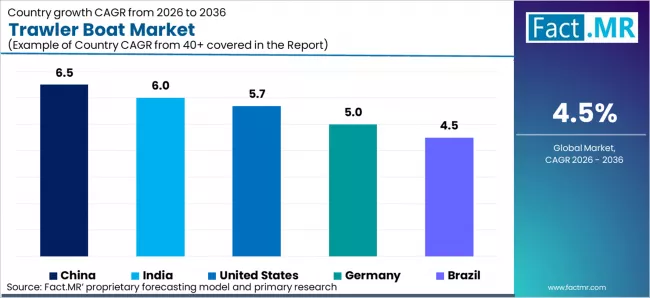
Trawler Boat Market Cagr Analysis By Country | Source: Fact.MR
| Country | CAGR (2026-2036) |
|---|---|
| China | 6.5% |
| India | 6.0% |
| United States | 5.7% |
| Germany | 5.0% |
| Brazil | 4.5% |
Source: Fact.MR analysis. Updated Feb 26, 2026
Source: Fact.MR (FACT.MR) analysis, based on proprietary forecasting model and primary research
Asia Pacific Trawler Boat Market Analysis
Asia Pacific is the global production epicenter and largest demand market for trawler boats, accounting for the majority of the world's active commercial fishing vessel fleet. China's distant water fishing programme, India's government-subsidized fleet renewal, and Southeast Asian aquaculture sector growth combine to make the region the primary driver of new build trawler orders globally. International builders including Selene Yachts compete alongside strong domestic Chinese and Indian shipyards that command the coastal and mid-sized trawler segments.
- China: Demand for trawler boats in China is projected to rise at 6.5% CAGR through 2036. China operates the world's largest distant water fishing fleet, with the Bureau of Fisheries under the Ministry of Agriculture and Rural Affairs reporting 2,701 active distant water vessels in its 2024 annual statistics. The 14th Five-Year Plan for Fisheries Development directed state capital toward newbuild procurement of fuel-efficient stern and freezer trawlers compliant with updated emission specifications, with a January 2025 Bureau of Fisheries circular reaffirming subsidy availability for qualifying newbuilds.
- India: Demand for trawler boats in India is projected to rise at 6.0% CAGR through 2036. India's fisheries sector is the world's third-largest by production volume, with the government's Pradhan Mantri Matsya Sampada Yojana scheme disbursing INR 6,000 crore through state fisheries departments for new mechanised trawler procurement in the 2024-2025 period. The scheme specifically targets replacement of wooden single-engine trawlers over 20 years old with steel-hulled, fuel-efficient vessels in the 15 to 30 metre medium trawler category, concentrating procurement in Kerala, Tamil Nadu, Gujarat, and Andhra Pradesh coastal fishing districts.
FACT.MR's Asia Pacific analysis covers China, Japan, South Korea, India, Australia and New Zealand, ASEAN, and Rest of Asia Pacific. Readers can find fleet renewal programme details, government subsidy timelines, vessel type demand forecasts, and newbuild shipyard capacity analysis within Asia Pacific.
Europe Trawler Boat Market Analysis
Europe functions as the global regulatory standard-setter for sustainable fishing vessel operations, with the EU Common Fisheries Policy and IMO emissions framework shaping fleet investment decisions across Norwegian, Dutch, Spanish, Scottish, and Danish commercial fishing operators. German and Norwegian maritime technology suppliers including MAN Energy Solutions and Wärtsilä anchor the region's premium propulsion and vessel systems supply chain.
- Germany: Demand for trawler boats in Germany is projected to rise at 5.0% CAGR through 2036. Germany's commercial fishing fleet is concentrated in the Baltic Sea and North Sea, with the German Fisheries Association reporting approximately 1,400 registered commercial fishing vessels in its 2024 fleet census, of which medium trawlers represent the primary vessel category by number. The Federal Ministry of Food and Agriculture's European Maritime, Fisheries and Aquaculture Fund (EMFAF) national programme allocates co-financing for vessel modernisation, specifically prioritising dual-engine, low-emission propulsion upgrades and onboard digital catch monitoring system installations.
FACT.MR's European analysis covers Germany, France, the United Kingdom, Norway, Spain, the Netherlands, Nordics, and Rest of Europe. Readers can find regulatory compliance frameworks, EU fund disbursement timelines, vessel certification requirements, and sustainable fishing fleet investment trends within Europe.
North America Trawler Boat Market Analysis
North America represents a large and technically advanced trawler boat market defined by the dual presence of major commercial fishing fleets in Alaska, the Gulf of Mexico, and Atlantic coast states, alongside the world's most developed recreational offshore trawler yacht segment. The United States Jones Act domestic shipbuilding preference requirement creates a captive demand channel for domestic commercial trawler new builds.
- United States: Demand for trawler boats in the United States is projected to rise at 5.7% CAGR through 2036. The National Marine Fisheries Service's 2024 Fisheries of the United States report documented 1.08 million tonnes of commercial catch valued at USD 5.3 billion, with Alaska pollock, Pacific salmon, and Gulf shrimp fleets representing the primary trawler-dependent species.
FACT.MR's North American analysis covers the United States, Canada, and Mexico. Readers can find Jones Act shipbuilding analysis, federal fisheries quota management data, recreational trawler market sizing, and Gulf of Mexico and Alaska fleet investment trends within North America.
Latin America Trawler Boat Market Analysis
Latin America is driven by its role as the world's largest producer of fishmeal and fish oil, with Peru, Chile, and Brazil operating large commercial trawler fleets serving both domestic seafood consumption and global aquaculture feed supply chains.
- Brazil: Demand for trawler boats in Brazil is projected to rise at 4.5% CAGR through 2036. Brazil's Secretaria de Aquicultura e Pesca reported 20,451 registered commercial fishing vessels in its November 2024 National Fisheries Registry update, with small and medium single-engine trawlers representing the dominant vessel category among artisanal and semi-industrial fishing communities in the Northeast, South, and Amazon basin regions.
FACT.MR's Latin American analysis covers Brazil, Chile, Ecuador, and Rest of Latin America. Readers can find fleet renewal grant structures, BNDES financing programme details, regional catch quota dynamics, and fishmeal production fleet investment trends within Latin America.
Competitive Aligners for Market Players
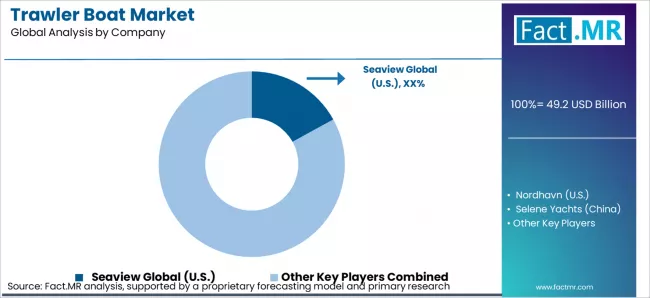
Trawler Boat Market Analysis By Company | Source: Fact.MR
The global trawler boat market is highly fragmented at the commercial fishing vessel tier and moderately concentrated in the premium recreational ocean trawler segment. No single manufacturer holds a dominant share across all vessel types and sizes. Commercial fishing trawler newbuilds are primarily produced by state-backed and private shipyards in China, Norway, the Netherlands, Spain, and South Korea, while the premium recreational trawler yacht segment is served by specialised builders including Nordhavn, Selene Yachts, Bering Yachts, and Nordic Tugs. Seaview Global and MAHASAGAR BOATS serve emerging market demand in the United States and India respectively.
Structural advantage in commercial trawler manufacturing derives from shipyard capacity scale, access to subsidised domestic steel, national fleet renewal programme relationships, and classification society certification breadth. Nordhavn and Selene Yachts maintain competitive advantage in the premium recreational segment through proprietary hull engineering optimised for long-range ocean passage-making, extensive global dealer and technical support networks, and established reputations among a relatively small but intensely brand-loyal buyer community. Bering Yachts competes on specification versatility and customisation flexibility. MAHASAGAR BOATS holds positioning in India's government-subsidised mechanized fishing vessel segment through compliance with Indian Register of Shipping vessel certification requirements that are mandatory for subsidy programme eligibility.
Government fleet procurement relationships represent the most durable competitive moat in commercial trawler manufacturing. Builders that maintain classification society certification across multiple national ship registration regimes and satisfy domestic content requirements under programmes like the U.S. Jones Act or India's Make in India shipbuilding initiative hold preferred supplier status in structured tender processes that account for the majority of newbuild commercial trawler order volume. Recreational trawler buyers exercise high individual discretion but rely heavily on dealer relationships and sea trial access, making distribution network strength a critical competitive variable.
Recent Developments
- In 2025, Torshavn expanded its Asia Pacific dealer network through new appointments in Australia and Southeast Asia, targeting long-range recreational trawler buyers in the premium offshore cruising segment, with the Nordhavn 40 and Nordhavn 60 series positioned as flagship offerings for extended passage-making and liveaboard use cases.
- In January 2025, Selene Yachts announced a partnership with a European marine hybrid systems integrator to install diesel-electric hybrid propulsion in its medium trawler line from the 2026 model year, targeting the European and North American recreational market where IMO-aligned sustainability credentials are increasingly requested by buyers.
Key Players
- Seaview Global (U.S.)
- Nordhavn (U.S.)
- Selene Yachts (China)
- Helmsman (U.S.)
- Marlow Hunter, LLC (U.S.)
- Alaska Motor Yachts (Australia)
- Bering Yachts (U.S.)
- Mirage Manufacturing (U.S.)
- Nordic Tugs (U.S.)
- MAHASAGAR BOATS (India)
Bibliography
- [1] Norwegian Fishermen's Association (Norges Fiskarlag). (February 2025). 2024 Fleet Investment Report: Newbuild and Conversion Programme Expenditure Summary. Trondheim.
- [2] International Maritime Organization. (2024). Carbon Intensity Indicator (CII) Regulatory Framework: Implementation Progress and Tightening Schedule.
- [3] Ministry of Fisheries, Animal Husbandry and Dairying, Government of India. (2025). Pradhan Mantri Matsya Sampada Yojana.
- [4] National Marine Manufacturers Association. (2024). 2024 Statistical Abstract of U.S. Recreational Boating.
- [5] Bureau of Fisheries, Ministry of Agriculture and Rural Affairs, People's Republic of China. (January 2025).
- [6] Pacific Asian Enterprises / Nordhavn. (2025). Asia Pacific Dealer Network Expansion Announcement.
- [7] Selene Yachts International. (January 2025). Hybrid Propulsion Partnership Announcement: 2026 Model Year Medium Trawler Line.
This Report Addresses
- Strategic market intelligence covering fleet renewal programme dynamics, IMO emission compliance investment cycles, recreational trawler demand expansion, and pricing pressure in commercial vessel segments across global trawler boat markets.
- Market size and forecast: valued at USD 49.2 billion in 2026, projected to reach USD 76.4 billion by 2036 at a 4.5% CAGR, segmented by usage type, vessel size, engine configuration, water level, and region.
- Growth opportunity mapping across medium trawler fleet renewal subsidies, dual-engine and hybrid-propulsion newbuild adoption, government fisheries programme procurement, and premium recreational ocean trawler expansion.
- Segment and regional outlook with country-level CAGR for China (6.5%), India (6.0%), United States (5.7%), Germany (5.0%), and Brazil (4.5%), supported by vessel type and fishing method sub-segment revenue projections.
- Competitive strategy assessment of Nordhavn, Selene Yachts, Bering Yachts, Nordic Tugs, MAHASAGAR BOATS, and Seaview Global, covering vessel positioning, market access strategy, propulsion technology investment, and distribution network strength.
- Product and technology tracking including hybrid diesel-electric propulsion adoption, IMO CII-compliant vessel specifications, satellite fishing data system integration, freezer trawler processing capacity upgrades, and electronic logbook compliance.
- Regulatory impact analysis covering IMO Carbon Intensity Indicator annual tightening schedules, EU Common Fisheries Policy quota allocations, U.S. Jones Act domestic shipbuilding requirements, India's PMMS Yojana subsidy eligibility criteria, and China's Distant Water Fishing programme specifications.
- Report delivered in PDF, Excel datasets, PowerPoint executive summary, and interactive dashboard formats supported by verified regulatory authority and manufacturer sources.
Segmentation
Scope of Report
| Items | Values |
|---|---|
| Quantitative Units | USD 49.2 billion (2026) to USD 76.4 billion (2036), at a CAGR of 4.5% |
| Market Definition | The trawler boat market encompasses commercial fishing vessels including outrigger, beam, otter, pair, side, stern, freezer, and wet fish trawlers, as well as trawler/purse seiners and naval trawlers, operating across bottom trawling and mid-water trawling methods, and used for recreational activity, commercial fishing, and naval purposes in single-engine and dual-engine configurations across small, medium, and large vessel size categories. |
| Usage Segmentation | Recreational Activity, Fishing (42%), Outrigger Trawlers, Beam Trawlers, Otter Trawlers, Pair Trawlers, Side Trawlers, Stern Trawlers, Freezer Trawlers, Wet Fish Trawlers, Trawler/Purse Seiners, Naval Trawlers |
| Size Segmentation | Small Trawler Boat, Medium Trawler Boat (48%), Large Trawler Boat |
| Engine Segmentation | Single Engine (58%), Dual Engine |
| Water Level Segmentation | Bottom Trawling (52%), Mid Water Trawling |
| Application Coverage | Commercial deep-sea and coastal fishing, recreational offshore cruising and sport fishing, naval patrol and survey operations, aquaculture support, research vessel operations, and offshore logistics support |
| Regions Covered | Asia Pacific, Europe, North America, Latin America, Middle East and Africa |
| Countries Covered | China, Japan, South Korea, Australia and New Zealand, India, ASEAN, Rest of Asia Pacific, Germany, France, United Kingdom, Norway, Spain, Netherlands, Nordics, Rest of Europe, United States, Canada, Mexico, Brazil, Chile, Ecuador, Rest of Latin America, Kingdom of Saudi Arabia, United Arab Emirates, South Africa, Turkey, Rest of Middle East and Africa |
| Key Companies Profiled | Seaview Global, Nordhavn, Selene Yachts, Helmsman, Marlow Hunter LLC, Alaska Motor Yachts, Bering Yachts, Mirage Manufacturing, Nordic Tugs, MAHASAGAR BOATS |
| Forecast Period | 2026 to 2036 |
| Approach | A hybrid top-down and bottom-up model was used. Top-down inputs included global fishing fleet census data, government fleet renewal budgets, and naval procurement plans. Bottom-up inputs covered average vessel prices by size and engine type, replacement cycles by fishing method, and newbuild growth rates from interviews with shipyards, brokers, and fishing cooperatives. |
Source: Fact.MR analysis. Updated Feb 26, 2026
Trawler Boat Market by Segment
-
By Usage
- Recreational Activity
- Fishing
- Outrigger Trawlers
- Beam Trawlers
- Otter Trawlers
- Pair Trawlers
- Side Trawlers
- Stern Trawlers
- Freezer Trawlers
-
By Size
- Small Trawler Boat
- Medium Trawler Boat
- Large Trawler Boat
-
By Number of Engine
- Single Engine
- Dual Engine
-
By Water Level
- Bottom Trawling
- Mid Water Trawling
-
By Region
- North America
- United States
- Canada
- Mexico
- Europe
- Germany
- United Kingdom
- France
- Italy
- Spain
- Netherlands
- Nordics
- Rest of Europe
- Asia Pacific
- China
- Japan
- South Korea
- India
- Australia and New Zealand
- ASEAN
- Rest of Asia Pacific
- Latin America
- Brazil
- Chile
- Ecuador
- Rest of Latin America
- Middle East and Africa
- Kingdom of Saudi Arabia
- United Arab Emirates
- South Africa
- Turkey
- Rest of Middle East and Africa
- North America
Frequently Asked Questions
How large is the trawler boat market in 2025?
What will the market size be in 2026?
What is the projected market size by 2036?
What is the expected CAGR for the forecast period 2026 to 2036?
Which usage segment is poised to lead the trawler boat market?
Which size segment commands the largest share?
Which engine configuration dominates?
Which water level segment holds the largest share?
Which country is projected to grow the fastest?
What is the expected growth rate for India?
What is the forecast CAGR for Germany's trawler boat market?
How is the trawler boat market in the United States expected to grow?
Who worked on this report


Preview the report firsthand - request a free sample
Free SampleGet the brochure for pricing and purchase details
Download PDF