- Base Value(2025): 31.7 Bn
- Estimated Value(2026): 36.5 Bn
- Forecast Value (2036): 149.0 Bn
- CAGR (2026 - 2036): 15.1%
Quadcopter Market Size, Market Forecast and Outlook by Fact.MR
- The quadcopter market was valued at USD 31.7 billion in 2025.
- Demand is estimated to reach USD 36.5 billion in 2026.
- The market is projected to grow at 15.1% CAGR from 2026 to 2036.
- Defense surveillance, inspection work, and commercial mapping are forecast to lift the market to USD 149.0 billion by 2036 as operators need stable aerial systems with flexible payload use.
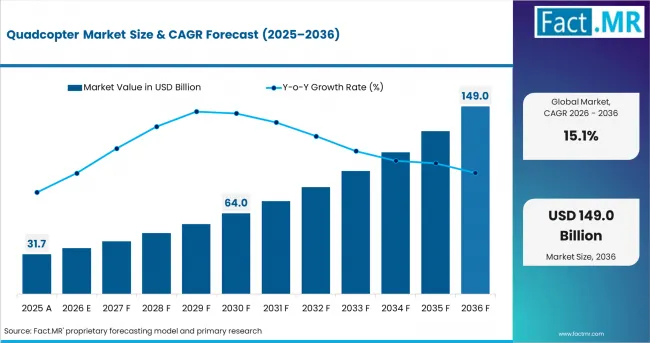
Quadcopter Market Value Analysis | Source: Fact.MR
| Metric | Details |
|---|---|
| Industry Size (2026) | USD 36.5 billion |
| Industry Value (2036) | USD 149.0 billion |
| CAGR (2026 to 2036) | 15.1% |
Source: Fact.MR analysis. Updated May 23, 2026
Summary of the Quadcopter Market
- Quadcopters Market Definition
- Quadcopters market refers to four-rotor unmanned aerial systems used for aerial imaging, inspection and short-range flight tasks. It includes consumer drones, enterprise platforms and defense models with camera or sensor payloads. Demand comes from operators seeking stable hovering, vertical takeoff, easier control and precise maneuvering.
- Demand Drivers in the Market
- Public Safety: Public safety drone coordinators need stable aerial platforms for faster field review. Quadcopters help agencies assess incidents and disaster sites with quick deployment.
- Inspection Services: Inspection service providers use quadcopters to capture data from difficult or unsafe assets. Stable hovering supports clearer review of roofs and industrial structures.
- Defense Programs: Defense drone program managers need compact aerial systems for surveillance and short-range mission support. Portable quadcopters help field units improve situational awareness.
- Key Segments Analyzed
- By Product Type: Cross shape quadcopters are projected to account for 46.0% share of quadcopter demand by product type in 2026 as users need balanced flight stability and easier payload placement.
- By Payload: Inspection and public safety users need compact payload systems. The up to 25 kg payload segment is expected to account for 54.0% share of quadcopter demand by payload in 2026.
- By Drone Type: Military drones are projected to account for 69.0% share of quadcopter demand by drone type in 2026 as defense users need stable short-range surveillance.
- By Application: Surveillance & monitoring is estimated to capture 29.0% share of quadcopter demand by application in 2026 as agencies need safer aerial review and field visibility.
- By Sales Channel: OEMs are expected to account for 52.0% share of quadcopter demand by sales channel in 2026 as enterprise users need setup support and payload integration.
- Geography: The United States quadcopter market is forecast to grow at 15.8% CAGR from 2026 to 2036 as commercial drone activity and public safety use expand.
- Analyst Opinion at Fact.MR
- Shambhu Nath Jha, Senior Analyst at Fact.MR, states, “Quadcopter adoption is moving from basic flight access to mission reliability. Defense users need stable aerial review. Commercial operators need repeatable inspection data. Suppliers will gain if flight stability, payload support, and service access are aligned.”
- Strategic Implications
- Payload Alignment: Quadcopter manufacturers must align payload capacity with flight stability and operator safety. Balanced design helps platforms support cameras and sensors during field use.
- Inspection Assessment: Inspection service providers should assess drones through endurance and sensor integration. Longer flight time and stable data capture improve asset review quality.
- Public Safety Support: Public safety agencies need training support and service access before scaling drone fleets. Reliable maintenance helps protect readiness during emergency response.
- Methodology
- Fact.MR interviews drone fleet operators and defense drone program managers for demand validation.
- Research incorporates aviation regulation product specifications and supplier portfolio assessment.
- Market estimates are developed using product type payload class and application demand patterns across key regions.
- Forecast assumptions are validated through operator feedback supplier checks and regional drone policy review to improve application-level accuracy and commercial demand validation.
Quadcopters are moving from recreational use toward mission-specific aerial tools. Commercial operators need platforms that can support inspection, mapping, and surveillance in confined sites. The FAA’s 2025 BVLOS proposal supports a pathway for routine low-altitude drone operations and includes requirements for aircraft manufacturing and recordkeeping. [1]
Drone programs are gaining structured as operators formalize flight safety and data capture. Quadcopter suppliers must align airframe stability with payload support and software reliability. This records advantage to platforms that reduce pilot effort and improve mission repeatability across industrial and public safety tasks.
The United States is forecast to grow at 15.8% CAGR from 2026 to 2036 as commercial drone use and public safety programs expand. China records 15.5% CAGR as manufacturing scale and industrial drone use support adoption. India follows at 15.2% CAGR due to training capacity and regulated drone activity. Germany is projected to grow at 14.7% CAGR through industrial inspection. UK demand may rise at 14.3% CAGR. Japan is likely to record 13.9% CAGR. Brazil is expected to grow at 13.2% CAGR as agriculture and inspection uses increase.
Segmental Analysis
Quadcopter Market Analysis by Product Type
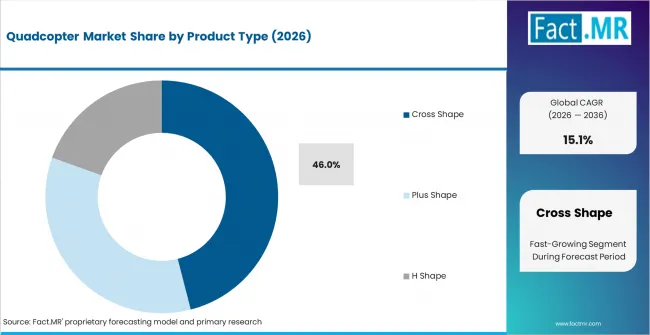
Quadcopter Market Analysis By Product Type | Source: Fact.MR
Cross shape quadcopters are projected to account for 46.0% share in 2026 as users need balanced stability and easier sensor placement. Plus shape systems serve simpler flight layouts and basic civil use. H shape quadcopters support heavier mission equipment. DJI’s Matrice 30 series is positioned for enterprise work with compact foldability and mission-ready deployment. [2] Cross shape platforms lead because commercial and defense users need stable airframes that can handle imaging payloads without complex setup.
- Cross Stability: Cross frame quadcopters help inspection crews keep camera angles steady during wind-affected roof and tower checks.
- Plus Shape Use: Plus layouts suit training programs because front-back orientation is easier for early pilots.
- H Shape Lift: H frames leave more center space for gimbals and payload mounts during industrial missions.
Quadcopter Market Analysis by Payload
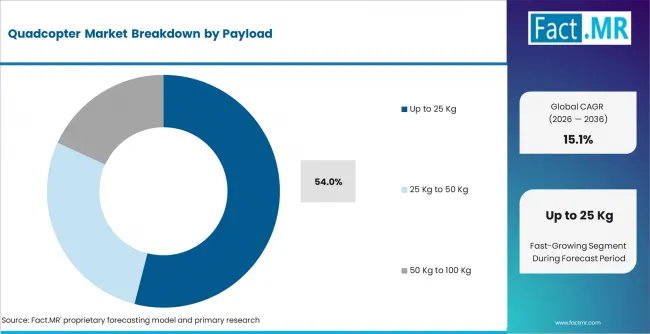
Quadcopter Market Analysis By Payload | Source: Fact.MR
Compact payload drones support leading mission volume because many operators carry cameras or inspection sensors. Larger payload classes serve specialist defense and industrial missions. The up to 25 kg payload segment is expected to account for 54.0% share over the assessment period. Inspection and public safety users need stable lift without heavy launch needs. This payload class leads because it balances handling ease and sensor flexibility. Smaller field operators can deploy these systems with less setup effort than heavy platforms.
- Compact Payload: Up to 25 kg quadcopters help emergency crews and utility inspectors move equipment quickly across tight sites.
- Mid Payload: 25 kg to 50 kg systems suit industrial operators carrying gas sensors or heavier optical payloads during plant checks.
- Heavy Lift: Above 100 kg platforms serve defense logistics and offshore support tasks that need short-distance transport of costly mission equipment.
Quadcopter Market Analysis by Drone Type
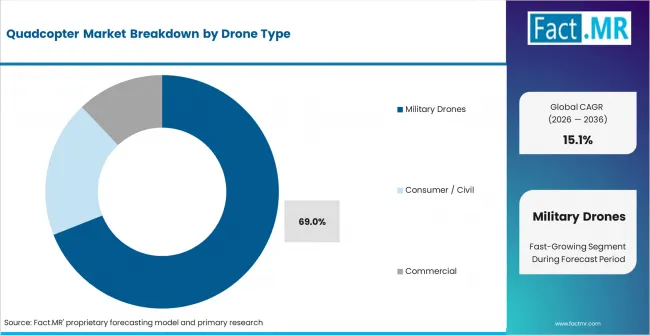
Quadcopter Market Analysis By Drone Type | Source: Fact.MR
Military drones are projected to account for 69.0% share of quadcopter demand by drone type in 2026 as defense users need stable short-range surveillance and payload support. Commercial quadcopters gain use in inspection, mapping, and site monitoring. Consumer and civil drones support photography and basic creator use. Defense demand leads because compact aerial systems help units improve situational awareness with lower exposure during field missions.
- Military Demand: Military quadcopters help patrol units check blind spots near convoys and forward posts before ground movement.
- Commercial Use: Commercial quadcopters help contractors record roof conditions and track jobsite progress without scaffolding access.
- Civil Access: Civil quadcopters give hobby pilots and training centers a lower-cost path into controlled aerial imaging.
Quadcopter Market Analysis by Application
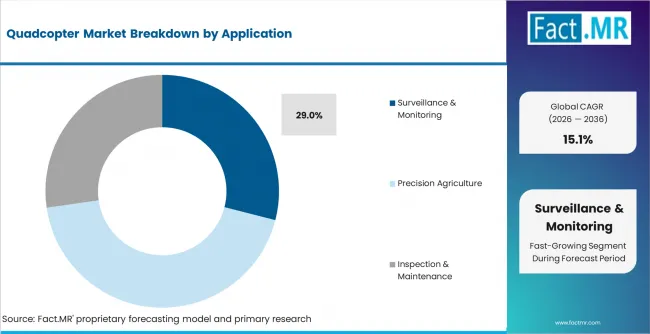
Quadcopter Market Analysis By Application | Source: Fact.MR
Surveillance & monitoring demand is tied to public safety, defense, and site security missions. Mapping & surveying users need stable aerial data across land and construction sites. Surveillance & monitoring is estimated to capture 29.0% share in 2026 as agencies need faster aerial review and field visibility. Skydio positions its platforms for Drone as First Responder, site security, and asset inspection. [3] This supports demand for quadcopters that can launch quickly and provide dependable situational data.
- Surveillance Role: Police departments and security operators use quick-launch quadcopters to assess perimeters before ground staff move in.
- Mapping Use: Survey crews use quadcopters to update site maps between construction milestones without slowing equipment movement.
- Inspection Need: Facility managers use quadcopters to record roof and tower conditions before planning repair work.
Quadcopter Market Analysis by Sales Channel
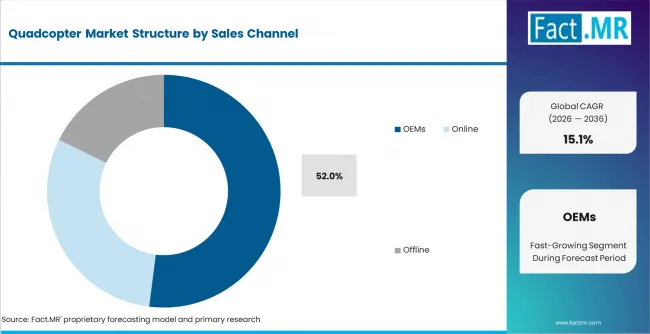
Quadcopter Market Analysis By Sales Channel | Source: Fact.MR
Enterprise users often need configuration support before drone fleets move into routine use. Online channels serve hobby and small commercial purchases. OEMs are expected to account for 52.0% share over the forecast period, as enterprise users need setup support and payload integration. Offline distributors support training and demonstration needs. Aftermarket channels support batteries and sensor replacement. OEMs lead because professional users need direct access to firmware updates and service support.
- OEM Support: OEM channels help fleet managers align firmware updates with mission software before drone fleets enter daily work.
- Offline Access: Offline distributors help training centers and enterprise operators test controls before committing to fleet purchases.
- Aftermarket Need: Spare batteries and propeller kits support service continuity after crashes and high-cycle field use.
Quadcopter Market Drivers, Restraints, and Opportunities
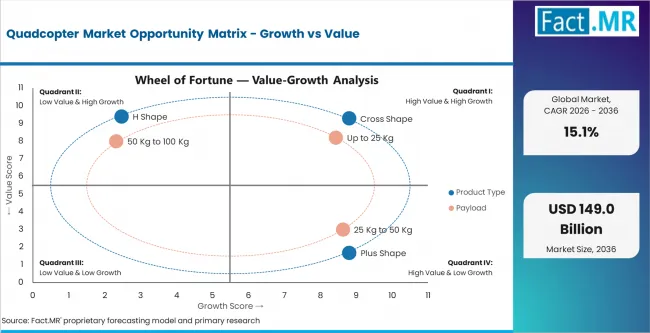
Quadcopter Market Opportunity Matrix Growth Vs Value | Source: Fact.MR
Mission flexibility is the primary demand driver for quadcopters across commercial, industrial, and defense applications. Operators favor four-rotor platforms because they can hover precisely, maneuver in confined environments, and capture stable aerial data in locations where larger aircraft may face operational limits. Defense units use quadcopters for close range surveillance and tactical review. Rapid situational assessment adds further field use. Commercial operators deploy them for infrastructure inspection and construction monitoring. Site mapping adds another application. Their ease of deployment and vertical takeoff capability further support widespread adoption.
The main restraints remain limited flight endurance and operating cost. Quadcopters generally offer shorter battery life than fixed-wing drones, while heavier payloads can reduce flight duration further. Spare-parts replacement, maintenance, and the need for skilled pilots may increase operating costs for smaller operators.
Opportunities in the Quadcopter Market
- Public Safety: Agencies can expand use through drone-as-first-responder programs and field review. Quadcopters support faster incident assessment during emergency response.
- Industrial Inspection: Operators can use quadcopters to reduce manual asset checks. Stable hovering helps review roofs, and industrial equipment from safer distances.
- Precision Agriculture: Farm service providers can use quadcopters for crop monitoring and spray support. Compact platforms help assess field conditions and support targeted treatment.
Regional Analysis
Based on regional analysis, the quadcopter market is segmented into North America, Latin America, Western Europe, Eastern Europe, East Asia, South Asia and Pacific, and Middle East and Africa across 30 plus countries.
.webp "Top Country Growth Comparison Quadcopter Market Cagr (2026 2036)")
Top Country Growth Comparison Quadcopter Market Cagr (2026 2036) | Source: Fact.MR
| Country | CAGR (2026 to 2036) |
|---|---|
| United States | 15.8% |
| China | 15.5% |
| India | 15.2% |
| Germany | 14.7% |
| UK | 14.3% |
| Japan | 13.9% |
| Brazil | 13.2% |
Source: Fact.MR analysis. Updated May 23, 2026
Source: Fact.MR analysis, based on proprietary forecasting model and primary research.
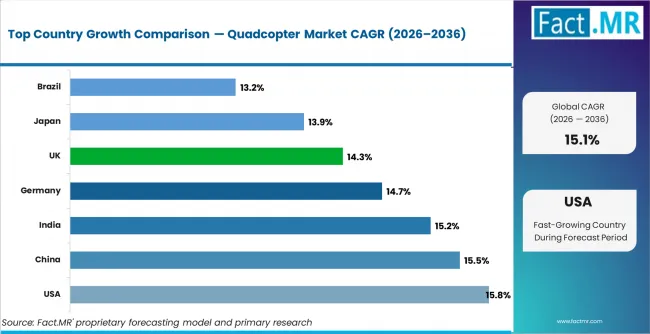
Quadcopter Market Cagr Analysis By Country | Source: Fact.MR
North America Quadcopter Market Analysis
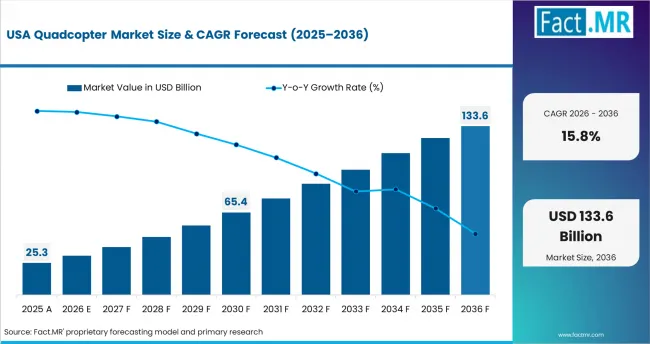
Quadcopter Market Country Value Analysis | Source: Fact.MR
North America demand is supported by commercial drone rules, public safety adoption, and enterprise inspection work. The United States leads because it combines defense use and advanced inspection demand. OEM service access and operator training shape repeat purchases in this region.
- United States: The United States quadcopter market is forecast to grow at 15.8% CAGR from 2026 to 2036 as public safety and inspection programs increase drone use. Commercial operators need stable platforms for asset checks, and remote site review. Public safety agencies are using drone programs for faster field awareness. Suppliers with fleet support and training services can gain stronger repeat demand from enterprise and government drone operators.
East Asia Quadcopter Market Analysis
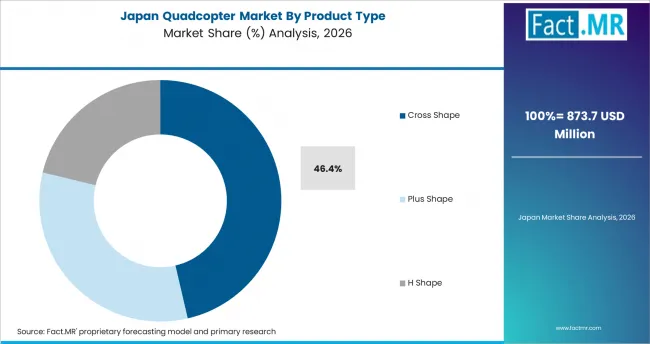
Quadcopter Market Japan Market Share Analysis By Product Type | Source: Fact.MR
East Asia demand comes from drone manufacturing strength and wide industrial use. China leads through production scale and domestic drone activity. Japan is tied to infrastructure inspection and disaster response. Quadcopter suppliers in this region compete through reliability, payload design, and service depth.
- China: China’s quadcopter demand benefits from domestic manufacturing and large industrial drone use. CAAC reported more than 2 million registered UAVs and more than 26 million annual UAV flight hours in 2024. [4] The country is forecast to rise at 15.5% CAGR from 2026 to 2036 as inspection, agriculture, and public service missions expand. Local production helps reduce platform access barriers. Suppliers gain when they pair product availability with mission software and after-sales support.
- Japan: Japan’s quadcopter demand is supported by infrastructure inspection and disaster response needs. Operators use compact drones to inspect bridges, slopes, and difficult terrain. The country is expected to grow at 13.9% CAGR over the study period as labor constraints increase the value of aerial inspection. Japan’s MLIT white paper discusses drone use in infrastructure maintenance and emergency safety assessment. [5] Suppliers with training support and stable sensor packages can serve public agencies and infrastructure operators.
South Asia and Pacific Quadcopter Market Analysis
South Asia and Pacific demand benefits from formal drone training, agricultural use, and infrastructure mapping. India is the key growth country because regulation and local manufacturing support adoption. Operators still need service access and pilot training before wider fleet deployment.
- India: India is projected to record 15.2% CAGR through 2036 as training capacity and infrastructure mapping support quadcopter demand. Public agencies need this for drones mapping and field monitoring. Farm service providers use quadcopters for crop review and spray planning. Local suppliers gain when they provide repair support and operator training beyond major cities.
Western Europe Quadcopter Market Analysis
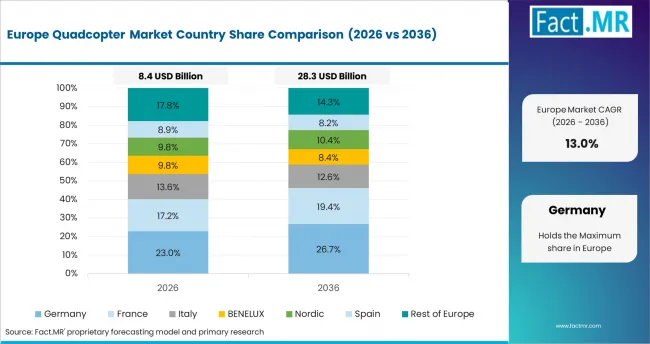
Quadcopter Market Europe Country Market Share Analysis, 2026 & 2036 | Source: Fact.MR
Western Europe demand reflects managed drone operations, infrastructure inspection, and public safety use. Germany and the UK lead adoption through industrial users and formal airspace oversight. European suppliers must align platform quality with airspace safety and operator compliance.
- Germany: Germany’s quadcopter demand is tied to industrial inspection and security use. Manufacturing sites and infrastructure operators use drones for safer visual checks. The country is projected to grow at 14.7% CAGR by 2036 because users expand routine inspection missions. Suppliers with compliant systems and training support can improve adoption among industrial operators.
- UK: The UK quadcopter market is forecast to grow at 14.3% CAGR from 2026 to 2036 as public safety and inspection users build drone programs. Commercial operators need clear operating procedures and registered pilots. Police and emergency services use drones for faster site review. Suppliers that offer training and service packages can support wider adoption across public and private operations.
Latin America Quadcopter Market Analysis
Latin America demand comes from agriculture, public safety and infrastructure checks. Brazil leads regional adoption because large farms and dispersed assets create a need for aerial monitoring. Cost control and service access shape platform selection across the region.
- Brazil: Brazil’s quadcopter demand is supported by agriculture, mining, and infrastructure monitoring. The country is expected to grow at 13.2% CAGR from 2026 to 2036 as farms and service providers use drones for field review. Large operating areas increase the value of fast aerial checks. Suppliers that provide maintenance and pilot support can improve repeat demand among farm and industrial users.
Competitive Aligners for Market Players
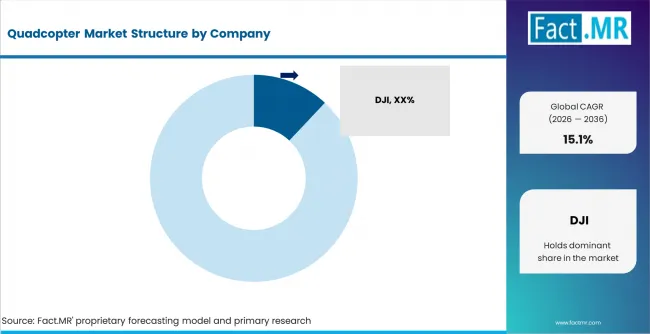
Quadcopter Market Analysis By Company | Source: Fact.MR
The quadcopter market includes drone OEMs, sensor firms, and enterprise service suppliers. DJI, Autel Robotics, DraganFly Inc., ALTAIR INC. ALL, Uvify Inc., Terra Drone Corp., Delair, Hubblefly Technologies Pvt Ltd., Potensic, Yuneec Holding Ltd., DroneNerds, ideaForge Pvt Ltd., and Teledyne FLIR LLC compete through flight stability, payload support, software quality, and service access.
Competitive advantage depends on matching flight design with mission needs. Consumer drones need camera quality and ease of use. Commercial drones need uptime and payload flexibility. Military drones need rugged design and secure data handling. Teledyne FLIR Defense positions unmanned aerial systems for intelligence, surveillance, reconnaissance, and mission-critical performance.
Supplier position will rely on training and after-sales support through 2036. Enterprise drone programs need maintenance, pilot support, and mission data workflows. OEMs with strong software and repair networks can protect repeat sales.
Key Players in Quadcopter Market
• DJI
• Autel Robotics Drones
• DraganFly Inc.
• ALTAIR INC. ALL
• Uvify Inc.
• Terra Drone Corp.
• Tracxn Technologies Limited
• Delair
• Hubblefly Technologies Pvt Ltd.
• Potensic
• Unmanned Systems Technology
• Yuneec Holding Ltd.
• DroneNerds
• ideaForge Pvt Ltd.
• Teledyne FLIR LLC
Bibliography
- [1]. Federal Aviation Administration. (2025, August 6). Beyond Visual Line of Sight (BVLOS). FAA.
- [2]. DJI. (2026). Matrice 30 series. DJI.
- [3]. Skydio. (2026). Drone as First Responder for public safety. Skydio.
- [4]. Civil Aviation Administration of China. (2024). Statistical bulletin of civil aviation industry development in 2024. CAAC.
- [5]. Ministry of Land, Infrastructure, Transport and Tourism. (2024). Summary of the White Paper on Land, Infrastructure, Transport and Tourism in Japan. MLIT.
Quadcopter Market Definition
The quadcopter market covers four-rotor unmanned aerial vehicles used for surveillance, photography, and defense missions. The market differs from fixed-wing drones because quadcopters can hover, and operate in constrained spaces. Scope includes product type, and regional deployment.
Quadcopter Market Inclusions
The scope includes plus shape quadcopters, cross shape quadcopters, H shape quadcopters, and military quadcopters. Payload classes up to 25 kg and above 100 kg are included. Use across filming, inspection, mapping, surveillance, and precision agriculture is counted when the platform uses four-rotor lift architecture.
Quadcopter Market Exclusions
The scope excludes fixed-wing drones, single-rotor drones, hexacopters, octocopters, toy aircraft without commercial use, and manned aerial platforms. Standalone sensors and software are excluded unless sold with quadcopter systems. Drone services without platform sales are outside the hardware-focused scope.
Quadcopter Market Research Methodology
- Primary Research
- Primary research includes interviews with drone fleet operators and defense drone program managers. Inspection service providers and public safety drone coordinators are covered separately. OEM channel teams provide supply-side inputs.
- Desk Research
- Desk research reviews aviation rules, drone product portfolios, and public agency guidance. Company datasheets and operator manuals support product-level validation. Regional drone policy documents are reviewed for adoption readiness.
- Market-Sizing and Forecasting
- Forecasting uses quadcopter demand by drone type, payload, and application. Commercial inspection, defense surveillance, and mapping demand are linked to platform use and replacement cycles.
- Data Validation and Update Cycle
- Forecasts are validated through supplier checks and operator interviews. Regional assumptions are reviewed through aviation regulation signals and country-level drone program development.
Segmentation
Scope of the Report
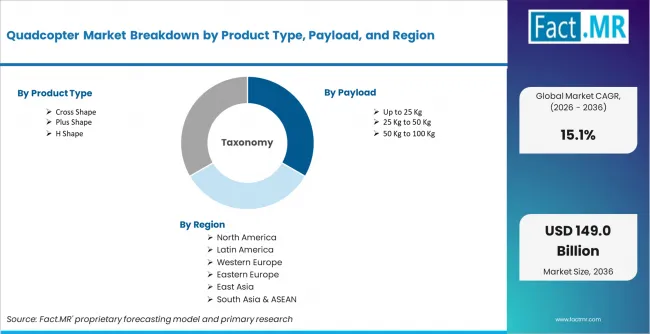
Quadcopter Market Breakdown By Product Type, Payload, And Region | Source: Fact.MR
| Attribute | Details |
|---|---|
| Quantitative Units | USD 36.5 billion in 2026 to USD 149.0 billion by 2036, at 15.1% CAGR |
| Market Definition | Four-rotor unmanned aerial vehicles used for stable flight, hovering, imaging, inspection, and surveillance. |
| Product Type | Plus Shape Quadcopter, Cross Shape Quadcopter, H Shape Quadcopter |
| Payload | Up to 25 Kg, 25 Kg to 50 Kg, 50 Kg to 100 Kg, Above 100 Kg |
| Drone Type | Consumer / Civil, Commercial, Military |
| Application | Filming & Photography, Inspection & Maintenance, Mapping & Surveying, Precision Agriculture, Surveillance & Monitoring |
| Sales Channel | Online, Offline, OEMs, Aftermarket |
| Regions Covered | North America, Latin America, Western Europe, Eastern Europe, East Asia, South Asia and Pacific, Middle East and Africa |
| Countries Covered | United States, China, India, Germany, UK, Japan, Brazil, 30 plus countries |
| Key Companies Profiled | DJI, Autel Robotics, DraganFly, ALTAIR, Uvify, Terra Drone, Delair, Hubblefly, Potensic, Yuneec, DroneNerds, ideaForge, Teledyne FLIR |
| Forecast Period | 2026 to 2036 |
| Approach | Hybrid top-down and bottom-up model using drone type demand, payload class, application use, channel checks, and operator interviews. |
Source: Fact.MR analysis. Updated May 23, 2026
Quadcopter Market Analysis by Segments
-
By Product Type:
- Plus Shape Quadcopter
- Cross Shape Quadcopter
- H Shape Quadcopter
-
By Payload:
- Up to 25 Kg
- 25 Kg to 50 Kg
- 50 Kg to 100 Kg
- Above 100 Kg
-
By Drone Type:
- Consumer / Civil
- Commercial
- Military
-
By Application:
- Filming & Photography
- Inspection & Maintenance
- Mapping & Surveying
- Precision Agriculture
- Surveillance & Monitoring
-
By Sales Channel:
- Online
- Offline
- OEMs
- Aftermarket
-
By Region:
- North America
- United States
- Canada
- Latin America
- Brazil
- Mexico
- Argentina
- Western Europe
- Germany
- United Kingdom
- France
- Italy
- Spain
- Eastern Europe
- Poland
- Russia
- Rest of Eastern Europe
- East Asia
- China
- Japan
- South Korea
- South Asia and Pacific
- India
- Australia
- ASEAN
- Middle East and Africa
- GCC Countries
- South Africa
- Israel
- North America
Frequently Asked Questions
How large is the quadcopter market in 2025?
What is the expected value of the quadcopter market in 2026?
What is the forecast value of the quadcopter market by 2036?
What CAGR is projected for the quadcopter market from 2026 to 2036?
Which product type leads the quadcopter market?
Why do cross shape quadcopters lead the quadcopter market?
Which payload class leads the quadcopter market?
Why does the up to 25 kg payload class lead the quadcopter market?
Which drone type leads the quadcopter market?
Why do military drones lead the quadcopter market?
Which application leads the quadcopter market?
Why does surveillance & monitoring lead the quadcopter market?
Who worked on this report


Preview the report firsthand - request a free sample
Free SampleGet the brochure for pricing and purchase details
Download PDF