- Base Value(2026): 451.9 Mn
- Forecast Value (2036): 712.4 Mn
- CAGR (2036): 4.7%
Trisodium Phosphate for Food-Grade Applications Market Forecast and Outlook By FACT.MR
The trisodium phosphate for food-grade applications market reached USD 428.6 million in 2025. Fact MR estimates the market will expand to USD 451.9 million in 2026 and attain USD 712.4 million by 2036. The market is forecast to register a CAGR of 4.7% across the assessment period.
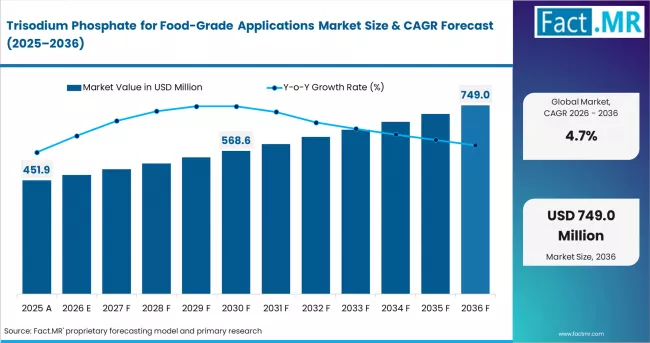
Trisodium Phosphate For Food Grade Applications Market Value Analysis | Source: Fact.MR
Summary of Trisodium Phosphate for Food-Grade Applications Market
- Market Definition
- The Trisodium Phosphate for Food-Grade Applications Market includes food-grade trisodium phosphate used as a functional additive in processed food formulations. It acts as a pH regulator, emulsifier, stabilizer, and moisture retention agent to support texture consistency, protein interaction performance, and formulation stability across processed meat, dairy, bakery, cereal, seafood, and beverage processing applications.
- Demand Drivers
- Stable utilization of buffering agents supporting pH balance across processed food manufacturing environments
- Increasing demand for moisture retention agents supporting texture consistency in processed meat and seafood products
- Continued incorporation of emulsifying salts across dairy, bakery, and prepared food formulations
- Consistent use of phosphate additives supporting processing efficiency across large-scale food production workflows
- Key Segments Analyzed
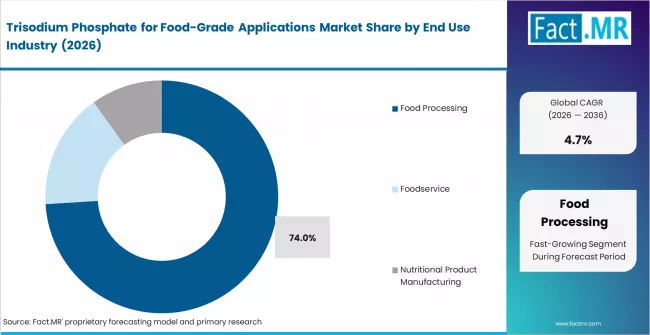
- End Use Industry: Food processing accounts for 74% share supported by demand for functional phosphate additives
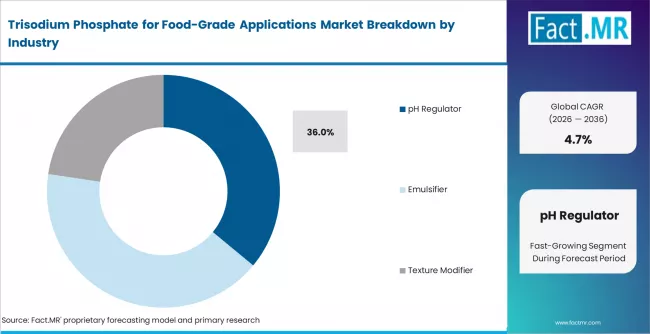
- Function: pH regulator represents 36% share driven by requirement for controlled acidity balance across formulations
- Application: Processed meat, dairy, bakery, and cereal products demonstrate stable additive utilization
- Geography: Europe, North America, and Asia demonstrate consistent demand across processed food ingredient markets
-
Analyst Opinion at Fact MR
- Shambhu Nath Jha, Principal Consultant, Fact MR, opines, "In this updated edition of the Trisodium Phosphate for Food-Grade Applications Market report, industry participants will observe steady demand supported by continued utilization of phosphate additives across processed food formulations. Functional performance consistency and regulatory compliance remain central considerations influencing supplier positioning across food ingredient supply chains through 2036."
-
Strategic Implications Executive Takeaways
- Maintain consistency of phosphate purity supporting stable functional performance across processed food formulations
- Strengthen supply reliability aligned with processed food manufacturing demand requirements
- Optimize formulation compatibility supporting controlled pH balance and emulsification stability performance
- Monitor regulatory frameworks influencing acceptable inclusion levels of phosphate additives across food ingredient markets
-
Methodology
- Primary interviews conducted with food ingredient manufacturers, food processors, and quality control specialists
- Desk research based on food additive databases, regulatory frameworks, technical literature, and trade publications
- Hybrid top-down food additive demand assessment combined with bottom-up trisodium phosphate consumption analysis
- Validation through cross verification of supplier data, expert consultation, and food formulation trend monitoring
Trisodium Phosphate for Food-Grade Applications Market
| Metric | Details |
|---|---|
| Industry Size (2026E) | USD 451.9 million |
| Industry Value (2036F) | USD 712.4 million |
| CAGR (2026 to 2036) | 4.7% |
Source: Fact.MR analysis. Updated Apr 20, 2026
A CAGR of 4.7% indicates incremental, stable expansion supported by continued use in pH control, emulsification, and moisture retention across processed food formulations. Variability remains limited due to established functional performance, while constraints persist from clean label reformulation pressure and substitution risk from alternative phosphate-free stabilizing systems.
The United Kingdom leads with a projected CAGR of 5.2%, supported by stable use of buffering and emulsifying agents across processed food formulations. Germany follows with a CAGR of 5.0%, driven by consistent incorporation of phosphate salts across meat processing and bakery applications. The United States records a CAGR of 4.7%, reflecting steady demand for food-grade phosphates across packaged food manufacturing operations. France shows a CAGR of 4.5%, supported by gradual utilization of functional phosphate additives across dairy and prepared food formulations. Japan records the slowest growth at 4.2%, reflecting a mature market where demand is largely tied to replacement procurement cycles within established food ingredient supply chains. Mature markets generate a significant share of replacement demand as formulation requirements remain aligned with texture stabilization, acidity control, and processing efficiency across packaged food applications.
Segmental Analysis
Trisodium Phosphate for Food-Grade Applications Market Analysis by End Use Industry
Trisodium Phosphate For Food Grade Applications Market Analysis By End Use Industry | Source: Fact.MR
- Market Overview: Based on Fact MR assessment, food processing is projected to account for 74% share of the trisodium phosphate for food-grade applications market in 2026. Food-grade trisodium phosphate is incorporated across processed meat, seafood, bakery, and dairy formulations requiring controlled buffering capacity and ionic strength adjustment. Chemical functionality supports protein hydration behavior, emulsification stability, and water retention performance across processed food matrices. Ingredient inclusion is structured to maintain consistency of texture and processing stability across thermal treatment stages applied in industrial food production workflows requiring defined pH balance control parameters.
- Demand Drivers:
- Protein Interaction Requirements: Trisodium phosphate supports water binding performance across processed meat and seafood formulations requiring controlled moisture retention characteristics.
- Emulsion Stability Parameters: Food processors incorporate buffering agents supporting uniform dispersion of fat and water phases across structured food matrices.
- Processing Consistency Needs: Defined pH control supports predictable functional behavior across heat treated food formulations requiring stable texture performance.
Trisodium Phosphate for Food-Grade Applications Market Analysis by Function
Trisodium Phosphate For Food Grade Applications Market Analysis By Function | Source: Fact.MR
- Market Overview: pH regulator functionality is estimated to hold 36% share of the trisodium phosphate for food-grade applications market in 2026, supported by requirement for acid-base balance control across food formulations exposed to thermal processing, storage, and ingredient interaction variability. Buffering performance enables stabilization of product acidity levels influencing protein structure, microbial growth conditions, and flavor balance across processed food systems. Controlled pH adjustment supports consistent chemical environment required for ingredient interaction performance across multi component food formulation processes.
- Demand Drivers:
- Acidity Control Requirements: pH regulation supports stabilization of chemical environment influencing protein solubility and structural integrity across processed food matrices.
- Shelf Stability Parameters: Controlled pH balance contributes to maintenance of microbial growth control conditions across packaged food products.
- Formulation Compatibility Needs: Buffering agents support interaction stability across multi ingredient formulations requiring defined acid-base equilibrium conditions.
Key Dynamics
Trisodium Phosphate for Food-Grade Applications Market Drivers, Restraints, and Opportunities
Trisodium Phosphate For Food Grade Applications Market Opportunity Matrix Growth Vs Value | Source: Fact.MR
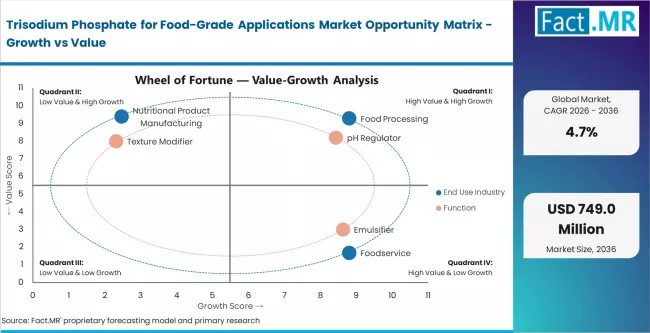
Fact MR analysis indicates that the trisodium phosphate market developed from inorganic phosphate chemistry used in food processing to regulate acidity, improve texture, and stabilize formulations. Early adoption was concentrated in processed foods such as meat products, baked goods, and cereals where phosphate salts supported moisture retention and pH control. The current market valuation reflects continued use of food-grade trisodium phosphate in processed meat, seafood treatment, bakery formulations, and beverage processing. Demand persists because phosphate salts improve water binding, emulsification, and processing stability within large-scale food manufacturing operations.
A structural shift is occurring as conventional phosphate additives face reformulation pressure in certain food categories emphasizing ingredient simplification. Trisodium phosphate remains widely used in processed foods where functional performance and cost efficiency remain primary considerations. Food manufacturers increasingly optimize phosphate usage levels and combine functional additives to maintain texture and shelf stability while addressing formulation requirements. Food-grade phosphate production requires purification and quality control processes that increase manufacturing costs relative to technical-grade phosphate materials. Even with stable consumption volumes, higher-value formulation optimization supports gradual market value expansion.
- Food Texture Optimization: Processors use trisodium phosphate to regulate acidity, improve moisture retention, and stabilize emulsions in processed food formulations.
- Food Additive Regulation: Standards such as U.S. Food and Drug Administration GRAS status for phosphates and Codex Alimentarius phosphate additive specifications regulate usage levels.
- North America Food Processing: The United States maintains large processed food manufacturing industries that utilize phosphate additives in meat, bakery, and cereal production.
Regional Analysis
The trisodium phosphate for food-grade applications market is assessed across North America, Europe, Asia Pacific, Latin America, and Middle East & Africa, segmented by country-level demand in food processing additives, acidity regulators, emulsification agents, and preservation formulations. Regional demand reflects food safety standards, additive compliance frameworks, and processed food production capacity. The full report offers market attractiveness analysis.
.webp "Top Country Growth Comparison Trisodium Phosphate For Food Grade Applications Market Cagr (2026 2036)")
Top Country Growth Comparison Trisodium Phosphate For Food Grade Applications Market Cagr (2026 2036) | Source: Fact.MR
| Country | CAGR (2026–2036) |
|---|---|
| United Kingdom | 5.2% |
| Germany | 5.0% |
| United States | 4.7% |
| France | 4.5% |
| Japan | 4.2% |
Source: Fact.MR analysis. Updated Apr 20, 2026
Source: Fact MR analysis, based on proprietary forecasting model and primary research
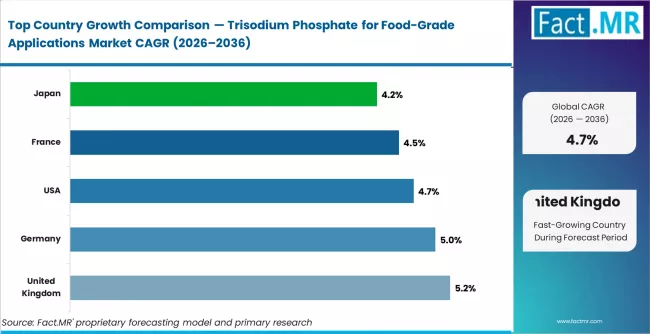
Trisodium Phosphate For Food Grade Applications Market Cagr Analysis By Country | Source: Fact.MR
Europe
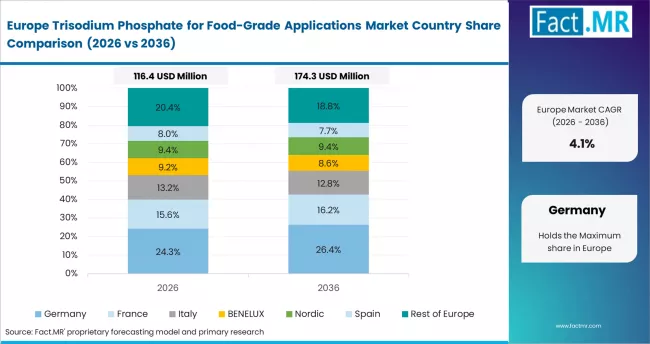
Trisodium Phosphate For Food Grade Applications Market Europe Country Market Share Analysis, 2026 & 2036 | Source: Fact.MR
Europe functions as the food additive regulatory laboratory for phosphate-based processing ingredients, supported by structured food safety standards and ingredient authorization frameworks. ICL Group Ltd. strengthens phosphate ingredient production capabilities. Prayon S.A. expands food-grade phosphate formulation portfolio. Budenheim Group supports food additive ingredient development.
- United Kingdom: Demand for trisodium phosphate for food-grade applications in United Kingdom is projected to rise at 5.2% CAGR through 2036. The UK Food Additives Regulation framework (Food Standards Agency, updated 2021) supports additive compliance standards. Budenheim Group expanded phosphate-based food additive production capabilities (March 2023), supporting supply.
- Germany: Demand for trisodium phosphate for food-grade applications in Germany is projected to rise at 5.0% CAGR through 2036. EU Food Additives Regulation framework (European Commission, ongoing) supports controlled phosphate ingredient use. Prayon S.A. expanded specialty phosphate product portfolio (February 2023), supporting market growth.
- France: Demand for trisodium phosphate for food-grade applications in France is projected to rise at 4.5% CAGR through 2036. The French Food Safety Law update (Ministry of Agriculture, 2022) supports additive formulation compliance. ICL Group Ltd. expanded phosphate ingredient manufacturing capabilities (January 2023), supporting adoption.
>North America
North America functions as the processed food formulation and ingredient commercialization hub, supported by strong packaged food production capacity and structured additive safety frameworks. Innophos Holdings, Inc. strengthens specialty phosphate ingredient production. The Mosaic Company expands phosphate material supply capabilities. ICL Group Ltd. supports food-grade phosphate product development.
- United States: Demand for trisodium phosphate for food-grade applications in United States is projected to rise at 4.7% CAGR through 2036. FDA food additive regulatory framework (U.S. FDA, ongoing) supports phosphate ingredient safety compliance. Innophos Holdings, Inc. expanded food-grade phosphate ingredient production capacity (April 2023), supporting supply expansion.
Asia Pacific
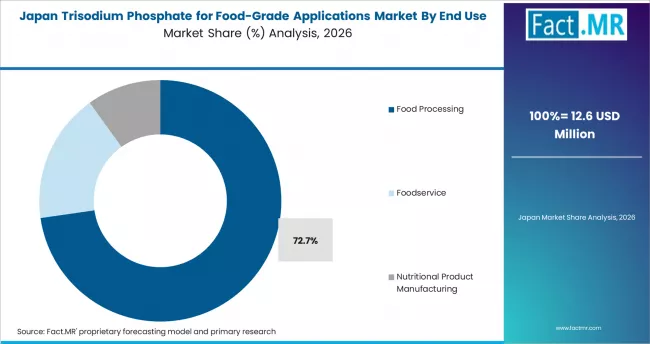
Trisodium Phosphate For Food Grade Applications Market Japan Market Share Analysis By End Use Industry | Source: Fact.MR
Asia Pacific serves as the processed food ingredient manufacturing and additive formulation market, supported by expanding food processing capacity and regulatory compliance requirements. Tosoh Corporation strengthens phosphate chemical manufacturing capabilities. Nippon Chemical Industrial Co., Ltd. expands specialty additive production. Kao Corporation supports specialty chemical ingredient development.
- Japan: Demand for trisodium phosphate for food-grade applications in Japan is projected to rise at 4.2% CAGR through 2036. The Food Sanitation Act additive standards update (Ministry of Health, Labour and Welfare, 2021) supports regulated additive usage compliance. Tosoh Corporation expanded phosphate chemical manufacturing capacity (May 2023), supporting market demand.
Fact MR's analysis of trisodium phosphate for food-grade applications market in global regions consists of country-wise assessment that includes United Kingdom, Germany, United States, France, and Japan. Readers can find food additive demand trends, phosphate formulation developments, regulatory frameworks, and competitive positioning across key markets.
Competitive Landscape
Competitive Structure and Buyer Dynamics in the Trisodium Phosphate for Food-Grade Applications Market
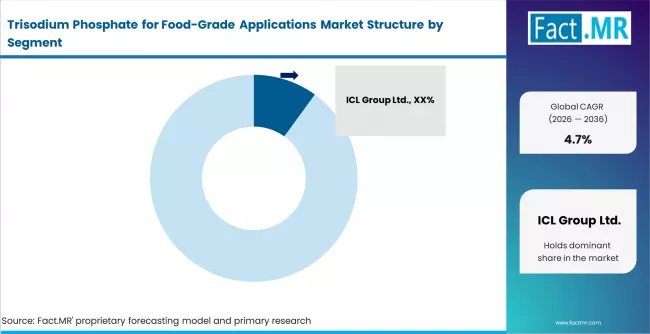
Trisodium Phosphate For Food Grade Applications Market Analysis By Company | Source: Fact.MR
The competitive structure of the Trisodium Phosphate for Food-Grade Applications Market is moderately concentrated, with phosphate producers and specialty chemical manufacturers controlling a significant share of supply. Companies such as ICL Group Ltd., Innophos Holdings Inc., Prayon SA, Aditya Birla Chemicals, and Haifa Group maintain strong positions through established phosphate processing infrastructure and global distribution networks. Additional participants including Hubei Xingfa Chemicals Group Co. Ltd., Wengfu Group Co. Ltd., Yuntianhua Group Co. Ltd., Spectrum Chemical Manufacturing Corp., and Jost Chemical Co. contribute through large scale phosphate production and specialty food grade chemical supply. Competition is primarily influenced by product purity, regulatory compliance, supply reliability, and consistency of phosphate quality across food processing applications.
Several companies maintain structural advantages through vertically integrated phosphate mining and chemical processing capabilities. Firms such as ICL Group Ltd., Prayon SA, and Aditya Birla Chemicals benefit from access to phosphate rock reserves and established refining infrastructure supporting stable raw material availability. Innophos Holdings Inc. and Jost Chemical Co. maintain advantages through expertise in food grade phosphate formulation and compliance with safety standards. Food manufacturers often adopt multi supplier sourcing strategies to reduce dependence on a single phosphate supplier and ensure supply continuity. Procurement decisions evaluate suppliers based on purity consistency, regulatory alignment, and long term availability, moderating supplier pricing leverage across the market.
Key Players of the Trisodium Phosphate for Food-Grade Applications Market
- ICL Group Ltd.
- Innophos Holdings Inc.
- Prayon SA
- Aditya Birla Chemicals
- Haifa Group
- Hubei Xingfa Chemicals Group Co. Ltd.
- Wengfu Group Co. Ltd.
- Yuntianhua Group Co. Ltd.
- Spectrum Chemical Manufacturing Corp.
- Jost Chemical Co.
Bibliographies
- [1] U.S. Food and Drug Administration (FDA). (n.d.). Generally Recognized as Safe (GRAS) status for phosphates, including trisodium phosphate, as food additives – GRAS notices and regulatory database. FDA GRAS Notices.
- [2] European Food Safety Authority (EFSA) and European Commission. (2019). Re-evaluation of phosphoric acid and phosphates (E 338–341, 343, 450–452) used as food additives. EFSA Panel on Food Additives and Nutrient Sources added to Food (ANS). EFSA Journal, 17(11), 5874.
- [3] Codex Alimentarius Commission. (2011). Codex General Standard for Food Additives (GSFA) – Sodium phosphates (E339) as acidity regulators and stabilizers. FAO and WHO.
- [4] FoodAdditives.net. (2020). What is trisodium phosphate (E339(iii)) in cereal? Uses, safety, and food-grade classification. FoodAdditives.net.
- [5] Ritz, E., et al. (2012). Phosphate additives in food – a health risk. Deutsches Ärzteblatt International, 109(4), 49–55.
This Report Addresses
- Market size estimation and revenue forecasts for the Trisodium Phosphate for Food Grade Applications Market from 2026 to 2036, supported by food additive demand benchmarks.
- Growth opportunity mapping across processed meat products, bakery products, dairy products, breakfast cereals, seafood processing, and beverage processing applications.
- Segment and regional revenue forecasts covering pH regulator, emulsifier, texture modifier, moisture retention agent, and stabilizer functional roles across processed food formulations.
- Competition strategy assessment of ICL Group Ltd., Innophos Holdings Inc., Prayon SA, Aditya Birla Chemicals, and Jost Chemical Co.
- Regulatory impact analysis covering FDA GRAS status, Codex Alimentarius phosphate specifications, and EU food additive compliance frameworks.
- Market report delivery in PDF, Excel, PPT, and interactive dashboard formats for food ingredient benchmarking.
- Supply chain vulnerability assessments examining phosphate rock availability, purification cost variability, regulatory limits on phosphate additives, and substitution risk from phosphate free stabilizers.
Trisodium Phosphate for Food-Grade Applications Market Definition
The trisodium phosphate for food-grade applications market includes food grade trisodium phosphate used as an acidity regulator, emulsifier, cleaning agent, and processing aid to improve texture, stability, and shelf life in processed foods, beverages, and food contact sanitation systems.
Trisodium Phosphate for Food-Grade Applications Market Inclusions
The report includes global and regional market size estimates, forecast analysis, and segmentation by purity grade, application type, functional role, end use industry, pricing structure, and supply chain distribution patterns.
Trisodium Phosphate for Food-Grade Applications Market Exclusions
The scope excludes industrial grade trisodium phosphate for detergents or water treatment, finished food products containing blended phosphates without specification, phosphate compounds not classified as trisodium phosphate, and non food processing chemical applications.
Trisodium Phosphate for Food-Grade Applications Market Research Methodology
- Primary Research
- Interviews were conducted with food ingredient manufacturers, processed food producers, distributors, regulatory specialists, and quality control laboratories.
- Desk Research
- Public sources included food additive regulatory databases, company technical documentation, trade statistics, food processing publications, and chemical safety guidelines.
- Market-Sizing and Forecasting
- A hybrid model combining top-down food additive demand evaluation and bottom-up analysis of trisodium phosphate consumption across processing applications was applied.
- Data Validation and Update Cycle
- Findings were validated through cross comparison of supplier data, expert consultation, and periodic monitoring of regulatory and application trends.
Segmentation
Report Scope
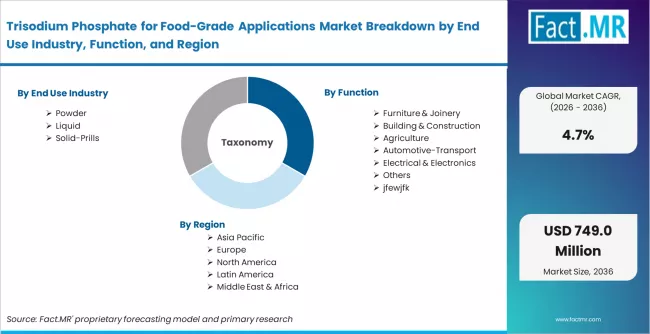
Trisodium Phosphate For Food Grade Applications Market Breakdown By End Use Industry, Function, And Region | Source: Fact.MR
| Metric | Value |
|---|---|
| Quantitative Units | USD 451.9 million (2026) to USD 712.4 million (2036), at a CAGR of 4.7% |
| Market Definition | The trisodium phosphate for food-grade applications market includes production and use of trisodium phosphate as a functional food additive used to regulate acidity, improve texture, enhance water retention, and stabilize formulations across processed food categories. |
| Application Segmentation | Processed meat products, Bakery products, Dairy products, Breakfast cereals, Seafood processing, Beverage processing |
| Function Segmentation | pH regulator, Emulsifier, Texture modifier, Moisture retention agent, Stabilizer |
| End Use Industry Segmentation | Food processing, Foodservice, Nutritional product manufacturing |
| Regions Covered | North America, Latin America, Europe, East Asia, South Asia, Oceania, Middle East and Africa |
| Countries Covered | United States, Canada, Mexico, Brazil, Germany, France, United Kingdom, Italy, Spain, Netherlands, China, Japan, South Korea, India, Thailand, Indonesia, Australia, United Arab Emirates, and 40+ countries |
| Key Companies Profiled | ICL Group Ltd., Innophos Holdings Inc., Prayon SA, Aditya Birla Chemicals, Haifa Group, Hubei Xingfa Chemicals Group Co. Ltd., Wengfu Group Co. Ltd., Yuntianhua Group Co. Ltd., Spectrum Chemical Manufacturing Corp., Jost Chemical Co. |
| Forecast Period | 2026 to 2036 |
| Approach | Hybrid top-down and bottom-up market estimation based on food additive consumption ratios, processed food production benchmarking, phosphate ingredient demand analysis, formulation usage patterns, and validation through primary interviews with ingredient manufacturers, food processors, and specialty chemical distributors. |
Source: Fact.MR analysis. Updated Apr 20, 2026
Trisodium Phosphate for Food Grade Applications Market Key Segments
-
Application:
- Processed Meat Products
- Bakery Products
- Dairy Products
- Breakfast Cereals
- Seafood Processing
- Beverage Processing
-
Function:
- pH Regulator
- Emulsifier
- Texture Modifier
- Moisture Retention Agent
- Stabilizer
-
End Use Industry:
- Food Processing
- Foodservice
- Nutritional Product Manufacturing
-
Region:
- North America
- USA
- Canada
- Mexico
- Europe
- Germany
- UK
- France
- Italy
- Spain
- Nordic Countries
- BENELUX
- Rest of Europe
- Asia Pacific
- China
- Japan
- South Korea
- India
- Australia
- Rest of Asia Pacific
- Latin America
- Brazil
- Argentina
- Rest of Latin America
- Middle East and Africa
- Kingdom of Saudi Arabia
- United Arab Emirates
- South Africa
- Rest of Middle East and Africa
- Other Regions
- Oceania
- Central Asia
- Other Markets
- North America
Frequently Asked Questions
How large is the demand for Trisodium Phosphate for Food-Grade Applications in the global market in 2026?
What will be the market size of Trisodium Phosphate for Food-Grade Applications in the global market by 2036?
What is the expected demand growth for Trisodium Phosphate for Food-Grade Applications in the global market between 2026 and 2036?
Which company is identified as a leading manufacturer in the Trisodium Phosphate for Food-Grade Applications market?
Which end use industry is projected to dominate Trisodium Phosphate demand by 2026?
Why is Trisodium Phosphate widely used in food processing applications?
What is driving demand for Trisodium Phosphate in food-grade applications in the United Kingdom?
What is the growth outlook for the Trisodium Phosphate for Food-Grade Applications market in the United Kingdom?
Why is Germany an important market for food-grade phosphate compounds?
What is the growth outlook for the Trisodium Phosphate for Food-Grade Applications market in Germany?
How is demand for Trisodium Phosphate evolving in the United States food processing sector?
What is the growth outlook for the Trisodium Phosphate for Food-Grade Applications market in the United States?
What is the growth outlook for the Trisodium Phosphate for Food-Grade Applications market in France?
How is Japan positioned in the Trisodium Phosphate for Food-Grade Applications market?
What is the growth outlook for the Trisodium Phosphate for Food-Grade Applications market in Japan?
What is Trisodium Phosphate and what is it mainly used for in food-grade applications?
What does the Trisodium Phosphate for Food-Grade Applications market include in this report?
What applications are included in the scope of the Trisodium Phosphate for Food-Grade Applications market?
What is excluded from the scope of the Trisodium Phosphate for Food-Grade Applications market report?
What does market forecast mean in the Trisodium Phosphate for Food-Grade Applications market report?
How is the Trisodium Phosphate for Food-Grade Applications market forecast developed in this report?
What does primary validation indicate in the Trisodium Phosphate for Food-Grade Applications market analysis?
Who worked on this report


Preview the report firsthand - request a free sample
Free SampleGet the brochure for pricing and purchase details
Download PDF