- Market Value (2025): USD 1.7 Bn
- Estimated Value (2026): USD 2.1 Bn
- Forecast Value (2036): USD 16.1 Bn
- CAGR (2026-2036): 22.6%
What is the VLEO Satellite Platforms Market forecast to be worth by 2036?
USD 2.1 billion in 2026 to USD 16.1 billion by 2036 at a 22.6% CAGR.
- The VLEO Satellite Platforms Market was valued at USD 1.7 billion in 2025.
- Demand is projected to increase from USD 2.1 billion in 2026 to USD 16.1 billion by 2036.
- The market is forecast to record 22.6% CAGR from 2026 to 2036 as satellite operators, defence mission teams and Earth observation providers evaluate lower-orbit platforms.
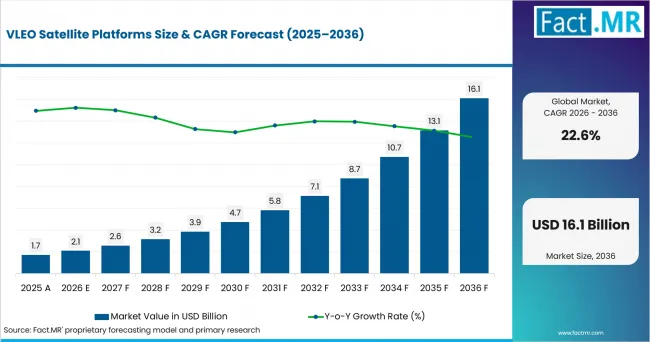
Vleo Satellite Platforms Value Analysis | Source: Fact.MR
What are the defining numbers behind VLEO Satellite Platforms Market growth?
USD 14.0 billion absolute opportunity by 2036, led by 101-300 kg platforms, Earth observation and electric propulsion.
- Demand Drivers in the Market
- Earth observation operators need lower orbital altitude to improve ground sampling distance while keeping payload mass controlled.
- Defence mission teams need shorter revisit cycles for missile tracking and RF monitoring in low-orbit sensing architectures.
- Platform manufacturers need drag-tolerant buses because residual atmosphere increases orbit-control work below conventional LEO bands.
- Constellation operators need compact spacecraft that launch in batches and leave orbit faster after service life.
- Key Segments Analyzed
- By Platform Class: 101-300 kg is expected to hold 31.0% share in 2026, owing to its balance of payload room and launch flexibility.
- By Mission: Earth observation is projected to account for 33.0% share in 2026, supported by lower-altitude imaging needs and high-revisit mapping.
- By Drag Compensation: Electric propulsion is anticipated to capture 39.0% share in 2026, driven by repeatable station keeping in thin atmosphere.
- By Orbit Altitude: 251-350 km is estimated to represent 34.0% share in 2026, led by missions that need sharper sensing with manageable drag exposure.
- Analyst Opinion at Fact.MR
- Shambhu Nath Jha, Principal Consultant at Fact.MR, states, “VLEO turns altitude into a platform-design decision. Operators are buying proof that propulsion, shape and materials work together during lower-orbit service. Suppliers are expected to combine drag modelling, attitude control and payload pointing evidence before customers approve multi-satellite deployments.”
- Strategic Implications
- Platform vendors should publish station-keeping margins across 100-450 km so satellite operators can compare mission life by altitude.
- Propulsion suppliers should document thrust range and power draw for electric and air-breathing systems used in lower orbit.
- Mission integrators should match bus mass and payload volume with rideshare launch windows to lower deployment friction.
- Government customers should use live sensing demonstrations before moving VLEO platforms into constellation-level programs.
Japan is forecast to post 22.9% CAGR through 2036, supported by satellite-system targets and domestic launch goals. The USA is projected to record 22.5% CAGR, driven by defence sensing and VLEO demonstration work. France is anticipated to advance at 22.1% CAGR, owing to CO3D and public low-orbit technology programs. Germany is estimated to hold 21.8% CAGR, reinforced by ESA funding weight and industrial satellite capability. The UK is forecast to reach 19.2% CAGR, supported by C-LEO connectivity funding and orbital safety activity.
How does the VLEO Satellite Platforms Market break down by segment?
101-300 kg leads Platform Class at 31.0%; Earth observation leads Mission at 33.0%.
Which Platform Class dominates?
101-300 kg holds 31.0% share in 2026.
The 101-300 kg class is expected to lead because it gives operators enough room for imaging payloads, propulsion and attitude control. CNES states that the CO3D constellation comprises four approximately 250 kg satellites for Earth observation and 3D mapping, launched in July 2025. CO3D operates in a 502 km low-Earth orbit, so it provides evidence for the 101–300 kg spacecraft-mass class rather than for VLEO operation itself.
What leads the Mission segment?
Earth observation holds 33.0% share in 2026.
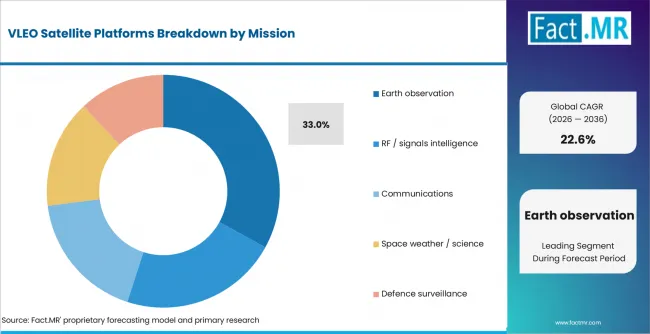
Vleo Satellite Platforms Analysis By Mission | Source: Fact.MR
Earth observation is projected to lead because lower orbit improves sensing proximity for optical and RF payloads. Skeyeon announced three U.S. patents in June 2025 covering VLEO remote sensing, RF downlink and atomic-oxygen-resistant low-drag materials for missions below 300 km. These capabilities are particularly relevant to applications that value higher-resolution observation, frequent revisits and low-latency data delivery.
How does Drag Compensation shape demand?
Electric propulsion holds 39.0% share in 2026.
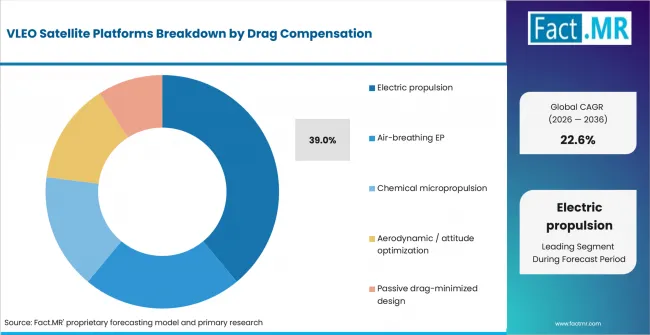
Vleo Satellite Platforms Analysis By Drag Compensation | Source: Fact.MR
Electric propulsion is anticipated to lead because VLEO platforms must counter atmospheric drag throughout service life. ESA reported in May 2026 that its VOLTA air-breathing electric propulsion system is being developed for small satellite platforms operating in VLEO, which ESA describes as altitudes of roughly 200–450 km. Conventional electric propulsion is already commercially established, while VOLTA and other air-breathing systems remain on a development, maturation and qualification pathway toward commercial VLEO applications.
What supports demand for 251-350 km within Orbit Altitude?
251-350 km holds 34.0% share in 2026.
The 251-350 km band is expected to hold the larger share as operators balance closer proximity to Earth with the atmospheric-drag requirements of VLEO operation. ESA describes VLEO as extending from about 100 km to approximately 450 km, with 250–350 km the most commonly considered range. ESA identifies atmospheric drag, active orbit maintenance and atomic-oxygen surface erosion as key operating challenges, increasing the importance of demonstrated orbit-control, propulsion and material-performance capabilities.
What is accelerating VLEO Satellite Platforms Market adoption, and what is holding it back?
Demand is expected to rise through lower-altitude sensing, defence surveillance and drag-compensation progress. Growth is constrained by propulsion maturity, debris exposure and qualification cost.
Drivers Impact Analysis
| DRIVER | (~) % IMPACT ON CAGR | GEOGRAPHIC RELEVANCE | IMPACT TIMELINE |
|---|---|---|---|
| Lower-altitude Earth observation requirements | +2.4% | North America, Europe, East Asia | Short term (<= 2 years) |
| Defence surveillance and missile tracking from proliferated LEO | +1.8% | USA, UK, France | Medium term (2-4 years) |
| Electric and air-breathing propulsion progress | +1.5% | Europe, USA, Japan | Medium term (2-4 years) |
| Small-satellite manufacturing and rideshare deployment | +1.0% | Global | Long term (>= 4 years) |
Opportunity Impact Analysis
| OPPORTUNITY | (~) % IMPACT ON CAGR | GEOGRAPHIC RELEVANCE | IMPACT TIMELINE |
|---|---|---|---|
| Air-breathing propulsion for long-duration VLEO missions | +1.3% | Europe, USA | Medium term (2-4 years) |
| Persistent Earth observation for mapping and infrastructure monitoring | +1.1% | France, Japan, USA | Short term (<= 2 years) |
| Secure communications and low-latency relay missions | +0.8% | USA, UK, Germany | Long term (>= 4 years) |
Restraints Impact Analysis
| RESTRAINT | (~) % IMPACT ON CAGR | GEOGRAPHIC RELEVANCE | IMPACT TIMELINE |
|---|---|---|---|
| Drag and power burden at very low altitude | -0.9% | Global | Short term (<= 2 years) |
| Crowded LEO environment and conjunction-management workload | -0.6% | North America, Europe, East Asia | Medium term (2-4 years) |
| Qualification cost for materials and propulsion subsystems | -0.5% | Global | Long term (>= 4 years) |
Which countries are scaling the VLEO Satellite Platforms Market through 2036?
- The country comparison spans 3.7 percentage points and forms three practical growth bands across the forecast period.
- Japan remains 0.4 percentage point above the USA as domestic satellite-system targets support lower-orbit mission planning.
- The USA remains 0.4 percentage point above France due to defence sensing programs and VLEO demonstration activity.
- France remains 0.3 percentage point above Germany through CO3D and public low-orbit technology programs.
- Germany remains 2.6 percentage points above the UK owing to ESA funding weight and industrial satellite capability.
- The UK closes the displayed range as C-LEO funding supports low-orbit communications technology.
Comparable CAGRs create different entry conditions because each country combines space funding, launch access, sensing demand and orbital safety rules differently. Full report coverage includes North America, Latin America, Western Europe, Eastern Europe, East Asia, South Asia & Pacific, Middle East & Africa.
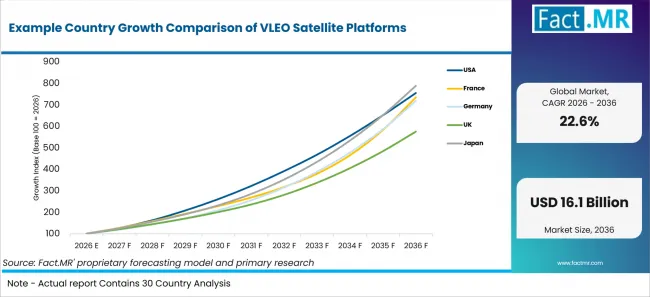
Example Country Growth Comparison Of Vleo Satellite Platforms | Source: Fact.MR
| Country | CAGR |
|---|---|
| Japan | 22.9% |
| United States | 22.5% |
| France | 22.1% |
| Germany | 21.8% |
| United Kingdom | 19.2% |
How does Japan perform?
22.9% CAGR, supported by satellite-system targets and domestic launch goals.
Japan is expanding its satellite base through public technology funding and private-company participation. JAXA’s Space Strategic Fund states that Japan targets at least five domestic private-company satellite systems by the early 2030s. The VLEO market is expected to benefit where Earth observation, communications and low-orbit testing need compact platforms with verified propulsion margins.
What supports USA adoption?
22.5% CAGR, supported by defence sensing and VLEO demonstration activity.
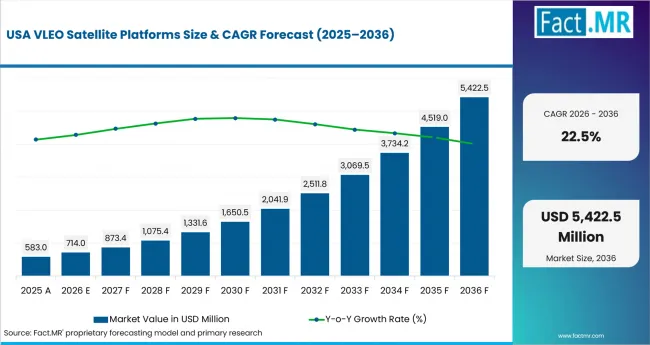
Vleo Satellite Platforms Country Value Analysis | Source: Fact.MR
The USA links lower-orbit platform demand with missile tracking, rapid revisit missions and technology demonstrations. The Space Development Agency’s December 2025 Tracking Layer awards create a clear pathway for high-volume deployment of proliferated LEO spacecraft. VLEO suppliers gain relevance when defence users seek sharper sensing and faster mission refresh cycles in lower orbital shells.
How is France scaling demand?
22.1% CAGR, supported by CO3D and public low-orbit technology programs.
France combines institutional Earth observation programs with established small-satellite engineering capability. CNES reports that the four-satellite CO3D constellation was launched in July 2025 and provides 50-cm spatial-resolution imagery for Earth observation and 3D mapping. CO3D operates at 502 km, placing it above ESA’s approximately 100–450 km VLEO range, while providing adjacent evidence of compact-satellite capability for high-resolution Earth observation.
What is supporting Germany’s adoption?
21.8% CAGR, reinforced by ESA funding weight and industrial satellite capability.
Germany’s VLEO outlook is tied to European mission funding and domestic satellite engineering. DLR reported in November 2025 that Germany is contributing approximately EUR 5.4 billion to ESA programs decided at the Bremen ministerial meeting. That funding base supports Earth observation, communications and space safety work where lower-orbit platforms need qualification depth.
What supports the United Kingdom’s growth?
19.2% CAGR, supported by C-LEO funding and orbital safety capability.
The UK is developing low-orbit communications capability through public funding and commercial satellite technology programs. UK Space Agency announced GBP 30 million in March 2026 for the second C-LEO round. VLEO platform demand is expected to form around compact communications payloads, safety reviews and mission designs that need lower latency.
Who leads the VLEO Satellite Platforms Market?
Redwire is an active VLEO platform provider through SabreSat and its DARPA Otter work. The Otter program links Redwire’s VLEO spacecraft architecture with long-duration on-orbit testing of technologies intended to sustain operations at very low altitudes. Redwire positions VLEO particularly for defence, intelligence and communications missions requiring persistent lower-orbit capabilities.
Thales Alenia Space announced in September 2026 that it would provide governmental payloads for 330 IRIS² telecommunications satellites in LEO. Thales states that these satellites will operate at approximately 1,200 km, so the program demonstrates secure LEO payload-integration capability rather than direct VLEO platform activity.
Blue Canyon Technologies provides small-satellite buses with capabilities including precision pointing, agility and increased payload capacity. RTX introduced Saturn-400 in August 2025 with payload capacity of up to 600 kg depending on the launch vehicle; the source establishes general satellite-bus capability rather than a VLEO-specific platform. Terran Orbital is included as an adjacent LEO supplier because its December 2025 selection by Lockheed Martin to provide satellite buses for SDA Tranche 3 links its platforms directly to proliferated LEO defence production rather than demonstrated VLEO deployment.
Skeyeon adds a specialized VLEO profile among the listed providers. Its patent portfolio addresses remote sensing, RF downlink and low-drag materials for operations below 300 km. Competitive differentiation is likely to depend on VLEO flight evidence, drag-compensation capability, payload-pointing performance and repeatable high-rate spacecraft production.
Which companies are the key providers?
Key companies include Redwire; Thales Alenia Space; York Space Systems; Blue Canyon Technologies; Terran Orbital; Skeyeon.
- Redwire
- Thales Alenia Space
- York Space Systems
- Blue Canyon Technologies
- Terran Orbital
- Skeyeon
Bibliography
- Redwire Corporation. (2025, November 19). Redwire awarded $44 million DARPA contract to advance very low-Earth orbit mission.
- Space Development Agency. (2025, December 19). Space Development Agency makes awards to build 72 Tracking Layer satellites for Tranche 3.
- European Space Agency. (2025, April 1). ESA Space Environment Report 2025.
- European Space Agency. (2026, May 6). OSIP highlights July–December 2025.
- German Aerospace Center (DLR). (2025, November 28). Germany invests 5.4 billion euros in the future of European space.
- UK Space Agency. (2026, March 4). UK sets sights on £40 billion satellite communications market with fresh investment.
- Japan Aerospace Exploration Agency. (2026, June). Overview of the Space Strategy Fund (SSF) [Presentation slides].
- Airbus. (2026, September 10). Airbus starts the development of IRIS² satellites on behalf of Eutelsat.
- Thales Alenia Space. (2026, September 10). Thales Alenia Space to provide digital and secure payloads for 330 IRIS² telecommunications satellites in low Earth orbit. Thales Group.
- RTX. (2025, August 4). RTX's Blue Canyon Technologies announces new, larger spacecraft.
- Terran Orbital. (2025, December 30). Terran Orbital selected by Lockheed Martin to provide satellite buses for SDA’s Tranche 3 Tracking Layer.
- Skeyeon. (2025, June 10). Skeyeon awarded three breakthrough U.S. patents advancing VLEO satellite technology.
This Report Answers
- The report explains where VLEO satellite platforms are used across platform class and mission type. It also covers drag compensation and orbit altitude.
- Segment analysis identifies the subsegments with stronger commercial fit and the operating reasons satellite operators prioritize them.
- Country analysis examines the listed markets and the funding, mission and safety mechanisms supporting lower-orbit platform deployment.
- Competitive analysis reviews providers across VLEO buses, smallsat platforms, defence constellation supply and low-drag mission architectures.
- Application analysis considers how imaging quality, latency, station keeping and disposal planning influence supplier selection.
What does the VLEO Satellite Platforms Market cover?
The VLEO Satellite Platforms Market covers spacecraft buses and integrated platform systems designed for operation closer to Earth than conventional LEO missions. It includes structures, power systems, propulsion, attitude control and drag-management features used to keep missions stable at lower altitude.
The assessment covers Earth observation, RF and signals intelligence, communications, space weather and defence surveillance missions. Adjacent coverage of software-defined defence satellites, satellite communication systems and earth observation services helps frame mission demand.
What is included in the scope?
The scope includes satellite platforms designed for VLEO and VLEO-like operations across 100-450 km where drag compensation shapes mission life. It includes electric propulsion, air-breathing EP concepts, chemical micropropulsion, aerodynamic optimization and passive low-drag design.
It includes platform classes from 20 kg to above 1,000 kg when spacecraft design is built for lower-altitude operation. Adjacent coverage of 3D printed satellite parts, space cybersecurity controls and small satellite environmental testing supports upstream and mission-assurance context.
What is excluded from the scope?
The scope places launch vehicles, ground stations, raw payloads, data analytics software and conventional LEO buses outside the transaction boundary. It also places mission services outside the boundary when platform-level integration is absent.
Standalone propulsion components remain outside the scope unless sold as part of a platform architecture or integrated bus design. Commercial satellite imagery subscriptions are outside the scope when the underlying VLEO platform is absent from the transaction boundary.
How Was the Analysis Built?
The analysis draws on 120+ sources, 35+ company portfolios, 25+ countries, and more than 20 industry interviews.
- Primary Research: Primary research includes discussions with manufacturers, service providers, technology developers, distributors, end users, and subject-matter experts. These conversations examine purchasing priorities, product adoption, operational challenges, approval requirements, competitive positioning, and the factors that influence wider market acceptance.
- Desk Research: Desk research covers government statistics, regulatory publications, company filings, trade data, technical studies, industry associations, standards, public policy, and other authoritative sources. Every source used in the analysis is documented in the bibliography.
- Market Sizing and Forecasting: Market estimates combine historical performance, demand indicators, pricing and volume trends, segment shares, company participation, country-level growth, adoption patterns, investment activity, and barriers to market expansion.
- Data Validation and Update Cycle: Findings are validated by comparing primary interviews with public data, company activity, regulatory changes, trade patterns, and industry developments. Regular updates review new product launches, capacity changes, partnerships, approvals, and shifts in commercial adoption.
What is the report’s scope and coverage?
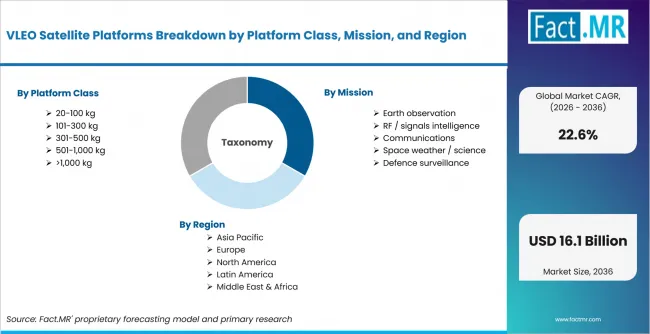
Vleo Satellite Platforms Breakdown By Platform Class, Mission, And Region | Source: Fact.MR
| Attribute | Details |
|---|---|
| Quantitative Units | USD billion |
| Market Definition | VLEO satellite platforms cover spacecraft buses, subsystems and integrated platform designs intended to operate in very low Earth orbit, including propulsion, attitude control, power, thermal and drag-reduction elements. |
| Platform Class | 101-300 kg; 20-100 kg; 301-500 kg; 501-1,000 kg; >1,000 kg |
| Mission | Earth observation; RF / signals intelligence; Communications; Space weather / science; Defence surveillance |
| Drag Compensation | Electric propulsion; Air-breathing EP; Chemical micropropulsion; Aerodynamic / attitude optimization; Passive drag-minimized design |
| Orbit Altitude | 251-350 km; 181-250 km; 100-180 km; 351-450 km; >450 km VLEO-like |
| Regions Covered | North America; Latin America; Western Europe; Eastern Europe; East Asia; South Asia & Pacific; Middle East & Africa |
| Countries Covered | United States; France; Germany; United Kingdom; Japan |
| Key Companies Profiled | Redwire; Thales Alenia Space; York Space Systems; Blue Canyon Technologies; Terran Orbital; Skeyeon |
| Forecast Period | 2026 to 2036 |
| Approach | Hybrid top-down and bottom-up approach using satellite program activity, platform class, mission need, propulsion readiness, altitude band, country policy and provider portfolio review. |
How is the market segmented?
-
By Platform Class
- 101-300 kg
- 20-100 kg
- 301-500 kg
- 501-1,000 kg
- >1,000 kg
-
By Mission
- Earth observation
- RF / signals intelligence
- Communications
- Space weather / science
- Defence surveillance
-
By Drag Compensation
- Electric propulsion
- Air-breathing EP
- Chemical micropropulsion
- Aerodynamic / attitude optimization
- Passive drag-minimized design
-
By Orbit Altitude
- 251-350 km
- 181-250 km
- 100-180 km
- 351-450 km
- >450 km VLEO-like
-
By Region
- North America
- Latin America
- Western Europe
- Eastern Europe
- East Asia
- South Asia & Pacific
- Middle East & Africa