- Market Value (2025): USD 0.2 Bn
- Estimated Value (2026): USD 0.3 Bn
- Forecast Value (2036): USD 2.2 Bn
- CAGR (2026-2036): 22.0%
What is the warehouse digital replicas market forecast to be worth by 2036?
USD 0.3 billion in 2026 to USD 2.2 billion by 2036, at 22.0% CAGR.
- The warehouse digital replicas market crossed a valuation of USD 0.2 billion in 2025.
- Demand is expected to increase from USD 0.3 billion in 2026 to USD 2.2 billion by 2036.
- The market is forecast to record 22.0% CAGR from 2026 to 2036 as warehouse operators use replicas to test layout changes, robot routes and picking flows before live execution.
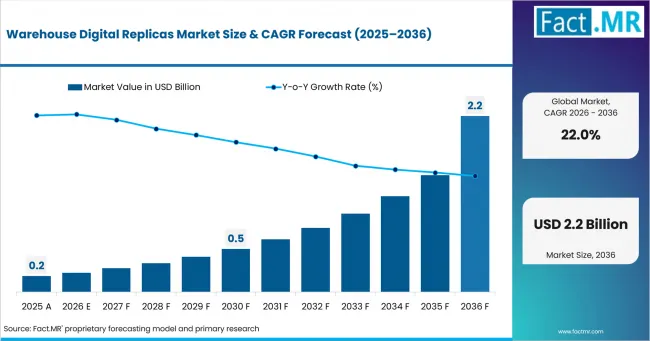
Warehouse Digital Replicas Market Market Value Analysis | Source: Fact.MR
What are the defining numbers behind warehouse digital replicas growth?
USD 1.9 billion absolute opportunity by 2036, led by India and China.
- Demand Drivers in the Market
- Warehouse operators need replica testing before changing slotting, labor waves and dock schedules.
- 3PLs need faster scenario comparison because customer contracts change fulfillment profiles by season.
- E-commerce operators need visual proof that new picking flows can protect service levels.
- Warehouse automation integrators need virtual commissioning before conveyors, robots and WES rules go live.
- Key Segments Analyzed
- By Replica Scope: Layout Twins hold 34.0% share because facility changes usually start with aisles, storage zones and travel paths.
- By Application: Automation Simulation holds 38.0% share because buyers test robotics and material flow before changing live instructions.
- By Facility Type: E-commerce Fulfillment holds 41.0% share because order volatility makes flow testing a recurring need.
- By Integration: Warehouse Management Systems hold 36.0% share because replicas need inventory, order and task data from the operating core.
- By Buyer Type: 3PLs hold 32.0% share because multi-client sites need frequent scenario testing.
- By Geography: India records 24.4% CAGR from 2026 to 2036 because quick-commerce sites need faster slotting tests.
- Analyst Opinion at Fact.MR
- Shambhu Nath Jha, Senior Analyst at Fact.MR, states, “Warehouse digital replicas are becoming the planning layer between automation design and daily execution. Buyers are asking whether a layout change can be tested before it interrupts orders. Providers that connect simulation with WMS and robot fleet data are likely to win the first scaled programs.”
- Strategic Implications
- 3PLs should build replica workflows around customer onboarding and seasonal capacity planning.
- Retail distribution teams need replicas that compare labor, inventory and dock effects in one view.
- Automation integrators should package virtual commissioning with every complex retrofit proposal.
- Software providers need stronger connectors for WMS and WES. They also need links to AMR managers and sensor data.
Warehouse digital replicas form the planning layer for warehouse layouts and material movement. They also mirror robot traffic and inventory flow before a site changes live instructions. The United States Census Bureau reported seasonally adjusted retail e-commerce sales of USD 326.7 billion for the first quarter of 2026. This order pressure supports replica tools that help fulfillment teams compare slotting, labor release and dock sequencing before floor changes.
India is projected to record 24.4% CAGR through 2036 as quick-commerce fulfillment and dense urban delivery nodes expand. China is expected to expand at 23.2% CAGR because online retail scale raises slotting and robot-path pressure. South Korea is forecast to grow at 22.7% CAGR as high online shopping intensity supports replica-led fulfillment planning. The United States is expected to advance at 21.9% CAGR as e-commerce and 3PL networks require faster simulation before rollout. Germany is projected to rise at 20.8% CAGR as automated intralogistics sites need better virtual commissioning discipline. Japan is forecast at 20.3% CAGR because labor constraints push warehouse teams toward safer workflow testing. The United Kingdom is expected to post 19.8% CAGR as online retail networks use replicas to manage cost and service-level pressure.
How does the warehouse digital replicas market break down by segment?
Layout twins lead at 34.0% share, and Automation simulation leads at 38.0% share.
Which replica scope dominates?
Layout Twins hold 34.0% share in 2026.
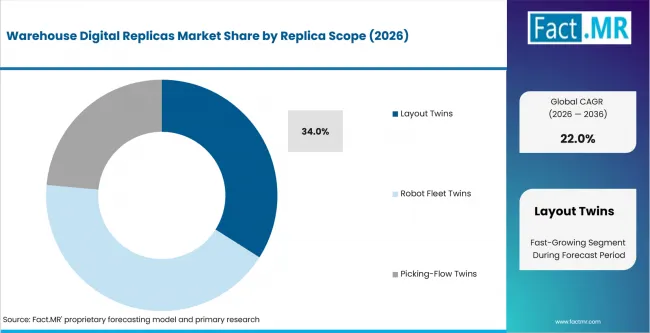
Warehouse Digital Replicas Market Analysis By Replica Scope | Source: Fact.MR
Layout Twins lead because most warehouse replica projects begin with storage zones, travel paths and workstation placement. Buyers use them to check aisle changes, pick-face movement and congestion before a facility team issues new instructions. Operators that need orchestration beyond static layout models often compare warehouse digital twin orchestration software with replica tools that connect order flow and robot traffic.
Which application leads?
Automation Simulation accounts for 38.0% share in 2026.
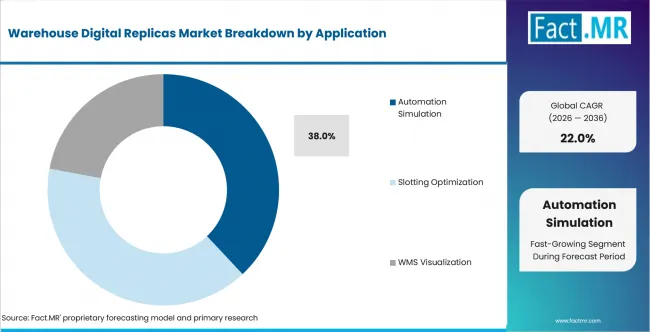
Warehouse Digital Replicas Market Analysis By Application | Source: Fact.MR
Automation Simulation leads because robot and conveyor projects carry schedule risk once site work begins. A replica lets planners compare control rules and material paths before hardware acceptance testing starts. This makes warehouse simulation a close planning category for buyers that want offline testing before a floor change.
Which facility type leads?
E-commerce Fulfillment holds 41.0% share in 2026.
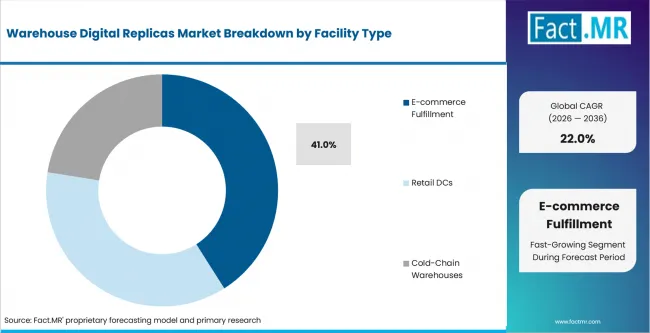
Warehouse Digital Replicas Market Analysis By Facility Type | Source: Fact.MR
E-commerce Fulfillment leads because order mix and cutoff times change quickly. Replicas help managers test labor waves, robot density and dock release windows without disrupting live orders.
Which integration dominates?
Warehouse Management Systems lead with 36.0% share in 2026.
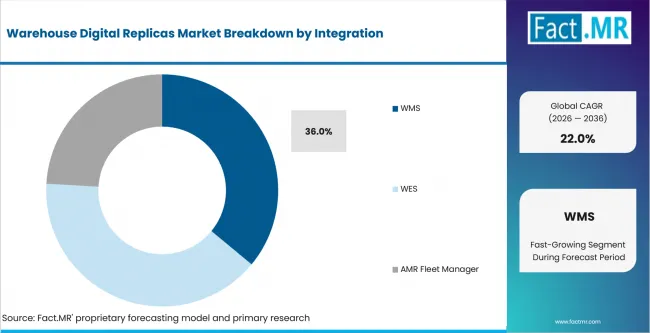
Warehouse Digital Replicas Market Analysis By Integration | Source: Fact.MR
Warehouse Management Systems lead because replicas need order, inventory and task logic from the core operating system. Buyers prefer tools that read current WMS data and return clear workflow recommendations.
Which buyer type dominates?
3PLs hold 32.0% share in 2026.
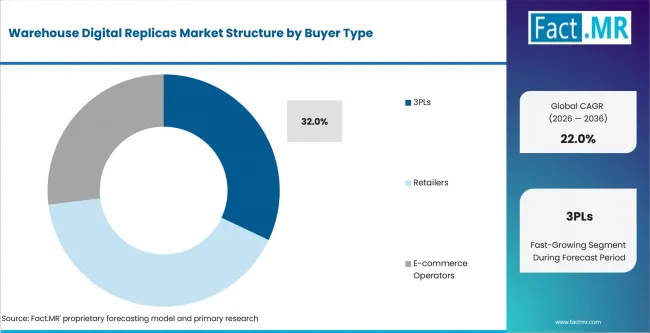
Warehouse Digital Replicas Market Analysis By Buyer Type | Source: Fact.MR
3PLs lead because each new client can change inventory velocity, picking methods and storage rules. A replica gives contract logistics teams a lower-risk way to price capacity and test service promises.
What is accelerating warehouse digital replicas adoption, and what is holding it back?
E-commerce flow volatility and robot fleet planning needs drive it, while weak legacy data quality and unclear ownership restrain it.
Drivers Impact Analysis
| DRIVER | (~) % IMPACT ON CAGR | GEOGRAPHIC RELEVANCE | IMPACT TIMELINE |
|---|---|---|---|
| E-commerce flow volatility | +4.9% | United States, China, India | Short term |
| Robot fleet planning needs | +4.3% | South Korea, Japan, Germany | Medium term |
| Retrofit risk in live warehouses | +3.8% | United States, United Kingdom, Germany | Short term |
| WMS and WES data availability | +3.4% | Global | Medium term |
| 3PL customer onboarding pressure | +3.1% | India, United States, China | Medium term |
Source: Fact.MR analysis. Updated Jul 2, 2026
- E-commerce flow volatility
- Online order profiles change by campaign, category and cutoff time. The replica becomes useful when operations teams need to test a change before the next peak day. China’s National Bureau of Statistics reported online retail sales of physical goods at RMB 13,092.3 billion in the latest annual release.
- Robot fleet planning needs
- Robot routes can fail when a warehouse adds more traffic without changing flow rules. The International Federation of Robotics reported 102,900 transportation and logistics service robots sold in the latest reported year. This supports demand for replicas that test robot congestion and task allocation before deployment.
- Retrofit risk in live warehouses
- Brownfield warehouses cannot stop orders while integrators rebuild flows. Replicas reduce this risk by testing the new state while the site keeps operating. Automated material handling equipment supports retrofit projects because software testing often needs to align with physical flow changes.
Opportunity Impact Analysis
| OPPORTUNITY | (~) % IMPACT ON CAGR | GEOGRAPHIC RELEVANCE | IMPACT TIMELINE |
|---|---|---|---|
| Replica packages for quick commerce | +4.2% | India, China, South Korea | Short term |
| Robot fleet digital validation | +3.9% | United States, Japan, Germany | Medium term |
| Cold-chain flow simulation | +3.2% | United States, Japan, United Kingdom | Medium term |
| Dock-door sequencing replicas | +2.8% | Global | Short term |
| Managed replica updates | +2.6% | Global | Long term |
Source: Fact.MR analysis. Updated Jul 2, 2026
- Replica packages for quick commerce
- Quick-commerce networks change stock positions and pick paths more often than traditional retail DCs. India Brand Equity Foundation reported that India’s e-commerce industry reached USD 125 billion in the latest available year. This creates room for replica packages that test micro-fulfillment layouts and dark-store replenishment rules.
- Robot fleet digital validation
- Robot fleet validation is moving earlier in the sales cycle. NVIDIA announced Mega as an Omniverse Blueprint for testing physical artificial intelligence and robot fleets inside a digital twin.
- Managed replica updates
- Warehouse replicas lose value when data connectors are not maintained. Managed update services can refresh layout files, rule sets and automation logic after each facility change. Those services become more useful as autonomous mobile robots are added to facilities with mixed manual and automated workflows.
Restraints Impact Analysis
| RESTRAINT | (~) % IMPACT ON CAGR | GEOGRAPHIC RELEVANCE | IMPACT TIMELINE |
|---|---|---|---|
| Data quality inside legacy warehouses | -3.8% | Global | Short term |
| Unclear ownership after go-live | -3.2% | United States, Europe, Japan | Medium term |
| Connector cost across systems | -2.9% | Global | Short term |
| Low trust in simulation outputs | -2.4% | Emerging markets | Medium term |
| Cybersecurity review delays | -2.0% | United States, Europe | Long term |
Source: Fact.MR analysis. Updated Jul 2, 2026
- Data quality inside legacy warehouses
- Older sites often have incomplete location master data and inconsistent process timing. The replica can produce weak results when the model starts from stale inventory and equipment records. This limitation is visible in facilities that still depend on automated guided vehicle routes without live traffic feedback.
- Unclear ownership after go-live
- Replica ownership can sit between IT, operations and the automation integrator. That split slows updates after a layout change and reduces trust in the model.
- Connector cost across systems
- Warehouse replicas need connectors to WMS and WES. They also need links to fleet managers and sensors. The project can stall when integration cost exceeds the planning value that a buyer can prove early.
Which countries are scaling warehouse digital replicas fastest?
India 24.4%; China 23.2%; South Korea 22.7%; United States 21.9%; Germany 20.8%; Japan 20.3%; United Kingdom 19.8%.
Based on regional analysis, the warehouse digital replicas market is segmented into North America; Europe; East Asia; South Asia and Pacific; Latin America; and Middle East and Africa.
| Country | CAGR |
|---|---|
| India | 24.4% |
| China | 23.2% |
| South Korea | 22.7% |
| United States | 21.9% |
| Germany | 20.8% |
| Japan | 20.3% |
| United Kingdom | 19.8% |
Source: Fact.MR analysis. Updated Jul 2, 2026
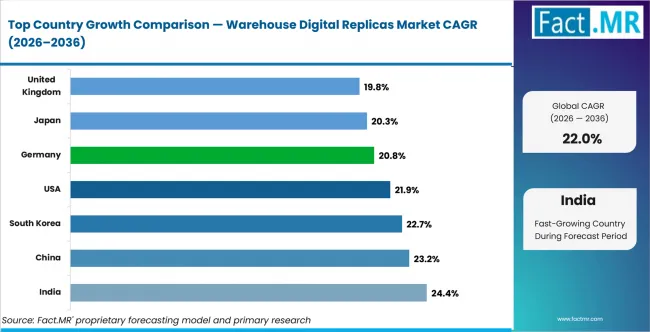
Warehouse Digital Replicas Market Cagr Analysis By Country | Source: Fact.MR
What is powering India’s lead?
24.4% CAGR, supported by quick-commerce density and fast fulfillment investment.
Quick-commerce operators in India are adding dense fulfillment nodes that need slotting and replenishment tests. India is projected to record 24.4% CAGR through 2036, supported by quick-commerce fulfillment and dense urban delivery nodes. Suppliers can win here by packaging low-cost replica setup with WMS and picker-flow diagnostics.
How is China scaling replica demand?
23.2% CAGR, driven by online retail scale and automation depth.
China’s warehouse operators manage high order volumes across large regional fulfillment networks. China is expected to expand at 23.2% CAGR through 2036 as online retail scale raises slotting and robot-path pressure. Demand favors providers that can localize integration with domestic WMS and robotics platforms.
Why is South Korea an important market?
22.7% CAGR, supported by online shopping intensity and robotics readiness.
South Korean buyers expect fast online fulfillment and tighter inventory control. The Ministry of Data and Statistics reported online shopping transactions of KRW 22.5974 trillion for February 2026. South Korea is forecast to grow at 22.7% CAGR through 2036 because high online shopping intensity supports replica-led fulfillment planning.
What supports the United States outlook?
21.9% CAGR, backed by e-commerce scale and 3PL automation programs.
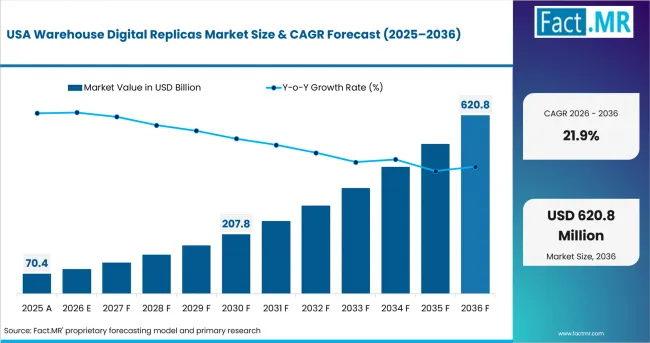
Warehouse Digital Replicas Market Country Value Analysis | Source: Fact.MR
United States warehouses face seasonal order swings and high labor planning pressure. The United States is expected to advance at 21.9% CAGR through 2036 as e-commerce and 3PL networks require faster simulation before rollout. Buyers are likely to favor providers with strong WMS connectors and site-level implementation support.
What underpins Germany’s growth?
20.8% CAGR, supported by automated intralogistics and virtual commissioning discipline.
German warehouses place weight on engineered validation before automation changes reach the floor. Germany is projected to rise at 20.8% CAGR through 2036 as automated intralogistics sites need better virtual commissioning discipline. The European e-commerce report recorded European turnover of EUR 842 billion in the latest published year.
That automation culture also supports adjacent spending in industrial automation control systems where warehouse software must align with equipment control layers.
How does Japan perform?
20.3% CAGR, driven by labor pressure and careful warehouse validation.
Japan has a long automation base and a careful approach to operational change. Japan is forecast at 20.3% CAGR through 2036 because labor constraints push warehouse teams toward safer workflow testing. Replica providers can gain access through integrator partnerships and proof of site reliability.
What shapes the United Kingdom outlook?
19.8% CAGR, supported by online retail pressure and cost control needs.
United Kingdom fulfillment networks must balance high online share with rising operating cost. The Office for National Statistics tracks internet sales as a share of total retail sales in its retail series. The United Kingdom is expected to post 19.8% CAGR through 2036 as online retail networks use replicas to manage cost and service-level pressure.
Who leads the warehouse digital replicas landscape?
NVIDIA and Siemens lead through simulation and automation integration depth, while Dassault Systèmes and Dematic remain relevant through virtual twin and automation capability.
Warehouse digital replicas are used by 3PLs, retailers and e-commerce operators that need working copies of facility flow before live changes. NVIDIA supports robot fleet and facility simulation through Omniverse, and Siemens brings automation software depth for engineered warehouse planning. Dassault Systèmes adds virtual twin experience, while Dematic connects replica logic to warehouse automation programs through KION Group.
Honeywell Intelligrated and Workflow Solutions supports warehouse automation projects, while Competition through 2036 is expected to depend on connector quality and operating-site knowledge. Providers with clean WMS links and robot fleet visibility are better placed because buyers need working replicas, not static models.
Which companies are the key players?
NVIDIA, Siemens, Dassault Systèmes, Dematic, Honeywell Intelligrated
- NVIDIA
- Siemens
- Dassault Systèmes
- Dematic
- Honeywell Intelligrated
Bibliography
- U.S. Census Bureau. (2026, May 18). Quarterly retail e-commerce sales: 1st quarter 2026. U.S. Department of Commerce.
- MHI. (2026, April 15). New MHI and Deloitte report finds AI biggest disruptor of supply chains over the next decade.
- National Bureau of Statistics of China. (2026, January 20). Total retail sales of consumer goods in December 2025.
- International Federation of Robotics. (2025, October 7). World Robotics 2025 report: Service robots.
- India Brand Equity Foundation. (2026, February). Indian e-commerce industry analysis.
- NVIDIA. (2025, January 6). NVIDIA unveils “Mega” Omniverse Blueprint for building industrial robot fleet digital twins.
- Ministry of Data and Statistics, Republic of Korea. (2026, April 1). Online shopping in February 2026.
- EuroCommerce. (2025, September 24). European E-commerce Report 2025.
- Office for National Statistics. (2026, June 19). Retail sales, Great Britain: May 2026.
- KION Group AG. (2025, March 19). KION presents AI Control Tower at GTC in San José, California.
- Honeywell International Inc. (2026, April 23). Honeywell reports first quarter results and reaffirms 2026 outlook; announces sale of Warehouse and Workflow Solutions.
This Report Addresses
- Strategic intelligence on warehouse digital replicas across replica scope, application and buyer type.
- Segment analysis covers Layout Twins and Automation Simulation. It also covers E-commerce Fulfillment, WMS and 3PLs.
- Regional outlook covers India and China. It also covers South Korea, United States and Germany. Japan and United Kingdom complete the country view.
- Competitive analysis covers NVIDIA and Siemens. It also covers Dassault Systèmes, Dematic and Honeywell Intelligrated.
- Service assessment covers layout modeling and robot fleet testing. It also covers WMS visualization and managed replica updates.
- Forecast logic is supported by official e-commerce data and robotics releases. It is also supported by company disclosures and provider validation.
What does the warehouse digital replicas market cover?
Software and services that create virtual replicas of warehouse operations.
The warehouse digital replicas market covers platforms and services that build virtual operating copies of warehouse layouts and material flows. It also covers robot routes and inventory movement. The scope includes simulation models and real-time visualization layers. Planning replicas connect to warehouse execution data. The market differs from general dashboard software because the replica can test a future operating state before the physical floor is changed.
What is included in the scope?
Layout twins, robot fleet twins and flow replicas for warehouse decision support.
The scope includes layout twins and robot fleet twins. It also includes picking-flow twins and dock-door twins. Inventory-flow twins are included when they mirror storage movement. The application base includes automation simulation and slotting optimization. It also includes warehouse management system visualization and robotics planning. Integration covers warehouse execution systems and autonomous mobile robot fleet managers. Sensor feeds can include Internet of Things sensors and computer vision feeds.
What is excluded from the scope?
Standalone WMS software and physical automation hardware without a replica layer.
The scope excludes general warehouse management software that does not create a virtual replica. It excludes autonomous mobile robots and conveyors sold without replica software. It also excludes racks and scanners sold as physical assets. Enterprise control towers are excluded when they only show shipment status without facility-level layout or flow simulation.
How was the analysis built?
100+ sources, 40+ company portfolios, 25+ countries, 20+ interviews.
- Primary Research: Primary research includes interviews with warehouse automation integrators, 3PL operations teams and retail distribution leaders. It includes input from robotics planners and warehouse software implementation teams.
- Desk Research: Desk research reviews official e-commerce data and robotics association releases. It also reviews warehouse automation company pages and digital twin product disclosures. Fact.MR adjacent categories support market boundary checks.
- Market-Sizing and Forecasting: Forecasting uses automation spending and installed fulfillment sites. It also uses replica software pricing and integration intensity. The Material Handling Industry reported that artificial intelligence is seen as the biggest supply chain disruptor by 71% of respondents.
- Data Validation and Update Cycle: Forecasts are validated through provider checks, adjacent market benchmarking and buyer interview feedback. Updates track new robot fleet simulation releases, WMS architecture shifts and warehouse execution software launches.
Segmentation
What is the report’s scope and coverage?
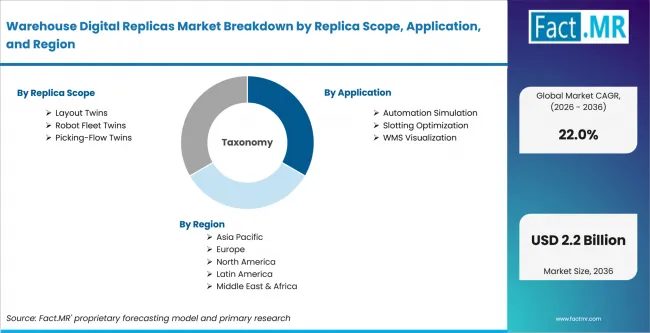
Warehouse Digital Replicas Market Breakdown By Replica Scope, Application, And Region | Source: Fact.MR
| Attribute | Details |
|---|---|
| Quantitative Units | USD Billion in 2026 to USD Billion by 2036 at CAGR |
| Market Definition | Software and services that create virtual operating replicas of warehouse layouts, flows, automation assets and inventory movement |
| Replica Scope | Layout Twins, Robot Fleet Twins, Picking-Flow Twins, Dock-Door Twins, Inventory-Flow Twins |
| Application | Automation Simulation, Slotting Optimization, WMS Visualization, Robotics Planning |
| Facility Type | E-commerce Fulfillment, Retail DCs, Cold-Chain Warehouses, 3PL Facilities |
| Integration | WMS, WES, AMR Fleet Manager, IoT Sensors, Computer Vision |
| Buyer Type | 3PLs, Retailers, E-commerce Operators, Warehouse Automation Integrators |
| Regions Covered | North America, Europe, East Asia, South Asia and Pacific, Latin America, Middle East and Africa |
| Countries Covered | India, China, South Korea, United States, Germany, Japan, United Kingdom |
| Key Companies Profiled | NVIDIA, Siemens, Dassault Systèmes, Dematic, Honeywell Intelligrated |
| Forecast Period | 2026 to 2036 |
| Approach | Hybrid top-down and bottom-up approach using e-commerce scale, automation intensity, replica pricing, facility base and provider validation |
Source: Fact.MR analysis. Updated Jul 2, 2026
How is the market segmented?
-
By Replica Scope:
- Layout Twins
- Robot Fleet Twins
- Picking-Flow Twins
- Dock-Door Twins
- Inventory-Flow Twins
-
By Application:
- Automation Simulation
- Slotting Optimization
- WMS Visualization
- Robotics Planning
-
By Facility Type:
- E-commerce Fulfillment
- Retail DCs
- Cold-Chain Warehouses
- 3PL Facilities
-
By Integration:
- WMS
- WES
- AMR Fleet Manager
- IoT Sensors
- Computer Vision
-
By Buyer Type:
- 3PLs
- Retailers
- E-commerce Operators
- Warehouse Automation Integrators
-
By Region:
- North America
- United States
- Canada
- Mexico
- Latin America
- Brazil
- Argentina
- Rest of Latin America
- Europe
- Germany
- United Kingdom
- France
- Italy
- Spain
- Rest of Europe
- East Asia
- China
- Japan
- South Korea
- South Asia and Pacific
- India
- ASEAN
- Australia and New Zealand
- Rest of South Asia and Pacific
- Middle East and Africa
- GCC Countries
- South Africa
- UAE
- Rest of Middle East and Africa
- North America
Frequently Asked Questions
Which replica scope leads the Warehouse Digital Replicas Market?
Which application leads the Warehouse Digital Replicas Market?
Which country expands fastest in the Warehouse Digital Replicas Market?
How does China perform in the Warehouse Digital Replicas Market?
How does the United States perform in the Warehouse Digital Replicas Market?
What is the primary driver in the Warehouse Digital Replicas Market?
What is the main restraint in the Warehouse Digital Replicas Market?
Why are 3PLs important in this market?
Who worked on this report


Preview the report firsthand - request a free sample
Free SampleGet the brochure for pricing and purchase details
Download PDF