- Market Value (2025): USD 370 Mn
- Estimated Value (2026): USD 420 Mn
- Forecast Value (2036): USD 1,477 Mn
- CAGR (2026-2036): 13.4%
What is the Waterless Body-Wash Products Market forecast to be worth by 2036?
USD 420 million in 2026 to USD 1,477 million by 2036, at 13.4% CAGR.
- The waterless body-wash products market reached USD 370.4 million in 2025.
- Demand is projected to increase from USD 420 million in 2026 to USD 1,477 million by 2036.
- The market is expected to expand at 13.4% CAGR from 2026 to 2036.
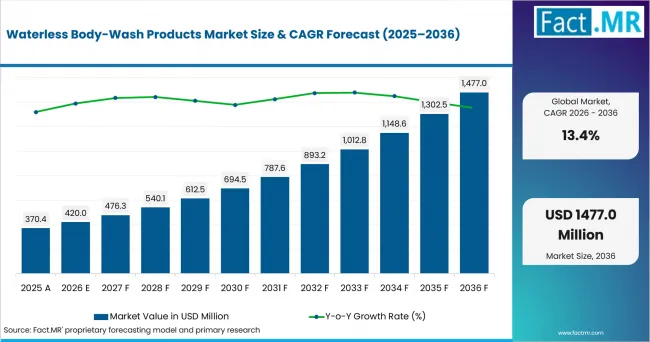
Waterless Body Wash Products Market Value Analysis | Source: Fact.MR
What are the defining numbers behind Waterless Body-Wash Products Market growth?
- Market Defination
- USD 1,057 million in absolute opportunity is expected between 2026 and 2036.
- The Solid/bar washes category accounts for 41.0% of Product Format in the waterless body-wash products market in 2026, equivalent to USD 172.2 million.
- The Women category accounts for 48.0% of End User in the waterless body-wash products market in 2026.
- The Online/DTC category accounts for 44.0% of Distribution in the waterless body-wash products market in 2026.
- Demand Drivers in the Market
- Waterless body-wash formats such as solid bars, powder-to-foam, concentrate tablets and dissolvable sheets eliminate water from the product, cutting shipping weight, packaging volume and plastic waste compared with bottled washes.
- Travel convenience is driving adoption of solid and powder formats that comply with carry-on liquid restrictions and are easier to transport than bulky bottles.
- Corporate plastic-reduction commitments and broader packaging-waste rules are pushing personal-care brands toward refillable and waterless formats.
- Sustainable and natural-positioning retailers are giving waterless body-wash brands dedicated fixture space, increasing visibility and trial among eco-conscious shoppers.
- Solid format innovation, including better lather, ergonomic shapes and moisturizing formulations, is removing the perceived performance gap versus conventional body wash.
- Key Segments Analyzed
- By Product Format: The Solid/bar washes category is projected to account for 41.0% of the waterless body-wash products market in 2026. Solid and bar formats are familiar and require little change in the everyday shower routine.
- By End User: The Women category is projected to account for 48.0% of the waterless body-wash products market in 2026. Women account for a substantial share of personal-care purchasing and early trial of new cleansing formats.
- By Distribution: The Online/DTC category is projected to account for 44.0% of the waterless body-wash products market in 2026. Online and direct-to-consumer channels support product education, trial offers and replenishment.
- Analyst Opinion at Fact.MR
- Fact.MR opines, "Waterless cleansing moves part of the preparation step from the factory to the shower. The format can reduce package size and transport weight, but the consumer still expects quick lather, clean rinsing and a product that stays stable in a humid bathroom. Bars are familiar, while powders, tablets and sheets need clearer use instructions to build repeat behavior." - Shambhu Nath Jha, Principal Consultant at Fact.MR.
- Strategic Implications
- Solid and bar formats with moisturizing and fragrance parity to liquid body wash are the key to converting mainstream users and sustaining repeat purchase.
- Powder-to-foam and concentrate tablet formats are extending waterless body-wash beyond the bar, attracting consumers who prefer liquid-like application.
- Subscription and refill models are creating recurring revenue streams for waterless brands while reinforcing the waste-reduction story at each delivery.
- Travel, gym and outdoor-activity positioning is expanding the waterless audience beyond committed sustainability shoppers into convenience buyers.
- Retail partnerships with natural and specialty chains are providing the trial infrastructure that digital-only waterless brands need to scale mass-market.
How does the Waterless Body-Wash Products Marketbreak down by segment?
Why does the Online/DTC category lead Distribution?
The Online/DTC category is expected to represent 44.0% of Distribution within the waterless body-wash products market in 2026.
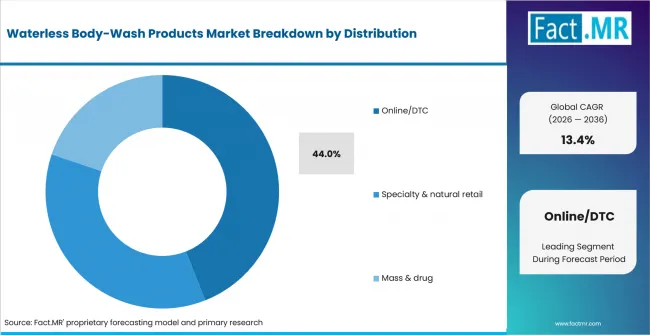
Waterless Body Wash Products Market Analysis By Distribution | Source: Fact.MR
Digital channels give brands room to demonstrate use, explain water and packaging reduction and offer low-risk trial sizes. Direct relationships also support replenishment reminders and subscription models.
Specialty retail adds physical discovery and credibility once the format is established. Mass and drug channels provide scale, but they require simpler shelf communication and dependable supply at lower price points.
Why does the Solid/bar washes category lead Product Format?
In 2026, the Solid/bar washes category is projected to account for 41.0% of Product Format within the waterless body-wash products market.
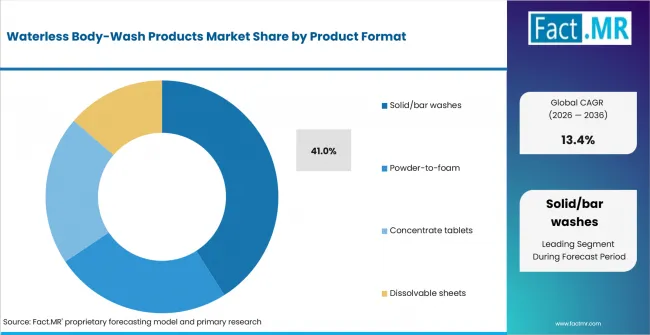
Waterless Body Wash Products Market Analysis By Product Format | Source: Fact.MR
Solid and bar washes remove most or all formulation water before sale, reducing package volume and shipped weight. Their familiar use pattern lowers the learning burden compared with powders, tablets or dissolvable sheets.
The decisive product tests occur in the shower. Lather, glide, rinse behavior and resistance to softening in a humid bathroom determine whether the environmental proposition converts into repeat use.
Why does the Women category lead End User?
Within End User, the Women category is projected to hold a 48.0% share in the waterless body-wash products market in 2026.
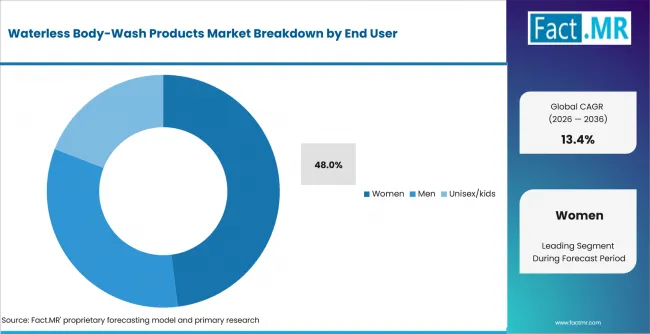
Waterless Body Wash Products Market Analysis By End User | Source: Fact.MR
Women account for a substantial share of personal-care purchasing and are often the first audience addressed by sustainable cleansing launches. Brands therefore place a large portion of early assortment and communication around this customer group.
Men's and unisex or children's ranges expand the category through sport, travel and family use. Product design has to reflect different fragrance, skin-feel and packaging expectations rather than relying on one universal proposition.
What is accelerating Waterless Body-Wash Products Market adoption, and what is holding it back?
Adoption is being driven by water and packaging reduction and the portability of concentrated formats, while perceived performance gaps, premium pricing and unfamiliar routines can slow repeat use.
Drivers Impact Analysis
| Driver | (~) % Impact on CAGR | Geographic Relevance | Impact Timeline |
|---|---|---|---|
| Water and packaging reduction in personal care | +1.8% | North America, Europe, Oceania | Near term |
| Travel convenience and carry-on liquid compliance | +1.3% | Global | Near term |
| Plastic-reduction regulation and brand sustainability commitments | +1.1% | Europe, North America | Mid term |
| Natural-retail fixture expansion for solid formats | +0.8% | North America, Europe, Oceania | Mid term |
Opportunity Impact Analysis
| Opportunity | (~) % Impact on CAGR | Geographic Relevance | Impact Timeline |
|---|---|---|---|
| Powder-to-foam and concentrate tablet formats for liquid-like experience | +1.2% | Global | Mid term |
| Subscription and refill models creating recurring revenue | +0.9% | North America, Europe | Long term |
| Travel, gym and outdoor-activity convenience positioning | +0.7% | Global | Long term |
Restraints Impact Analysis
| Restraint | (~) % Impact on CAGR | Geographic Relevance | Impact Timeline |
|---|---|---|---|
| Performance and lather perception gap versus liquid body wash | -0.6% | Global | Near term |
| Premium pricing of sustainable formats versus conventional wash | -0.5% | Global | Mid term |
| Habit inertia and format unfamiliarity among mainstream users | -0.4% | Global | Long term |
Which countries are scaling the Waterless Body-Wash Products Market through 2036?
- United States: The United States has an active waterless body-wash market, with direct-to-consumer innovation, a natural-retail channel and consumer interest in sustainable formats.
- United Kingdom: The online beauty market and plastic-reduction commitments give powder-to-foam and tablet body washes a credible test environment. Brands still need clear lather instructions and moisture-resistant packaging to convert trial into repeat purchase.
- Germany: Germany's packaging regulation and eco-conscious consumer base support solid and refillable formats in the European market.
- France: France's natural-beauty sector and pharmacy-driven personal-care retail are expanding waterless body-wash into mainstream distribution.
- Italy: Italy's growing clean-beauty segment and specialty retail network are supporting adoption of solid and waterless formats.
- Australia: Natural personal-care retailers and established solid-format brands provide a route for waterless body wash. Warm-climate travel and outdoor use cases also support portable bars, powders and tablets.
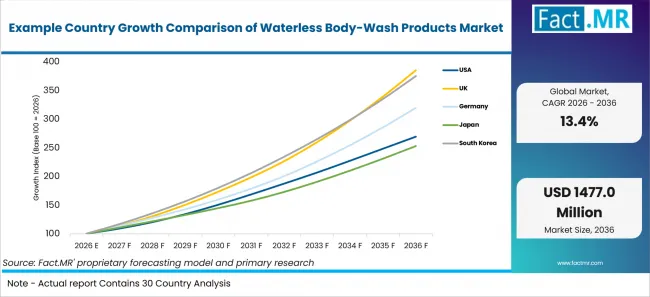
Example Country Growth Comparison Of Waterless Body Wash Products Market | Source: Fact.MR
| Country | 2026 Share | CAGR (2026-2036) |
|---|---|---|
| United States | 31.0% | 14.2% |
| United Kingdom | 15.0% | 13.8% |
| Germany | 14.0% | 13.7% |
| France | 13.0% | 14.0% |
| Italy | 14.0% | 13.9% |
| Australia | 13.0% | 15.7% |
What is driving growth in the United States through 2036?
The market in the United States is projected to expand at a 14.2% CAGR from 2026 to 2036.
The United States combines personal-care spending, a direct-to-consumer ecosystem and retail acceptance of solid and powder formats.
What is driving growth in the United Kingdom through 2036?
From 2026 to 2036, demand in the United Kingdom is forecast to grow at a 13.8% CAGR.
The United Kingdom's plastic-reduction awareness and online participation make it a test market for powder-to-foam and tablet body-wash formats.
What is driving Germany's growth through 2036?
Germany is expected to record a 13.7% CAGR between 2026 and 2036.
Germany's packaging legislation and sustainability-conscious shoppers favor solid and refillable formats, sustaining premium adoption.
What is driving France's growth through 2036?
Demand in France is forecast to rise at a 14.0% CAGR from 2026 to 2036.
France's natural beauty heritage and pharmacy retail structure are moving waterless body-wash from niche to mainstream distribution.
What is driving Italy's growth through 2036?
A 13.9% CAGR is projected for Italy from 2026 to 2036.
Italy's expanding clean-beauty segment and specialty retail network support steady adoption of solid formats across urban markets.
What is driving Australia's growth through 2036?
Between 2026 and 2036, Australia is projected to post a 15.7% CAGR.
Australia combines eco-conscious consumer demand, established waterless brands and a developed natural-retail base, supporting adoption of these formats.
Who leads the Waterless Body-Wash Products Market?
The competitive field includes multinational personal-care companies and specialist waterless brands. Unilever, Procter & Gamble and L'Oréal can apply formulation, brand and retail capabilities to concentrated cleansing formats.
Ethique, Superzero and by Humankind compete through solid or low-water propositions with a stronger direct-to-consumer and sustainability-led identity. Their challenge is to convert an environmental proposition into a dependable daily-use experience.
Differentiation rests on cleansing performance, skin feel, fragrance, humidity stability and packaging that protects the concentrate through use. Claims and labeling also matter because therapeutic language can change the regulatory treatment of a personal-care product.
Which companies are the key providers?
Key companies profiled include Unilever; Procter & Gamble; L'Oréal; Ethique; Superzero; and by Humankind.
- Unilever
- Procter & Gamble
- L'Oréal
- Ethique
- Superzero
- by Humankind
Bibliography
- U.S. Food and Drug Administration. Cosmetics labeling regulations.
- U.S. Food and Drug Administration. Summary of cosmetics labeling requirements.
- U.S. Food and Drug Administration. FDA Authority Over Cosmetics: How Cosmetics Are Not FDA-Approved, but Are FDA-Regulated.
- European Union. Regulation (EC) No 1223/2009 on cosmetic products.
- European Commission. Regulation (EU) 2025/40 on packaging and packaging waste.
- European Commission. EU Ecolabel criteria and information for personal-care products.
- Unilever. Personal-care packaging and concentrated-format disclosures.
- Procter & Gamble. Personal-care sustainability and concentrated-product documentation.
- L'Oréal. Solid-format and packaging-reduction product documentation.
- Ethique. Solid body-wash product and packaging documentation.
- Superzero. Solid body-wash product documentation.
- by Humankind. Low-waste personal-care product documentation.
This Report Answers
- The report assesses waterless body wash by product format, end user and distribution channel.
- It compares familiar solid bars with powder, tablet and sheet-based cleansing systems.
- Country analysis considers direct-to-consumer adoption, natural retail and packaging-reduction priorities.
- The competitive review contrasts multinational personal-care companies with specialist waterless brands.
- The scope excludes conventional liquid body wash and dry-wipe products that do not perform a rinse-off cleansing function.
What does the Waterless Body-Wash Products Market cover?
Waterless body-wash formats including solid and bar washes, powder-to-foam systems, concentrate tablets and dissolvable sheets across women's, men's and unisex-kids segments.
Waterless body-wash products distributed through online and direct-to-consumer channels, specialty and natural retail, and mass and drug retail in the tracked countries.
What is included in the scope?
Solid and bar body washes, waterless powder-to-foam and tablet formats, dissolvable cleansing sheets, and associated refill and subscription packaging models.
Branded and private-label waterless body-wash products across the tracked channels, including travel, natural and performance-positioned ranges.
What is excluded from the scope?
Conventional liquid body washes and shower gels, bar soaps positioned primarily for hand or facial cleansing, and waterless shampoo and conditioner formats.
Raw cosmetic ingredient supply, solid-format manufacturing machinery, and private-label production services for waterless personal-care brands.
How Was the Analysis Built?
The category is defined by cleansing products sold without the water load of a conventional ready-to-use liquid body wash.
- Primary Research: Interviews focus on personal-care formulators, category managers and online retailers evaluating lather, stability and consumer use behavior.
- Secondary Research: Cosmetic labeling rules, packaging policy, environmental criteria and official product documentation support the market review.
- Market Sizing and Forecasting: Demand is modeled from format mix, channel sales, end-user positioning and realized retail value in the listed countries.
- Validation and Updates: Conventional bottled wash, cleansing wipes and unrelated shampoo bars are removed, and company products are checked for a body-cleansing use case.
What is the report's scope and coverage?
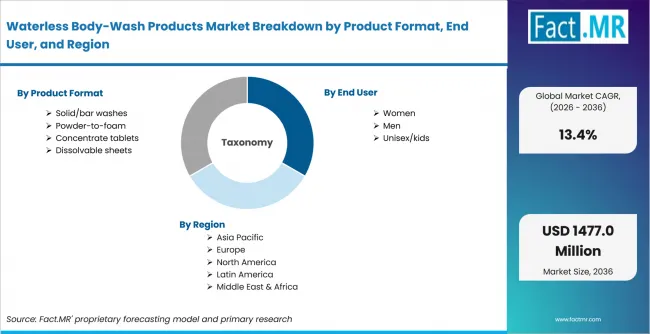
Waterless Body Wash Products Market Breakdown By Product Format, End User, And Region | Source: Fact.MR
| Attribute | Details |
|---|---|
| Quantitative Units | USD Million |
| Market Definition | Solid, powder, tablet and dissolvable-sheet cleansing formats sold without the water content of conventional bottled body wash. |
| Segments Covered | Product Format; End User; Distribution |
| Regions Covered | North America; Latin America; Europe; East Asia; South Asia and Oceania; Middle East and Africa |
| Countries Covered | United States; United Kingdom; Germany; France; Italy; Australia |
| Key Companies Profiled | Unilever; Procter & Gamble; L'Oréal; Ethique; Superzero; by Humankind |
| Forecast Period | 2026 to 2036 |
| Base Year | 2025 |
| Market Value, 2026 | USD 420 million |
| Market Value, 2036 | USD 1,477 million |
| CAGR, 2026-2036 | 13.4% |
| Absolute Opportunity | USD 1,057 million |
| Approach | Demand is modeled from format mix, channel sales, end-user positioning and realized retail value in the listed countries. |
How is the market segmented?
-
By Product Format:
- Solid/bar washes
- Powder-to-foam
- Concentrate tablets
- Dissolvable sheets
-
By End User:
- Women
- Men
- Unisex/kids
-
By Distribution:
- Online/DTC
- Specialty & natural retail
- Mass & drug
-
By Region:
- North America
- Latin America
- Europe
- East Asia
- South Asia and Oceania
- Middle East and Africa