- Market Value (2025): USD 236.9 Mn
- Estimated Value (2026): USD 248 Mn
- Forecast Value (2036): USD 394 Mn
- CAGR (2026-2036): 4.7%
What is the Wax Soluble Dyes Market forecast to be worth by 2036?
USD 248 million in 2026 to USD 394 million by 2036, at 4.7% CAGR.
- The market reached USD 236.9 million in 2025, reflecting colorant demand across candles, polishes, art materials, coatings, and decorative wax goods.
- Sales are forecast to move from USD 248 million in 2026 to USD 394 million by 2036 as wax processors broaden shade ranges and ask for more repeatable incorporation across different substrates.
- The market is forecast to record a 4.7% CAGR from 2026 to 2036, supported by decorative product turnover, growing use of premeasured color forms, and the need to match shade with wax, fragrance, wick, and processing temperature.
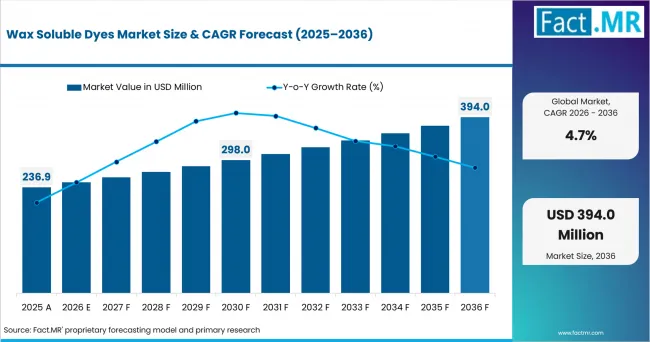
Wax Soluble Dyes Market Value Analysis | Source: Fact.MR
What are the defining numbers behind Wax Soluble Dyes Market growth?
USD 146 million absolute opportunity by 2036, led by Paraffin wax and Candles within their respective segments.
- Demand Drivers in the Market
- Candle makers need dyes that distribute through the wax rather than leaving suspended particles that can obstruct a wick.
- Polish and coating formulators value clear, strong color that develops at a low dose and remains uniform after cooling.
- Craft brands are expanding the number of shades they offer, which favors colorants that are easy to portion and reproduce in small batches.
- Industrial wax users increasingly expect suppliers to document solubility, heat response, light stability, and compatibility with the intended wax blend.
- Key Segments Analyzed
- By Wax Substrate: Paraffin Wax is expected to hold 42.0% share in 2026 supported by its broad use across candles and other formulated wax products.
- By Application: Candles are projected to account for 37.0% share in 2026 owing to the importance of color in product design and wax formulation.
- By Dye Form: Powder Soluble Dyes are anticipated to capture 31.0% share in 2026 due to concentrated color, flexible dosing, and lower transport costs.
- By Color Type: Bright Shades are estimated to represent 30.0% share in 2026 attributable to strong shelf appeal and frequent decorative range changes.
- By Buyer Type: Candle Manufacturers are forecast to account for 35.0% share in 2026 driven by repeated color use across fragrances, wax blends, formats, and seasonal collections.
- Analyst Opinion at Fact.MR
- Shambhu Nath Jha, Senior Analyst at Fact.MR, states, "The main test is not simply whether the dye dissolves in wax. It must also produce the right color in the customer’s full product mix. Companies that test the shade along with candle burning, cooling and storage performance are more likely to win difficult projects."
- Strategic Implications
- Colorant manufacturers should build application files around paraffin, microcrystalline, vegetable, beeswax, and synthetic wax systems rather than treating wax as one medium.
- Candle producers need to approve color together with wick and fragrance because each component can alter the final burn or appearance.
- Craft suppliers can reduce dosing errors by offering chips, pellets, or clearly standardized liquid concentrates for short production runs.
- Distributors should retain physical shade standards and batch records so repeat orders are matched against the finished wax, not powder color alone.
The United States is projected to expand at a 5.4% CAGR from 2026 to 2036, driven by active candle branding, craft channels, and specialized wax-product formulation. Poland at 5.5% on Europe's largest candle-production volumes, Germany at 5.2% through formulation discipline and documentation, and the United Kingdom at 5.1% across home-fragrance and craft channels. Japan is anticipated to advance at a 5.0% CAGR, supported by exacting decorative-product quality and consistent specialty shades.
How does the Wax Soluble Dyes Market break down by segment?
The leading shares are Paraffin wax at 42.0% by Wax Substrate and Candles at 37.0% by Application.
Why does Paraffin Wax lead the Wax Substrate segment?
Paraffin Wax holds 42.0% share in 2026.
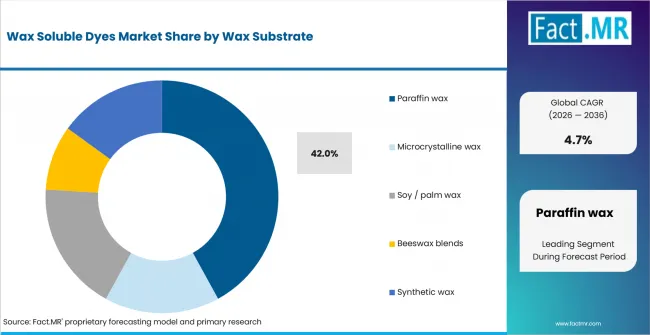
Wax Soluble Dyes Market Analysis By Wax Substrate | Source: Fact.MR
Paraffin Wax gives color developers a familiar base for shade matching across candles and other formulated wax products. Its clear appearance and steady melt behavior make dye strength, cooling stability, and finished color easier to assess. Many manufacturers already use paraffin across several product lines, so one approved dye system can often support multiple designs. This broad processing base keeps the substrate ahead of alternatives that need more adjustment during formulation.
What places Candles first within Application?
Candles account for 37.0% share in 2026.
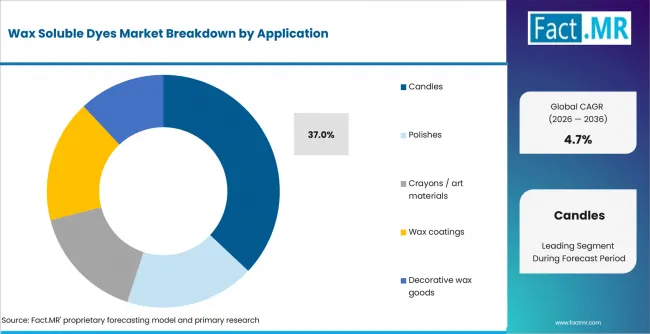
Wax Soluble Dyes Market Analysis By Application | Source: Fact.MR
Color plays a direct role in candle identity, fragrance presentation, and seasonal range planning. Each shade must remain even during heating, pouring, cooling, and storage while also working with the chosen wax and fragrance. Manufacturers refresh collections often, which creates repeated demand for new colors and shade corrections. High production volumes combined with frequent design changes give Candles a stronger need for wax-soluble dyes than other applications.
Why do Powder Soluble Dyes hold the largest Dye Form share?
Powder Soluble Dyes represent 31.0% share in 2026.
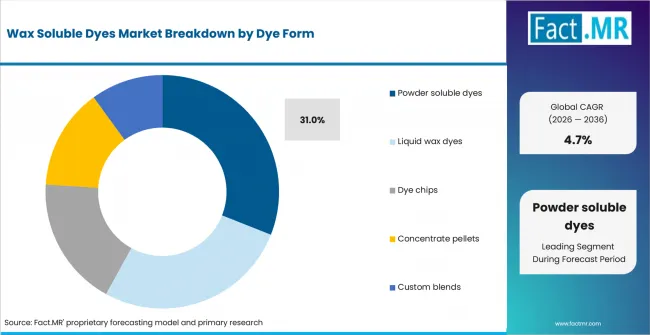
Wax Soluble Dyes Market Analysis By Dye Form | Source: Fact.MR
Powder Soluble Dyes provide strong color in a compact form and let experienced processors adjust dosage with precision. The format is economical to store and transport, especially for companies handling many shades or large production runs. Plants with controlled weighing and mixing systems can work without a fixed liquid carrier. This flexibility suits different wax blends, batch sizes, and color-strength targets, keeping powder formats in the leading position.
What supports Bright Shades within Color Type?
Bright Shades capture 30.0% share in 2026.
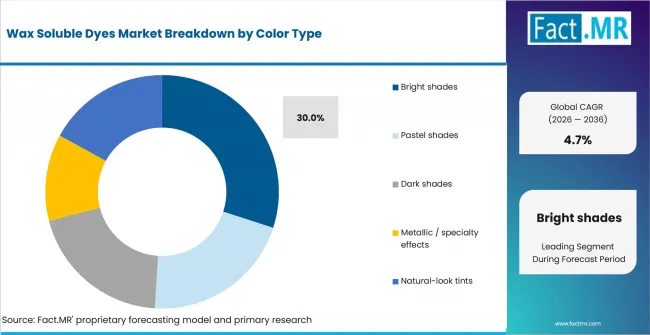
Wax Soluble Dyes Market Analysis By Color Type | Source: Fact.MR
Bright Shades create immediate visual impact and help decorative wax products stand out on crowded shelves. They are widely suited to festive ranges, themed collections, children’s products, and seasonal launches. Small changes in tone are also easier for customers to notice in stronger colors. Manufacturers can therefore refresh a product line through color alone without changing the wax format, fragrance system, or overall design, which keeps demand concentrated in this category.
Why are Candle Manufacturers the largest Buyer Type?
Candle Manufacturers hold 35.0% share in 2026.
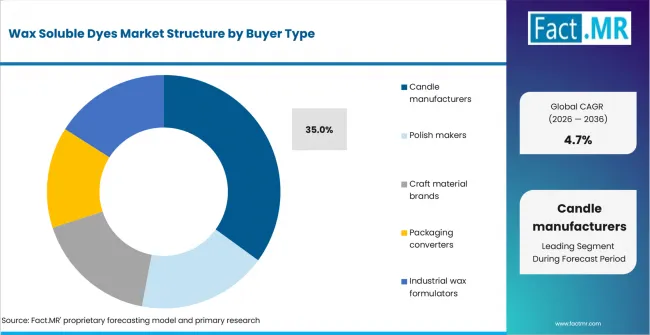
Wax Soluble Dyes Market Analysis By Buyer Type | Source: Fact.MR
Candle Manufacturers use color across a wide mix of fragrances, wax blends, shapes, sizes, and seasonal collections. Each product line needs shade control through heating, pouring, cooling, and storage. A dye that performs well in one wax-fragrance system may need adjustment in another, creating repeated testing and purchasing activity. Their broad product range and frequent assortment changes generate a larger and more continuous need for wax-soluble dyes than other buyer groups.
What is accelerating Wax Soluble Dyes Market adoption, and what is holding it back?
The strongest accelerator is the commercial value of differentiated, repeatable color across candle and decorative-wax ranges. Adoption is held back when a shade must be requalified for every change in wax, wick, fragrance, or process temperature.
Drivers Impact Analysis
| DRIVER | (~) % IMPACT ON CAGR | GEOGRAPHIC RELEVANCE | IMPACT TIMELINE |
|---|---|---|---|
| Decorative candle assortments | +0.7% | Global consumer markets | Short term (<= 2 years) |
| Premeasured color delivery | +0.6% | North America and Europe | Medium term (2-4 years) |
| Vegetable wax formulation | +0.5% | United States, Germany, and Japan | Long term (>= 4 years) |
| Polish and coating utility | +0.4% | Asia Pacific | Medium term (2-4 years) |
| Chemical documentation | +0.3% | European Union | Long term (>= 4 years) |
Source: Fact.MR analysis. Updated Jul 21, 2026
- Decorative candle assortments: Color helps candle brands distinguish fragrance families, seasons, and price tiers. Frequent assortment refreshes create recurring matching work for soluble-dye suppliers.
- Premeasured color delivery: Chips and pellets reduce handling and can improve lot-to-lot dosing discipline. Their value rises for multi-site producers and small-batch makers that lack a full color laboratory.
- Vegetable wax formulation: Soy and palm waxes create additional shade-development work because color can read differently against their natural appearance and crystallization profile. Suppliers with comparative wax libraries can shorten these trials.
Opportunity Impact Analysis
| OPPORTUNITY | (~) % IMPACT ON CAGR | GEOGRAPHIC RELEVANCE | IMPACT TIMELINE |
|---|---|---|---|
| Wax-specific shade libraries | +0.4% | Global | Medium term (2-4 years) |
| Low-error dosing forms | +0.3% | North America, Europe, and Japan | Short term (<= 2 years) |
| Burn-compatible candle colors | +0.3% | United States and Germany | Medium term (2-4 years) |
| Stable natural-look tints | +0.2% | Europe and Asia Pacific | Long term (>= 4 years) |
Source: Fact.MR analysis. Updated Jul 21, 2026
- Wax-specific shade libraries: A supplier can show how one color family develops in paraffin, soy / palm, microcrystalline, beeswax, and synthetic substrates. Such references make the first laboratory discussion more useful and reveal where a custom correction is necessary.
- Low-error dosing forms: Standardized chips, pellets, and liquids can reduce weighing variability in short runs. Clear dose guidance by wax mass gives craft and private-label customers a practical reason to trade up from loose powder.
- Burn-compatible candle colors: Candle programs need color that works alongside the chosen wick, fragrance, and wax. Suppliers that pair matching with controlled burn observations can compete on evidence instead of shade cards alone.
Restraints Impact Analysis
| RESTRAINT | (~) % IMPACT ON CAGR | GEOGRAPHIC RELEVANCE | IMPACT TIMELINE |
|---|---|---|---|
| Formulation-dependent shade | -0.3% | Global | Short term (<= 2 years) |
| Heat and light fade | -0.3% | Warm-climate retail channels | Medium term (2-4 years) |
| Wick-performance risk | -0.2% | Candle manufacturing markets | Long term (>= 4 years) |
| Small-batch inconsistency | -0.2% | Craft production clusters | Short term (<= 2 years) |
Source: Fact.MR analysis. Updated Jul 21, 2026
- Formulation-dependent shade: Wax type, fragrance, and process history can shift the apparent color. A previously approved dye may therefore need a new dose or blend when the base formula changes.
- Heat and light fade: Prolonged storage near heat or strong light can alter some candle shades. Complaints may emerge late, after inventory has already reached the shelf.
- Wick-performance risk: An unsuitable colorant or excessive dose can become part of a poor-burning formulation. Conservative manufacturers will restrict color loading until the complete candle passes their internal checks.
How is wax soluble dye demand spread across countries?
A global growth rate represents the weighted average of all markets included in the analysis. It therefore cannot exceed the growth rate of every individual market within the coverage set. The Wax Soluble Dyes Market is forecast to grow at a global CAGR of 4.7%. The five countries presented are illustrative examples, and each one records a rate above the global figure.
- The countries are distinguished less by their CAGRs, which remain within a narrow range of 0.5 percentage points, and more by the manufacturing and product conditions shaping demand.
- Poland and the United States form a closely aligned upper group. Poland is supported by large candle-production volumes, while the United States depends more on branded candles, craft channels, and specialist wax formulations.
- Germany, the United Kingdom, and Japan form a compressed second group. Germany places greater emphasis on formulation control and documentation. The United Kingdom is shaped by home-fragrance ranges and seasonal product changes, while Japan focuses more closely on consistent decorative quality and specialty shades.
- Markets with broadly similar CAGRs can therefore follow different development paths. These differences become relevant when comparing technical support needs, qualification requirements, and market-entry conditions across the countries covered.
The full report examines these dynamics for every market included in the study. It provides country-level CAGR analysis across North America, Latin America, Europe, East Asia, South Asia, Oceania, and the Middle East and Africa.
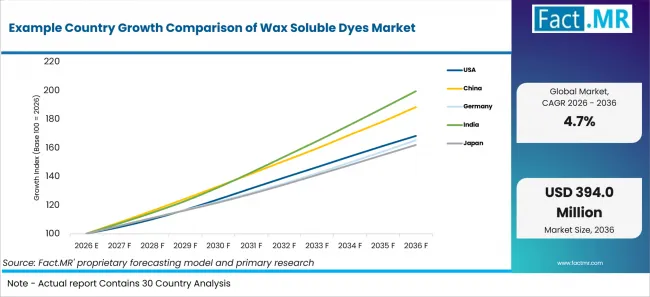
Example Country Growth Comparison Of Wax Soluble Dyes Market | Source: Fact.MR
| COUNTRY | CAGR |
|---|---|
| United States | 5.4% |
| Poland | 5.5% |
| Germany | 5.2% |
| United Kingdom | 5.1% |
| Japan | 5.0% |
Source: Fact.MR analysis. Updated Jul 21, 2026
What sustains Wax Soluble Dyes demand in the United States?
5.4% CAGR, driven by branded candle ranges and active craft channels.
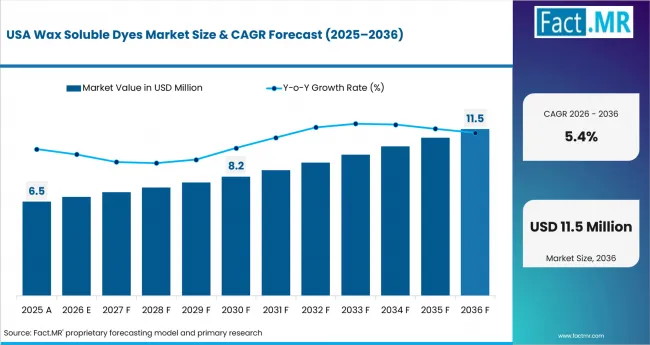
Wax Soluble Dyes Market Country Value Analysis | Source: Fact.MR
United States candle makers often coordinate shade with fragrance and container design, which creates repeated color-development work. The market is expected to record a 5.4% CAGR through 2036 as large producers and small-batch brands seek burn-compatible dyes, dependable cooling performance, and easier dosing across frequent product launches.
Why is Poland central to European wax coloration?
5.5% CAGR, supported by large candle-production volumes and export-oriented manufacturing.
Poland’s candle plants run long seasonal campaigns for retailers across Europe, placing heavy importance on batch-to-batch shade control. Demand is projected to expand at a 5.5% CAGR from 2026 to 2036 as suppliers provide stable color across repeated deliveries and help factories avoid visible differences between production lots.
How does Germany shape supplier requirements?
5.2% CAGR, owing to formulation discipline and detailed product documentation.
German buyers examine chemical identity, wax compatibility, shade stability, and processing behavior together before approving a dye. The market is anticipated to post a 5.2% CAGR through 2036 as candle, polish, and industrial-wax producers favor color companies that provide clear technical records and repeatable results across different substrates.
What sustains Wax Soluble Dyes demand in the United Kingdom?
5.1% CAGR, driven by home-fragrance ranges and small-batch product renewal.
United Kingdom brands often use color to separate fragrance families and seasonal collections, which creates demand for responsive shade development. The market is forecast to record a 5.1% CAGR from 2026 to 2036 as suppliers support shorter runs with smaller order sizes, clean-burn evidence, and reliable color matching.
Where does Japan offer room for Wax Soluble Dyes?
5.0% CAGR, supported by exacting decorative quality and repeatable specialty shades.
Japanese buyers place strong value on controlled appearance and dependable reordering when color forms part of a carefully designed product range. The market is estimated to expand at a 5.0% CAGR through 2036 as suppliers maintain physical shade standards, manage formulation changes carefully, and deliver consistent visual results across production cycles.
Who leads the Wax Soluble Dyes Market?
Solar Organics and Alliance Organics stand out for their broad solvent-dye ranges, while Orco adds strong coverage across candles, wax coatings, paraffin, lamp oils, and polish products.
Solar Organics serves a wide mix of wax and solvent-color uses, giving it a broad base across decorative and industrial products. Alliance Organics also supports wax coloring through a large solvent-dye range and practical shade options. Orco adds products made for wax, candles, coatings, paraffin, lamp oils, and shoe polish. These companies compete on shade choice, clean mixing, and steady color after cooling. Their technical support also becomes important when fragrance or wax type changes the final result.
Abbey Color focuses on solvent dyes for waxes and polishes, while FastColours supports candle makers with color guidance for different wax systems. Both companies are useful for buyers that need help with shade matching and repeat orders. Competition through 2036 is expected to depend on wax compatibility, simple dosing, clear product records, and fast help when a color changes during heating, cooling, or storage.
Which companies are the key providers?
The company set includes Solar Organics, Alliance Organics, Orco, Abbey Color, and FastColours.
- Solar Organics
- Alliance Organics
- Orco
- Abbey Color
- FastColours
Bibliography
- European Chemicals Agency. (2025, April 24). Industry classifications: Classification information submitted via REACH registrations and CLP notifications. ECHA CHEM.
- Electronic Code of Federal Regulations. (2026, July 17). 16 CFR § 1500.17: Banned hazardous substances. U.S. Government Publishing Office.
- European Commission. (2025, September 3). Combined nomenclature tariff commitments: Paraffin waxes and related mineral waxes (COM(2025) 356 final, Annex 3).
This Report Addresses
- The report provides strategic intelligence on Wax Soluble Dyes across Wax Substrate and Application choices that shape candle and formulated-wax color programs.
- Segment analysis covers Paraffin Wax and Candles as the share leaders within the 2026 market.
- Regional outlook evaluates the United States and Poland alongside Germany, the United Kingdom, and Japan while 30+ countries complete the growth comparison.
- Competitive analysis profiles Solar Organics and Alliance Organics alongside Orco, followed by Abbey Color and FastColours as additional active wax-color providers.
- Dye Form assessment covers Powder Soluble Dyes and Liquid Wax Dyes alongside Dye Chips, Concentrate Pellets, and Custom Blends.
- Use-case assessment covers Candles and Polishes alongside Crayons / Art Materials, Wax Coatings, and Decorative Wax Goods.
What does the Wax Soluble Dyes Market cover?
Powder Soluble Dyes, Liquid Wax Dyes, Dye Chips, Concentrate Pellets, and Custom Blends used to color wax products throughout the finished article.
The Wax Soluble Dyes Market covers colorants designed to dissolve in molten wax or a compatible carrier and produce even color after cooling. Coverage includes products used in Paraffin Wax, Microcrystalline Wax, Soy / Palm Wax, Beeswax Blends, and Synthetic Wax across candles, polishes, art materials, coatings, and decorative wax goods.
The market differs from pigments and surface treatments because commercial value comes from internal wax coloration, shade consistency, and compatibility with the finished formulation. Finished candles, base waxes, fragrances, and wicks remain outside the boundary unless their value is directly tied to the wax-soluble dye component.
What is included in the scope?
Wax-soluble colorants used across candle production, polish making, craft materials, wax coatings, and industrial wax formulation.
The scope includes Powder Soluble Dyes and Liquid Wax Dyes alongside Dye Chips, Concentrate Pellets, and Custom Blends. Coverage spans Paraffin Wax, Microcrystalline Wax, Soy / Palm Wax, Beeswax Blends, and Synthetic Wax. Bright Shades, Pastel Shades, Dark Shades, Metallic / Specialty Effects, and Natural-Look Tints are included when the color is delivered through a wax-soluble system. The scope also considers dosing, melt behavior, cooling stability, fragrance interaction, wick performance, storage conditions, and repeat shade matching.
What is excluded from the scope?
Finished wax products and color systems that do not dissolve in wax are outside the scope.
The scope excludes finished candles, crayons, polishes, coatings, decorative wax goods, base waxes, fragrances, and wicks. Insoluble pigments, standalone metallic particles, water-soluble dyes, and decorative surface coatings without a wax-soluble component are also excluded. General colorants remain outside the market unless they are sold specifically for use in molten wax or a compatible soluble preparation.
How Was the Analysis Built?
The analysis draws on 120+ sources, 35+ company portfolios, 25+ countries, and more than 20 industry interviews.
- Primary Research: Primary research includes discussions with manufacturers, service providers, technology developers, distributors, end users, procurement teams, and subject-matter experts. These conversations examine purchasing priorities, product adoption, operational challenges, approval requirements, competitive positioning, and the factors that influence wider market acceptance.
- Desk Research: Desk research covers government statistics, regulatory publications, company filings, trade data, technical studies, industry associations, standards, public policy, and other authoritative sources. Every source used in the analysis is documented in the bibliography.
- Market Sizing and Forecasting: Market estimates combine historical performance, demand indicators, pricing and volume trends, segment shares, company participation, country-level growth, adoption patterns, investment activity, and barriers to market expansion.
- Data Validation and Update Cycle: Findings are validated by comparing primary interviews with public data, company activity, regulatory changes, trade patterns, and industry developments. Regular updates review new product launches, capacity changes, partnerships, approvals, procurement trends, and shifts in commercial adoption.
Segmentation
What is the report's scope and coverage?
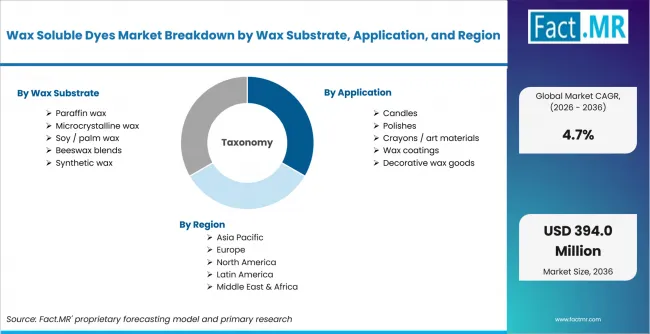
Wax Soluble Dyes Market Breakdown By Wax Substrate, Application, And Region | Source: Fact.MR
| ATTRIBUTE | DETAILS |
|---|---|
| Quantitative Units | USD million in 2026 to USD million by 2036 at CAGR |
| Market Definition | Wax soluble dyes are concentrated colorants and formulated preparations sold to dissolve in molten wax or a compatible carrier and color the finished wax article throughout. |
| Wax Substrate | Paraffin wax; Microcrystalline wax; Soy / palm wax; Beeswax blends; Synthetic wax |
| Application | Candles; Polishes; Crayons / art materials; Wax coatings; Decorative wax goods |
| Dye Form | Powder soluble dyes; Liquid wax dyes; Dye chips; Concentrate pellets; Custom blends |
| Color Type | Bright shades; Pastel shades; Dark shades; Metallic / specialty effects; Natural-look tints |
| Buyer Type | Candle manufacturers; Polish makers; Craft material brands; Packaging converters; Industrial wax formulators |
| Regions Covered | North America, Latin America, Europe, East Asia, South Asia, Oceania, and the Middle East and Africa |
| Countries Covered | United States; Poland; Germany; United Kingdom; Japan (30+ countries covered in the complete study) |
| Key Companies Profiled | Solar Organics; Alliance Organics; Orco; Abbey Color; FastColours |
| Forecast Period | 2026 to 2036 |
| Approach | Sizing should multiply colored wax output by soluble-dye dosage and realized colorant price, with adjustments for delivery form, shade strength, substrate, and application. |
Source: Fact.MR analysis. Updated Jul 21, 2026
How is the market segmented?
-
By Wax Substrate:
- Paraffin wax
- Microcrystalline wax
- Soy / palm wax
- Beeswax blends
- Synthetic wax
-
By Application:
- Candles
- Polishes
- Crayons / art materials
- Wax coatings
- Decorative wax goods
-
By Dye Form:
- Powder soluble dyes
- Liquid wax dyes
- Dye chips
- Concentrate pellets
- Custom blends
-
By Color Type:
- Bright shades
- Pastel shades
- Dark shades
- Metallic / specialty effects
- Natural-look tints
-
By Buyer Type:
- Candle manufacturers
- Polish makers
- Craft material brands
- Packaging converters
- Industrial wax formulators
-
By Region:
- North America
- United States
- Europe
- Poland
- Germany
- United Kingdom
- Asia Pacific
- Japan
Frequently Asked Questions
What is the largest wax-dye application?
Which dye form leads the market?
What color type has the leading share?
Which buyer category purchases the largest share of wax-soluble dyes?
Which countries frame the outlook?
Who worked on this report


Preview the report firsthand - request a free sample
Free SampleGet the brochure for pricing and purchase details
Download PDF