- Base Value(2025): 290 Mn
- Estimated Value(2026): 320 Mn
- Forecast Value (2036): 980 Mn
- CAGR (2026 - 2036): 11.9%
Wearable Swallow Monitoring Devices Market Forecast and Outlook By FACT.MR
In 2025, the wearable swallow monitoring devices market was valued at USD 290 million. Based on Fact MR analysis, demand for wearable swallow monitoring devices is estimated to grow to USD 320 million in 2026 and USD 980 million by 2036. FMR projects a CAGR of 11.9% during the forecast period.
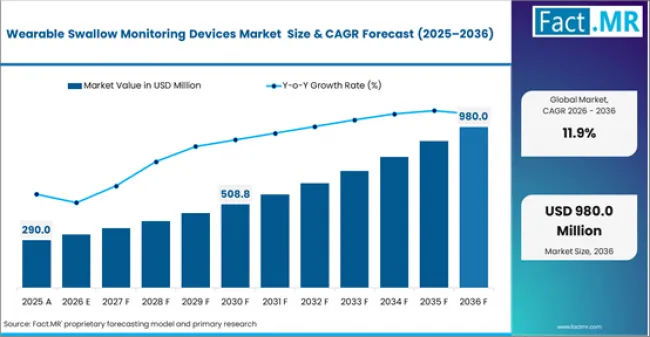
Wearable Swallow Monitoring Devices Market Market Value Analysis | Source: Fact.MR
Summary of Wearable Swallow Monitoring Devices Market
- Market Definition
- The market comprises sensor based wearable medical devices designed to detect swallowing activity through motion, acoustic vibration, and electromyographic signals. These devices support assessment, diagnosis, and monitoring of dysphagia and related neurological swallowing disorders across hospitals, rehabilitation centers, and home healthcare environments.
- Demand Drivers
- Increasing prevalence of dysphagia associated with neurological disorders supporting need for continuous swallow monitoring solutions.
- Growing adoption of wearable biosensor technologies enabling non invasive evaluation of swallowing biomechanics.
- Rising demand for remote patient monitoring systems supporting home based rehabilitation workflows.
- Expanding integration of digital health devices enabling continuous physiological signal tracking across clinical care pathways.
- Increasing use of multimodal sensors supporting improved detection accuracy across aspiration risk assessment environments.
- Growing requirement for continuous therapy monitoring enabling objective measurement of swallowing recovery progression.
- Key Segments Analyzed
- End User: Hospitals account for 42% share supported by integration of wearable diagnostic monitoring devices across clinical workflows.
- Application: Dysphagia diagnosis holds 38% share supported by demand for objective measurement of swallowing function abnormalities.
- Sensor Type: Accelerometer, electromyography, acoustic, and multimodal sensors enable capture of physiological signals linked to swallowing activity.
- Clinical Function: Wearable biosensors support continuous monitoring of muscle activity and vibration patterns associated with ingestion processes.
- Geography: Asia Pacific, North America, and Europe demonstrate increasing adoption supported by expansion of digital health infrastructure.
- Analyst Opinion at Fact MR
- Shambhu Nath Jha, Principal Consultant, Fact MR, opines, 'In this updated edition of the Wearable Swallow Monitoring Devices Market report, multimodal biosensor platforms demonstrate increasing clinical relevance for continuous dysphagia assessment and rehabilitation monitoring across digital health environments through 2036.'
- Strategic Implications or Executive Takeaways
- Improve sensor fusion capability supporting accurate detection of swallowing biomechanics across multimodal monitoring devices.
- Strengthen integration with telehealth platforms supporting remote rehabilitation monitoring workflows.
- Expand clinical validation studies supporting regulatory approval of wearable dysphagia diagnostic technologies.
- Develop lightweight wearable form factors supporting long duration patient compliance across home monitoring environments.
- Enhance data analytics capability supporting interpretation of physiological signal patterns across swallowing activity datasets.
- Improve interoperability capability supporting integration with electronic health record systems across healthcare providers.
- Methodology
- Primary interviews conducted with wearable medical device manufacturers, clinicians, and rehabilitation specialists.
- Benchmarked against dysphagia prevalence indicators influencing demand for continuous swallowing monitoring technologies.
- Evaluated biosensor engineering developments supporting multimodal signal capture across wearable diagnostic devices.
- Hybrid modeling applied combining top-down digital health adoption estimation with bottom-up wearable device utilization assessment.
- Validation conducted using clinical study data and regulatory approval pathways across digital medical technologies.
- Peer review applied using Fact MR analytical frameworks linking wearable monitoring demand with neurological disorder prevalence indicators.
Wearable Swallow Monitoring Devices Market
| Metric | Details |
|---|---|
| Industry Size (2026E) | USD 320 million |
| Industry Value (2036F) | USD 980 million |
| CAGR (2026 to 2036) | 11.9% |
Source: Fact.MR analysis. Updated Apr 22, 2026
A CAGR of 11.9% indicates transformational expansion with variability linked to clinical validation progress and reimbursement pathway clarity for dysphagia monitoring technologies. Growth is supported by demand for continuous patient monitoring, while volatility persists due to regulatory approval timelines, device accuracy requirements, and adoption rates across healthcare providers.
China leads with a projected CAGR of 13.2%, supported by increasing adoption of wearable diagnostic sensors across neurological and rehabilitation monitoring environments. India follows with a CAGR of 12.8%, driven by expanding deployment of non-invasive swallowing assessment technologies across clinical monitoring infrastructure. The United Kingdom records a CAGR of 12.5%, reflecting steady integration of wearable biosensing devices across patient monitoring workflows. Germany shows a CAGR of 12.2%, supported by consistent incorporation of sensor-based medical monitoring tools across healthcare diagnostic systems. The United States records the slowest growth at 11.9%, reflecting a relatively mature digital health ecosystem tied to replacement demand within established patient monitoring device supply chains.
Segmental Analysis
Wearable Swallow Monitoring Devices Market Analysis by End User
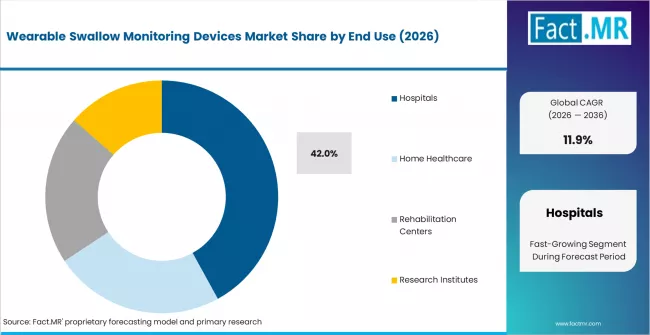
Wearable Swallow Monitoring Devices Market Analysis By End Use | Source: Fact.MR
- Market Overview: Based on Fact MR assessment, hospitals are projected to account for 42% share of the wearable swallow monitoring devices market in 2026. Clinical monitoring systems incorporate wearable biosensors enabling detection of swallowing frequency, muscle movement patterns, and acoustic vibration signals generated during ingestion processes. Device integration supports continuous observation of patient swallowing function across neurological disorder assessment, post stroke rehabilitation monitoring, and geriatric care environments requiring objective evaluation of swallowing performance parameters. Sensor enabled wearable systems support non invasive monitoring workflows enabling collection of physiological signals supporting clinical decision processes aligned with dysphagia management protocols.
- Demand Drivers:
- Clinical Monitoring Requirements: Hospitals utilize wearable biosensor devices enabling capture of swallowing motion signals supporting assessment of swallowing irregularities.
- Patient Observation Parameters: Continuous monitoring supports identification of swallowing dysfunction patterns influencing treatment planning workflows.
- Diagnostic Data Needs: Wearable monitoring systems support acquisition of physiological signals enabling evaluation of swallowing coordination across clinical care environments.
Wearable Swallow Monitoring Devices Market Analysis by Application
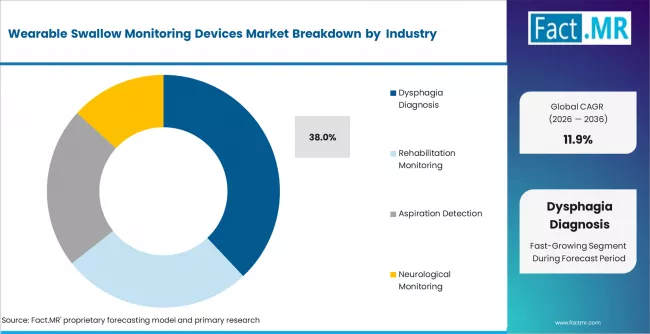
Wearable Swallow Monitoring Devices Market Analysis By Application | Source: Fact.MR
- Market Overview: Dysphagia diagnosis is estimated to hold 38% share of the wearable swallow monitoring devices market in 2026, supported by requirement for objective measurement of swallowing mechanics across patients experiencing neurological impairment, muscular degeneration, or age related swallowing disorders. Sensor based monitoring systems capture vibration and muscle activity signals enabling identification of abnormal swallowing sequences affecting safe ingestion performance. Clinical data generated through wearable monitoring devices supports evaluation of aspiration risk and swallowing coordination characteristics enabling healthcare providers to determine appropriate therapeutic intervention strategies aligned with patient specific clinical assessment requirements.
- Demand Drivers:
- Swallow Function Assessment Requirements: Wearable devices support measurement of swallowing patterns enabling identification of irregular ingestion mechanics associated with dysphagia conditions.
- Physiological Signal Monitoring Parameters: Sensor technology supports detection of muscle activity and acoustic signals associated with swallowing events.
- Clinical Evaluation Needs: Monitoring data supports diagnostic interpretation enabling determination of treatment approaches addressing swallowing dysfunction conditions.
Key Dynamics
Wearable Swallow Monitoring Devices Market Drivers, Restraints, and Opportunities
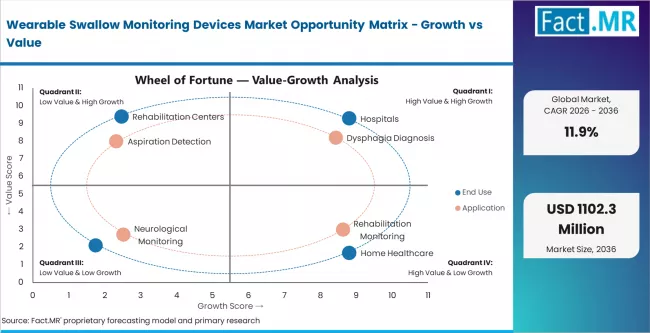
Wearable Swallow Monitoring Devices Market Opportunity Matrix Growth Vs Value | Source: Fact.MR
FMR analysts observe that historical swallowing assessment has relied on imaging techniques such as videofluoroscopy and endoscopy, which provide high diagnostic accuracy but require specialized clinical infrastructure and episodic evaluation. The current market size reflects a transition toward wearable biosensor platforms capable of continuously monitoring swallowing biomechanics through acoustic, accelerometric, electromyographic, and pressure sensing technologies integrated into neck-worn or skin-mounted devices. Structural reality indicates an early growth digital health market because dysphagia prevalence increases with aging populations, stroke survivorship, Parkinson disease, and neurodegenerative disorders, creating sustained demand for objective, home-based monitoring tools that enable early detection of aspiration risk and rehabilitation tracking. Wearable sensors provide continuous physiological data that can support clinical decision making outside hospital environments.
The present structural shift reflects declining reliance on episodic clinical testing as multimodal wearable systems integrate AI-enabled signal interpretation to identify abnormal swallowing patterns in real time. Device cost per patient remains relatively high due to sensor calibration complexity and regulatory validation requirements, yet remote monitoring capability reduces hospitalization risk and improves therapy adherence across chronic care populations. Value growth is driven by integration into telehealth rehabilitation pathways where clinicians require continuous biomarker data to personalize therapy intensity and monitor treatment outcomes.
- Dysphagia Prevalence Growth: Increasing incidence of neurological disorders and aging-related swallowing impairment sustains demand for continuous monitoring solutions supporting early intervention and rehabilitation tracking.
- Clinical Validation Pathway: FDA SaMD guidance and EU MDR medical device frameworks influence commercialization timelines as wearable diagnostic tools require clinical evidence for accuracy and safety.
- North America Research Base: United States leads innovation through academic biomedical engineering programs developing AI-enabled wearable sensors for non-invasive swallowing detection and therapy monitoring.
Regional Analysis
The wearable swallow monitoring devices market is assessed across North America, Europe, and Asia Pacific, segmented by country-level demand in dysphagia monitoring sensors, wearable throat motion tracking devices, rehabilitation biofeedback systems, and continuous swallowing pattern analytics platforms. Regional demand reflects integration of digital health monitoring technologies in neurological rehabilitation and geriatric care. The full report offers market attractiveness analysis.
.webp "Top Country Growth Comparison Wearable Swallow Monitoring Devices Market Cagr (2026 2036)")
Top Country Growth Comparison Wearable Swallow Monitoring Devices Market Cagr (2026 2036) | Source: Fact.MR
CAGR Table
| Country | CAGR (2026–2036) |
|---|---|
| China | 13.2% |
| India | 12.8% |
| United Kingdom | 12.5% |
| Germany | 12.2% |
| United States | 11.9% |
Source: Fact.MR analysis. Updated Apr 22, 2026
Source: Fact MR analysis, based on proprietary forecasting model and primary research
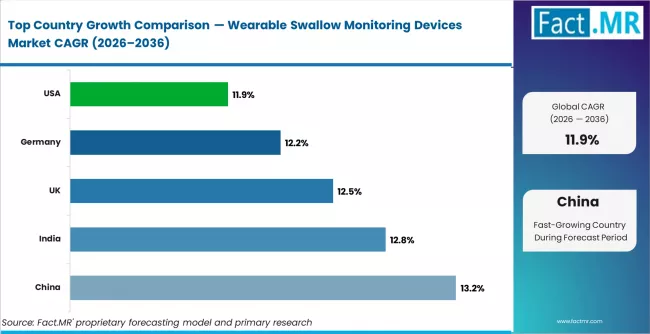
Wearable Swallow Monitoring Devices Market Cagr Analysis By Country | Source: Fact.MR
Asia Pacific
Asia Pacific functions as the digital rehabilitation monitoring adoption hub, supported by expansion of wearable health technology integration and increasing use of remote patient monitoring tools in neurological care. Natus Medical Incorporated strengthens neurodiagnostic monitoring capability. Philips Healthcare expands connected health wearable analytics platforms. Xiaomi Corporation supports sensor-enabled health device engineering.
- China: China is projected to record 13.2% CAGR in wearable swallow monitoring devices through 2036. Healthy China digital healthcare initiative update (National Health Commission, March 2024) supports adoption of wearable diagnostic monitoring tools. Xiaomi Corporation expanded wearable biosensor engineering capability (June 2023).
- India: Adoption of wearable swallow monitoring devices in India is forecast to grow at 12.8% CAGR through 2036. National Digital Health Mission telehealth monitoring framework update (Ministry of Health and Family Welfare, January 2024) supports remote rehabilitation monitoring device utilization. Philips Healthcare expanded digital patient monitoring capability (May 2023).
Europe
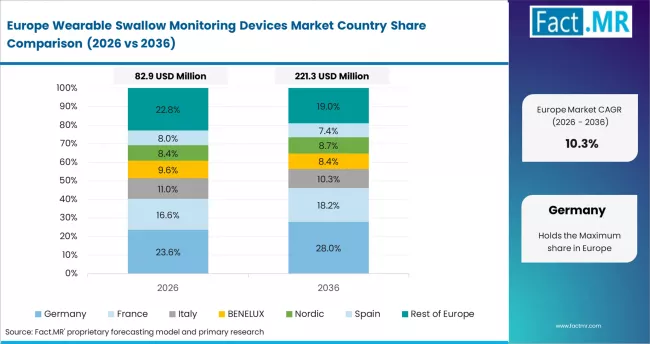
Wearable Swallow Monitoring Devices Market Europe Country Market Share Analysis, 2026 & 2036 | Source: Fact.MR
Europe operates as the clinical validation environment for rehabilitation wearables, supported by structured medical device compliance frameworks and integration of digital patient monitoring technologies in therapy pathways. Medtronic plc strengthens wearable neuro-monitoring capability. Koninklijke Philips N.V. expands remote patient monitoring platform expertise. Siemens Healthineers AG supports connected rehabilitation analytics innovation.
- United Kingdom: Deployment of wearable swallow monitoring devices in United Kingdom is expected to expand at 12.5% CAGR through 2036. NHS digital remote monitoring framework update (Department of Health and Social Care, February 2024) supports wearable rehabilitation device adoption. Medtronic plc expanded biofeedback monitoring engineering capability (July 2023).
- Germany: Germany is anticipated to observe 12.2% CAGR in wearable swallow monitoring devices through 2036. Digital Healthcare Act reimbursement pathway update (Federal Ministry of Health, October 2023) supports integration of wearable monitoring devices in therapy protocols. Siemens Healthineers AG expanded digital rehabilitation analytics capability (April 2023).
North America
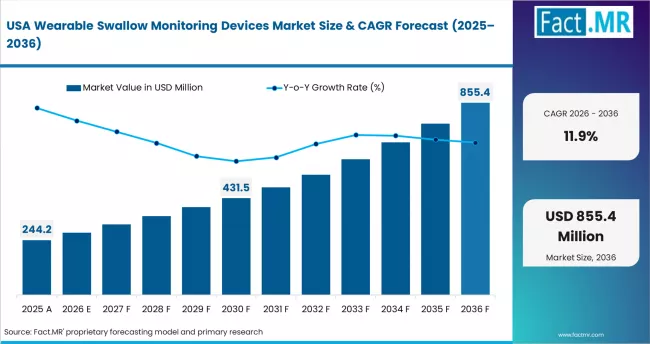
Wearable Swallow Monitoring Devices Market Country Value Analysis | Source: Fact.MR
North America represents the remote patient monitoring technology commercialization environment, supported by strong adoption of wearable diagnostic tools and integration of biofeedback analytics in neurological rehabilitation pathways. Natus Medical Incorporated strengthens neurodiagnostic device capability. Masimo Corporation expands wearable health monitoring platforms. Abbott Laboratories supports connected care device innovation.
- United States: The United States is forecast to witness 11.9% CAGR in wearable swallow monitoring devices through 2036. FDA digital health innovation action plan update (April 2024) supports wearable diagnostic device deployment. Abbott Laboratories expanded wearable biosensor engineering capability (August 2023).
Fact MR's analysis of wearable swallow monitoring devices market in global regions consists of country-wise assessment that includes China, India, United Kingdom, Germany, and United States. Readers can find remote patient monitoring trends, rehabilitation wearable developments, digital health adoption signals, and competitive positioning across key markets.
Competitive Landscape
What is the Competitive Structure of the Wearable Swallow Monitoring Devices Market?
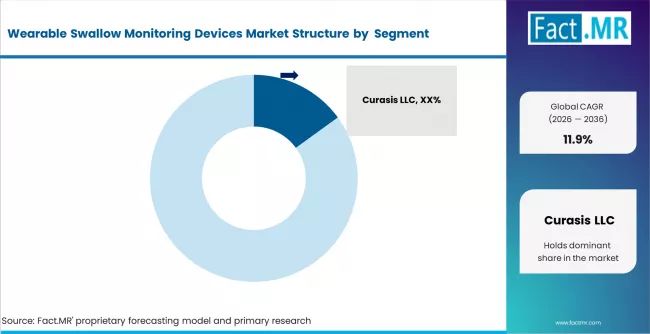
Wearable Swallow Monitoring Devices Market Analysis By Company | Source: Fact.MR
The Wearable Swallow Monitoring Devices Market reflects a moderately fragmented competitive structure, characterized by participation from specialized biosensor developers and digital health technology companies. Key participants including Curasis LLC, Sempulse Corporation, Valencell Inc., Nox Medical, BioSerenity SA, Shimmer Research Ltd., MC10 Inc., VitalConnect Inc., Empatica Inc., and Neurosoft Ltd. collectively account for approximately 50–60% of market presence, with a mix of clinical-stage and commercially deployed monitoring platforms. Competitive differentiation is primarily defined by sensor sensitivity, signal processing accuracy, comfort of wearable form factors, and integration with remote patient monitoring systems. High product development complexity related to biosignal capture and algorithm validation limits rapid entry of new competitors. Companies with proven physiological sensing capabilities maintain stronger positioning in clinical dysphagia monitoring applications.
Structural advantages are held by companies possessing proprietary biosensing technologies and established expertise in wearable medical-grade electronics. Valencell Inc. and VitalConnect Inc. benefit from validated sensor platforms and established collaborations with healthcare technology providers. Buyers including hospitals, rehabilitation centers, and telehealth providers typically reduce supplier dependency through pilot testing across multiple device platforms to validate accuracy and usability in clinical settings. Procurement decisions often involve evaluation of regulatory compliance, interoperability with digital health records, and reliability of continuous monitoring performance. Pricing power remains balanced, though suppliers retain moderate leverage where clinical validation data and patented sensor architectures create switching barriers for healthcare providers adopting long-term patient monitoring solutions.
Key Players of the Wearable Swallow Monitoring Devices Market
- Curasis LLC
- Sempulse Corporation
- Valencell Inc.
- Nox Medical
- BioSerenity SA
- Shimmer Research Ltd.
- MC10 Inc.
- VitalConnect Inc.
- Empatica Inc.
- Neurosoft Ltd.
Bibliographies
- [1] National Health Commission. (2024, March). Healthy China digital healthcare initiative update. Government of China.
- [2] Ministry of Health and Family Welfare. (2024, January). National digital health mission telehealth monitoring framework update. Government of India.
- [3] Department of Health and Social Care. (2024, February). NHS digital remote monitoring framework update. UK Government.
- [4] Federal Ministry of Health. (2023, October). Digital healthcare act reimbursement pathway update. Government of Germany.
- [5] U.S. Food and Drug Administration. (2024, April). FDA digital health innovation action plan update. U.S. Department of Health and Human Services.
- [6] Philips Healthcare. (2023, May). Digital patient monitoring capability expansion. Philips Healthcare.
- [7] Xiaomi Corporation. (2023, June). Wearable biosensor engineering capability expansion. Xiaomi Corporation.
- [8] Medtronic plc. (2023, July). Biofeedback monitoring engineering capability expansion. Medtronic plc.
- [9] Siemens Healthineers AG. (2023, April). Digital rehabilitation analytics capability expansion. Siemens Healthineers AG.
- [10] Abbott Laboratories. (2023, August). Wearable biosensor engineering capability expansion. Abbott Laboratories.
This Report Addresses
- Market size forecasts for 2026 to 2036 based on adoption of sensor-based wearable technologies for continuous swallowing pattern monitoring.
- Opportunity mapping across accelerometer, electromyography, acoustic, and multimodal sensor configurations integrated in wearable biosensing devices.
- Segment and regional forecasts covering dysphagia diagnosis, rehabilitation monitoring, aspiration detection, and neurological swallowing assessment applications.
- Competition benchmarking based on signal detection accuracy, sensor sensitivity performance, data processing capability, and device ergonomics.
- Regulatory review covering digital health device approval pathways, clinical validation requirements, and remote patient monitoring compliance frameworks.
- Report delivery in PDF, Excel, PPT, and dashboard formats supporting medical device manufacturers, rehabilitation technology providers, and digital health stakeholders.
- Supply risk evaluation covering sensor calibration complexity, reimbursement pathway uncertainty, data integration challenges, and variability in clinical adoption rates across healthcare providers.
Market Definition
The Wearable Swallow Monitoring Devices Market includes sensor based wearable devices designed to detect and analyze swallowing activity through acoustic, motion, or bioelectrical signals to support assessment, monitoring, and management of dysphagia and related swallowing disorders in clinical, rehabilitation, and home care settings.
Wearable Swallow Monitoring Devices Market Inclusions
The report includes global and regional market size estimates, forecast analysis, and segmentation by sensor technology, device form factor, monitoring capability, application area, end use sector, pricing structure, and integration with digital health and remote patient monitoring systems.
Wearable Swallow Monitoring Devices Market Exclusions
The scope excludes diagnostic imaging systems such as videofluoroscopy, therapeutic swallowing exercise equipment, general wearable health trackers without swallow detection capability, and clinical software not directly connected to swallow monitoring device data capture.
Wearable Swallow Monitoring Devices Market Research Methodology
- Primary Research
- Interviews were conducted with medical device manufacturers, healthcare providers, rehabilitation specialists, digital health developers, and clinical researchers.
- Desk Research
- Public sources included medical device publications, clinical research literature, regulatory documentation, company technical materials, and studies on biosensor based swallow monitoring technologies.
- Market-Sizing and Forecasting
- A hybrid model combining top-down digital health monitoring demand evaluation and bottom-up analysis of wearable swallow monitoring device adoption across healthcare and home care environments was applied.
- Data Validation and Update Cycle
- Outputs were validated through cross comparison of clinical adoption data, expert consultation, and periodic monitoring of wearable medical technology development trends.
Segmentation
Report Scope
| Metric | Value |
|---|---|
| Quantitative Units | USD 320 million (2026) to USD 980 million (2036), at a CAGR of 11.9% |
| Market Definition | The wearable swallow monitoring devices market includes sensor-based wearable technologies designed to detect swallowing patterns, muscle activity, and acoustic signals to support dysphagia diagnosis, rehabilitation monitoring, and neurological assessment in clinical and home care environments. |
| Sensor Type Segmentation | Accelerometer sensors, Electromyography sensors, Acoustic sensors, Multimodal sensors |
| Application Segmentation | Dysphagia diagnosis, Rehabilitation monitoring, Aspiration detection, Neurological monitoring |
| End User Segmentation | Hospitals, Home healthcare, Rehabilitation centers, Research institutes |
| Regions Covered | North America, Latin America, Europe, East Asia, South Asia, Oceania, Middle East and Africa |
| Countries Covered | United States, Canada, Germany, France, United Kingdom, Italy, Spain, Netherlands, China, Japan, South Korea, India, Australia, Singapore, Brazil, Mexico, United Arab Emirates, South Africa, and 40+ countries |
| Key Companies Profiled | Curasis LLC, Sempulse Corporation, Valencell Inc., Nox Medical, BioSerenity SA, Shimmer Research Ltd., MC10 Inc., VitalConnect Inc., Empatica Inc., Neurosoft Ltd. |
| Forecast Period | 2026 to 2036 |
| Approach | Hybrid top-down and bottom-up market estimation based on wearable healthcare device adoption trends, dysphagia monitoring technology demand benchmarking, digital health diagnostics investment analysis, remote patient monitoring implementation patterns, and validation through primary interviews with medical device manufacturers, healthcare providers, and clinical research organizations. |
Source: Fact.MR analysis. Updated Apr 22, 2026
Wearable Swallow Monitoring Devices Market Key Segments
-
Sensor Type:
- Accelerometer Sensors
- Electromyography Sensors
- Acoustic Sensors
- Multimodal Sensors
-
Application:
- Dysphagia Diagnosis
- Rehabilitation Monitoring
- Aspiration Detection
- Neurological Monitoring
-
End User:
- Hospitals
- Home Healthcare
- Rehabilitation Centers
- Research Institutes
-
Region:
- North America
- USA
- Canada
- Mexico
- Europe
- Germany
- UK
- France
- Italy
- Spain
- Nordic Countries
- BENELUX
- Rest of Europe
- Asia Pacific
- China
- Japan
- South Korea
- India
- Australia
- Rest of Asia Pacific
- Latin America
- Brazil
- Argentina
- Rest of Latin America
- Middle East and Africa
- Kingdom of Saudi Arabia
- United Arab Emirates
- South Africa
- Rest of Middle East and Africa
- Other Regions
- Oceania
- Central Asia
- Other Markets
- North America
Frequently Asked Questions
How large is the demand for Wearable Swallow Monitoring Devices in the global market in 2026?
What will be the market size of Wearable Swallow Monitoring Devices in the global market by 2036?
What is the expected demand growth for Wearable Swallow Monitoring Devices in the global market between 2026 and 2036?
Which company is identified as a leading manufacturer in the Wearable Swallow Monitoring Devices market?
Which end user segment is projected to dominate wearable swallow monitoring device adoption by 2026?
Why are wearable swallow monitoring devices widely used in hospital diagnostic environments?
What is driving demand for wearable swallow monitoring devices in China?
What is the growth outlook for the Wearable Swallow Monitoring Devices market in China?
Why is India an important market for swallow monitoring technologies?
What is the growth outlook for the Wearable Swallow Monitoring Devices market in India?
How is demand for wearable swallow monitoring devices evolving in the United Kingdom healthcare sector?
What is the growth outlook for the Wearable Swallow Monitoring Devices market in the United Kingdom?
What is the growth outlook for the Wearable Swallow Monitoring Devices market in Germany?
How is the United States positioned in the Wearable Swallow Monitoring Devices market?
What is the growth outlook for the Wearable Swallow Monitoring Devices market in the United States?
What are wearable swallow monitoring devices and what are they mainly used for?
What does the Wearable Swallow Monitoring Devices market include in this report?
What applications are included in the scope of the Wearable Swallow Monitoring Devices market?
What is excluded from the scope of the Wearable Swallow Monitoring Devices market report?
What does market forecast mean in the Wearable Swallow Monitoring Devices market report?
How is the Wearable Swallow Monitoring Devices market forecast developed in this report?
What does primary validation indicate in the Wearable Swallow Monitoring Devices market analysis?
Who worked on this report


Preview the report firsthand - request a free sample
Free SampleGet the brochure for pricing and purchase details
Download PDF