- Market Value (2025): USD 12.9 Bn
- Estimated Value (2026): USD 13.5 Bn
- Forecast Value (2036): USD 19.9 Bn
- CAGR (2026-2036): 4.0%
What is the Wheat Bran Market forecast to be worth by 2036?
USD 13.5 billion in 2026 to USD 19.9 billion by 2036, at a 3.98% CAGR.
- As per Fact.MR analysis, the wheat bran market reached USD 12.9 billion in 2025.
- Demand will increase from USD 13.5 billion in 2026 to USD 19.9 billion in 2036.
- The market is forecast to record a 4.0% CAGR during 2026 to 2036 as livestock herd expansion, aquaculture dietary upgrades, and whole-grain consumer nutrition trends drive industrial utilization of milling coproducts.
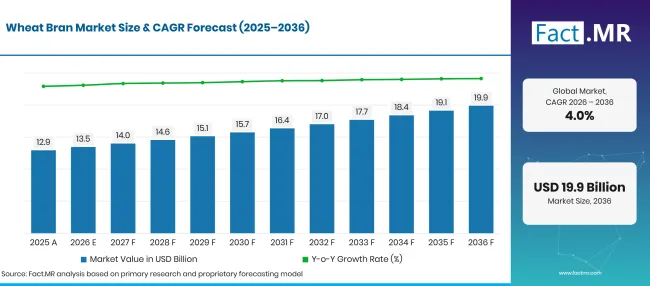
Factmr Wheat Bran Market Forecast Global | Source: Fact.MR
| Year | Basis | Market Value (USD billion) |
|---|---|---|
| 2025 | Actual | 12.9 |
| 2026 | Estimate | 13.5 |
| 2036 | Forecast | 19.9 |
| CAGR 2026 to 2036 | Forecast period | 4.0% |
Source: Fact.MR analysis. Updated Oct 19, 2026
What are the defining numbers behind Wheat Bran Market growth?
USD 6.4 billion absolute chance between 2026 and 2036, with coarse wheat bran and commercial livestock nutrition operations capturing the majority of processing tonnage.
- Demand Drivers in the Market
- Livestock nutritionists are systematically incorporating wheat bran into monogastric and ruminant compound feed rations to optimize gastrointestinal motility and gut microbiome health. Animal nutritional trials demonstrated that wheat bran dietary fiber fractions improve intestinal barrier integrity, enhance short-chain fatty acid synthesis, and reduce subclinical enteric inflammation across swine herds [1]. Commercial feed mills rely on steady bulk bran deliveries to maintain balanced crude fiber ratios in commercial grower pellets.
- Swine and poultry feed formulators are increasingly utilizing microbial solid-state fermentation to break down anti-nutritional phytate complexes and unlock bound nutrients in cereal bran. Controlled feeding trials confirmed that fermented wheat bran supplementation significantly improves average daily gain, nutrient digestibility, and feed conversion ratios in weaned piglets [2]. Industrial feed processors deploy specialized enzyme inoculants to enhance protein bioavailability before feed extrusion.
- Poultry integrators evaluate particle size distribution in fine wheat bran to optimize gizzard development and digestive enzyme stimulation in commercial broilers. Comparative avian research revealed that coarse-ground wheat bran promotes muscular gizzard hypertrophy and improves starch digestion without depressing voluntary feed intake [3]. Feed manufacturing plants adjust roller mill settings to deliver customized particle sizes tailored to specific avian age groups.
- Global grain trade balances and flour milling output dictate raw byproduct availability across international agricultural hubs. The USDA Economic Research Service documented that steady commercial flour milling rates sustain substantial co-product supplies, with wheat bran serving as an indispensable foundation for domestic animal feeding programs and feed trade balances [4]. Milling facilities partner with regional logistics freight providers to ship freshly separated bran directly to livestock finishing operations.
- Key Segments Analyzed
- By Product Type: Coarse Wheat Bran holds 62.3% share in 2026, preferred across ruminant and equine feeding programs for its superior fiber bulk, ruminal mat formation properties, and cost-effective bulk handling.
- By Application: Animal Feed accounts for 54.7% share in 2026 as livestock producers, commercial poultry integrators, and dairy farms utilize millions of metric tons annually for basal fiber requirements.
- By Sales Channel: Supermarkets/Hypermarkets accounts for 40.0% share in 2026, serving as the dominant point of sale for consumer packaged wheat bran, high-fiber breakfast cereals, and home baking supplies.
- By End-User: Livestock Industry represents 62.9% share in 2026, propelled by large-scale commercial dairy, beef cattle, swine, and broiler production enterprises.
- Analyst Opinion at Fact.MR
- Shambhu Nath Jha, Lead Consultant at Fact.MR, states, “The commercial valuation of wheat bran is undergoing an important evolution from a low-margin milling residual toward a functional fiber powerhouse. Large food processors and feed integrators are demanding microbiological safety, low mycotoxin counts, and precise granulation control. Milling enterprises that install advanced debranning technology, optical sorting, and stabilization equipment will capture elevated margins in both premium livestock nutrition and clean-label human bakery sectors.”
- Strategic Implications
- Commercial flour mills are investing in continuous infrared and dry-extrusion stabilization systems to deactivate endogenous lipase enzymes in freshly milled bran. Enzyme stabilization prevents rancidity development during storage, extending commercial shelf life and enabling long-distance export across international shipping lanes.
- Feed compounders are adopting multi-enzyme blends featuring xylanase and phytase to degrade fibrous cell walls and liberate bound phosphorus. The USDA Economic Research Service reports that rising grain processing yields and domestic feed balance demands reinforce the strategic role of cereal coproducts in sustaining livestock productivity [5].
- Industrial bakery brands are reformulating packaged sliced breads and morning muffins with ultra-fine micronized wheat bran to satisfy consumer appetite for dietary fiber without compromising crumb texture or loaf volume. Food scientists use enzymatic softening to mitigate moisture migration and preserve bread softness.
- Aquaculture feed manufacturers are formulating pelletized floating feeds that utilize wheat bran as an economical carbohydrate binder and dietary bulk source for herbivorous and omnivorous finfish species. Extrusion specialists adjust conditioning temperatures to achieve optimal pellet buoyancy and water stability.
The United Kingdom is projected to advance at a 4.82% CAGR, while the United States records 4.48%, fueled by sustainable animal feeding programs and expanding whole-grain consumer foods. Brazil achieves a 4.14% CAGR, driven by vast commercial cattle ranches and intensive poultry farming operations. Germany expands at 3.79%, supported by strict feed hygiene regulations and organic bakery traditions. Japan registers a 3.23% CAGR, underpinned by high-value wagyu feed formulations and functional fiber functional food approvals.
How does the Wheat Bran Market break down by segment?
Coarse Wheat Bran 62.3%; Animal Feed 54.7%; Supermarkets/Hypermarkets 40.0%; Livestock Industry 62.9% in 2026.
Which Product Type dominates?
Coarse Wheat Bran holds 62.3% share in 2026.
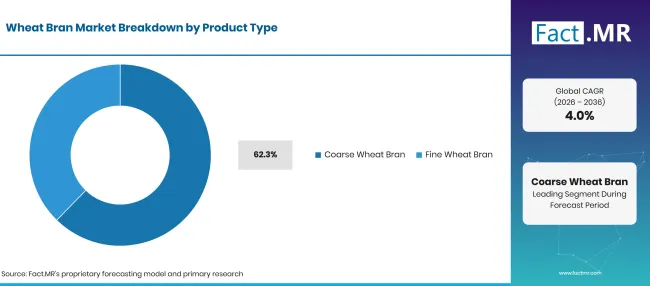
Factmr Wheat Bran Market Breakdown Product Type | Source: Fact.MR
| Product Type | Share (2026) |
|---|---|
| Coarse Wheat Bran (Leading segment) | 62.3% |
| Other segments combined | 37.7%* |
| Total | 100.0% |
Source: Fact.MR analysis. Updated Oct 19, 2026
Coarse wheat bran maintains structural dominance across commercial milling shipments because dairy and beef cattle nutritionists specifically demand larger flake sizes to stimulate rumination and sustain optimal rumen pH levels. Feed compounders blend coarse flakes into dairy total mixed rations to prevent subacute ruminal acidosis during high-grain feeding cycles. Fine wheat bran is prioritized by commercial poultry feed formulators and industrial bread bakeries where uniform small particle dispersion is required. Specialty food processors also separate the aleurone layer to isolate concentrated minerals and bioactive ferulic acid. Sourcing managers evaluate complementary cereal inputs such as 00 flour to optimize bakery blending economics. Flour millers also coordinate shipments of flour treatment agent additives to ensure standardized flour performance.
What leads the Application segment?
Animal Feed accounts for 54.7% share in 2026.
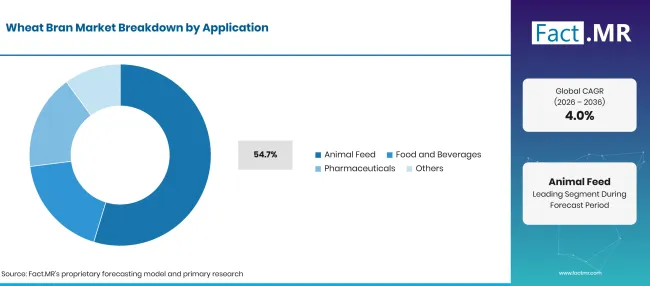
Factmr Wheat Bran Market Breakdown Application | Source: Fact.MR
| Application | Share (2026) |
|---|---|
| Animal Feed (Leading segment) | 54.7% |
| Other segments combined | 45.3%* |
| Total | 100.0% |
Source: Fact.MR analysis. Updated Oct 19, 2026
Animal feed represents the overwhelming volume driver for wheat bran, absorbing more than half of all milling coproducts generated globally. Commercial feed mills blend bran into pelletized rations for swine, broilers, layers, dairy cows, and horses to deliver essential dietary fiber, B vitamins, and trace minerals. Food and beverage applications represent the most lucrative and rapidly expanding sector, driven by consumer interest in digestive wellness, gut microbiome health, and high-fiber snacks. Industrial pharmaceutical manufacturers extract purified cellulose and dietary fiber fractions for laxative tablets and bulking agents. Technological advancements in fermented feed production have dramatically enhanced the digestibility of fibrous coproducts. Concurrently, beverage innovators formulate fiber fortified beverages to offer convenient daily fiber supplementation.
How does Sales Channel influence distribution?
Supermarkets/Hypermarkets accounts for 40.0% share in 2026.
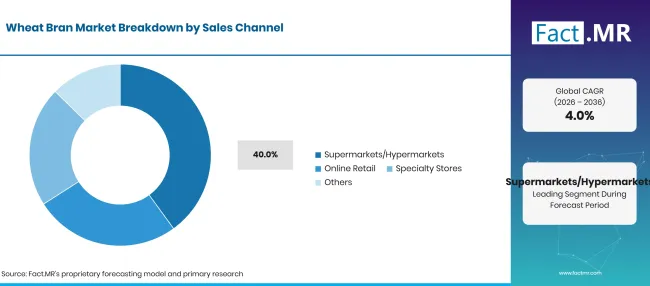
Factmr Wheat Bran Market Breakdown Sales Channel | Source: Fact.MR
| Sales Channel | Share (2026) |
|---|---|
| Supermarkets/Hypermarkets (Leading segment) | 40.0% |
| Other segments combined | 60.0%* |
| Total | 100.0% |
Source: Fact.MR analysis. Updated Oct 19, 2026
Supermarkets and hypermarkets serve as the primary retail channel for packaged consumer wheat bran, offering branded and private-label boxes in the cereal and baking aisles. Consumers purchase stabilized raw wheat bran to sprinkle onto breakfast yogurts, blend into smoothies, or bake into homemade breads and muffins. Online retail channels are growing rapidly as health-conscious consumers subscribe to recurring deliveries of organic, non-GMO, and stone-ground specialty brans. Commercial agricultural supply depots and feed cooperatives handle bulk truckload shipments destined for independent livestock farms and local feed mills. Feed integrators routinely incorporate specialized mineral feed premixes alongside bulk bran deliveries. Agricultural distributors also supply essential feedstuff additives to enhance animal nutrient uptake.
What is accelerating Wheat Bran Market adoption, and what is holding it back?
Expansion of commercial livestock herds, adoption of prebiotic cereal fibers in bakery foods, and circular economy valorization of milling streams accelerate market expansion. Mycotoxin contamination risks from damp harvest seasons, bulky low-density transportation costs, and price sensitivity relative to substitute cereal grains restrict frictionless growth.
Drivers Impact Analysis
| DRIVER | (~) % IMPACT ON CAGR | GEOGRAPHIC RELEVANCE | IMPACT TIMELINE |
|---|---|---|---|
| Global livestock herd expansion and commercial feed pelleting | +1.1% | Global | Short term (<= 2 years) |
| Consumer demand for digestive wellness and dietary fiber foods | +0.9% | North America, Europe | Medium term (2–4 years) |
| Fermentation technologies unlocking bran nutrient bioavailability | +0.8% | East Asia, Europe | Medium term (2–4 years) |
| Commercial adoption in aquaculture floating feed formulations | +0.7% | Asia Pacific, Latin America | Medium term (2–4 years) |
| Circular economy initiatives maximizing agricultural coproducts | +0.5% | Global | Long term (>= 4 years) |
Source: Fact.MR analysis. Updated Oct 19, 2026
Opportunity Impact Analysis
| OPPORTUNITY | (~) % IMPACT ON CAGR | GEOGRAPHIC RELEVANCE | IMPACT TIMELINE |
|---|---|---|---|
| Micronized stabilized bran for clean-label commercial bakery | +1.0% | North America, Europe | Short term (<= 2 years) |
| Bioactive ferulic acid and arabinoxylan dietary nutraceuticals | +0.8% | Western Europe, USA | Medium term (2–4 years) |
| High-protein fermented bran blends replacing costly soy meal | +0.7% | Latin America, Asia | Medium term (2–4 years) |
| Specialized equine digestive mash formulations | +0.5% | North America, UK | Long term (>= 4 years) |
Source: Fact.MR analysis. Updated Oct 19, 2026
Restraints Impact Analysis
| RESTRAINT | (~) % IMPACT ON CAGR | GEOGRAPHIC RELEVANCE | IMPACT TIMELINE |
|---|---|---|---|
| Fusarium mycotoxin contamination during wet grain harvests | -0.9% | North America, Europe | Short term (<= 2 years) |
| High bulk-to-weight freight expenses for long-distance transport | -0.7% | Global | Short term (<= 2 years) |
| Enzymatic rancidity risk limiting unheated bran storage life | -0.6% | Global | Medium term (2–4 years) |
| Price competition from alternative distillers grains and soy hulls | -0.4% | USA, Latin America | Long term (>= 4 years) |
Source: Fact.MR analysis. Updated Oct 19, 2026
Which countries are scaling the Wheat Bran Market through 2036?
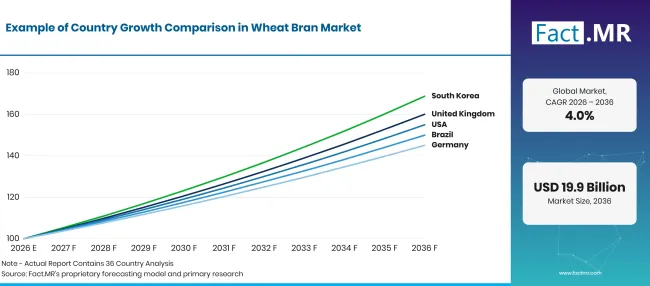
Factmr Wheat Bran Market Growth Index | Source: Fact.MR
| Country | CAGR (2026–2036) |
|---|---|
| UK | 4.82% |
| USA | 4.48% |
| Brazil | 4.14% |
| Germany | 3.79% |
| Japan | 3.23% |
Source: Fact.MR analysis. Updated Oct 19, 2026
Why is the United Kingdom experiencing the fastest regional growth?
4.82% CAGR, driven by high-fiber consumer bakery mandates, regenerative livestock feed practices, and strong domestic flour milling infrastructure.
British commercial bakeries are aggressively introducing wholemeal and high-fiber bread lines to align with national dietary guidelines encouraging increased fiber consumption. Flour mills across East Anglia, Yorkshire, and the Midlands maintain automated separation systems that channel stabilized wheat bran into industrial bakeries and regional feed compounders. British livestock producers prioritize domestically sourced wheat bran over imported protein meals to shrink the carbon footprint of dairy and beef production. Strict retail retailer standards in the UK mandate rigorous screening for deoxynivalenol and other cereal mycotoxins before bran enters feed supply chains.
How is the United States maintaining massive volume consumption?
4.48% CAGR, supported by industrial livestock feeding belts, expanding breakfast cereal manufacturing, and whole-grain consumer trends.
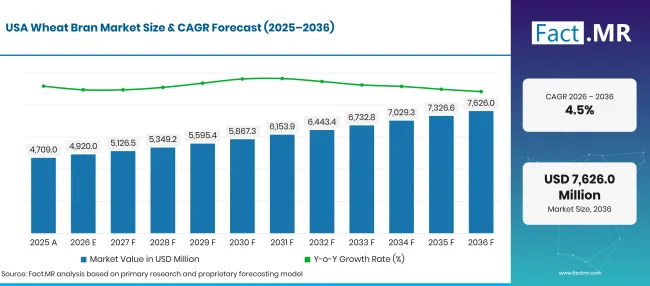
Factmr Wheat Bran Market Forecast Usa | Source: Fact.MR
The United States represents the largest commercial consumer of wheat bran, driven by the colossal requirements of feedlot cattle, swine operations, and poultry integrators in the Midwest and Great Plains. Large agribusiness milling complexes process millions of bushels of wheat annually, generating continuous bran output that moves directly via railcars to commercial feed mixing plants. American food manufacturers incorporate stabilized wheat bran into extruded breakfast cereals, granola bars, and fiber-rich baking mixes. Growing consumer awareness of cardiovascular health and bowel regularity reinforces demand for fiber-fortified packaged foods.
What drives agricultural demand in Brazil?
4.14% CAGR, propelled by expanding commercial cattle feedlots, intensive swine production complexes, and domestic flour milling growth.
Brazilian agribusiness conglomerates in Paraná, Rio Grande do Sul, and São Paulo are expanding wheat cultivation and milling capacity to meet domestic flour demand, yielding abundant bran for regional livestock producers. Intensive cattle feedlots increasingly utilize wheat bran as a palatable fiber source to balance high-energy grain rations during the dry season. Brazil's massive commercial broiler and swine export sectors consume large quantities of pelletized bran feeds. Agribusiness exporters also explore opportunities to pelletize excess bran for bulk maritime export to neighboring South American markets.
What factors support stable utilization in Germany?
3.79% CAGR, underpinned by Germany's deep-rooted artisan and industrial bread culture, rigorous feed hygiene standards, and organic farming regulations.
German consumers hold a deep appreciation for dense, dark whole-grain breads, pumpernickels, and multi-seed baked goods that incorporate significant proportions of wheat bran. Commercial bakeries across North Rhine-Westphalia and Bavaria procure premium stabilized bran to enhance the crust texture, crumb density, and nutritional profiles of artisanal loaves. German feed compounders adhere to strict QS certification protocols, ensuring that feed bran is thoroughly tested for salmonella, pesticide residues, and heavy metals. Germany's expanding organic livestock sector drives steady demand for certified organic wheat bran sourced from domestic ecological farms.
Why is Japan sustaining demand for high-purity wheat bran?
3.23% CAGR, driven by specialized wagyu beef feeding protocols, functional fiber food approvals, and strict grain import quality controls.
Japanese livestock producers utilize carefully measured proportions of wheat bran in high-grade wagyu cattle diets to regulate digestion, promote ruminal stability, and support optimal intramuscular fat marbling. Japanese food manufacturers incorporate micronized soluble and insoluble wheat bran into government-approved Foods for Specified Health Uses (FOSHU) targeting blood sugar regulation and digestive health. Because Japan imports the vast majority of its food wheat via government tenders, domestic flour mills in coastal ports operate under rigorous sanitation standards, producing premium-grade bran free from foreign matter.
Who leads the Wheat Bran Market?
Cargill Incorporated holds a dominant global position in agricultural supply chains, operating expansive wheat origination, flour milling, and compound animal feed processing networks across North America, Europe, and Latin America. Archer Daniels Midland Company (ADM) and Bunge Global SA process vast volumes of cereal grains, delivering stabilized wheat bran fractions and customized livestock feed formulations to global agribusiness customers. Ardent Mills operates premier flour milling facilities across the United States, providing standardized food-grade bran and commercial feed coproducts.
Grain Millers Inc. and Bay State Milling Company specialize in organic, non-GMO, and identity-preserved wheat bran products tailored for specialty consumer bakery and clean-label food processors. General Mills Inc. and Associated British Foods plc utilize substantial captive bran volumes in branded breakfast cereals and packaged baked goods while distributing surplus feed streams. Siemer Milling Company and Hodgson Mill supply high-quality culinary wheat bran and stone-ground whole-grain products. Grain traders coordinate shipments of primary feed materials and single feed commodities to stabilize regional feed supplies. Nutritionists also integrate animal feed probiotics and standardized dietary fibers to enhance livestock growth.
Which companies are the key providers?
Key companies include Cargill Incorporated; Archer Daniels Midland Company; Bunge Global SA; Ardent Mills; Grain Millers Inc.; Bay State Milling Company; General Mills Inc.; Associated British Foods plc; Siemer Milling Company; and Hodgson Mill.
- Cargill Incorporated
- Archer Daniels Midland Company
- Bunge Global SA
- Ardent Mills
- Grain Millers Inc.
- Bay State Milling Company
- General Mills Inc.
- Associated British Foods plc
- Siemer Milling Company
- Hodgson Mill
Bibliography
- [1] PMC. (2025, January 18). Dietary fiber from wheat bran improves intestinal barrier function and gut microbiota in animal nutrition models. PMC13163089.
- [2] PMC. (2025, February 11). Effects of fermented wheat bran on nutrient digestibility, growth performance, and fecal microbiota in swine diets. PMC12042227.
- [3] PMC. (2025, March 05). Impact of wheat bran particle size on gizzard development and nutrient utilization in poultry feeds. PMC12907871.
- [4] USDA Economic Research Service. (2024, November 14). Wheat sector: Flour milling byproducts, supply balances, and feed utilization.
- [5] USDA Economic Research Service. (2024, December 10). Wheat sector at a glance: Coproduct supplies, animal feed balances, and trade dynamics.
This Report Answers
- The report evaluates production volumes and pricing spreads between coarse and fine wheat bran across global milling centers.
- Application assessments detail why compound animal feed formulations absorb over half of all commercially milled wheat bran.
- Country-level analysis investigates the agricultural and economic factors enabling the United Kingdom and the United States to lead value expansion.
- Nutritional profiling compares the digestive kinetics of insoluble arabinoxylans, phytate degradation, and fiber fermentation across livestock species.
- Competitive profiling benchmarks flour milling capacities, bran stabilization technologies, and bulk logistics infrastructure across top agribusiness operators.
What does the Wheat Bran Market cover?
The market encompasses commercial shipments of separated wheat bran coproducts generated during the commercial milling of common and durum wheat. It tracks raw, heat-stabilized, and pelletized bran streams channeled into animal feed compounding mills, commercial bread bakeries, breakfast cereal extrusion plants, and dietary fiber extraction facilities. The analysis evaluates volume movements across wholesale bulk freight networks as well as retail packaged fiber products.
What is included in the scope?
The scope covers merchant and captive shipments of wheat bran sold in bulk truckloads, railcars, shipping containers, and consumer retail packaging. Revenues reflect the transactional value of processed bran coproducts at milling gate and wholesale distribution price levels. Value-added stabilized brans, micronized flour-grade brans, and certified organic brans are fully evaluated within the market revenue boundaries.
What is excluded from the scope?
The scope excludes whole unprocessed wheat grain, endosperm-derived white flour, separated wheat germ, and wheat middlings that contain excessive flour dust outside standard bran specifications. Synthetic cellulose fibers, oat bran, and rice bran are excluded from wheat bran market totals. Industrial flour milling equipment, grain storage silos, and roller mill machinery are outside the scope of this commodity report.
How Was the Analysis Built?
The analysis draws on 120+ sources, 35+ company portfolios, 25+ countries, and more than 20 industry interviews.
- Primary Research: Primary research includes discussions with manufacturers, service providers, technology developers, distributors, end users, and subject-matter experts. These conversations examine purchasing priorities, product adoption, operational challenges, approval requirements, competitive positioning, and the factors that influence wider market acceptance.
- Desk Research: Desk research covers government statistics, regulatory publications, company filings, trade data, technical studies, industry associations, standards, public policy, and other authoritative sources. Every source used in the analysis is documented in the bibliography.
- Market Sizing and Forecasting: Market estimates combine historical performance, demand indicators, pricing and volume trends, segment shares, company participation, country-level growth, adoption patterns, investment activity, and barriers to market expansion.
- Data Validation and Update Cycle: Findings are validated by comparing primary interviews with public data, company activity, regulatory changes, trade patterns, and industry developments. Regular updates review new product launches, capacity changes, partnerships, approvals, and shifts in commercial adoption.
Segmentation
What is the report’s scope and coverage?
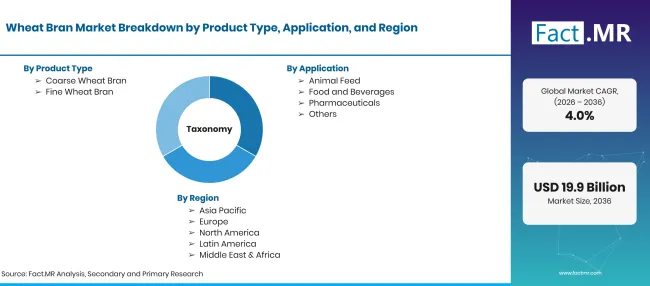
Factmr Wheat Bran Market Taxonomy | Source: Fact.MR
| Attribute | Details |
|---|---|
| Quantitative Units | USD billion |
| Market Definition | The outer protective husk layers of the wheat kernel (Triticum aestivum) separated during dry roller milling, processed into coarse or fine bran for livestock feeds and food manufacturing. |
| Product Type | Coarse Wheat Bran; Fine Wheat Bran |
| Application | Animal Feed; Food and Beverages; Pharmaceuticals; Others |
| Sales Channel | Supermarkets/Hypermarkets; Online Retail; Specialty Stores; Others |
| End-User | Livestock Industry; Food Industry; Pharmaceutical Industry; Others |
| Regions Covered | North America; Latin America; Western Europe; Eastern Europe; East Asia; South Asia & Pacific; Middle East & Africa |
| Countries Covered | UK; USA; Brazil; Germany; Japan |
| Companies Profiled | Cargill Incorporated; Archer Daniels Midland Company; Bunge Global SA; Ardent Mills; Grain Millers Inc.; Bay State Milling Company; General Mills Inc.; Associated British Foods plc; Siemer Milling Company; Hodgson Mill |
| Forecast Period | 2026 to 2036 |
| Approach | Primary interviews with commercial grain millers, compound feed formulators, industrial bakery directors, and trade logistics operators combined with USDA and international cereal trade balances |
Source: Fact.MR analysis. Updated Oct 19, 2026
How is the market segmented?
-
By Product Type:
- Coarse Wheat Bran
- Fine Wheat Bran
-
By Application:
- Animal Feed
- Food and Beverages
- Pharmaceuticals
- Others
-
By Sales Channel:
- Supermarkets/Hypermarkets
- Online Retail
- Specialty Stores
- Others
-
By End-User:
- Livestock Industry
- Food Industry
- Pharmaceutical Industry
- Others
-
By Region:
- North America
- Latin America
- Western Europe
- Eastern Europe
- East Asia
- South Asia & Pacific
- Middle East & Africa
Frequently Asked Questions
How big is the wheat bran market in 2026?
What is the CAGR from 2026 to 2036?
Which product type leads?
Which application leads?
Which companies participate in wheat bran?
Who worked on this report


Preview the report firsthand - request a free sample
Free SampleGet the brochure for pricing and purchase details
Download PDF