- Market Value (2025): USD 1.6 Bn
- Estimated Value (2026): USD 1.7 Bn
- Forecast Value (2036): USD 3.2 Bn
- CAGR (2026-2036): 6.4%
What is the White Noise Machine Market forecast to be worth by 2036?
USD 1.7 billion in 2026 to USD 3.2 billion by 2036, at a 6.4% CAGR.
White noise machines are often evaluated alongside other sleep-support products when buyers compare sound masking with broader bedtime routines.
- The white noise machine market reached USD 1.6 billion in 2025 as sleep-product brands and hospitality buyers spent against a clear use case: controlled sound masking for sleep routines, privacy, focus and travel use.
- Demand is projected to increase from USD 1.7 billion in 2026 to USD 3.2 billion by 2036, at a 6.4% CAGR.
- The market is forecast to record 6.4% CAGR from 2026 to 2036. Controlled sound masking for sleep routines and travel use remains a central product requirement.
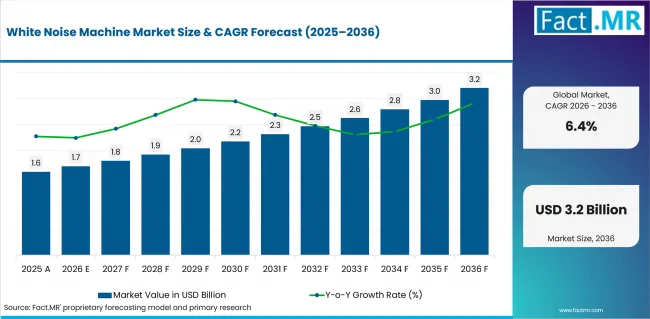
White Noise Machine Market Value Analysis | Source: Fact.MR
What are the defining numbers behind White Noise Machine Market growth?
USD 1.5 billion absolute opportunity is expected by 2036.
Nursery applications require clear safety guidance, especially when parents evaluate electronics used near a child.
- Demand Drivers in the Market
- Plug-in formats continue to gain traction as buyers expect a device that stays in one sleep location, runs through the night and avoids battery anxiety. This keeps bedside and nursery use close to the electrical-outlet format.
- Adult sleep and focus use is a key application as white noise is bought to block street noise and travel disruption. This creates a more repeatable purchase case.
- Online retail leads as shoppers compare sound libraries night-light features and user reviews before choosing a device. The channel also gives smaller brands room to explain decibel guidance and placement.
- Digital sound generation continues to gain share as it lets suppliers offer multiple sound profiles, app control and timer presets while keeping the product compact. The risk is sameness, so differentiation has to come from sound quality and safety communication.
- Key Segments Analyzed
- By Product Type: Plug-in Noise Machines is projected to hold 38.5% share in 2026. Plug-in noise machines lead because many purchases are tied to a fixed sleep space. The format gives parents and hospitality buyers a predictable overnight setup with fewer charging concerns.
- By End User: Individual Consumers is projected to hold 30.2% share in 2026. Individual consumers lead as most purchases are self-funded and tied to a household pain point. Institutional use exists in hospitality and care settings, but the core cycle begins with personal sleep or focus needs.
- By Distribution Channel: Online sales channel is projected to hold 57.3% share in 2026. Buyers use online channels to compare sound options, controls, portability, safety guidance, and user reviews before purchase.
- By Technology: Digital Sound Generation is projected to hold 42.8% share in 2026. Digital sound generation leads because it supports sound libraries and compact device designs. Mechanical fan-based units still matter where buyers prefer non-looping sound, but digital units give wider control.
- Analyst Opinion at Fact.MR
- Shambhu Nath Jha, Sr. Consultant at Fact.MR, opines, "White noise machines continue to gain share as users look for concentration. The stronger brands are focusing on selling a safer, repeatable sleep routine with controls that ordinary households understand."
- Strategic Implications
- Brands should make decibel guidance and power safety visible on product pages and packaging.
- Retailers should segment nursery, adult sleep, focus and travel use separately because each occasion has different safety and feature expectations.
- Companies should avoid broad wellness promises and instead prove the narrow job: stable masking sound, easy controls and dependable overnight operation.
The USA is projected to record 8.31% CAGR from 2026 to 2036, followed by Japan at 7.70%, Germany at 7.04%, the UK at 6.40%, Canada at 5.75%, South Korea at 5.09%, and Australia at 4.50%.
How does the White Noise Machine Market break down by segment?
Plug-in Noise Machines lead Product Type at 38.5%.
The sound-quality discussion also connects with Fact.MR's Sound Reception System Market, where reception and device reliability shape the buyer's trust.
Why does Plug-in Noise Machines lead Product Type?
Plug-in Noise Machines is projected to account for 38.5% share in 2026.
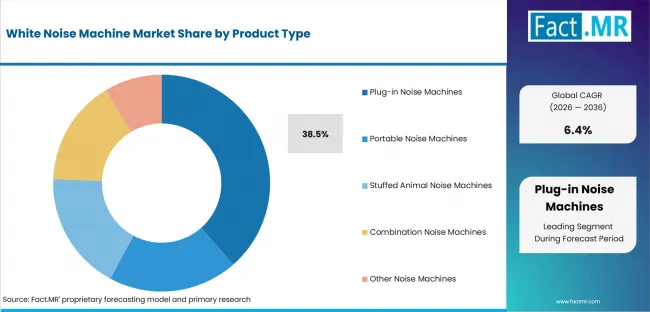
White Noise Machine Market Analysis By Product Type | Source: Fact.MR
Plug-in noise machines lead because many purchases are tied to a fixed sleep space. The format is preferred by many end-users.
Why does Individual Consumers lead End User?
Individual Consumers is projected to account for 30.2% share in 2026.
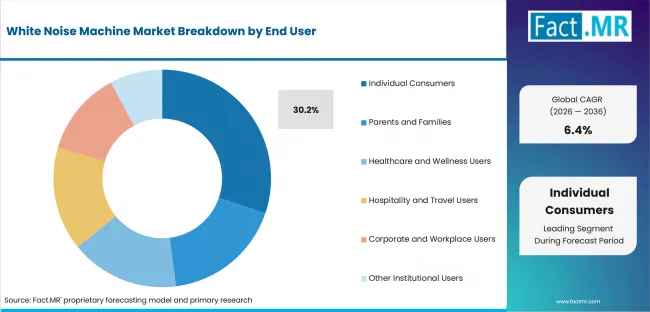
White Noise Machine Market Analysis By End User | Source: Fact.MR
Individual consumers lead as most purchases are self-funded and tied to a household pain point. Institutional use exists in hospitality and care settings, but the core cycle begins with personal sleep or focus needs.
Why does Online lead Distribution Channel?
Online is projected to account for 57.3% share in 2026.
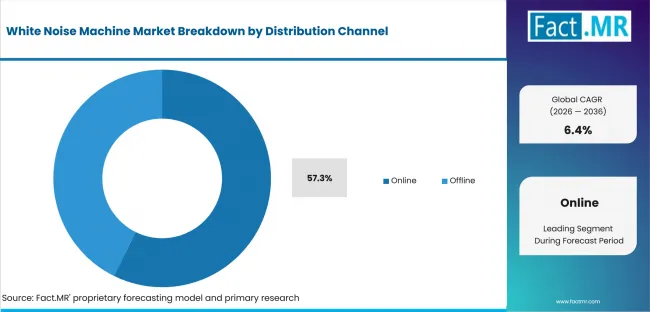
White Noise Machine Market Analysis By Distribution Channel | Source: Fact.MR
Online leads because product comparison matters. Buyers want to evaluate volume controls, sound options, portability, child-safety claims and reviews before purchase.
Why does Digital Sound Generation lead Technology?
Digital Sound Generation is projected to account for 42.8% share in 2026.
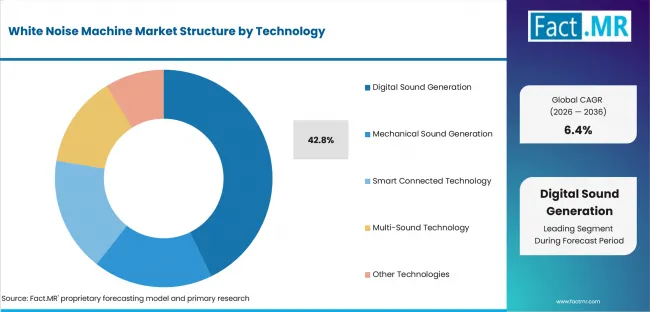
White Noise Machine Market Analysis By Technology | Source: Fact.MR
Digital sound generation leads as it supports sound libraries, timers and compact device designs. Mechanical fan-based units still matter where buyers prefer non-looping sound, but digital units give wider assortment control.
What is accelerating White Noise Machine Market adoption, and what is holding it back?
Adoption is strongest where buyers can see the product's practical job and the proof needed to approve it. The main drag is buyer doubt around safety, cost, performance or documentation.
Clinical sleep equipment is outside this market, but Fact.MR's Continuous Positive Airway Pressure (CPAP) Device Market helps keep consumer masking devices separate from therapeutic respiratory equipment.
Drivers Impact Analysis
| DRIVER | QUALITATIVE RELEVANCE | GEOGRAPHIC RELEVANCE | IMPACT TIMELINE |
|---|---|---|---|
| Plug-in overnight use | High | South Korea | Short term (<=2 years) |
| Adult sleep and focus routines | High | USA | Short term (<=2 years) |
| Online comparison of sound, timers and reviews | Moderate | Australia | Medium term (2-4 years) |
| Digital sound libraries and smart controls | Selective | Germany | Medium term (2-4 years) |
Source: Fact.MR analysis. Updated Jul 29, 2026
- Plug-in models remain popular for overnight use: Buyers often use white noise machines in one fixed place, such as beside the bed or in a nursery. A plug-in model can run all night without the worry of the battery running out. Portable models are becoming more common, but plug-in devices still suit regular home use.
- Adults use white noise for sleep and concentration: Many adults use white noise to reduce traffic sounds, noise from other rooms or distractions at work. Some also carry these devices while travelling. Since these problems occur regularly, adults are more likely to use the product often.
- Most buyers compare products online: People usually check the type of sounds, timer settings, night-light options and customer reviews before buying. They may also compare fan-based machines with digital models. Online stores help smaller brands explain their features and provide guidance on safe volume and device placement.
- Digital models offer more sound choices: Digital white noise machines can include different sounds, timer settings and app controls in a small device. However, many products now offer similar features. Brands therefore need to compete through better sound quality, easier controls and clear safety information.
Opportunity Impact Analysis
| OPPORTUNITY | QUALITATIVE RELEVANCE | GEOGRAPHIC RELEVANCE | IMPACT TIMELINE |
|---|---|---|---|
| Nursery-safe volume guidance | High | South Korea | Medium term (2-4 years) |
| Travel and remote-work bundles | Moderate | USA | Medium term (2-4 years) |
| Hospitality and care-facility assortments | Selective | Australia | Medium term (2-4 years) |
Source: Fact.MR analysis. Updated Jul 29, 2026
- Clear volume guidance can build trust with parents: Parents are more careful about sound levels when a device is used in a nursery or around young children. Brands that give clear guidance on safe volume and placement can stand out from cheaper products that offer little safety information.
- Travel bundles can support higher prices: People who use white noise while travelling or working remotely may prefer a compact device with USB charging, timer settings and a carrying case. Selling these features together can make the product more useful and justify a higher price.
- Hotels and care facilities can create repeat demand: Hotels, nursing homes and care facilities may buy these devices in larger numbers. They are more likely to reorder products that are easy to clean, simple for staff to use and quick to replace when needed.
Restraints Impact Analysis
| RESTRAINT | QUALITATIVE RELEVANCE | GEOGRAPHIC RELEVANCE | IMPACT TIMELINE |
|---|---|---|---|
| Volume-safety concern in infant and child use | High | South Korea | Short term (<=2 years) |
| Marketplace price pressure | Moderate | USA | Medium term (2-4 years) |
| Electrical adapter and durability confidence | Selective | Australia | Medium term (2-4 years) |
Source: Fact.MR analysis. Updated Jul 29, 2026
- Safety concerns can affect parents’ trust: Parents may avoid white noise machines if brands do not explain safe volume levels or where the device should be placed. This concern is greater when the product is meant for babies or young children.
- Low-cost online products put pressure on prices: Many marketplace and private-label products make similar claims, which makes it difficult for buyers to see why one model costs more than another. Since shoppers cannot judge sound quality before buying, price often becomes a major factor.
- Adapter and durability issues can discourage buyers: Recalls, faulty adapters and complaints about products breaking too soon can hurt confidence in the category. Buyers are especially cautious because these devices often run through the night without supervision.
Which countries are scaling White Noise Machine Market fastest?
Country rates show where buying conditions and supplier proof are already stronger.
Volume guidance also matters for adjacent hearing categories, so Fact.MR's Hearing Aid Market is useful context when safety claims are assessed country by country.
- South Korea: The market is expected to grow at a CAGR of 5.09% from 2026 to 2036. Demand is supported by dense urban living, strong e-commerce use and interest in compact sleep products. Brands will still need to provide clear guidance on volume safety and power reliability, especially for products used around infants and children.
- USA: The market is expected to grow at a CAGR of 8.31% from 2026 to 2036. Online reviews, adult sleep needs and a well-developed baby-care market support demand. Brands that clearly explain safe placement, product life and electrical safety are likely to earn more trust than those making broad sleep-related claims.
- Australia: The market is expected to grow at a CAGR of 4.50% from 2026 to 2036. Online specialty stores and travel use are helping the category grow, although buyers remain careful about price. Compact models with reliable warranty support are likely to perform better than low-cost products with few clear differences.
- Germany: The market is expected to grow at a CAGR of 7.04% from 2026 to 2036. German buyers tend to pay close attention to product safety, power reliability and energy use. Clear product information and durable electrical parts may matter more than offering a very large sound library.
- Canada: The market is expected to grow at a CAGR of 5.75% from 2026 to 2036. Buyers often discover products through online stores and reviews, much like in the USA. Demand also comes from long indoor periods during winter and noise in shared homes. Retailers may improve sales by clearly separating products meant for adult sleep from those designed for nurseries.
The full report provides country-level CAGR analysis across North America, Latin America, Europe, East Asia, South Asia and Oceania, and the Middle East and Africa.
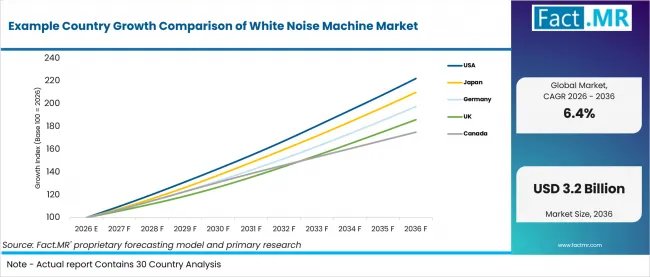
Example Country Growth Comparison Of White Noise Machine Market | Source: Fact.MR
| Country | CAGR (2026-2036) |
|---|---|
| South Korea | 5.09% |
| USA | 8.31% |
| Australia | 4.50% |
| Germany | 7.04% |
| Canada | 5.75% |
| Japan | 7.70% |
| UK | 6.40% |
Source: Fact.MR analysis. Updated Jul 29, 2026
What is shaping South Korea's outlook through 2036?
5.09% CAGR from 2026 to 2036.
South Korea's outlook is helped by dense urban housing, high e-commerce use and consumer interest in compact sleep products. Growth still depends on clear safety claims because infant and family use is sensitive to volume and power reliability.
What is shaping USA's outlook through 2036?
8.31% CAGR from 2026 to 2036.
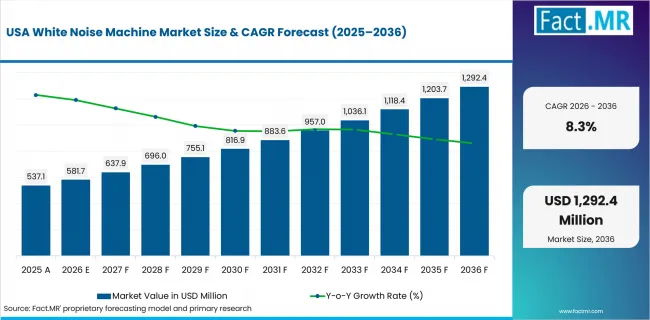
White Noise Machine Market Country Value Analysis | Source: Fact.MR
USA demand is shaped by online review behavior, adult sleep routines and a strong baby-care channel. Brands that explain safe placement and product durability have a cleaner path than sellers relying only on broad sleep-aid claims.
What is shaping Australia's outlook through 2036?
4.50% CAGR from 2026 to 2036.
Australia benefits from online specialty retail and travel use, but buyers remain price conscious. Compact devices with clear warranty support are better placed than undifferentiated marketplace listings.
What is shaping Germany's outlook through 2036?
7.04% CAGR from 2026 to 2036.
Germany's adoption is steadier because consumers weigh product safety, power reliability and household energy use. Clear documentation and durable electrical design matter more than large sound libraries alone.
What is shaping Canada's outlook through 2036?
5.75% CAGR from 2026 to 2036.
Canada follows USA-style e-commerce discovery, with added demand from winter indoor routines and shared housing noise. Retailers can improve conversion by separating adult sleep from nursery use.
Who leads the White Noise Machine Market?
HoMedics USA; Conair Corporation; Hatch Ltd.; Marpac, LLC (Yogasleep) are among the visible providers in the white noise machine market.
HoMedics USA and Conair Corporation are among the most visible providers. Competition is shaped by product proof, channel access and buyer trust.
Between 2026 and 2036, market rivalry is likely to center on clearer positioning around Plug-in Noise Machines, stronger documentation and better support at the point of purchase.
Which companies are the key providers?
Key companies include HoMedics USA; Conair Corporation; Hatch Ltd.; Marpac, LLC (Yogasleep); Snooz, Inc.; Adaptive Sound Technologies, Inc. (LectroFan); Sweet ZZZ Mattress; Munchkin, Inc..
- HoMedics USA
- Conair Corporation
- Hatch Ltd.
- Marpac, LLC (Yogasleep)
- Snooz, Inc.
- Adaptive Sound Technologies, Inc. (LectroFan)
- Sweet ZZZ Mattress
- Munchkin, Inc.
Bibliography
- American Academy of Pediatrics, Noise Exposure.
- HealthyChildren.org, AAP Sounds Alarm on Excessive Noise Risks to Children.
- CDC NIOSH, Noise-Induced Hearing Loss.
- CDC, About Sleep.
- CPSC, Marpac Recalls Sound Machines Due to Burn Hazard.
- Fact.MR, Sleeping Aids Market.
This Report Answers
- The report provides strategic intelligence on the White Noise Machine Market across segment choices that shape the 2026 market structure.
- Segment analysis covers Plug-in Noise Machines and Adults as the share leaders within the 2026 market.
- Country outlook evaluates the listed markets by CAGR and explains how similar growth rates can carry different adoption conditions.
- Competitive analysis profiles the named providers and evaluates competition around product proof, channel access and buyer trust.
- Internal linking connects the report only with related Fact.MR report pages.
What does the White Noise Machine Market cover?
The White Noise Machine Market covers plug-in, portable, stuffed-animal, combination and smart connected sound machines used for sleep, relaxation, focus, privacy and travel-related sound masking.
The White Noise Machine Market covers plug-in, portable, stuffed-animal, combination and smart connected sound machines used for sleep, relaxation, focus, privacy and travel-related sound masking.
Adjacent spending is included only when it is part of the same purchase decision or operating use case.
What is included in the scope?
The scope includes Product Type, Application, End User, Distribution Channel, Technology and regional demand.
Coverage includes adjacent segment options only when they are purchased for the same defined market use.
What is excluded from the scope?
clinical sleep-disorder treatment devices, CPAP systems, hearing aids, generic speakers and mobile apps that are not sold as dedicated white-noise or sleep-sound machines.
The scope excludes clinical sleep-disorder treatment devices, CPAP systems, hearing aids, generic speakers and mobile apps that are not sold as dedicated white-noise or sleep-sound machines.
How Was the Analysis Built?
The analysis combines primary research with desk research focused on the white noise machine market, its segment structure and country-level demand.
- Primary Research: Interviews and validation discussions test buyer priorities, adoption barriers, pricing logic and operating requirements.
- Desk Research: The assessment reviews company disclosures, public datasets, regulatory material, technical literature and industry records relevant to the market.
- Market Sizing and Forecasting: Estimates combine top-down and bottom-up checks across demand signals, segment shares, country activity, company participation and adoption constraints.
- Data Validation and Update Cycle: Findings are validated against public evidence, company activity and country-level adoption patterns before final use.
Segmentation
What is the report's scope and coverage?
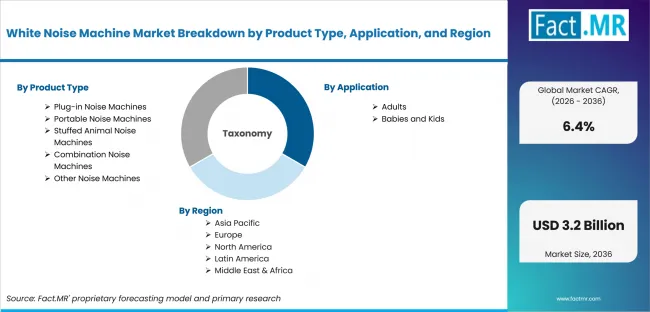
White Noise Machine Market Breakdown By Product Type, Application, And Region | Source: Fact.MR
| Attribute | Details |
|---|---|
| Quantitative Units | USD 1.7 billion in 2026 to USD 3.2 billion by 2036, at a 6.4% CAGR. |
| Market Definition | White Noise Machine Market covers plug-in, portable, stuffed-animal, combination and smart connected sound machines used for sleep, relaxation, focus, privacy and travel-related sound masking. |
| Product Type | Plug-in Noise Machines; Traditional Plug-in Sound Machines; Advanced Plug-in Sound Machines; Portable Noise Machines; Travel Portable Noise Machines; Battery-Powered Portable Machines; Stuffed Animal Noise Machines; Plush Animal Sound Machines; Baby Comfort Sound Toys; Combination Noise Machines; White Noise and Night-Light Combinations; Sound and Sleep-Timer Combinations; Other Noise Machines; Smart Connected Noise Machines; Multi-Sound Wellness Devices |
| Application | Adults; Sleep and Insomnia Management; Relaxation and Stress Reduction; Babies and Kids; Infant Sleep Support; Children's Sleep and Soothing |
| End User | Individual Consumers; Adults and Sleep Aid Users; Students and Remote Workers; Parents and Families; Parents of Infants; Families with Young Children; Healthcare and Wellness Users; Sleep Therapy Users; Meditation and Relaxation Users; Hospitality and Travel Users; Hotels and Resorts; Travelers and Frequent Flyers; Corporate and Workplace Users; Office Workers; Focus and Productivity Users; Other Institutional Users; Educational Institutions; Care and Assisted Living Facilities |
| Distribution Channel | Online; E-Commerce Marketplaces; Brand-Owned Online Stores; Offline; Specialty Electronics Stores; Mass Merchandisers and Department Stores |
| Technology | Digital Sound Generation; Digital White Noise Generation; Digital Nature and Ambient Sounds; Mechanical Sound Generation; Mechanical Fan-Based Sound; Physical Acoustic Noise Generation; Smart Connected Technology; Bluetooth and Smartphone Connectivity; Wi-Fi and Smart Home Integration; Multi-Sound Technology; Multi-Track Sound Libraries; Customizable Sound Profiles; Other Technologies; Voice Assistant Integration; Adaptive Sound and Automatic Volume Control |
| Regions Covered | North America; Latin America; Europe; East Asia; South Asia and Oceania; Middle East and Africa |
| Countries Covered | South Korea; USA; Australia; Germany; Canada; Japan; UK |
| Key Companies Profiled | HoMedics USA; Conair Corporation; Hatch Ltd.; Marpac, LLC (Yogasleep); Snooz, Inc.; Adaptive Sound Technologies, Inc. (LectroFan); Sweet ZZZ Mattress; Munchkin, Inc. |
| Forecast Period | 2026 to 2036 |
| Approach | Hybrid top-down and bottom-up assessment using demand indicators, segment mix, country growth, company participation and public evidence relevant to the category. |
Source: Fact.MR analysis. Updated Jul 29, 2026
How is the market segmented?
-
By Product Type:
- Plug-in Noise Machines
- Traditional Plug-in Sound Machines
- Advanced Plug-in Sound Machines
- Portable Noise Machines
- Travel Portable Noise Machines
- Battery-Powered Portable Machines
- Stuffed Animal Noise Machines
- Plush Animal Sound Machines
- Baby Comfort Sound Toys
- Combination Noise Machines
- White Noise and Night-Light Combinations
- Sound and Sleep-Timer Combinations
- Other Noise Machines
- Smart Connected Noise Machines
- Multi-Sound Wellness Devices
-
By Application:
- Adults
- Sleep and Insomnia Management
- Relaxation and Stress Reduction
- Babies and Kids
- Infant Sleep Support
- Children's Sleep and Soothing
-
By End User:
- Individual Consumers
- Adults and Sleep Aid Users
- Students and Remote Workers
- Parents and Families
- Parents of Infants
- Families with Young Children
- Healthcare and Wellness Users
- Sleep Therapy Users
- Meditation and Relaxation Users
- Hospitality and Travel Users
- Hotels and Resorts
- Travelers and Frequent Flyers
- Corporate and Workplace Users
- Office Workers
- Focus and Productivity Users
- Other Institutional Users
- Educational Institutions
- Care and Assisted Living Facilities
-
By Distribution Channel:
- Online
- E-Commerce Marketplaces
- Brand-Owned Online Stores
- Offline
- Specialty Electronics Stores
- Mass Merchandisers and Department Stores
-
By Technology:
- Digital Sound Generation
- Digital White Noise Generation
- Digital Nature and Ambient Sounds
- Mechanical Sound Generation
- Mechanical Fan-Based Sound
- Physical Acoustic Noise Generation
- Smart Connected Technology
- Bluetooth and Smartphone Connectivity
- Wi-Fi and Smart Home Integration
- Multi-Sound Technology
- Multi-Track Sound Libraries
- Customizable Sound Profiles
- Other Technologies
- Voice Assistant Integration
- Adaptive Sound and Automatic Volume Control
-
By Region:
- North America
- Latin America
- Europe
- East Asia
- South Asia and Oceania
- Middle East and Africa
Frequently Asked Questions
Which Product Type leads the market?
Which Application leads the market?
Which End User leads the market?
Which Distribution Channel leads the market?
Which Technology leads the market?
Which country records the highest listed CAGR?
What is the primary driver in this market?
What is the main restraint?
Who worked on this report


Preview the report firsthand - request a free sample
Free SampleGet the brochure for pricing and purchase details
Download PDF