Wi-Fi Market (2026 - 2036)

Wi-Fi Market is segmented by Component (Hardware, Solutions, and Services), Density (Hi-Density and Enterprise-Class), Location Type (Indoor and Outdoor), Organization Type (Large Enterprises and SMEs), Vertical (Education, Healthcare and Life Sciences, Transportation and Logistics, Retail and e-Commerce, Government, Manufacturing, and Hospitality), and Region. Forecast for 2026 to 2036.

Core Findings

    Wi-Fi Market Forecast By Fact.MR

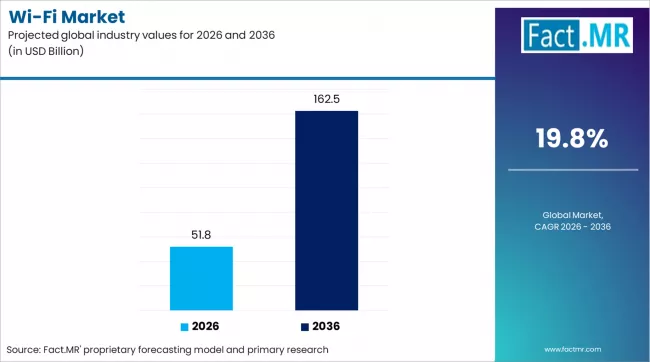
    In 2025, the Wi-Fi market was valued at USD 43.2 billion. Based on Fact MR analysis, demand for Wi-Fi solutions is estimated to grow to USD 51.8 billion in 2026 and USD 162.5 billion by 2036. FMR projects a CAGR of 19.8% during the forecast period.

    The absolute dollar growth from 2026 to 2036 is USD 110.7 billion. This magnitude of expansion reflects a structural shift in wireless connectivity infrastructure rather than incremental network upgrades. Wi-Fi technologies are increasingly deployed across residential broadband, enterprise networking, industrial automation, and public connectivity systems. Growth is supported by rising device connectivity, expansion of smart homes, and increasing data traffic across digital platforms. Deployment of advanced standards such as Wi-Fi 6 and Wi-Fi 7 continues to drive infrastructure upgrades. Growth remains influenced by semiconductor component costs, spectrum management policies, and network security requirements.
    Wi Fi Market Industry Value Analysis

    Metric Details
    Industry Size (2026E) USD 51.8 billion
    Industry Value (2036F) USD 162.5 billion
    CAGR (2026 to 2036) 19.8%

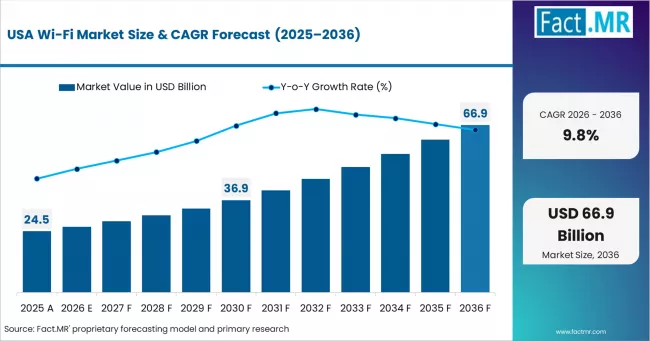
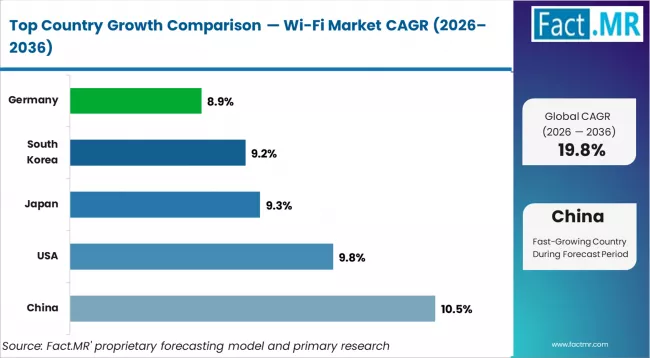
    China leads with a projected CAGR of 10.5%, supported by large scale deployment of wireless infrastructure and strong demand for connected consumer devices. The United States follows with a CAGR of 9.8%, driven by enterprise network upgrades and expanding home broadband connectivity. Japan records a CAGR of 9.3%, reflecting steady adoption across consumer electronics and industrial networking environments. South Korea shows a CAGR of 9.2%, supported by advanced telecommunications infrastructure and high device connectivity rates. Germany records the slowest growth at 8.9%, reflecting a mature networking equipment market where demand is increasingly linked to replacement and upgrade cycles.

    Summary of the Wi-Fi Market

    • Market Definition
      • The market comprises wireless networking technologies and equipment that enable devices to connect to local networks and the internet using radio frequency signals. Wi-Fi systems operate on standardized protocols and include routers, access points, and network interface components. These systems support short range wireless communication across residential, enterprise, and public environments, enabling data transmission, internet access, and connectivity for digital devices.
    • Demand Drivers
      • Increasing number of connected devices across residential, enterprise, and industrial environments requiring reliable wireless connectivity.
      • Rising deployment of Wi-Fi infrastructure in smart homes, enterprise networks, and public access environments.
      • Expansion of data traffic driven by digital applications, streaming services, and cloud based platforms.
      • Adoption of advanced Wi-Fi standards such as Wi-Fi 6 and Wi-Fi 7 supporting higher bandwidth and improved network efficiency.
    • Key Segments Analyzed
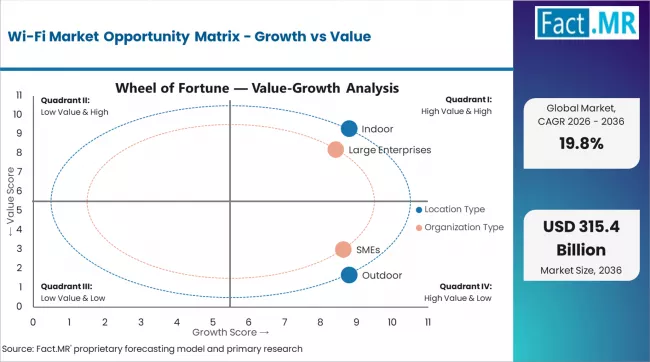
      • Location Type: Indoor deployments account for about 70% share supported by demand for connectivity in homes, offices, and commercial buildings.
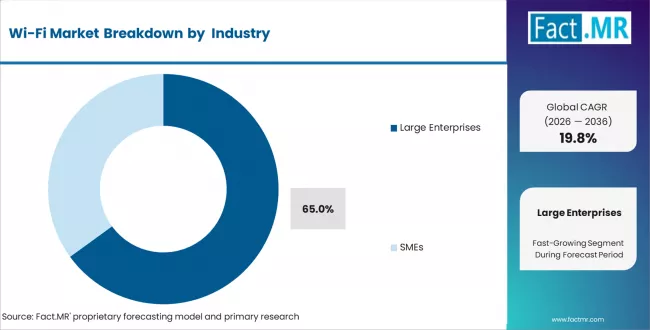
      • Organization Type: Large enterprises represent roughly 65% share due to extensive network infrastructure requirements and high device density.
      • Component: Hardware, solutions, and services collectively support deployment across residential and enterprise networking environments.
      • Geography: China records the fastest expansion supported by large scale wireless infrastructure deployment and high device connectivity.
    • Analyst Opinion at Fact MR
      • Shambhu Nath Jha, Principal Consultant, Fact MR, opines, "In this updated edition of the Wi-Fi Market report, industry participants will observe that wireless connectivity infrastructure continues to expand across residential and enterprise environments. Wi-Fi technologies support high speed data transmission and network access across connected devices. Companies developing advanced networking equipment and supporting next generation wireless standards will maintain strong positions in the global connectivity market."
    • Strategic Implications or Executive Takeaways
      • Invest in development of next generation Wi-Fi technologies supporting high bandwidth and low latency communication.
      • Expand deployment of wireless infrastructure across enterprise networks, smart homes, and public connectivity systems.
      • Strengthen network security capabilities to address risks associated with wireless communication environments.
      • Enhance semiconductor and networking equipment supply chains supporting large scale Wi-Fi deployment.
    • Methodology
      • Primary interviews conducted with networking equipment manufacturers, telecommunications providers, system integrators, and enterprise IT managers.
      • Desk research based on telecommunications industry publications, company reports, regulatory filings, and international trade statistics.
      • Market sizing developed through a hybrid approach combining bottom up equipment shipment analysis and top down demand assessment across residential, enterprise, and public networking sectors.
      • Findings validated through multiple telecommunications data sources and expert consultations following Fact MR internal modeling standards.

    Segmental Analysis

    Wi Fi Market Analysis by Location Type

    • Market Overview: Indoor deployments are projected to account for around 70% share of the Wi Fi market by 2026. Indoor environments such as offices, residential buildings, commercial complexes, educational institutions, and healthcare facilities require consistent wireless connectivity to support daily operations and user access. Wi Fi networks installed within indoor spaces provide coverage for high density user environments and enable connectivity for devices such as smartphones, laptops, IoT devices, and enterprise systems. The increasing reliance on wireless internet within enclosed environments continues to support strong demand for indoor Wi Fi infrastructure.
    • Demand Drivers:
      • High Density Connectivity Requirements: Indoor spaces require stable wireless networks to support multiple connected devices and users simultaneously.
      • Enterprise Network Deployment: Offices and commercial buildings deploy Wi Fi systems to support business operations and internal communication.
      • Residential Internet Usage: Households rely on indoor Wi Fi networks to support internet access across personal devices and home entertainment systems.

    Wi Fi Market Analysis by Organization Type
    Wi Fi Market Analysis By Organization Type

    • Market Overview: Large enterprises are expected to represent approximately 65% share of the Wi Fi market in 2026. These organizations deploy extensive wireless network infrastructure across offices, campuses, and operational facilities. Enterprise Wi Fi networks support internal communication, cloud applications, data transfer, and connectivity for employees and devices. Large enterprises require high capacity, secure, and scalable wireless networks to manage large numbers of connected devices and users. The complexity of enterprise IT environments continues to support adoption of advanced Wi Fi solutions within large organizations.
    • Demand Drivers:
      • Enterprise Network Infrastructure: Large organizations deploy Wi Fi systems across offices and campuses to support business operations and employee connectivity.
      • Device Connectivity Growth: Increasing number of connected devices within enterprises drives demand for high capacity wireless networks.
      • Secure Wireless Communication: Enterprises require secure Wi Fi networks to protect data transmission and maintain network integrity across operations.

    Wi-Fi Market Drivers, Restraints, and Opportunities
    Wi Fi Market Opportunity Matrix Growth Vs Value

    Fact MR analysis indicates that the Wi-Fi market developed from wireless networking technologies designed to replace wired local area networks in residential, enterprise, and public environments. Early Wi-Fi deployments focused on basic internet access within homes and offices using limited bandwidth and short-range connectivity. The current market valuation reflects widespread adoption of high-speed wireless connectivity across smartphones, laptops, smart home devices, and industrial systems. Demand persists because Wi-Fi serves as a primary access layer for internet connectivity across consumer and enterprise digital ecosystems.

    A structural shift is occurring as legacy Wi-Fi standards gradually lose relevance in environments that require higher bandwidth, lower latency, and improved device density support. Conventional routers and access points based on earlier standards remain widely deployed in residential and small office environments where basic connectivity remains sufficient. Newer Wi-Fi technologies such as Wi-Fi 6 and Wi-Fi 7 incorporate advanced modulation techniques, multi-user communication protocols, and improved spectrum efficiency. These systems command higher equipment prices due to advanced chipsets and network management capabilities. Even with gradual upgrade cycles, higher pricing associated with next-generation networking equipment supports steady market value growth.

    • High Density Connectivity: Enterprises and public venues deploy advanced Wi-Fi systems to support large numbers of connected devices and high data traffic volumes.
    • Wireless Communication Standards: Industry standards such as IEEE 802.11ax (Wi-Fi 6) and IEEE 802.11be (Wi-Fi 7) define performance requirements and interoperability across wireless networking devices.
    • Asia Device Manufacturing: China, Taiwan, and South Korea maintain large semiconductor and networking equipment production ecosystems that support global Wi-Fi hardware supply chains.

    Regional Analysis

    The Wi-Fi Market is assessed across North America, Europe, Asia Pacific, Latin America, and Middle East & Africa, segmented by country-level connectivity demand, spectrum policies, and infrastructure deployment. Regional performance reflects broadband penetration, device ecosystems, and public network expansion. The full report offers market attractiveness analysis.

    Top Country Growth Comparison Wi Fi Market Cagr (2026 2036)

    Country CAGR (2026-2036)
    China 10.5%
    USA 9.8%
    Japan 9.3%
    South Korea 9.2%
    Germany 8.9%

    Source: Fact MR analysis, based on proprietary forecasting model and primary research
    Wi Fi Market Cagr Analysis By Country

    North America

    Wi Fi Market Country Value Analysis

    North America functions as the advanced connectivity and standards leadership hub, supported by early adoption of next-generation Wi-Fi protocols. Cisco Systems, Inc. maintains leadership in enterprise networking solutions. Qualcomm Incorporated drives chipset innovation. Broadcom Inc. sustains a strong position in wireless components.

    • USA: Demand for Wi-Fi in USA is projected to rise at 9.8% CAGR through 2036. Growth is supported by FCC spectrum allocation for Wi-Fi 6E (Federal Communications Commission, April 2020). Cisco Systems, Inc. expanded Wi-Fi 6 and Wi-Fi 7 enterprise solutions (March 2023), strengthening deployment.

    Europe
    Wi Fi Market Europe Country Market Share Analysis, 2026 & 2036

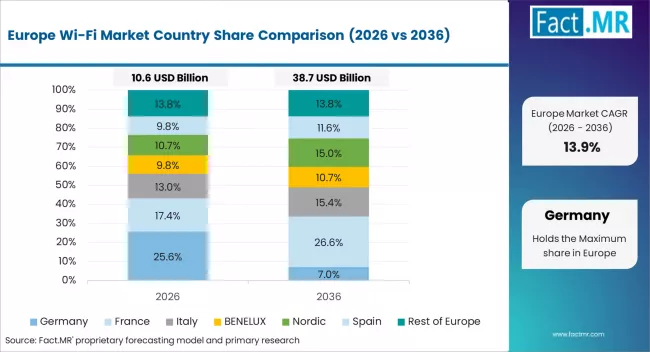
    Europe operates as the regulatory and standardization base, shaped by coordinated spectrum policies and enterprise network upgrades. Nokia Corporation leads in network infrastructure solutions. Ericsson maintains strong positioning in enterprise wireless systems. Infineon Technologies AG supports connectivity through semiconductor components.

    • Germany: Demand for Wi-Fi in Germany is projected to rise at 8.9% CAGR through 2036. The EU Digital Decade targets (European Commission, March 2021) support connectivity expansion. Infineon Technologies AG expanded semiconductor capacity for connectivity applications (February 2023), supporting supply.

    Asia Pacific
    Wi Fi Market Japan Market Share Analysis By Location Type

    Asia Pacific serves as the high-density connectivity and deployment market, supported by urban infrastructure and large-scale device adoption. Huawei Technologies Co., Ltd. leads in wireless infrastructure deployment. Samsung Electronics Co., Ltd. strengthens presence in consumer and enterprise devices. NEC Corporation advances enterprise networking solutions.

    • China: Demand for Wi-Fi in China is projected to rise at 10.5% CAGR through 2036. The New Infrastructure policy (NDRC, April 2020) supports digital connectivity investments. Huawei Technologies Co., Ltd. expanded Wi-Fi 6 infrastructure deployments (May 2023), strengthening market penetration.
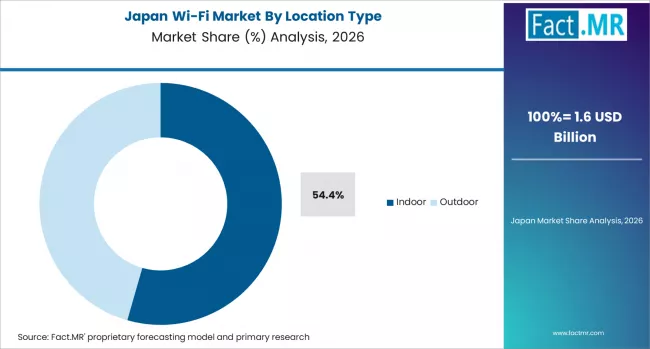
    • Japan: Demand for Wi-Fi in Japan is projected to rise at 9.3% CAGR through 2036. Spectrum policy updates by MIC (Ministry of Internal Affairs and Communications, December 2022) support next-generation Wi-Fi adoption. NEC Corporation launched enterprise-grade Wi-Fi solutions (January 2023), supporting deployments.
    • South Korea: Demand for Wi-Fi in South Korea is projected to rise at 9.2% CAGR through 2036. The Digital New Deal (Ministry of Economy and Finance, July 2020) supports nationwide connectivity upgrades. Samsung Electronics Co., Ltd. expanded Wi-Fi 6E and Wi-Fi 7 device ecosystem (April 2023), strengthening adoption.

    Fact MR's analysis of Wi-Fi market in global regions consists of country-wise assessment that includes China, USA, Japan, South Korea, and Germany. Readers can find connectivity trends, spectrum developments, infrastructure investments, and competitive positioning across key markets.

    Competitive Structure and Buyer Dynamics in the Wi-Fi Market
    Wi Fi Market Analysis By Company

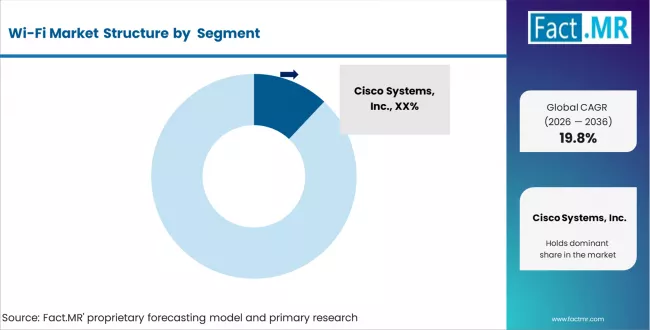
    The competitive structure of the Wi-Fi Market is moderately fragmented, with semiconductor vendors, network equipment manufacturers, and enterprise solution providers participating across different layers of the value chain. Companies such as Broadcom Inc. and Qualcomm Incorporated maintain strong positions in Wi-Fi chipset supply, supporting device manufacturers with integrated connectivity solutions. Network equipment providers including Cisco Systems, Inc., Hewlett Packard Enterprise Company, Aruba Networks, Inc., NETGEAR, Inc., TP-Link Technologies Co., Ltd., D-Link Corporation, Ubiquiti Inc., Zyxel Communications Corp., and Samsung Electronics Co., Ltd. compete in enterprise and consumer networking hardware segments. Competition in the market is primarily influenced by data throughput performance, network reliability, security features, and compatibility with evolving Wi-Fi standards. Product differentiation is also shaped by ease of deployment, cloud based network management, and scalability across enterprise and residential environments.

    Several companies maintain structural advantages through control of semiconductor design and established enterprise networking ecosystems. Broadcom Inc. and Qualcomm Incorporated benefit from strong positions in wireless chipset development, enabling integration across a wide range of connected devices. Cisco Systems, Inc. and Hewlett Packard Enterprise Company maintain advantages through enterprise networking portfolios and long term relationships with corporate customers. Aruba Networks, Inc. supports enterprise deployments through integrated network management platforms. Buyers, including enterprises and telecom operators, typically adopt multi vendor sourcing strategies to reduce dependence on a single supplier and maintain network flexibility. Procurement decisions evaluate vendors based on performance standards, security compliance, and long term support capabilities. This purchasing behavior moderates supplier pricing leverage, while vendors with integrated hardware and software ecosystems retain stronger negotiating influence.

    Key Players of the Wi-Fi Market

    • Cisco Systems, Inc.
    • Broadcom Inc.
    • Qualcomm Incorporated (parent of Qualcomm Technologies, Inc.)
    • NETGEAR, Inc.
    • TP-Link Technologies Co., Ltd.
    • Hewlett Packard Enterprise Company
    • Aruba Networks, Inc. (subsidiary of Hewlett Packard Enterprise Company)
    • D-Link Corporation
    • Samsung Electronics Co., Ltd.
    • Ubiquiti Inc.
    • Zyxel Communications Corp.

    Report Scope
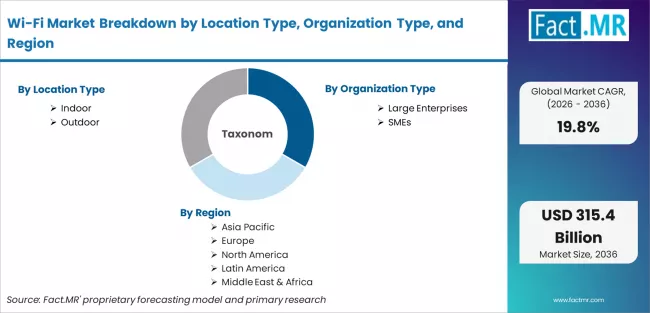
    Wi Fi Market Breakdown By Location Type, Organization Type, And Region

    Metric Value
    Quantitative Units USD 51.8 billion (2026) to USD 162.5 billion (2036), at a CAGR of 19.8%
    Market Definition The Wi-Fi market includes wireless networking technologies, equipment, software platforms, and related services that enable high-speed data transmission over local area networks using radio frequency spectrum, supporting connectivity across residential, enterprise, and public environments.
    Component Segmentation Hardware, Solutions, Services
    Density Segmentation Hi-Density, Enterprise-Class
    Location Type Segmentation Indoor, Outdoor
    Organization Type Segmentation Large Enterprises, SMEs
    Vertical Segmentation Education, Healthcare and Life Sciences, Transportation and Logistics, Retail and e-Commerce, Government, Manufacturing, Hospitality
    Regions Covered North America, Latin America, Europe, East Asia, South Asia, Oceania, Middle East and Africa
    Countries Covered United States, Canada, Mexico, Brazil, Germany, United Kingdom, France, Italy, Spain, China, India, Japan, South Korea, Australia, and 40+ countries
    Key Companies Profiled Cisco Systems, Inc., Broadcom Inc., Qualcomm Incorporated (parent of Qualcomm Technologies, Inc.), NETGEAR, Inc., TP-Link Technologies Co., Ltd., Hewlett Packard Enterprise Company, Aruba Networks, Inc. (subsidiary of Hewlett Packard Enterprise Company), D-Link Corporation, Samsung Electronics Co., Ltd., Ubiquiti Inc., Zyxel Communications Corp.
    Forecast Period 2026 to 2036
    Approach Hybrid top-down and bottom-up market modeling supported by wireless infrastructure shipment analysis, chipset demand assessment, network deployment trends, and validation through interviews with network equipment vendors, service providers, and enterprise IT administrators.

    Wi Fi Market Key Segments

    • Component :

      • Hardware
      • Solutions
      • Services
    • Density :

      • High Density
      • Enterprise Class
    • Location Type :

      • Indoor
      • Outdoor
    • Organization Type :

      • Large Enterprises
      • SMEs
    • Vertical :

      • Education
      • Healthcare and Life Sciences
      • Transportation and Logistics
      • Retail and e Commerce
      • Government
      • Manufacturing
      • Hospitality
    • Region :

      • North America
        • USA
        • Canada
        • Mexico
      • Europe
        • Germany
        • UK
        • France
        • Italy
        • Spain
        • Nordic Countries
        • BENELUX
        • Rest of Europe
      • Asia Pacific
        • China
        • Japan
        • South Korea
        • India
        • Australia
        • Rest of Asia Pacific
      • Latin America
        • Brazil
        • Argentina
        • Rest of Latin America
      • Middle East and Africa
        • Kingdom of Saudi Arabia
        • United Arab Emirates
        • South Africa
        • Rest of Middle East and Africa
      • Other Regions
        • Oceania
        • Central Asia
        • Other Markets

    Bibliographies

    • [1] Federal Communications Commission, USA. (2020). Spectrum allocation for Wi-Fi 6E.
    • [2] European Commission. (2021). EU Digital Decade targets.
    • [3] National Development and Reform Commission, China. (2020). New Infrastructure policy.
    • [4] Ministry of Internal Affairs and Communications, Japan. (2022). Spectrum policy updates.
    • [5] Ministry of Economy and Finance, South Korea. (2020). Digital New Deal.
    • [6] Cisco Systems, Inc. (2023). Wi-Fi 6 and Wi-Fi 7 enterprise solutions expansion.
    • [7] Huawei Technologies Co., Ltd. (2023). Wi-Fi 6 infrastructure deployments expansion.
    • [8] Infineon Technologies AG. (2023). Semiconductor capacity expansion for connectivity.
    • [9] IEEE Standards Association. (2023). IEEE 802.11ax (Wi-Fi 6) and 802.11be (Wi-Fi 7) standards.

    This Report Addresses

    • Market size estimation and revenue forecasts for the Wi-Fi Market from 2026 to 2036, supported by wireless infrastructure deployment benchmarks and network equipment shipment indicators across residential, enterprise, and public connectivity environments.
    • Growth opportunity analysis across hardware, solutions, and service components used in wireless networking systems, including routers, access points, and managed connectivity platforms.
    • Segment and regional revenue forecasts covering indoor and outdoor deployment environments, along with applications across education, healthcare, transportation, retail, government, manufacturing, and hospitality sectors.
    • Competitive strategy assessment including wireless chipset development capability, network equipment performance optimization, and enterprise connectivity solution benchmarking among semiconductor vendors and networking equipment providers.
    • Regulatory and standards evaluation covering frameworks such as IEEE 802.11 wireless communication standards and national spectrum allocation policies governing performance, interoperability, and deployment of Wi-Fi systems.
    • Market report delivery in PDF, Excel, PPT, and interactive dashboard formats designed for telecommunications infrastructure planning, enterprise network strategy evaluation, and wireless connectivity investment assessment.
    • Supply chain and operational risk analysis identifying semiconductor component dependency, spectrum management constraints, and network security requirements affecting deployment and performance of Wi-Fi infrastructure systems.

    Wi-Fi Market Definition

    The Wi-Fi Market includes wireless networking technologies and equipment that enable devices to connect to the internet and local networks using radio frequency signals. Wi-Fi systems operate based on standardized protocols to provide short range data transmission without physical cables. These networks are widely used in homes, offices, public spaces, and industrial environments to support internet access and device connectivity. Key components include routers, access points, and wireless network interfaces. The primary function of Wi-Fi technology is to deliver reliable wireless communication for data transfer, internet access, and network connectivity across connected devices.

    Wi-Fi Market Inclusions

    This report covers global and regional market sizes for Wi-Fi technologies and equipment with forecast analysis for the study period. The market is segmented by product type including routers, wireless access points, and network interface devices. Application segments include residential connectivity, enterprise networking, public hotspot deployment, and industrial wireless communication. End users include households, businesses, telecommunications providers, and public infrastructure operators. The report also evaluates pricing patterns, equipment deployment trends, and selected trade flow analysis across major telecommunications and networking markets.

    Wi-Fi Market Exclusions

    The report excludes wired networking technologies such as Ethernet and fiber optic communication systems. Cellular communication technologies including mobile network infrastructure are not included. The scope also excludes network management software platforms that operate independently of Wi-Fi hardware. Consumer electronic devices such as smartphones, laptops, and tablets that use Wi-Fi connectivity are outside the defined market scope, as the analysis focuses strictly on wireless networking technologies and equipment.

    Wi-Fi Market Research Methodology

    • Primary Research: Interviews were conducted with networking equipment manufacturers, telecommunications providers, system integrators, and enterprise IT managers.
    • Desk Research: Public information was collected from telecommunications industry publications, company reports, regulatory filings, and international trade statistics.
    • Market-Sizing and Forecasting: A hybrid model combining bottom up equipment shipment analysis with top down demand assessment across residential, enterprise, and public networking sectors was applied.
    • Data Validation and Update Cycle: Findings were cross verified using multiple telecommunications data sources and expert inputs, with periodic updates conducted as new market information becomes available.

    Table of Content

    1. Executive Summary
      • Global Market Outlook
      • Demand to side Trends
      • Supply to side Trends
      • Technology Roadmap Analysis
      • Analysis and Recommendations
    2. Market Overview
      • Market Coverage / Taxonomy
      • Market Definition / Scope / Limitations
    3. Research Methodology
      • Chapter Orientation
      • Analytical Lens and Working Hypotheses
        • Market Structure, Signals, and Trend Drivers
        • Benchmarking and Cross-market Comparability
        • Market Sizing, Forecasting, and Opportunity Mapping
      • Research Design and Evidence Framework
        • Desk Research Programme (Secondary Evidence)
          • Company Annual and Sustainability Reports
          • Peer-reviewed Journals and Academic Literature
          • Corporate Websites, Product Literature, and Technical Notes
          • Earnings Decks and Investor Briefings
          • Statutory Filings and Regulatory Disclosures
          • Technical White Papers and Standards Notes
          • Trade Journals, Industry Magazines, and Analyst Briefs
          • Conference Proceedings, Webinars, and Seminar Materials
          • Government Statistics Portals and Public Data Releases
          • Press Releases and Reputable Media Coverage
          • Specialist Newsletters and Curated Briefings
          • Sector Databases and Reference Repositories
          • Fact.MR Internal Proprietary Databases and Historical Market Datasets
          • Subscription Datasets and Paid Sources
          • Social Channels, Communities, and Digital Listening Inputs
          • Additional Desk Sources
        • Expert Input and Fieldwork (Primary Evidence)
          • Primary Modes
            • Qualitative Interviews and Expert Elicitation
            • Quantitative Surveys and Structured Data Capture
            • Blended Approach
          • Why Primary Evidence is Used
          • Field Techniques
            • Interviews
            • Surveys
            • Focus Groups
            • Observational and In-context Research
            • Social and Community Interactions
          • Stakeholder Universe Engaged
            • C-suite Leaders
            • Board Members
            • Presidents and Vice Presidents
            • R&D and Innovation Heads
            • Technical Specialists
            • Domain Subject-matter Experts
            • Scientists
            • Physicians and Other Healthcare Professionals
          • Governance, Ethics, and Data Stewardship
            • Research Ethics
            • Data Integrity and Handling
        • Tooling, Models, and Reference Databases
      • Data Engineering and Model Build
        • Data Acquisition and Ingestion
        • Cleaning, Normalisation, and Verification
        • Synthesis, Triangulation, and Analysis
      • Quality Assurance and Audit Trail
    4. Market Background
      • Market Dynamics
        • Drivers
        • Restraints
        • Opportunity
        • Trends
      • Scenario Forecast
        • Demand in Optimistic Scenario
        • Demand in Likely Scenario
        • Demand in Conservative Scenario
      • Opportunity Map Analysis
      • Product Life Cycle Analysis
      • Supply Chain Analysis
      • Investment Feasibility Matrix
      • Value Chain Analysis
      • PESTLE and Porter’s Analysis
      • Regulatory Landscape
      • Regional Parent Market Outlook
      • Production and Consumption Statistics
      • Import and Export Statistics
    5. Global Market Analysis 2021 to 2025 and Forecast, 2026 to 2036
      • Historical Market Size Value (USD Million) Analysis, 2021 to 2025
      • Current and Future Market Size Value (USD Million) Projections, 2026 to 2036
        • Y to o to Y Growth Trend Analysis
        • Absolute $ Opportunity Analysis
    6. Global Market Pricing Analysis 2021 to 2025 and Forecast 2026 to 2036
    7. Global Market Analysis 2021 to 2025 and Forecast 2026 to 2036, By Location Type
      • Introduction / Key Findings
      • Historical Market Size Value (USD Million) Analysis By Location Type, 2021 to 2025
      • Current and Future Market Size Value (USD Million) Analysis and Forecast By Location Type, 2026 to 2036
        • Indoor
        • Outdoor
      • Y to o to Y Growth Trend Analysis By Location Type, 2021 to 2025
      • Absolute $ Opportunity Analysis By Location Type, 2026 to 2036
    8. Global Market Analysis 2021 to 2025 and Forecast 2026 to 2036, By Organization Type
      • Introduction / Key Findings
      • Historical Market Size Value (USD Million) Analysis By Organization Type, 2021 to 2025
      • Current and Future Market Size Value (USD Million) Analysis and Forecast By Organization Type, 2026 to 2036
        • Large Enterprises
        • SMEs
      • Y to o to Y Growth Trend Analysis By Organization Type, 2021 to 2025
      • Absolute $ Opportunity Analysis By Organization Type, 2026 to 2036
    9. Global Market Analysis 2021 to 2025 and Forecast 2026 to 2036, By Region
      • Introduction
      • Historical Market Size Value (USD Million) Analysis By Region, 2021 to 2025
      • Current Market Size Value (USD Million) Analysis and Forecast By Region, 2026 to 2036
        • North America
        • Latin America
        • Western Europe
        • Eastern Europe
        • East Asia
        • South Asia and Pacific
        • Middle East & Africa
      • Market Attractiveness Analysis By Region
    10. North America Market Analysis 2021 to 2025 and Forecast 2026 to 2036, By Country
      • Historical Market Size Value (USD Million) Trend Analysis By Market Taxonomy, 2021 to 2025
      • Market Size Value (USD Million) Forecast By Market Taxonomy, 2026 to 2036
        • By Country
          • USA
          • Canada
          • Mexico
        • By Location Type
        • By Organization Type
      • Market Attractiveness Analysis
        • By Country
        • By Location Type
        • By Organization Type
      • Key Takeaways
    11. Latin America Market Analysis 2021 to 2025 and Forecast 2026 to 2036, By Country
      • Historical Market Size Value (USD Million) Trend Analysis By Market Taxonomy, 2021 to 2025
      • Market Size Value (USD Million) Forecast By Market Taxonomy, 2026 to 2036
        • By Country
          • Brazil
          • Chile
          • Rest of Latin America
        • By Location Type
        • By Organization Type
      • Market Attractiveness Analysis
        • By Country
        • By Location Type
        • By Organization Type
      • Key Takeaways
    12. Western Europe Market Analysis 2021 to 2025 and Forecast 2026 to 2036, By Country
      • Historical Market Size Value (USD Million) Trend Analysis By Market Taxonomy, 2021 to 2025
      • Market Size Value (USD Million) Forecast By Market Taxonomy, 2026 to 2036
        • By Country
          • Germany
          • UK
          • Italy
          • Spain
          • France
          • Nordic
          • BENELUX
          • Rest of Western Europe
        • By Location Type
        • By Organization Type
      • Market Attractiveness Analysis
        • By Country
        • By Location Type
        • By Organization Type
      • Key Takeaways
    13. Eastern Europe Market Analysis 2021 to 2025 and Forecast 2026 to 2036, By Country
      • Historical Market Size Value (USD Million) Trend Analysis By Market Taxonomy, 2021 to 2025
      • Market Size Value (USD Million) Forecast By Market Taxonomy, 2026 to 2036
        • By Country
          • Russia
          • Poland
          • Hungary
          • Balkan & Baltic
          • Rest of Eastern Europe
        • By Location Type
        • By Organization Type
      • Market Attractiveness Analysis
        • By Country
        • By Location Type
        • By Organization Type
      • Key Takeaways
    14. East Asia Market Analysis 2021 to 2025 and Forecast 2026 to 2036, By Country
      • Historical Market Size Value (USD Million) Trend Analysis By Market Taxonomy, 2021 to 2025
      • Market Size Value (USD Million) Forecast By Market Taxonomy, 2026 to 2036
        • By Country
          • China
          • Japan
          • South Korea
        • By Location Type
        • By Organization Type
      • Market Attractiveness Analysis
        • By Country
        • By Location Type
        • By Organization Type
      • Key Takeaways
    15. South Asia and Pacific Market Analysis 2021 to 2025 and Forecast 2026 to 2036, By Country
      • Historical Market Size Value (USD Million) Trend Analysis By Market Taxonomy, 2021 to 2025
      • Market Size Value (USD Million) Forecast By Market Taxonomy, 2026 to 2036
        • By Country
          • India
          • ASEAN
          • Australia & New Zealand
          • Rest of South Asia and Pacific
        • By Location Type
        • By Organization Type
      • Market Attractiveness Analysis
        • By Country
        • By Location Type
        • By Organization Type
      • Key Takeaways
    16. Middle East & Africa Market Analysis 2021 to 2025 and Forecast 2026 to 2036, By Country
      • Historical Market Size Value (USD Million) Trend Analysis By Market Taxonomy, 2021 to 2025
      • Market Size Value (USD Million) Forecast By Market Taxonomy, 2026 to 2036
        • By Country
          • Kingdom of Saudi Arabia
          • Other GCC Countries
          • Turkiye
          • South Africa
          • Other African Union
          • Rest of Middle East & Africa
        • By Location Type
        • By Organization Type
      • Market Attractiveness Analysis
        • By Country
        • By Location Type
        • By Organization Type
      • Key Takeaways
    17. Key Countries Market Analysis
      • USA
        • Pricing Analysis
        • Market Share Analysis, 2025
          • By Location Type
          • By Organization Type
      • Canada
        • Pricing Analysis
        • Market Share Analysis, 2025
          • By Location Type
          • By Organization Type
      • Mexico
        • Pricing Analysis
        • Market Share Analysis, 2025
          • By Location Type
          • By Organization Type
      • Brazil
        • Pricing Analysis
        • Market Share Analysis, 2025
          • By Location Type
          • By Organization Type
      • Chile
        • Pricing Analysis
        • Market Share Analysis, 2025
          • By Location Type
          • By Organization Type
      • Germany
        • Pricing Analysis
        • Market Share Analysis, 2025
          • By Location Type
          • By Organization Type
      • UK
        • Pricing Analysis
        • Market Share Analysis, 2025
          • By Location Type
          • By Organization Type
      • Italy
        • Pricing Analysis
        • Market Share Analysis, 2025
          • By Location Type
          • By Organization Type
      • Spain
        • Pricing Analysis
        • Market Share Analysis, 2025
          • By Location Type
          • By Organization Type
      • France
        • Pricing Analysis
        • Market Share Analysis, 2025
          • By Location Type
          • By Organization Type
      • India
        • Pricing Analysis
        • Market Share Analysis, 2025
          • By Location Type
          • By Organization Type
      • ASEAN
        • Pricing Analysis
        • Market Share Analysis, 2025
          • By Location Type
          • By Organization Type
      • Australia & New Zealand
        • Pricing Analysis
        • Market Share Analysis, 2025
          • By Location Type
          • By Organization Type
      • China
        • Pricing Analysis
        • Market Share Analysis, 2025
          • By Location Type
          • By Organization Type
      • Japan
        • Pricing Analysis
        • Market Share Analysis, 2025
          • By Location Type
          • By Organization Type
      • South Korea
        • Pricing Analysis
        • Market Share Analysis, 2025
          • By Location Type
          • By Organization Type
      • Russia
        • Pricing Analysis
        • Market Share Analysis, 2025
          • By Location Type
          • By Organization Type
      • Poland
        • Pricing Analysis
        • Market Share Analysis, 2025
          • By Location Type
          • By Organization Type
      • Hungary
        • Pricing Analysis
        • Market Share Analysis, 2025
          • By Location Type
          • By Organization Type
      • Kingdom of Saudi Arabia
        • Pricing Analysis
        • Market Share Analysis, 2025
          • By Location Type
          • By Organization Type
      • Turkiye
        • Pricing Analysis
        • Market Share Analysis, 2025
          • By Location Type
          • By Organization Type
      • South Africa
        • Pricing Analysis
        • Market Share Analysis, 2025
          • By Location Type
          • By Organization Type
    18. Market Structure Analysis
      • Competition Dashboard
      • Competition Benchmarking
      • Market Share Analysis of Top Players
        • By Regional
        • By Location Type
        • By Organization Type
    19. Competition Analysis
      • Competition Deep Dive
        • Cisco Systems, Inc.
          • Overview
          • Product Portfolio
          • Profitability by Market Segments (Product/Age /Sales Channel/Region)
          • Sales Footprint
          • Strategy Overview
            • Marketing Strategy
            • Product Strategy
            • Channel Strategy
        • Broadcom Inc.
        • Qualcomm Incorporated (parent of Qualcomm Technologies, Inc.)
        • NETGEAR, Inc.
        • TP-Link Technologies Co., Ltd.
        • Hewlett Packard Enterprise Company
        • Aruba Networks, Inc. (subsidiary of Hewlett Packard Enterprise Company)
        • D-Link Corporation
        • Samsung Electronics Co., Ltd.
        • Ubiquiti Inc.
        • Zyxel Communications Corp.
    20. Assumptions & Acronyms Used

    List Of Table

    • Table 1: Global Market Value (USD Million) Forecast by Region, 2021 to 2036
    • Table 2: Global Market Value (USD Million) Forecast by Location Type, 2021 to 2036
    • Table 3: Global Market Value (USD Million) Forecast by Organization Type, 2021 to 2036
    • Table 4: North America Market Value (USD Million) Forecast by Country, 2021 to 2036
    • Table 5: North America Market Value (USD Million) Forecast by Location Type, 2021 to 2036
    • Table 6: North America Market Value (USD Million) Forecast by Organization Type, 2021 to 2036
    • Table 7: Latin America Market Value (USD Million) Forecast by Country, 2021 to 2036
    • Table 8: Latin America Market Value (USD Million) Forecast by Location Type, 2021 to 2036
    • Table 9: Latin America Market Value (USD Million) Forecast by Organization Type, 2021 to 2036
    • Table 10: Western Europe Market Value (USD Million) Forecast by Country, 2021 to 2036
    • Table 11: Western Europe Market Value (USD Million) Forecast by Location Type, 2021 to 2036
    • Table 12: Western Europe Market Value (USD Million) Forecast by Organization Type, 2021 to 2036
    • Table 13: Eastern Europe Market Value (USD Million) Forecast by Country, 2021 to 2036
    • Table 14: Eastern Europe Market Value (USD Million) Forecast by Location Type, 2021 to 2036
    • Table 15: Eastern Europe Market Value (USD Million) Forecast by Organization Type, 2021 to 2036
    • Table 16: East Asia Market Value (USD Million) Forecast by Country, 2021 to 2036
    • Table 17: East Asia Market Value (USD Million) Forecast by Location Type, 2021 to 2036
    • Table 18: East Asia Market Value (USD Million) Forecast by Organization Type, 2021 to 2036
    • Table 19: South Asia and Pacific Market Value (USD Million) Forecast by Country, 2021 to 2036
    • Table 20: South Asia and Pacific Market Value (USD Million) Forecast by Location Type, 2021 to 2036
    • Table 21: South Asia and Pacific Market Value (USD Million) Forecast by Organization Type, 2021 to 2036
    • Table 22: Middle East & Africa Market Value (USD Million) Forecast by Country, 2021 to 2036
    • Table 23: Middle East & Africa Market Value (USD Million) Forecast by Location Type, 2021 to 2036
    • Table 24: Middle East & Africa Market Value (USD Million) Forecast by Organization Type, 2021 to 2036

    List Of Figures

    • Figure 1: Global Market Pricing Analysis
    • Figure 2: Global Market Value (USD Million) Forecast 2021 to 2036
    • Figure 3: Global Market Value Share and BPS Analysis by Location Type, 2026 and 2036
    • Figure 4: Global Market Y-o-Y Growth Comparison by Location Type, 2026 to 2036
    • Figure 5: Global Market Attractiveness Analysis by Location Type
    • Figure 6: Global Market Value Share and BPS Analysis by Organization Type, 2026 and 2036
    • Figure 7: Global Market Y-o-Y Growth Comparison by Organization Type, 2026 to 2036
    • Figure 8: Global Market Attractiveness Analysis by Organization Type
    • Figure 9: Global Market Value (USD Million) Share and BPS Analysis by Region, 2026 and 2036
    • Figure 10: Global Market Y-o-Y Growth Comparison by Region, 2026 to 2036
    • Figure 11: Global Market Attractiveness Analysis by Region
    • Figure 12: North America Market Incremental Dollar Opportunity, 2026 to 2036
    • Figure 13: Latin America Market Incremental Dollar Opportunity, 2026 to 2036
    • Figure 14: Western Europe Market Incremental Dollar Opportunity, 2026 to 2036
    • Figure 15: Eastern Europe Market Incremental Dollar Opportunity, 2026 to 2036
    • Figure 16: East Asia Market Incremental Dollar Opportunity, 2026 to 2036
    • Figure 17: South Asia and Pacific Market Incremental Dollar Opportunity, 2026 to 2036
    • Figure 18: Middle East & Africa Market Incremental Dollar Opportunity, 2026 to 2036
    • Figure 19: North America Market Value Share and BPS Analysis by Country, 2026 and 2036
    • Figure 20: North America Market Value Share and BPS Analysis by Location Type, 2026 and 2036
    • Figure 21: North America Market Y-o-Y Growth Comparison by Location Type, 2026 to 2036
    • Figure 22: North America Market Attractiveness Analysis by Location Type
    • Figure 23: North America Market Value Share and BPS Analysis by Organization Type, 2026 and 2036
    • Figure 24: North America Market Y-o-Y Growth Comparison by Organization Type, 2026 to 2036
    • Figure 25: North America Market Attractiveness Analysis by Organization Type
    • Figure 26: Latin America Market Value Share and BPS Analysis by Country, 2026 and 2036
    • Figure 27: Latin America Market Value Share and BPS Analysis by Location Type, 2026 and 2036
    • Figure 28: Latin America Market Y-o-Y Growth Comparison by Location Type, 2026 to 2036
    • Figure 29: Latin America Market Attractiveness Analysis by Location Type
    • Figure 30: Latin America Market Value Share and BPS Analysis by Organization Type, 2026 and 2036
    • Figure 31: Latin America Market Y-o-Y Growth Comparison by Organization Type, 2026 to 2036
    • Figure 32: Latin America Market Attractiveness Analysis by Organization Type
    • Figure 33: Western Europe Market Value Share and BPS Analysis by Country, 2026 and 2036
    • Figure 34: Western Europe Market Value Share and BPS Analysis by Location Type, 2026 and 2036
    • Figure 35: Western Europe Market Y-o-Y Growth Comparison by Location Type, 2026 to 2036
    • Figure 36: Western Europe Market Attractiveness Analysis by Location Type
    • Figure 37: Western Europe Market Value Share and BPS Analysis by Organization Type, 2026 and 2036
    • Figure 38: Western Europe Market Y-o-Y Growth Comparison by Organization Type, 2026 to 2036
    • Figure 39: Western Europe Market Attractiveness Analysis by Organization Type
    • Figure 40: Eastern Europe Market Value Share and BPS Analysis by Country, 2026 and 2036
    • Figure 41: Eastern Europe Market Value Share and BPS Analysis by Location Type, 2026 and 2036
    • Figure 42: Eastern Europe Market Y-o-Y Growth Comparison by Location Type, 2026 to 2036
    • Figure 43: Eastern Europe Market Attractiveness Analysis by Location Type
    • Figure 44: Eastern Europe Market Value Share and BPS Analysis by Organization Type, 2026 and 2036
    • Figure 45: Eastern Europe Market Y-o-Y Growth Comparison by Organization Type, 2026 to 2036
    • Figure 46: Eastern Europe Market Attractiveness Analysis by Organization Type
    • Figure 47: East Asia Market Value Share and BPS Analysis by Country, 2026 and 2036
    • Figure 48: East Asia Market Value Share and BPS Analysis by Location Type, 2026 and 2036
    • Figure 49: East Asia Market Y-o-Y Growth Comparison by Location Type, 2026 to 2036
    • Figure 50: East Asia Market Attractiveness Analysis by Location Type
    • Figure 51: East Asia Market Value Share and BPS Analysis by Organization Type, 2026 and 2036
    • Figure 52: East Asia Market Y-o-Y Growth Comparison by Organization Type, 2026 to 2036
    • Figure 53: East Asia Market Attractiveness Analysis by Organization Type
    • Figure 54: South Asia and Pacific Market Value Share and BPS Analysis by Country, 2026 and 2036
    • Figure 55: South Asia and Pacific Market Value Share and BPS Analysis by Location Type, 2026 and 2036
    • Figure 56: South Asia and Pacific Market Y-o-Y Growth Comparison by Location Type, 2026 to 2036
    • Figure 57: South Asia and Pacific Market Attractiveness Analysis by Location Type
    • Figure 58: South Asia and Pacific Market Value Share and BPS Analysis by Organization Type, 2026 and 2036
    • Figure 59: South Asia and Pacific Market Y-o-Y Growth Comparison by Organization Type, 2026 to 2036
    • Figure 60: South Asia and Pacific Market Attractiveness Analysis by Organization Type
    • Figure 61: Middle East & Africa Market Value Share and BPS Analysis by Country, 2026 and 2036
    • Figure 62: Middle East & Africa Market Value Share and BPS Analysis by Location Type, 2026 and 2036
    • Figure 63: Middle East & Africa Market Y-o-Y Growth Comparison by Location Type, 2026 to 2036
    • Figure 64: Middle East & Africa Market Attractiveness Analysis by Location Type
    • Figure 65: Middle East & Africa Market Value Share and BPS Analysis by Organization Type, 2026 and 2036
    • Figure 66: Middle East & Africa Market Y-o-Y Growth Comparison by Organization Type, 2026 to 2036
    • Figure 67: Middle East & Africa Market Attractiveness Analysis by Organization Type
    • Figure 68: Global Market - Tier Structure Analysis
    • Figure 69: Global Market - Company Share Analysis

    - Frequently Asked Questions -

    How large is the demand for Wi-Fi in the global market in 2026?

    Demand for Wi-Fi in the global market is estimated to be valued at USD 51.8 billion in 2026.

    What will be the market size of Wi-Fi in the global market by 2036?

    Market size for Wi-Fi is projected to reach USD 162.5 billion by 2036.

    What is the expected demand growth for Wi-Fi in the global market between 2026 and 2036?

    Demand for Wi-Fi in the global market is expected to grow at a CAGR of 19.8% during 2026 to 2036.

    Which Location Type Segment is poised to lead global demand by 2026?

    Indoor Wi-Fi deployments are expected to remain the dominant segment, accounting for approximately 70% of the global market share in 2026.

    Which Company is Identified as a Leading Participant in the Wi-Fi Market?

    Cisco Systems, Inc. is identified as a leading participant in the Wi-Fi market due to its strong portfolio of networking infrastructure and wireless communication solutions.

    What is Driving Wi-Fi Demand in the United States?

    Demand growth in the United States is supported by increasing adoption of high speed internet connectivity and expansion of enterprise and residential wireless networks.

    What is the United States Growth Outlook in this Report?

    The United States Wi-Fi market is projected to expand at a CAGR of 9.8% during 2026 to 2036.

    Why is China an Important Market for Wi-Fi?

    China represents a significant market due to rapid digital infrastructure development and increasing deployment of wireless connectivity solutions across urban environments.

    What is the China Growth Outlook in this Report?

    The China Wi-Fi market is projected to expand at a CAGR of 10.5% during 2026 to 2036.

    Why is Japan an Important Market for Wi-Fi?

    Japan represents an important market due to strong adoption of advanced communication technologies and widespread use of wireless connectivity in public and private sectors.

    What is the Japan Growth Outlook in this Report?

    The Japan Wi-Fi market is projected to expand at a CAGR of 9.3% during 2026 to 2036.

    Why is South Korea Considered a Key Market for Wi-Fi?

    South Korea is considered a key market due to advanced telecommunications infrastructure and high penetration of wireless internet services.

    What is the South Korea Growth Outlook in this Report?

    The South Korea Wi-Fi market is projected to expand at a CAGR of 9.2% during 2026 to 2036.

    Why is Germany Considered an Important Market for Wi-Fi in Europe?

    Germany represents a key European market due to strong enterprise networking infrastructure and increasing adoption of wireless communication technologies.

    What is the Germany Growth Outlook in this Report?

    The Germany Wi-Fi market is projected to expand at a CAGR of 8.9% during 2026 to 2036.

    What is Wi-Fi and What is It Mainly Used For?

    Wi-Fi is a wireless networking technology that enables devices to connect to the internet and communicate over local area networks without physical cables.

    What does Wi-Fi Market Mean in this Report?

    Wi-Fi market refers to global development, deployment, and adoption of wireless networking technologies used for internet connectivity and data communication.

    What is Included in the Scope of this Wi-Fi Market Report?

    The scope includes Wi-Fi technologies categorized by location type and their deployment across residential, commercial, and public network environments.

    What is Excluded from the Scope of this Report?

    Wired networking technologies and unrelated communication systems are excluded unless integrated with Wi-Fi infrastructure.

    What does Market Forecast Mean on this Page?

    Market forecast represents a projection of future demand based on wireless connectivity adoption and expansion of digital infrastructure.

    How is the Wi-Fi Market Forecast Developed in this Report?

    Forecast analysis is developed using telecommunications infrastructure data, network equipment deployment statistics, and wireless internet usage trends.

    Wi-Fi Market