Windrow Elevator Market Size, Share, Growth and Forecast (2026 - 2036)

The Windrow Elevator Market is Segmented by Product Type, Conveyor Type, Buyer Type and Region. Forecast for 2026 to 2036.

Windrow Elevator Market Overview, Growth Outlook, and Forecast by Fact.MR

  • Global windrow elevator market revenue stood at USD 132.0 million in 2025 and is estimated to reach USD 139.3 million in 2026. The market is forecast to reach USD 237.9 million by 2036, expanding at a 5.5% CAGR from 2026 to 2036.
  • This market is set to expand ~ 1.7x in value, adding USD 98.6 million in absolute opportunity.
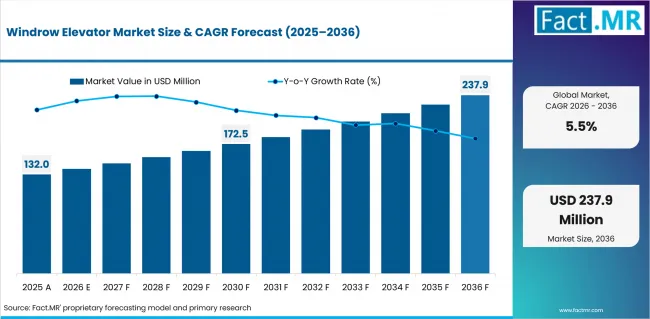
Windrow Elevator Market Market Value Analysis

Summary of the Windrow Elevator Market

  • Market Snapshot
    • Global windrow elevator market revenue stood at USD 132 million in 2025 and is forecast to reach USD 237.9 million by 2036.
    • At a 5.5% CAGR from 2026 to 2036, the market is set to expand around 1.7x, adding USD 98.6 million in absolute opportunity.
    • Growth is being driven by increasing demand for efficient asphalt material transfer and road paving support equipment across transportation infrastructure projects.
    • Rising investments in highway construction, road rehabilitation, and pavement maintenance are reinforcing deployment of windrow elevator systems.
    • Advancements in conveyor technologies, equipment mobility, and operational efficiency are supporting market expansion.
  • Demand and Growth Drivers
    • Increasing investments in road construction, resurfacing, and pavement rehabilitation activities
    • Rising demand for efficient material transfer and asphalt handling systems
    • Expansion of government infrastructure modernization and transport development programs
    • Growing adoption of productivity-enhancing road construction equipment
    • Need for solutions that provide:
      • Efficient asphalt windrow collection and transfer
      • Improved paving productivity and operational continuity
      • Reduced material wastage and enhanced jobsite efficiency
      • Flexible deployment across infrastructure construction environments
  • Product and Segment View
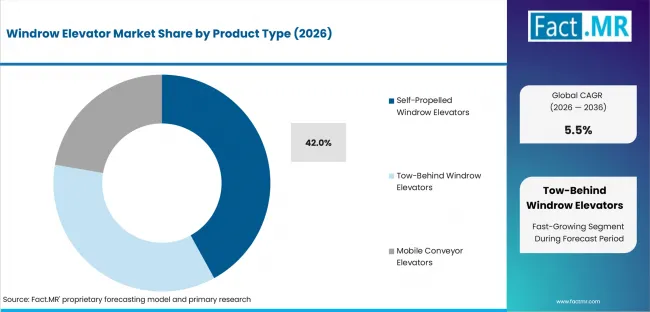
    • Self-propelled windrow elevators hold 42% of product type share in 2026, emerging as the leading segment.
    • Tow-behind windrow elevators account for 33% share, while mobile conveyor elevators represent 25% share.
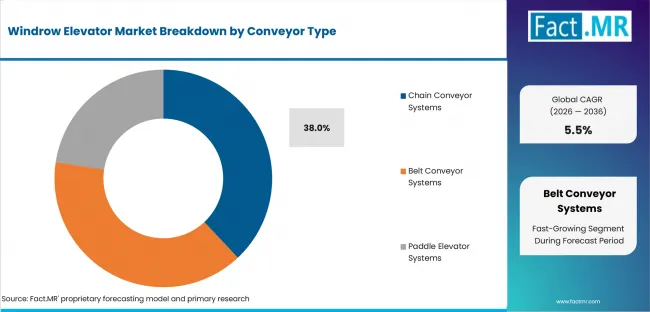
    • Chain conveyor systems account for 38% of conveyor type share in 2026, positioning them as the dominant segment due to durability and material handling reliability.
    • Belt conveyor systems represent 34% share, while paddle elevator systems account for 28% share.
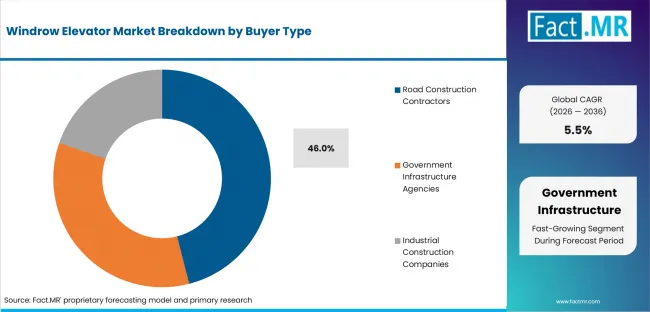
    • Road construction contractors hold 46% of buyer type share, supported by widespread deployment across highway paving, rehabilitation, and resurfacing projects.
    • Government infrastructure agencies account for 31% share, while industrial construction companies contribute 23% share.
  • Geography and Competitive Outlook
    • Growth is supported across North America, Europe, Asia Pacific, and Middle East & Africa.
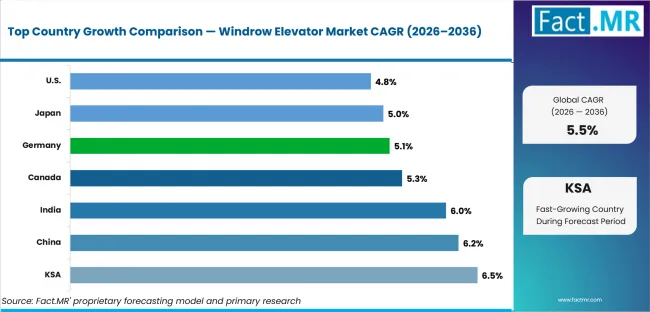
    • Key growth markets and CAGR: U.S. 4.8%, Japan 5.0%, Germany 5.1%, Canada 5.3%, India 6.0%, China 6.2%, KSA 6.5%.
    • Market expansion is closely tied to:
      • Rising investments in transportation infrastructure and highway modernization
      • Expansion of road rehabilitation and asphalt paving projects
      • Increasing adoption of advanced material transfer and paving support technologies
      • Key companies active in this market include: Roadtec (Astec Industries), Weiler, BOMAG, Carlson Paving Products, and LeeBoy.
  • Analyst Opinion
    • Shambhu Nath Jha, Principal Consultant at Fact.MR, says, “The Windrow Elevator Market is no longer defined solely by conventional material transfer equipment and standard paving support systems. Growth is increasingly driven by rising investments in road construction and pavement rehabilitation, expanding adoption of high-efficiency self-propelled and advanced conveyor technologies, advancements in automation and material handling precision, and increasing deployment of windrow elevators across highways, airports, municipal roads, and large-scale infrastructure projects seeking enhanced paving productivity, operational efficiency, and pavement quality outcomes."

Windrow Elevator Market - At a Glance

Attribute Details
Market Value 2025 USD 132 million
Market Value 2036 USD 237.9 million
Absolute Dollar Opportunity 2026–2036 USD 98.6 million
Total Growth 2026–2036 70.8%
CAGR 2026–2036 5.5%
Growth Multiple ~1.7x
Key Demand Theme Growing adoption of asphalt material transfer equipment for road construction efficiency
Leading Segment by Product Type (2026) Self-Propelled Windrow Elevators
Segment Share (2026) 42%
Leading Segment by Conveyor Type (2026) Chain Conveyor Systems
Segment Share (2026) 38%
Leading Segment by Buyer Type (2026) Road Construction Contractors
Segment Share (2026) 46%
Key Growth Regions North America, Europe, Asia Pacific, Middle East & Africa
Country CAGRs U.S. 4.8%, Japan 5.0%, Germany 5.1%, Canada 5.3%, India 6.0%, China 6.2%, KSA 6.5%
Top Companies Roadtec (Astec Industries), Weiler, BOMAG, Carlson Paving Products, LeeBoy
Segmentation by Product Type Self-Propelled Windrow Elevators, Tow-Behind Windrow Elevators, Mobile Conveyor Elevators
Segmentation by Conveyor Type Chain Conveyor Systems, Belt Conveyor Systems, Paddle Elevator Systems
Segmentation by Buyer Type Road Construction Contractors, Government Infrastructure Agencies, Industrial Construction Companies
Segmentation by Region North America, Latin America, Europe, Asia Pacific, Middle East & Africa

The increasing investment in road construction, highway rehabilitation, and transportation infrastructure modernization is emerging as a primary growth driver for the Windrow Elevator Market. Windrow elevators are gaining demand for their critical role in efficient asphalt material transfer, continuous paving support, and improved workflow coordination across highways, airports, and large-scale road projects. Demand is being reinforced by rising government infrastructure spending, expanding pavement maintenance programs, and growing contractor emphasis on productivity and operational efficiency. The market is further benefiting from increasing adoption of self-propelled systems, advanced conveyor technologies, automated controls, and high-capacity equipment designed to enhance paving efficiency, reduce material handling delays, and improve pavement quality outcomes.

Key Growth Drivers, Constraints, and Opportunities

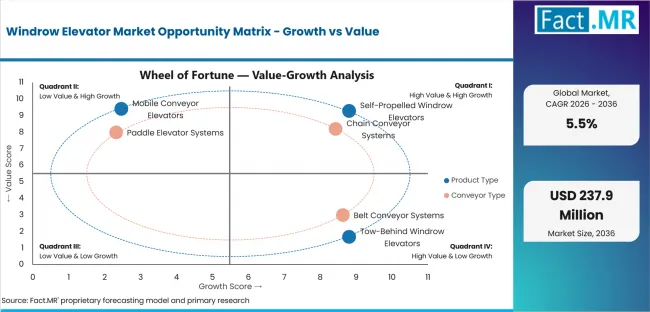
Windrow Elevator Market Opportunity Matrix Growth Vs Value

Key Factors Driving Growth

  • As more investments in road building and highway repair work take place around the globe, there would be an increased need for windrow elevators.
  • The preference towards high-production rate material handling machinery along with paving machinery by the contractors and infrastructure companies would lead to the adoption of windrow elevators.
  • The widespread use of windrow elevators in highways, airports, municipal roads, and paving operations would ensure steady market growth.
Growth Driver Demand Impact Time Horizon Key Impact Area Fact.MR Insight
Rising investments in road construction and pavement rehabilitation High Short-Mid Term Infrastructure development and paving demand Growing transportation infrastructure spending is accelerating windrow elevator deployment
Expansion of road maintenance and resurfacing programs High Short-Mid Term Equipment utilization and replacement demand Aging road networks are increasing demand for efficient asphalt material transfer equipment
Growth of highway, airport, and commercial paving projects High Mid-Long Term End-use expansion and project deployment Windrow elevators are gaining traction across large-scale paving and infrastructure projects
Advancements in automation, conveyor systems, and material handling technologies Medium-High Mid-Long Term Product innovation and operational efficiency Advanced windrow elevators are improving paving continuity, productivity, and material flow efficiency
Increasing investments in equipment distribution, rental fleets, and contractor networks Medium Short-Mid Term Market accessibility and equipment availability Expanded dealer and rental ecosystems are broadening market penetration globally

Key Market Constraints

  • Elevated expenses related to windrow elevator equipment purchase, maintenance, running costs, and fuel costs might restrain the growth of the Windrow Elevator Market.
  • Consortium from other paving operations, financial constraints faced by contractors, and procurement procedures of infrastructure firms could act as hindrances to market growth.
  • Possible reasons affecting the growth of the Windrow Elevator Market include fluctuating construction activities, budget constraints on infrastructure development, experienced operator availability, and difficult maintenance techniques.

Key Opportunity Areas

  • The increasing investment in highway construction, airport construction, municipal road construction, and overall infrastructure development in emerging countries would present business opportunities for windrow elevators.
  • Innovations in technology resulting in development of automated and advanced windrow elevators with improved performance could provide growth opportunities for the windrow elevator market.

Opportunities in fleet management, predictive maintenance services, equipment rental, and remote equipment monitoring would be prevalent in the Windrow Elevator Market.

Segment-wise Analysis of the Windrow Elevator Market

  • By 2026, Self-Propelled Windrow Elevators account for a 42% market share of the product type segment due to their high productivity, superior mobility, and growing adoption in large-scale road construction, highway rehabilitation, and airport paving activities, supported by rising demand for continuous material transfer, operational efficiency, and reduced paving downtime across infrastructure projects globally.
  • Chain Conveyor Systems represent a 38% market share of the conveyor type segment by 2026, driven by their durability, reliable material handling capability, suitability for heavy-duty asphalt transfer operations, and strong adoption among contractors and infrastructure developers engaged in highway, municipal road, and large-scale paving projects worldwide.

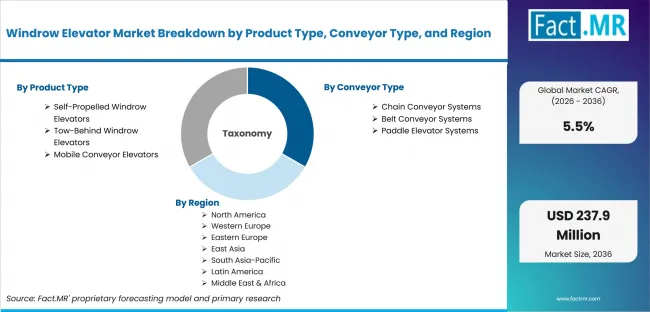
The segmentation of the Windrow Elevator Market includes product type, conveyor type, buyer type, and region.

Which Product Type Dominates the Windrow Elevator Market?
Windrow Elevator Market Analysis By Product Type

Market share of major product types includes 42% in Self-Propelled Windrow Elevators. This dominant market share of self-propelled windrow elevators can be attributed to their good mobility capabilities, continuous material movement, and applicability in large scale road construction, rehabilitation of highways, airport paving, and infrastructure maintenance operations. Due to rising investments in transport infrastructure, increased demand for productive paving, and a general concern about minimization of operational delays, more road construction and infrastructure maintenance organizations are adopting self-propelled windrow elevators.

Which Conveyor Type Dominates the Windrow Elevator Market?
Windrow Elevator Market Analysis By Conveyor Type

Market share of major conveyor types includes 38% in Chain Conveyor Systems. The major reason behind their popularity lies in their durability, effectiveness in moving asphalt materials and applicability in harsh paving conditions. As global infrastructural activities are expanding, there is an increased requirement for durable and efficient equipment that could help support continuous paving operations in highway, road, and commercial paving. Hence, chain conveyor systems have become the preferred choice among contractors.

Which Buyer Type Dominates the Windrow Elevator Market?
Windrow Elevator Market Analysis By Buyer Type

Market share of major buyer types includes 46% in Road Construction Contractors. Road construction contractors have dominated the market owing to their active participation in highway construction, pavement rehabilitation, resurfacing operations, and commercial paving activities. Due to increased outsourcing of infrastructural activities, investments made by contractors in paving equipment, and increasing productivity needs, more road construction contractors are adopting windrow elevators.

Regional Outlook Across Key Markets

The market analysis covers key global regions, including South Asia and Pacific, Middle East & Africa, North America, Latin America, Western Europe, and Eastern Europe. It is segmented geographically, with specific market dynamics for each region. The full report provides a detailed market attractiveness analysis.

Top Country Growth Comparison Windrow Elevator Market Cagr (2026 2036)

CAGR Table

Country CAGR (%)
U.S. 4.8%
Japan 5.0%
Germany 5.1%
Canada 5.3%
India 6.0%
China 6.2%
KSA 6.5%

Source: Fact.MR analysis, based on proprietary forecasting model and primary research.
Windrow Elevator Market Cagr Analysis By Country

North America

North America serves as the global technology standardization hub for windrow elevators, driven by precision agriculture mandates and replacement cycles. Key suppliers serving North American paving equipment demand include Roadtec/Astec, Weiler, LeeBoy, Carlson Paving Products, and BOMAG. The region’s mature market emphasizes efficiency retrofits and emission-compliant models.

  • United States: Demand for windrow elevators in the U.S. is projected to rise at 4.8% CAGR through 2036. Rising federal infrastructure funding, highway rehabilitation programs, and large-scale pavement modernization projects are driving demand for windrow elevators, supported by contractor preference for high-productivity asphalt material transfer equipment.

East Asia
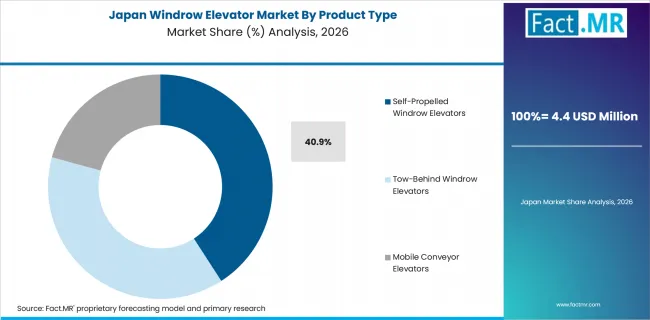
Windrow Elevator Market Japan Market Share Analysis By Product Type

East Asia is supported by highway expansion, urban road rehabilitation, and adoption of higher-productivity asphalt paving equipment across China and Japan. Regional growth is fueled by aging farming populations and government-led smart agriculture mandates.

  • China: Demand for windrow elevators in China is projected to rise at 6.2% CAGR through 2036. Large-scale transportation infrastructure expansion, expressway maintenance investments, and rapid adoption of advanced construction equipment are strengthening demand for windrow elevators in high-volume paving environments.
  • Japan: Demand for windrow elevators in Japan is projected to rise at 5.0% CAGR through 2036. Aging transport infrastructure, road maintenance prioritization, and continuous investment in resilient urban mobility networks are supporting windrow elevator adoption for efficient paving workflows and pavement rehabilitation operations.

Western Europe

Western Europe acts as the global regulatory benchmark for low-noise, low-emission windrow elevators, with strict CE Mark revisions. Environmental compliance drives both innovation and equipment retirement.

  • Germany: Demand for windrow elevators in Germany is projected to rise at 5.1% CAGR through 2036. Highway modernization, autobahn repair programs, and strong construction equipment mechanization trends are boosting demand for windrow elevators, particularly for precision paving, material handling efficiency, and infrastructure maintenance applications.

Middle East & Africa

The Middle East & Africa functions as the desert forage and strategic food security frontier for windrow elevators, driven by state-led vertical farming. The market is tender-driven with low price elasticity.

  • KSA: Demand for windrow elevators in KSA is projected to rise at 6.5% CAGR through 2036. Vision 2030 infrastructure projects, road network expansion, and major urban development initiatives are driving adoption of windrow elevators to support efficient paving execution and large-scale transportation construction activities.

Fact.MR’s complete windrow elevator market study (forecast period 2026–2036) delivers regional deep-dives across North America, East Asia, Western Europe, and Middle East & Africa. The analysis quantifies the impact of 2025-2026 regulatory updates, state subsidies, and corporate tenders on market share for the top seven countries: U.S., Canada, Germany, Japan, China, India, and KSA, providing actionable intelligence for product compliance and bidding strategies.

Competitive Benchmarking and Company Positioning

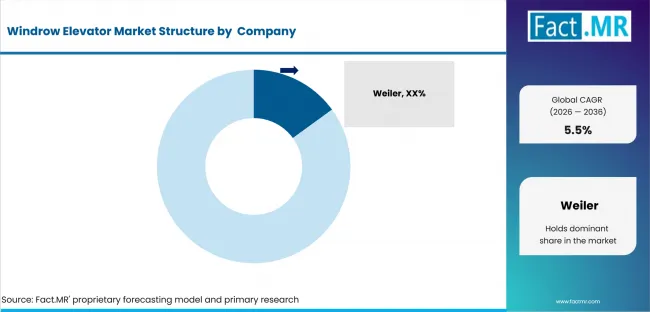
Windrow Elevator Market Analysis By Company

Leading Companies Shaping the Windrow Elevator Market

Windrow Elevator Market can be considered as moderately concentrated market. In this market there are firms like Weiler, Carlson Paving Products, Leeboy, Roadtec/Astec, Wirtgen, Bomag, and Dynapac who operate based on reliability of their equipment, ability to handle materials efficiently, paving effectiveness, and after sales services offered. These key suppliers have the advantage of having good dealership network, variety of construction equipment line, engineering knowledge, and relationships with construction contractors. Buyer behavior shows competition for sources, use of multiple brands and focus on operational efficiency.

Key Players of the Windrow Elevator Market

  • Weiler
  • Carlson Paving Products
  • LeeBoy
  • Roadtec / Astec
  • Wirtgen
  • Bomag
  • Dynapac

Recent Industry Developments

  • LeeBoy showcases expanded road construction equipment portfolio at World of Asphalt 2025 (March 2025): LeeBoy highlighted its road construction and asphalt workflow equipment at World of Asphalt 2025, strengthening its positioning in paving and material handling equipment through productivity-focused machinery and contractor-oriented operational support. [LeeBoy News] [1]
  • Wirtgen Group introduces new technologies for automated road construction at Bauma 2025 (February 2025): Wirtgen Group announced new pavers, automation solutions, digital road construction technologies, and the Vögele MT 3000-5 feeder designed to improve paving precision, equipment coordination, and operational efficiency across infrastructure projects. [Wirtgen Group Press Release] [2]
  • Astec strengthens promotion of Roadtec SB-3000 Shuttle Buggy material transfer technology for paving productivity applications (2025): Astec continued highlighting its material transfer vehicle portfolio, including the Roadtec SB-3000 Shuttle Buggy platform, emphasizing continuous paving support, material remixing capability, improved mat quality, and productivity enhancement for highway and infrastructure paving operations. [Astec Industries Product Release] [3]
  • Dynapac unveils next-generation paving and compaction technologies at Bauma 2025 (April 2025): Dynapac introduced advanced road construction and paving equipment solutions at Bauma 2025, highlighting enhanced automation, digital connectivity, and productivity-focused machine technologies aimed at improving operational performance across infrastructure and asphalt paving applications. [Dynapac Press Release] [4]
  • BOMAG introduces BOMAP Pave digital paving management solution at Bauma 2025 (February 2025): BOMAG announced BOMAP Pave, a new digital platform designed to connect pavers and asphalt rollers within an open, manufacturer-independent ecosystem. The solution enables real-time paving process monitoring, improved coordination, and enhanced transparency from asphalt delivery through compaction, supporting productivity and process optimization in road construction operations. [BOMAG Official Press Release] [5]

Sources and Research References

[1] LeeBoy. (2025). World of Asphalt 2025 & AGG1 2025 exhibitor profile. LeeBoy.

[2] Wirtgen Group. (2025, February 19). Bauma 2025: New pavers and technologies for automated road construction. Wirtgen Group.

[3] Astec Industries, Inc. (2026). Material transfer vehicles products. Astec Industries, Inc.

[4] Dynapac. (2025, April 7). Bauma 2025 Munich, Germany. Dynapac.

[5] BOMAG. (2025, February 18). BOMAG presents BOMAP Pave. BOMAG.

Windrow Elevator Market Definition

Windrow Elevator Market consists of equipment that is used in asphalt paving activities for collecting, lifting, and transferring asphalt material from windrows into paving machines. The purpose of such equipment is improving efficiency in material handling, supporting continuous paving processes, and providing consistent quality of pavement. Windrow elevators are mostly used in road constructions, rehabilitation of highways, runway paving, and other infrastructural constructions done by contractors, public organizations, and industrial construction companies.

Windrow Elevator MarketInclusions

This research examines the global and regional sizes of the market with projections until 2036. Product types, conveyor types, buyers, and regions are discussed separately. The report provides market shares analysis, pricing dynamics analysis, competitive analysis, technological innovations analysis, and selective trade flows and procurement trends evaluation.

Windrow Elevator MarketExclusions

The scope does not include asphalt pavers, tack distributors, compactors, milling machines, other material handling conveyors except for those used for asphalt handling from windrows. Also, the market does not include road constructions services, paved pavements and their installations, and niche industrial conveyors not intended to be applied in asphalt windrow elevators.

Windrow Elevator MarketResearch Methodology

  • Primary Research
    • Primary research was conducted using interviews from construction machinery manufacturers, road construction contractors, infrastructure procurement officials, distributors, and experts in the area of asphalt paving and material handling equipment.
  • Desk Research
    • Desk research was done using sources like company annuals, investor relations materials, government infrastructure statistics, trade journals, construction equipment databases, regulatory magazines, and industry body documents.
  • Market-Sizing and Forecasting
    • Market size figures were obtained using a combination of bottom-up and top-down approach where bottom-up analysis focused on equipment demand and prices while top-down involved infrastructure expenditure and construction statistics.
  • Data Validation and Update Cycle
    • The research findings have been validated using industry inputs, secondary data, and market size benchmarks. The forecast models are revised periodically based on changes in macroeconomic conditions, technology adoption, and infrastructure spending.

Scope of Analysis

Windrow Elevator Market Breakdown By Product Type, Conveyor Type, And Region

Parameter Details
Quantitative Units USD 132 million in 2025 to USD 237.9 million in 2036, at a CAGR of 5.5%
Market Definition The Windrow Elevator Market comprises equipment used to collect, elevate, and transfer asphalt material during paving operations, supporting efficient road construction, pavement rehabilitation, and infrastructure projects through improved material handling and paving continuity.
Regions Covered North America, Latin America, Europe, East Asia, South Asia and Pacific, MiddleEastand Africa
Countries Covered USA, Canada, UK, Germany, China, India, 30 plus countries
Key Companies Weiler, Carlson Paving Products, LeeBoy, Roadtec / Astec, Wirtgen, Bomag, Dynapac
Forecast Period 2026 to 2036
Approach Hybrid demand-side and top-downmethodologybuilt on country-level application demand, product benchmarking, pricing analysis, shipment validation, and primary interviews across manufacturers, distributors, retailers, and end users

Analysis by Product Type, by Conveyor Type, by Buyer Type and by Region

  • Windrow Elevator Market by Product Type

    • Self-Propelled Windrow Elevators
    • Tow-Behind Windrow Elevators
    • Mobile Conveyor Elevators
  • Windrow Elevator Market by Conveyor Type

    • Chain Conveyor Systems
    • Belt Conveyor Systems
    • Paddle Elevator Systems
  • Windrow Elevator Market by Buyer Type

    • Road Construction Contractors
    • Government Infrastructure Agencies
    • Industrial Construction Companies
  • Windrow Elevator Market by Region

    • North America
      • USA
      • Canada
      • Mexico
    • Latin America
      • Brazil
      • Chile
      • Rest of LATAM
    • East Asia
      • China
      • Japan
      • South Korea
    • Western Europe
      • Germany
      • Italy
      • France
      • U.K.
      • Spain
      • BENELUX
      • Nordic
      • Rest of W. Europe
    • Eastern Europe
      • Russia
      • Hungary
      • Poland
      • Balkan & Baltics
      • Rest of E. Europe
    • South Asia & Pacific
      • India
      • ASEAN
      • ANZ
      • Rest of SAP
    • Middle East and Africa
      • Kingdom of Saudi Arabia
      • United Arab Emirates
      • South Africa
      • Rest of Middle East and Africa

- Frequently Asked Questions -

How large is the demand for Windrow Elevators in the global market in 2026?

Demand for Windrow Elevators in the global market is estimated to be valued at USD 139.3 million in 2026.

What will be the market size of Windrow Elevators in the global market by 2036?

The market size for Windrow Elevators is projected to reach USD 237.9 million by 2036.

What is the expected demand growth for Windrow Elevators in the global market between 2026 and 2036?

Demand for Windrow Elevators in the global market is expected to grow at a CAGR of 5.5% between 2026 and 2036, driven by increasing road rehabilitation projects and demand for efficient asphalt recycling technologies.

Which product type is expected to dominate the market?

Self-Propelled Windrow Elevators are expected to dominate the market, accounting for 42% of the market share in 2026, supported by their operational flexibility, higher productivity, and suitability for large-scale paving applications.

Which region is expected to show the highest growth rate for Windrow Elevators?

KSA is projected to show the highest regional CAGR at 6.5%, supported by major transport infrastructure projects and increasing investment in road construction equipment.

How significant is the growth outlook for China in this market?

China is expected to grow at a CAGR of 6.2%, reflecting strong demand from highway expansion programs, urban infrastructure projects, and road maintenance activities.

What is the growth outlook for India in this report?

India is anticipated to grow at a CAGR of 6.0%, supported by rising highway development, smart city projects, and investments in pavement rehabilitation technologies.

What is the growth outlook for Canada in the Windrow Elevator market?

Canada is expected to grow at a CAGR of 5.3%, driven by road resurfacing activities, infrastructure upgrades, and adoption of advanced asphalt material handling equipment.

Which European market is highlighted in this analysis?

Germany is a key European market, projected to grow at a CAGR of 5.1%, influenced by road maintenance initiatives, sustainable pavement technologies, and modern paving equipment demand.

Which company is identified as a leading player in the Windrow Elevator market?

Weiler is recognized as a leading player in this market, offering advanced windrow elevator equipment and asphalt material transfer solutions for paving operations.

Table of Content

  1. Windrow Elevator Market – Executive Summary
  2. Market Overview
    • Market Definition & Introduction
    • Market Taxonomy & Research Scope
  3. Global Windrow Elevator Market Demand Analysis 2021-2025 and Forecast, 2026–2036
    • Historical Market Volume (Units) Analysis, 2021-2025
    • Current and Future Market Volume (Units) Projections, 2026–2036
    • Y-o-Y Growth Trend Analysis
  4. Global Windrow Elevator Market - Pricing Analysis
    • Product Category and Country-Level Pricing Analysis
    • Region Average Pricing Analysis Benchmark
    • Price Trends and Forecasts
      • Historical price trends
      • Future price forecasts
    • Factors Influencing Pricing
    • Competitive Pricing Strategies
    • Cost Structure Analysis: Elementary Deep Dive
  5. Global Windrow Elevator Market Demand (in Value or Size in US$ Million) Analysis 2021-2025 and Forecast, 2026–2036
    • Historical Market Value (US$ Million) Analysis, 2021-2025
    • Current and Future Market Value (US$ Million) Projections, 2026–2036
      • Y-o-Y Growth Trend Analysis
      • Absolute $ Opportunity Analysis
  6. Market Background and Foundational Data Points
    • Road Infrastructure Development Spending
    • Highway Construction & Rehabilitation Projects
    • Construction Equipment Mechanization Rate
    • Government Infrastructure Investment Programs
    • Construction Contractor Procurement Trends
    • Technology Adoption in Paving Equipment
    • Equipment Production & Sales Volume
    • Installed Equipment Base & Replacement Cycle
    • End-User Demand by Buyer Type
    • Regional Construction & Transportation Sector Growth Rates
    • Trade Scenario, 2025
      • Imports and Export Analysis
        • By Region
        • By Country
      • Tariff and its Impact on Supply Chain
      • Tariff and Opportunity in Alternatives Markets
      • Tariff and its Impact on End-User Pricing
    • Start-up Ecosystem Analysis, 2021-2025
    • Windrow Elevator Market Opportunity Assessment
      • Total Available Market (US$ Million)
      • Serviceable Addressable Market (US$ Million)
      • Serviceable Obtainable Market (US$ Million)
    • Porter’s Five Forces and PESTEL Analysis
    • Investment Feasibility Analysis
    • Macro-Economic Factors & Forecast Factors - Relevance & Impact
    • Industry Value and Supply Chain Analysis
      • List of Key Channel Partners
      • Profit Margin & Operating Margin at Each Node of Supply Chain.
      • Notes on Value Added at Each Node in the Value Chain
      • Factors Influencing Value Chain
    • Market Dynamics
      • Drivers
      • Restraints
      • Opportunity Analysis
    • Key Regulations & Certifications
  7. Windrow Elevator Market Analysis 2021-2025 and Forecast 2026–2036, By Product Type
    • Introduction / Key Findings
    • Historical Market Size (US$ Million) & Volume (Units) Trend Analysis By Product Type, 2021-2025
    • Current and Future Market Size (US$ Million) & Volume (Units) Analysis and Forecast By Product Type, 2026-2036
      • Self-Propelled Windrow Elevators
      • Tow-Behind Windrow Elevators
      • Mobile Conveyor Elevators
    • Market Attractiveness Analysis By Product Type
  8. Windrow Elevator Market Analysis 2021-2025 and Forecast 2026–2036, By Conveyor Type
    • Introduction / Key Findings
    • Historical Market Size (US$ Million) & Volume (Units) Trend Analysis By Conveyor Type, 2021-2025
    • Current and Future Market Size (US$ Million) & Volume (Units) Analysis and Forecast By Conveyor Type, 2026-2036
      • Chain Conveyor Systems
      • Belt Conveyor Systems
      • Paddle Elevator Systems
    • Market Attractiveness Analysis By Conveyor Type
  9. Windrow Elevator Market Analysis 2021-2025 and Forecast 2026–2036, By Buyer Type
    • Introduction / Key Findings
    • Historical Market Size (US$ Million) & Volume (Units) Trend Analysis By Buyer Type, 2021-2025
    • Current and Future Market Size (US$ Million) & Volume (Units) Analysis and Forecast By Buyer Type, 2026-2036
      • Road Construction Contractors
      • Government Infrastructure Agencies
      • Industrial Construction Companies
    • Market Attractiveness Analysis By Buyer Type
  10. Global Windrow Elevator Market Analysis and Forecast, by Region
    • Introduction / Key Findings
    • Historical Market Size (US$ Million) & Volume (Units) Trend Analysis by Region, 2021-2025
    • Current and Future Market Size (US$ Million) & Volume (Units) Analysis and Forecast by Region, 2026-2036
      • North America
      • Latin America
      • Western Europe
      • Eastern Europe
      • East Asia
      • South Asia & Pacific
      • Middle East & Africa
    • Market Attractiveness Analysis by Region
  11. North America Windrow Elevator Market Analysis and Forecast
    • Introduction / Key Findings
    • Pricing Analysis
    • Historical Market Size (US$ Million) & Volume (Units) Trend Analysis by Market Taxonomy, 2021-2025
    • Current and Future Market Size (US$ Million) and Volume (Units) Analysis & Forecast by Market Taxonomy, 2026-2036
    • By Country
      • United States
      • Canada
      • Mexico
    • By Taxonomy
    • Market Attractiveness Analysis By Country & Taxonomy
    • Market Trends
    • Key Market Participants – Intensity Mapping
    • Drivers and Restraints - Impact Analysis
  12. Latin America Windrow Elevator Market Analysis and Forecast
    • Introduction / Key Findings
    • Pricing Analysis
    • Historical Market Size (US$ Million) & Volume (Units) Trend Analysis by Market Taxonomy, 2021-2025
    • Current and Future Market Size (US$ Million) and Volume (Units) Analysis & Forecast by Market Taxonomy, 2026-2036
    • By Country
      • Brazil
      • Chile
      • Rest of LATAM
    • By Taxonomy
    • Market Attractiveness Analysis By Country & Taxonomy
    • Market Trends
    • Key Market Participants – Intensity Mapping
    • Drivers and Restraints - Impact Analysis
  13. Western Europe Windrow Elevator Market Analysis and Forecast
    • Introduction / Key Findings
    • Pricing Analysis
    • Historical Market Size (US$ Million) & Volume (Units) Trend Analysis by Market Taxonomy, 2021-2025
    • Current and Future Market Size (US$ Million) and Volume (Units) Analysis & Forecast by Market Taxonomy, 2026-2036
    • By Country
      • Germany
      • Italy
      • France
      • United Kingdom
      • Spain
      • BENELUX
      • Nordics
      • Rest of Western Europe
    • By Taxonomy
    • Market Attractiveness Analysis By Country & Taxonomy
    • Market Trends
    • Key Market Participants – Intensity Mapping
    • Drivers and Restraints - Impact Analysis
  14. Eastern Europe Windrow Elevator Market Analysis and Forecast
    • Introduction / Key Findings
    • Pricing Analysis
    • Historical Market Size (US$ Million) & Volume (Units) Trend Analysis by Market Taxonomy, 2021-2025
    • Current and Future Market Size (US$ Million) and Volume (Units) Analysis & Forecast by Market Taxonomy, 2026-2036
    • By Country
      • Russia
      • Hungary
      • Poland
      • Balkan & Baltics
      • Rest of Eastern Europe
    • By Taxonomy
    • Market Attractiveness Analysis By Country & Taxonomy
    • Market Trends
    • Key Market Participants – Intensity Mapping
    • Drivers and Restraints - Impact Analysis
  15. East Asia Windrow Elevator Market Analysis and Forecast
    • Introduction / Key Findings
    • Pricing Analysis
    • Historical Market Size (US$ Million) & Volume (Units) Trend Analysis by Market Taxonomy, 2021-2025
    • Current and Future Market Size (US$ Million) and Volume (Units) Analysis & Forecast by Market Taxonomy, 2026-2036
    • By Country
      • China
      • Japan
      • South Korea
    • By Taxonomy
    • Market Attractiveness Analysis By Country & Taxonomy
    • Market Trends
    • Key Market Participants – Intensity Mapping
    • Drivers and Restraints - Impact Analysis
  16. South Asia & Pacific Windrow Elevator Market Analysis and Forecast
    • Introduction / Key Findings
    • Pricing Analysis
    • Historical Market Size (US$ Million) & Volume (Units) Trend Analysis by Market Taxonomy, 2021-2025
    • Current and Future Market Size (US$ Million) and Volume (Units) Analysis & Forecast by Market Taxonomy, 2026-2036
    • By Country
      • India
      • ASEAN
      • Australia & New Zealand
      • Rest of South Asia & Pacific
    • By Taxonomy
    • Market Attractiveness Analysis By Country & Taxonomy
    • Market Trends
    • Key Market Participants – Intensity Mapping
    • Drivers and Restraints - Impact Analysis
  17. Middle East & Africa Windrow Elevator Market Analysis and Forecast
    • Introduction / Key Findings
    • Pricing Analysis
    • Historical Market Size (US$ Million) & Volume (Units) Trend Analysis by Market Taxonomy, 2021-2025
    • Current and Future Market Size (US$ Million) and Volume (Units) Analysis & Forecast by Market Taxonomy, 2026-2036
    • By Country
      • Kingdom of Saudi Arabia
      • Other GCC Countries
      • Turkiye
      • South Africa
      • Other African Union
    • By Taxonomy
    • Market Attractiveness Analysis By Country & Taxonomy
    • Market Trends
    • Key Market Participants – Intensity Mapping
    • Drivers and Restraints - Impact Analysis
  18. Country-level Windrow Elevator Market Analysis and Forecast
    • Introduction
    • Market Value Proportion Analysis, By Key Countries
    • Global Vs. Country Growth Comparison
      • United States Windrow Elevator Market Analysis
        • Market Size (US$ Million) & Volume (Units) Analysis by Market Taxonomy, 2021–2036
        • By Product Type
        • By Conveyor Type
        • By Buyer Type
        • Canada Windrow Elevator Market Analysis
        • Mexico Windrow Elevator Market Analysis
        • Brazil Windrow Elevator Market Analysis
        • Chile Windrow Elevator Market Analysis
        • Germany Windrow Elevator Market Analysis
        • France Windrow Elevator Market Analysis
        • Italy Windrow Elevator Market Analysis
        • Spain Windrow Elevator Market Analysis
        • United Kingdom Windrow Elevator Market Analysis
        • BENELUX Windrow Elevator Market Analysis
        • Nordics Windrow Elevator Market Analysis
        • Poland Windrow Elevator Market Analysis
        • Russia Windrow Elevator Market Analysis
        • Hungary Windrow Elevator Market Analysis
        • Balkan & Baltics Windrow Elevator Market Analysis
        • China Windrow Elevator Market Analysis
        • Japan Windrow Elevator Market Analysis
        • South Korea Windrow Elevator Market Analysis
        • India Windrow Elevator Market Analysis
        • ASEAN Windrow Elevator Market Analysis
        • ANZ Windrow Elevator Market Analysis
        • KSA Windrow Elevator Market Analysis
        • Other GCC Countries Windrow Elevator Market Analysis
        • South Africa Windrow Elevator Market Analysis
        • Turkiye Windrow Elevator Market Analysis
    • Windrow Elevator Market Structure Analysis
      • Market Analysis by Tier of Companies
      • Market Concentration
      • Market Share Analysis of Top Players
      • Market Space for New Brands and Dollar Opportunity
      • Market Presence Analysis
        • Regional Footprint of Players
        • Product Footprint by Players
    • Mobile Optical Pluggable Competition Analysis
      • Competition Dashboard
      • Pricing Analysis by Competition
      • Competition Benchmarking
      • Competition Deep Dive
        • Weiler
          • Overview
          • Product Portfolio
          • Sales Footprint
          • Key Developments
          • SWOT Analysis
          • Strategy Overview
          • Key Financials
        • Carlson Paving Products
        • LeeBoy
        • Roadtec / Astec
        • Wirtgen
        • Bomag
        • Dynapac
        • Other Prominent Players
    • Primary insights
    • Assumptions & Acronyms Used
    • Research Methodology & Data Sources

List Of Table

  • Table 1: Global Market Value (USD Million) Forecast by Region, 2021 to 2036
  • Table 2: Global Market Volume (Units) Forecast by Region, 2021 to 2036
  • Table 3: Global Market Value (USD Million) Forecast by Product Type, 2021 to 2036
  • Table 4: Global Market Volume (Units) Forecast by Product Type, 2021 to 2036
  • Table 5: Global Market Value (USD Million) Forecast by Conveyor Type, 2021 to 2036
  • Table 6: Global Market Volume (Units) Forecast by Conveyor Type, 2021 to 2036
  • Table 7: Global Market Value (USD Million) Forecast by Buyer Type, 2021 to 2036
  • Table 8: Global Market Volume (Units) Forecast by Buyer Type, 2021 to 2036
  • Table 9: North America Market Value (USD Million) Forecast by Country, 2021 to 2036
  • Table 10: North America Market Volume (Units) Forecast by Country, 2021 to 2036
  • Table 11: North America Market Value (USD Million) Forecast by Product Type, 2021 to 2036
  • Table 12: North America Market Volume (Units) Forecast by Product Type, 2021 to 2036
  • Table 13: North America Market Value (USD Million) Forecast by Conveyor Type, 2021 to 2036
  • Table 14: North America Market Volume (Units) Forecast by Conveyor Type, 2021 to 2036
  • Table 15: North America Market Value (USD Million) Forecast by Buyer Type, 2021 to 2036
  • Table 16: North America Market Volume (Units) Forecast by Buyer Type, 2021 to 2036
  • Table 17: Latin America Market Value (USD Million) Forecast by Country, 2021 to 2036
  • Table 18: Latin America Market Volume (Units) Forecast by Country, 2021 to 2036
  • Table 19: Latin America Market Value (USD Million) Forecast by Product Type, 2021 to 2036
  • Table 20: Latin America Market Volume (Units) Forecast by Product Type, 2021 to 2036
  • Table 21: Latin America Market Value (USD Million) Forecast by Conveyor Type, 2021 to 2036
  • Table 22: Latin America Market Volume (Units) Forecast by Conveyor Type, 2021 to 2036
  • Table 23: Latin America Market Value (USD Million) Forecast by Buyer Type, 2021 to 2036
  • Table 24: Latin America Market Volume (Units) Forecast by Buyer Type, 2021 to 2036
  • Table 25: Western Europe Market Value (USD Million) Forecast by Country, 2021 to 2036
  • Table 26: Western Europe Market Volume (Units) Forecast by Country, 2021 to 2036
  • Table 27: Western Europe Market Value (USD Million) Forecast by Product Type, 2021 to 2036
  • Table 28: Western Europe Market Volume (Units) Forecast by Product Type, 2021 to 2036
  • Table 29: Western Europe Market Value (USD Million) Forecast by Conveyor Type, 2021 to 2036
  • Table 30: Western Europe Market Volume (Units) Forecast by Conveyor Type, 2021 to 2036
  • Table 31: Western Europe Market Value (USD Million) Forecast by Buyer Type, 2021 to 2036
  • Table 32: Western Europe Market Volume (Units) Forecast by Buyer Type, 2021 to 2036
  • Table 33: Eastern Europe Market Value (USD Million) Forecast by Country, 2021 to 2036
  • Table 34: Eastern Europe Market Volume (Units) Forecast by Country, 2021 to 2036
  • Table 35: Eastern Europe Market Value (USD Million) Forecast by Product Type, 2021 to 2036
  • Table 36: Eastern Europe Market Volume (Units) Forecast by Product Type, 2021 to 2036
  • Table 37: Eastern Europe Market Value (USD Million) Forecast by Conveyor Type, 2021 to 2036
  • Table 38: Eastern Europe Market Volume (Units) Forecast by Conveyor Type, 2021 to 2036
  • Table 39: Eastern Europe Market Value (USD Million) Forecast by Buyer Type, 2021 to 2036
  • Table 40: Eastern Europe Market Volume (Units) Forecast by Buyer Type, 2021 to 2036
  • Table 41: East Asia Market Value (USD Million) Forecast by Country, 2021 to 2036
  • Table 42: East Asia Market Volume (Units) Forecast by Country, 2021 to 2036
  • Table 43: East Asia Market Value (USD Million) Forecast by Product Type, 2021 to 2036
  • Table 44: East Asia Market Volume (Units) Forecast by Product Type, 2021 to 2036
  • Table 45: East Asia Market Value (USD Million) Forecast by Conveyor Type, 2021 to 2036
  • Table 46: East Asia Market Volume (Units) Forecast by Conveyor Type, 2021 to 2036
  • Table 47: East Asia Market Value (USD Million) Forecast by Buyer Type, 2021 to 2036
  • Table 48: East Asia Market Volume (Units) Forecast by Buyer Type, 2021 to 2036
  • Table 49: South Asia and Pacific Market Value (USD Million) Forecast by Country, 2021 to 2036
  • Table 50: South Asia and Pacific Market Volume (Units) Forecast by Country, 2021 to 2036
  • Table 51: South Asia and Pacific Market Value (USD Million) Forecast by Product Type, 2021 to 2036
  • Table 52: South Asia and Pacific Market Volume (Units) Forecast by Product Type, 2021 to 2036
  • Table 53: South Asia and Pacific Market Value (USD Million) Forecast by Conveyor Type, 2021 to 2036
  • Table 54: South Asia and Pacific Market Volume (Units) Forecast by Conveyor Type, 2021 to 2036
  • Table 55: South Asia and Pacific Market Value (USD Million) Forecast by Buyer Type, 2021 to 2036
  • Table 56: South Asia and Pacific Market Volume (Units) Forecast by Buyer Type, 2021 to 2036
  • Table 57: Middle East & Africa Market Value (USD Million) Forecast by Country, 2021 to 2036
  • Table 58: Middle East & Africa Market Volume (Units) Forecast by Country, 2021 to 2036
  • Table 59: Middle East & Africa Market Value (USD Million) Forecast by Product Type, 2021 to 2036
  • Table 60: Middle East & Africa Market Volume (Units) Forecast by Product Type, 2021 to 2036
  • Table 61: Middle East & Africa Market Value (USD Million) Forecast by Conveyor Type, 2021 to 2036
  • Table 62: Middle East & Africa Market Volume (Units) Forecast by Conveyor Type, 2021 to 2036
  • Table 63: Middle East & Africa Market Value (USD Million) Forecast by Buyer Type, 2021 to 2036
  • Table 64: Middle East & Africa Market Volume (Units) Forecast by Buyer Type, 2021 to 2036 Market Size, Share, Growth and Forecast 2036

List Of Figures

  • Figure 1: Global Market Volume (Units) Forecast 2021–2036
  • Figure 2: Global Market Pricing Analysis
  • Figure 3: Global Market Value (USD Million) Forecast 2021–2036
  • Figure 4: Global Market Value Share and BPS Analysis by Product Type, 2026 and 2036
  • Figure 5: Global Market Y-o-Y Growth Comparison by Product Type, 2026 to 2036
  • Figure 6: Global Market Attractiveness Analysis by Product Type
  • Figure 7: Global Market Value Share and BPS Analysis by Conveyor Type, 2026 and 2036
  • Figure 8: Global Market Y-o-Y Growth Comparison by Conveyor Type, 2026 to 2036
  • Figure 9: Global Market Attractiveness Analysis by Conveyor Type
  • Figure 10: Global Market Value Share and BPS Analysis by Buyer Type, 2026 and 2036
  • Figure 11: Global Market Y-o-Y Growth Comparison by Buyer Type, 2026 to 2036
  • Figure 12: Global Market Attractiveness Analysis by Buyer Type
  • Figure 13: Global Market Value (USD Million) Share and BPS Analysis by Region, 2026 and 2036
  • Figure 14: Global Market Y-o-Y Growth Comparison by Region, 2026 to 2036
  • Figure 15: Global Market Attractiveness Analysis by Region
  • Figure 16: North America Market Incremental $ Opportunity, 2026 to 2036
  • Figure 17: Latin America Market Incremental $ Opportunity, 2026 to 2036
  • Figure 18: Western Europe Market Incremental $ Opportunity, 2026 to 2036
  • Figure 19: Eastern Europe Market Incremental $ Opportunity, 2026 to 2036
  • Figure 20: East Asia Market Incremental $ Opportunity, 2026 to 2036
  • Figure 21: South Asia and Pacific Market Incremental $ Opportunity, 2026 to 2036
  • Figure 22: Middle East & Africa Market Incremental $ Opportunity, 2026 to 2036
  • Figure 23: North America Market Value Share and BPS Analysis by Country, 2026 and 2036
  • Figure 24: North America Market Value Share and BPS Analysis by Product Type, 2026 and 2036
  • Figure 25: North America Market Y-o-Y Growth Comparison by Product Type, 2026 to 2036
  • Figure 26: North America Market Attractiveness Analysis by Product Type
  • Figure 27: North America Market Value Share and BPS Analysis by Conveyor Type, 2026 and 2036
  • Figure 28: North America Market Y-o-Y Growth Comparison by Conveyor Type, 2026 to 2036
  • Figure 29: North America Market Attractiveness Analysis by Conveyor Type
  • Figure 30: North America Market Value Share and BPS Analysis by Buyer Type, 2026 and 2036
  • Figure 31: North America Market Y-o-Y Growth Comparison by Buyer Type, 2026 to 2036
  • Figure 32: North America Market Attractiveness Analysis by Buyer Type
  • Figure 33: Latin America Market Value Share and BPS Analysis by Country, 2026 and 2036
  • Figure 34: Latin America Market Value Share and BPS Analysis by Product Type, 2026 and 2036
  • Figure 35: Latin America Market Y-o-Y Growth Comparison by Product Type, 2026 to 2036
  • Figure 36: Latin America Market Attractiveness Analysis by Product Type
  • Figure 37: Latin America Market Value Share and BPS Analysis by Conveyor Type, 2026 and 2036
  • Figure 38: Latin America Market Y-o-Y Growth Comparison by Conveyor Type, 2026 to 2036
  • Figure 39: Latin America Market Attractiveness Analysis by Conveyor Type
  • Figure 40: Latin America Market Value Share and BPS Analysis by Buyer Type, 2026 and 2036
  • Figure 41: Latin America Market Y-o-Y Growth Comparison by Buyer Type, 2026 to 2036
  • Figure 42: Latin America Market Attractiveness Analysis by Buyer Type
  • Figure 43: Western Europe Market Value Share and BPS Analysis by Country, 2026 and 2036
  • Figure 44: Western Europe Market Value Share and BPS Analysis by Product Type, 2026 and 2036
  • Figure 45: Western Europe Market Y-o-Y Growth Comparison by Product Type, 2026 to 2036
  • Figure 46: Western Europe Market Attractiveness Analysis by Product Type
  • Figure 47: Western Europe Market Value Share and BPS Analysis by Conveyor Type, 2026 and 2036
  • Figure 48: Western Europe Market Y-o-Y Growth Comparison by Conveyor Type, 2026 to 2036
  • Figure 49: Western Europe Market Attractiveness Analysis by Conveyor Type
  • Figure 50: Western Europe Market Value Share and BPS Analysis by Buyer Type, 2026 and 2036
  • Figure 51: Western Europe Market Y-o-Y Growth Comparison by Buyer Type, 2026 to 2036
  • Figure 52: Western Europe Market Attractiveness Analysis by Buyer Type
  • Figure 53: Eastern Europe Market Value Share and BPS Analysis by Country, 2026 and 2036
  • Figure 54: Eastern Europe Market Value Share and BPS Analysis by Product Type, 2026 and 2036
  • Figure 55: Eastern Europe Market Y-o-Y Growth Comparison by Product Type, 2026 to 2036
  • Figure 56: Eastern Europe Market Attractiveness Analysis by Product Type
  • Figure 57: Eastern Europe Market Value Share and BPS Analysis by Conveyor Type, 2026 and 2036
  • Figure 58: Eastern Europe Market Y-o-Y Growth Comparison by Conveyor Type, 2026 to 2036
  • Figure 59: Eastern Europe Market Attractiveness Analysis by Conveyor Type
  • Figure 60: Eastern Europe Market Value Share and BPS Analysis by Buyer Type, 2026 and 2036
  • Figure 61: Eastern Europe Market Y-o-Y Growth Comparison by Buyer Type, 2026 to 2036
  • Figure 62: Eastern Europe Market Attractiveness Analysis by Buyer Type
  • Figure 63: East Asia Market Value Share and BPS Analysis by Country, 2026 and 2036
  • Figure 64: East Asia Market Value Share and BPS Analysis by Product Type, 2026 and 2036
  • Figure 65: East Asia Market Y-o-Y Growth Comparison by Product Type, 2026 to 2036
  • Figure 66: East Asia Market Attractiveness Analysis by Product Type
  • Figure 67: East Asia Market Value Share and BPS Analysis by Conveyor Type, 2026 and 2036
  • Figure 68: East Asia Market Y-o-Y Growth Comparison by Conveyor Type, 2026 to 2036
  • Figure 69: East Asia Market Attractiveness Analysis by Conveyor Type
  • Figure 70: East Asia Market Value Share and BPS Analysis by Buyer Type, 2026 and 2036
  • Figure 71: East Asia Market Y-o-Y Growth Comparison by Buyer Type, 2026 to 2036
  • Figure 72: East Asia Market Attractiveness Analysis by Buyer Type
  • Figure 73: South Asia and Pacific Market Value Share and BPS Analysis by Country, 2026 and 2036
  • Figure 74: South Asia and Pacific Market Value Share and BPS Analysis by Product Type, 2026 and 2036
  • Figure 75: South Asia and Pacific Market Y-o-Y Growth Comparison by Product Type, 2026 to 2036
  • Figure 76: South Asia and Pacific Market Attractiveness Analysis by Product Type
  • Figure 77: South Asia and Pacific Market Value Share and BPS Analysis by Conveyor Type, 2026 and 2036
  • Figure 78: South Asia and Pacific Market Y-o-Y Growth Comparison by Conveyor Type, 2026 to 2036
  • Figure 79: South Asia and Pacific Market Attractiveness Analysis by Conveyor Type
  • Figure 80: South Asia and Pacific Market Value Share and BPS Analysis by Buyer Type, 2026 and 2036
  • Figure 81: South Asia and Pacific Market Y-o-Y Growth Comparison by Buyer Type, 2026 to 2036
  • Figure 82: South Asia and Pacific Market Attractiveness Analysis by Buyer Type
  • Figure 83: Middle East & Africa Market Value Share and BPS Analysis by Country, 2026 and 2036
  • Figure 84: Middle East & Africa Market Value Share and BPS Analysis by Product Type, 2026 and 2036
  • Figure 85: Middle East & Africa Market Y-o-Y Growth Comparison by Product Type, 2026 to 2036
  • Figure 86: Middle East & Africa Market Attractiveness Analysis by Product Type
  • Figure 87: Middle East & Africa Market Value Share and BPS Analysis by Conveyor Type, 2026 and 2036
  • Figure 88: Middle East & Africa Market Y-o-Y Growth Comparison by Conveyor Type, 2026 to 2036
  • Figure 89: Middle East & Africa Market Attractiveness Analysis by Conveyor Type
  • Figure 90: Middle East & Africa Market Value Share and BPS Analysis by Buyer Type, 2026 and 2036
  • Figure 91: Middle East & Africa Market Y-o-Y Growth Comparison by Buyer Type, 2026 to 2036
  • Figure 92: Middle East & Africa Market Attractiveness Analysis by Buyer Type
  • Figure 93: Global Market – Tier Structure Analysis
  • Figure 94: Global Market – Company Share Analysis

Windrow Elevator Market

Buy Report Now