- Market Value (2025): USD 107.3 Bn
- Estimated Value (2026): USD 112.6 Bn
- Forecast Value (2036): USD 181.7 Bn
- CAGR (2026-2036): 4.9%
What is the Women's T-Shirts Market forecast to be worth by 2036?
USD 112.6 billion in 2026 to USD 181.7 billion by 2036 at 4.9% CAGR.
- The women's t-shirts market reached USD 107.3 billion in 2025 as core casualwear and branded basics supported repeat purchase frequency.
- Demand is projected to increase from USD 112.6 billion in 2026 to USD 181.7 billion by 2036.
- The market is forecast to record 4.9% CAGR from 2026 to 2036 owing to everyday casualwear use and wider channel access.
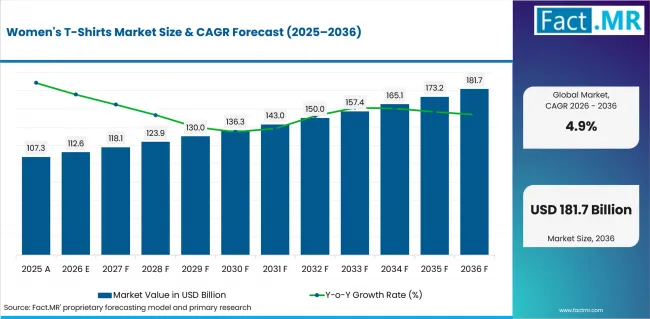
Womens T Shirts Market Value Analysis | Source: Fact.MR
What are the defining numbers behind Women's T-Shirts Market growth?
USD 69.1 billion absolute opportunity by 2036. Growth is led by Crew Neck T-Shirts and Casual Wear with Adult Women and Cotton shaping the main product mix.
- Demand Drivers in the Market
- Crew neck basics give retailers a clear replenishment product. The format lets buyers repeat colors and size curves without changing the selling plan.
- Casualwear use keeps t-shirts close to everyday spending. Retail teams can plan packs and core colors around steady replacement needs.
- USA route-to-market activity turns demand into sales when brands manage shelves and online listings together. Clear size information helps shoppers compare basics with less hesitation.
- Adult women demand widens the assortment across age groups and use occasions. Retailers are expected to protect basic styles before expanding graphic and performance variants.
- Key Segments Analyzed
- By Product Type: Crew Neck T-Shirts are expected to hold 37.6% share in 2026. The format fits multipacks and everyday layering.
- By Application: Casual Wear is projected to account for 31.9% share in 2026. Daily use keeps the category close to routine apparel purchases.
- By End User: Adult Women are anticipated to capture 30.1% share in 2026. This buyer group guides most repeat fit and fabric decisions.
- By Distribution Channel: Offline Retail Stores are estimated to represent 32.1% share in 2026. In-store buying helps shoppers check fit and fabric feel.
- By Fabric Type: Cotton is forecast to hold 35.5% share in 2026. Shoppers continue to associate the fabric with comfort and familiar care.
- Analyst Opinion at Fact.MR
- Shambhu Nath Jha, Senior Analyst at Fact.MR, states, "Women's t-shirts remain a repeat-purchase apparel category. The winning offer must prove fit consistency and fabric comfort before retailers add trend-led designs or premium fabric claims."
- Strategic Implications
- Retailers can use crew neck t-shirts as a repeat inventory test. Fit consistency and size availability can lower return pressure across stores and online channels.
- Brands need a clear split between fabric feel and price position. Cotton basics need shrinkage control and replenishment terms before larger programs expand.
- Investors should look at channel strength before premium fashion signals. Women's t-shirts create value when basics sell steadily and higher-priced styles add margin without slowing stock turns.
The U.S. Census Bureau reported in February 2025 that U.S. retail e-commerce sales reached USD 1,192.6 billion in 2024. The figure shows why t-shirt suppliers need store coverage and online replenishment in the same plan.
USA is projected to grow at 6.4% CAGR from 2026 to 2036, supported by strong retail coverage and repeat purchases. Germany follows at 5.9% as quality-focused casualwear buying shapes supplier selection. The UK is forecast at 5.4% through active store and online channels. Japan is expected to post 4.9% as fit and fabric comfort influence buying decisions. Canada is estimated at 4.5% due to wider replenishment needs. Australia is projected at 3.9% through seasonal planning, while Brazil may record 3.5% amid price-sensitive casualwear demand and careful distributor-led inventory management practices.
How does the Women's T-Shirts Market break down by segment?
Crew Neck T-Shirts are expected to lead Product Type at 37.6% share in 2026. Casual Wear is projected to lead Application at 31.9% share in 2026.
Which product type dominates?
Crew Neck T-Shirts are projected to account for 37.6% share in 2026.
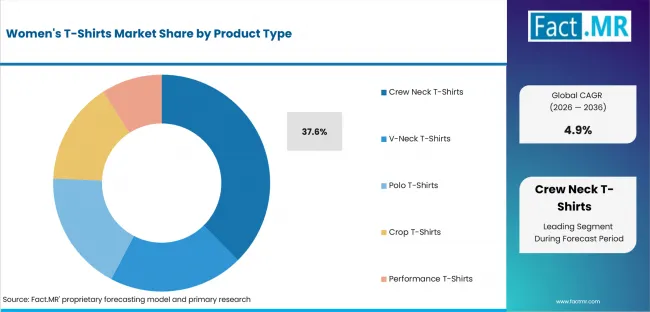
Womens T Shirts Market Analysis By Product Type | Source: Fact.MR
Crew Neck T-Shirts hold the top position through broad styling flexibility and strong use in everyday wardrobes. Basic Crew Neck styles support regular replacement demand, while Graphic Crew Neck products attract buyers interested in prints and branded designs. V-Neck T-Shirts address a smaller group that prefers a more open neckline and different layering options.
What leads the Application segment?
Casual Wear is expected to hold 31.9% share in 2026.
Casual Wear remains the largest application as t-shirts are commonly worn at home, during travel and in informal social settings. Daily Wear creates steady replacement needs due to frequent washing and repeated use. Streetwear adds demand through oversized fits and bold graphics. Sports & Fitness depends more on stretch, airflow and sweat-control features.
How does End User shape demand?
Adult Women are anticipated to lead with 30.1% share in 2026.
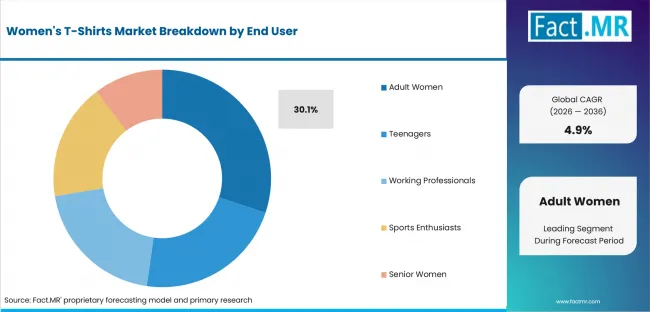
Womens T Shirts Market Analysis By End User | Source: Fact.MR
Adult Women form the main buyer group across work, leisure and household use. Consumers aged 18–35 often respond to changing styles, online trends and brand launches. Buyers aged 36–55 usually place greater value on fit, fabric quality and durability. Teenagers contribute separate demand shaped by affordable pricing, fast fashion and social media influence.
What supports Offline Retail Stores within Distribution Channel?
Offline Retail Stores are estimated to represent 32.1% share in 2026.
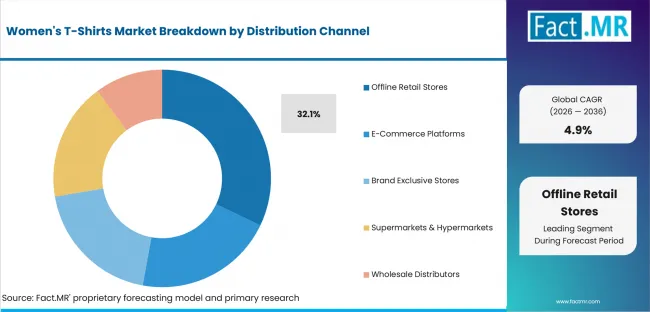
Womens T Shirts Market Analysis By Distribution Channel | Source: Fact.MR
Offline Retail Stores retain a strong position by allowing shoppers to try different sizes and inspect fabric quality before purchase. Apparel Specialty Stores offer deeper product variety and brand-focused ranges. Department Stores make price comparison easier across several labels. E-Commerce Platforms extend access through home delivery, wider stock availability and online promotions.
What supports Cotton within Fabric Type?
Cotton is forecast to hold 35.5% share in 2026.
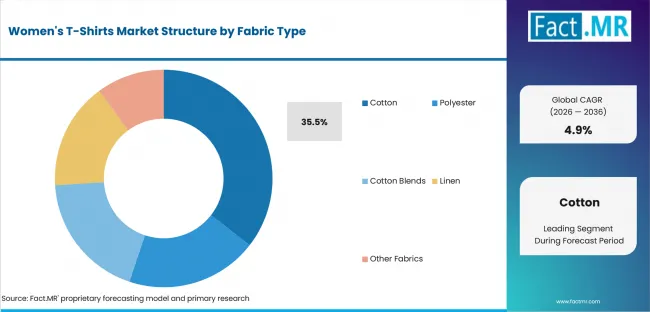
Womens T Shirts Market Analysis By Fabric Type | Source: Fact.MR
Cotton remains the preferred fabric for its softness, breathability and suitability for regular wear. Organic Cotton appeals to customers interested in more responsible material choices. Combed Cotton supports higher-priced products through a smoother finish and stronger fibers. Polyester serves performance uses where quick drying, shape retention and moisture management carry more importance.
What is accelerating Women's T-Shirts Market adoption, and what is holding it back?
Demand is supported by regular casualwear purchases and wider sales channels. Growth may be limited by low-priced private labels and returns caused by poor fit.
Drivers Impact Analysis
| DRIVER | QUALITATIVE RELEVANCE | GEOGRAPHIC RELEVANCE | IMPACT TIMELINE |
|---|---|---|---|
| Crew neck t-shirts specification pull | High | USA | Short term (<=2 years) |
| Casual wear repeat-use occasion | High | Germany | Short term (<=2 years) |
| USA route-to-market activity | Moderate | UK | Medium term (2-4 years) |
| Adult women packaging and shelf conversion | Selective | Japan | Medium term (2-4 years) |
Source: Fact.MR analysis. Updated Jul 29, 2026
- Crew neck t-shirts specification pull: Retailers are expected to use crew neck basics as a dependable reorder point. The format helps teams compare fit tolerance and size availability before wider seasonal buys.
- Casual wear repeat-use occasion: Casual Wear is expected to benefit from everyday use across home and relaxed work settings. This creates steady planning needs for color depth and fabric feel.
- USA route-to-market activity: Channel teams in the USA are expected to focus on sell-through evidence for Adult Women assortments. Online listing quality and shelf presentation shape replenishment speed.
- Adult women packaging and shelf conversion: Offline Retail Stores are expected to need clear pack sizing and easy fabric comparison. Better shelf conversion can reduce markdown pressure when buyers test cotton basics.
Opportunity Impact Analysis
| OPPORTUNITY | QUALITATIVE RELEVANCE | GEOGRAPHIC RELEVANCE | IMPACT TIMELINE |
|---|---|---|---|
| Casual wear occasion-led assortments | High | USA | Medium term (2-4 years) |
| Private-label partnerships | Moderate | Germany | Medium term (2-4 years) |
| Crew neck t-shirts bundle formats | Selective | UK | Medium term (2-4 years) |
Source: Fact.MR analysis. Updated Jul 29, 2026
- Casual wear occasion-led assortments: The opening is expected to come from tighter product edits around Crew Neck T-Shirts. Retailers can build daily-wear capsule offers without adding slow-moving variants.
- Private-label partnerships: Suppliers can win more programs when they give retailers predictable fabric quality and steady delivery windows. Germany is expected to favor partners that simplify approval for basic casualwear lines.
- Crew neck t-shirts bundle formats: Bundle packs are expected to help buyers compare value across Adult Women ranges. The approach works best when size consistency and return rules are documented before launch.
Restraints Impact Analysis
| RESTRAINT | QUALITATIVE RELEVANCE | GEOGRAPHIC RELEVANCE | IMPACT TIMELINE |
|---|---|---|---|
| Private-label competition and changing discretionary spending for crew neck t-shirts | High | USA | Short term (<=2 years) |
| Price sensitivity around casual wear | Moderate | Germany | Medium term (2-4 years) |
| Slow conversion where crew neck t-shirts lacks buyer-side validation | Selective | UK | Medium term (2-4 years) |
Source: Fact.MR analysis. Updated Jul 29, 2026
- Private-label competition and changing discretionary spending for crew neck t-shirts: Smaller suppliers are expected to face pressure when retailers compare them with in-house basics. Service coverage and repeat supply become harder to prove when price points are narrow.
- Price sensitivity around casual wear: Shoppers may delay discretionary purchases when basic tops lose their clear value gap. Casual Wear suppliers need sharper pack pricing and fabric claims to protect conversion.
- Slow conversion where crew neck t-shirts lacks buyer-side validation: Approval slows when Crew Neck T-Shirts lack proof on fit recovery and return levels. Weak documentation can extend listing decisions across online and store channels.
Which countries are scaling Women's T-Shirts Market fastest?
The country comparison is narrow across the listed markets. USA, Germany and UK form the upper group. Japan is aligned with the global pace. Canada, Australia and Brazil remain below the global trajectory because channel depth and price sensitivity shape order timing.
- The USA holds the highest listed position through broad retail coverage and repeat basic buying. Crew Neck T-Shirts benefit when sell-through evidence guides color and size planning.
- Germany remains close to the USA through quality-sensitive casualwear buying. Retailers are expected to ask for fabric clarity and sourcing assurance before adding more basic lines.
- The UK stays in the upper range through active online and store-based fashion channels. Adult Women demand is expected to depend on fit clarity and simple return handling.
- Japan tracks the global CAGR where shoppers place value on neat fit and fabric comfort. Offline Retail Stores remain useful when buyers compare touch and sizing before purchase.
- Canada stays slightly below the global pace as service coverage is spread across a large retail geography. Cotton basics are expected to perform better when availability is consistent.
- Australia reflects distance-related supply planning and seasonal inventory limits. Retailers are expected to favor dependable crew neck ranges before testing wider fashion-led assortments.
- Brazil records the lowest listed CAGR but remains relevant through regional distributors. Buyers need price stability and local availability before expanding casualwear assortments.
Comparable CAGRs can produce different market entry conditions across these countries. Deployment timing depends on channel readiness and buyer proof. Commercial readiness also reflects fabric consistency and return management.
The full report provides country-level CAGR analysis across North America and Latin America. It covers Europe and East Asia along with South Asia and Oceania. The Middle East and Africa are also covered.
| Country | CAGR (2026-2036) |
|---|---|
| USA | 6.4% |
| Germany | 5.9% |
| UK | 5.4% |
| Japan | 4.9% |
| Canada | 4.5% |
| Australia | 3.9% |
| Brazil | 3.5% |
Source: Fact.MR analysis. Updated Jul 29, 2026
What supports USA adoption?
6.4% CAGR, supported by strong brand presence and omnichannel retail expansion.
The USA benefits from a mature apparel market where national brands regularly introduce new collections and replenish basic styles. Consumers purchase t-shirts throughout the year, encouraging retailers to maintain broad size and color availability. Online marketplaces and branded stores together strengthen product visibility and repeat sales.
How is Germany scaling demand?
5.9% CAGR, driven by preference for durable fabrics and premium quality.
German consumers place greater emphasis on garment construction, fabric durability and long-term value than on rapid fashion turnover. Cotton quality, stitching standards and consistent sizing influence purchasing decisions. Brands that maintain reliable product quality are more likely to secure customer loyalty across casual apparel.
What is driving the UK's growth from 2026 to 2036?
5.4% CAGR, backed by fast-changing fashion trends and digital shopping.
The UK market benefits from rapid style refreshes supported by strong online fashion retailers. Consumers frequently update wardrobes in response to seasonal collections and social media influence. Flexible delivery options and convenient return policies encourage regular purchases across both value and premium brands.
How is Japan developing demand?
4.9% CAGR, supported by minimalist fashion preferences and premium basics.
Japanese buyers often favor clean designs, lightweight fabrics and precise garment finishing over bold graphics. Demand remains concentrated in high-quality essentials that combine comfort with understated styling. Retailers continue expanding premium basics that suit everyday urban lifestyles.
What supports Canada's outlook?
4.5% CAGR, supported by climate-based layering needs and stable apparel demand.
Canadian consumers regularly use t-shirts as base layers across changing seasons, supporting consistent sales throughout the year. Demand remains balanced between everyday basics and casual fashion. National retailers also focus on maintaining inventory across geographically dispersed markets.
How does Australia perform?
3.9% CAGR, led by warm-weather clothing demand and relaxed fashion preferences.
Australia's climate supports year-round use of lightweight t-shirts for outdoor activities and casual lifestyles. Consumers prefer breathable fabrics and comfortable fits suited to daily wear. Seasonal collections continue to emphasize versatile basics rather than heavily layered apparel.
What shapes Brazil's growth?
3.5% CAGR, supported by value-oriented purchasing and expanding local apparel retail.
Brazil's market grows through rising demand for affordable everyday clothing across urban centers. Consumers often balance price with comfort, encouraging retailers to expand entry-level collections. Domestic brands and regional retailers strengthen market reach by offering accessible styles across different income groups.
Who leads the Women's T-Shirts Market?
Nike Inc. and Adidas AG are among the most visible listed providers in sportswear-led women's t-shirts. H & M Hennes & Mauritz AB and Inditex widen the provider set through fashion basics and frequent assortment refreshes.
Nike Inc. supports premium and athletic-inspired women's t-shirts through brand reach and digital retail. Adidas AG adds sports lifestyle relevance. H&M and Zara compete through fast-changing basics ranges. Uniqlo and Gap Inc. add basic apparel depth. PUMA SE and Levi Strauss & Co. complete the listed provider set.
From 2026 to 2036, competition is expected to depend on fabric consistency and channel execution. Providers are expected to compare return rates and replenishment speed before scaling supplier relationships. Brands that keep core basics available across stores and online channels may gain stronger repeat demand.
Which companies are the key providers?
Key companies include Nike Inc.; Adidas AG; H & M Hennes & Mauritz AB; Inditex; Fast Retailing Co., Ltd.; Gap Inc.; PUMA SE; Levi Strauss & Co.
- Nike Inc.
- Adidas AG
- H & M Hennes & Mauritz AB
- Inditex
- Fast Retailing Co., Ltd.
- Gap Inc.
- PUMA SE
- Levi Strauss & Co.
Bibliography
- U.S. Census Bureau. (2025, February). Quarterly retail e-commerce sales, 4th quarter 2024.
- U.S. Department of Agriculture, Economic Research Service. (2025, December 11). Cotton and wool outlook: December 2025.
- Office for National Statistics. (2025, September 5). Retail sales, Great Britain: July 2025.
- Australian Bureau of Statistics. (2025, July 31). Retail trade, Australia: June 2025.
This Report Answers
- The report provides strategic intelligence on the Women's T-Shirts Market across Product Type and Application choices that shape repeat apparel buying.
- Segment analysis covers Crew Neck T-Shirts and Casual Wear as the share leaders within the 2026 market structure.
- Country outlook evaluates the USA and Germany alongside the UK and Japan. Canada, Australia and Brazil complete the growth comparison across the profiled markets.
- Competitive analysis profiles Nike Inc. and Adidas AG alongside H&M and Zara. Uniqlo and Gap Inc. are included with PUMA SE and Levi Strauss & Co.
- Channel assessment covers Offline Retail Stores and E-Commerce Platforms. Brand websites and online marketplaces complete the channel view alongside store-based retail.
What does the Women's T-Shirts Market cover?
Women's t-shirts include basic, fashion and performance tops sold through retail and online channels. These products serve casualwear and workwear. Sports use and promotional apparel are also covered.
The Women's T-Shirts Market covers commercial activity tied to crew neck and v-neck formats. Polo, crop and performance t-shirts are included when they are sold as women's tops. Coverage extends to cotton and synthetic fabric options. The market includes products sold to adult women and teenagers. Working professionals, sports users and senior women are also included.
The market differs from the wider women's apparel category because value comes from repeat purchase and fit consistency. Dresses and outerwear remain outside the boundary. Woven shirts and unrelated accessories are excluded. General apparel spending is included only when it directly involves women's t-shirts.
What is included in the scope?
Women's t-shirts are used across casualwear and streetwear. Fitness and fashion wear are included when the product is sold as a women's t-shirt. Workwear and promotional apparel follow the same rule.
The scope includes Product Type and Application alongside End User, Distribution Channel and Fabric Type. Coverage spans Crew Neck T-Shirts and V-Neck T-Shirts. Polo T-Shirts, Crop T-Shirts and Performance T-Shirts complete the product view. It includes Cotton and Polyester. Cotton Blends, Linen and other fabrics follow the same category-use rule.
What is excluded from the scope?
Unrelated apparel categories and general fashion spending remain outside the scope of this market.
The scope excludes products that are not sold as women's t-shirts. Dresses and knit sweaters are outside the boundary. Jackets and lingerie are also excluded. Men's t-shirts and children's t-shirts are excluded unless the sale is directly classified under women's t-shirt ranges. Company revenue without a clear connection to women's t-shirts is also excluded.
How Was the Analysis Built?
The analysis draws on 120+ sources, 35+ company portfolios, 25+ countries, and more than 20 industry interviews.
- Primary Research: Primary research includes discussions with manufacturers, service providers, technology developers, distributors, end users, procurement teams, and subject-matter experts. These conversations examine purchasing priorities, product adoption, operational challenges, approval requirements, competitive positioning, and the factors that influence wider market acceptance.
- Desk Research: Desk research covers government statistics, regulatory publications, company filings, trade data, technical studies, industry associations, standards, public policy, and other authoritative sources. Every source used in the analysis is documented in the bibliography.
- Market Sizing and Forecasting: Market estimates combine historical performance, demand indicators, pricing and volume trends, segment shares, company participation, country-level growth, adoption patterns, investment activity, and barriers to market expansion.
- Data Validation and Update Cycle: Findings are validated by comparing primary interviews with public data, company activity, regulatory changes, trade patterns, and industry developments. Regular updates review new product launches, capacity changes, partnerships, approvals, procurement trends, and shifts in commercial adoption.
Segmentation
What is the report's scope and coverage?
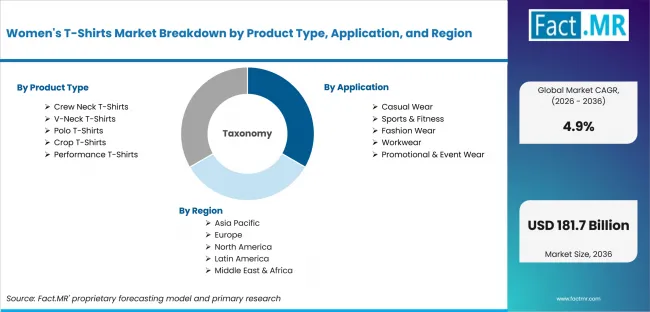
Women's T Shirts Market Breakdown By Product Type, Application, And Region | Source: Fact.MR
| Attribute | Details |
|---|---|
| Quantitative Units | USD billion in 2026 to USD billion by 2036 at CAGR |
| Market Definition | Commercial sale of women's t-shirts across basic, fashion and performance formats used for casualwear, workwear, fitness and promotional apparel |
| Product Type | Crew Neck T-Shirts; Basic Crew Neck; Graphic Crew Neck; V-Neck T-Shirts; Basic V-Neck; Deep V-Neck; Polo T-Shirts; Short Sleeve Polo; Long Sleeve Polo; Crop T-Shirts; Fitted Crop Tops; Oversized Crop Tops; Performance T-Shirts; Athletic T-Shirts; Moisture Wicking T-Shirts |
| Application | Casual Wear; Daily Wear; Streetwear; Sports & Fitness; Gym Wear; Yoga & Training; Fashion Wear; Premium Fashion; Designer Collections; Workwear; Corporate Casual; Uniform Wear; Promotional & Event Wear; Brand Merchandise; Event Apparel |
| End User | Adult Women; Age 18-35; Age 36-55; Teenagers; High School Students; College Students; Working Professionals; Corporate Employees; Service Professionals; Sports Enthusiasts; Fitness Participants; Athletes; Senior Women; Age 56-70; Age Above 70 |
| Distribution Channel | Offline Retail Stores; Apparel Specialty Stores; Department Stores; E-Commerce Platforms; Brand Websites; Online Marketplaces; Brand Exclusive Stores; Flagship Stores; Outlet Stores; Supermarkets & Hypermarkets; Hypermarkets; Discount Retailers; Wholesale Distributors; Fashion Wholesalers; Bulk Retail Suppliers |
| Fabric Type | Cotton; Organic Cotton; Combed Cotton; Polyester; Recycled Polyester; Performance Polyester; Cotton Blends; Cotton-Polyester Blend; Cotton-Spandex Blend; Linen; Pure Linen; Linen Blend; Other Fabrics; Bamboo Fabric; Modal & Viscose |
| Regions Covered | North America; Latin America; Europe; East Asia; South Asia and Oceania; Middle East and Africa |
| Countries Covered | USA; Germany; UK; Japan; Canada; Australia; Brazil |
| Key Companies Profiled | Nike Inc.; Adidas AG; H & M Hennes & Mauritz AB; Inditex; Fast Retailing Co., Ltd.; Gap Inc.; PUMA SE; Levi Strauss & Co. |
| Forecast Period | 2026 to 2036 |
| Approach | Hybrid top-down and bottom-up approach using apparel demand indicators; product mix; channel participation; country growth; company portfolio review and public evidence relevant to the category |
Source: Fact.MR analysis. Updated Jul 29, 2026
How is the market segmented?
-
By Product Type:
- Crew Neck T-Shirts
- Basic Crew Neck
- Graphic Crew Neck
- V-Neck T-Shirts
- Basic V-Neck
- Deep V-Neck
- Polo T-Shirts
- Short Sleeve Polo
- Long Sleeve Polo
- Crop T-Shirts
- Fitted Crop Tops
- Oversized Crop Tops
- Performance T-Shirts
- Athletic T-Shirts
- Moisture Wicking T-Shirts
-
By Application:
- Casual Wear
- Daily Wear
- Streetwear
- Sports & Fitness
- Gym Wear
- Yoga & Training
- Fashion Wear
- Premium Fashion
- Designer Collections
- Workwear
- Corporate Casual
- Uniform Wear
- Promotional & Event Wear
- Brand Merchandise
- Event Apparel
-
By End User:
- Adult Women
- Age 18-35
- Age 36-55
- Teenagers
- High School Students
- College Students
- Working Professionals
- Corporate Employees
- Service Professionals
- Sports Enthusiasts
- Fitness Participants
- Athletes
- Senior Women
- Age 56-70
- Age Above 70
-
By Distribution Channel:
- Offline Retail Stores
- Apparel Specialty Stores
- Department Stores
- E-Commerce Platforms
- Brand Websites
- Online Marketplaces
- Brand Exclusive Stores
- Flagship Stores
- Outlet Stores
- Supermarkets & Hypermarkets
- Hypermarkets
- Discount Retailers
- Wholesale Distributors
- Fashion Wholesalers
- Bulk Retail Suppliers
-
By Fabric Type:
- Cotton
- Organic Cotton
- Combed Cotton
- Polyester
- Recycled Polyester
- Performance Polyester
- Cotton Blends
- Cotton-Polyester Blend
- Cotton-Spandex Blend
- Linen
- Pure Linen
- Linen Blend
- Other Fabrics
- Bamboo Fabric
- Modal & Viscose
-
By Region:
- North America
- Latin America
- Europe
- East Asia
- South Asia and Oceania
- Middle East and Africa
Frequently Asked Questions
Which Product Type leads the market?
Which Application leads the market?
Which End User category leads the market?
Which Distribution Channel leads the market?
Which Fabric Type leads the market?
Which country records the highest listed CAGR?
What is the primary driver in this market?
What is the main restraint?
Why do Adult Women lead demand?
Who worked on this report


Preview the report firsthand - request a free sample
Free SampleGet the brochure for pricing and purchase details
Download PDF