- Market Value (2025): USD 1.7 Bn
- Estimated Value (2026): USD 2.0 Bn
- Forecast Value (2036): USD 10.5 Bn
- CAGR (2026-2036): 18.0%
What is the In-wheel Motor Market forecast to be worth by 2036?
USD 2.0 billion in 2026 to USD 10.5 billion by 2036 at 18.0% CAGR.
- The in-wheel motor market was valued at USD 1.7 billion in 2025.
- Demand is projected to increase from USD 2.0 billion in 2026 to USD 10.5 billion by 2036.
- The market is forecast to record 18.0% CAGR from 2026 to 2036 as electric platforms place more value on in-wheel motor systems and wheel-level torque.
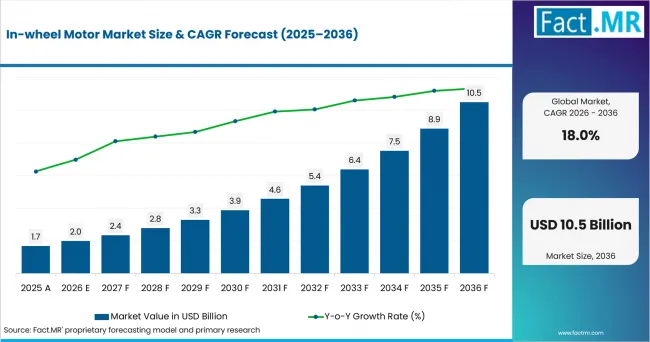
In Wheel Motor Market Value Analysis | Source: Fact.MR
What are the defining numbers behind In-wheel Motor Market growth?
USD 8.5 billion absolute opportunity by 2036, led by Battery Electric Vehicles, Axial In-wheel Motor and Passenger Cars.
- Demand Drivers in the Market
- EV platform engineers need compact propulsion layouts so battery packs and cabin space do not compete with shafts or e-axle hardware.
- Chassis teams need wheel-level torque control because distributed drive improves response during acceleration and cornering.
- Passenger-car programs are expected to widen the test base after the IEA reported in May 2026 that global electric car sales exceeded 20 million in 2025 and are expected to reach 23 million in 2026.
- Motor suppliers need efficient thermal designs since heat near the wheel affects durability and warranty risk.
- Key Segments Analyzed
- By Propulsion: Battery Electric Vehicles are expected to hold 32.10% share in 2026 due to the direct fit between wheel motors and pure electric drivetrains.
- By Cooling: Air Cooling is anticipated to capture 65.40% share in 2026 as simple thermal systems lower cost and assembly burden.
- By Power Output: Up to 60 KW is estimated to represent 45.20% share in 2026 owing to its fit with city cars and light duty models.
- By Vehicle Type: Passenger Cars are forecast to hold 69.80% share in 2026 since automakers test wheel-motor layouts first in car platforms.
- Analyst Opinion at Fact.MR
- Shambhu Nath Jha,Principal Consultant at Fact.MR states, "In-wheel motors shift propulsion decisions from the engine bay to the wheel corner. Supplier selection is expected to depend on integration proof across the motor, inverter, brake and suspension package. Programs should combine torque density, thermal stability and service access without adding unsprung-mass risk."
- Strategic Implications
- Automakers should test wheel-motor systems during platform packaging reviews instead of treating them as a late driveline option.
- Motor suppliers should document wheel-corner durability and thermal behavior before commercial negotiations begin.
- U.S. product teams should monitor shifts in the electric-drive mix, as EIA reported in February 2026 that about 22% of U.S. light-duty vehicles sold in 2025 were hybrid, battery electric, or plug-in hybrid vehicles.
- Investors should separate production-ready in-wheel motor programs from concept vehicles and prototype demonstrations.
Germany is projected to record 19.7% CAGR through 2036 due to electric car registrations and supplier depth. Brazil is forecast to advance at 18.0% as fleet-renewal financing widens cleaner-vehicle access. The USA is anticipated to post 16.3% as electric-drive sales widen. The U.K. is expected to record 14.6% as zero-emission registrations expand. Japan is estimated to reach 12.8% as hybrid strength offsets slower BEV penetration.
How does the In-wheel Motor Market break down by segment?
Battery Electric Vehicles lead at 32.10%; Air Colling leads at 65.40%.
Which propulsion segment dominates?
Battery Electric Vehicles hold 32.10% share in 2026.
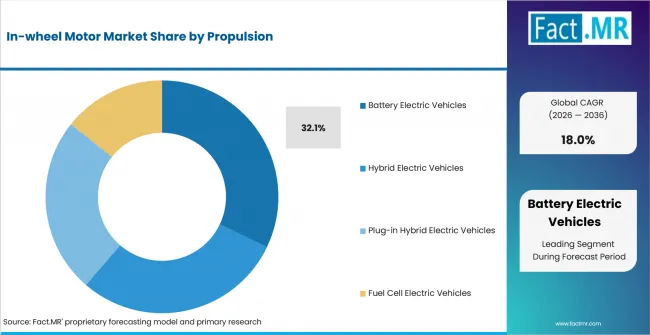
In Wheel Motor Market Analysis By Propulsion | Source: Fact.MR
Battery Electric Vehicles are expected to lead Propulsion because wheel motors fit platforms without combustion hardware. Passenger Electric Vehicles remain central as automakers seek space gains and faster torque delivery. Commercial Electric Vehicles form a smaller base where route reliability affects adoption. Hybrid and fuel cell vehicles support narrower programs where packaging or traction control is the main test need.
How does Cooling shape demand?
Air Cooling leads with 65.40% share in 2026.
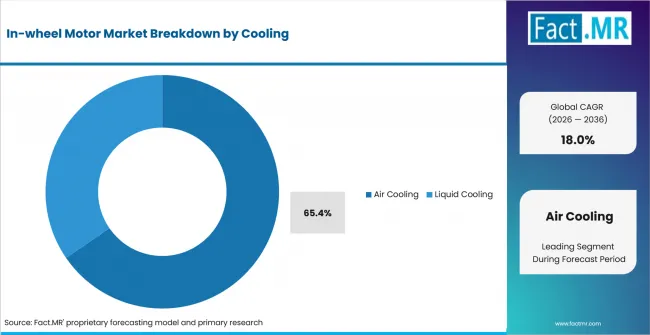
In Wheel Motor Market Analysis By Cooling | Source: Fact.MR
Air Cooling is anticipated to lead Cooling because it avoids pumps, hoses and coolant service points near the wheel. Natural Air Cooling suits lower-output vehicles where duty cycles are predictable. Forced Air Cooling supports higher thermal loads without moving fully into liquid loops. Liquid Cooling remains necessary for harder drive cycles and premium torque demand.
What supports the Power Output segment?
Up to 60 KW holds 45.20% share in 2026.
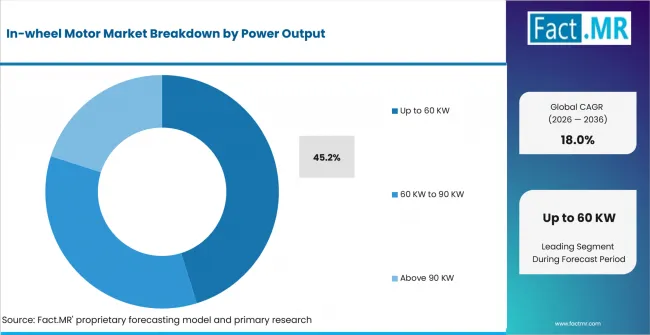
In Wheel Motor Market Analysis By Power Output | Source: Fact.MR
Up to 60 KW is estimated to represent the main Power Output share because early programs often serve city cars and light commercial use. Below 30 KW supports compact mobility where vehicle mass and speed requirements remain modest. The 30 KW to 60 KW range gives automakers usable wheel torque without premium cooling. Schaeffler presented electric motor variants of 125, 299 and 315 kW in April 2025, showing how higher-output work feeds adjacent EV traction motor platforms.
What supports Passenger Cars within Vehicle Type?
Passenger Cars hold 69.80% share in 2026.
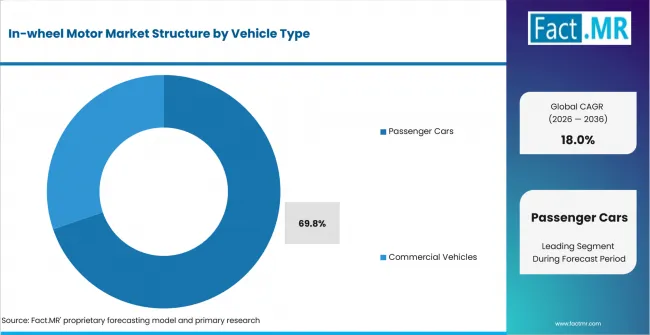
In Wheel Motor Market Analysis By Vehicle Type | Source: Fact.MR
Passenger Cars are forecast to lead Vehicle Type since packaging benefits are easiest to show in electric car platforms. Hatchbacks use compact layouts where freed battery space carries value. SUV and Sedan programs create room for torque-vectoring features.
What is accelerating In-wheel Motor Market adoption, and what is holding it back?
EV platform packaging drives it; wheel-corner complexity restrains it.
Drivers Impact Analysis
| DRIVER | (~) % IMPACT ON CAGR | GEOGRAPHIC RELEVANCE | IMPACT TIMELINE |
|---|---|---|---|
| EV platform packaging | +4.2% | Germany, USA, U.K. | Short term (<= 2 years) |
| Wheel-level torque control | +3.6% | Germany, Japan, USA | Short term (<= 2 years) |
| Axial motor density | +2.9% | U.K., Germany, Japan | Medium term (2-4 years) |
| Urban electric mobility | +2.3% | Brazil, Japan, Europe | Medium term (2-4 years) |
| Modular commercial EV layouts | +1.7% | Brazil, U.K., USA | Long term (>= 4 years) |
- EV platform packaging: Placing propulsion at the wheel frees space otherwise used by shafts and e-axle hardware. Engineers are expected to value this in compact cars and vans.
- Wheel-level torque control: Independent wheel drive gives software teams a direct route to traction and stability tuning. Adoption still depends on brake, suspension and tire validation.
- Axial motor density: Axial flux designs shorten the motor package while maintaining useful torque. Scale is expected to improve once coil, rotor and end-of-line testing become repeatable.
- Urban electric mobility: City vehicles benefit from compact drivetrains and sharper low-speed response. Cost remains a gate for value-focused segments.
- Modular commercial EV layouts: Light commercial vehicles create a practical route when cargo space and uptime are central. Wider use depends on parts availability and repair training.
Opportunity Impact Analysis
| OPPORTUNITY | (~) % IMPACT ON CAGR | GEOGRAPHIC RELEVANCE | IMPACT TIMELINE |
|---|---|---|---|
| Integrated inverter modules | +1.8% | Germany, U.K., USA | Medium term (2-4 years) |
| Software-defined torque control | +1.5% | Japan, Germany, USA | Medium term (2-4 years) |
| Light commercial EV conversions | +1.1% | Brazil, U.K., USA | Long term (>= 4 years) |
| Wheel-hub motor supply chains | +0.9% | Germany, Japan, U.K. | Long term (>= 4 years) |
- Integrated inverter modules: Combining motor control closer to the wheel reduces wiring complexity and improves response. Warranty teams need clear service instructions before fleet programs scale.
- Software-defined torque control: In-wheel systems give vehicle software a cleaner path to independent wheel torque. The opportunity narrows when software gains do not offset automotive power electronics cost.
- Light commercial EV conversions: Vans and small delivery vehicles offer room for modular wheel-motor layouts. Suppliers need maintenance data before fleets scale pilots.
- Wheel-hub motor supply chains: Localized stator, rotor and electronics production shortens program risk. Regional supply depth becomes more useful as volumes rise.
Restraints Impact Analysis
| RESTRAINT | (~) % IMPACT ON CAGR | GEOGRAPHIC RELEVANCE | IMPACT TIMELINE |
|---|---|---|---|
| Unsprung mass risk | -1.7% | Global | Short term (<= 2 years) |
| Thermal durability near wheel | -1.4% | Germany, USA, Japan | Short term (<= 2 years) |
| Service and repair complexity | -1.0% | Fleet markets | Medium term (2-4 years) |
| Program qualification cost | -0.8% | New EV platforms | Long term (>= 4 years) |
- Unsprung mass risk: Adding motor hardware near the wheel changes suspension behavior and ride tuning. Validation must cover potholes, water exposure and braking heat.
- Thermal durability near wheel: The wheel area faces road debris, braking heat and limited package space. Liquid loops add control but raise assembly cost.
- Service and repair complexity: In-wheel motors move expensive hardware into a damage-prone location. Fleets are expected to wait for proven service intervals and parts access.
- Program qualification cost: Automakers must qualify motor and inverter interfaces together with brake, bearing and suspension interfaces. Smaller programs are likely to wait for repeatable supplier data.
Which countries are scaling In-wheel Motor Market fastest?
- The country comparison spans 6.9 percentage points and forms three practical growth bands across the forecast period.
- Germany remains 1.7 percentage points above Brazil through electric-car recovery and supplier engineering depth.
- Brazil matches the global CAGR as fleet-renewal finance and imported electrified models widen test conditions.
- The USA remains 1.7 percentage points below Brazil while electric-drive sales still create a wide platform base.
- The U.K. remains 1.8 percentage points below the USA as zero-emission registrations expand from a smaller market.
- Japan closes the displayed range as hybrid strength slows pure BEV replacement cycles.
Comparable CAGRs create different entry conditions. Full report coverage includes North America, Latin America, Europe, East Asia, South Asia and Pacific, Middle East and Africa.
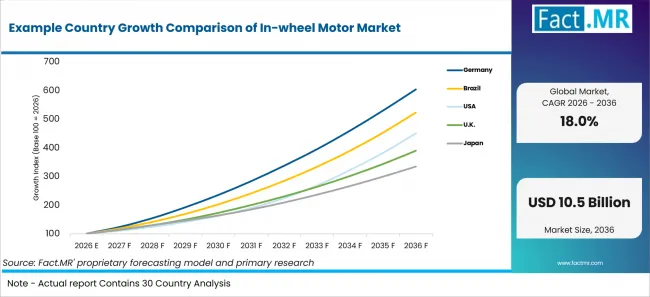
Example Country Growth Comparison Of In Wheel Motor Market | Source: Fact.MR
| Country | CAGR (2026-2036) |
|---|---|
| Germany | 19.7% |
| Brazil | 18.0% |
| USA | 16.3% |
| U.K. | 14.6% |
| Japan | 12.8% |
What supports Germany adoption?
19.7% CAGR, driven by electric-car registrations and supplier engineering depth.
Germany’s OEM and component base is expected to value wheel-corner propulsion where compact drivetrains support electric platform packaging. Germany is projected to record 19.7% CAGR through 2036. The Federal Ministry for Economic Affairs and Energy reported in January 2026 that BEV registrations reached 545,142 in 2025, up 43.2%. Local engineering depth gives suppliers a practical route to test motor, brake and suspension interfaces before production nomination.
How is Brazil scaling in-wheel motor demand?
18.0% CAGR, supported by fleet-renewal finance and cleaner-vehicle programs.
Brazil’s urban vehicle base is expected to create selective demand where wheel motors help low-speed torque and cabin packaging. Brazil is forecast to advance at 18.0% CAGR through 2036, and BNDES began operating Move Motoristas financing in June 2026 under the Move Brasil program, which provides up to R$30 billion in credit for eligible taxi and app-based drivers and applies a vehicle-price ceiling of R$150,000. This price constraint may increase the importance of demonstrating a competitive cost case for advanced technologies such as in-wheel motors.
How is USA scaling in-wheel motor demand?
16.3% CAGR, led by electric-drive sales and platform breadth.
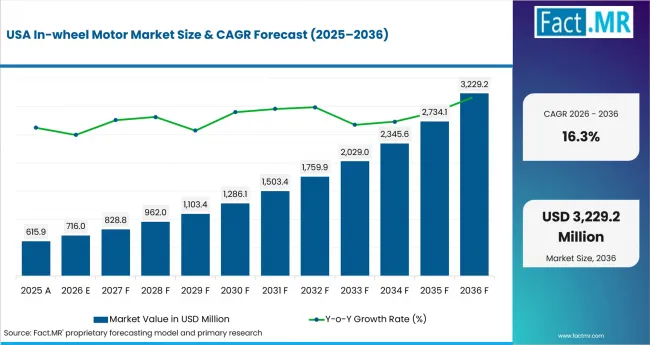
In Wheel Motor Market Country Value Analysis | Source: Fact.MR
The USA offers a broad platform base where automakers and fleets can evaluate distributed propulsion across passenger and light commercial vehicles. The USA is anticipated to post 16.3% CAGR through 2036, and the U.S. Energy Information Administration reported in February 2026 that hybrid, battery electric and plug-in hybrid vehicles reached about 22% of light-duty sales in 2025. Adoption still depends on proving wheel-end durability against e-axle cost and service risk.
How is U.K. scaling in-wheel motor demand?
14.6% CAGR, supported by zero-emission registrations and axial-flux engineering.
The U.K. is expected to use in-wheel motor trials where compact passenger cars and light commercial vehicles need packaging gains. The market is projected to record 14.6% CAGR through 2036. The Department for Transport reported in April 2026 that 473,000 zero-emission cars were first registered in 2025, up 24% from 2024.
What supports Japan adoption?
12.8% CAGR, shaped by hybrid strength and selective BEV adoption.
Japan’s automakers are expected to compare wheel motors with mature hybrid architectures before committing to pure BEV platforms. Japan is estimated to reach 12.8% CAGR through 2036, and the IEA reported in May 2026 that electric car sales stayed just above 100,000 in 2025 while electric cars represented less than 3% of sales. Motor, bearing and precision component depth supports development, but slower BEV turnover limits immediate scale.
Who leads the In-wheel Motor Market?
Protean Electric, an EXEDY company and Schaeffler AG lead direct wheel-motor coverage. PMW Dynamics, Elaphe Propulsion Technologies, Donut Lab and DeepDrive strengthen adjacent motor capability.
Protean Electric, an EXEDY company has direct in-wheel motor positioning through ProteanDrive for passenger cars and light commercial vehicles. Its September 2025 IAA Mobility announcement placed the Pm18 2500 at more than 2,500 Nm and 220 kW per wheel motor. Schaeffler AG supports the field through PowerWheel and wheel-hub drive capability linked to permanent magnet synchronous machine work.
PMW Dynamics contributes electric motor design and manufacturing depth for specialized traction use cases. Elaphe Propulsion Technologies, Donut Lab and DeepDrive add adjacent relevance through hub, modular EV and axial-flux motor expertise. Tesla, General Motors and Volkswagen AG influence EV platform benchmarks, but they are not treated as standalone in-wheel motor suppliers in this report. Competition is expected to depend on durability and e-axle cost parity.
Which companies are the key providers?
Key companies include Protean Electric, an EXEDY company, Schaeffler AG, PMW Dynamics, Elaphe Propulsion Technologies, Donut Lab, DeepDrive.
- Protean Electric, an EXEDY company
- Schaeffler AG
- PMW Dynamics
- Elaphe Propulsion Technologies
- Donut Lab
- DeepDrive
How is the market segmented?
-
By Propulsion
- Battery Electric Vehicles
- Passenger Electric Vehicles
- Commercial Electric Vehicles
- Hybrid Electric Vehicles
- Series Hybrid Vehicles
- Parallel Hybrid Vehicles
- Plug-in Hybrid Electric Vehicles
- Passenger PHEVs
- Commercial PHEVs
- Fuel Cell Electric Vehicles
- Passenger Fuel Cell Vehicles
- Commercial Fuel Cell Vehicles
- Battery Electric Vehicles
-
By Product:
- Axial In-wheel Motor
- Single Rotor Axial Motor
- Dual Rotor Axial Motor
- Radial In-wheel Motor
- Inner Rotor Radial Motor
- Outer Rotor Radial Motor
- Axial In-wheel Motor
-
By Cooling
- Air Cooling
- Natural Air Cooling
- Forced Air Cooling
- Liquid Cooling
- Water Glycol Cooling
- Advanced Liquid Cooling
- Air Cooling
-
By Power Output
- Up to 60 KW
- Below 30 KW
- 30 KW to 60 KW
- 60 KW to 90 KW
- 60 KW to 75 KW
- 75 KW to 90 KW
- Above 90 KW
- 90 KW to 120 KW
- Above 120 KW
- Up to 60 KW
-
By Vehicle Type
- Passenger Cars
- Hatchback
- SUV and Sedan
- Commercial Vehicles
- Light Commercial Vehicles
- Heavy Commercial Vehicles
- Passenger Cars
-
By Region
- North America
- Latin America
- Western Europe
- Eastern Europe
- East Asia
- South Asia and Pacific
- Middle East & Africa
Bibliography
- International Energy Agency. (2026, May 20). Executive summary. In Global EV Outlook 2026.
- International Energy Agency. (2026, May 20). Trends in electric cars. In Global EV Outlook 2026.
- Federal Ministry for Economic Affairs and Energy. (2026, January 27). Great prospects for electric mobility.
- Department for Transport. (2026, April 29). Vehicle licensing statistics, United Kingdom: 2025.
- U.S. Energy Information Administration. (2026, February 9). Electric vehicle sales fell as hybrid vehicle sales continued to rise in 2025.
- Banco Nacional de Desenvolvimento Econômico e Social. (2026, June 19). Move Brasil: Com R$ 30 bi, BNDES inicia operação de linha de crédito para renovar frota de taxistas e motoristas de aplicativo.
- Protean Electric. (2025, September 5). Protean to showcase IWM technology offering cost reductions over advanced e-axles at IAA Mobility.
- Schaeffler AG. (2025, April 3). On the road to decarbonization: Schaeffler presents e-motors with outputs of up to 315 kW.
- YASA Ltd. (2025, May 13). YASA opens UK’s first axial-flux motor super-factory.
This Report Answers
- The report provides strategic intelligence on the In-wheel Motor Market across Propulsion and Cooling choices that shape electric platform design.
- Segment analysis covers Battery Electric Vehicles and Axial In-wheel Motor as the 2026 share leaders within the market.
- Country outlook evaluates Germany, Brazil, the USA, the U.K. and Japan across the displayed CAGR range.
- Competitive analysis profiles Protean Electric, an EXEDY company, Schaeffler AG, PMW Dynamics, Elaphe Propulsion Technologies, Donut Lab and DeepDrive.
- Technology assessment covers cooling and power-output bands that affect wheel-end durability, service access and thermal control.
What does the In-wheel Motor Market cover?
In-wheel motor systems place electric propulsion at the wheel assembly and reduce dependence on conventional driveline layouts. The market covers axial and radial in-wheel motors used in electric, hybrid, plug-in hybrid and fuel cell vehicle programs. The scope connects with automotive motor assemblies, automotive power electronics and e-axle inverter and control unit systems where the technology relationship is direct.
What is included in the scope?
The scope includes propulsion systems where traction torque is delivered from a motor placed inside or near the wheel. Cooling coverage includes air and liquid designs. Power-output coverage runs from below 30 KW to above 120 KW. Adjacent mechanical context includes automotive metal wheels, automotive wheel platforms and sealed wheel hub bearings.
What is excluded from the scope?
The scope excludes conventional e-axles unless the system includes a wheel-mounted propulsion motor. It excludes unrelated tires, brakes and suspension parts sold outside an in-wheel motor package. Separate coverage of truck wheel hubs and hub bearings and passenger car hub bearings remains outside the market unless the component is sold as part of a wheel-motor system.
How Was the Analysis Built?
The analysis draws on 120+ sources, 35+ company portfolios, 25+ countries and 20+ interviews.
- Primary Research: Interviews cover manufacturers, technology developers, procurement teams and subject-matter experts. They test purchasing priorities, approval requirements and adoption limits.
- Desk Research: Desk research covers government statistics and regulatory publications. It also covers company filings, standards and public policy.
- Market Sizing and Forecasting: Estimates combine historical performance and segment shares. They also consider country growth, adoption patterns and barriers.
- Data Validation and Update Cycle: Findings are checked against public data, company activity and regulation. Updates review launches and capacity changes.
What is the report’s scope and coverage?
| Attribute | Details |
|---|---|
| Quantitative Units | USD billion |
| Market Definition | Electric traction motors placed inside or near the wheel assembly where propulsion torque, thermal behavior, braking load and service access affect production release |
| Propulsion | Battery Electric Vehicles; Passenger Electric Vehicles; Commercial Electric Vehicles; Hybrid Electric Vehicles; Series Hybrid Vehicles; Parallel Hybrid Vehicles; Plug-in Hybrid Electric Vehicles; Passenger PHEVs; Commercial PHEVs; Fuel Cell Electric Vehicles; Passenger Fuel Cell Vehicles; Commercial Fuel Cell Vehicles |
| Cooling | Air Cooling; Natural Air Cooling; Forced Air Cooling; Liquid Cooling; Water Glycol Cooling; Advanced Liquid Cooling |
| Power Output | Up to 60 KW; Below 30 KW; 30 KW to 60 KW; 60 KW to 90 KW; 60 KW to 75 KW; 75 KW to 90 KW; Above 90 KW; 90 KW to 120 KW; Above 120 KW |
| Vehicle Type | Passenger Cars; Hatchback; SUV and Sedan; Commercial Vehicles; Light Commercial Vehicles; Heavy Commercial Vehicles |
| Regions Covered | North America; Latin America; Europe; East Asia; South Asia and Pacific; Middle East and Africa |
| Countries Covered | Germany; Brazil; USA; U.K.; Japan; South Korea |
| Key Companies Profiled | Protean Electric, an EXEDY company; Schaeffler AG; PMW Dynamics; Elaphe Propulsion Technologies; Donut Lab; DeepDrive |
| Forecast Period | 2026 to 2036 |
| Approach | Hybrid top-down and bottom-up approach using EV sales, motor technology fit, wheel-end integration requirements, cooling choices, power-output bands, vehicle type mix, country adoption patterns and company portfolio review |