- Market Value (2025): USD 1.0 Bn
- Estimated Value (2026): USD 1.1 Bn
- Forecast Value (2036): USD 1.8 Bn
- CAGR (2026-2036): 5.0%
What is the Shock Mat Market forecast to be worth by 2036?
USD 1.1 billion in 2026 to USD 1.8 billion by 2036, at 5.0% CAGR.
- The shock mat market reached USD 1.0 billion in 2025.
- Demand is projected to increase from USD 1.1 billion in 2026 to USD 1.8 billion by 2036.
- The market is expected to expand at 5.0% CAGR from 2026 to 2036.
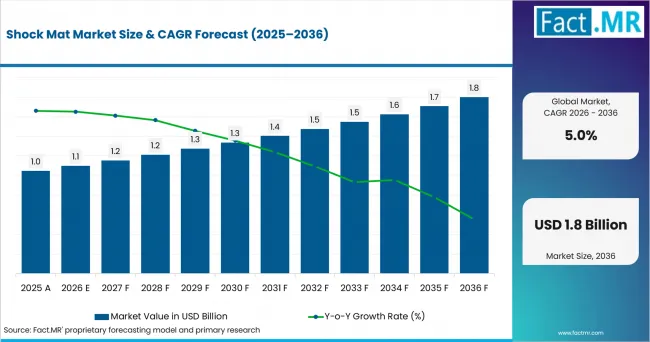
Shock Mat Market Value Analysis | Source: Fact.MR
What are the defining numbers behind Shock Mat Market growth?
- USD 0.7 billion in absolute opportunity is expected between 2026 and 2036.
- Demand Drivers in the Market
- Manufacturers use shock mats to reduce vibration transfer, protect floors and equipment, and stabilize work areas.
- Warehouses and production lines use anti-fatigue formats where operators stand for extended periods.
- Electronic and precision-device areas require cushioning that can be combined with electrostatic-control performance.
- Rubber and composite formulations let suppliers tune hardness, rebound, compression set, chemical resistance, and surface grip.
- Key Segments Analyzed
- By Product: Industrial Shock Mats accounts for 68.3% in 2026. Industrial Shock Mats lead because machinery and equipment-isolation duties create repeatable demand for load-bearing and vibration-control performance.
- By Application: Manufacturing Facilities accounts for 44.6% in 2026. Manufacturing Facilities lead because production plants combine heavy equipment, operator workstations, electronic areas, and maintenance zones.
- By End Use: Industrial Manufacturers accounts for 57.8% in 2026. Industrial Manufacturers lead because mat selection directly affects machine stability, floor protection, safety, and maintenance conditions.
- By Technology: Vibration Absorption Technology accounts for 62.1% in 2026. Vibration Absorption Technology leads because elastomeric dampening and layered cushioning address a core mechanical function across machinery and equipment installations.
- By Formulation: Rubber Based Formulations accounts for 49.7% in 2026. Rubber Based Formulations lead because natural and synthetic rubber systems offer grip, resilience, abrasion resistance, and tunable hardness.
- By Distribution Channel: Direct Industrial Sales accounts for 38.9% in 2026. Direct Industrial Sales leads because site dimensions, load conditions, chemicals, and installation details often require supplier involvement.
- Analyst Opinion at Fact.MR
- Fact.MR opines, "Shock-mat purchasing starts with the load case. A mat under a machine must control deflection, creep, vibration transmission, fluid exposure, and anchoring; a workstation mat must also manage footing, edges, cleanability, and operator movement. Suppliers should document the test condition behind every performance claim." - Shambhu Nath Jha, Principal Consultant at Fact.MR.
- Strategic Implications
- Suppliers need load-deflection, compression-set, slip, chemical-resistance, and durability data tied to the intended installation.
- Industrial buyers should distinguish machinery isolation from anti-fatigue, ESD, logistics, and vehicle-floor duties.
- Distributors can reduce failure risk by matching mat dimensions, edge design, surface pattern, and formulation to the work zone.
How does the Shock Mat Market break down by segment?
Why does Industrial Shock Mats lead Product?
Industrial Shock Mats leads Product within the shock mat market. Industrial shock mats provide shock absorption where machinery and equipment-isolation duties require load-bearing and vibration-control performance.
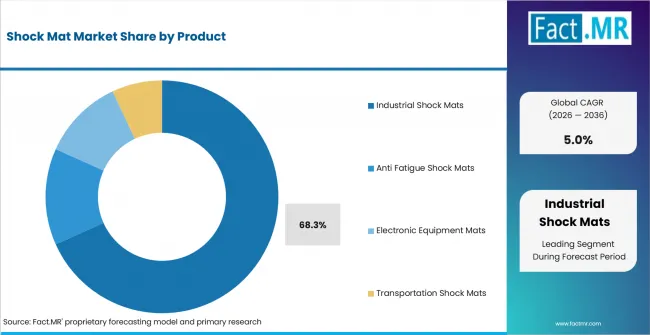
Shock Mat Market Analysis By Product | Source: Fact.MR
The remaining Product set includes Anti Fatigue Shock Mats, Electronic Equipment Mats, and Transportation Shock Mats. Anti-fatigue mats, electronic-equipment mats, and transportation mats address operator comfort, ESD protection, precision devices, logistics, and vehicle-floor conditions.
Why does Manufacturing Facilities lead Application?
Manufacturing Facilities leads Application within the shock mat market. Manufacturing Facilities lead because production plants combine heavy equipment, operator workstations, electronic areas, and maintenance zones.
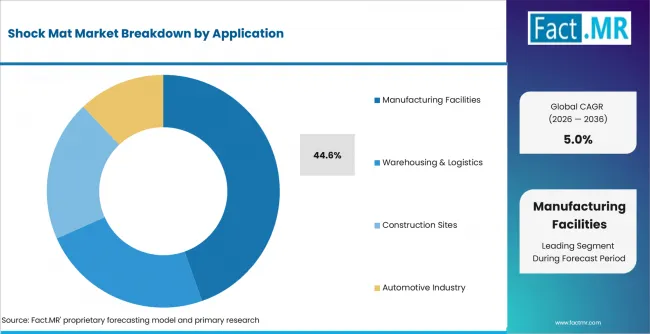
Shock Mat Market Analysis By Application | Source: Fact.MR
The remaining Application set includes Warehousing & Logistics, Construction Sites, and Automotive Industry. Warehousing, construction, automotive, storage, and handling zones require different surface, movement, cleaning, and impact-control properties.
Why does Industrial Manufacturers lead End Use?
Industrial Manufacturers leads End Use within the shock mat market. Mat selection complements anti-vibration fasteners and directly affects machine stability, floor protection, safety, and maintenance conditions.
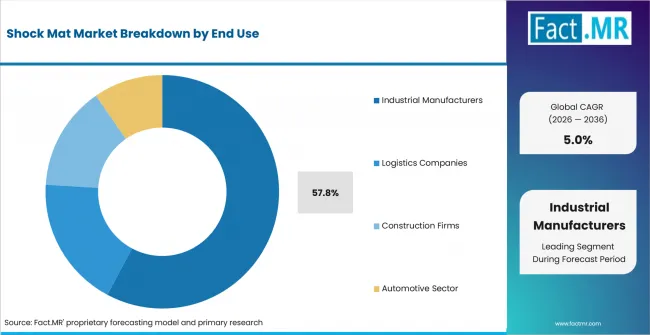
Shock Mat Market Analysis By End Use | Source: Fact.MR
The remaining End Use set includes Logistics Companies, Construction Firms, and Automotive Sector. Logistics operators, contractors, service firms, vehicle plants, and component suppliers qualify mats against their own traffic and load patterns.
Why does Vibration Absorption Technology lead Technology?
Vibration Absorption Technology leads Technology within the shock mat market. A vibration absorber may be a compact component, whereas mats use elastomeric dampening and layered cushioning across a larger support area.
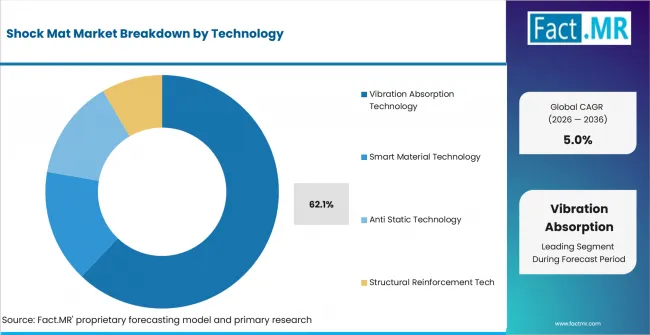
Shock Mat Market Analysis By Technology | Source: Fact.MR
The remaining Technology set includes Smart Material Technology, Anti Static Technology, and Structural Reinforcement Tech. Smart polymers, foam systems, anti-static layers, reinforcement, and structural distribution systems extend performance beyond basic rubber damping.
Why does Rubber Based Formulations lead Formulation?
Rubber Based Formulations leads Formulation within the shock mat market. Rubber Based Formulations lead because natural and synthetic rubber systems offer grip, resilience, abrasion resistance, and tunable hardness.
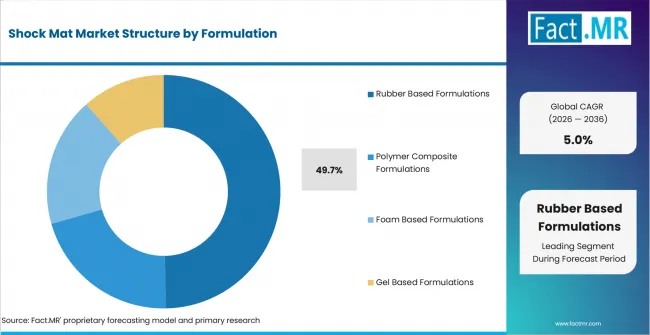
Shock Mat Market Analysis By Formulation | Source: Fact.MR
The remaining Formulation set includes Polymer Composite Formulations, Foam Based Formulations, and Gel Based Formulations. Thermoplastics, thermosets, polyurethane foam, memory foam, silicone gel, and hybrid systems tune rebound, cushioning, temperature, and chemical behavior.
Why does Direct Industrial Sales lead Distribution Channel?
Direct Industrial Sales leads Distribution Channel within the shock mat market. Direct Industrial Sales leads because site dimensions, load conditions, chemicals, and installation details often require supplier involvement.
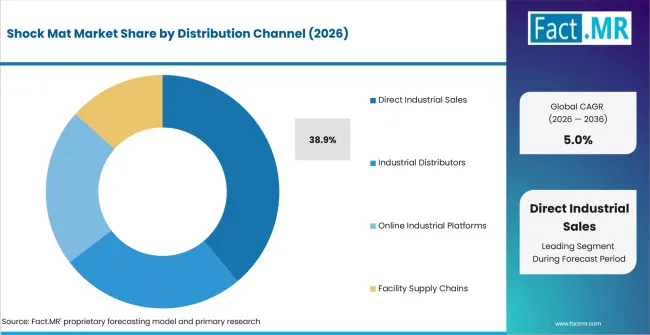
Shock Mat Market Analysis By Distribution Channel | Source: Fact.MR
The remaining Distribution Channel set includes Industrial Distributors, Online Industrial Platforms, and Facility Supply Chains. Distributors, marketplaces, facility-supply channels, and maintenance vendors compete on stock, sizing, and local service.
What is accelerating Shock Mat Market adoption, and what is holding it back?
Adoption is supported by machinery protection, workplace ergonomics, and floor-safety needs. Vibration testing must reproduce the actual load, frequency, mounting, and floor condition. Adoption is restrained by weakly defined performance claims, incorrect load matching, edge-trip risks, chemical attack, and replacement-cost comparisons with simpler flooring.
Drivers Impact Analysis
| DRIVER | (~) % IMPACT ON CAGR | GEOGRAPHIC RELEVANCE | IMPACT TIMELINE |
|---|---|---|---|
| Industrial vibration and impact-control requirements | +1.3% | Global | Short term (<= 2 years) |
| Operator comfort programs at fixed workstations | +1.0% | North America, Europe, Asia | Medium term (2-4 years) |
| Equipment and floor protection in warehouses | +0.8% | Global | Short term (<= 2 years) |
| ESD and precision-device protection | +0.7% | Global | Medium term (2-4 years) |
| Custom mat sizing for machinery footprints | +0.5% | Global | Long term (> 4 years) |
Source: Fact.MR analysis. Updated Aug 21, 2026
Opportunity Impact Analysis
| OPPORTUNITY | (~) % IMPACT ON CAGR | GEOGRAPHIC RELEVANCE | IMPACT TIMELINE |
|---|---|---|---|
| Validated load-specific isolation systems | +0.8% | Global | Medium term (2-4 years) |
| Combined anti-fatigue and ESD performance | +0.7% | North America, Europe, East Asia | Long term (> 4 years) |
| Chemical-resistant mats for process facilities | +0.6% | Global | Medium term (2-4 years) |
| Modular replacement formats for logistics sites | +0.5% | Global | Long term (> 4 years) |
Source: Fact.MR analysis. Updated Aug 21, 2026
Restraints Impact Analysis
| RESTRAINT | (~) % IMPACT ON CAGR | GEOGRAPHIC RELEVANCE | IMPACT TIMELINE |
|---|---|---|---|
| Poor load matching and unverified performance claims | -0.6% | Global | Short term (<= 2 years) |
| Compression set, edge curl, and surface wear | -0.5% | Global | Medium term (2-4 years) |
| Chemical and temperature incompatibility | -0.4% | Global | Medium term (2-4 years) |
| Price comparison with basic floor coverings | -0.4% | Global | Short term (<= 2 years) |
Source: Fact.MR analysis. Updated Aug 21, 2026
Which countries are scaling the Shock Mat Market through 2036?
- Germany: Machinery, automotive, chemicals, and logistics sites create varied isolation and workstation duties.
- Brazil: Manufacturing, warehousing, transport, and construction support demand for durable floor and equipment protection.
- USA: Large industrial and logistics networks support machinery-isolation and anti-fatigue applications.
- UK: Workplace vibration and standing-risk management support documented mat selection.
- Japan: Precision manufacturing and dense production layouts favor stable, cleanable, dimensionally controlled mats.
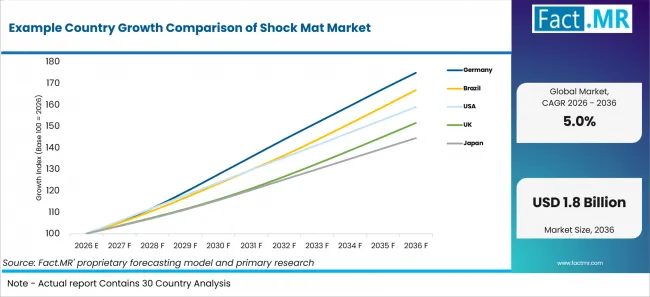
Example Country Growth Comparison Of Shock Mat Market | Source: Fact.MR
| Country | CAGR (2026-2036) |
|---|---|
| Germany | 5.8% |
| Brazil | 5.2% |
| USA | 4.8% |
| UK | 4.2% |
| Japan | 3.8% |
Source: Fact.MR analysis. Updated Aug 21, 2026
What is the Germany growth outlook through 2036?
The shock mat market in Germany is projected to expand at 5.8% CAGR from 2026 to 2036.
German plants require mat performance to be matched with machine load, traffic, floor condition, and chemical exposure. Maintenance teams value predictable compression behavior and documented installation limits.
What is the Brazil growth outlook through 2036?
The shock mat market in Brazil is projected to expand at 5.2% CAGR from 2026 to 2036.
Brazilian buyers often weigh abrasion, moisture, oils, outdoor exposure, and replacement access. Local dimensions and distributor stock can be as important as nominal cushioning.
What is the USA growth outlook through 2036?
The shock mat market in the USA is projected to expand at 4.8% CAGR from 2026 to 2036.
NIOSH guidance identifies vibration and ergonomic risk factors in work design. Buyers must validate each mat within the complete workstation or equipment duty.
What is the UK growth outlook through 2036?
The shock mat market in the UK is projected to expand at 4.2% CAGR from 2026 to 2036.
U.K. health and safety guidance emphasizes risk assessment and exposure control. Mat suppliers therefore need clear limits for load, vibration, slip, cleaning, and edge conditions.
What is the Japan growth outlook through 2036?
The shock mat market in Japan is projected to expand at 3.8% CAGR from 2026 to 2036.
Japanese facilities often combine machinery, electronics, and operator work zones. Product qualification centers on consistent thickness, compression, surface finish, contamination control, and installation accuracy.
Which companies are profiled in the Shock Mat Market?
Key companies profiled include Qingdao Finest Industry Co., Ltd.; India Mart; Splendor Industrial Comp Ltd.; Qingdao Emei Ind & Tech Co., Ltd.; Qingdao SOL Industrial and Trade Company Ltd.; and Hangzhou Green Valley Rubber Products Co., Ltd.
- Qingdao Finest Industry Co., Ltd
- India Mart
- Splendor Industrial Comp Ltd.
- Qingdao Emei Ind & Tech Co., Ltd.
- Qingdao SOL Industrial and Trade Company Ltd.
- Hangzhou Green Valley Rubber Products Co., Ltd.
Research Sources and Bibliography
- U.S. National Institute for Occupational Safety and Health. Occupational Exposure to Hand-Arm Vibration.
- U.S. National Institute for Occupational Safety and Health. Ergonomic Risk Factors.
- U.S. Occupational Safety and Health Administration. Warehousing Hazards and Solutions.
- U.K. Health and Safety Executive. Vibration at Work.
- German Federal Statistical Office. Production Index for Manufacturing Industries.
- Japan Ministry of Economy, Trade and Industry. Current Survey of Production.
- Hangzhou Green Valley Rubber Products Co., Ltd. Anti-Vibration Rubber Mats.
This Report Answers
- The report assesses the shock mat market by Product, Application, End Use, Technology, Formulation, Distribution Channel, and Region.
- It compares the complete taxonomy and explains every listed alternative qualitatively.
- Country analysis covers Germany, Brazil, USA, UK, and Japan.
- The competitive review compares product portfolios, application coverage, regional reach, and technical positioning.
- The scope separates shock mat demand from adjacent products, equipment, and services.
What does the Shock Mat Market cover?
Rubber, polymer, foam, gel, or composite mats designed to absorb impact, isolate vibration, improve standing comfort, protect equipment, or control electrostatic and floor-contact risks in industrial, logistics, construction, automotive, and electronic settings.
What is included in scope?
Every listed subsegment under Product, Application, End Use, Technology, Formulation, and Distribution Channel, together with the regional coverage across seven regions.
What is excluded from the scope?
Sports and fitness mats; Residential decorative mats; Vehicle suspension components; Packaging foams and loose shock-protection inserts.
How Was the Analysis Built?
Fact.MR is of the opinion that this assessment combines structured market inputs with a review of public information and industry evidence relevant to the shock mat market.
- Primary Research: Research design covers mat manufacturers, rubber compounders, plant engineers, safety teams, facility managers, logistics operators, distributors, and maintenance buyers.
- Desk Research: Review covers occupational vibration guidance, ergonomic risk information, walking-surface safety, industrial production statistics, and official company information.
- Market Sizing and Forecasting: Market inputs are assessed against mat area and unit volumes, realized prices, formulation mix, installation duty, replacement cycles, end-use activity, and channel structure.
- Data Validation and Update Cycle: Historical progression, forecast values, CAGR, absolute opportunity, country rates, segment logic, and taxonomy sequence are cross-checked across the forecast period and refreshed through Fact.MR's scheduled update cycle.
Segmentation
Research Scope and Coverage
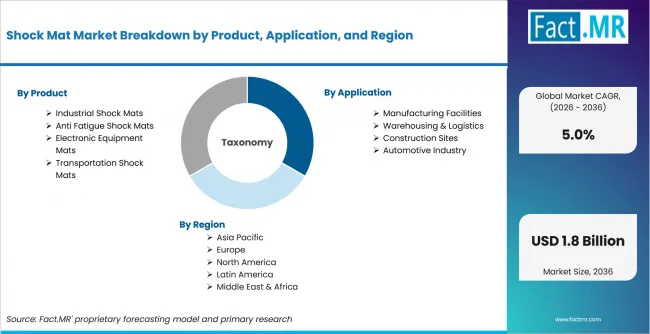
Shock Mat Market Breakdown By Product, Application, And Region | Source: Fact.MR
| Attribute | Details |
|---|---|
| Quantitative Units | USD billion |
| Market Definition | Rubber, polymer, foam, gel, or composite mats designed to absorb impact, isolate vibration, improve standing comfort, protect equipment, or control electrostatic and floor-contact risks in industrial, logistics, construction, automotive, and electronic settings. |
| Segments Covered | Product; Application; End Use; Technology; Formulation; Distribution Channel |
| Regions Covered | North America; Latin America; Western Europe; Eastern Europe; East Asia; South Asia & Pacific; Middle East & Africa |
| Countries Covered | Germany; Brazil; USA; UK; Japan |
| Companies Included | Qingdao Finest Industry Co., Ltd; India Mart; Splendor Industrial Comp Ltd.; Qingdao Emei Ind & Tech Co., Ltd.; Qingdao SOL Industrial and Trade Company Ltd.; Hangzhou Green Valley Rubber Products Co., Ltd. |
| Forecast Period | 2026 to 2036 |
| Base Year | 2025 |
| Market Value, 2025 | USD 1.0 billion |
| Market Value, 2026 | USD 1.1 billion |
| Market Value, 2036 | USD 1.8 billion |
| CAGR, 2026-2036 | 5.0% |
| Absolute Opportunity | USD 0.7 billion |
| Approach | Assessment considers mat area and unit volumes, realized prices, formulation mix, installation duty, replacement cycles, end-use activity, and channel structure. |
Source: Fact.MR analysis. Updated Aug 21, 2026
Market Breakdown by Segments
-
By Product
- Industrial Shock Mats
- Heavy Machinery Shock Mats
- Equipment Isolation Mats
- Anti Fatigue Shock Mats
- Workstation Comfort Mats
- Operator Safety Mats
- Electronic Equipment Mats
- ESD Shock Protection Mats
- Precision Device Protection Mats
- Transportation Shock Mats
- Logistics Shock Absorption Mats
- Vehicle Floor Shock Mats
- Industrial Shock Mats
-
By Application
- Manufacturing Facilities
- Heavy Engineering Plants
- Electronics Manufacturing
- Warehousing & Logistics
- Storage Facilities
- Material Handling Zones
- Construction Sites
- Infrastructure Projects
- Industrial Construction Zones
- Automotive Industry
- Vehicle Manufacturing Plants
- Service Workshops
- Manufacturing Facilities
-
By End Use
- Industrial Manufacturers
- Heavy Equipment Manufacturers
- Electrical Equipment Manufacturers
- Logistics Companies
- Warehousing Operators
- Transport Operators
- Construction Firms
- Infrastructure Developers
- Specialized Contractors
- Automotive Sector
- OEM Manufacturers
- Service & Maintenance Firms
- Industrial Manufacturers
-
By Technology
- Vibration Absorption Technology
- Elastomeric Dampening Systems
- Multi Layer Cushioning Systems
- Smart Material Technology
- Memory Polymer Systems
- Gel Based Shock Systems
- Anti Static Technology
- Conductive Layer Systems
- ESD Protection Systems
- Structural Reinforcement Tech
- Composite Layer Structures
- Impact Distribution Systems
- Vibration Absorption Technology
-
By Formulation
- Rubber Based Formulations
- Natural Rubber Systems
- Synthetic Rubber Systems
- Polymer Composite Formulations
- Thermoplastic Systems
- Thermoset Systems
- Foam Based Formulations
- Polyurethane Foam Systems
- Memory Foam Systems
- Gel Based Formulations
- Silicone Gel Systems
- Hybrid Gel Systems
- Rubber Based Formulations
-
By Distribution Channel
- Direct Industrial Sales
- OEM Contracts
- Enterprise Procurement
- Industrial Distributors
- Regional Distributors
- Specialized Distributors
- Online Industrial Platforms
- B2B Marketplaces
- Manufacturer Direct Platforms
- Facility Supply Chains
- Maintenance Supply Vendors
- Direct Industrial Sales
-
By Region
- North America
- Latin America
- Western Europe
- Eastern Europe
- East Asia
- South Asia & Pacific
- Middle East & Africa
Frequently Asked Questions
What is the Shock Mat Market value in 2026?
At what CAGR is the market projected to grow?
What is the projected market value by 2036?
What absolute opportunity is expected through 2036?
Which Product category has the leading share?
Which Application category has the leading share?
Which End Use category has the leading share?
Which Technology category has the leading share?
Which Formulation category has the leading share?
Which Distribution Channel category has the leading share?
Which listed country is projected to grow fastest?
Which companies are profiled in the Shock Mat Market?
Who worked on this report


Preview the report firsthand - request a free sample
Free SampleGet the brochure for pricing and purchase details
Download PDF