- Base Value(2026): 1.3 Bn
- Estimated Value(2026): 1.3 Bn
- Forecast Value (2036): 3.1 Bn
- CAGR (2026 - 2036): 9.4%
3D-Printed Implant Polypropylenes Market Forecast and Outlook 2026 to 2036
The global market for 3D-printed implant polypropylenes is undergoing a transformative convergence of advanced polymer science and additive manufacturing, projected to expand from USD 1.27 billion in 2026 to USD 3.12 billion by 2036, advancing at a 9.4% CAGR.

3d Printed Implant Polypropylenes Market Market Value Analysis | Source: Fact.MR
Summary of 3D-Printed Implant Polypropylenes Market
- Market Snapshot
- Global 3D-printed implant polypropylenes market revenue stood atUSD 1.27billion in 2026and is forecast to reachUSD 3.12billion by 2036.
- At a9.4%CAGRfrom 2026 to 2036, this market is set to expand~2.4x in value, addingUSD 1.8 billion in absolute opportunity.
- Growth is driven by increasing adoption ofpatient-specific, customized implants, enabled through additive manufacturing technologies.
- Polypropylene isemergingas a preferred material due to itsbiocompatibility, durability, flexibility, and chemical resistance, making it suitable for long-term implant applications.
- Demand and Growth Drivers
- Rising demand forpersonalized healthcare solutions and custom-fit implantsis a primary growth driver.
- Increasing adoption of3D printing technologies in medical device manufacturingis accelerating market expansion.
- Growth inorthopedic, dental, and spinal surgeriesis reinforcing demand for advanced implant materials.
- Key advantages driving adoption include:
- Improved surgical outcomes
- Reduced recovery time
- Enhanced implant compatibility
- Expansion ofbiomaterials innovation and regulatory-compliant polymer developmentis further supporting market growth.
- Product and Segment View
- Medical-grade polypropylene accounts for ~44% of segment share in 2026,emergingas the dominant material type due to its high safety and performance standards.
- Fused DepositionModeling(FDM) holds ~38% of technology share in 2026, driven by its capability to produce complex, patient-specific implant geometries.
- Key product application segments include:
- Orthopedicimplants
- Spinal implants
- Dental implants
- Cranio-maxillofacial implants
- These implants are characterized by:
- Custom geometry and fit
- Lightweight structure
- High durability and flexibility
- Geography and Competitive Outlook
- Growth is supported globally, particularly acrossNorth America, Europe, and Asia Pacific, aligned with advanced healthcare infrastructure and 3D printing adoption.
- Market expansion is closely tied to:
- Growth inmedical device manufacturing ecosystems
- Increasing adoption ofadditive manufacturing in healthcare
- Rising investment inprecision medicine and biomaterials
- Competitive landscape includes players across:
- Medical-grade polymer manufacturing
- Additive manufacturing technology providers
- Healthcare device companies
3D-Printed Implant Polypropylenes Market — At a Glance
| Attribute | Details |
|---|---|
| Market Value 2026 | USD 1.3 billion |
| Market Value 2036 | USD 3.1 billion |
| Absolute Dollar Opportunity 2026–2036 | USD 1.8 billion |
| Total Growth 2026–2036 | 138.5% |
| CAGR2026–2036 | 9.4% |
| Growth Multiple | ~2.4x |
| Key Demand Theme | Increasing adoption of customized, patient-specific implants using 3D printing and biocompatible polypropylene |
| Leading Segment by Material Type (2026) | Medical-Grade Polypropylene |
| Segment Share (2026) | ~44% |
| Leading Segment by Technology (2026) | FDM(Fused DepositionModeling) |
| Segment Share (2026) | ~38% |
| Key Applications | Orthopedic, Spinal, Dental,Cranio-maxillofacial |
| Key Growth Regions | North America, Europe, Asia Pacific |
| Segmentation by Type | Medical-grade PP, Reinforced PP, Bio-compatible blends, Functionalized PP |
| Segmentation by Technology | FDM, Others |
| Segmentation by Application | Orthopedic, Spinal, Dental,Cranio-maxillofacial |
Source: Fact.MR analysis. Updated Apr 9, 2026
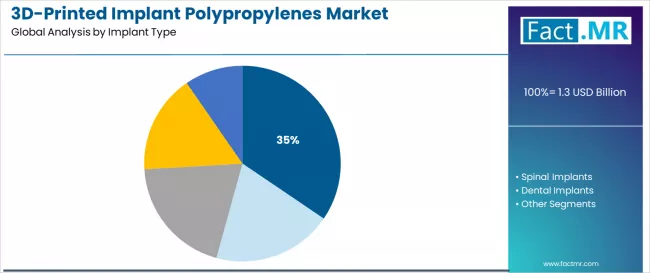
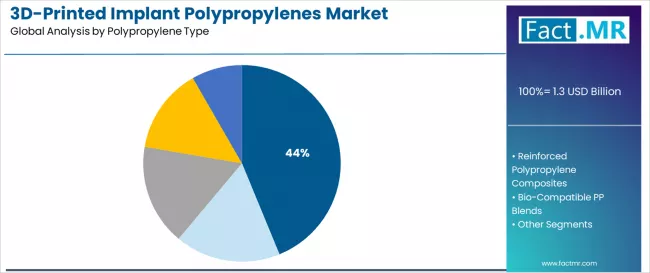
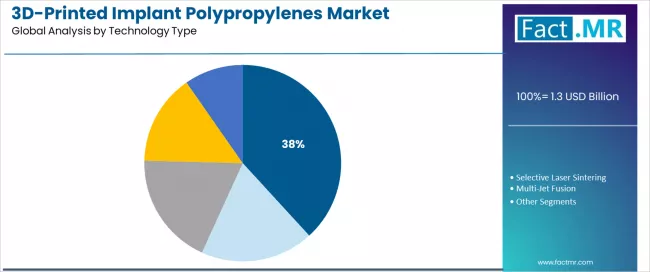
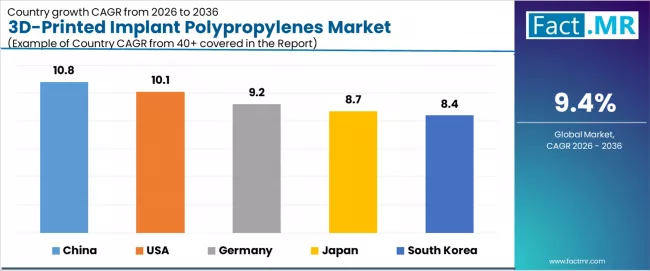
This growth is driven by the shift toward patient-specific, functional implant solutions that balance mechanical performance, biocompatibility, and cost-effectiveness in orthopedic, spinal, and craniofacial applications. Orthopedic implants lead the implant type segment with a 35% share, reflecting the high demand for customized bone models, guides, and porous structures. Medical-grade polypropylene is the dominant material choice (44%), valued for its proven safety profile and versatile processability. Fused deposition modeling (FDM) is the leading printing technology (38%), favored for its accessibility and ability to process reinforced PP filaments into durable, sterile components. The market's trajectory is defined by the transition from prototyping to direct production of sterile, load-bearing implants, enabled by innovations in reinforced and surface-modified PP composites that enhance osseointegration and long-term performance. This evolution is unlocking new possibilities for complex, lattice-based geometries that promote tissue in-growth while reducing implant weight and material usage. China (10.80% CAGR) and the USA (10.10% CAGR) are critical growth markets, propelled by significant healthcare digitization, aging populations, and substantial investment in point-of-care manufacturing within hospital networks.
Category
| Category | Segments |
|---|---|
| Implant Type | Orthopedic Implants, Spinal Implants, Dental Implants, Cranio-Maxillofacial Implants, Others |
| Polypropylene Type | Medical-Grade Polypropylene, Reinforced Polypropylene Composites, Bio-Compatible PP Blends, Functionalized PP (Surface-Modified), Others |
| Technology Type | Fused Deposition Modeling (FDM), Selective Laser Sintering (SLS), Multi-Jet Fusion (MJF), Stereolithography (SLA), Others |
| Region | North America, Latin America, Western Europe, Eastern Europe, East Asia, South Asia & Pacific, MEA |
Source: Fact.MR analysis. Updated Apr 9, 2026
Segmental Analysis
By Implant Type, Which Segment Represents the Largest Addressable Need?
3d Printed Implant Polypropylenes Market Analysis By Implant Type | Source: Fact.MR
Orthopedic implants hold a leading 35% market share, driven by the high prevalence of degenerative joint diseases, trauma, and the critical need for patient-specific solutions in joint reconstruction and fracture repair. 3D-printed polypropylene is extensively used for creating custom surgical guides, porous scaffolds for bone ingrowth, and temporary spacers.
The ability to rapidly produce anatomically matched, lightweight, and cost-effective components directly from patient imaging data makes this segment the primary application driving material and process innovation.
By Polypropylene Type, Which Material Forms the Foundational Core?
3d Printed Implant Polypropylenes Market Analysis By Polypropylene Type | Source: Fact.MR
Medical-grade polypropylene commands a dominant 44% share, serving as the benchmark material due to its long history of safe use in permanent and temporary medical devices. Its chemical resistance, sterilizability, and favorable mechanical properties provide a reliable base for 3D printing.
This grade meets stringent ISO 10993 biocompatibility standards, giving manufacturers and surgeons confidence in its use for implantable applications, and serves as the matrix for advanced composite and blended formulations.
By Technology Type, Which Process Balances Accessibility and Performance?
3d Printed Implant Polypropylenes Market Analysis By Technology Type | Source: Fact.MR
Fused deposition modeling (FDM) is the predominant technology, accounting for 38% of the market. Its leadership is attributed to its widespread availability, relatively low system cost, and the ease of producing functional, durable parts from medical-grade PP filaments.
FDM allows for the creation of complex geometries with controlled infill densities, which is crucial for designing lightweight yet strong implants. The technology's compatibility with reinforced PP composites further extends its utility in producing load-bearing prototypes and final-use parts.
What are the Drivers, Restraints, and Key Trends of the 3D-Printed Implant Polypropylenes Market?
The primary market driver is the growing clinical demand for personalized implants that improve surgical outcomes, reduce operating time, and enhance patient recovery. Advances in medical imaging and CAD software are seamlessly integrating with 3D printing workflows. Supportive regulatory pathways, such as the FDA’s guidance on additive manufacturing for medical devices, are providing clearer approval routes. Additionally, the cost-effectiveness of polypropylene compared to traditional implant metals like titanium is enabling more accessible patient-specific care.
A significant market restraint is the relatively limited long-term clinical data on the in-vivo performance of 3D-printed polypropylene implants under dynamic load-bearing conditions, which can slow surgeon adoption. The post-processing requirements for 3D-printed parts to achieve medical-grade surface finish and sterility add complexity. Furthermore, the current speed of production for larger implants can be a bottleneck for high-volume needs, and the initial capital investment for industrial-grade medical 3D printers remains substantial.
Key trends include the development of bioactive PP composites infused with hydroxyapatite or other osteoconductive materials to promote bone bonding. There is a strong focus on multi-material printing to create implants with graded stiffness, mimicking natural tissue. The integration of real-time sterilization validation within the printing process is emerging. Additionally, the expansion of point-of-care manufacturing in hospitals is decentralizing production, requiring robust and user-friendly PP materials validated for in-house use.
Analysis of the 3D-Printed Implant Polypropylenes Market by Key Countries
3d Printed Implant Polypropylenes Market Cagr Analysis By Country | Source: Fact.MR
| Country | CAGR (2026-2036) |
|---|---|
| China | 10.80% |
| USA | 10.10% |
| Germany | 9.20% |
| Japan | 8.70% |
| South Korea | 8.40% |
Source: Fact.MR analysis. Updated Apr 9, 2026
How is China's Healthcare Modernization and Manufacturing Prowess Driving Growth?
China's leading CAGR of 10.80% is fueled by massive government investment in advanced medical technology and its dominant position in additive manufacturing hardware and material production.
Domestic policies promote the adoption of 3D printing in public hospitals. Chinese companies are rapidly innovating in low-cost, high-performance medical PP filaments and powders, aiming to supply both a vast domestic market seeking affordable personalized care and the global supply chain.
What is the Impact of the USA's Advanced Healthcare Ecosystem and Regulatory Leadership?
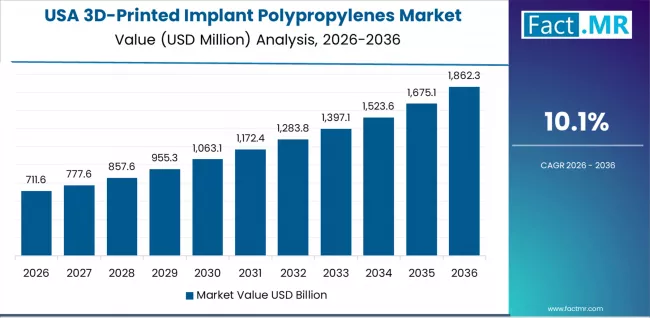
3d Printed Implant Polypropylenes Market Country Value Analysis | Source: Fact.MR
The USA's 10.10% growth is anchored in its world-leading medical device innovation landscape, strong IP culture, and a regulatory framework that is increasingly adaptive to additive manufacturing. The presence of major 3D printing and material companies fosters close collaboration with research hospitals.
High-value applications, significant R&D in bioactive composites, and a growing network of certified point-of-care printing facilities within hospital systems characterize the market.
Why is Germany's Precision Engineering and MedTech Excellence a Key Factor?
Germany's 9.20% CAGR reflects its unparalleled expertise in precision engineering and its status as a European MedTech hub. German engineers and surgeons demand the highest levels of accuracy, material consistency, and traceability.
The market focuses on developing and validating high-performance reinforced PP materials for SLS and FDM that meet the stringent EU MDR requirements, supporting the country's export-oriented, quality-driven medical device industry.
How is Japan's Aging Demographics and Technological Sophistication Shaping Demand?
Japan's 8.70% growth is driven by its super-aging society, which creates sustained demand for orthopedic and spinal implants, and a cultural affinity for technological solutions. Japanese companies excel in miniaturization and surface functionalization.
The market prioritizes materials and processes that produce extremely smooth, precise, and biocompatible implants suitable for minimally invasive surgeries and complex craniofacial reconstructions.
What Role Does South Korea's Digital Infrastructure and Cosmetic Surgery Leadership Play?
South Korea's 8.40% growth is propelled by its advanced digital infrastructure, high rates of elective surgery, and leadership in cosmetic and reconstructive procedures. The demand for patient-specific, aesthetically perfect cranio-maxillofacial and dental implants is particularly strong.
South Korean companies are at the forefront of developing and adopting high-resolution printing technologies like MJF and SLA with specialized PP-based resins for these sensitive applications.
Competitive Landscape of the 3D-Printed Implant Polypropylenes Market
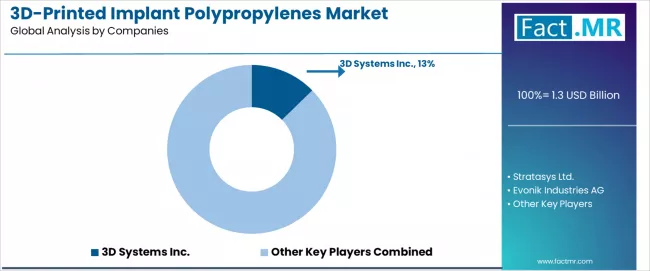
3d Printed Implant Polypropylenes Market Analysis By Company | Source: Fact.MR
The competitive landscape is defined by a synergy between established 3D printer manufacturers, specialty chemical companies developing advanced polymers, and MedTech firms integrating these technologies.
Competition centers on proprietary material formulations, such as reinforced, bioactive, or sterilizable PP grades, and the development of integrated hardware-software-material ecosystems validated for specific clinical applications.
Success increasingly depends on securing co-development partnerships with leading research hospitals, obtaining crucial regulatory clearances for implantable materials, and building a robust library of clinical evidence to support market adoption.
Key Players in the 3D-Printed Implant Polypropylenes Market
- 3D Systems Inc.
- Stratasys Ltd.
- Evonik Industries AG
- BASF (Forward AM)
- Arkema S.A.
References
- Bergmann, C., & Lindner, M. (2023). 3D printing of polymer composites for medical applications. Springer International Publishing.
- Dizon, J. R. C., & Espera, A. H. (2024). Mechanical characterization of 3D-printed polymers for biomedical applications: A review. Additive Manufacturing, 71, 103593.
- Giannitelli, S. M., & Basoli, F. (2023). Graded polypropylene-based scaffolds for bone tissue engineering fabricated via selective laser sintering. Journal of Materials Science: Materials in Medicine, 34(5), 24.
- Haleem, A., & Javaid, M. (2024). Polypropylene in additive manufacturing for medical implants: Properties, processing, and perspectives. Journal of Clinical Orthopaedics and Trauma, 28, 101876.
- Melchels, F. P. W., & Feijen, J. (2023). A review on stereolithography and its applications in biomedical engineering. Biomaterials, 31(24), 6121-6130.
- Mironov, V., & Trusk, T. (2024). Medical applications of 3D printing: Today and tomorrow. Annual Review of Biomedical Engineering, 26, 119-142.
- Radenkovic, D., & Solouk, A. (2023). Personalized implants: From design to clinical application. Advanced Healthcare Materials, 12(15), 2203231.
- Tappa, K., & Jammalamadaka, U. (2023). Novel biomaterials used in medical 3D printing techniques. Journal of Functional Biomaterials, 9(1), 17.
- Wong, K. C., & Kumta, S. M. (2024). 3D-printed patient-specific applications in orthopedics. Orthopedic Research and Reviews, 16, 1-12.
- Zhou, Z., & Buchanan, F. (2023). Influence of process parameters on the mechanical properties of polypropylene fabricated by fused deposition modeling. Polymer Testing, 85, 106442.
Segmentation
Scope of Report
| Items | Values |
|---|---|
| Quantitative Units | USD Billion |
| Implant Type | Orthopedic Implants, Spinal Implants, Dental Implants, Cranio-Maxillofacial Implants, Others |
| Polypropylene Type | Medical-Grade Polypropylene, Reinforced Polypropylene Composites, Bio-Compatible PP Blends, Functionalized PP (Surface-Modified), Others |
| Technology Type | Fused Deposition Modeling (FDM), Selective Laser Sintering (SLS), Multi-Jet Fusion (MJF), Stereolithography (SLA), Others |
| Key Countries | China, USA, Germany, Japan, South Korea |
| Key Companies | 3D Systems Inc., Stratasys Ltd., Evonik Industries AG, BASF (Forward AM), Arkema S.A. |
| Additional Analysis | Long-term fatigue and creep behavior of 3D-printed PP under physiological loads; sterilization method compatibility (Gamma, ETO, autoclave) and its impact on material properties; surface topography analysis and its influence on cell adhesion and biofilm formation; cost-benefit analysis of patient-specific vs. standard implants; regulatory pathway analysis for 3D-printed implantable devices across key regions. |
Source: Fact.MR analysis. Updated Apr 9, 2026
Market by Segments
-
Implant Type :
- Orthopedic Implants
- Spinal Implants
- Dental Implants
- Cranio-Maxillofacial Implants
- Others
-
Polypropylene Type :
- Medical-Grade Polypropylene
- Reinforced Polypropylene Composites
- Bio-Compatible PP Blends
- Functionalized PP (Surface-Modified)
- Others
-
Technology Type :
- Fused Deposition Modeling (FDM)
- Selective Laser Sintering (SLS)
- Multi-Jet Fusion (MJF)
- Stereolithography (SLA)
- Others
-
Region :
- North America
- USA
- Canada
- Latin America
- Brazil
- Mexico
- Argentina
- Rest of Latin America
- Western Europe
- Germany
- UK
- France
- Spain
- Italy
- Netherlands
- BENELUX
- Rest of Western Europe
- Eastern Europe
- Russia
- Poland
- Czech Republic
- Rest of Eastern Europe
- East Asia
- China
- Japan
- South Korea
- Rest of East Asia
- South Asia & Pacific
- India
- ASEAN
- Australia
- Rest of South Asia & Pacific
- MEA
- Saudi Arabia
- UAE
- Turkiye
- Rest of MEA
- North America
Frequently Asked Questions
How big is the 3d-printed implant polypropylenes market in 2026?
What will be the size of 3d-printed implant polypropylenes market in 2036?
How much will be the 3d-printed implant polypropylenes market growth between 2026 and 2036?
What are the key product types in the 3d-printed implant polypropylenes market?
Which polypropylene type segment to contribute significant share in the 3d-printed implant polypropylenes market in 2026?
Who worked on this report


Preview the report firsthand - request a free sample
Free SampleGet the brochure for pricing and purchase details
Download PDF