3D Printed Shoes Market Size, Share, Growth and Forecast (2026 - 2036)
The 3D Printed Shoes Market is segmented by Product Type, by Material, by Technology, by Application, and by Sales Channel and Region. Forecast for 2026 to 2036.
Fact.MR notes that 3D printed shoes demand is moving toward personalized fit and faster footwear development. Footwear brands require tools that reduce sample cycles. Sportswear companies need shoe components that improve cushioning and product differentiation.
3D Printed Shoes Market Size, Market Forecast and Outlook by Fact.MR
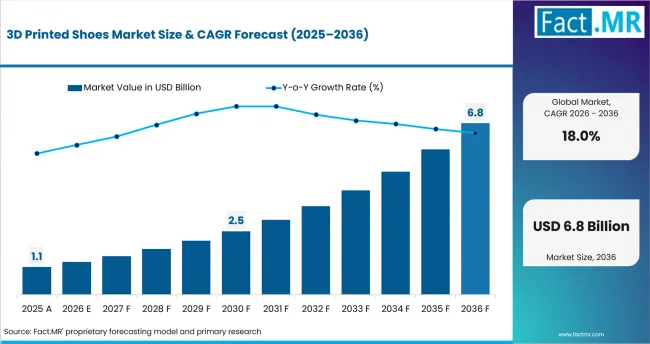
- The 3D printed shoes market was valued at USD 1.1 billion in 2025.
- Demand is expected to increase from USD 1.3 billion in 2026 to USD 6.8 billion by 2036.
- The market is forecast to record 18.0% CAGR during 2026 to 2036 as footwear brands use additive manufacturing for midsoles, full-shoe structures, and scan-based fit models.
Metric Details
| Metric | Details |
|---|---|
| Industry Size 2026 | USD 1.3 billion |
| Industry Value 2036 | USD 6.8 billion |
| CAGR 2026 to 2036 | 18.0% |
Summary of the 3D Printed Shoes Market
- Demand Drivers in the Market
- Fit Personalization: Footwear brands use 3D printing to create shoe structures that can support scan-based customization.
- Product Testing: Sportswear companies use printed midsoles to test cushioning and lattice designs faster.
- Inventory Control: Digital production can help brands serve custom footwear demand with lower finished-goods stock.
- Key Segments Analyzed
- By Product Type: Midsoles are expected to hold 42.0% share in 2026 because cushioning lattices offer a clear performance use for printed footwear.
- By Material: Elastomeric polymers lead because they support flexible cushioning and underfoot comfort. The segment is likely to account for 46.0% share in 2026.
- By Technology: Digital Light Synthesis is projected to hold 34.0% share in 2026 because it supports lattice midsoles and flexible polymer footwear components.
- By Application: Athletic footwear is anticipated to capture 39.0% share in 2026 because sports brands use printed structures for cushioning and performance positioning.
- By Sales Channel: Online customization platforms are expected to hold 36.0% share in 2026 because digital design and scan-based ordering suit printed footwear.
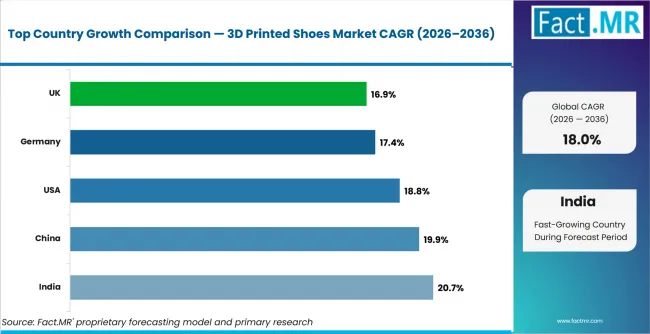
- By Geography: India is projected to record 20.7% CAGR through 2036 as online sneaker demand and digital customization expand.
- Analyst Opinion at Fact.MR
- Shambhunath Jha, Principal Consultant at Fact.MR, states, “3D printed shoes are moving beyond concept pairs. Retail testing is showing the value of fit control and faster design cycles. Brands that link digital design with comfort and scalable output will gain stronger market access.”
- Strategic Implications
- Fit Data: Footwear brands need scan workflows that turn foot data into usable product files.
- Material Comfort: Suppliers should focus on flexible materials that can handle daily wear.
- Channel Control: Retailers can use digital customization to reduce stock risk and serve personalized demand.
3D printed shoes demand is becoming more product-led. Adidas launched CLIMACOOL LACED in 2026 and described the shoe as a 3D-printed sneaker made with advanced additive manufacturing for airflow and wearability. [1] This shows how printed footwear is moving from limited experiments into wider retail releases.
The market is moving from prototype use to commercial shoe launches. Printed midsoles are still the main starting point because cushioning and lattice designs work well with 3D printing. Fully printed shoes are gaining interest because brands can reduce stitching and part assembly. Fit personalization will become more important as scan-to-print platforms improve.
India is projected to record 20.7% CAGR by 2036 as online sneaker demand and digital customization expand. China is likely to post 19.9% CAGR as footwear manufacturing clusters test printed components. The United States is expected to register 18.8% CAGR as sneaker innovation and direct-to-consumer platforms deepen. Germany is forecast to advance at 17.4% CAGR because sportswear engineering and orthotic applications support adoption. The United Kingdom is set to record 16.9% CAGR as custom footwear and scan-based fitting gain retail attention.
Segmental Analysis
3D Printed Shoes Market Analysis by Product Type
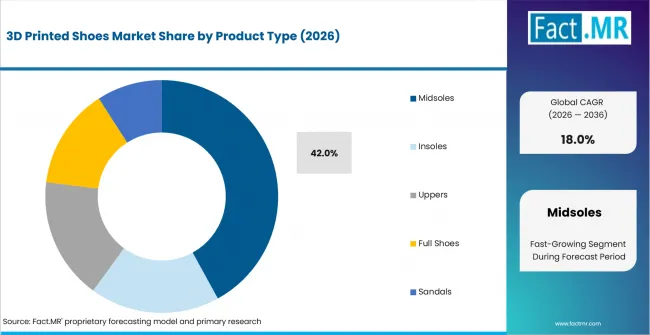
Midsoles are expected to hold 42.0% share in 2026 because cushioning lattices offer a clear performance use for printed footwear. Sports brands use printed midsoles to tune underfoot response and reduce traditional mold dependence. Insoles serve orthotic and comfort-focused demand. Uppers and full shoes are gaining attention because printed structures can reduce assembly steps. Sandals support scan-based and single-material formats.
- Cushioning Base: Midsoles support energy return and comfort control for performance shoes.
- Orthotic Use: Insoles help clinics and footwear brands serve foot-specific support needs.
- Full-Shoe Shift: Full printed shoes reduce part count and open new design options.
3D Printed Shoes Market Analysis by Material
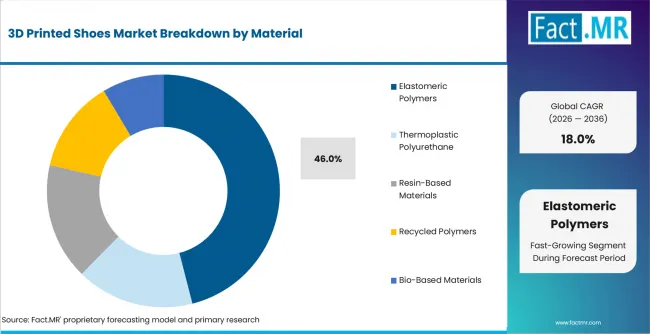
Flexible materials decide whether printed shoes can move from novelty into daily use. Elastomeric polymers support cushioning and rebound across midsoles and sandals. The segment is likely to account for 46.0% share in 2026 because underfoot comfort needs flexible material response. Thermoplastic polyurethane serves durable footwear parts and full printed shoes. Resin-based materials support selected midsoles and prototypes.
- Comfort Response: Elastomeric polymers support flexible cushioning for wearable shoes.
- Durable Structure: Thermoplastic polyurethane helps full printed shoes handle repeated wear.
- Material Renewal: Recycled polymers support brands that want lower-waste footwear concepts.
3D Printed Shoes Market Analysis by Technology
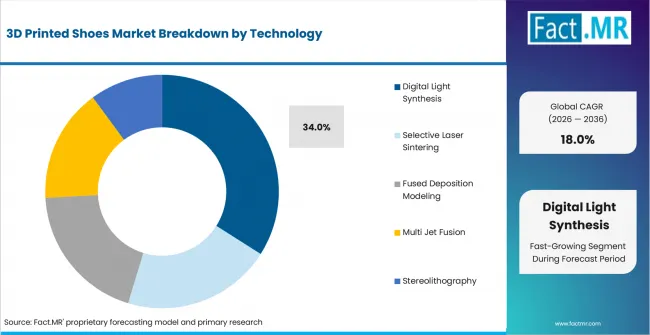
Digital Light Synthesis is projected to hold 34.0% share in 2026 because it supports lattice midsoles and flexible polymer footwear components. The technology helps brands produce complex cushioning structures with fewer tooling steps. Selective laser sintering supports full-shoe and sandal builds. Fused deposition modeling serves design trials and low-volume footwear concepts. Multi Jet Fusion supports durable polymer parts. Stereolithography supports detailed components and early product testing. TPM3D introduced a printed footwear solution in 2025 with a focus on small-batch and on-demand production. [2]
- Lattice Printing: Digital Light Synthesis supports complex cushioning structures for footwear.
- Full-Shoe Builds: Selective laser sintering helps produce integrated shoe forms.
- Prototype Speed: Fused deposition modeling supports faster early footwear design reviews.
3D Printed Shoes Market Analysis by Application
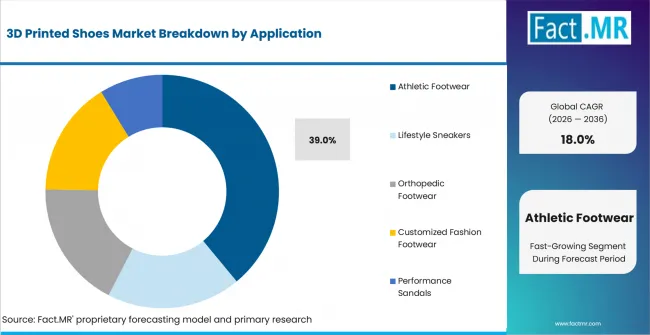
Athletic footwear leads because sports brands use printed structures for cushioning and performance positioning. Running and training shoes benefit from midsole designs that can be tuned through lattice geometry. The segment is anticipated to capture 39.0% share in 2026 because performance shoes can justify higher development cost. Lifestyle sneakers follow as brands test sculptural designs and limited releases. Orthopedic footwear uses scan-based insoles and sandals. Customized fashion footwear serves niche design demand. Performance sandals support barefoot and recovery use.
- Running Use: Athletic footwear benefits from tuned cushioning and design differentiation.
- Sneaker Design: Lifestyle sneakers use printed structures for limited-edition product identity.
- Clinical Fit: Orthopedic footwear uses scan-based designs to improve foot support.
3D Printed Shoes Market Analysis by Sales Channel
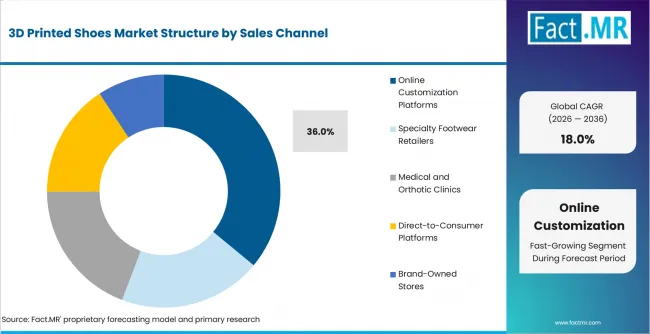
Digital ordering is a natural fit for printed shoes because the product often starts with a design file or foot scan. Online customization platforms are expected to hold 36.0% share in 2026 because shoppers can select fit and design options before production. Brand-owned stores support in-person scanning and premium product education. Specialty footwear retailers serve runners and sneaker collectors. Medical and orthotic clinics support custom insoles and therapeutic footwear. Direct-to-consumer platforms help printed shoe brands reduce retail inventory needs.
- Custom Ordering: Online customization platforms help brands connect scan data with production.
- Store Scanning: Brand-owned stores support fitting and product explanation.
- Clinical Access: Orthotic clinics use printed footwear for foot-specific support needs.
3D Printed Shoes Market Drivers, Restraints, and Opportunities

Customization and faster product development are the main drivers for 3D printed shoes. Nike unveiled the 3D-printed Air Max 95000 in 2025 and described it as the first shoe created using Project Nectar. [3] This shows how major sportswear brands are using printed structures for footwear design identity. Direct-to-consumer platforms can use scan data and digital files to serve personalized demand.
Scale and comfort consistency can restrain adoption. Printed shoes need materials that handle repeated bending and daily wear. Production speed can limit wider release volumes. Consumers may also compare printed shoes against conventional sneakers on price and durability. Brands need enough testing before positioning printed footwear as everyday-use products.
Opportunities in the 3D Printed Shoes Market
- Custom Insoles: Orthotic providers can use 3D printing for foot-specific support.
- Limited Drops: Sneaker brands can use printed designs for smaller runs and faster product tests.
- Scan-to-Print Shoes: Retailers can link foot scanning with on-demand production.
Regional Analysis
Based on regional analysis, the 3D printed shoes market is segmented into North America, Latin America, Europe, East Asia, South Asia and Pacific, and Middle East and Africa.
.webp)
Country CAGR 2026 to 2036
| Country | CAGR |
|---|---|
| India | 20.7% |
| China | 19.9% |
| United States | 18.8% |
| Germany | 17.4% |
| United Kingdom | 16.9% |

South Asia and East Asia 3D Printed Shoes Market Analysis
South Asia and East Asia demand comes from footwear production depth and rising sneaker interest. India leads the outlook because online footwear channels and custom sneaker interest are expanding. China has a large footwear manufacturing base and additive manufacturing capacity.
- India: India is projected to record 20.7% CAGR from 2026 to 2036 as online sneaker demand and digital customization expand. Young urban shoppers are more open to limited-edition footwear and personalized designs. Local footwear manufacturers can test printed midsoles and insoles before moving into full shoes. Orthotic clinics add demand through custom foot support. Price sensitivity still limits premium adoption.
- China: China has strong footwear manufacturing clusters and additive manufacturing capacity. Local producers can test printed midsoles and full-shoe structures at lower development cost. The country is likely to post 19.9% CAGR through 2036 as factories use digital tools for faster sampling. Domestic sneaker brands can use printed designs for product differentiation. Scale will depend on material consistency and production speed. Suppliers with local material support and printer service networks will gain better access.
North America 3D Printed Shoes Market Analysis

North America demand is led by the United States because sneaker innovation and direct-to-consumer platforms are active. Sportswear brands use printed structures to test design identity and performance features.
- United States: The United States is forecast to register 18.8% CAGR over the study period as sneaker innovation and direct-to-consumer platforms deepen. Sportswear brands use printed shoes for limited releases and concept validation. Independent creators use digital tools to reach sneaker communities. Orthotic providers can use printed insoles for foot-specific support. Production speed remains a barrier for mass retail. Suppliers with scan workflows and reliable materials will hold stronger positions.
Europe 3D Printed Shoes Market Analysis

Europe demand comes from sportswear engineering, footwear design, and orthotic use. Germany benefits from manufacturing know-how and footwear engineering. The United Kingdom has strong interest in scan-to-print footwear and direct-to-consumer models. Vivobarefoot’s VivoBiome platform is positioned around an on-demand scan-to-print approach for barefoot footwear. [4]
- Germany: Germany is forecast to advance at 17.4% CAGR because sportswear engineering and orthotic applications support adoption. Footwear developers can use printed midsoles for cushioning tests and specialty products. Medical footwear providers may use printed insoles for foot-specific support. Material reliability matters more than concept appeal in this market. German users will expect strong durability evidence and clear service support. Suppliers with validated elastomeric materials will be better placed.
- United Kingdom: The United Kingdom is set to record 16.9% CAGR as custom footwear and scan-based fitting gain retail attention. Barefoot and comfort-focused footwear brands are testing personalized models. London-based retail experiences can support foot scanning and made-to-order shoes. Orthotic clinics add demand through insoles and sandal formats. Wider adoption will depend on price acceptance and delivery time. Brands that make scan-to-print ordering simple can gain stronger consumer trust.
Competitive Aligners for Market Suppliers

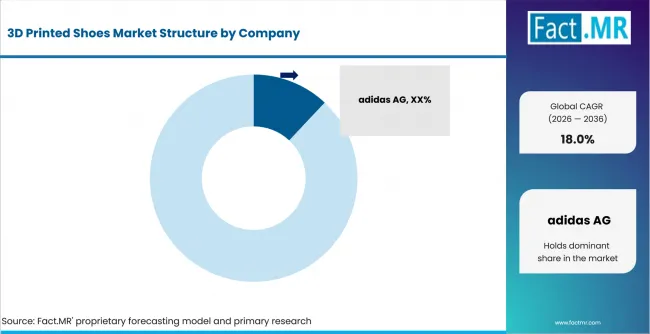
The 3D printed shoes market is served by sportswear brands and additive manufacturing specialists. adidas AG competes through 3D printed CLIMACOOL and 4D footwear lines. Nike, Inc. is exploring printed footwear concepts through limited product launches and design-led trials. Carbon, Inc. supports footwear production through elastomeric printing and lattice structure design.
Zellerfeld Shoe Company Inc. is positioned around fully printed shoes and creator-led product drops. HP Inc. adds capability through industrial 3D printing systems that can support footwear prototyping and component production. Product success will depend on comfort and material strength. Brands need printed shoes that perform well during daily use.
Through 2036, competition will depend on production speed and repeat wear performance. Visual novelty alone will not support wider adoption. Suppliers with better materials and design tools will gain stronger brand interest. Companies that connect print quality with reliable fulfillment will be better placed in the 3D printed shoes market.
Key Companies in 3D Printed Shoes Market
- adidas AG
- Nike, Inc.
- Carbon, Inc.
- Zellerfeld Shoe Company Inc.
- HP Inc.
Bibliography
- [1] adidas. (2026, March 3). adidas drops latest 3D-printed CLIMACOOL LACED: Meeting every step with all-round breathability. adidas.
- [2] TPM3D. (2025, July 8). TPM3D introduces 3D printed footwear solution at CISCE 2025, reduces production time to 25 minutes per shoe. TPM3D.
- [3] Nike, Inc. (2025, October 24). Nike unveils 3D-printed Air Max 95000 at ComplexCon. Nike, Inc.
- [4] VoxelMatters. (2026, April 30). Vivobarefoot launches custom-fit 3D printed Tabi Gen 02 sandals. VoxelMatters.
This Report Addresses
- Strategic intelligence on 3D printed shoes demand across product type, material, technology, application, and sales channel.
- Forecast mapping from USD 1.3 billion in 2026 to USD 6.8 billion by 2036.
- Segment analysis covering midsoles, elastomeric polymers, Digital Light Synthesis, athletic footwear, and online customization platforms.
- Regional outlook covering India, China, the United States, Germany, and the United Kingdom.
- Competitive analysis of adidas AG, Nike, Inc., Carbon, Inc., Zellerfeld Shoe Company Inc., HP Inc.
- Product assessment covering printed midsoles, insoles, uppers, full shoes, and sandals.
- Channel assessment covering brand-owned stores, online customization platforms, specialty retailers, clinics, and direct-to-consumer platforms.
- Primary interviews, supplier checks, official source review, and footwear production workflow validation support the forecast.
3D Printed Shoes Market Definition
The 3D printed shoes market covers footwear and shoe components produced through additive manufacturing. It includes printed midsoles and full-shoe structures. The market differs from conventional footwear because digital design files and printed material structures guide the final shoe shape and function.
3D Printed Shoes Market Inclusions
The scope includes athletic shoes and performance sandals made with 3D printed parts. Printed midsoles and insoles are included when they form part of commercial footwear. Full printed shoes and scan-based custom footwear are included when sold as wearable products.
3D Printed Shoes Market Exclusions
The scope excludes conventional shoes made only through stitching or foam cutting. It excludes general footwear CAD software unless tied to printed footwear output. Footwear prototypes are excluded when they are not intended for retail or clinical use. Shoe accessories are outside scope unless printed as part of the footwear system.
3D Printed Shoes Market Research Methodology
- Primary Research
- Primary research includes interviews with footwear product managers and additive manufacturing suppliers. It includes input from sneaker retailers and orthotic clinic operators.
- Desk Research
- Desk research reviews brand launch pages and additive manufacturing company releases. It covers footwear retail signals and orthotic production references.
- Market-Sizing and Forecasting
- Forecasting uses product type demand and technology uptake. Material use and channel movement support future market assessment.
- Data Validation and Update Cycle
- Forecasts are validated through supplier checks and footwear retailer feedback. Product launch activity and customization platform signals help confirm demand direction.
Scope of the Report

| Attribute | Details |
|---|---|
| Quantitative Units | USD 1.3 billion in 2026 to USD 6.8 billion by 2036 at 18.0% CAGR |
| Market Definition | Footwear and shoe components produced through additive manufacturing |
| Product Type | Midsoles, Insoles, Uppers, Full Shoes, Sandals |
| Material | Elastomeric Polymers, Thermoplastic Polyurethane, Resin-Based Materials, Recycled Polymers, Bio-Based Materials |
| Technology | Digital Light Synthesis, Selective Laser Sintering, Fused Deposition Modeling, Multi Jet Fusion, Stereolithography |
| Application | Athletic Footwear, Lifestyle Sneakers, Orthopedic Footwear, Customized Fashion Footwear, Performance Sandals |
| Sales Channel | Brand-Owned Stores, Online Customization Platforms, Specialty Footwear Retailers, Medical and Orthotic Clinics, Direct-to-Consumer Platforms |
| Regions Covered | North America, Latin America, Europe, East Asia, South Asia and Pacific, Middle East and Africa |
| Countries Covered | India, China, United States, Germany, United Kingdom |
| Key Companies Profiled | adidas AG, Nike, Inc., Carbon, Inc., Zellerfeld Shoe Company Inc., HP Inc. |
| Forecast Period | 2026 to 2036 |
| Approach | Hybrid top-down and bottom-up approach using product type demand, material use, technology uptake, application demand, sales channel movement, and regional validation |
3D Printed Shoes Market Analysis by Segments
-
By Product Type:
- Midsoles
- Insoles
- Uppers
- Full Shoes
- Sandals
-
By Material:
- Elastomeric Polymers
- Thermoplastic Polyurethane
- Resin-Based Materials
- Recycled Polymers
- Bio-Based Materials
-
By Technology:
- Digital Light Synthesis
- Selective Laser Sintering
- Fused Deposition Modeling
- Multi Jet Fusion
- Stereolithography
-
By Application:
- Athletic Footwear
- Lifestyle Sneakers
- Orthopedic Footwear
- Customized Fashion Footwear
- Performance Sandals
-
By Sales Channel:
- Brand-Owned Stores
- Online Customization Platforms
- Specialty Footwear Retailers
- Medical and Orthotic Clinics
- Direct-to-Consumer Platforms
-
Region:
- North America
- United States
- Canada
- Europe
- Germany
- United Kingdom
- France
- Italy
- Spain
- Asia Pacific
- China
- Japan
- South Korea
- Taiwan
- Singapore
- Latin America
- Brazil
- Mexico
- Argentina
- Middle East & Africa
- GCC Countries
- South Africa
- Israel
- North America
- Frequently Asked Questions -
What is the 3D Printed Shoes Market size in 2026?
The 3D printed shoes market is estimated to reach USD 1.3 billion in 2026 as printed midsoles and customized footwear gain use.
What will the 3D Printed Shoes Market be worth by 2036?
The 3D printed shoes market is projected to reach USD 6.8 billion by 2036 as scan-based footwear and printed components expand.
How large is the chicory root oligofructose for low-sugar dairy market in 2025?
The 3D printed shoes market is forecast to record 18.0% CAGR during 2026 to 2036.
Which product type leads the 3D Printed Shoes Market?
Midsoles lead with 42.0% share in 2026 because cushioning lattices offer a clear performance use for printed footwear.
Which country expands faster in the 3D Printed Shoes Market?
India is projected to record 20.7% CAGR through 2036 as online sneaker demand and digital customization expand.
How does China perform in the 3D Printed Shoes Market?
China is likely to post 19.9% CAGR through 2036 as footwear manufacturing clusters test printed components.
What is the primary driver in the 3D Printed Shoes Market?
The primary driver is customization. Brands use 3D printing to support fit personalization and faster shoe development.
What is the main restraint in the 3D Printed Shoes Market?
The main restraint is production scale. Printed shoes need faster output and durable materials before wider retail adoption.
Why are midsoles important in the 3D Printed Shoes Market?
Midsoles are important because lattice structures can improve cushioning and give brands a visible performance feature.
Why are online customization platforms important in this market?
Online customization platforms are important because printed footwear can start from digital design files and foot scan data.
Table of Content
- Executive Summary
- Global Market Outlook
- Demand to side Trends
- Supply to side Trends
- Technology Roadmap Analysis
- Analysis and Recommendations
- Market Overview
- Market Coverage / Taxonomy
- Market Definition / Scope / Limitations
- Research Methodology
- Chapter Orientation
- Analytical Lens and Working Hypotheses
- Market Structure, Signals, and Trend Drivers
- Benchmarking and Cross-market Comparability
- Market Sizing, Forecasting, and Opportunity Mapping
- Research Design and Evidence Framework
- Desk Research Programme (Secondary Evidence)
- Company Annual and Sustainability Reports
- Peer-reviewed Journals and Academic Literature
- Corporate Websites, Product Literature, and Technical Notes
- Earnings Decks and Investor Briefings
- Statutory Filings and Regulatory Disclosures
- Technical White Papers and Standards Notes
- Trade Journals, Industry Magazines, and Analyst Briefs
- Conference Proceedings, Webinars, and Seminar Materials
- Government Statistics Portals and Public Data Releases
- Press Releases and Reputable Media Coverage
- Specialist Newsletters and Curated Briefings
- Sector Databases and Reference Repositories
- Fact.MR Internal Proprietary Databases and Historical Market Datasets
- Subscription Datasets and Paid Sources
- Social Channels, Communities, and Digital Listening Inputs
- Additional Desk Sources
- Expert Input and Fieldwork (Primary Evidence)
- Primary Modes
- Qualitative Interviews and Expert Elicitation
- Quantitative Surveys and Structured Data Capture
- Blended Approach
- Why Primary Evidence is Used
- Field Techniques
- Interviews
- Surveys
- Focus Groups
- Observational and In-context Research
- Social and Community Interactions
- Stakeholder Universe Engaged
- C-suite Leaders
- Board Members
- Presidents and Vice Presidents
- R&D and Innovation Heads
- Technical Specialists
- Domain Subject-matter Experts
- Scientists
- Physicians and Other Healthcare Professionals
- Governance, Ethics, and Data Stewardship
- Research Ethics
- Data Integrity and Handling
- Primary Modes
- Tooling, Models, and Reference Databases
- Desk Research Programme (Secondary Evidence)
- Data Engineering and Model Build
- Data Acquisition and Ingestion
- Cleaning, Normalisation, and Verification
- Synthesis, Triangulation, and Analysis
- Quality Assurance and Audit Trail
- Market Background
- Market Dynamics
- Drivers
- Restraints
- Opportunity
- Trends
- Scenario Forecast
- Demand in Optimistic Scenario
- Demand in Likely Scenario
- Demand in Conservative Scenario
- Opportunity Map Analysis
- Product Life Cycle Analysis
- Supply Chain Analysis
- Investment Feasibility Matrix
- Value Chain Analysis
- PESTLE and Porter’s Analysis
- Regulatory Landscape
- Regional Parent Market Outlook
- Production and Consumption Statistics
- Import and Export Statistics
- Market Dynamics
- Global Market Analysis 2021 to 2025 and Forecast, 2026 to 2036
- Historical Market Size Value (USD Million) Analysis, 2021 to 2025
- Current and Future Market Size Value (USD Million) Projections, 2026 to 2036
- Y to o to Y Growth Trend Analysis
- Absolute $ Opportunity Analysis
- Global Market Pricing Analysis 2021 to 2025 and Forecast 2026 to 2036
- Global Market Analysis 2021 to 2025 and Forecast 2026 to 2036, By Material
- Introduction / Key Findings
- Historical Market Size Value (USD Million) Analysis By Material , 2021 to 2025
- Current and Future Market Size Value (USD Million) Analysis and Forecast By Material , 2026 to 2036
- Metals
- Polymers
- Composites
- Ceramics & Geopolymers
- Metals
- Y to o to Y Growth Trend Analysis By Material , 2021 to 2025
- Absolute $ Opportunity Analysis By Material , 2026 to 2036
- Global Market Analysis 2021 to 2025 and Forecast 2026 to 2036, By End Use
- Introduction / Key Findings
- Historical Market Size Value (USD Million) Analysis By End Use, 2021 to 2025
- Current and Future Market Size Value (USD Million) Analysis and Forecast By End Use, 2026 to 2036
- Mining Companies
- Equipment OEMs
- Service Providers
- Research Institutes
- Mining Companies
- Y to o to Y Growth Trend Analysis By End Use, 2021 to 2025
- Absolute $ Opportunity Analysis By End Use, 2026 to 2036
- Global Market Analysis 2021 to 2025 and Forecast 2026 to 2036, By Application
- Introduction / Key Findings
- Historical Market Size Value (USD Million) Analysis By Application, 2021 to 2025
- Current and Future Market Size Value (USD Million) Analysis and Forecast By Application, 2026 to 2036
- Spare Parts Manufacturing
- Equipment Repair
- Tooling & Fixtures
- Prototype Development
- On-site Component Production
- Spare Parts Manufacturing
- Y to o to Y Growth Trend Analysis By Application, 2021 to 2025
- Absolute $ Opportunity Analysis By Application, 2026 to 2036
- Global Market Analysis 2021 to 2025 and Forecast 2026 to 2036, By Technology
- Introduction / Key Findings
- Historical Market Size Value (USD Million) Analysis By Technology, 2021 to 2025
- Current and Future Market Size Value (USD Million) Analysis and Forecast By Technology, 2026 to 2036
- Powder Bed Fusion
- Directed Energy Deposition
- Binder Jetting
- Material Extrusion
- Vat Photopolymerization
- Powder Bed Fusion
- Y to o to Y Growth Trend Analysis By Technology, 2021 to 2025
- Absolute $ Opportunity Analysis By Technology, 2026 to 2036
- Global Market Analysis 2021 to 2025 and Forecast 2026 to 2036, By Mining Process
- Introduction / Key Findings
- Historical Market Size Value (USD Million) Analysis By Mining Process, 2021 to 2025
- Current and Future Market Size Value (USD Million) Analysis and Forecast By Mining Process, 2026 to 2036
- Mineral Processing Operations
- Exploration Activities
- Extraction Operations
- Material Handling
- Maintenance Operations
- Mineral Processing Operations
- Y to o to Y Growth Trend Analysis By Mining Process, 2021 to 2025
- Absolute $ Opportunity Analysis By Mining Process, 2026 to 2036
- Global Market Analysis 2021 to 2025 and Forecast 2026 to 2036, By Region
- Introduction
- Historical Market Size Value (USD Million) Analysis By Region, 2021 to 2025
- Current Market Size Value (USD Million) Analysis and Forecast By Region, 2026 to 2036
- North America
- Latin America
- Western Europe
- Eastern Europe
- East Asia
- South Asia and Pacific
- Middle East & Africa
- Market Attractiveness Analysis By Region
- North America Market Analysis 2021 to 2025 and Forecast 2026 to 2036, By Country
- Historical Market Size Value (USD Million) Trend Analysis By Market Taxonomy, 2021 to 2025
- Market Size Value (USD Million) Forecast By Market Taxonomy, 2026 to 2036
- By Country
- USA
- Canada
- Mexico
- By Material
- By End Use
- By Application
- By Technology
- By Mining Process
- By Country
- Market Attractiveness Analysis
- By Country
- By Material
- By End Use
- By Application
- By Technology
- By Mining Process
- Key Takeaways
- Latin America Market Analysis 2021 to 2025 and Forecast 2026 to 2036, By Country
- Historical Market Size Value (USD Million) Trend Analysis By Market Taxonomy, 2021 to 2025
- Market Size Value (USD Million) Forecast By Market Taxonomy, 2026 to 2036
- By Country
- Brazil
- Chile
- Rest of Latin America
- By Material
- By End Use
- By Application
- By Technology
- By Mining Process
- By Country
- Market Attractiveness Analysis
- By Country
- By Material
- By End Use
- By Application
- By Technology
- By Mining Process
- Key Takeaways
- Western Europe Market Analysis 2021 to 2025 and Forecast 2026 to 2036, By Country
- Historical Market Size Value (USD Million) Trend Analysis By Market Taxonomy, 2021 to 2025
- Market Size Value (USD Million) Forecast By Market Taxonomy, 2026 to 2036
- By Country
- Germany
- UK
- Italy
- Spain
- France
- Nordic
- BENELUX
- Rest of Western Europe
- By Material
- By End Use
- By Application
- By Technology
- By Mining Process
- By Country
- Market Attractiveness Analysis
- By Country
- By Material
- By End Use
- By Application
- By Technology
- By Mining Process
- Key Takeaways
- Eastern Europe Market Analysis 2021 to 2025 and Forecast 2026 to 2036, By Country
- Historical Market Size Value (USD Million) Trend Analysis By Market Taxonomy, 2021 to 2025
- Market Size Value (USD Million) Forecast By Market Taxonomy, 2026 to 2036
- By Country
- Russia
- Poland
- Hungary
- Balkan & Baltic
- Rest of Eastern Europe
- By Material
- By End Use
- By Application
- By Technology
- By Mining Process
- By Country
- Market Attractiveness Analysis
- By Country
- By Material
- By End Use
- By Application
- By Technology
- By Mining Process
- Key Takeaways
- East Asia Market Analysis 2021 to 2025 and Forecast 2026 to 2036, By Country
- Historical Market Size Value (USD Million) Trend Analysis By Market Taxonomy, 2021 to 2025
- Market Size Value (USD Million) Forecast By Market Taxonomy, 2026 to 2036
- By Country
- China
- Japan
- South Korea
- By Material
- By End Use
- By Application
- By Technology
- By Mining Process
- By Country
- Market Attractiveness Analysis
- By Country
- By Material
- By End Use
- By Application
- By Technology
- By Mining Process
- Key Takeaways
- South Asia and Pacific Market Analysis 2021 to 2025 and Forecast 2026 to 2036, By Country
- Historical Market Size Value (USD Million) Trend Analysis By Market Taxonomy, 2021 to 2025
- Market Size Value (USD Million) Forecast By Market Taxonomy, 2026 to 2036
- By Country
- India
- ASEAN
- Australia & New Zealand
- Rest of South Asia and Pacific
- By Material
- By End Use
- By Application
- By Technology
- By Mining Process
- By Country
- Market Attractiveness Analysis
- By Country
- By Material
- By End Use
- By Application
- By Technology
- By Mining Process
- Key Takeaways
- Middle East & Africa Market Analysis 2021 to 2025 and Forecast 2026 to 2036, By Country
- Historical Market Size Value (USD Million) Trend Analysis By Market Taxonomy, 2021 to 2025
- Market Size Value (USD Million) Forecast By Market Taxonomy, 2026 to 2036
- By Country
- Kingdom of Saudi Arabia
- Other GCC Countries
- Turkiye
- South Africa
- Other African Union
- Rest of Middle East & Africa
- By Material
- By End Use
- By Application
- By Technology
- By Mining Process
- By Country
- Market Attractiveness Analysis
- By Country
- By Material
- By End Use
- By Application
- By Technology
- By Mining Process
- Key Takeaways
- Key Countries Market Analysis
- USA
- Pricing Analysis
- Market Share Analysis, 2025
- By Material
- By End Use
- By Application
- By Technology
- By Mining Process
- Canada
- Pricing Analysis
- Market Share Analysis, 2025
- By Material
- By End Use
- By Application
- By Technology
- By Mining Process
- Mexico
- Pricing Analysis
- Market Share Analysis, 2025
- By Material
- By End Use
- By Application
- By Technology
- By Mining Process
- Brazil
- Pricing Analysis
- Market Share Analysis, 2025
- By Material
- By End Use
- By Application
- By Technology
- By Mining Process
- Chile
- Pricing Analysis
- Market Share Analysis, 2025
- By Material
- By End Use
- By Application
- By Technology
- By Mining Process
- Germany
- Pricing Analysis
- Market Share Analysis, 2025
- By Material
- By End Use
- By Application
- By Technology
- By Mining Process
- UK
- Pricing Analysis
- Market Share Analysis, 2025
- By Material
- By End Use
- By Application
- By Technology
- By Mining Process
- Italy
- Pricing Analysis
- Market Share Analysis, 2025
- By Material
- By End Use
- By Application
- By Technology
- By Mining Process
- Spain
- Pricing Analysis
- Market Share Analysis, 2025
- By Material
- By End Use
- By Application
- By Technology
- By Mining Process
- France
- Pricing Analysis
- Market Share Analysis, 2025
- By Material
- By End Use
- By Application
- By Technology
- By Mining Process
- India
- Pricing Analysis
- Market Share Analysis, 2025
- By Material
- By End Use
- By Application
- By Technology
- By Mining Process
- ASEAN
- Pricing Analysis
- Market Share Analysis, 2025
- By Material
- By End Use
- By Application
- By Technology
- By Mining Process
- Australia & New Zealand
- Pricing Analysis
- Market Share Analysis, 2025
- By Material
- By End Use
- By Application
- By Technology
- By Mining Process
- China
- Pricing Analysis
- Market Share Analysis, 2025
- By Material
- By End Use
- By Application
- By Technology
- By Mining Process
- Japan
- Pricing Analysis
- Market Share Analysis, 2025
- By Material
- By End Use
- By Application
- By Technology
- By Mining Process
- South Korea
- Pricing Analysis
- Market Share Analysis, 2025
- By Material
- By End Use
- By Application
- By Technology
- By Mining Process
- Russia
- Pricing Analysis
- Market Share Analysis, 2025
- By Material
- By End Use
- By Application
- By Technology
- By Mining Process
- Poland
- Pricing Analysis
- Market Share Analysis, 2025
- By Material
- By End Use
- By Application
- By Technology
- By Mining Process
- Hungary
- Pricing Analysis
- Market Share Analysis, 2025
- By Material
- By End Use
- By Application
- By Technology
- By Mining Process
- Kingdom of Saudi Arabia
- Pricing Analysis
- Market Share Analysis, 2025
- By Material
- By End Use
- By Application
- By Technology
- By Mining Process
- Turkiye
- Pricing Analysis
- Market Share Analysis, 2025
- By Material
- By End Use
- By Application
- By Technology
- By Mining Process
- South Africa
- Pricing Analysis
- Market Share Analysis, 2025
- By Material
- By End Use
- By Application
- By Technology
- By Mining Process
- USA
- Market Structure Analysis
- Competition Dashboard
- Competition Benchmarking
- Market Share Analysis of Top Players
- By Regional
- By Material
- By End Use
- By Application
- By Technology
- By Mining Process
- Competition Analysis
- Competition Deep Dive
- Caterpillar Inc.
- Overview
- Product Portfolio
- Profitability by Market Segments (Product/Age /Sales Channel/Region)
- Sales Footprint
- Strategy Overview
- Marketing Strategy
- Product Strategy
- Channel Strategy
- Epiroc AB
- FLSmidth & Co. A/S
- Fortescue Metals Group Ltd.
- Sandvik AB
- Caterpillar Inc.
- Competition Deep Dive
- Assumptions & Acronyms Used
List Of Table
- Table 1: Global Market Value (USD Million) Forecast by Region, 2021 to 2036
- Table 2: Global Market Value (USD Million) Forecast by Material, 2021 to 2036
- Table 3: Global Market Value (USD Million) Forecast by End Use, 2021 to 2036
- Table 4: Global Market Value (USD Million) Forecast by Application, 2021 to 2036
- Table 5: Global Market Value (USD Million) Forecast by Technology, 2021 to 2036
- Table 6: Global Market Value (USD Million) Forecast by Mining Process, 2021 to 2036
- Table 7: North America Market Value (USD Million) Forecast by Country, 2021 to 2036
- Table 8: North America Market Value (USD Million) Forecast by Material, 2021 to 2036
- Table 9: North America Market Value (USD Million) Forecast by End Use, 2021 to 2036
- Table 10: North America Market Value (USD Million) Forecast by Application, 2021 to 2036
- Table 11: North America Market Value (USD Million) Forecast by Technology, 2021 to 2036
- Table 12: North America Market Value (USD Million) Forecast by Mining Process, 2021 to 2036
- Table 13: Latin America Market Value (USD Million) Forecast by Country, 2021 to 2036
- Table 14: Latin America Market Value (USD Million) Forecast by Material, 2021 to 2036
- Table 15: Latin America Market Value (USD Million) Forecast by End Use, 2021 to 2036
- Table 16: Latin America Market Value (USD Million) Forecast by Application, 2021 to 2036
- Table 17: Latin America Market Value (USD Million) Forecast by Technology, 2021 to 2036
- Table 18: Latin America Market Value (USD Million) Forecast by Mining Process, 2021 to 2036
- Table 19: Western Europe Market Value (USD Million) Forecast by Country, 2021 to 2036
- Table 20: Western Europe Market Value (USD Million) Forecast by Material, 2021 to 2036
- Table 21: Western Europe Market Value (USD Million) Forecast by End Use, 2021 to 2036
- Table 22: Western Europe Market Value (USD Million) Forecast by Application, 2021 to 2036
- Table 23: Western Europe Market Value (USD Million) Forecast by Technology, 2021 to 2036
- Table 24: Western Europe Market Value (USD Million) Forecast by Mining Process, 2021 to 2036
- Table 25: Eastern Europe Market Value (USD Million) Forecast by Country, 2021 to 2036
- Table 26: Eastern Europe Market Value (USD Million) Forecast by Material, 2021 to 2036
- Table 27: Eastern Europe Market Value (USD Million) Forecast by End Use, 2021 to 2036
- Table 28: Eastern Europe Market Value (USD Million) Forecast by Application, 2021 to 2036
- Table 29: Eastern Europe Market Value (USD Million) Forecast by Technology, 2021 to 2036
- Table 30: Eastern Europe Market Value (USD Million) Forecast by Mining Process, 2021 to 2036
- Table 31: East Asia Market Value (USD Million) Forecast by Country, 2021 to 2036
- Table 32: East Asia Market Value (USD Million) Forecast by Material, 2021 to 2036
- Table 33: East Asia Market Value (USD Million) Forecast by End Use, 2021 to 2036
- Table 34: East Asia Market Value (USD Million) Forecast by Application, 2021 to 2036
- Table 35: East Asia Market Value (USD Million) Forecast by Technology, 2021 to 2036
- Table 36: East Asia Market Value (USD Million) Forecast by Mining Process, 2021 to 2036
- Table 37: South Asia and Pacific Market Value (USD Million) Forecast by Country, 2021 to 2036
- Table 38: South Asia and Pacific Market Value (USD Million) Forecast by Material, 2021 to 2036
- Table 39: South Asia and Pacific Market Value (USD Million) Forecast by End Use, 2021 to 2036
- Table 40: South Asia and Pacific Market Value (USD Million) Forecast by Application, 2021 to 2036
- Table 41: South Asia and Pacific Market Value (USD Million) Forecast by Technology, 2021 to 2036
- Table 42: South Asia and Pacific Market Value (USD Million) Forecast by Mining Process, 2021 to 2036
- Table 43: Middle East & Africa Market Value (USD Million) Forecast by Country, 2021 to 2036
- Table 44: Middle East & Africa Market Value (USD Million) Forecast by Material, 2021 to 2036
- Table 45: Middle East & Africa Market Value (USD Million) Forecast by End Use, 2021 to 2036
- Table 46: Middle East & Africa Market Value (USD Million) Forecast by Application, 2021 to 2036
- Table 47: Middle East & Africa Market Value (USD Million) Forecast by Technology, 2021 to 2036
- Table 48: Middle East & Africa Market Value (USD Million) Forecast by Mining Process, 2021 to 2036
List Of Figures
- Figure 1: Global Market Pricing Analysis
- Figure 2: Global Market Value (USD Million) Forecast 2021-2036
- Figure 3: Global Market Value Share and BPS Analysis by Material, 2026 and 2036
- Figure 4: Global Market Y-o-Y Growth Comparison by Material, 2026 to 2036
- Figure 5: Global Market Attractiveness Analysis by Material
- Figure 6: Global Market Value Share and BPS Analysis by End Use, 2026 and 2036
- Figure 7: Global Market Y-o-Y Growth Comparison by End Use, 2026 to 2036
- Figure 8: Global Market Attractiveness Analysis by End Use
- Figure 9: Global Market Value Share and BPS Analysis by Application, 2026 and 2036
- Figure 10: Global Market Y-o-Y Growth Comparison by Application, 2026 to 2036
- Figure 11: Global Market Attractiveness Analysis by Application
- Figure 12: Global Market Value Share and BPS Analysis by Technology, 2026 and 2036
- Figure 13: Global Market Y-o-Y Growth Comparison by Technology, 2026 to 2036
- Figure 14: Global Market Attractiveness Analysis by Technology
- Figure 15: Global Market Value Share and BPS Analysis by Mining Process, 2026 and 2036
- Figure 16: Global Market Y-o-Y Growth Comparison by Mining Process, 2026 to 2036
- Figure 17: Global Market Attractiveness Analysis by Mining Process
- Figure 18: Global Market Value (USD Million) Share and BPS Analysis by Region, 2026 and 2036
- Figure 19: Global Market Y-o-Y Growth Comparison by Region, 2026 to 2036
- Figure 20: Global Market Attractiveness Analysis by Region
- Figure 21: North America Market Incremental Dollar Opportunity, 2026 to 2036
- Figure 22: Latin America Market Incremental Dollar Opportunity, 2026 to 2036
- Figure 23: Western Europe Market Incremental Dollar Opportunity, 2026 to 2036
- Figure 24: Eastern Europe Market Incremental Dollar Opportunity, 2026 to 2036
- Figure 25: East Asia Market Incremental Dollar Opportunity, 2026 to 2036
- Figure 26: South Asia and Pacific Market Incremental Dollar Opportunity, 2026 to 2036
- Figure 27: Middle East & Africa Market Incremental Dollar Opportunity, 2026 to 2036
- Figure 28: North America Market Value Share and BPS Analysis by Country, 2026 and 2036
- Figure 29: North America Market Value Share and BPS Analysis by Material, 2026 and 2036
- Figure 30: North America Market Y-o-Y Growth Comparison by Material, 2026 to 2036
- Figure 31: North America Market Attractiveness Analysis by Material
- Figure 32: North America Market Value Share and BPS Analysis by End Use, 2026 and 2036
- Figure 33: North America Market Y-o-Y Growth Comparison by End Use, 2026 to 2036
- Figure 34: North America Market Attractiveness Analysis by End Use
- Figure 35: North America Market Value Share and BPS Analysis by Application, 2026 and 2036
- Figure 36: North America Market Y-o-Y Growth Comparison by Application, 2026 to 2036
- Figure 37: North America Market Attractiveness Analysis by Application
- Figure 38: North America Market Value Share and BPS Analysis by Technology, 2026 and 2036
- Figure 39: North America Market Y-o-Y Growth Comparison by Technology, 2026 to 2036
- Figure 40: North America Market Attractiveness Analysis by Technology
- Figure 41: North America Market Value Share and BPS Analysis by Mining Process, 2026 and 2036
- Figure 42: North America Market Y-o-Y Growth Comparison by Mining Process, 2026 to 2036
- Figure 43: North America Market Attractiveness Analysis by Mining Process
- Figure 44: Latin America Market Value Share and BPS Analysis by Country, 2026 and 2036
- Figure 45: Latin America Market Value Share and BPS Analysis by Material, 2026 and 2036
- Figure 46: Latin America Market Y-o-Y Growth Comparison by Material, 2026 to 2036
- Figure 47: Latin America Market Attractiveness Analysis by Material
- Figure 48: Latin America Market Value Share and BPS Analysis by End Use, 2026 and 2036
- Figure 49: Latin America Market Y-o-Y Growth Comparison by End Use, 2026 to 2036
- Figure 50: Latin America Market Attractiveness Analysis by End Use
- Figure 51: Latin America Market Value Share and BPS Analysis by Application, 2026 and 2036
- Figure 52: Latin America Market Y-o-Y Growth Comparison by Application, 2026 to 2036
- Figure 53: Latin America Market Attractiveness Analysis by Application
- Figure 54: Latin America Market Value Share and BPS Analysis by Technology, 2026 and 2036
- Figure 55: Latin America Market Y-o-Y Growth Comparison by Technology, 2026 to 2036
- Figure 56: Latin America Market Attractiveness Analysis by Technology
- Figure 57: Latin America Market Value Share and BPS Analysis by Mining Process, 2026 and 2036
- Figure 58: Latin America Market Y-o-Y Growth Comparison by Mining Process, 2026 to 2036
- Figure 59: Latin America Market Attractiveness Analysis by Mining Process
- Figure 60: Western Europe Market Value Share and BPS Analysis by Country, 2026 and 2036
- Figure 61: Western Europe Market Value Share and BPS Analysis by Material, 2026 and 2036
- Figure 62: Western Europe Market Y-o-Y Growth Comparison by Material, 2026 to 2036
- Figure 63: Western Europe Market Attractiveness Analysis by Material
- Figure 64: Western Europe Market Value Share and BPS Analysis by End Use, 2026 and 2036
- Figure 65: Western Europe Market Y-o-Y Growth Comparison by End Use, 2026 to 2036
- Figure 66: Western Europe Market Attractiveness Analysis by End Use
- Figure 67: Western Europe Market Value Share and BPS Analysis by Application, 2026 and 2036
- Figure 68: Western Europe Market Y-o-Y Growth Comparison by Application, 2026 to 2036
- Figure 69: Western Europe Market Attractiveness Analysis by Application
- Figure 70: Western Europe Market Value Share and BPS Analysis by Technology, 2026 and 2036
- Figure 71: Western Europe Market Y-o-Y Growth Comparison by Technology, 2026 to 2036
- Figure 72: Western Europe Market Attractiveness Analysis by Technology
- Figure 73: Western Europe Market Value Share and BPS Analysis by Mining Process, 2026 and 2036
- Figure 74: Western Europe Market Y-o-Y Growth Comparison by Mining Process, 2026 to 2036
- Figure 75: Western Europe Market Attractiveness Analysis by Mining Process
- Figure 76: Eastern Europe Market Value Share and BPS Analysis by Country, 2026 and 2036
- Figure 77: Eastern Europe Market Value Share and BPS Analysis by Material, 2026 and 2036
- Figure 78: Eastern Europe Market Y-o-Y Growth Comparison by Material, 2026 to 2036
- Figure 79: Eastern Europe Market Attractiveness Analysis by Material
- Figure 80: Eastern Europe Market Value Share and BPS Analysis by End Use, 2026 and 2036
- Figure 81: Eastern Europe Market Y-o-Y Growth Comparison by End Use, 2026 to 2036
- Figure 82: Eastern Europe Market Attractiveness Analysis by End Use
- Figure 83: Eastern Europe Market Value Share and BPS Analysis by Application, 2026 and 2036
- Figure 84: Eastern Europe Market Y-o-Y Growth Comparison by Application, 2026 to 2036
- Figure 85: Eastern Europe Market Attractiveness Analysis by Application
- Figure 86: Eastern Europe Market Value Share and BPS Analysis by Technology, 2026 and 2036
- Figure 87: Eastern Europe Market Y-o-Y Growth Comparison by Technology, 2026 to 2036
- Figure 88: Eastern Europe Market Attractiveness Analysis by Technology
- Figure 89: Eastern Europe Market Value Share and BPS Analysis by Mining Process, 2026 and 2036
- Figure 90: Eastern Europe Market Y-o-Y Growth Comparison by Mining Process, 2026 to 2036
- Figure 91: Eastern Europe Market Attractiveness Analysis by Mining Process
- Figure 92: East Asia Market Value Share and BPS Analysis by Country, 2026 and 2036
- Figure 93: East Asia Market Value Share and BPS Analysis by Material, 2026 and 2036
- Figure 94: East Asia Market Y-o-Y Growth Comparison by Material, 2026 to 2036
- Figure 95: East Asia Market Attractiveness Analysis by Material
- Figure 96: East Asia Market Value Share and BPS Analysis by End Use, 2026 and 2036
- Figure 97: East Asia Market Y-o-Y Growth Comparison by End Use, 2026 to 2036
- Figure 98: East Asia Market Attractiveness Analysis by End Use
- Figure 99: East Asia Market Value Share and BPS Analysis by Application, 2026 and 2036
- Figure 100: East Asia Market Y-o-Y Growth Comparison by Application, 2026 to 2036
- Figure 101: East Asia Market Attractiveness Analysis by Application
- Figure 102: East Asia Market Value Share and BPS Analysis by Technology, 2026 and 2036
- Figure 103: East Asia Market Y-o-Y Growth Comparison by Technology, 2026 to 2036
- Figure 104: East Asia Market Attractiveness Analysis by Technology
- Figure 105: East Asia Market Value Share and BPS Analysis by Mining Process, 2026 and 2036
- Figure 106: East Asia Market Y-o-Y Growth Comparison by Mining Process, 2026 to 2036
- Figure 107: East Asia Market Attractiveness Analysis by Mining Process
- Figure 108: South Asia and Pacific Market Value Share and BPS Analysis by Country, 2026 and 2036
- Figure 109: South Asia and Pacific Market Value Share and BPS Analysis by Material, 2026 and 2036
- Figure 110: South Asia and Pacific Market Y-o-Y Growth Comparison by Material, 2026 to 2036
- Figure 111: South Asia and Pacific Market Attractiveness Analysis by Material
- Figure 112: South Asia and Pacific Market Value Share and BPS Analysis by End Use, 2026 and 2036
- Figure 113: South Asia and Pacific Market Y-o-Y Growth Comparison by End Use, 2026 to 2036
- Figure 114: South Asia and Pacific Market Attractiveness Analysis by End Use
- Figure 115: South Asia and Pacific Market Value Share and BPS Analysis by Application, 2026 and 2036
- Figure 116: South Asia and Pacific Market Y-o-Y Growth Comparison by Application, 2026 to 2036
- Figure 117: South Asia and Pacific Market Attractiveness Analysis by Application
- Figure 118: South Asia and Pacific Market Value Share and BPS Analysis by Technology, 2026 and 2036
- Figure 119: South Asia and Pacific Market Y-o-Y Growth Comparison by Technology, 2026 to 2036
- Figure 120: South Asia and Pacific Market Attractiveness Analysis by Technology
- Figure 121: South Asia and Pacific Market Value Share and BPS Analysis by Mining Process, 2026 and 2036
- Figure 122: South Asia and Pacific Market Y-o-Y Growth Comparison by Mining Process, 2026 to 2036
- Figure 123: South Asia and Pacific Market Attractiveness Analysis by Mining Process
- Figure 124: Middle East & Africa Market Value Share and BPS Analysis by Country, 2026 and 2036
- Figure 125: Middle East & Africa Market Value Share and BPS Analysis by Material, 2026 and 2036
- Figure 126: Middle East & Africa Market Y-o-Y Growth Comparison by Material, 2026 to 2036
- Figure 127: Middle East & Africa Market Attractiveness Analysis by Material
- Figure 128: Middle East & Africa Market Value Share and BPS Analysis by End Use, 2026 and 2036
- Figure 129: Middle East & Africa Market Y-o-Y Growth Comparison by End Use, 2026 to 2036
- Figure 130: Middle East & Africa Market Attractiveness Analysis by End Use
- Figure 131: Middle East & Africa Market Value Share and BPS Analysis by Application, 2026 and 2036
- Figure 132: Middle East & Africa Market Y-o-Y Growth Comparison by Application, 2026 to 2036
- Figure 133: Middle East & Africa Market Attractiveness Analysis by Application
- Figure 134: Middle East & Africa Market Value Share and BPS Analysis by Technology, 2026 and 2036
- Figure 135: Middle East & Africa Market Y-o-Y Growth Comparison by Technology, 2026 to 2036
- Figure 136: Middle East & Africa Market Attractiveness Analysis by Technology
- Figure 137: Middle East & Africa Market Value Share and BPS Analysis by Mining Process, 2026 and 2036
- Figure 138: Middle East & Africa Market Y-o-Y Growth Comparison by Mining Process, 2026 to 2036
- Figure 139: Middle East & Africa Market Attractiveness Analysis by Mining Process
- Figure 140: Global Market - Tier Structure Analysis
- Figure 141: Global Market - Company Share Analysis