Baby Training Diaper Market (2026 - 2036)

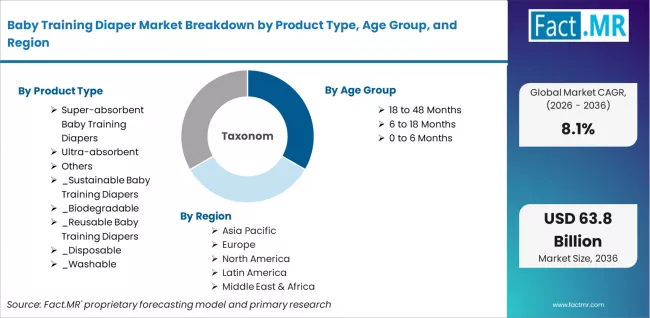
Baby Training Diaper Market is segmented by Product Type (Super-absorbent Baby Training Diapers, Ultra-absorbent, Others), Age Group (18 to 48 Months, 6 to 18 Months, 0 to 6 Months), Sales Channel (Offline, Online), and Region. Forecast for 2026 to 2036.

Core Findings

    Baby Training Diaper Market Size, Market Forecast and Outlook By FACT.MR

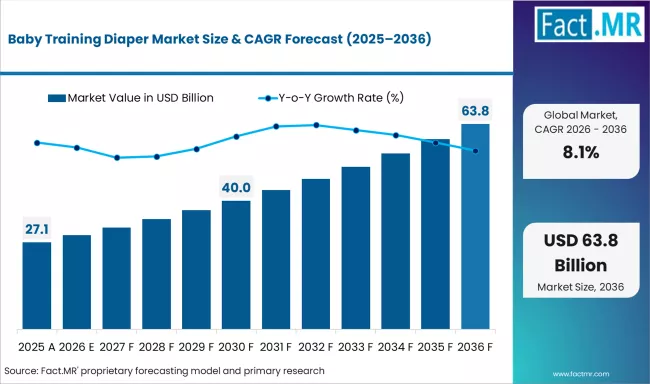
    The Baby Training Diaper market was valued at USD 27.07 billion in 2025, projected to reach USD 29.26 billion in 2026, and is forecast to expand to USD 63.76 billion by 2036 at an 8.1% CAGR. Rising parental awareness of age-appropriate toilet training milestone products, expanding modern retail penetration of pull-up style training diaper formats in India and Brazil, and premium product innovation in biodegradable and plant-based absorbent material segments are accelerating demand across both emerging and developed market geographies. What were once considered niche transitional products between disposable diapers and underwear have now become structured product categories carrying dedicated aisle space in global mass retail, pharmacy, and e-commerce channels.

    The absolute dollar growth of USD 34.50 billion across the forecast decade positions baby training diapers as among the highest-growth subcategories in the broader disposable hygiene market. Super-absorbent Product Type commanding 42.6% of segment share confirms the critical role of advanced absorbent polymer technology in sustaining product performance above basic training pant alternatives for active toddlers. The 18 to 48 Months age group retaining 49.0% of age group share anchors the primary toilet training transition window as the market's dominant procurement demographic, supported by pediatric guideline-backed parental adoption programs.

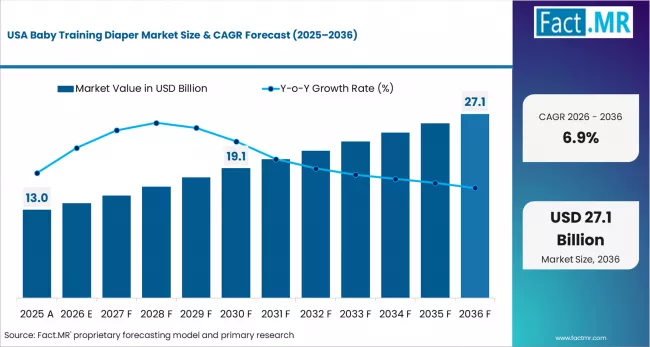
    Based on FACT.MR's regional analysis, India leads at 10.12% CAGR as rapid urbanization, rising disposable income among urban middle-class parents, and expanding modern retail access for branded baby hygiene products sustain aggressive training diaper category growth. Germany advances at 9.31% as premium sustainable training diaper product lines with certified organic materials and biodegradable certification command growing share in the health-conscious German baby care retail market. Brazil tracks at 8.51% as urban family income growth and expanding pharmacy chain distribution of training diaper formats in metro and secondary city markets sustain consistent category expansion. The United Kingdom records 7.70% as premium plant-based and fragrance-free training diaper product development in established baby care retail channels captures growing parental demand for certified natural alternatives. The United States registers 6.88% as sustained category demand in mass retail and subscription e-commerce channels maintains consistent training diaper procurement from a large installed base of toddler-age households. Japan advances at 6.08% where established pull-up training diaper category development and product technology leadership sustain consistent premium format demand.
    Baby Training Diaper Market Market Value Analysis

    Baby Training Diaper Market Key Takeaways

    Metric Details
    Industry Size (2026) USD 29.26 Billion
    Industry Value (2036) USD 63.76 Billion
    CAGR (2026-2036) 8.1%
    Source Fact.MR, 2026

    Baby Training Diaper Market Definition

    The Baby Training Diaper market covers pull-up style disposable absorbent hygiene products specifically designed to support toilet training transitions in children aged 0 to 48 months, incorporating easy-tear side panels, wetness indicator features, and standing waistband construction to simulate underwear while providing absorbent leak protection. Super-absorbent and ultra-absorbent product classifications distinguish advanced polymer core technology from standard training pant constructions. Sales channel scope covers offline mass retail, pharmacy, and grocery distribution alongside online e-commerce and subscription direct-to-consumer platforms.

    Baby Training Diaper Market Inclusions

    Market scope covers super-absorbent and ultra-absorbent baby training diapers in offline and online sales channels for the 18 to 48 months, 6 to 18 months, and 0 to 6 months age groups. Sustainable and biodegradable training diaper product lines carrying certified organic or plant-based material credentials are fully incorporated. Regional coverage spans India, Germany, Brazil, UK, USA, Japan, and 40 plus countries for the 2026 to 2036 forecast period.

    Baby Training Diaper Market Exclusions

    Standard disposable baby diapers without pull-up waistband or tear-away side panel construction are excluded from the baby training diaper market scope. Reusable cloth training pants and washable absorbent underwear products fall outside defined boundaries. Adult incontinence pull-up products and youth pull-up products for children above 48 months fall outside baby training diaper market valuation. Diaper rash cream, baby wipes, and complementary baby hygiene accessory products without absorbent training diaper functionality are explicitly omitted.

    Baby Training Diaper Market Research Methodology

    • Primary Research: Analysts conducted interviews with baby care retail category managers, pharmacy chain baby hygiene buyers, and pediatric nurse practitioners across India, Germany, Brazil, UK, and USA to validate training diaper adoption timing, product preference drivers, and retail channel procurement structures.
    • Desk Research: Data collection aggregated national birth rate statistics from WHO and national statistical offices, FMCG retail audit sell-out data for baby hygiene categories, e-commerce category growth rates, and pediatric society toilet training guideline publications.
    • Market-Sizing and Forecasting: Baseline values derive from bottom-up aggregation of national toddler population cohorts by age group, applying training diaper category penetration rates by market maturity tier and per-capita unit consumption models to regional revenue projections.
    • Data Validation and Update Cycle: Forecasts cross-validate against baby care segment revenues from Kimberly-Clark Corporation, The Procter and Gamble Company, Ontex Group NV, and Domtar Corporation annual investor reports.

    Summary of Baby Training Diaper Market

    • Baby Training Diaper Market Definition
      • The Baby Training Diaper market covers pull-up style super-absorbent and ultra-absorbent disposable training hygiene products for children aged 0 to 48 months sold through offline retail and online channels globally.
    • Demand Drivers in the Market
      • Rapid urbanization and rising disposable income among urban middle-class parents in India and Brazil expand modern retail access to branded baby hygiene training diaper formats, sustaining category penetration growth well above developed market base rates.
      • Premium sustainable training diaper product innovation with certified organic absorbent material, biodegradable outer cover, and fragrance-free construction commands growing share in German and UK baby care retail channels where health-conscious parental purchase criteria have shifted category value upward.
      • E-commerce subscription model adoption for baby hygiene replenishment in the USA and UK reduces category switching friction and sustains consistent training diaper brand loyalty through automated delivery programs targeted at the 18 to 48 months toilet training transition window.
    • Key Segments Analyzed in the FACT.MR Report
      • Super-absorbent Baby Training Diapers lead by Product Type with 42.6% share in 2026, where advanced polymer core construction sustains performance for active toddlers above basic training pant absorbency levels during the primary toilet training transition period.
      • 18 to 48 Months Age Group commands 49.0% of segment share in 2026, anchoring the primary toilet training transition window as the dominant procurement demographic supported by pediatric guideline-backed parental product adoption programs.
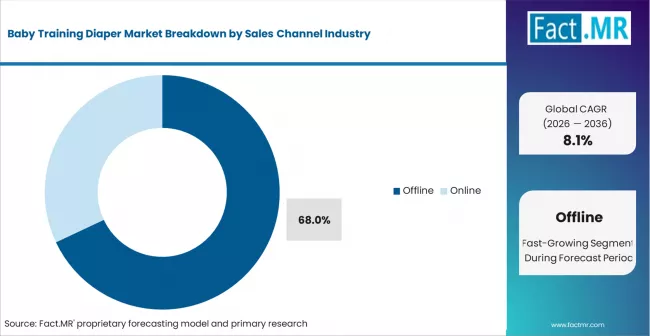
      • Offline Sales Channel accounts for 68.0% of channel share in 2026, where mass retail, pharmacy chain, and grocery store purchase remains the primary baby hygiene procurement format in both emerging and developed markets above online alternatives.
    • Analyst Opinion at FACT.MR
      • Shambhu Nath Jha, Principal Consultant, opines: 'The baby training diaper category is transitioning from a supplementary baby hygiene purchase to a primary structured category commanding dedicated retail space and brand investment comparable to disposable diapers. Manufacturers that develop clear product architecture communicating toilet training milestone alignment, age-appropriate absorbency specifications, and pediatric endorsement credentials will capture the premium pricing tier that generic pull-up training pants cannot defend against. The India and Brazil category penetration opportunity is particularly significant because the market entry phase coincides with urban middle-class parental behavior formation, where early brand establishment creates long training diaper purchase lifecycle loyalty.'
    • Strategic Implications / Executive Takeaways
      • Baby training diaper manufacturers must develop India and Brazil market-entry strategies that combine mass retail aisle placement with pediatric clinic sampling programs to build category awareness and brand preference during the critical urban middle-class consumer acquisition window.
      • Sustainable training diaper product line investment with certified organic absorbent material and biodegradable outer cover documentation is a prerequisite for premium shelf positioning in German, UK, and Scandinavian baby care retail channels where parents apply strict ingredient and environmental scrutiny.
      • E-commerce subscription program architecture with age-milestone product progression communications converts single training diaper purchasers into multi-year brand relationships spanning the full 0 to 48 month toilet training journey.
    • Methodology
      • Primary Research: FACT.MR interviewed retail category managers and pediatric practitioners across 40 countries to validate training diaper adoption timing and retail procurement structures.
      • Desk Research: Analysts aggregated WHO birth rate statistics, FMCG retail audit sell-out data, and pediatric society toilet training guideline publications.
      • Market-Sizing and Forecasting: Bottom-up aggregation of national toddler population cohorts with training diaper penetration rates and per-capita unit consumption models applied to regional revenue projections.
      • Data Validation: Cross-validation against Kimberly-Clark, Procter and Gamble, Ontex Group, and Domtar Corporation annual investor reports for baby care segment revenues.

    What’s Piquing the Interest of Start-ups in This Space?

    Rising Inclination towards Sustainable and Biodegradable Diapers

    Sustainability is a trend that is expected to shape the future of all aspects of life in ways we can’t comprehend, which is also true for training diapers. A wave of new diaper companies has been hitting the market as they create products that are sustainable and biodegradable to attract environment-conscious parents.

    • In February 2023, Happy Hues, an inclusivity-centered toddler care company founded by Eunique Jones Gibson, revealed that they were set to launch a new line of training pants called ‘Big-ups’ for kids made from plant-derived materials. The company has taken a unique approach to penetrating the market and seems like it could shed light on some unexplored opportunities in the childcare industry.
    • Kudos, a diaper manufacturing company founded in 2019, is focusing on capitalizing on the sustainability trend by marketing its diapers directly to eco-conscious millennial parents. Kudos provides diapers with liners made from 100% cotton but is still working on eliminating plastic in its diapers.
    • Coterie, a diaper start-up founded in 2018, is taking a unique approach toward sustainability by providing a product that helps toilet-train kids faster than usual. The brand provides a product called ‘Pant’, which is a hybrid between training pants and diapers.

    While these start-ups have been stirring up the global landscape, established baby training diaper companies have also started paying attention and launching new eco-friendly products to compete better as the focus on sustainability increases.

    Country-wise Insights

    Top Country Growth Comparison Baby Training Diaper Market Cagr (2026 2036)

    Is the United States a Lucrative Market for Baby Training Diaper Vendors?
    Baby Training Diaper Market Country Value Analysis

    “Steady Birth Rates and Rising Focus on Child Care”

    The birth rate in the United States has been steady for the past few years and this has created a good bankable space for baby training diaper companies in the country.

    • As per Macrotrends, the birth rate for the United States in 2023 is 12.023 births per 1,000 people, which is a 0.09% increase from the previous year of 2022.

    Spending on child care is increasing in the United States and this is also a key factor that could benefit market development in the future. Hectic lifestyles of parents, the growing working women population, and the high availability of baby training diapers are other aspects that could offer remunerative scope for baby training diaper companies.

    • As per the National Diaper Bank Network, 1 in 3 families in the United States have revealed that they need diapers.
    • Rising at 7.5% CAGR throughout the forecast period, baby training diaper sales are estimated to rake in a revenue valuation of US$ 14.9 billion by 2033-end.

    How Does this Report Define the Situation for Diaper Suppliers in Japan?

    “Presence of Premium Diaper Brands and Plummeting Birth Rates”

    Japanese diapers are preferred for their superior quality and comfort as compared to other diapers made across the world, which is projected to benefit market growth in the country going forward. However, plummeting birth rates and a rapidly expanding senescent population are influentially turning the tide in favor of adult diapers and resulting in slow sales of baby diapers in the country.

    • Sales of baby training diapers in Japan are slated to rise at 7.9% CAGR over the next ten years to attain a value of US$ 2.78 billion by 2033-end.

    Despite the contradictory nature of the Japanese marketplace, demand for premium baby training diapers by brands such as Merries, KAO, Genki, etc. is high and projected to create sustainable moneymaking opportunities in the future. Japanese diapers are witnessing high demand from parents around the world and this is expected to create lucrative opportunities for Japanese baby training diaper manufacturers across the forecast period as they expand their business scope on a global level.

    • In February 2021, Unicharm, a Japanese manufacturer of hygiene products, revealed its plans to expand its production facilities to India and Africa, where domestic consumption was projected to rise. The company had plans of spending US$ 473 million to ramp up its diaper production capacities in the aforementioned countries and regions.

    Which Type of Baby Training Diaper is Preferred in European Countries?

    “Voguish Outlook for Reusable and Biodegradable Nappies”

    The United Kingdom is slated to be a noteworthy market for baby training diaper suppliers in the European region over the coming years. The paradigm shift of consumer preference toward sustainable baby care products and the increasing working women population are also estimated to be key reasons to attract new investments from established as well as incoming baby training diaper producers going forward.

    • Consumption of baby training diapers in the United Kingdom is projected to increase at 6.9% CAGR over the next ten years and is projected to increase 1.9X in terms of value by 2033-end.

    Category-wise Insights

    Where Will Majority of People Buy Baby Training Diapers From?
    Baby Training Diaper Market Analysis By Sales Channel

    e-Commerce-Favorite Channel for Baby Training Diaper Sales in Future

    Huge discounts, the comfort of home, and doorstep delivery are some perks that have made online shopping a preferred way of purchasing many things for the majority of people around the world. An increasing number of baby training diaper brands investing in expanding their online presence and the launch of online stores to promote sales are also expected to favor baby training diaper sales through e-commerce in the future.

    • Baby training diaper shipments via e-commerce channels are projected to exhibit an increase at an impressive 9.4% CAGR over the next ten years.

    Which Type of Training Diaper is Most Widely Used?
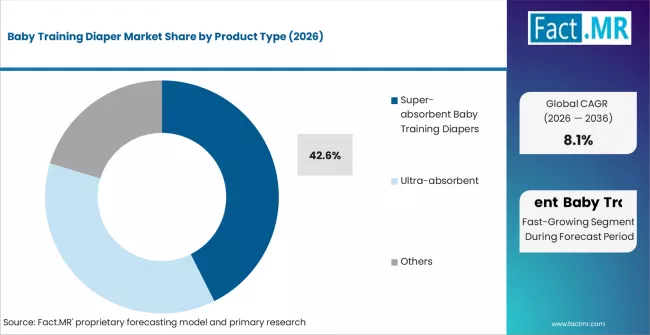
    Baby Training Diaper Market Analysis By Product Type

    Ultra-absorbent Baby Training Diapers-Maintaining Hegemony

    • Sales of ultra-absorbent baby training diapers are extrapolated to increase at a noteworthy CAGR of 8.6% from 2023 to 2033.

    Superior leak guards and longer wetness protection are prime benefits associated with ultra-absorbent training diapers that make them a preferred choice among parents around the world. The unparalleled absorption capabilities of these diapers is a major selling point that all established as well as incoming baby training diaper brands are capitalizing on.

    Competitive Landscape
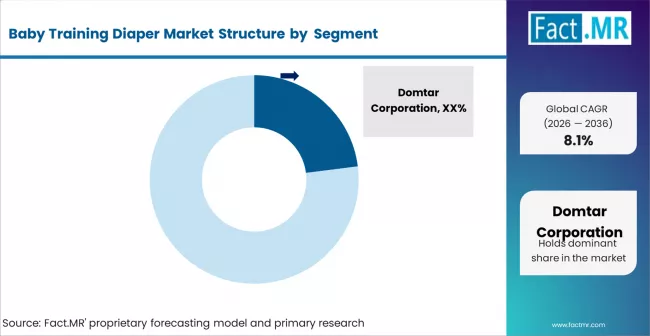
    Baby Training Diaper Market Analysis By Company

    Prime baby training diaper vendors are focusing on expanding their product portfolio by launching attractive new diapers and training pants. Baby training diaper manufacturers are decorating diapers with kids’ favorite cartoon characters to make them more appealing.

    • In January 2023, Pampers, a globally renowned manufacturer of diapers, released new limited-edition training underwear for kids with Peppa Pig prints. The products were made available at Walmart for purchase.

    A more detailed and elaborative account of how new developments by top baby training diaper distributors influence factors such as pricing trends and product standards has been mentioned in this latest Fact.MR research analysis.

    Scope of the Report

    Baby Training Diaper Market Breakdown By Product Type, Age Group, And Region

    Metric Value
    Quantitative Units USD 29.26 billion to USD 63.76 billion, at a CAGR of 8.1%
    Market Definition The Baby Training Diaper market covers pull-up style super-absorbent and ultra-absorbent disposable training hygiene products for children aged 0 to 48 months sold through offline and online channels globally.
    Product Type Segmentation Super-absorbent Baby Training Diapers, Ultra-absorbent, Others
    Age Group Segmentation 18 to 48 Months, 6 to 18 Months, 0 to 6 Months
    Sales Channel Segmentation Offline, Online
    Regions Covered North America, Latin America, Europe, East Asia, South Asia, Oceania, Middle East and Africa
    Countries Covered India, Germany, Brazil, UK, USA, Japan, and 40 plus countries
    Key Companies Profiled Domtar Corporation, First Quality Enterprise Inc., Kimberly Clark Corporation, Delipap, The Procter and Gamble Company, Ontex Group NV, MEGA, ABENA, Fippi, Linette Hellas, Europrosan SpA, Hygienika
    Forecast Period 2026 to 2036
    Approach Bottom-up aggregation of national toddler population cohorts by age group with training diaper category penetration rates and per-capita unit consumption models applied to regional revenue projections

    Key Segments of Baby Training Diaper Industry Research

    • By Product Type :

      • Super-absorbent Baby Training Diapers
      • Ultra-absorbent
      • Others
        • Sustainable Baby Training Diapers
        • Biodegradable
        • Reusable Baby Training Diapers
        • Disposable
        • Washable
        • Baby Training Diapers For Infant Boys
        • Baby Training Diapers For Infant Girls
        • Cloth Baby
        • Flat Cloth
        • Fitted
        • Pre-fold Cloth
        • Patterned
        • Tape Style
        • Pant Style
        • Ultra-thin
        • Woven
        • Non-woven
        • Organic
        • Eco-friendly
        • Regular
        • Low Absorption
        • High Absorption
    • By Age Group :

      • 0 to 6 Months
      • 6 to 18 Months
      • 18 to 48 Months
    • By Sales Channel :

      • Online
        • e-Commerce
      • Offline
        • Hypermarkets/Supermarkets
        • Convenience Stores
        • Pharmacy/Drug Stores
    • By Region:

      • North America
      • Latin America
      • Europe
      • APAC
      • MEA

    Bibliography

    • World Health Organization. (2024). Global health statistics: Birth rates and under-5 population by country. WHO.
    • Government of India, Ministry of Commerce and Industry. (2024). Fast-moving consumer goods sector: Baby hygiene product retail distribution and market development guidelines. MoCI.
    • European Commission, Directorate-General for Internal Market. (2024). Regulation EU 2016/425: Personal protective equipment and disposable hygiene product compliance. European Commission.
    • United States Consumer Product Safety Commission. (2024). Children's product safety standards: Absorbent baby hygiene product material compliance. CPSC.
    • Organisation for Economic Co-operation and Development. (2024). Family database: Fertility rates and child population projections by country. OECD.
    • Food and Agriculture Organization of the United Nations. (2024). Sustainable packaging and disposable hygiene product environmental impact. FAO.

    This bibliography is provided for reader reference. The full FACT.MR report contains the complete reference list with primary research documentation.

    This Report Addresses

    • Market sizing and quantitative forecast metrics detailing revenue projections for the Baby Training Diaper market across product type, age group, and sales channel categories through 2036.
    • Segmentation analysis mapping adoption velocity across super-absorbent and ultra-absorbent training diapers by 18 to 48 months, 6 to 18 months, and 0 to 6 months age groups in offline and online channels.
    • Regional intelligence comparing India and Brazil category penetration expansion dynamics against premium sustainable product development in Germany and UK established markets.
    • Regulatory compliance assessment analyzing EU disposable hygiene product material compliance, CPSC children's product safety standards, and India BIS certification requirements for absorbent baby hygiene products.
    • Competitive landscape evaluation tracking Kimberly-Clark, Procter and Gamble, Ontex, and Domtar product portfolio strategies across pull-up training diaper format innovation and sustainable material development.
    • E-commerce subscription model analysis identifying automated replenishment program architecture and age-milestone product progression communication as primary digital channel growth drivers.
    • Sustainable product development guidance defining certified organic material, biodegradable outer cover, and fragrance-free construction requirements for premium retail positioning in European baby care markets.
    • Custom data delivery formats encompassing interactive dashboards, raw Excel datasets, and comprehensive PDF narrative reports.

    Table of Content

    1. Executive Summary
      • Global Market Outlook
      • Demand to side Trends
      • Supply to side Trends
      • Technology Roadmap Analysis
      • Analysis and Recommendations
    2. Market Overview
      • Market Coverage / Taxonomy
      • Market Definition / Scope / Limitations
    3. Research Methodology
      • Chapter Orientation
      • Analytical Lens and Working Hypotheses
        • Market Structure, Signals, and Trend Drivers
        • Benchmarking and Cross-market Comparability
        • Market Sizing, Forecasting, and Opportunity Mapping
      • Research Design and Evidence Framework
        • Desk Research Programme (Secondary Evidence)
          • Company Annual and Sustainability Reports
          • Peer-reviewed Journals and Academic Literature
          • Corporate Websites, Product Literature, and Technical Notes
          • Earnings Decks and Investor Briefings
          • Statutory Filings and Regulatory Disclosures
          • Technical White Papers and Standards Notes
          • Trade Journals, Industry Magazines, and Analyst Briefs
          • Fact.MR Internal Proprietary Databases and Historical Market Datasets
          • Subscription Datasets and Paid Sources
          • Social Channels, Communities, and Digital Listening Inputs
          • Additional Desk Sources
        • Expert Input and Fieldwork (Primary Evidence)
          • Primary Modes
            • Qualitative Interviews and Expert Elicitation
            • Quantitative Surveys and Structured Data Capture
            • Blended Approach
          • Why Primary Evidence is Used
          • Field Techniques
            • Interviews
            • Surveys
            • Focus Groups
            • Observational and In-context Research
            • Social and Community Interactions
          • Stakeholder Universe Engaged
            • C-suite Leaders
            • Board Members
            • Presidents and Vice Presidents
            • R&D and Innovation Heads
            • Technical Specialists
            • Domain Subject-matter Experts
            • Scientists
            • Physicians and Other Healthcare Professionals
          • Governance, Ethics, and Data Stewardship
            • Research Ethics
            • Data Integrity and Handling
        • Tooling, Models, and Reference Databases
      • Data Engineering and Model Build
        • Data Acquisition and Ingestion
        • Cleaning, Normalisation, and Verification
        • Synthesis, Triangulation, and Analysis
      • Quality Assurance and Audit Trail
    4. Market Background
      • Market Dynamics
        • Drivers
        • Restraints
        • Opportunity
        • Trends
      • Scenario Forecast
        • Demand in Optimistic Scenario
        • Demand in Likely Scenario
        • Demand in Conservative Scenario
      • Opportunity Map Analysis
      • Product Life Cycle Analysis
      • Supply Chain Analysis
      • Investment Feasibility Matrix
      • Value Chain Analysis
      • PESTLE and Porter’s Analysis
      • Regulatory Landscape
      • Regional Parent Market Outlook
      • Production and Consumption Statistics
      • Import and Export Statistics
    5. Global Market Analysis 2021 to 2025 and Forecast, 2026 to 2036
      • Historical Market Size Value (USD Million) Analysis, 2021 to 2025
      • Current and Future Market Size Value (USD Million) Projections, 2026 to 2036
        • Y to o to Y Growth Trend Analysis
        • Absolute $ Opportunity Analysis
    6. Global Market Pricing Analysis 2021 to 2025 and Forecast 2026 to 2036
    7. Global Market Analysis 2021 to 2025 and Forecast 2026 to 2036, By Product Type
      • Introduction / Key Findings
      • Historical Market Size Value (USD Million) Analysis By Product Type , 2021 to 2025
      • Current and Future Market Size Value (USD Million) Analysis and Forecast By Product Type , 2026 to 2036
        • Super-absorbent Baby Training Diapers
        • Ultra-absorbent
        • Others
          • Sustainable Baby Training Diapers
          • Biodegradable
          • Reusable Baby Training Diapers
          • Disposable
          • Washable
      • Y to o to Y Growth Trend Analysis By Product Type , 2021 to 2025
      • Absolute $ Opportunity Analysis By Product Type , 2026 to 2036
    8. Global Market Analysis 2021 to 2025 and Forecast 2026 to 2036, By Age Group
      • Introduction / Key Findings
      • Historical Market Size Value (USD Million) Analysis By Age Group, 2021 to 2025
      • Current and Future Market Size Value (USD Million) Analysis and Forecast By Age Group, 2026 to 2036
        • 18 to 48 Months
        • 6 to 18 Months
        • 0 to 6 Months
      • Y to o to Y Growth Trend Analysis By Age Group, 2021 to 2025
      • Absolute $ Opportunity Analysis By Age Group, 2026 to 2036
    9. Global Market Analysis 2021 to 2025 and Forecast 2026 to 2036, By Sales Channel
      • Introduction / Key Findings
      • Historical Market Size Value (USD Million) Analysis By Sales Channel, 2021 to 2025
      • Current and Future Market Size Value (USD Million) Analysis and Forecast By Sales Channel, 2026 to 2036
        • Offline
          • Hypermarkets/Supermarkets
          • Convenience Stores
          • Pharmacy/Drug Stores
        • Online
          • e-Commerce
      • Y to o to Y Growth Trend Analysis By Sales Channel, 2021 to 2025
      • Absolute $ Opportunity Analysis By Sales Channel, 2026 to 2036
    10. Global Market Analysis 2021 to 2025 and Forecast 2026 to 2036, By Region
      • Introduction
      • Historical Market Size Value (USD Million) Analysis By Region, 2021 to 2025
      • Current Market Size Value (USD Million) Analysis and Forecast By Region, 2026 to 2036
        • North America
        • Latin America
        • Western Europe
        • Eastern Europe
        • East Asia
        • South Asia and Pacific
        • Middle East & Africa
      • Market Attractiveness Analysis By Region
    11. North America Market Analysis 2021 to 2025 and Forecast 2026 to 2036, By Country
      • Historical Market Size Value (USD Million) Trend Analysis By Market Taxonomy, 2021 to 2025
      • Market Size Value (USD Million) Forecast By Market Taxonomy, 2026 to 2036
        • By Country
          • USA
          • Canada
          • Mexico
        • By Product Type
        • By Age Group
        • By Sales Channel
      • Market Attractiveness Analysis
        • By Country
        • By Product Type
        • By Age Group
        • By Sales Channel
      • Key Takeaways
    12. Latin America Market Analysis 2021 to 2025 and Forecast 2026 to 2036, By Country
      • Historical Market Size Value (USD Million) Trend Analysis By Market Taxonomy, 2021 to 2025
      • Market Size Value (USD Million) Forecast By Market Taxonomy, 2026 to 2036
        • By Country
          • Brazil
          • Chile
          • Rest of Latin America
        • By Product Type
        • By Age Group
        • By Sales Channel
      • Market Attractiveness Analysis
        • By Country
        • By Product Type
        • By Age Group
        • By Sales Channel
      • Key Takeaways
    13. Western Europe Market Analysis 2021 to 2025 and Forecast 2026 to 2036, By Country
      • Historical Market Size Value (USD Million) Trend Analysis By Market Taxonomy, 2021 to 2025
      • Market Size Value (USD Million) Forecast By Market Taxonomy, 2026 to 2036
        • By Country
          • Germany
          • UK
          • Italy
          • Spain
          • France
          • Nordic
          • BENELUX
          • Rest of Western Europe
        • By Product Type
        • By Age Group
        • By Sales Channel
      • Market Attractiveness Analysis
        • By Country
        • By Product Type
        • By Age Group
        • By Sales Channel
      • Key Takeaways
    14. Eastern Europe Market Analysis 2021 to 2025 and Forecast 2026 to 2036, By Country
      • Historical Market Size Value (USD Million) Trend Analysis By Market Taxonomy, 2021 to 2025
      • Market Size Value (USD Million) Forecast By Market Taxonomy, 2026 to 2036
        • By Country
          • Russia
          • Poland
          • Hungary
          • Balkan & Baltic
          • Rest of Eastern Europe
        • By Product Type
        • By Age Group
        • By Sales Channel
      • Market Attractiveness Analysis
        • By Country
        • By Product Type
        • By Age Group
        • By Sales Channel
      • Key Takeaways
    15. East Asia Market Analysis 2021 to 2025 and Forecast 2026 to 2036, By Country
      • Historical Market Size Value (USD Million) Trend Analysis By Market Taxonomy, 2021 to 2025
      • Market Size Value (USD Million) Forecast By Market Taxonomy, 2026 to 2036
        • By Country
          • China
          • Japan
          • South Korea
        • By Product Type
        • By Age Group
        • By Sales Channel
      • Market Attractiveness Analysis
        • By Country
        • By Product Type
        • By Age Group
        • By Sales Channel
      • Key Takeaways
    16. South Asia and Pacific Market Analysis 2021 to 2025 and Forecast 2026 to 2036, By Country
      • Historical Market Size Value (USD Million) Trend Analysis By Market Taxonomy, 2021 to 2025
      • Market Size Value (USD Million) Forecast By Market Taxonomy, 2026 to 2036
        • By Country
          • India
          • ASEAN
          • Australia & New Zealand
          • Rest of South Asia and Pacific
        • By Product Type
        • By Age Group
        • By Sales Channel
      • Market Attractiveness Analysis
        • By Country
        • By Product Type
        • By Age Group
        • By Sales Channel
      • Key Takeaways
    17. Middle East & Africa Market Analysis 2021 to 2025 and Forecast 2026 to 2036, By Country
      • Historical Market Size Value (USD Million) Trend Analysis By Market Taxonomy, 2021 to 2025
      • Market Size Value (USD Million) Forecast By Market Taxonomy, 2026 to 2036
        • By Country
          • Kingdom of Saudi Arabia
          • Other GCC Countries
          • Turkiye
          • South Africa
          • Other African Union
          • Rest of Middle East & Africa
        • By Product Type
        • By Age Group
        • By Sales Channel
      • Market Attractiveness Analysis
        • By Country
        • By Product Type
        • By Age Group
        • By Sales Channel
      • Key Takeaways
    18. Key Countries Market Analysis
      • USA
        • Pricing Analysis
        • Market Share Analysis, 2025
          • By Product Type
          • By Age Group
          • By Sales Channel
      • Canada
        • Pricing Analysis
        • Market Share Analysis, 2025
          • By Product Type
          • By Age Group
          • By Sales Channel
      • Mexico
        • Pricing Analysis
        • Market Share Analysis, 2025
          • By Product Type
          • By Age Group
          • By Sales Channel
      • Brazil
        • Pricing Analysis
        • Market Share Analysis, 2025
          • By Product Type
          • By Age Group
          • By Sales Channel
      • Chile
        • Pricing Analysis
        • Market Share Analysis, 2025
          • By Product Type
          • By Age Group
          • By Sales Channel
      • Germany
        • Pricing Analysis
        • Market Share Analysis, 2025
          • By Product Type
          • By Age Group
          • By Sales Channel
      • UK
        • Pricing Analysis
        • Market Share Analysis, 2025
          • By Product Type
          • By Age Group
          • By Sales Channel
      • Italy
        • Pricing Analysis
        • Market Share Analysis, 2025
          • By Product Type
          • By Age Group
          • By Sales Channel
      • Spain
        • Pricing Analysis
        • Market Share Analysis, 2025
          • By Product Type
          • By Age Group
          • By Sales Channel
      • France
        • Pricing Analysis
        • Market Share Analysis, 2025
          • By Product Type
          • By Age Group
          • By Sales Channel
      • India
        • Pricing Analysis
        • Market Share Analysis, 2025
          • By Product Type
          • By Age Group
          • By Sales Channel
      • ASEAN
        • Pricing Analysis
        • Market Share Analysis, 2025
          • By Product Type
          • By Age Group
          • By Sales Channel
      • Australia & New Zealand
        • Pricing Analysis
        • Market Share Analysis, 2025
          • By Product Type
          • By Age Group
          • By Sales Channel
      • China
        • Pricing Analysis
        • Market Share Analysis, 2025
          • By Product Type
          • By Age Group
          • By Sales Channel
      • Japan
        • Pricing Analysis
        • Market Share Analysis, 2025
          • By Product Type
          • By Age Group
          • By Sales Channel
      • South Korea
        • Pricing Analysis
        • Market Share Analysis, 2025
          • By Product Type
          • By Age Group
          • By Sales Channel
      • Russia
        • Pricing Analysis
        • Market Share Analysis, 2025
          • By Product Type
          • By Age Group
          • By Sales Channel
      • Poland
        • Pricing Analysis
        • Market Share Analysis, 2025
          • By Product Type
          • By Age Group
          • By Sales Channel
      • Hungary
        • Pricing Analysis
        • Market Share Analysis, 2025
          • By Product Type
          • By Age Group
          • By Sales Channel
      • Kingdom of Saudi Arabia
        • Pricing Analysis
        • Market Share Analysis, 2025
          • By Product Type
          • By Age Group
          • By Sales Channel
      • Turkiye
        • Pricing Analysis
        • Market Share Analysis, 2025
          • By Product Type
          • By Age Group
          • By Sales Channel
      • South Africa
        • Pricing Analysis
        • Market Share Analysis, 2025
          • By Product Type
          • By Age Group
          • By Sales Channel
    19. Market Structure Analysis
      • Competition Dashboard
      • Competition Benchmarking
      • Market Share Analysis of Top Players
        • By Regional
        • By Product Type
        • By Age Group
        • By Sales Channel
    20. Competition Analysis
      • Competition Deep Dive
        • Domtar Corporation
          • Overview
          • Product Portfolio
          • Profitability by Market Segments (Product/Age /Sales Channel/Region)
          • Sales Footprint
          • Strategy Overview
            • Marketing Strategy
            • Product Strategy
            • Channel Strategy
        • First Quality Enterprise Inc.
        • Kimberly Clark Corporation
        • Delipap
        • The Procter and Gamble Company
        • Ontex Group NV
        • MEGA
        • ABENA
        • Fippi
        • Linette Hellas
        • Europrosan SpA
        • Hygienika
    21. Assumptions & Acronyms Used

    List Of Table

    • Table 1: Global Market Value (USD Million) Forecast by Region, 2021 to 2036
    • Table 2: Global Market Value (USD Million) Forecast by Product Type, 2021 to 2036
    • Table 3: Global Market Value (USD Million) Forecast by Age Group, 2021 to 2036
    • Table 4: Global Market Value (USD Million) Forecast by Sales Channel, 2021 to 2036
    • Table 5: North America Market Value (USD Million) Forecast by Country, 2021 to 2036
    • Table 6: North America Market Value (USD Million) Forecast by Product Type, 2021 to 2036
    • Table 7: North America Market Value (USD Million) Forecast by Age Group, 2021 to 2036
    • Table 8: North America Market Value (USD Million) Forecast by Sales Channel, 2021 to 2036
    • Table 9: Latin America Market Value (USD Million) Forecast by Country, 2021 to 2036
    • Table 10: Latin America Market Value (USD Million) Forecast by Product Type, 2021 to 2036
    • Table 11: Latin America Market Value (USD Million) Forecast by Age Group, 2021 to 2036
    • Table 12: Latin America Market Value (USD Million) Forecast by Sales Channel, 2021 to 2036
    • Table 13: Western Europe Market Value (USD Million) Forecast by Country, 2021 to 2036
    • Table 14: Western Europe Market Value (USD Million) Forecast by Product Type, 2021 to 2036
    • Table 15: Western Europe Market Value (USD Million) Forecast by Age Group, 2021 to 2036
    • Table 16: Western Europe Market Value (USD Million) Forecast by Sales Channel, 2021 to 2036
    • Table 17: Eastern Europe Market Value (USD Million) Forecast by Country, 2021 to 2036
    • Table 18: Eastern Europe Market Value (USD Million) Forecast by Product Type, 2021 to 2036
    • Table 19: Eastern Europe Market Value (USD Million) Forecast by Age Group, 2021 to 2036
    • Table 20: Eastern Europe Market Value (USD Million) Forecast by Sales Channel, 2021 to 2036
    • Table 21: East Asia Market Value (USD Million) Forecast by Country, 2021 to 2036
    • Table 22: East Asia Market Value (USD Million) Forecast by Product Type, 2021 to 2036
    • Table 23: East Asia Market Value (USD Million) Forecast by Age Group, 2021 to 2036
    • Table 24: East Asia Market Value (USD Million) Forecast by Sales Channel, 2021 to 2036
    • Table 25: South Asia and Pacific Market Value (USD Million) Forecast by Country, 2021 to 2036
    • Table 26: South Asia and Pacific Market Value (USD Million) Forecast by Product Type, 2021 to 2036
    • Table 27: South Asia and Pacific Market Value (USD Million) Forecast by Age Group, 2021 to 2036
    • Table 28: South Asia and Pacific Market Value (USD Million) Forecast by Sales Channel, 2021 to 2036
    • Table 29: Middle East & Africa Market Value (USD Million) Forecast by Country, 2021 to 2036
    • Table 30: Middle East & Africa Market Value (USD Million) Forecast by Product Type, 2021 to 2036
    • Table 31: Middle East & Africa Market Value (USD Million) Forecast by Age Group, 2021 to 2036
    • Table 32: Middle East & Africa Market Value (USD Million) Forecast by Sales Channel, 2021 to 2036

    List Of Figures

    • Figure 1: Global Market Pricing Analysis
    • Figure 2: Global Market Value (USD Million) Forecast 2021-2036
    • Figure 3: Global Market Value Share and BPS Analysis by Product Type, 2026 and 2036
    • Figure 4: Global Market Y-o-Y Growth Comparison by Product Type, 2026 to 2036
    • Figure 5: Global Market Attractiveness Analysis by Product Type
    • Figure 6: Global Market Value Share and BPS Analysis by Age Group, 2026 and 2036
    • Figure 7: Global Market Y-o-Y Growth Comparison by Age Group, 2026 to 2036
    • Figure 8: Global Market Attractiveness Analysis by Age Group
    • Figure 9: Global Market Value Share and BPS Analysis by Sales Channel, 2026 and 2036
    • Figure 10: Global Market Y-o-Y Growth Comparison by Sales Channel, 2026 to 2036
    • Figure 11: Global Market Attractiveness Analysis by Sales Channel
    • Figure 12: Global Market Value (USD Million) Share and BPS Analysis by Region, 2026 and 2036
    • Figure 13: Global Market Y-o-Y Growth Comparison by Region, 2026 to 2036
    • Figure 14: Global Market Attractiveness Analysis by Region
    • Figure 15: North America Market Incremental Dollar Opportunity, 2026 to 2036
    • Figure 16: Latin America Market Incremental Dollar Opportunity, 2026 to 2036
    • Figure 17: Western Europe Market Incremental Dollar Opportunity, 2026 to 2036
    • Figure 18: Eastern Europe Market Incremental Dollar Opportunity, 2026 to 2036
    • Figure 19: East Asia Market Incremental Dollar Opportunity, 2026 to 2036
    • Figure 20: South Asia and Pacific Market Incremental Dollar Opportunity, 2026 to 2036
    • Figure 21: Middle East & Africa Market Incremental Dollar Opportunity, 2026 to 2036
    • Figure 22: North America Market Value Share and BPS Analysis by Country, 2026 and 2036
    • Figure 23: North America Market Value Share and BPS Analysis by Product Type, 2026 and 2036
    • Figure 24: North America Market Y-o-Y Growth Comparison by Product Type, 2026 to 2036
    • Figure 25: North America Market Attractiveness Analysis by Product Type
    • Figure 26: North America Market Value Share and BPS Analysis by Age Group, 2026 and 2036
    • Figure 27: North America Market Y-o-Y Growth Comparison by Age Group, 2026 to 2036
    • Figure 28: North America Market Attractiveness Analysis by Age Group
    • Figure 29: North America Market Value Share and BPS Analysis by Sales Channel, 2026 and 2036
    • Figure 30: North America Market Y-o-Y Growth Comparison by Sales Channel, 2026 to 2036
    • Figure 31: North America Market Attractiveness Analysis by Sales Channel
    • Figure 32: Latin America Market Value Share and BPS Analysis by Country, 2026 and 2036
    • Figure 33: Latin America Market Value Share and BPS Analysis by Product Type, 2026 and 2036
    • Figure 34: Latin America Market Y-o-Y Growth Comparison by Product Type, 2026 to 2036
    • Figure 35: Latin America Market Attractiveness Analysis by Product Type
    • Figure 36: Latin America Market Value Share and BPS Analysis by Age Group, 2026 and 2036
    • Figure 37: Latin America Market Y-o-Y Growth Comparison by Age Group, 2026 to 2036
    • Figure 38: Latin America Market Attractiveness Analysis by Age Group
    • Figure 39: Latin America Market Value Share and BPS Analysis by Sales Channel, 2026 and 2036
    • Figure 40: Latin America Market Y-o-Y Growth Comparison by Sales Channel, 2026 to 2036
    • Figure 41: Latin America Market Attractiveness Analysis by Sales Channel
    • Figure 42: Western Europe Market Value Share and BPS Analysis by Country, 2026 and 2036
    • Figure 43: Western Europe Market Value Share and BPS Analysis by Product Type, 2026 and 2036
    • Figure 44: Western Europe Market Y-o-Y Growth Comparison by Product Type, 2026 to 2036
    • Figure 45: Western Europe Market Attractiveness Analysis by Product Type
    • Figure 46: Western Europe Market Value Share and BPS Analysis by Age Group, 2026 and 2036
    • Figure 47: Western Europe Market Y-o-Y Growth Comparison by Age Group, 2026 to 2036
    • Figure 48: Western Europe Market Attractiveness Analysis by Age Group
    • Figure 49: Western Europe Market Value Share and BPS Analysis by Sales Channel, 2026 and 2036
    • Figure 50: Western Europe Market Y-o-Y Growth Comparison by Sales Channel, 2026 to 2036
    • Figure 51: Western Europe Market Attractiveness Analysis by Sales Channel
    • Figure 52: Eastern Europe Market Value Share and BPS Analysis by Country, 2026 and 2036
    • Figure 53: Eastern Europe Market Value Share and BPS Analysis by Product Type, 2026 and 2036
    • Figure 54: Eastern Europe Market Y-o-Y Growth Comparison by Product Type, 2026 to 2036
    • Figure 55: Eastern Europe Market Attractiveness Analysis by Product Type
    • Figure 56: Eastern Europe Market Value Share and BPS Analysis by Age Group, 2026 and 2036
    • Figure 57: Eastern Europe Market Y-o-Y Growth Comparison by Age Group, 2026 to 2036
    • Figure 58: Eastern Europe Market Attractiveness Analysis by Age Group
    • Figure 59: Eastern Europe Market Value Share and BPS Analysis by Sales Channel, 2026 and 2036
    • Figure 60: Eastern Europe Market Y-o-Y Growth Comparison by Sales Channel, 2026 to 2036
    • Figure 61: Eastern Europe Market Attractiveness Analysis by Sales Channel
    • Figure 62: East Asia Market Value Share and BPS Analysis by Country, 2026 and 2036
    • Figure 63: East Asia Market Value Share and BPS Analysis by Product Type, 2026 and 2036
    • Figure 64: East Asia Market Y-o-Y Growth Comparison by Product Type, 2026 to 2036
    • Figure 65: East Asia Market Attractiveness Analysis by Product Type
    • Figure 66: East Asia Market Value Share and BPS Analysis by Age Group, 2026 and 2036
    • Figure 67: East Asia Market Y-o-Y Growth Comparison by Age Group, 2026 to 2036
    • Figure 68: East Asia Market Attractiveness Analysis by Age Group
    • Figure 69: East Asia Market Value Share and BPS Analysis by Sales Channel, 2026 and 2036
    • Figure 70: East Asia Market Y-o-Y Growth Comparison by Sales Channel, 2026 to 2036
    • Figure 71: East Asia Market Attractiveness Analysis by Sales Channel
    • Figure 72: South Asia and Pacific Market Value Share and BPS Analysis by Country, 2026 and 2036
    • Figure 73: South Asia and Pacific Market Value Share and BPS Analysis by Product Type, 2026 and 2036
    • Figure 74: South Asia and Pacific Market Y-o-Y Growth Comparison by Product Type, 2026 to 2036
    • Figure 75: South Asia and Pacific Market Attractiveness Analysis by Product Type
    • Figure 76: South Asia and Pacific Market Value Share and BPS Analysis by Age Group, 2026 and 2036
    • Figure 77: South Asia and Pacific Market Y-o-Y Growth Comparison by Age Group, 2026 to 2036
    • Figure 78: South Asia and Pacific Market Attractiveness Analysis by Age Group
    • Figure 79: South Asia and Pacific Market Value Share and BPS Analysis by Sales Channel, 2026 and 2036
    • Figure 80: South Asia and Pacific Market Y-o-Y Growth Comparison by Sales Channel, 2026 to 2036
    • Figure 81: South Asia and Pacific Market Attractiveness Analysis by Sales Channel
    • Figure 82: Middle East & Africa Market Value Share and BPS Analysis by Country, 2026 and 2036
    • Figure 83: Middle East & Africa Market Value Share and BPS Analysis by Product Type, 2026 and 2036
    • Figure 84: Middle East & Africa Market Y-o-Y Growth Comparison by Product Type, 2026 to 2036
    • Figure 85: Middle East & Africa Market Attractiveness Analysis by Product Type
    • Figure 86: Middle East & Africa Market Value Share and BPS Analysis by Age Group, 2026 and 2036
    • Figure 87: Middle East & Africa Market Y-o-Y Growth Comparison by Age Group, 2026 to 2036
    • Figure 88: Middle East & Africa Market Attractiveness Analysis by Age Group
    • Figure 89: Middle East & Africa Market Value Share and BPS Analysis by Sales Channel, 2026 and 2036
    • Figure 90: Middle East & Africa Market Y-o-Y Growth Comparison by Sales Channel, 2026 to 2036
    • Figure 91: Middle East & Africa Market Attractiveness Analysis by Sales Channel
    • Figure 92: Global Market - Tier Structure Analysis
    • Figure 93: Global Market - Company Share Analysis

    - Frequently Asked Questions -

    How large is the demand for Baby Training Diapers in the global market in 2026?

    Demand for Baby Training Diapers in the global market is estimated to be valued at USD 29.26 billion in 2026.

    What will be the market size of Baby Training Diapers by 2036?

    Market size for Baby Training Diapers is projected to reach USD 63.76 billion by 2036.

    What is the expected demand growth between 2026 and 2036?

    Demand for Baby Training Diapers is expected to grow at a CAGR of 8.1% between 2026 and 2036.

    Which Product Type leads global sales by 2026?

    Super-absorbent Baby Training Diapers account for 42.6% of product type share in 2026, where advanced polymer core construction sustains active toddler performance above basic training pant absorbency levels.

    Which Age Group dominates?

    18 to 48 Months Age Group commands 49.0% of segment share in 2026, anchoring the primary toilet training transition window as the dominant procurement demographic.

    What is India's growth outlook?

    India is projected to expand at a CAGR of 10.12% during 2026 to 2036, driven by urbanization, rising middle-class disposable income, and expanding modern retail access for branded baby training diaper formats.

    What drives demand in Germany?

    Premium sustainable training diaper product lines with certified organic materials and biodegradable certification drive consistent category value growth, supporting Germany's 9.31% CAGR through 2036.

    Which Sales Channel leads?

    Offline Sales Channel accounts for 68.0% of channel share in 2026, where mass retail, pharmacy chain, and grocery store purchase remains the primary baby hygiene procurement format across both emerging and developed markets.

    What is excluded from the scope?

    Standard disposable diapers without pull-up construction, reusable cloth training pants, adult incontinence products, and baby hygiene accessories without absorbent training diaper functionality are excluded.

    How does FACT.MR validate the Baby Training Diaper forecast?

    Forecasts cross-validate against baby care segment revenues from Kimberly-Clark Corporation, Procter and Gamble, Ontex Group NV, and Domtar Corporation annual investor reports.

    Baby Training Diaper Market