- Base Value(2025): 1.0 Bn
- Estimated Value(2026): 1.2 Bn
- Forecast Value (2036): 2.4 Bn
- CAGR (2026 - 2036): 7.2%
Acacia Senegal Gum for Low-Glycemic Beverage Formulation Market Forecast and Outlook By Fact.MR
In 2025, the acacia senegal gum for low-glycemic beverage formulation market was valued at USD 1.0 billion. Based on Fact.MR analysis, demand for acacia senegal gum for low-glycemic beverage formulation is estimated to grow to USD 1.2 billion in 2026 and USD 2.4 billion by 2036. FACT.MR projects a CAGR of 7.2% during the forecast period.
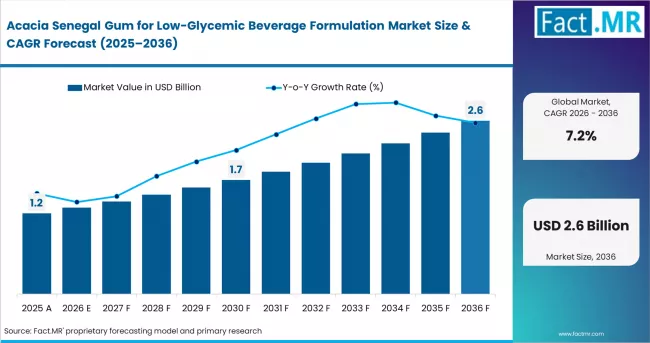
Acacia Senegal Gum For Low Glycemic Beverage Formulation Market Market Value Analysis | Source: Fact.MR
| Metric | Value |
|---|---|
| Estimated Value in 2026 | USD 1.2 billion |
| Forecast Value in 2036 | USD 2.4 billion |
| Forecast CAGR (2026 to 2036) | 7.2% |
Source: Fact.MR analysis. Updated Apr 10, 2026
Summary of Acacia Senegal Gum for Low-Glycemic Beverage Formulation Market
- Market Definition
- The market covers a gum supplied as soluble dietary fibre, emulsifier, and stabiliser ingredient to low-glycaemic and functional beverage manufacturers across food and beverage, nutraceutical, and pharmaceutical applications globally.
- Demand Drivers
- China's GB 28050 front-of-pack nutrition labelling rules are accelerating Acacia Senegal gum adoption in low-sugar RTD beverage formulations.
- U.S. FDA dietary fibre definition compliance requirements are driving demand for substantiated soluble fibre ingredients in functional beverage formats.
- EU Nutri-Score reformulation pressure is expanding Acacia Senegal gum use as a clean-label emulsifier and fibre contributor in European beverage categories.
- Key Segments Analyzed
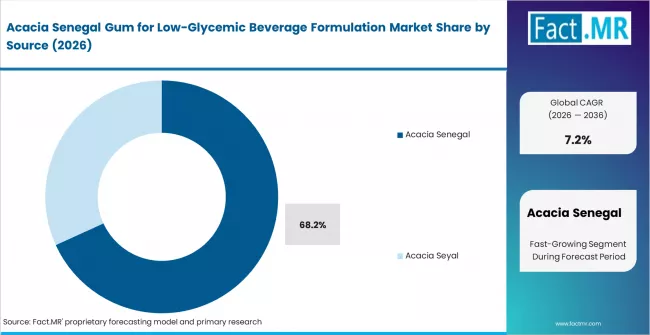
- By Source: Acacia Senegal leads with 68.2% share in 2026. It is preferred for superior emulsification and higher soluble fibre content versus Acacia Seyal.
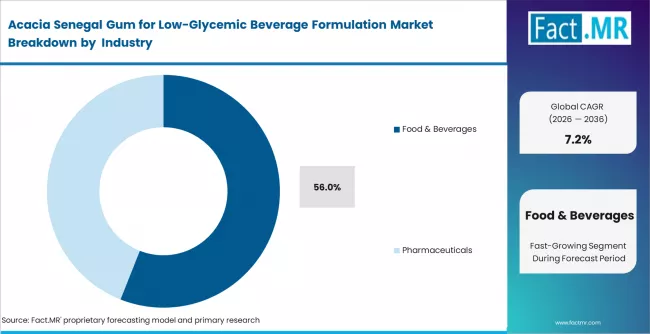
- By Application: Food & Beverages holds 56% share in 2026. Growth is driven by adoption in low-sugar RTD, functional tea, and powder drinks.
- By Functionality: Emulsifier leads with 28% share in 2026. Dietary fibre and stabiliser roles are expanding with clean-label and low-GI reformulation.
- By Geography: China leads with 7.0% CAGR driven by low-sugar mandates. India and United States follow as key growth markets.
- Analyst Opinion at FACT.MR
- Shambhu Nath Jha, Principal Consultant at Fact.MR, states that traceable Acacia Senegal with GI and prebiotic validation is replacing commodity gum. Clinical substantiation is becoming the key differentiator through 2036.
- Strategic Implications
- Invest in traceable and sustainable Acacia Senegal sourcing to meet EU and North America clean-label demand.
- Develop clinical data for dietary fibre and low-GI claims to meet U.S. Food and Drug Administration and EU standards.
- Ensure approvals under FSANZ, FSSAI, and GB regulations for multi-market supply.
- Methodology
- Market sizing based on harvest volumes, beverage demand, and pricing tiers.
- Forecasts include low-GI trends, regulatory shifts, and clean-label adoption.
- Validated using data from Nexira, Ingredion, Kerry Group, and global standards.
The market is projected to generate approximately USD 1.2 billion in incremental revenue between 2026 and 2036, reflecting structurally above-average growth for a botanical hydrocolloid ingredient. Growth is driven by rising demand for clean-label stabilisers in beverage formulations. These ingredients provide soluble dietary fibre and support low glycaemic index claims. They are widely used in ready-to-drink and powder beverage formats. However, expansion is constrained by limited harvest capacity in Sahelian regions. Export processing challenges in Sudan and Senegal add supply pressure. Seasonal yield variability further creates pricing and availability uncertainty for large manufacturers.
Country-level performance reflects low-sugar regulatory momentum, clean-label formulation penetration, and functional beverage market maturity. China leads at 7.0% CAGR through 2036, driven by GB 28050 front-of-pack rules and rapid growth of low-sugar RTD tea and juice categories. India follows at 6.5% CAGR, supported by FSSAI dietary fibre labelling updates and functional wellness drink expansion. The United States records 6.2% CAGR, anchored by FDA dietary fibre substantiation requirements and sustained keto and low-GI beverage demand. Germany grows at 5.7%, aligned with EU Nutri-Score reformulation pressure and clean-label emulsifier substitution. Japan registers approximately 6.0% CAGR through FOSHU-linked functional beverage programmes and precision dietary fibre formulation demand.
Segmental Analysis
Acacia Senegal Gum for Low-Glycemic Beverage Formulation Market Analysis by Source
Acacia Senegal Gum For Low Glycemic Beverage Formulation Market Analysis By Application | Source: Fact.MR
Acacia Senegal is projected to hold 68.2% share in 2026. It dominates due to higher arabinogalactan content supporting fibre claims and prebiotic functionality in beverages.
- Nexira Sustainable Sourcing Programme: Nexira launched traceable Inavea Pure Acacia in 2024. This supports sustainability and regulatory compliance for beverage manufacturers. [4]
- Ingredion Low-GI Development: Ingredion expanded TICACEL Acacia gum for low-GI beverages. It includes glycaemic-index data and regulatory documentation support. [5]
- Acacia Seyal Blending Trend: CODEX standards allow blending with Acacia Seyal. Lower-cost blends are increasing in commodity applications, reinforcing premium positioning for pure Acacia Senegal. [6]
Acacia Senegal Gum for Low-Glycemic Beverage Formulation Market Analysis by Application
Acacia Senegal Gum For Low Glycemic Beverage Formulation Market Analysis By Source | Source: Fact.MR
Food & Beverages is expected to hold 56% share in 2026. Demand is driven by RTD functional drinks, low-sugar juices, and powder beverage formulations.
- Kerry Group Beverage Investment: Kerry Group expanded functional beverage solutions in 2024. This includes Acacia-based fibre ingredients for clean-label reformulation. [7]
- BASF Nutraceutical Development: BASF introduced gum acacia-based prebiotic ingredients. These support gut-health positioning in beverage and supplement formats. [8]
- Functional RTD Growth Trend: Functional RTD launches with fibre claims grew 18% in 2024. This is increasing procurement of Acacia Senegal gum across key markets. [9]
Drivers, Restraints, and Opportunities
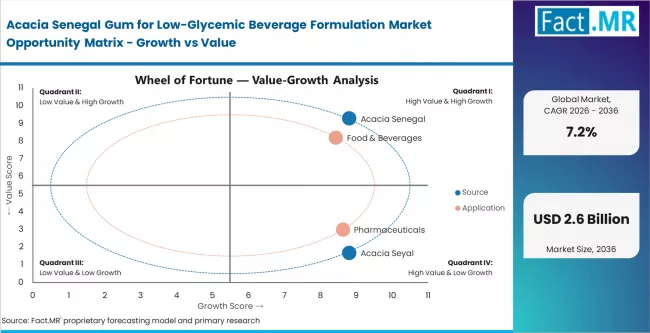
Acacia Senegal Gum For Low Glycemic Beverage Formulation Market Opportunity Matrix Growth Vs Value | Source: Fact.MR
Acacia Senegal gum in low-glycaemic beverage formulation has evolved from a commodity hydrocolloid into a dual-function ingredient. It is now valued for both emulsification and its soluble dietary fibre and prebiotic benefits.
- Market growth is supported by low-sugar reformulation mandates and rising demand for multifunctional, plant-based stabilisers. However, demand is polarising between low-cost commodity gum and premium, clinically validated Acacia Senegal fractions with traceability.
- EU Nutri-Score Reformulation Mandate: The EU Nutri-Score system is pushing beverage companies to reduce sugar and increase fibre content. This is expanding adoption of Acacia Senegal gum in RTD and powder beverages as a clean-label fibre source. [1]
- U.S. FDA Dietary Fibre Substantiation: U.S. Food and Drug Administration requires physiological benefit validation for fibre claims. Acacia Senegal qualifies, enabling its use in labelled functional beverages. [2]
- Sahelian Harvest Supply Constraint: Sudan and Senegal supply over 70% of global output. Yield variability is tightening supply and increasing price volatility for manufacturers. [3]
Regional Analysis
The acacia senegal gum for low-glycemic beverage formulation market is assessed across Asia Pacific, North America, Europe, Latin America, and Middle East and Africa, covering 40+ countries with distinct demand profiles shaped by low-sugar regulatory mandates, functional beverage market maturity, clean-label formulation adoption, and gum arabic trade flow infrastructure. The full report provides market attractiveness analysis by region and country.
.webp "Top Country Growth Comparison Acacia Senegal Gum For Low Glycemic Beverage Formulation Market Cagr (2026 2036)")
Top Country Growth Comparison Acacia Senegal Gum For Low Glycemic Beverage Formulation Market Cagr (2026 2036) | Source: Fact.MR
| Country | CAGR (2026 to 2036) |
|---|---|
| China | 7.0% |
| India | 6.5% |
| United States | 6.2% |
| Germany | 5.7% |
| Japan | 6.0% |
Source: Fact.MR analysis. Updated Apr 10, 2026
Source: Fact.MR (FACT.MR) analysis, based on proprietary forecasting model and primary research
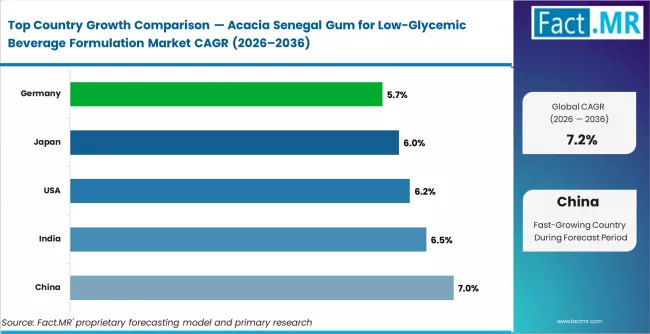
Acacia Senegal Gum For Low Glycemic Beverage Formulation Market Cagr Analysis By Country | Source: Fact.MR
Asia Pacific Acacia Senegal Gum for Low-Glycemic Beverage Formulation Market Analysis
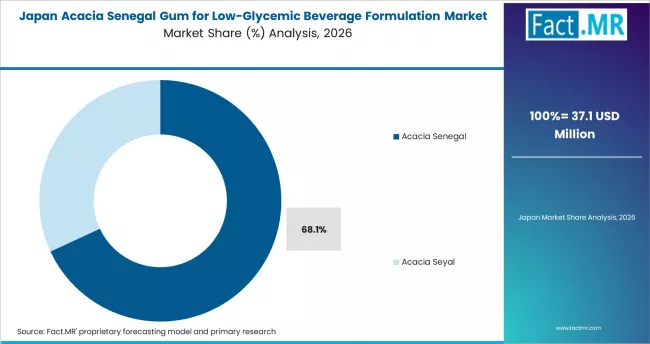
Acacia Senegal Gum For Low Glycemic Beverage Formulation Market Japan Market Share Analysis By Source | Source: Fact.MR
Asia Pacific is the fastest-growing region, driven by regulatory-led low-sugar reformulation and rising demand for functional beverages. Nexira, Ingredion, and TIC Gums supply through import and distributor networks aligned with regional standards.
- China: Regulatory-driven reformulation is supporting 7.0% CAGR through 2036. GB 28050 standards are pushing beverage manufacturers toward low-sugar and higher fibre formulations. This is increasing demand for Acacia Senegal gum as a dual-function emulsifier and fibre ingredient. Functional beverage launches with low-GI positioning are rising across RTD formats. Nexira has expanded technical support operations to assist local formulation and compliance needs.
- India: Labeling regulation updates are driving growth at 6.5% CAGR through 2036. FSSAI requirements are increasing demand for substantiated fibre ingredients in beverages. The wellness and low-sugar drink segment is expanding rapidly across urban markets. Kerry Group is strengthening supply through domestic facilities, while TIC Gums has expanded regulatory approvals for beverage use. India reflects strong volume growth driven by functional drink innovation.
- Japan: Clinical validation requirements are supporting steady growth at ~6.0% CAGR through 2036. The FOSHU framework requires substantiated health claims for functional beverages. Acacia Senegal gum is gaining traction in green tea, sports, and wellness drinks due to its prebiotic benefits. Regulatory approvals for fibre-based beverages are increasing. Ashland is expanding documentation support to accelerate product approvals.
FACT.MR's analysis of acacia senegal gum for low-glycemic beverage formulation market in Asia Pacific covers China, Japan, South Korea, India, ASEAN, and Australia and New Zealand. Readers can find GB 28050 regulatory data, FOSHU programme trends, and beverage formulation procurement insights.
North America Acacia Senegal Gum for Low-Glycemic Beverage Formulation Market Analysis
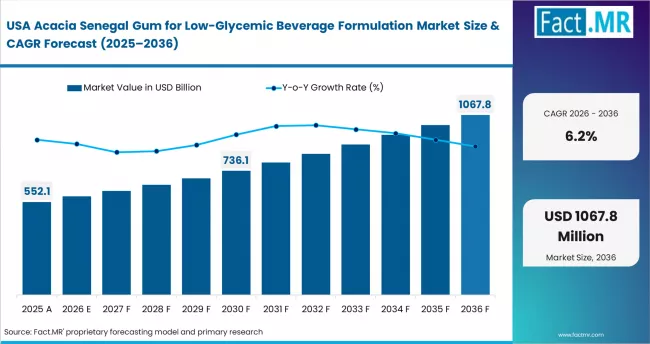
Acacia Senegal Gum For Low Glycemic Beverage Formulation Market Country Value Analysis | Source: Fact.MR
North America is a mature functional ingredient market supported by regulatory compliance and growing demand for low-GI beverages. Nexira, Ingredion, and Archer Daniels Midland lead supply through established beverage partnerships.
- United States: Regulation-led demand is supporting 6.2% CAGR through 2036. U.S. Food and Drug Administration dietary fibre rules enable on-pack fibre claims for Acacia Senegal gum. Functional beverage categories such as keto and prebiotic drinks are expanding rapidly. Archer Daniels Midland is increasing supply through beverage ingredient distribution networks. Growth is driven by strong consumer demand for clean-label and fibre-fortified drinks.
FACT.MR's analysis of acacia senegal gum for low-glycemic beverage formulation market in North America covers the United States, Canada, and Mexico. Readers can find FDA dietary fibre regulatory data, low-GI beverage trends, and supplier contract insights.
Europe Acacia Senegal Gum for Low-Glycemic Beverage Formulation Market Analysis
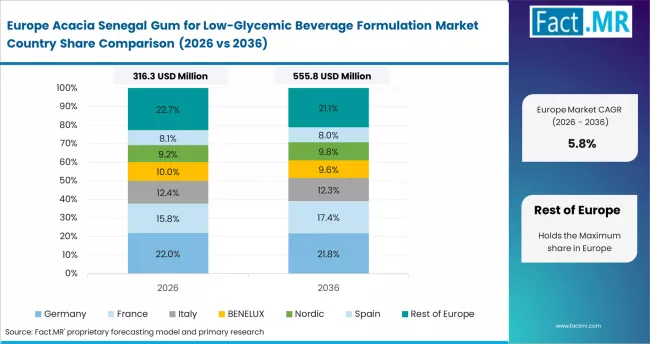
Acacia Senegal Gum For Low Glycemic Beverage Formulation Market Europe Country Market Share Analysis, 2026 & 2036 | Source: Fact.MR
Europe is a regulation-driven market where clean-label standards and health claims shape demand. Nexira and Alland & Robert are key suppliers across beverage applications.
- Germany: Regulatory and label-driven reformulation is supporting 5.7% CAGR through 2036. Nutri-Score adoption is pushing beverage brands to increase fibre content and reduce sugar. Companies like Eckes-Granini and Refresco are reformulating products using clean-label ingredients. EFSA validation of acacia fibre benefits supports its use in functional beverages. Alland & Robert is expanding distribution to meet rising demand.
FACT.MR's analysis of acacia senegal gum for low-glycemic beverage formulation market in Europe covers Germany, France, United Kingdom, Italy, Spain, Nordic, BENELUX, and Rest of Europe. Readers can find Nutri-Score compliance data, EFSA health claim trends, and clean-label formulation benchmarks.
Competitive Aligners for Market Players
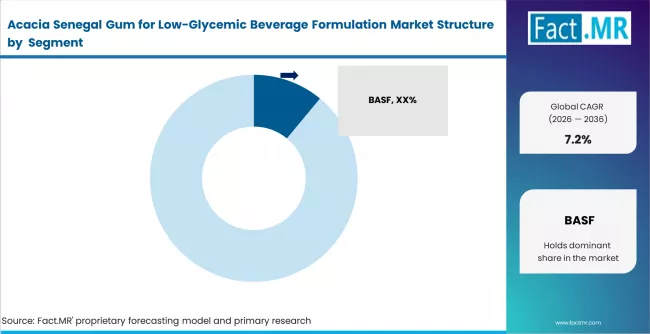
Acacia Senegal Gum For Low Glycemic Beverage Formulation Market Analysis By Company | Source: Fact.MR
The acacia senegal gum for low-glycemic beverage formulation market shows moderate concentration, with Nexira, Ingredion, TIC Gums, and Alland & Robert controlling a significant share of refined, beverage-grade supply. Competition is not primarily price-driven. Instead, it is shaped by the ability to deliver traceable, sustainability-certified gum with strong technical and regulatory documentation. Beverage manufacturers operating under Nutri-Score, GB 28050, and U.S. Food and Drug Administration requirements increasingly prioritise suppliers that provide glycaemic-index data, prebiotic validation, and compliance support.
Producers with integrated sourcing in Sahelian regions hold structural advantages. Established supply chains in Sudan, Senegal, and Chad ensure access to high-quality raw material and enable traceability. Nexira’s certified sourcing programmes and Ingredion’s TICACEL portfolio highlight this model, supporting direct engagement with beverage manufacturers while limiting the role of commodity traders.
Kerry Group adds further differentiation by offering integrated ingredient systems that combine acacia gum with complementary functional components. Large beverage companies such as Nestlé, PepsiCo, and Coca-Cola manage supply risk through dual sourcing strategies and long-term contracts with certified suppliers. Qualification cycles for new suppliers typically require 12 to 18 months of testing and regulatory validation. These barriers reinforce supplier loyalty and sustain pricing power for technically differentiated producers, even as commodity-grade gum markets remain volatile.
Key Players
- BASF
- Archer Daniels Midland
- Kerry Group
- Nexira
- Ashland
- TIC Gums
- Ingredion
- Alland & Robert
Bibliography
- [1] European Commission. (2024). EU Farm to Fork Strategy: Review of Nutri-Score Front-of-Pack Labelling Harmonisation Progress and Mandatory Implementation Assessment Including Beverage Category Dietary Fibre Scoring Implications. March 2024. ec. europa.eu/food/safety/labelling_nutrition
- [2] U.S. Food and Drug Administration. (2024). Dietary Fiber Guidance Update: 21 CFR 101.9 Isolated and Synthetic Non-Digestible Carbohydrates Including Acacia Gum Qualifying Status and Physiological Benefit Evidence Requirements for Nutrition Facts Label Declarations. 2024. fda.gov/food/nutrition-facts-label
- [3] FAO. (2024). Non-Wood Forest Products Global Market Review: Gum Arabic Production Volume Data from Sudan and Senegal Including Seasonal Yield Variability Analysis and Export Price Trend Implications. 2024. fao.org/forestry/nwfp
- [4] Nexira. (2024). Inavea Pure Acacia Programme Launch: Certified-Sustainable Acacia Senegal Gum Supply with Origin Traceability from Sahelian Harvest Zones to Beverage-Grade Powder for EU and North American Clean-Label Manufacturers. 2024. nexira.com/inavea
- [5] Ingredion. (2025). TICACEL Acacia Gum Product Line Expansion: Low-Glycaemic-Index Positioning for RTD Beverage and Powder-Drink Applications with GB 28050 and FDA Dietary Fibre Regulatory Documentation. January 2025. ingredion.com/na/en-us/ingredients
- [6] Codex Alimentarius Commission. (2024). CODEX STAN 210 Standard for Named Vegetable Oils Review Including Gum Arabic Blend Specification for Acacia Senegal and Acacia Seyal in Food and Beverage Applications. 2024. fao.org/fao-who-codexalimentarius
- [7] Kerry Group. (2024). Annual Report 2024: Functional Beverage Ingredient Portfolio Expansion Including TasteSense Gum Acacia-Based Soluble Fibre Solutions for Low-Sugar RTD Beverage Reformulation in North American and European Markets. 2024. kerrygroup.com/investors
- [8] BASF SE. (2024). Product Portfolio Update: Gum Acacia-Based Prebiotic Fibre Ingredient Launch for Nutraceutical Beverage and Dietary Supplement Applications with EU Health Claim Efficacy Data. 2024. nutrition.basf.com/en/products
- [9] Mintel. (2024). Global New Products Database Annual Review 2024: Functional RTD Beverage Launch Data Including Dietary Fibre Claim Frequency Growth and Acacia Gum Formulation Adoption in East Asia and North American Private-Label Beverage Manufacturing. December 2024. mintel.com/reports
This Report Addresses
- Strategic insights on acacia senegal gum demand across China GB 28050-driven low-sugar beverage reformulation, U.S. FDA dietary fibre substantiation compliance, EU Nutri-Score clean-label emulsifier displacement, India FSSAI labelling expansion, and Japan FOSHU functional beverage programme growth.
- Market forecast from USD 1.2 billion in 2026 to USD 2.4 billion by 2036, reflecting a CAGR of 7.2%.
- Growth opportunity mapping across dietary-fibre-claim beverage formats, prebiotic RTD and powder-drink categories, nutraceutical functional beverage supply, and clean-label emulsifier substitution in low-GI formulations.
- Segment analysis by source (Acacia Senegal, Acacia Seyal), application (food & beverages, pharmaceuticals, nutraceuticals), and functionality (emulsifier, stabiliser, dietary fibre / low-glycaemic ingredient).
- Regional outlook covering Asia Pacific regulatory-driven demand leadership, North America FDA and keto-beverage-growth expansion, and Europe Nutri-Score compliance-led reformulation demand.
- Competitive analysis of BASF, Archer Daniels Midland, Kerry Group, Nexira, Ashland, TIC Gums, Ingredion, and Alland & Robert covering supply origin programmes, functionality positioning, and regulatory documentation capabilities.
- Regulatory impact analysis covering EU Nutri-Score and Farm to Fork Strategy implementation, U.S. FDA 21 CFR 101.9 dietary fibre definition, China GB 28050 front-of-pack rules, India FSSAI labelling updates, and Japan FOSHU claim requirements.
- Report available in PDF, Excel datasets, and presentation formats supported by primary gum acacia trader interviews, beverage manufacturer procurement data, harvest volume records, and government regulatory databases (2024–2025).
Acacia Senegal Gum for Low-Glycemic Beverage Formulation Market Definition
The acacia senegal gum for low-glycemic beverage formulation market covers the harvesting, processing, and supply of dried exudate from Acacia Senegal trees, refined into spray-dried and granulated powder grades.
-
Acacia Senegal Gum for Low-Glycemic Beverage Formulation Market Inclusions
- Covers global and regional market sizes from 2026 to 2036 by source, application, and functionality. Includes food-grade and nutraceutical-grade Acacia Senegal gum supplied as emulsifier, stabiliser, and dietary fibre ingredient across food and beverage, pharmaceutical, and nutraceutical applications.
-
Acacia Senegal Gum for Low-Glycemic Beverage Formulation Market Exclusions
- Excludes Acacia Seyal unless blended with Acacia Senegal in certified gum arabic supply. Finished beverage products, dietary supplement capsules, and pharmaceutical excipient formulations are excluded.
-
Acacia Senegal Gum for Low-Glycemic Beverage Formulation Market Research Methodology
- Primary Research
- Interviews with gum acacia traders, beverage ingredient procurement managers, nutraceutical formulators, and R&D teams across China, United States, Germany, India, and Japan.
- Desk Research
- Analysis of CODEX STAN gum arabic standards, EU Nutri-Score regulation, FDA dietary fibre guidance, FSSAI labelling updates, and corporate disclosures from Nexira, Ingredion, and Kerry Group (2024–2025).
- Market Sizing and Forecasting
- Uses a hybrid top-down and bottom-up model based on gum arabic production volumes, beverage application demand benchmarks, functionality pricing tiers, and low-GI beverage market projections.
- Data Validation and Update Cycle
- Validated through harvest volume data, trade statistics, regulatory databases, and expert interviews with periodic updates.
- Primary Research
Segmentation
Scope of Report
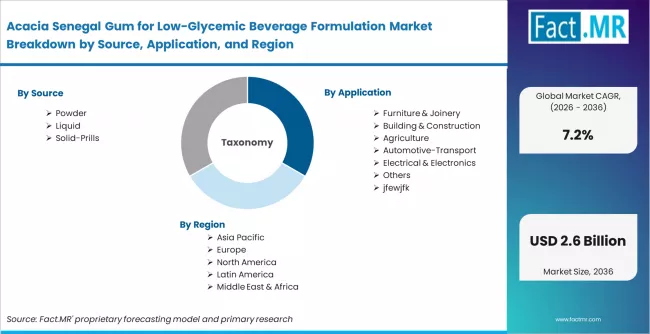
Acacia Senegal Gum For Low Glycemic Beverage Formulation Market Breakdown By Source Application And Region | Source: Fact.MR
| Attribute | Details |
|---|---|
| Quantitative Units | USD 1.2 billion (2026) to USD 2.4 billion (2036), at a CAGR of 7.2% |
| Market Definition | Acacia Senegal gum, a refined tree-exudate polysaccharide, supplied in spray-dried and granulated grades as a soluble dietary fibre, emulsifier, and stabiliser ingredient for low-glycaemic and functional beverage formulation globally. |
| Source Segmentation | Acacia Senegal, Acacia Seyal |
| Application Segmentation | Food & Beverages, Pharmaceuticals, Nutraceuticals |
| Functionality Segmentation | Emulsifier, Stabilizer, Dietary Fiber / Low-Glycemic Ingredient |
| Application Coverage | Low-GI RTD beverage emulsification, functional powder drink fibre fortification, nutraceutical prebiotic beverage, pharmaceutical excipient, and clean-label stabiliser applications. |
| Regions Covered | North America, Europe, Asia Pacific, Latin America, Middle East and Africa |
| Countries Covered | USA, Canada, Mexico, Germany, UK, France, Italy, Spain, Nordic, BENELUX, China, Japan, South Korea, India, ASEAN, Australia and New Zealand, Brazil, Argentina, Saudi Arabia, GCC, Turkey, South Africa, Rest of MEA |
| Key Companies Profiled | BASF, Archer Daniels Midland, Kerry Group, Nexira, Ashland, TIC Gums, Ingredion, Alland & Robert |
| Forecast Period | 2026 to 2036 |
| Approach | Hybrid top-down and bottom-up model using Acacia Senegal gum harvest volume data, beverage application demand benchmarks, functionality pricing tiers, regulatory labelling databases, and primary interviews with gum acacia traders and beverage ingredient procurement managers. |
Source: Fact.MR analysis. Updated Apr 10, 2026
Acacia Senegal Gum for Low-Glycemic Beverage Formulation Market by Segments
-
By Source:
- Acacia Senegal
- Acacia Seyal
-
By Application:
- Food & Beverages
- Pharmaceuticals
- Nutraceuticals
-
By Functionality:
- Emulsifier
- Stabilizer
- Dietary Fiber / Low-Glycemic Ingredient
-
By Region:
-
North America
- United States
- Canada
- Mexico
-
Latin America
- Brazil
- Mexico
- Argentina
- Chile
- Rest of Latin America
-
Western Europe
- Germany
- United Kingdom
- France
- Italy
- Spain
- Nordic Countries
- BENELUX
- Rest of Western Europe
-
Eastern Europe
- Russia
- Poland
- Hungary
- Balkan and Baltic
- Rest of Eastern Europe
-
East Asia
- China
- Japan
- South Korea
-
South Asia and Pacific
- India
- ASEAN
- Australia and New Zealand
- Rest of South Asia and Pacific
-
Middle East and Africa
- Kingdom of Saudi Arabia
- Other GCC Countries
- Turkey
- South Africa
- Rest of Middle East and Africa
-
Frequently Asked Questions
How large is the acacia senegal gum for low-glycemic beverage formulation market in 2025?
What will the market size be in 2026?
What is the projected market size by 2036?
What is the expected CAGR of the acacia senegal gum for low-glycemic beverage formulation market?
What is the absolute dollar opportunity in this market?
Which source segment leads the market?
Which application segment holds the largest share?
Which country shows the fastest growth?
Which functionality segment leads the market?
Who are the key players?
What is driving demand for acacia senegal gum in beverages?
Why is acacia senegal preferred over other gums?
What role does glycaemic index play in this market?
What challenges do beverage manufacturers face?
How do large beverage companies manage supply risks?
What is the role of sustainability in this market?
Who worked on this report


Preview the report firsthand - request a free sample
Free SampleGet the brochure for pricing and purchase details
Download PDF