Accelerated Processing Unit Market Size, Share, Growth and Forecast (2026 - 2036)

The Accelerated Processing Unit Market is segmented by Product Type, by Architecture, by Application, by End User, and by Sales Channel, and Region. Forecast for 2026 to 2036.

Fact.MR states that accelerated processing unit demand is moving toward integrated compute platforms that combine CPU and AI acceleration in one package. PC makers require processors that improve graphics and local AI performance.

Accelerated Processing Unit Market Size, Market Forecast and Outlook by Fact.MR

  • The accelerated processing unit market was valued at USD 9.7 billion in 2025.
  • Demand is expected to increase from USD 10.8 billion in 2026 to USD 39.4 billion by 2036.
  • The market is forecast to record 13.8% CAGR during 2026 to 2036 as AI PCsn and heterogeneous data center platforms raise demand for integrated compute.
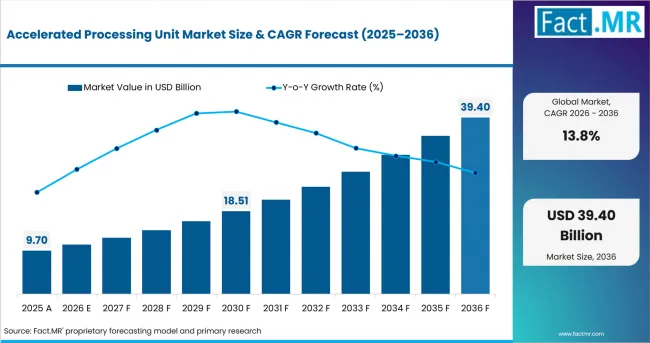
Accelerated Processing Unit Market Value Analysis

Metric Value
Industry Size 2026 USD 10.8 billion
Industry Value 2036 USD 39.4 billion
CAGR 2026 to 2036 13.8%

Summary of the Accelerated Processing Unit Market

  • Demand Drivers in the Market
    • AI PC Demand: PC OEMs use APUs with local acceleration to support on-device AI workloads.
    • Gaming Performance: Console and handheld gaming makers use APUs to balance graphics and power use.
    • Data Movement Control: Data center users adopt integrated CPU-GPU platforms to reduce memory-transfer friction.
  • Key Segments Analyzed
    • By Product Type: Laptop APUs are expected to hold 38.0% share in 2026 because notebook platforms need integrated graphics and AI acceleration.
    • By Architecture: x86-based APUs lead because established PC platforms use them across notebooks and desktops. The segment is likely to account for 52.0% share in 2026.
    • By Application: Personal computing is projected to hold 43.0% share in 2026 because laptops and desktops form the main APU demand base.
    • By End User: PC OEMs lead as notebook and desktop brands buy APUs for high-volume platforms. The segment is anticipated to capture 46.0% share in 2026.
    • By Sales Channel: OEM supply is expected to hold 68.0% share in 2026 because most APUs are sold through system manufacturers.
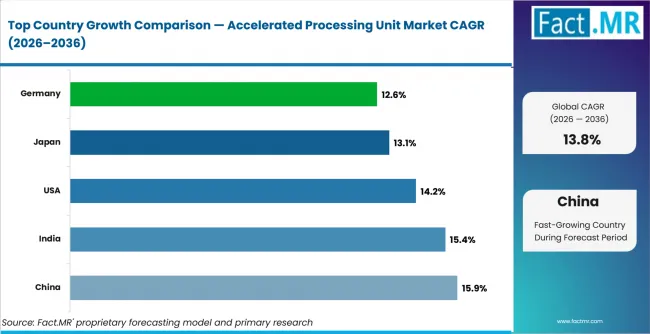
    • By Geography: China is projected to record 15.9% CAGR from 2026 to 2036 as local PC production and AI-enabled device demand expand.
  • Analyst Opinion at Fact.MR
    • Shambhu Nath Jha, Principal Consultant at Fact.MR, states, “Accelerated processing units are becoming part of full platform design. PC makers and data center users need lower data movement and better local acceleration. Suppliers that connect compute power with graphics and AI engines will gain stronger platform access.”
  • Strategic Implications
    • Platform Design: Chipmakers need APUs that balance CPU throughput with graphics and AI acceleration.
    • OEM Coordination: PC brands should align thermal design with processor power and graphics needs.
    • Software Support: Developers need drivers and frameworks that help workloads use integrated compute engines.

Accelerated processing unit demand is becoming more platform-led. PC OEMs need processors that can combine everyday computing with graphics and AI tasks. AMD reported record 2025 Client business revenue of USD 10.6 billion, driven by demand for Ryzen processors and a richer product mix. [1] This supports wider demand for high-performance client processors with stronger integrated capabilities.

China is projected to record 15.9% CAGR from 2026 to 2036 as local PC production and AI-enabled device demand expand. India is likely to post 15.4% CAGR by 2036 because laptop demand and digital device manufacturing grow. The United States is expected to register 14.2% CAGR over the study period as AI PCs and data center APUs gain deeper use. Japan is forecast to advance at 13.1% CAGR through 2036 because gaming devices and embedded systems support steady demand. Germany is set to record 12.6% CAGR as industrial computing and automotive electronics support adoption.

Segmental Analysis

Accelerated Processing Unit Market Analysis by Product Type

Accelerated Processing Unit Market Analysis By Product Type

Laptop APUs are expected to hold 38.0% share in 2026 because notebook platforms need integrated graphics and AI acceleration. Thin laptops need processors that support graphics and local AI tasks without requiring discrete GPUs. Desktop APUs serve entry-level and compact PCs. Data center APUs support HPC and AI workloads through tighter CPU-GPU integration. Embedded APUs serve industrial and edge systems. Console and gaming APUs remain important because gaming devices need graphics performance in compact thermal envelopes. AMD launched Ryzen AI 300 Series processors in 2024 for elite ultrathin laptops with Zen 5 CPU cores and a dedicated AI engine. [2]

  • Notebook Base: Laptop APUs support graphics and AI acceleration in compact PC designs.
  • Data Center Use: Data center APUs reduce CPU-GPU data movement in HPC and AI workloads.
  • Gaming Fit: Console and handheld APUs balance graphics performance with power limits.

Accelerated Processing Unit Market Analysis by Architecture

Accelerated Processing Unit Market Analysis By Architecture

x86-based APUs lead because established PC platforms use them across notebooks and desktops. Windows PC brands and gaming device makers rely heavily on x86 software compatibility. ARM-based integrated SoCs are gaining attention in thin laptops because they offer power-efficient compute and integrated AI engines. The x86-based APU segment is likely to account for 52.0% share in 2026 as current PC demand remains tied to x86 ecosystems. Heterogeneous CPU-GPU APUs support workloads that need shared memory and fast data access.

  • Software Base: x86 APUs benefit from wide PC application compatibility.
  • Power Focus: ARM-based integrated SoCs support thin devices and longer battery life.
  • AI Integration: AI-enabled APUs add local acceleration for new PC workloads.

Accelerated Processing Unit Market Analysis by Application

Accelerated Processing Unit Market Analysis By Application

Personal computing is projected to hold 43.0% share in 2026 because laptops and desktops form the main APU demand base. PC users need everyday performance and better battery life. Gaming systems follow because consoles and handheld devices rely on integrated compute and graphics. AI PCs are rising as local inference becomes part of device marketing. Edge computing uses APUs where compact systems need graphics or AI capability. High-performance computing uses selected data center APUs that combine CPU and GPU resources in one package. Application demand depends on software readiness and thermal design.

  • PC Performance: Personal computing uses APUs for everyday speed and integrated graphics.
  • Gaming Systems: Consoles and handheld devices rely on compact CPU-GPU integration.
  • Edge Compute: Edge systems use APUs when local graphics and AI processing are needed.

Accelerated Processing Unit Market Analysis by End User

Accelerated Processing Unit Market Analysis By End User

PC OEMs lead as notebook and desktop brands buy APUs for high-volume platforms. These companies select processors based on power use and platform cost. The segment is anticipated to capture 46.0% share in 2026 because client systems remain the major APU outlet. Consumer electronics brands use APUs in gaming systems and media devices. Data center operators adopt data center APUs for HPC and AI workloads.

  • PC Platform: PC OEMs use APUs to balance cost and battery life.
  • Data Center Use: Data center operators adopt APUs for unified CPU-GPU compute.
  • Industrial Systems: Integrators use embedded APUs for automation and visual workloads.

Accelerated Processing Unit Market Analysis by Sales Channel

Accelerated Processing Unit Market Analysis By Sales Channel

OEM supply is expected to hold 68.0% share in 2026 because most APUs are sold through system manufacturers. AMD stated in its 2026 Form 10-K that its client and gaming customers primarily include PC OEMs and independent distributors, with OEM customers covering servers and game consoles [3]. Laptop and embedded device brands buy processors before final system assembly. Retail component sales serve desktop builders and gaming users.

  • OEM Fitment: OEM supply dominates because APUs are selected during system design.
  • Retail Builds: Retail component sales serve desktop and gaming PC builders.
  • Embedded Access: Module distribution supports industrial and automotive system designers.

Accelerated Processing Unit Market Drivers, Restraints, and Opportunities

Accelerated Processing Unit Market Opportunity Matrix Growth Vs Value

AI PCs and integrated graphics demand are the main drivers for accelerated processing units. Qualcomm reported fiscal 2025 results and noted strong performance across automotive and IoT revenue, areas that rely on connected and efficient computing platforms. [4] APUs benefit as device makers seek processors that combine CPU and local acceleration. PC brands also use integrated processors to reduce discrete component needs in thin devices.

Memory bandwidth and thermal limits can restrain adoption. Integrated processors must share power and memory across compute engines. Heavy graphics workloads may still require discrete GPUs. Data center APUs need strong software support before users can shift major workloads. OEMs also need careful cooling design because compact systems can limit sustained performance.

Opportunities in the Accelerated Processing Unit Market

  • AI PCs: Chipmakers can target notebooks that need local inference and power-efficient performance.
  • Handheld Gaming: APU suppliers can support portable devices that need graphics in tight thermal envelopes.
  • Embedded Vision: Industrial suppliers can use APUs for compact systems running vision and control workloads.

Regional Analysis

Based on regional analysis, the accelerated processing unit market is segmented into North America, Latin America, Western Europe, Eastern Europe, East Asia, South Asia and Pacific, and Middle East and Africa.

Top Country Growth Comparison Accelerated Processing Unit Market Cagr (2026 2036)

Country CAGR (2026 to 2036)
China 15.9%
India 15.4%
United States 14.2%
Japan 13.1%
Germany 12.6%

Accelerated Processing Unit Market Cagr Analysis By Country

East Asia Accelerated Processing Unit Market Analysis

Accelerated Processing Unit Market Japan Market Share Analysis By Product Type

East Asia demand comes from PC manufacturing and electronics production. China leads regional demand because local PC brands and device makers need integrated processors for AI-ready notebooks and compact computing. Japan has steadier demand through gaming systems and industrial devices.

  • China: China is projected to record 15.9% CAGR through 2036 as local PC production and AI-enabled device demand expand. Notebook makers need APUs that balance graphics performance and power use. Gaming handhelds and mini PCs create additional demand. Embedded system suppliers use integrated processors for industrial and retail devices. Local OEMs will favor processors with stable supply and strong driver support.
  • Japan: Japan has a strong base in gaming hardware and compact electronics. Embedded device makers need processors that can handle graphics and control workloads. Japan is forecast to post 13.1% CAGR from 2026 to 2036 because gaming devices and embedded systems support steady demand. Console design cycles will shape large order timing. Industrial electronics users value reliability and long product support.

South Asia and North America Accelerated Processing Unit Market Analysis

Accelerated Processing Unit Market Country Value Analysis

South Asia has faster headroom because PC penetration and local electronics assembly are expanding. India leads this group through laptop demand and digital device manufacturing. North America has deeper demand from AI PCs and data center APUs. The United States benefits from semiconductor design ecosystems and enterprise computing demand.

  • India: India is likely to post 15.4% CAGR from 2026 to 2036 as laptop demand and digital device manufacturing grow. Education and online work support notebook shipments. Local assembly programs can raise OEM demand for APUs. Price sensitivity will favor processors that reduce the need for discrete graphics. Gaming laptops and compact PCs add higher-value demand. Suppliers with local OEM partnerships and affordable platform designs will gain stronger adoption.
  • United States: The United States is expected to register 14.2% CAGR during 2026 to 2036 as AI PCs and data center APUs gain deeper use. PC makers need integrated processors that support local AI workloads. Data center teams are evaluating CPU-GPU integration for HPC and AI workflows.

Western Europe Accelerated Processing Unit Market Analysis

Accelerated Processing Unit Market Europe Country Market Share Analysis, 2026 & 2036

Western Europe demand comes from enterprise PCs and automotive electronics. Germany leads the regional view because industrial system makers and vehicle electronics suppliers need compact processors with graphics and AI capability. Sustainability and energy use also influence processor selection in business PCs and edge devices.

  • Germany: Germany is forecast to advance at 12.6% CAGR from 2026 to 2036 because industrial computing and automotive electronics support adoption. Factory automation systems use APUs for machine vision and control tasks. Automotive electronics suppliers need integrated processors for infotainment and cockpit workloads. Enterprise PC refreshes support AI-ready notebook demand.

Competitive Aligners for Market Suppliers

Accelerated Processing Unit Market Analysis By Company

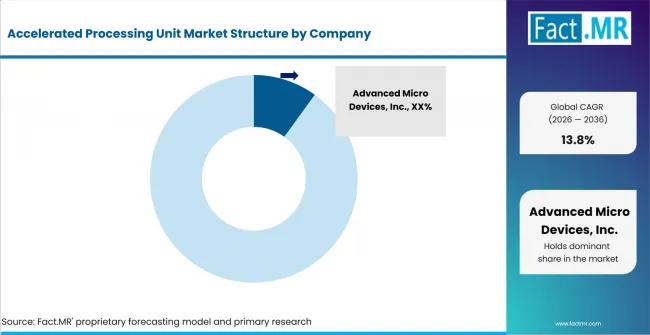
The accelerated processing unit market includes processor companies that combine CPU power with graphics and AI acceleration. Advanced Micro Devices, Inc. has a clear position in APUs across client devices and data center workloads. Intel Corporation competes through Core Ultra processors with integrated graphics and AI acceleration.

Apple Inc. competes through M-series integrated SoCs used across Macs and iPads. NVIDIA Corporation supports the wider integrated compute market through GPU-led platforms and accelerated computing systems. AMD’s MI300A product page describes the processor as an APU that combines AMD CPU cores and GPUs for HPC and AI convergence. This shows how APU positioning is expanding beyond PCs into advanced computing workloads.

Through 2036, competition will depend on power efficiency and software support. Processor suppliers need more than faster hardware. OEMs will look for stable drivers and platform reliability. Companies that align CPU and memory design with strong software ecosystems will gain better design wins.

Key Companies in Accelerated Processing Unit Market

  • Advanced Micro Devices, Inc.
  • Intel Corporation
  • Qualcomm Incorporated
  • Apple Inc.
  • NVIDIA Corporation

Bibliography

  • [1] Advanced Micro Devices, Inc. (2026, February 3). AMD reports fourth quarter and full year 2025 financial results. Advanced Micro Devices, Inc.
  • [2] Advanced Micro Devices, Inc. (2024, June 2). AMD unveils next-gen “Zen 5” Ryzen processors to power advanced AI experiences. Advanced Micro Devices, Inc.
  • [3] Advanced Micro Devices, Inc. (2026, February 4). Form 10-K for the fiscal year ended December 27, 2025. U.S. Securities and Exchange Commission.
  • [4] Qualcomm Incorporated. (2025, November). Qualcomm announces fourth quarter and fiscal 2025 results. Qualcomm Incorporated.

This Report Addresses

  • Strategic intelligence on accelerated processing unit demand across product type, architecture, application, end user, and sales channel.
  • Forecast mapping from USD 10.8 billion in 2026 to USD 39.4 billion by 2036.
  • Segment analysis covering laptop APUs, x86-based APUs, personal computing, PC OEMs, and OEM supply.
  • Regional outlook covering China, India, the United States, Japan, and Germany.
  • Competitive analysis of Advanced Micro Devices, Inc., Intel Corporation, Qualcomm Incorporated, Apple Inc., NVIDIA Corporation.
  • Product assessment covering desktop APUs, laptop APUs, data center APUs, embedded APUs, and console and gaming APUs.
  • Architecture assessment covering x86-based APUs, ARM-based integrated SoCs, heterogeneous CPU-GPU APUs, and AI-integrated APUs.
  • Primary interviews, supplier checks, official source review, and semiconductor platform validation support the forecast.

Accelerated Processing Unit Market Definition

The accelerated processing unit market covers processors that integrate central processing and graphics processing functions within the same package or system design. The market includes APUs used in personal computers and selected data center platforms. It differs from discrete CPU and GPU markets because compute and graphics functions are packaged closer together for power and data-flow efficiency.

Accelerated Processing Unit Market Inclusions

The scope includes desktop and data center APUs. It includes x86-based and ARM-based integrated compute platforms that combine CPU and GPU functions. AI-integrated processors are included when they combine CPU and local acceleration within the same platform. OEM and retail component sales are included.

Accelerated Processing Unit Market Exclusions

The scope excludes standalone CPUs that do not include graphics or accelerator functions. Discrete GPUs are excluded unless they are sold as part of an integrated APU platform. General AI accelerators are outside scope when they do not combine CPU and GPU compute. Smartphone-only chipsets are excluded unless positioned for PC or edge computing use.

Accelerated Processing Unit Market Research Methodology

  • Primary Research
    • Primary research includes interviews with PC platform managers and semiconductor distribution heads. It includes input from embedded system designers and gaming hardware product teams.
  • Desk Research
    • Desk research reviews processor launch materials and annual reports. It covers PC platform updates and data center accelerator documentation.
  • Market-Sizing and Forecasting
    • Forecasting uses product type demand and architecture mix. Application adoption and sales channel movement support the market assessment.
  • Data Validation and Update Cycle
    • Forecasts are validated through supplier checks and OEM feedback. Processor launch cycles and PC shipment signals help confirm market direction.

Scope of the Report

Accelerated Processing Unit Market Breakdown By Product Type, Architecture, And Region

Attribute Details
Quantitative Units USD 10.8 billion in 2026 to USD 39.4 billion by 2036 at 13.8% CAGR
Market Definition Processors that integrate CPU and graphics functions within the same package or system design
Product Type Desktop APUs, Laptop APUs, Data Center APUs, Embedded APUs, Console and Gaming APUs
Architecture x86-Based APUs, ARM-Based Integrated SoCs, Heterogeneous CPU-GPU APUs, AI-Integrated APUs
Application Personal Computing, Gaming Systems, AI PCs, Edge Computing, High-Performance Computing
End User Consumer Electronics Brands, PC OEMs, Data Center Operators, Automotive Electronics Suppliers, Industrial System Integrators
Sales Channel OEM Supply, Retail Component Sales, Enterprise Procurement, Embedded Module Distribution, Cloud and HPC Platform Supply
Regions Covered North America, Latin America, Western Europe, Eastern Europe, East Asia, South Asia and Pacific, Middle East and Africa
Countries Covered China, India, United States, Japan, Germany
Key Companies Profiled Advanced Micro Devices, Inc., Intel Corporation, Qualcomm Incorporated, Apple Inc., NVIDIA Corporation
Forecast Period 2026 to 2036
Approach Hybrid top-down and bottom-up approach using product type demand, architecture mix, application movement, end-user demand, sales channel structure, and regional validation

Accelerated Processing Unit Market Analysis by Segments

  • By Product Type:

    • Desktop APUs
    • Laptop APUs
    • Data Center APUs
    • Embedded APUs
    • Console and Gaming APUs
  • By Architecture:

    • x86-Based APUs
    • ARM-Based Integrated SoCs
    • Heterogeneous CPU-GPU APUs
    • AI-Integrated APUs
  • By Application:

    • Personal Computing
    • Gaming Systems
    • AI PCs
    • Edge Computing
    • High-Performance Computing
  • By End User:

    • Consumer Electronics Brands
    • PC OEMs
    • Data Center Operators
    • Automotive Electronics Suppliers
    • Industrial System Integrators
  • By Sales Channel:

    • OEM Supply
    • Retail Component Sales
    • Enterprise Procurement
    • Embedded Module Distribution
    • Cloud and HPC Platform Supply
  • Region:

    • North America
      • United States
      • Canada
    • Europe
      • Germany
      • United Kingdom
      • France
      • Italy
      • Spain
    • Asia Pacific
      • China
      • Japan
      • South Korea
      • Taiwan
      • Singapore
    • Latin America
      • Brazil
      • Mexico
      • Argentina
    • Middle East & Africa
      • GCC Countries
      • South Africa
      • Israel

- Frequently Asked Questions -

What is the Accelerated Processing Unit Market size in 2026?

The accelerated processing unit market is estimated to reach USD 10.8 billion in 2026 as AI PCs and integrated computing platforms expand.

What will the Accelerated Processing Unit Market be worth by 2036?

The accelerated processing unit market is projected to reach USD 39.4 billion by 2036.

What CAGR is projected for the Accelerated Processing Unit Market?

The accelerated processing unit market is forecast to record 13.8% CAGR during 2026 to 2036.

Which product type leads the Accelerated Processing Unit Market?

Laptop APUs lead with 38.0% share in 2026 because notebook platforms need integrated graphics and AI acceleration.

Which country expands fastest in the Accelerated Processing Unit Market?

China is projected to record 15.9% CAGR from 2026 to 2036 as local PC production and AI-enabled device demand expand.

How does India perform in the Accelerated Processing Unit Market?

India is likely to post 15.4% CAGR from 2026 to 2036 as laptop demand and digital device manufacturing grow.

How does the United States perform in the Accelerated Processing Unit Market?

The United States is forecast to register 14.2% CAGR from 2026 to 2036 as AI PCs and data center APUs gain deeper use.

What is the primary driver in the Accelerated Processing Unit Market?

The primary driver is integrated compute demand. Device makers need CPU and AI acceleration in compact platforms.

What is the main restraint in the Accelerated Processing Unit Market?

The main restraint is thermal constraints in compact systems. Compact systems can limit sustained performance across shared compute engines.

Why is OEM supply important in the Accelerated Processing Unit Market?

OEM supply is important because APUs are usually selected during system design and purchased by device manufacturers.

Table of Content

  1. Executive Summary
    • Global Market Outlook
    • Demand to side Trends
    • Supply to side Trends
    • Technology Roadmap Analysis
    • Analysis and Recommendations
  2. Market Overview
    • Market Coverage / Taxonomy
    • Market Definition / Scope / Limitations
  3. Research Methodology
    • Chapter Orientation
    • Analytical Lens and Working Hypotheses
      • Market Structure, Signals, and Trend Drivers
      • Benchmarking and Cross-market Comparability
      • Market Sizing, Forecasting, and Opportunity Mapping
    • Research Design and Evidence Framework
      • Desk Research Programme (Secondary Evidence)
        • Company Annual and Sustainability Reports
        • Peer-reviewed Journals and Academic Literature
        • Corporate Websites, Product Literature, and Technical Notes
        • Earnings Decks and Investor Briefings
        • Statutory Filings and Regulatory Disclosures
        • Technical White Papers and Standards Notes
        • Trade Journals, Industry Magazines, and Analyst Briefs
        • Conference Proceedings, Webinars, and Seminar Materials
        • Government Statistics Portals and Public Data Releases
        • Press Releases and Reputable Media Coverage
        • Specialist Newsletters and Curated Briefings
        • Sector Databases and Reference Repositories
        • Fact.MR Internal Proprietary Databases and Historical Market Datasets
        • Subscription Datasets and Paid Sources
        • Social Channels, Communities, and Digital Listening Inputs
        • Additional Desk Sources
      • Expert Input and Fieldwork (Primary Evidence)
        • Primary Modes
          • Qualitative Interviews and Expert Elicitation
          • Quantitative Surveys and Structured Data Capture
          • Blended Approach
        • Why Primary Evidence is Used
        • Field Techniques
          • Interviews
          • Surveys
          • Focus Groups
          • Observational and In-context Research
          • Social and Community Interactions
        • Stakeholder Universe Engaged
          • C-suite Leaders
          • Board Members
          • Presidents and Vice Presidents
          • R&D and Innovation Heads
          • Technical Specialists
          • Domain Subject-matter Experts
          • Scientists
          • Physicians and Other Healthcare Professionals
        • Governance, Ethics, and Data Stewardship
          • Research Ethics
          • Data Integrity and Handling
      • Tooling, Models, and Reference Databases
    • Data Engineering and Model Build
      • Data Acquisition and Ingestion
      • Cleaning, Normalisation, and Verification
      • Synthesis, Triangulation, and Analysis
    • Quality Assurance and Audit Trail
  4. Market Background
    • Market Dynamics
      • Drivers
      • Restraints
      • Opportunity
      • Trends
    • Scenario Forecast
      • Demand in Optimistic Scenario
      • Demand in Likely Scenario
      • Demand in Conservative Scenario
    • Opportunity Map Analysis
    • Product Life Cycle Analysis
    • Supply Chain Analysis
    • Investment Feasibility Matrix
    • Value Chain Analysis
    • PESTLE and Porter’s Analysis
    • Regulatory Landscape
    • Regional Parent Market Outlook
    • Production and Consumption Statistics
    • Import and Export Statistics
  5. Global Market Analysis 2021 to 2025 and Forecast, 2026 to 2036
    • Historical Market Size Value (USD Million) Analysis, 2021 to 2025
    • Current and Future Market Size Value (USD Million) Projections, 2026 to 2036
      • Y to o to Y Growth Trend Analysis
      • Absolute $ Opportunity Analysis
  6. Global Market Pricing Analysis 2021 to 2025 and Forecast 2026 to 2036
  7. Global Market Analysis 2021 to 2025 and Forecast 2026 to 2036, By Product Type
    • Introduction / Key Findings
    • Historical Market Size Value (USD Million) Analysis By Product Type , 2021 to 2025
    • Current and Future Market Size Value (USD Million) Analysis and Forecast By Product Type , 2026 to 2036
      • Laptop APUs
      • Desktop APUs
      • Data Center APUs
    • Y to o to Y Growth Trend Analysis By Product Type , 2021 to 2025
    • Absolute $ Opportunity Analysis By Product Type , 2026 to 2036
  8. Global Market Analysis 2021 to 2025 and Forecast 2026 to 2036, By Architecture
    • Introduction / Key Findings
    • Historical Market Size Value (USD Million) Analysis By Architecture, 2021 to 2025
    • Current and Future Market Size Value (USD Million) Analysis and Forecast By Architecture, 2026 to 2036
      • x86-Based APUs
      • ARM-Based Integrated SoCs
      • AI-Integrated APUs
    • Y to o to Y Growth Trend Analysis By Architecture, 2021 to 2025
    • Absolute $ Opportunity Analysis By Architecture, 2026 to 2036
  9. Global Market Analysis 2021 to 2025 and Forecast 2026 to 2036, By Application
    • Introduction / Key Findings
    • Historical Market Size Value (USD Million) Analysis By Application, 2021 to 2025
    • Current and Future Market Size Value (USD Million) Analysis and Forecast By Application, 2026 to 2036
      • Personal Computing
      • Gaming Systems
      • AI PCs
    • Y to o to Y Growth Trend Analysis By Application, 2021 to 2025
    • Absolute $ Opportunity Analysis By Application, 2026 to 2036
  10. Global Market Analysis 2021 to 2025 and Forecast 2026 to 2036, By End User
    • Introduction / Key Findings
    • Historical Market Size Value (USD Million) Analysis By End User, 2021 to 2025
    • Current and Future Market Size Value (USD Million) Analysis and Forecast By End User, 2026 to 2036
      • PC OEMs
      • Data Center Operators
      • Automotive Electronics Suppliers
    • Y to o to Y Growth Trend Analysis By End User, 2021 to 2025
    • Absolute $ Opportunity Analysis By End User, 2026 to 2036
  11. Global Market Analysis 2021 to 2025 and Forecast 2026 to 2036, By Sales Channel
    • Introduction / Key Findings
    • Historical Market Size Value (USD Million) Analysis By Sales Channel, 2021 to 2025
    • Current and Future Market Size Value (USD Million) Analysis and Forecast By Sales Channel, 2026 to 2036
      • OEM Supply
      • Retail Component Sales
      • Enterprise Procurement
    • Y to o to Y Growth Trend Analysis By Sales Channel, 2021 to 2025
    • Absolute $ Opportunity Analysis By Sales Channel, 2026 to 2036
  12. Global Market Analysis 2021 to 2025 and Forecast 2026 to 2036, By Region
    • Introduction
    • Historical Market Size Value (USD Million) Analysis By Region, 2021 to 2025
    • Current Market Size Value (USD Million) Analysis and Forecast By Region, 2026 to 2036
      • North America
      • Latin America
      • Western Europe
      • Eastern Europe
      • East Asia
      • South Asia and Pacific
      • Middle East & Africa
    • Market Attractiveness Analysis By Region
  13. North America Market Analysis 2021 to 2025 and Forecast 2026 to 2036, By Country
    • Historical Market Size Value (USD Million) Trend Analysis By Market Taxonomy, 2021 to 2025
    • Market Size Value (USD Million) Forecast By Market Taxonomy, 2026 to 2036
      • By Country
        • USA
        • Canada
        • Mexico
      • By Product Type
      • By Architecture
      • By Application
      • By End User
      • By Sales Channel
    • Market Attractiveness Analysis
      • By Country
      • By Product Type
      • By Architecture
      • By Application
      • By End User
      • By Sales Channel
    • Key Takeaways
  14. Latin America Market Analysis 2021 to 2025 and Forecast 2026 to 2036, By Country
    • Historical Market Size Value (USD Million) Trend Analysis By Market Taxonomy, 2021 to 2025
    • Market Size Value (USD Million) Forecast By Market Taxonomy, 2026 to 2036
      • By Country
        • Brazil
        • Chile
        • Rest of Latin America
      • By Product Type
      • By Architecture
      • By Application
      • By End User
      • By Sales Channel
    • Market Attractiveness Analysis
      • By Country
      • By Product Type
      • By Architecture
      • By Application
      • By End User
      • By Sales Channel
    • Key Takeaways
  15. Western Europe Market Analysis 2021 to 2025 and Forecast 2026 to 2036, By Country
    • Historical Market Size Value (USD Million) Trend Analysis By Market Taxonomy, 2021 to 2025
    • Market Size Value (USD Million) Forecast By Market Taxonomy, 2026 to 2036
      • By Country
        • Germany
        • UK
        • Italy
        • Spain
        • France
        • Nordic
        • BENELUX
        • Rest of Western Europe
      • By Product Type
      • By Architecture
      • By Application
      • By End User
      • By Sales Channel
    • Market Attractiveness Analysis
      • By Country
      • By Product Type
      • By Architecture
      • By Application
      • By End User
      • By Sales Channel
    • Key Takeaways
  16. Eastern Europe Market Analysis 2021 to 2025 and Forecast 2026 to 2036, By Country
    • Historical Market Size Value (USD Million) Trend Analysis By Market Taxonomy, 2021 to 2025
    • Market Size Value (USD Million) Forecast By Market Taxonomy, 2026 to 2036
      • By Country
        • Russia
        • Poland
        • Hungary
        • Balkan & Baltic
        • Rest of Eastern Europe
      • By Product Type
      • By Architecture
      • By Application
      • By End User
      • By Sales Channel
    • Market Attractiveness Analysis
      • By Country
      • By Product Type
      • By Architecture
      • By Application
      • By End User
      • By Sales Channel
    • Key Takeaways
  17. East Asia Market Analysis 2021 to 2025 and Forecast 2026 to 2036, By Country
    • Historical Market Size Value (USD Million) Trend Analysis By Market Taxonomy, 2021 to 2025
    • Market Size Value (USD Million) Forecast By Market Taxonomy, 2026 to 2036
      • By Country
        • China
        • Japan
        • South Korea
      • By Product Type
      • By Architecture
      • By Application
      • By End User
      • By Sales Channel
    • Market Attractiveness Analysis
      • By Country
      • By Product Type
      • By Architecture
      • By Application
      • By End User
      • By Sales Channel
    • Key Takeaways
  18. South Asia and Pacific Market Analysis 2021 to 2025 and Forecast 2026 to 2036, By Country
    • Historical Market Size Value (USD Million) Trend Analysis By Market Taxonomy, 2021 to 2025
    • Market Size Value (USD Million) Forecast By Market Taxonomy, 2026 to 2036
      • By Country
        • India
        • ASEAN
        • Australia & New Zealand
        • Rest of South Asia and Pacific
      • By Product Type
      • By Architecture
      • By Application
      • By End User
      • By Sales Channel
    • Market Attractiveness Analysis
      • By Country
      • By Product Type
      • By Architecture
      • By Application
      • By End User
      • By Sales Channel
    • Key Takeaways
  19. Middle East & Africa Market Analysis 2021 to 2025 and Forecast 2026 to 2036, By Country
    • Historical Market Size Value (USD Million) Trend Analysis By Market Taxonomy, 2021 to 2025
    • Market Size Value (USD Million) Forecast By Market Taxonomy, 2026 to 2036
      • By Country
        • Kingdom of Saudi Arabia
        • Other GCC Countries
        • Turkiye
        • South Africa
        • Other African Union
        • Rest of Middle East & Africa
      • By Product Type
      • By Architecture
      • By Application
      • By End User
      • By Sales Channel
    • Market Attractiveness Analysis
      • By Country
      • By Product Type
      • By Architecture
      • By Application
      • By End User
      • By Sales Channel
    • Key Takeaways
  20. Key Countries Market Analysis
    • USA
      • Pricing Analysis
      • Market Share Analysis, 2025
        • By Product Type
        • By Architecture
        • By Application
        • By End User
        • By Sales Channel
    • Canada
      • Pricing Analysis
      • Market Share Analysis, 2025
        • By Product Type
        • By Architecture
        • By Application
        • By End User
        • By Sales Channel
    • Mexico
      • Pricing Analysis
      • Market Share Analysis, 2025
        • By Product Type
        • By Architecture
        • By Application
        • By End User
        • By Sales Channel
    • Brazil
      • Pricing Analysis
      • Market Share Analysis, 2025
        • By Product Type
        • By Architecture
        • By Application
        • By End User
        • By Sales Channel
    • Chile
      • Pricing Analysis
      • Market Share Analysis, 2025
        • By Product Type
        • By Architecture
        • By Application
        • By End User
        • By Sales Channel
    • Germany
      • Pricing Analysis
      • Market Share Analysis, 2025
        • By Product Type
        • By Architecture
        • By Application
        • By End User
        • By Sales Channel
    • UK
      • Pricing Analysis
      • Market Share Analysis, 2025
        • By Product Type
        • By Architecture
        • By Application
        • By End User
        • By Sales Channel
    • Italy
      • Pricing Analysis
      • Market Share Analysis, 2025
        • By Product Type
        • By Architecture
        • By Application
        • By End User
        • By Sales Channel
    • Spain
      • Pricing Analysis
      • Market Share Analysis, 2025
        • By Product Type
        • By Architecture
        • By Application
        • By End User
        • By Sales Channel
    • France
      • Pricing Analysis
      • Market Share Analysis, 2025
        • By Product Type
        • By Architecture
        • By Application
        • By End User
        • By Sales Channel
    • India
      • Pricing Analysis
      • Market Share Analysis, 2025
        • By Product Type
        • By Architecture
        • By Application
        • By End User
        • By Sales Channel
    • ASEAN
      • Pricing Analysis
      • Market Share Analysis, 2025
        • By Product Type
        • By Architecture
        • By Application
        • By End User
        • By Sales Channel
    • Australia & New Zealand
      • Pricing Analysis
      • Market Share Analysis, 2025
        • By Product Type
        • By Architecture
        • By Application
        • By End User
        • By Sales Channel
    • China
      • Pricing Analysis
      • Market Share Analysis, 2025
        • By Product Type
        • By Architecture
        • By Application
        • By End User
        • By Sales Channel
    • Japan
      • Pricing Analysis
      • Market Share Analysis, 2025
        • By Product Type
        • By Architecture
        • By Application
        • By End User
        • By Sales Channel
    • South Korea
      • Pricing Analysis
      • Market Share Analysis, 2025
        • By Product Type
        • By Architecture
        • By Application
        • By End User
        • By Sales Channel
    • Russia
      • Pricing Analysis
      • Market Share Analysis, 2025
        • By Product Type
        • By Architecture
        • By Application
        • By End User
        • By Sales Channel
    • Poland
      • Pricing Analysis
      • Market Share Analysis, 2025
        • By Product Type
        • By Architecture
        • By Application
        • By End User
        • By Sales Channel
    • Hungary
      • Pricing Analysis
      • Market Share Analysis, 2025
        • By Product Type
        • By Architecture
        • By Application
        • By End User
        • By Sales Channel
    • Kingdom of Saudi Arabia
      • Pricing Analysis
      • Market Share Analysis, 2025
        • By Product Type
        • By Architecture
        • By Application
        • By End User
        • By Sales Channel
    • Turkiye
      • Pricing Analysis
      • Market Share Analysis, 2025
        • By Product Type
        • By Architecture
        • By Application
        • By End User
        • By Sales Channel
    • South Africa
      • Pricing Analysis
      • Market Share Analysis, 2025
        • By Product Type
        • By Architecture
        • By Application
        • By End User
        • By Sales Channel
  21. Market Structure Analysis
    • Competition Dashboard
    • Competition Benchmarking
    • Market Share Analysis of Top Players
      • By Regional
      • By Product Type
      • By Architecture
      • By Application
      • By End User
      • By Sales Channel
  22. Competition Analysis
    • Competition Deep Dive
      • Advanced Micro Devices, Inc.
        • Overview
        • Product Portfolio
        • Profitability by Market Segments (Product/Age /Sales Channel/Region)
        • Sales Footprint
        • Strategy Overview
          • Marketing Strategy
          • Product Strategy
          • Channel Strategy
      • Intel Corporation
      • Qualcomm Incorporated
      • Apple Inc.
      • NVIDIA Corporation
  23. Assumptions & Acronyms Used

List Of Table

  • Table 1: Global Market Value (USD Million) Forecast by Region, 2021 to 2036
  • Table 2: Global Market Value (USD Million) Forecast by Product Type, 2021 to 2036
  • Table 3: Global Market Value (USD Million) Forecast by Architecture, 2021 to 2036
  • Table 4: Global Market Value (USD Million) Forecast by Application, 2021 to 2036
  • Table 5: Global Market Value (USD Million) Forecast by End User, 2021 to 2036
  • Table 6: Global Market Value (USD Million) Forecast by Sales Channel, 2021 to 2036
  • Table 7: North America Market Value (USD Million) Forecast by Country, 2021 to 2036
  • Table 8: North America Market Value (USD Million) Forecast by Product Type, 2021 to 2036
  • Table 9: North America Market Value (USD Million) Forecast by Architecture, 2021 to 2036
  • Table 10: North America Market Value (USD Million) Forecast by Application, 2021 to 2036
  • Table 11: North America Market Value (USD Million) Forecast by End User, 2021 to 2036
  • Table 12: North America Market Value (USD Million) Forecast by Sales Channel, 2021 to 2036
  • Table 13: Latin America Market Value (USD Million) Forecast by Country, 2021 to 2036
  • Table 14: Latin America Market Value (USD Million) Forecast by Product Type, 2021 to 2036
  • Table 15: Latin America Market Value (USD Million) Forecast by Architecture, 2021 to 2036
  • Table 16: Latin America Market Value (USD Million) Forecast by Application, 2021 to 2036
  • Table 17: Latin America Market Value (USD Million) Forecast by End User, 2021 to 2036
  • Table 18: Latin America Market Value (USD Million) Forecast by Sales Channel, 2021 to 2036
  • Table 19: Western Europe Market Value (USD Million) Forecast by Country, 2021 to 2036
  • Table 20: Western Europe Market Value (USD Million) Forecast by Product Type, 2021 to 2036
  • Table 21: Western Europe Market Value (USD Million) Forecast by Architecture, 2021 to 2036
  • Table 22: Western Europe Market Value (USD Million) Forecast by Application, 2021 to 2036
  • Table 23: Western Europe Market Value (USD Million) Forecast by End User, 2021 to 2036
  • Table 24: Western Europe Market Value (USD Million) Forecast by Sales Channel, 2021 to 2036
  • Table 25: Eastern Europe Market Value (USD Million) Forecast by Country, 2021 to 2036
  • Table 26: Eastern Europe Market Value (USD Million) Forecast by Product Type, 2021 to 2036
  • Table 27: Eastern Europe Market Value (USD Million) Forecast by Architecture, 2021 to 2036
  • Table 28: Eastern Europe Market Value (USD Million) Forecast by Application, 2021 to 2036
  • Table 29: Eastern Europe Market Value (USD Million) Forecast by End User, 2021 to 2036
  • Table 30: Eastern Europe Market Value (USD Million) Forecast by Sales Channel, 2021 to 2036
  • Table 31: East Asia Market Value (USD Million) Forecast by Country, 2021 to 2036
  • Table 32: East Asia Market Value (USD Million) Forecast by Product Type, 2021 to 2036
  • Table 33: East Asia Market Value (USD Million) Forecast by Architecture, 2021 to 2036
  • Table 34: East Asia Market Value (USD Million) Forecast by Application, 2021 to 2036
  • Table 35: East Asia Market Value (USD Million) Forecast by End User, 2021 to 2036
  • Table 36: East Asia Market Value (USD Million) Forecast by Sales Channel, 2021 to 2036
  • Table 37: South Asia and Pacific Market Value (USD Million) Forecast by Country, 2021 to 2036
  • Table 38: South Asia and Pacific Market Value (USD Million) Forecast by Product Type, 2021 to 2036
  • Table 39: South Asia and Pacific Market Value (USD Million) Forecast by Architecture, 2021 to 2036
  • Table 40: South Asia and Pacific Market Value (USD Million) Forecast by Application, 2021 to 2036
  • Table 41: South Asia and Pacific Market Value (USD Million) Forecast by End User, 2021 to 2036
  • Table 42: South Asia and Pacific Market Value (USD Million) Forecast by Sales Channel, 2021 to 2036
  • Table 43: Middle East & Africa Market Value (USD Million) Forecast by Country, 2021 to 2036
  • Table 44: Middle East & Africa Market Value (USD Million) Forecast by Product Type, 2021 to 2036
  • Table 45: Middle East & Africa Market Value (USD Million) Forecast by Architecture, 2021 to 2036
  • Table 46: Middle East & Africa Market Value (USD Million) Forecast by Application, 2021 to 2036
  • Table 47: Middle East & Africa Market Value (USD Million) Forecast by End User, 2021 to 2036
  • Table 48: Middle East & Africa Market Value (USD Million) Forecast by Sales Channel, 2021 to 2036

List Of Figures

  • Figure 1: Global Market Pricing Analysis
  • Figure 2: Global Market Value (USD Million) Forecast 2021-2036
  • Figure 3: Global Market Value Share and BPS Analysis by Product Type, 2026 and 2036
  • Figure 4: Global Market Y-o-Y Growth Comparison by Product Type, 2026 to 2036
  • Figure 5: Global Market Attractiveness Analysis by Product Type
  • Figure 6: Global Market Value Share and BPS Analysis by Architecture, 2026 and 2036
  • Figure 7: Global Market Y-o-Y Growth Comparison by Architecture, 2026 to 2036
  • Figure 8: Global Market Attractiveness Analysis by Architecture
  • Figure 9: Global Market Value Share and BPS Analysis by Application, 2026 and 2036
  • Figure 10: Global Market Y-o-Y Growth Comparison by Application, 2026 to 2036
  • Figure 11: Global Market Attractiveness Analysis by Application
  • Figure 12: Global Market Value Share and BPS Analysis by End User, 2026 and 2036
  • Figure 13: Global Market Y-o-Y Growth Comparison by End User, 2026 to 2036
  • Figure 14: Global Market Attractiveness Analysis by End User
  • Figure 15: Global Market Value Share and BPS Analysis by Sales Channel, 2026 and 2036
  • Figure 16: Global Market Y-o-Y Growth Comparison by Sales Channel, 2026 to 2036
  • Figure 17: Global Market Attractiveness Analysis by Sales Channel
  • Figure 18: Global Market Value (USD Million) Share and BPS Analysis by Region, 2026 and 2036
  • Figure 19: Global Market Y-o-Y Growth Comparison by Region, 2026 to 2036
  • Figure 20: Global Market Attractiveness Analysis by Region
  • Figure 21: North America Market Incremental Dollar Opportunity, 2026 to 2036
  • Figure 22: Latin America Market Incremental Dollar Opportunity, 2026 to 2036
  • Figure 23: Western Europe Market Incremental Dollar Opportunity, 2026 to 2036
  • Figure 24: Eastern Europe Market Incremental Dollar Opportunity, 2026 to 2036
  • Figure 25: East Asia Market Incremental Dollar Opportunity, 2026 to 2036
  • Figure 26: South Asia and Pacific Market Incremental Dollar Opportunity, 2026 to 2036
  • Figure 27: Middle East & Africa Market Incremental Dollar Opportunity, 2026 to 2036
  • Figure 28: North America Market Value Share and BPS Analysis by Country, 2026 and 2036
  • Figure 29: North America Market Value Share and BPS Analysis by Product Type, 2026 and 2036
  • Figure 30: North America Market Y-o-Y Growth Comparison by Product Type, 2026 to 2036
  • Figure 31: North America Market Attractiveness Analysis by Product Type
  • Figure 32: North America Market Value Share and BPS Analysis by Architecture, 2026 and 2036
  • Figure 33: North America Market Y-o-Y Growth Comparison by Architecture, 2026 to 2036
  • Figure 34: North America Market Attractiveness Analysis by Architecture
  • Figure 35: North America Market Value Share and BPS Analysis by Application, 2026 and 2036
  • Figure 36: North America Market Y-o-Y Growth Comparison by Application, 2026 to 2036
  • Figure 37: North America Market Attractiveness Analysis by Application
  • Figure 38: North America Market Value Share and BPS Analysis by End User, 2026 and 2036
  • Figure 39: North America Market Y-o-Y Growth Comparison by End User, 2026 to 2036
  • Figure 40: North America Market Attractiveness Analysis by End User
  • Figure 41: North America Market Value Share and BPS Analysis by Sales Channel, 2026 and 2036
  • Figure 42: North America Market Y-o-Y Growth Comparison by Sales Channel, 2026 to 2036
  • Figure 43: North America Market Attractiveness Analysis by Sales Channel
  • Figure 44: Latin America Market Value Share and BPS Analysis by Country, 2026 and 2036
  • Figure 45: Latin America Market Value Share and BPS Analysis by Product Type, 2026 and 2036
  • Figure 46: Latin America Market Y-o-Y Growth Comparison by Product Type, 2026 to 2036
  • Figure 47: Latin America Market Attractiveness Analysis by Product Type
  • Figure 48: Latin America Market Value Share and BPS Analysis by Architecture, 2026 and 2036
  • Figure 49: Latin America Market Y-o-Y Growth Comparison by Architecture, 2026 to 2036
  • Figure 50: Latin America Market Attractiveness Analysis by Architecture
  • Figure 51: Latin America Market Value Share and BPS Analysis by Application, 2026 and 2036
  • Figure 52: Latin America Market Y-o-Y Growth Comparison by Application, 2026 to 2036
  • Figure 53: Latin America Market Attractiveness Analysis by Application
  • Figure 54: Latin America Market Value Share and BPS Analysis by End User, 2026 and 2036
  • Figure 55: Latin America Market Y-o-Y Growth Comparison by End User, 2026 to 2036
  • Figure 56: Latin America Market Attractiveness Analysis by End User
  • Figure 57: Latin America Market Value Share and BPS Analysis by Sales Channel, 2026 and 2036
  • Figure 58: Latin America Market Y-o-Y Growth Comparison by Sales Channel, 2026 to 2036
  • Figure 59: Latin America Market Attractiveness Analysis by Sales Channel
  • Figure 60: Western Europe Market Value Share and BPS Analysis by Country, 2026 and 2036
  • Figure 61: Western Europe Market Value Share and BPS Analysis by Product Type, 2026 and 2036
  • Figure 62: Western Europe Market Y-o-Y Growth Comparison by Product Type, 2026 to 2036
  • Figure 63: Western Europe Market Attractiveness Analysis by Product Type
  • Figure 64: Western Europe Market Value Share and BPS Analysis by Architecture, 2026 and 2036
  • Figure 65: Western Europe Market Y-o-Y Growth Comparison by Architecture, 2026 to 2036
  • Figure 66: Western Europe Market Attractiveness Analysis by Architecture
  • Figure 67: Western Europe Market Value Share and BPS Analysis by Application, 2026 and 2036
  • Figure 68: Western Europe Market Y-o-Y Growth Comparison by Application, 2026 to 2036
  • Figure 69: Western Europe Market Attractiveness Analysis by Application
  • Figure 70: Western Europe Market Value Share and BPS Analysis by End User, 2026 and 2036
  • Figure 71: Western Europe Market Y-o-Y Growth Comparison by End User, 2026 to 2036
  • Figure 72: Western Europe Market Attractiveness Analysis by End User
  • Figure 73: Western Europe Market Value Share and BPS Analysis by Sales Channel, 2026 and 2036
  • Figure 74: Western Europe Market Y-o-Y Growth Comparison by Sales Channel, 2026 to 2036
  • Figure 75: Western Europe Market Attractiveness Analysis by Sales Channel
  • Figure 76: Eastern Europe Market Value Share and BPS Analysis by Country, 2026 and 2036
  • Figure 77: Eastern Europe Market Value Share and BPS Analysis by Product Type, 2026 and 2036
  • Figure 78: Eastern Europe Market Y-o-Y Growth Comparison by Product Type, 2026 to 2036
  • Figure 79: Eastern Europe Market Attractiveness Analysis by Product Type
  • Figure 80: Eastern Europe Market Value Share and BPS Analysis by Architecture, 2026 and 2036
  • Figure 81: Eastern Europe Market Y-o-Y Growth Comparison by Architecture, 2026 to 2036
  • Figure 82: Eastern Europe Market Attractiveness Analysis by Architecture
  • Figure 83: Eastern Europe Market Value Share and BPS Analysis by Application, 2026 and 2036
  • Figure 84: Eastern Europe Market Y-o-Y Growth Comparison by Application, 2026 to 2036
  • Figure 85: Eastern Europe Market Attractiveness Analysis by Application
  • Figure 86: Eastern Europe Market Value Share and BPS Analysis by End User, 2026 and 2036
  • Figure 87: Eastern Europe Market Y-o-Y Growth Comparison by End User, 2026 to 2036
  • Figure 88: Eastern Europe Market Attractiveness Analysis by End User
  • Figure 89: Eastern Europe Market Value Share and BPS Analysis by Sales Channel, 2026 and 2036
  • Figure 90: Eastern Europe Market Y-o-Y Growth Comparison by Sales Channel, 2026 to 2036
  • Figure 91: Eastern Europe Market Attractiveness Analysis by Sales Channel
  • Figure 92: East Asia Market Value Share and BPS Analysis by Country, 2026 and 2036
  • Figure 93: East Asia Market Value Share and BPS Analysis by Product Type, 2026 and 2036
  • Figure 94: East Asia Market Y-o-Y Growth Comparison by Product Type, 2026 to 2036
  • Figure 95: East Asia Market Attractiveness Analysis by Product Type
  • Figure 96: East Asia Market Value Share and BPS Analysis by Architecture, 2026 and 2036
  • Figure 97: East Asia Market Y-o-Y Growth Comparison by Architecture, 2026 to 2036
  • Figure 98: East Asia Market Attractiveness Analysis by Architecture
  • Figure 99: East Asia Market Value Share and BPS Analysis by Application, 2026 and 2036
  • Figure 100: East Asia Market Y-o-Y Growth Comparison by Application, 2026 to 2036
  • Figure 101: East Asia Market Attractiveness Analysis by Application
  • Figure 102: East Asia Market Value Share and BPS Analysis by End User, 2026 and 2036
  • Figure 103: East Asia Market Y-o-Y Growth Comparison by End User, 2026 to 2036
  • Figure 104: East Asia Market Attractiveness Analysis by End User
  • Figure 105: East Asia Market Value Share and BPS Analysis by Sales Channel, 2026 and 2036
  • Figure 106: East Asia Market Y-o-Y Growth Comparison by Sales Channel, 2026 to 2036
  • Figure 107: East Asia Market Attractiveness Analysis by Sales Channel
  • Figure 108: South Asia and Pacific Market Value Share and BPS Analysis by Country, 2026 and 2036
  • Figure 109: South Asia and Pacific Market Value Share and BPS Analysis by Product Type, 2026 and 2036
  • Figure 110: South Asia and Pacific Market Y-o-Y Growth Comparison by Product Type, 2026 to 2036
  • Figure 111: South Asia and Pacific Market Attractiveness Analysis by Product Type
  • Figure 112: South Asia and Pacific Market Value Share and BPS Analysis by Architecture, 2026 and 2036
  • Figure 113: South Asia and Pacific Market Y-o-Y Growth Comparison by Architecture, 2026 to 2036
  • Figure 114: South Asia and Pacific Market Attractiveness Analysis by Architecture
  • Figure 115: South Asia and Pacific Market Value Share and BPS Analysis by Application, 2026 and 2036
  • Figure 116: South Asia and Pacific Market Y-o-Y Growth Comparison by Application, 2026 to 2036
  • Figure 117: South Asia and Pacific Market Attractiveness Analysis by Application
  • Figure 118: South Asia and Pacific Market Value Share and BPS Analysis by End User, 2026 and 2036
  • Figure 119: South Asia and Pacific Market Y-o-Y Growth Comparison by End User, 2026 to 2036
  • Figure 120: South Asia and Pacific Market Attractiveness Analysis by End User
  • Figure 121: South Asia and Pacific Market Value Share and BPS Analysis by Sales Channel, 2026 and 2036
  • Figure 122: South Asia and Pacific Market Y-o-Y Growth Comparison by Sales Channel, 2026 to 2036
  • Figure 123: South Asia and Pacific Market Attractiveness Analysis by Sales Channel
  • Figure 124: Middle East & Africa Market Value Share and BPS Analysis by Country, 2026 and 2036
  • Figure 125: Middle East & Africa Market Value Share and BPS Analysis by Product Type, 2026 and 2036
  • Figure 126: Middle East & Africa Market Y-o-Y Growth Comparison by Product Type, 2026 to 2036
  • Figure 127: Middle East & Africa Market Attractiveness Analysis by Product Type
  • Figure 128: Middle East & Africa Market Value Share and BPS Analysis by Architecture, 2026 and 2036
  • Figure 129: Middle East & Africa Market Y-o-Y Growth Comparison by Architecture, 2026 to 2036
  • Figure 130: Middle East & Africa Market Attractiveness Analysis by Architecture
  • Figure 131: Middle East & Africa Market Value Share and BPS Analysis by Application, 2026 and 2036
  • Figure 132: Middle East & Africa Market Y-o-Y Growth Comparison by Application, 2026 to 2036
  • Figure 133: Middle East & Africa Market Attractiveness Analysis by Application
  • Figure 134: Middle East & Africa Market Value Share and BPS Analysis by End User, 2026 and 2036
  • Figure 135: Middle East & Africa Market Y-o-Y Growth Comparison by End User, 2026 to 2036
  • Figure 136: Middle East & Africa Market Attractiveness Analysis by End User
  • Figure 137: Middle East & Africa Market Value Share and BPS Analysis by Sales Channel, 2026 and 2036
  • Figure 138: Middle East & Africa Market Y-o-Y Growth Comparison by Sales Channel, 2026 to 2036
  • Figure 139: Middle East & Africa Market Attractiveness Analysis by Sales Channel
  • Figure 140: Global Market - Tier Structure Analysis
  • Figure 141: Global Market - Company Share Analysis

Accelerated Processing Unit Market