Active Protection System Market Forecast and Outlook by Fact.MR
- In 2025, the active protection system market was valued at USD 4.6 billion. Based on Fact.MR analysis, demand is estimated at USD 4.8 billion in 2026.
- Market is projected to reach USD 8.6 billion by 2036, expanding at a CAGR of 6.0% during the forecast period.
- The market is projected to add nearly USD 3.8 billion in new revenue between 2026 and 2036. Expansion reflects increasing investment in armored vehicle protection technologies across defense forces.
- Growth is supported by modernization programs and rising battlefield survivability requirements.
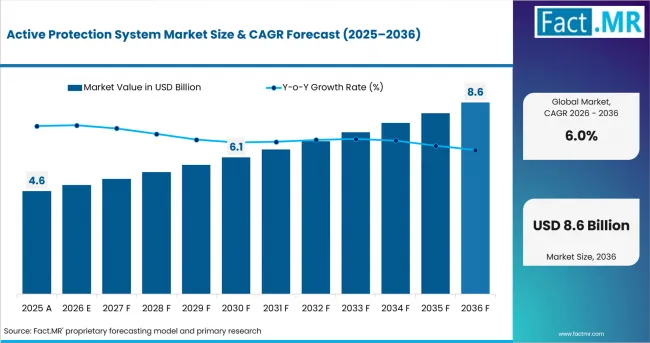
Active Protection System Market Value Analysis | Source: Fact.MR
Summary of Active Protection System Market
- Demand Drivers
- Armored vehicle modernization programs are increasing demand for advanced protection technologies. Vehicle survivability requirements support system deployment.
- Anti-tank missile proliferation is strengthening investment in active defense capabilities. Military forces are prioritizing threat interception technologies.
- Defense budget expansion supports acquisition of next-generation protection systems. Demand reflects rising focus on battlefield protection.
- Key Segments Analyzed
- By Platform: Ground platforms account for 65% share in 2026 as armored vehicle fleets represent the largest deployment base.
- By Kill System Type: Hard kill systems hold 48% share due to direct interception capability against incoming threats.
- By End User: Defense segment registers 90% share supported by military modernization and vehicle protection requirements.
- By Technology: Radar-based systems contribute 45% share in 2026 as threat detection accuracy remains a critical operational requirement.
- By Threat Type: Anti-Tank Guided Missiles account for 40% share in 2026 due to increasing deployment across modern conflict environments.
- By Geography: India is projected to record CAGR at 7.1% by 2036 supported by armored vehicle modernization investment.
- Analyst Opinion at Fact.MR
- Shambhu Nath Jha, Principal Consultant at Fact.MR, opines, "Vehicle survivability requirements are reshaping defense investment priorities. Protection systems with advanced threat detection capability will secure stronger adoption across military modernization programs. Integration flexibility and response effectiveness will influence future contract awards."
- Strategic Implications
- Defense technology suppliers should strengthen active protection portfolios for armored vehicle programs. Advanced interception capability improves competitive positioning.
- Vehicle integrators should expand partnerships with protection system developers. Platform compatibility improves deployment opportunities.
- Defense agencies should prioritize scalable protection architectures. Flexible systems improve long-term modernization planning.
India is expected to record 7.1% CAGR from 2026 to 2036 supported by armored vehicle modernization initiatives. South Korea is forecast to grow at 6.7% CAGR by 2036 due to defense technology investment. The United States is projected to expand at 5.9% CAGR through 2036 driven by vehicle protection upgrades. Israel is estimated to witness 5.6% CAGR from 2026 to 2036 supported by active defense system deployment. Germany is likely to register 5.2% CAGR by 2036 due to military modernization programs and armored fleet enhancement.
Segmental Analysis
Active Protection System Market Analysis by Platform
Ground platforms are estimated to account for 65% share in 2026. Armored vehicles face direct exposure to missile and projectile threats during combat operations. Protection system integration has become a standard requirement across vehicle modernization programs. Elbit Systems received a $228 million contract from General Dynamics Ordnance and Tactical Systems (GD-OTS) to supply its Iron Fist Active Protection System (APS) for U.S. Army Bradley Infantry Fighting Vehicle upgrades. The contract will be executed over three years and supports the Army's efforts to enhance armored vehicle survivability against modern battlefield threats.
- Vehicle Modernization: Defense agencies are upgrading armored vehicle fleets with active protection technologies. Demand reflects higher survivability requirements across frontline platforms.
- Threat Exposure: Ground combat vehicles operate in environments with elevated missile risk. Protection systems improve operational effectiveness during combat missions.
- Fleet Expansion: Military organizations are increasing investment in protected mobility assets. Platform deployment supports higher system installation volumes.
Active Protection System Market Analysis by Kill System Type
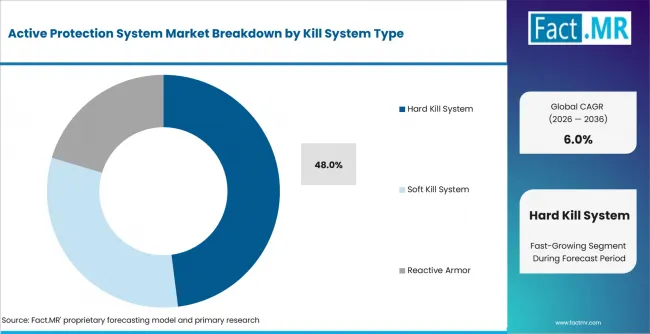
Active Protection System Market Analysis By Kill System Type | Source: Fact.MR
Hard kill systems are estimated to hold 48% share in 2026. These systems neutralize incoming threats before impact through interceptor deployment. Direct engagement capability supports adoption across advanced armored platforms. The U.S. Army certified that the TROPHY Hard-Kill Active Protection System successfully met all mandatory technical requirements for Modular APS Framework (MAF) 2.0 compliance. The achievement confirms Trophy's compatibility with the Army's modular vehicle protection architecture and supports future integration across multiple armored platforms.
- Interception Capability: Hard kill systems destroy incoming projectiles before vehicle contact. Defense agencies prioritize systems with proven combat effectiveness.
- Platform Integration: Manufacturers are improving compatibility across armored vehicle classes. Integration flexibility supports procurement activity.
- Battlefield Protection: Military operators seek technologies that reduce vehicle vulnerability. Demand reflects evolving threat environments.
Active Protection System Market Analysis by End User
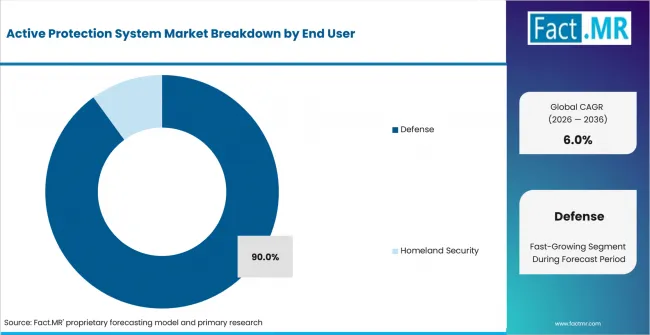
Active Protection System Market Analysis By End User | Source: Fact.MR
Defense is estimated to contribute 90% share in 2026. Military organizations account for most active protection system deployment activity. Vehicle protection requirements support sustained acquisition programs. KNDS Deutschland and EuroTrophy successfully integrated the Trophy Active Protection System (APS) onto the BOXER armored vehicle and completed the installation phase. The program advances vehicle survivability capabilities, with live-fire testing planned to validate Trophy's protection against anti-tank threats and support future operational deployment.
- Military Spending: Defense budgets support investment in advanced protection technologies. Procurement programs remain the primary source of demand.
- Operational Readiness: Armed forces seek improved survivability across combat platforms. Protection capability influences modernization priorities.
- Strategic Programs: National defense initiatives include vehicle protection upgrades. Long-term funding supports system adoption.
Active Protection System Market Analysis by Technology
Radar-based systems register 45% share in 2026. Radar technology provides continuous threat detection and tracking capability. High detection accuracy supports deployment across active protection architectures.
- Detection Accuracy: Radar systems identify incoming threats at operational distances. Early warning capability improves response effectiveness.
- All-Weather Operation: Radar performance remains effective across challenging environments. Reliability supports military adoption.
- System Integration: Protection platforms increasingly combine radar with countermeasure technologies. Advanced sensing capability strengthens market demand.
Active Protection System Market Analysis by Threat Type
Anti-Tank Guided Missiles are estimated to hold 40% share in 2026. Modern combat environments present growing exposure to missile-based threats. Protection systems are designed primarily to counter these attacks.
- Missile Proliferation: Anti-tank missile deployment has increased across military forces. Defense agencies are prioritizing countermeasure technologies.
- Vehicle Survivability: Armored platforms require protection against precision-guided threats. Demand reflects evolving battlefield conditions.
- Defense Planning: Military modernization programs emphasize missile defense capability. Investment supports active protection system deployment.
Drivers, Restraints, and Opportunities
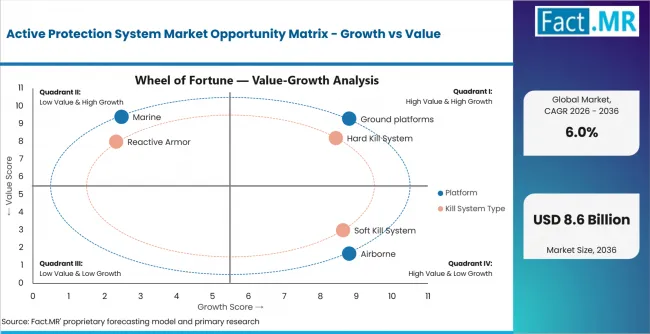
Active Protection System Market Opportunity Matrix Growth Vs Value | Source: Fact.MR
Fact.MR analysts observe that the market is transitioning from selective deployment toward wider integration across armored vehicle fleets. Earlier adoption focused on specialized military platforms. Demand is increasingly expanding across modernization programs and new vehicle procurement activity. Hanwha Systems unveiled its Next-Generation Active Protection System (NG-APS), integrating AESA radar, EO/IR sensors, AI-driven threat analysis, and hard-kill interceptors to counter anti-tank missiles, kinetic-energy rounds, drones, and loitering munitions. The company plans to begin hardware testing in 2027, with the system designed for integration across tanks and other armored combat vehicles.
Military planners are placing greater emphasis on crew protection and mission survivability. Protection systems are receiving higher priority within defense spending programs. Technology advancement is improving interception capability and operational reliability.
- Armored Fleet Modernization: Defense agencies are upgrading existing combat vehicles with advanced protection technologies. Growth is supported by rising investment in battlefield survivability.
- Evolving Threat Environment: Anti-tank missiles and precision-guided threats are increasing protection requirements. Demand reflects the need for improved defensive capability.
- Integration Complexity: Adoption is constrained by installation requirements and platform compatibility challenges. Integration costs influence procurement decisions.
Regional Analysis
The active protection system market is assessed across North America, Europe, Asia Pacific, Latin America, and the Middle East & Africa. The study evaluates defense spending activity, vehicle modernization programs, military technology investment, and protection system deployment trends across major economies.
.webp "Top Country Growth Comparison — Active Protection System Market CAGR (2026–2036)")
Top Country Growth Comparison — Active Protection System Market CAGR (2026–2036) | Source: Fact.MR
| Country | CAGR (2026 to 2036) |
|---|---|
| India | 7.1% |
| South Korea | 6.7% |
| United States | 5.9% |
| Israel | 5.6% |
| Germany | 5.2% |
Source: Fact.MR analysis based on proprietary forecasting model and primary research.
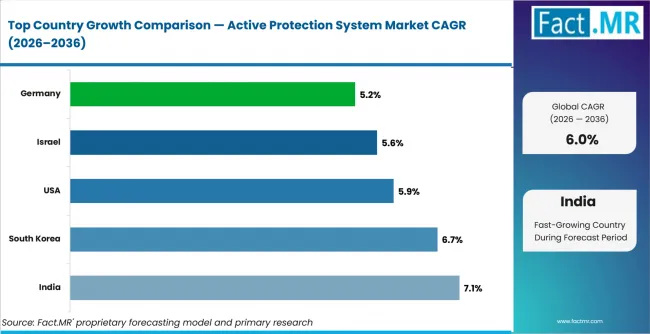
Active Protection System Market Cagr Analysis By Country | Source: Fact.MR
Asia Pacific Active Protection System Market Analysis
Asia Pacific represents a major growth region for active protection systems. Rising defense expenditure and armored vehicle modernization support demand. Military technology investment is strengthening regional deployment activity. Rafael Advanced Defense Systems and Larsen & Toubro signed an MoU to jointly offer and potentially manufacture the TROPHY Active Protection System (APS) in India for current and future combat platforms. The partnership supports indigenous defense manufacturing under the "Make in India" initiative while expanding deployment of APS technology for Indian armored vehicles.
- India: Demand for active protection systems in India is projected to rise at 7.1% CAGR by 2036. Growth is attributable to armored vehicle modernization and domestic defense manufacturing initiatives. Military investment is focused on improving battlefield survivability. Vehicle upgrade programs are supporting protection system demand.
- South Korea: South Korea is projected to expand at 6.7% CAGR from 2026 to 2036 due to investment in advanced armored vehicle technologies. Defense modernization supports integration of protection systems across military platforms. Demand reflects continued focus on force readiness and protection capability.
North America Active Protection System Market Analysis
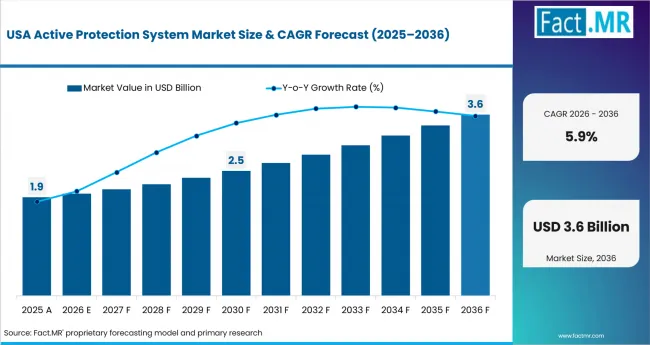
Active Protection System Market Country Value Analysis | Source: Fact.MR
North America remains an important market for advanced defense technologies. Military modernization and vehicle protection initiatives support demand. Defense spending priorities continue to favor survivability enhancements.
- United States: Demand for active protection systems in the United States is projected to rise at 5.9% CAGR through 2036. Growth is supported by armored vehicle upgrade programs and defense technology investment. Military organizations are expanding deployment of advanced protection solutions. Vehicle survivability remains a strategic priority across modernization initiatives.
Europe and Middle East Active Protection System Market Analysis
Europe and the Middle East maintain strong demand for vehicle protection technologies. Regional security priorities support investment in advanced defense systems. Modernization programs continue to strengthen market opportunities.
- Israel: Israel is expected to advance at 5.6% CAGR from 2026 to 2036 due to extensive deployment experience with active protection technologies. Defense manufacturers maintain strong expertise in threat interception systems. Growth reflects ongoing investment in vehicle protection capability.
- Germany: Demand for active protection systems in Germany is projected to rise at 5.2% CAGR by 2036. Growth is supported by military modernization programs and armored vehicle capability enhancement. Defense investment is strengthening adoption of advanced protection technologies. Vehicle fleet upgrades continue to create deployment opportunities.
Competitive Aligners for Market Players
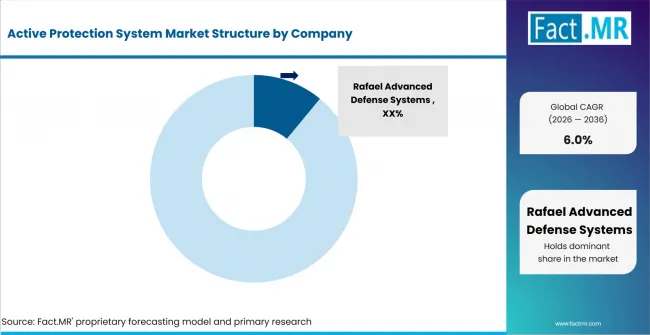
Active Protection System Market Analysis By Company | Source: Fact.MR
The active protection system market is concentrated among a limited number of defense technology providers with proven operational deployment records. Performance reliability influences supplier selection across military programs. Companies with combat-proven systems hold stronger positions during defense evaluations and contract awards.
Technology integration capability creates a competitive advantage across armored vehicle platforms. Defense contractors with established relationships with vehicle manufacturers improve access to modernization programs. Platform compatibility supports faster deployment and lowers integration risk. Military organizations prioritize long-term support capability and operational performance. Procurement decisions emphasize threat detection accuracy and interception effectiveness. Suppliers with validated deployment experience strengthen their position in competitive tenders.
Commercial success is increasingly linked to multi-threat protection capability and integration flexibility. Demand is shifting toward systems that address missiles, rockets, and emerging aerial threats within a unified protection architecture.
Key Players
- Rafael Advanced Defense Systems
- Elbit Systems Ltd.
- Rheinmetall AG
- ASELSAN A.S
- EuroTrophy GmbH
Bibliography
- Elbit Systems Ltd. (2026, January 26). Elbit Systems awarded $228 million follow-on contract to provide Iron Fist APS for U.S. Army Bradley IFV upgrades. Elbit Systems Ltd.
- Rafael Systems Global Sustainment. (2025, May 21). Trophy Active Protection System achieves MAF 2.0. Rafael Systems Global Sustainment.
- KNDS Deutschland GmbH & Co. KG. (2025, September 9). KNDS Deutschland and EuroTrophy integrate Trophy Active Protection System onto the Boxer. KNDS.
- Larsen & Toubro Limited. (2025, February 15). Rafael and L&T sign MoU to jointly offer Trophy Active Protection System for Indian defence platforms. Larsen & Toubro Limited.
- ASELSAN A.Ş. (2024, December). AKKOR active protection system. ASELSAN A.Ş.
This Report Addresses
- Analysis of active protection system demand across military modernization and vehicle survivability applications.
- Opportunity assessment across armored vehicle protection and advanced defense technology deployment.
- Segment forecasts covering platform, kill system type, end user, technology, and threat type demand.
- Competitive assessment of defense technology suppliers and protection system developers.
- Evaluation of military modernization trends and defense investment activity.
- Country-level analysis across India, South Korea, the United States, Israel, and Germany.
- Report delivery through PDF and Excel formats supported by primary interviews and defense industry analysis.
Active Protection System Market Definition
The active protection system market covers integrated defense technologies designed to detect, track, and neutralize incoming threats before impact. These systems are installed on armored vehicles, combat platforms, and military assets to improve survivability against anti-tank missiles, rocket attacks, and other hostile projectiles. Active protection systems use sensors, radars, interceptors, and countermeasure technologies to identify threats and initiate protective responses. Demand is concentrated within military modernization programs and vehicle protection initiatives.
Active Protection System Market Inclusions
The study covers global and regional forecasts from 2026 to 2036 by platform, kill system type, end user, technology, and threat type. It includes active protection systems deployed across land, air, and naval defense platforms. The report evaluates defense spending trends, technology deployment activity, and vehicle modernization programs.
Active Protection System Market Exclusions
The study excludes passive armor solutions and standalone surveillance systems. It omits conventional armored vehicle manufacturing and unrelated defense electronics. Small arms protection equipment is excluded unless integrated directly within active protection system architecture.
Active Protection System Market Research Methodology
- Primary Research
- Interviews were conducted with defense system manufacturers, military technology specialists, armored vehicle integrators, defense consultants, and procurement officials across major regions.
- Desk Research
- Analysis included defense ministry publications, company disclosures, military modernization reports, procurement announcements, and defense industry updates published during 2024 and 2025.
- Market-Sizing and Forecasting
- Hybrid top-down and bottom-up model using defense spending trends, platform deployment rates, vehicle upgrade programs, and active protection system integration data.
- Data Validation and Update Cycle
- Forecast was validated through industry interviews, defense procurement assessments, company disclosures, and military modernization program analysis.
Segmentation
Scope of Report
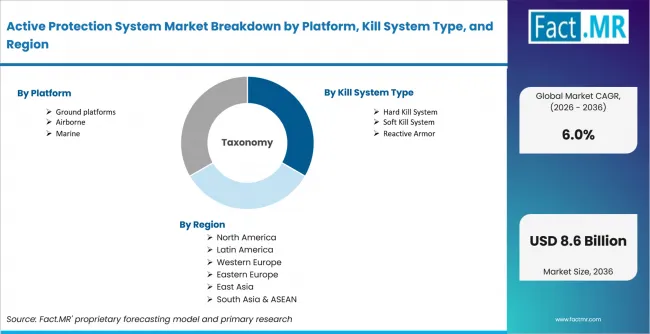
Active Protection System Market Breakdown By Platform, Kill System Type, And Region | Source: Fact.MR
| Attribute | Details |
|---|---|
| Quantitative Units |
USD Billion in 2026 to USD Billion by 2036 at CAGR |
| Market Definition | Covers active protection technologies designed to detect and neutralize incoming threats against military platforms. |
| Platform Segmentation | Ground, Airborne, Marine |
| Kill System Type Segmentation | Soft Kill System, Hard Kill System |
| End User Segmentation | Defense, Homeland Security |
| Technology Segmentation | Radar-Based Systems, Infrared-Based Systems, Laser-Based Systems, Electro-Optical Systems |
| Threat Type Segmentation | Anti-Tank Guided Missiles (ATGM), Rocket Propelled Grenades (RPGs), Unmanned Aerial Vehicles (UAVs), Kinetic Energy Projectiles, Others |
| Regions Covered | North America, Europe, Asia Pacific, Latin America, Middle East & Africa |
| Countries Covered | India, South Korea, United States, Israel, Germany, Canada, United Kingdom, France |
| Key Companies Profiled | Rafael Advanced Defense Systems, Elbit Systems Ltd., Rheinmetall AG, ASELSAN A.S, EuroTrophy GmbH |
| Forecast Period | 2026 to 2036 |
| Approach | Hybrid top-down and bottom-up model using defense spending and vehicle modernization analysis. |
Active Protection System Market by Segment
-
By Platform:
- Ground
- Airborne
- Marine
-
By Kill System Type:
- Soft Kill System
- Hard Kill System
-
By End User:
- Defense
- Homeland Security
-
By Technology:
- Radar-Based Systems
- Infrared-Based Systems
- Laser-Based Systems
- Electro-Optical Systems
-
By Threat Type:
- Anti-Tank Guided Missiles (ATGM)
- Rocket Propelled Grenades (RPGs)
- Unmanned Aerial Vehicles (UAVs)
- Kinetic Energy Projectiles
- Others
-
By Region:
- North America
- United States
- Canada
- Latin America
- Brazil
- Argentina
- Mexico
- Rest of Latin America
- Europe
- Germany
- United Kingdom
- France
- Italy
- Rest of Europe
- Asia Pacific
- India
- South Korea
- China
- Japan
- ASEAN
- Middle East & Africa
- Israel
- Saudi Arabia
- UAE
- Rest of Middle East & Africa
- North America
Frequently Asked Questions
Which platform segment is poised to lead market demand?
Which country records the fastest growth in the market?
What is driving active protection system demand?
Why are hard kill systems gaining traction?
Who worked on this report


Preview the report firsthand - request a free sample
Free SampleGet the brochure for pricing and purchase details
Download PDF