- Estimated Value(2026): 1.6 Bn
- Forecast Value (2036): 3.2 Bn
- CAGR (2026 - 2036): 7.2%
Acute External Ventricular Drain Market Size, Market Forecast and Outlook by Fact.MR
- The acute external ventricular drain market surpassed a valuation of USD 1.5 billion in 2025. Demand is expected to increase from USD 1.6 billion in 2026 to USD 3.2 billion by 2036.
- The market is forecast to record 7.2% CAGR from 2026 to 2036 as hospitals use EVD systems for acute hydrocephalus and post-neurosurgical CSF drainage.
- Acute external ventricular drain demand is becoming more safety-led. The market is moving from basic drainage sets to systems with monitoring and reliable flow control.
- Hospitals need devices that can support CSF drainage and ICP tracking in high-risk patients. Device quality is also under closer review after recent FDA and CDC safety communications.
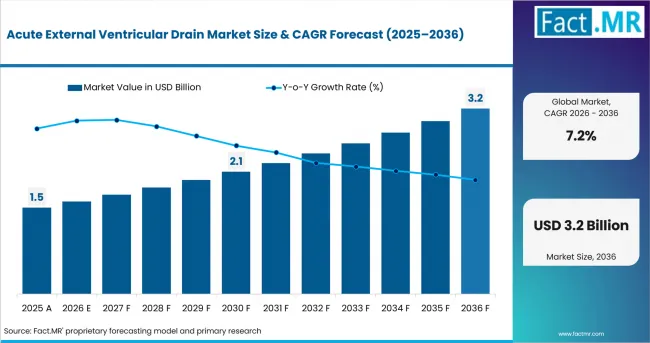
Acute External Ventricular Drain Market Value Analysis | Source: Fact.MR
Summary of Acute External Ventricular Drain Market
- Demand Drivers in the Market
- Acute CSF Drainage: Hospitals use EVDs to relieve intracranial pressure during emergency brain care.
- Infection Control: Neurocritical care units need drainage systems that reduce contamination and leakage risk.
- Monitoring Need: ICP-integrated systems help clinicians track pressure changes during acute treatment.
- Key Segments Analyzed
- By Product Type: External drainage and monitoring systems are expected to hold 36.0% share in 2026 because hospitals need drainage and pressure tracking in one workflow.
- By Material Type: Silicone leads because it is widely used in ventricular drainage catheters. The segment is likely to account for 42.0% share in 2026.
- By Application: Acute hydrocephalus is projected to hold 34.0% share in 2026 because EVDs are used to reduce CSF volume and pressure.
- By End User: Hospitals are anticipated to capture 61.0% share in 2026 as emergency neurosurgery and ICU care create the main EVD demand.
- By Sales Channel: Direct hospital procurement is expected to hold 46.0% share in 2026 because EVD systems require hospital-level standardization.
- By Geography: India is projected to record 8.7% CAGR from 2026 to 2036 as neurosurgery access and tertiary hospital capacity expand.
- Analyst Opinion at Fact.MR
- Shambhu Nath Jha, Principal Consultant at Fact.MR, states, “Acute external ventricular drains are becoming more closely tied to neurocritical care safety. We see hospitals focusing on infection control and staff handling. Suppliers that support safer systems and clear training will gain stronger neurosurgery access.”
- Strategic Implications
- Device Safety: Hospitals should review connector integrity and catheter compatibility before standardization.
- Staff Training: Neurocritical care teams need clear leveling and infection-control protocols.
- Product Selection: Suppliers should support catheters that reduce obstruction and maintain stable CSF flow.
India is projected to record 8.7% CAGR from 2026 to 2036 as neurosurgery access and tertiary hospital capacity expand. China is likely to post 8.1% CAGR by 2036 as neurocritical care units and trauma centers increase EVD use. The United States is expected to register 6.7% CAGR by 2036 as replacement demand and safety review programs sustain use. Germany is forecast to advance at 6.0% CAGR through 2036 because mature neurosurgical systems support protocol-led EVD adoption. Japan is set to record 5.5% CAGR from 2026 to 2036 as aging-related neurosurgical care and hospital replacement demand continue.
Segmental Analysis
Acute External Ventricular Drain Market Analysis by Product Type
External drainage and monitoring systems are expected to hold 36.0% share in 2026 because hospitals need drainage and pressure tracking in one workflow. A 2026 Neurocritical Care study states that external ventricular drains can be used to drain cerebrospinal fluid and measure intracranial pressure in neurocritical care patients. These systems support CSF diversion and pressure monitoring in ICUs. Standard EVD catheters are widely used in emergency and neurosurgery care. Antimicrobial EVD catheters gain attention because infection prevention is a major clinical concern. Drainage bags and accessories support repeat demand. ICP-integrated systems serve patients who need close pressure tracking.
- Monitoring Systems: Drainage and monitoring platforms help ICUs combine CSF diversion with pressure tracking.
- Antimicrobial Use: Coated catheters support infection-control programs in high-risk neurosurgical patients.
- Accessory Demand: Drainage bags and tubing accessories create recurring replacement needs across ICU workflows.
Acute External Ventricular Drain Market Analysis by Material Type
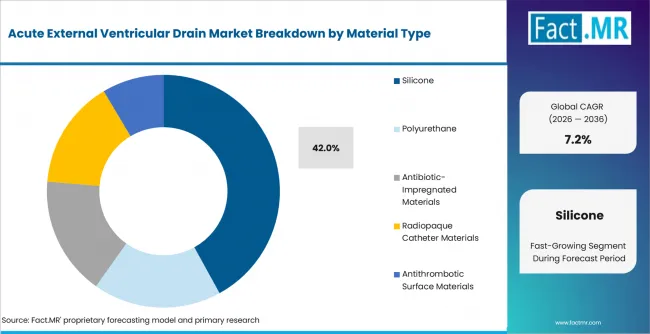
Acute External Ventricular Drain Market Analysis By Material Type | Source: Fact.MR
Silicone leads because it is widely used in ventricular drainage catheters. The segment is likely to account for 42.0% share in 2026 due to broad clinical familiarity and flexibility. Polyurethane supports selected catheter designs and surface technologies. Antibiotic-impregnated materials help reduce infection concerns in high-risk use. Radiopaque catheter materials support placement checks. Antithrombotic surface materials gain attention because catheter blockage can disrupt CSF drainage. Material choice depends on infection risk and hospital protocol.
- Silicone Base: Silicone catheters remain familiar to neurosurgical teams and support flexible ventricular placement.
- Infection Focus: Antibiotic materials help hospitals manage ventriculitis risk in longer-duration drainage cases.
- Flow Protection: Antithrombotic surfaces can reduce obstruction risk in hemorrhage-linked CSF drainage.
Acute External Ventricular Drain Market Analysis by Application
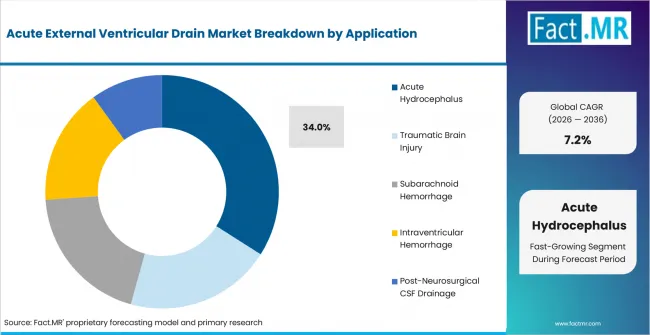
Acute External Ventricular Drain Market Analysis By Application | Source: Fact.MR
Acute hydrocephalus is projected to hold 34.0% share in 2026 because EVDs help reduce CSF volume and pressure. Emergency care staff use EVD placement when fluid buildup raises intracranial pressure. Traumatic brain injury creates demand for drainage and ICP monitoring. Subarachnoid hemorrhage and intraventricular hemorrhage often require CSF diversion. Post-neurosurgical drainage supports temporary pressure control after selected procedures. Application demand depends on neurosurgical access and ICU capacity. Mayo Clinic notes that EVDs may be used before, during, or after brain tumor surgery to treat or prevent hydrocephalus.
- Hydrocephalus Relief: Acute CSF buildup drives urgent drainage demand in emergency neurosurgical care.
- Trauma Care: TBI patients may need CSF drainage and ICP monitoring during ICU treatment.
- Hemorrhage Support: Ventricular blood can impair CSF flow and increase catheter drainage needs.
Acute External Ventricular Drain Market Analysis by End User
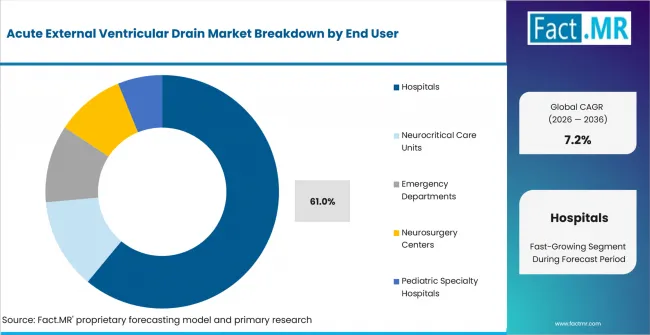
Acute External Ventricular Drain Market Analysis By End User | Source: Fact.MR
Hospitals lead as emergency neurosurgery and ICU care create the main EVD demand. The segment is anticipated to capture 61.0% share in 2026 because most EVD placement requires acute facilities with neurosurgical capability. Neurocritical care units manage daily leveling and monitoring. Emergency departments start trauma and hydrocephalus care pathways. Neurosurgery centers use EVDs during surgery and after surgery.
- Hospital Base: Acute hospitals manage EVD placement and complication response through neurosurgical staff.
- ICU Workflow: Neurocritical care units oversee drainage height and sterile handling.
- Pediatric Need: Specialty children’s hospitals use EVDs for hydrocephalus and brain tumor pathways.
Acute External Ventricular Drain Market Analysis by Sales Channel
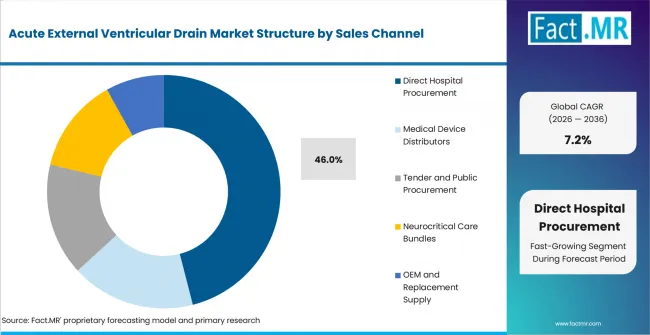
Acute External Ventricular Drain Market Analysis By Sales Channel | Source: Fact.MR
Direct hospital procurement is expected to hold 46.0% share in 2026 because EVD systems need hospital-level standardization. Health systems select EVD platforms through neurosurgery, ICU, and infection-control review. Medical device distributors serve smaller hospitals and regional centers. Public tenders support government hospital buying. Neurocritical care bundles combine EVD products with monitoring and accessories. OEM and replacement supply supports recurring bags and catheter kits.
- Hospital Contracts: Direct procurement helps health systems standardize EVD platforms across neurosurgery and ICU units.
- Distributor Reach: Regional distributors support smaller facilities with catheter kits and urgent replacement supply.
- Bundle Supply: Neurocritical care bundles simplify purchasing of catheters and monitoring accessories.
Acute External Ventricular Drain Market Drivers, Restraints, and Opportunities
Neurocritical care demand and product safety review are the main drivers for acute external ventricular drains. FDA identified a 2025 Medtronic Becker and Exacta recall as Class I due to crack or leak risk in stopcocks. This keeps hospital attention on connector quality and supplier response.
Infection risk can slow product acceptance. CDC reported in 2024 that a Rhode Island Hospital investigation linked Medtronic Duet EVD system malfunctions with infections and positive CSF cultures. Hospitals may delay product switching if device handling or infection-control evidence is unclear. EVD use needs trained ICU staff and neurosurgical backup.
Opportunities in the Acute External Ventricular Drain Market
- Infection-Control Catheters: Suppliers can target ICUs that standardize antimicrobial EVD products.
- ICP Integration: Device makers can develop systems that combine drainage with accurate pressure tracking.
- Training Support: Vendors can provide workflow education for leveling and contamination control.
Regional Analysis
Based on regional analysis, the acute external ventricular drain market is segmented into North America, Latin America, Western Europe, Eastern Europe, East Asia, South Asia and Pacific, and Middle East and Africa.
| Country | CAGR (2026 to 2036) |
|---|---|
| India | 8.7% |
| China | 8.1% |
| United States | 6.7% |
| Germany | 6.0% |
| Japan | 5.5% |
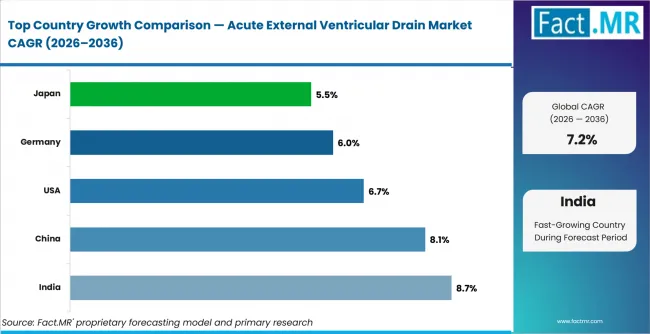
Acute External Ventricular Drain Market Cagr Analysis By Country | Source: Fact.MR
South Asia and East Asia Acute External Ventricular Drain Market Analysis
South Asia and East Asia demand comes from trauma care and wider neurosurgery access. India leads the growth outlook as private hospitals and neurocritical care units expand. China has wider tertiary hospital capacity and stronger domestic device supply.
- India: India is projected to record 8.7% CAGR through 2036 as neurosurgery access and tertiary hospital capacity expand. Urban hospitals are adding trauma and neurocritical care services. EVD demand is rising in hydrocephalus and brain injury cases. Smaller cities still face specialist and ICU staffing gaps. Price sensitivity can affect use of premium antimicrobial catheters.
- China: China has large tertiary hospitals and expanding neurosurgical care capacity. Trauma centers and stroke units need EVD systems for acute CSF drainage and ICP monitoring. The country is likely to post 8.1% CAGR by 2036 as neurocritical care units and trauma centers increase EVD use. Domestic suppliers can serve cost-sensitive hospitals. Premium systems may gain access in advanced centers.
North America Acute External Ventricular Drain Market Analysis
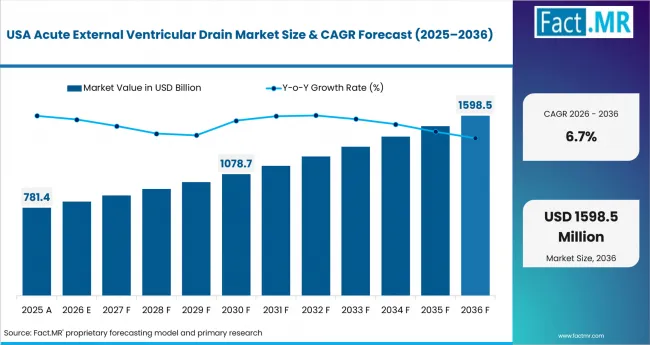
Acute External Ventricular Drain Market Country Value Analysis | Source: Fact.MR
North America demand is led by the United States because neurocritical care units and trauma centers already use EVD systems. The market is more replacement-led than access-led. Hospitals focus on product safety and standardized ICU handling.
- United States: The United States is expected to register 6.7% CAGR from 2026 to 2036 as replacement demand and safety review programs sustain use. Hospitals use EVD systems in neuro ICUs and post-neurosurgical care. Device switching is closely reviewed after recent FDA recall actions. FDA cleared Integra’s Codman Libertis EVD Catheter with Bactiseal and Endexo Technology in 2025 for ventricular access and CSF drainage. Suppliers with safety documentation will hold stronger accounts.
Western Europe Acute External Ventricular Drain Market Analysis
Western Europe demand comes from established neurosurgical systems and regulated hospital purchasing. Germany leads the regional view because trauma centers and neurosurgery departments use EVD systems in acute care.
- Germany: Germany is forecast to advance at 6.0% CAGR by 2036 because established neurosurgical systems support protocol-led EVD use. Hospitals use EVD systems in trauma care and post-operative monitoring. ICU staff need reliable drainage sets and clear device instructions. Tender committees review safety and accessory supply.
East Asia Acute External Ventricular Drain Market View
Japan has established neurosurgical care and advanced hospital systems. Demand is steady because emergency brain injury and hydrocephalus cases need acute drainage support. The market is more focused on replacement and product quality than first-time access.
- Japan: Japan is set to record 5.5% CAGR over the forecast period as aging-related neurosurgical care and hospital replacement demand continue. Hospitals use EVDs for hemorrhage and post-operative CSF management. Older patients create steady demand for neurocritical care. Product selection favors stable performance and sterile handling.
Competitive Aligners for Market Suppliers
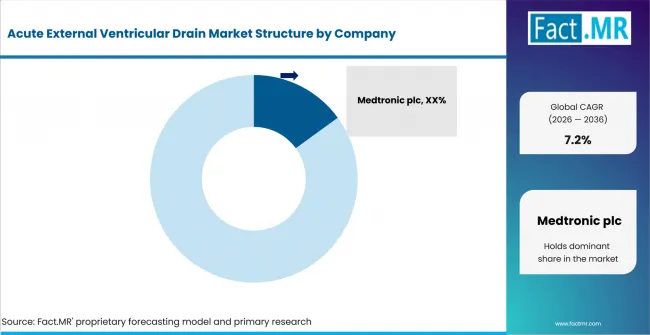
Acute External Ventricular Drain Market Analysis By Company | Source: Fact.MR
The acute external ventricular drain market is supported by neurosurgical device companies that support CSF drainage and pressure monitoring. Medtronic plc participates through Becker and Exacta external drainage systems. Integra LifeSciences Holdings Corporation competes through Codman external CSF drainage products and EVD catheter technologies. Natus Medical Incorporated supplies the EDS 3 external drainage system for CSF management.
Sophysa and Spiegelberg GmbH & Co. KG support hospital demand through external drainage systems and neuromonitoring products. Supplier choice depends on catheter design and sterile handling. Accessory compatibility and hospital service support also influence product selection.
By 2036, competition will depend on safety evidence and ICU usability. Hospitals need EVD products that support reliable drainage and reduce infection risk. Connector integrity and leakage prevention have become more important after recent recall activity. Suppliers with training support and complete accessory portfolios will gain stronger hospital access.
Key Companies in Acute External Ventricular Drain Market
- Medtronic plc
- Integra LifeSciences Holdings Corporation
- Natus Medical Incorporated
- Sophysa
- Spiegelberg GmbH & Co. KG
Bibliography
- Mayo Clinic. (2025, September 18). External ventricular drain. Mayo Foundation for Medical Education and Research.
- U.S. Food and Drug Administration. (2025, February 3). Pressure monitoring device recall: Medtronic Neurosurgery issues correction for Becker and Exacta external drainage and monitoring systems due to cracks and/or leaks in stopcocks.
- Centers for Disease Control and Prevention. (2024, April 11). Infections associated with Medtronic Duet external ventricular drains — Rhode Island Hospital, Providence, Rhode Island, January 2023–January 2024. MMWR.
- U.S. Food and Drug Administration. (2025, August 6). 510(k) premarket notification: Codman Libertís EVD Catheter with Bactiseal and Endexo Technology.
- Natus Medical Incorporated. (2026). Natus EDS 3 EVD drainage system.
- Integra LifeSciences. (2026). External CSF drainage.
This Report Addresses
- Strategic intelligence on acute external ventricular drain demand across product type, material type, application, end user, and sales channel.
- Segment analysis covering external drainage and monitoring systems, silicone materials, acute hydrocephalus, hospitals, and direct procurement.
- Regional outlook covering India, China, the United States, Germany, and Japan.
- Competitive analysis of Medtronic plc, Integra LifeSciences Holdings Corporation, Natus Medical Incorporated, Sophysa, Spiegelberg GmbH & Co. KG.
- Product assessment covering EVD catheters, antimicrobial catheters, drainage systems, accessories, and ICP-integrated systems.
- Application assessment covering hydrocephalus, traumatic brain injury, subarachnoid hemorrhage, intraventricular hemorrhage, and post-neurosurgical drainage.
- Primary interviews, supplier checks, official source review, and neurocritical care workflow validation support the forecast.
Acute External Ventricular Drain Market Definition
The acute external ventricular drain market covers temporary systems used to drain cerebrospinal fluid from the brain ventricles and monitor intracranial pressure. These systems are used in acute hydrocephalus and post-neurosurgical care. The market differs from permanent CSF shunt systems because EVDs are temporary acute care devices.
Acute External Ventricular Drain Market Inclusions
The scope includes EVD catheters and related accessories. It includes standard catheters and antimicrobial or antithrombotic catheter variants. Products used in emergency departments and pediatric specialty hospitals are included.
Acute External Ventricular Drain Market Exclusions
The scope excludes permanent ventricular shunts and implantable valves used for long-term hydrocephalus treatment. It excludes general ICP monitors when no CSF drainage function is included. Lumbar drainage-only systems are excluded unless sold as part of external ventricular drainage platforms.
Acute External Ventricular Drain Market Research Methodology
- Primary Research
- Primary research includes interviews with neurosurgeons and neurocritical care nurses. It includes input from ICU supply managers and neurosurgical device distributors.
- Desk Research
- Desk research reviews FDA device records and official product materials. It covers EVD systems and neurocritical care use.
- Market-Sizing and Forecasting
- Forecasting uses product type demand and application use. Material type and sales channel structure support the market assessment.
- Data Validation and Update Cycle
- Forecasts are validated through hospital feedback and supplier checks. Trauma admissions and EVD replacement trends help confirm market direction.
Scope of the Report
| Attribute | Details |
|---|---|
| Quantitative Units | USD billion in 2026 to USD billion by 2036 at CAGR |
| Market Definition | Temporary systems used to drain cerebrospinal fluid and monitor intracranial pressure |
| Product Type | Standard EVD Catheters, Antimicrobial EVD Catheters, External Drainage and Monitoring Systems, Drainage Bags and Accessories, ICP-Integrated EVD Systems |
| Material Type | Silicone, Polyurethane, Antibiotic-Impregnated Materials, Radiopaque Catheter Materials, Antithrombotic Surface Materials |
| Application | Acute Hydrocephalus, Traumatic Brain Injury, Subarachnoid Hemorrhage, Intraventricular Hemorrhage, Post-Neurosurgical CSF Drainage |
| End User | Hospitals, Neurocritical Care Units, Emergency Departments, Neurosurgery Centers, Pediatric Specialty Hospitals |
| Sales Channel | Direct Hospital Procurement, Medical Device Distributors, Tender and Public Procurement, Neurocritical Care Bundles, OEM and Replacement Supply |
| Regions Covered | North America, Latin America, Western Europe, Eastern Europe, East Asia, South Asia and Pacific, Middle East and Africa |
| Countries Covered | India, China, United States, Germany, Japan |
| Key Companies Profiled | Medtronic plc, Integra LifeSciences Holdings Corporation, Natus Medical Incorporated, Sophysa, Spiegelberg GmbH & Co. KG |
| Forecast Period | 2026 to 2036 |
| Approach | Hybrid top-down and bottom-up approach using product type demand, material use, application movement, end-user demand, sales channel structure, and regional validation |
Acute External Ventricular Drain Market Analysis by Segments
-
By Product Type:
- Standard EVD Catheters
- Antimicrobial EVD Catheters
- External Drainage and Monitoring Systems
- Drainage Bags and Accessories
- ICP-Integrated EVD Systems
-
By Material Type:
- Silicone
- Polyurethane
- Antibiotic-Impregnated Materials
- Radiopaque Catheter Materials
- Antithrombotic Surface Materials
-
By Application:
- Acute Hydrocephalus
- Traumatic Brain Injury
- Subarachnoid Hemorrhage
- Intraventricular Hemorrhage
- Post-Neurosurgical CSF Drainage
-
By End User:
- Hospitals
- Neurocritical Care Units
- Emergency Departments
- Neurosurgery Centers
- Pediatric Specialty Hospitals
-
By Sales Channel:
- Direct Hospital Procurement
- Medical Device Distributors
- Tender and Public Procurement
- Neurocritical Care Bundles
- OEM and Replacement Supply
-
Region:
- North America
- United States
- Canada
- Europe
- Germany
- United Kingdom
- France
- Italy
- Spain
- Asia Pacific
- China
- Japan
- South Korea
- Taiwan
- Singapore
- Latin America
- Brazil
- Mexico
- Argentina
- Middle East & Africa
- GCC Countries
- South Africa
- Israel
- North America