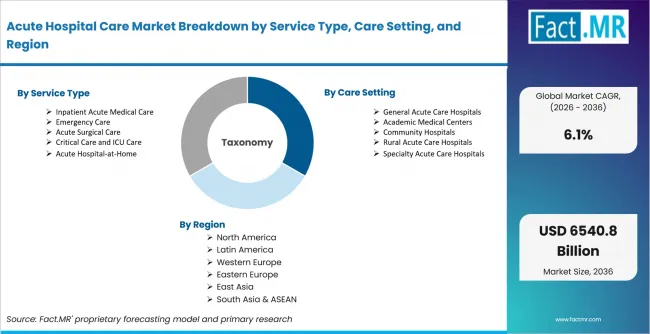
Acute Hospital Care Market Size, Share, Growth and Forecast (2026 - 2036)
The Acute Hospital Care Market is segmented by Service Type (Inpatient Acute Medical Care, Emergency Care, Acute Surgical Care, Critical Care and ICU Care, Acute Hospital-at-Home), by Care Setting (General Acute Care Hospitals, Academic Medical Centers, Community Hospitals, Rural Acute Care Hospitals, Specialty Acute Care Hospitals), by Payment Model by Delivery Model, and by Patient Group, and Region. Forecast for 2026 to 2036.
Fact.MR notes that acute hospital care demand is moving toward high-acuity treatment and shorter inpatient stays. Hospitals need better capacity control and care coordination. Health systems need acute care models that can manage complex patients and labor pressure.
Acute Hospital Care Market Size, Market Forecast and Outlook by Fact.MR
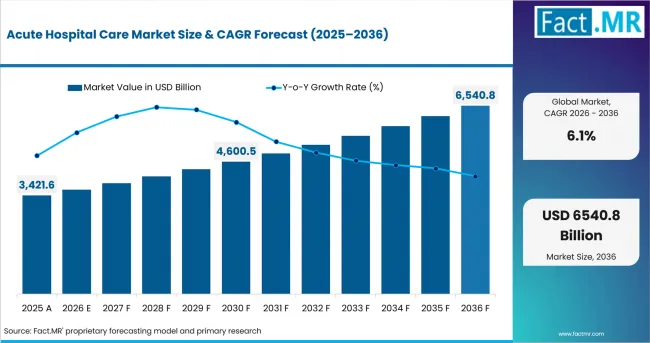
- The acute hospital care market was valued at USD 3,421.6 billion in 2025.
- Demand is expected to increase from USD 3,621.4 billion in 2026 to USD 6,540.8 billion by 2036.
- The market is forecast to record 6.1% CAGR during 2026 to 2036 as emergency admissions and hospital-at-home programs expand across healthcare systems.
Summary of Acute Hospital Care Market
- Demand Drivers in the Market
- Emergency Access: Hospitals need acute capacity to manage trauma and severe infection.
- High-Acuity Care: ICUs and acute wards support patients who need close monitoring and rapid intervention.
- Care Model Shift: Hospital-at-home programs support selected patients through remote monitoring and virtual rounds.
- Key Segments Analyzed
- By Service Type: Inpatient acute medical care is expected to hold 39.0% share in 2026 because hospitals manage serious medical admissions across core departments.
- By Care Setting: General acute care hospitals lead because they handle broad emergency and inpatient case volume. The segment is likely to account for 52.0% share in 2026.
- By Payment Model: Public insurance reimbursement is projected to hold 46.0% share in 2026 because government programs fund large inpatient volumes.
- By Delivery Model: Facility-based inpatient care leads as severe cases still need beds and continuous monitoring. The segment is anticipated to capture 57.0% share in 2026.
- By Patient Group: Geriatric patients are expected to hold 34.0% share in 2026 because older adults need more urgent inpatient care.
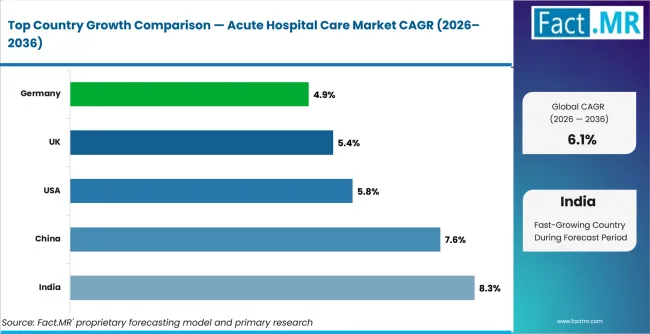
- By Geography: India is projected to record 8.3% CAGR from 2026 to 2036 as private hospital networks and emergency care access expand.
- Analyst Opinion at Fact.MR
- Shambhu Nath Jha, Principal Consultant at Fact.MR, states, “Acute hospital care is becoming more focused on capacity and patient acuity. Hospitals are managing emergency demand and shorter inpatient pathways. Providers that improve patient flow and clinical handoff will build stronger operating resilience.”
- Strategic Implications
- Capacity Planning: Hospitals should align bed use and discharge planning with high-acuity demand.
- Emergency Throughput: Health systems need faster triage and transfer protocols to reduce care delays.
- Home-Acute Models: Providers can use hospital-at-home programs for selected stable acute patients.
| Metric | Details |
|---|---|
| Industry Size 2026 | USD 3,621.4 billion |
| Industry Value 2036 | USD 6,540.8 billion |
| CAGR 2026 to 2036 | 6.1% |
Acute hospital care demand is becoming more capacity-led. Hospitals need to manage high-acuity admissions and rising care costs with better patient flow. The market is moving from traditional bed-based care toward mixed acute care models. Emergency departments remain the main entry point for urgent cases. ICUs handle complex patients who need continuous monitoring.
India is projected to record 8.3% CAGR from 2026 to 2036 as private hospital networks and emergency care access expand. China is likely to post 7.6% CAGR as tertiary hospitals and acute care infrastructure grow. The United States is expected to register 5.8% CAGR through 2036 as high-acuity admissions and hospital-at-home programs support demand. Germany is forecast to advance at 4.9% CAGR because mature hospital systems support protocol-led acute care. The United Kingdom is forecast to record 5.4% CAGR from 2026 to 2036 as NHS capacity pressure and virtual ward programs shape acute care delivery.
Segmental Analysis
Acute Hospital Care Market Analysis by Service Type
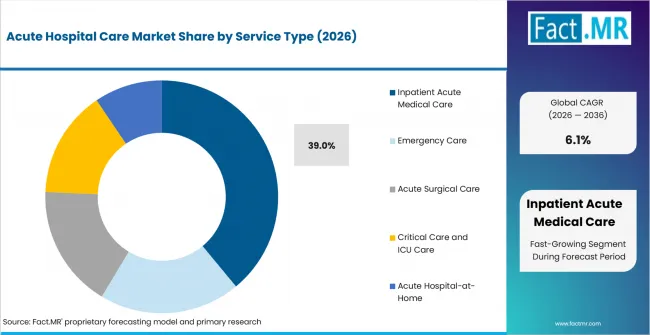
Inpatient acute medical care is expected to hold 39.0% share in 2026 because hospitals manage serious medical admissions across core departments. Patients with cardiac disease and neurological events often need acute beds and specialist care. Emergency care is a major entry point for urgent conditions. Acute surgical care supports time-sensitive procedures and post-operative monitoring. ICU care handles patients who need continuous support.
- Medical Admissions: Acute medical wards manage severe illness through physician review and inpatient treatment plans.
- Emergency Entry: Emergency departments provide triage and stabilization before admission or transfer decisions.
- ICU Support: Critical care units manage unstable patients needing continuous observation and organ support.
Acute Hospital Care Market Analysis by Care Setting
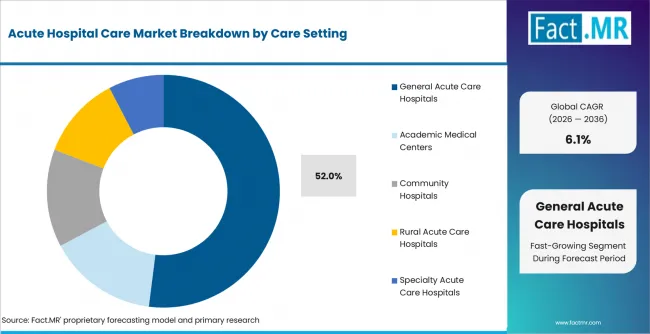
General acute care hospitals lead because they handle broad emergency and inpatient case volume. These hospitals serve routine acute admissions and urgent cases across multiple departments. The segment is likely to account for 52.0% share in 2026 because communities depend on them for emergency and inpatient treatment. Academic medical centers manage complex cases and advanced specialist care. Community hospitals serve local acute demand. Rural acute hospitals protect access in low-density areas.
- General Hospitals: Broad-service hospitals manage emergency access and most short-term inpatient admissions.
- Academic Centers: Teaching hospitals handle complex referrals and specialist-led acute care.
- Rural Access: Rural hospitals preserve local emergency care in areas with limited specialist availability.
Acute Hospital Care Market Analysis by Payment Model
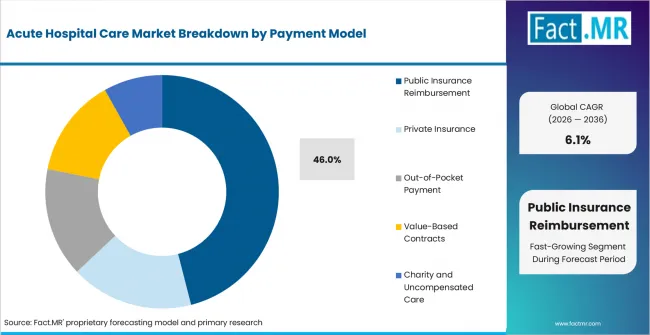
Public insurance reimbursement is projected to hold 46.0% share in 2026 because government programs fund large inpatient volumes. Medicare and national health programs support major acute hospital spending across many countries. Private insurance funds commercially covered admissions and higher-value service lines. Out-of-pocket payment stays important in markets with limited coverage. Value-based contracts are expanding as payers push quality and cost control. Charity and uncompensated care reflect treatment provided without full reimbursement. CMS issued the FY 2026 IPPS final rule to update Medicare payment policies and rates for inpatient hospitals. [1]
- Public Funding: Government programs fund large inpatient volumes and influence hospital reimbursement discipline.
- Private Coverage: Commercial insurance supports acute care revenue across employed and privately insured populations.
- Value Contracts: Risk-based payment models push hospitals to reduce avoidable admissions and readmissions.
Acute Hospital Care Market Analysis by Delivery Model
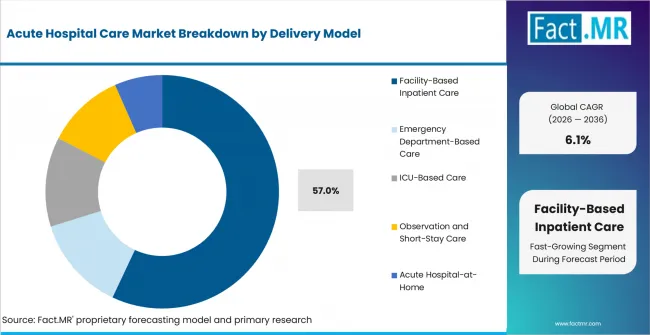
Facility-based inpatient care leads because severe cases still need beds and continuous monitoring. Hospitals manage acute deterioration through nursing care and specialist review. The segment is anticipated to capture 57.0% share in 2026 because serious cases need physical hospital infrastructure. Emergency department-based care supports triage and stabilization. ICU-based care serves unstable patients. Observation and short-stay care help hospitals manage lower-risk cases. Acute hospital-at-home supports selected patients through remote monitoring and in-person visits.
- Bed-Based Care: Inpatient facilities support patients who need continuous monitoring and rapid treatment changes.
- Short-Stay Pathways: Observation care helps hospitals manage lower-risk cases without full inpatient admission.
- Home-Acute Care: Hospital-at-home programs use monitoring and visits for selected stable acute patients.
Acute Hospital Care Market Analysis by Patient Group
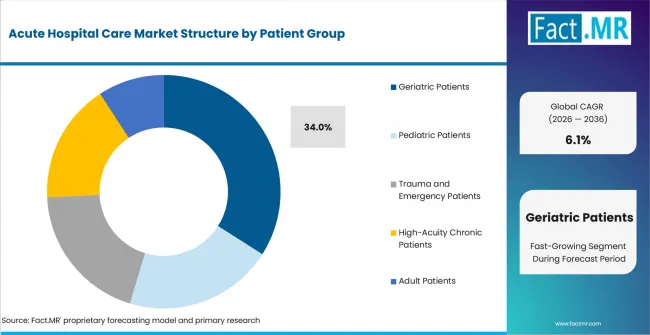
Geriatric patients are expected to hold 34.0% share in 2026 because older adults need more urgent inpatient care. Older patients often have complex conditions and higher risk of decline. Adult patients create the widest acute care volume through medical and surgical admissions. Pediatric patients need specialized acute care pathways and family support. Trauma and emergency patients need rapid stabilization. High-acuity chronic patients need hospital care during severe disease flare-ups.
- Older Patients: Geriatric admissions require stronger medication review and complication prevention.
- Trauma Cases: Emergency patients need rapid stabilization and clear transfer pathways.
- Chronic Flare-Ups: High-acuity chronic patients need inpatient care during severe respiratory or cardiac worsening.
Acute Hospital Care Market Drivers, Restraints, and Opportunities
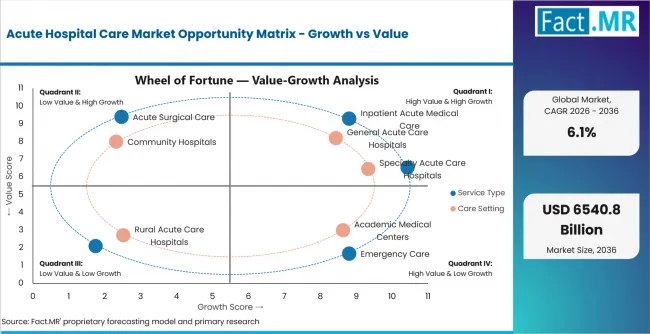
Emergency volume and hospital capacity pressure are the main drivers for acute hospital care demand. OECD reported in 2025 that emergency department visits across 16 OECD countries resulted in inpatient admission in 20% of cases, and high occupancy of curative care beds can signal pressure on health systems [2]. This shows the scale of urgent hospital access needs.
Staffing pressure can slow market expansion. Hospitals need nurses and support staff to operate acute wards and ICUs. Labor shortages can reduce bed availability even when physical capacity exists. Payment pressure affects hospitals because reimbursement may not match rising wages and supply costs. Rural hospitals face extra stress due to lower volumes and limited specialist access.
Opportunities in the Acute Hospital Care Market
- Hospital-at-Home: Providers can expand acute care capacity through monitored home-based hospital programs.
- Emergency Throughput: Hospitals can reduce crowding through faster triage and discharge planning.
- ICU Step-Down: Health systems can use intermediate care units to improve bed movement and patient flow.
Regional Analysis
Based on regional analysis, the acute hospital care market is segmented into North America, Latin America, Western Europe, Eastern Europe, East Asia, South Asia and Pacific, and Middle East and Africa.
.webp)
| Country | CAGR (2026 to 2036) |
|---|---|
| India | 8.3% |
| China | 7.6% |
| United States | 5.8% |
| United Kingdom | 5.4% |
| Germany | 4.9% |
Source: Fact MR analysis, based on proprietary forecasting model and primary research.
North America Acute Hospital Care Market Analysis
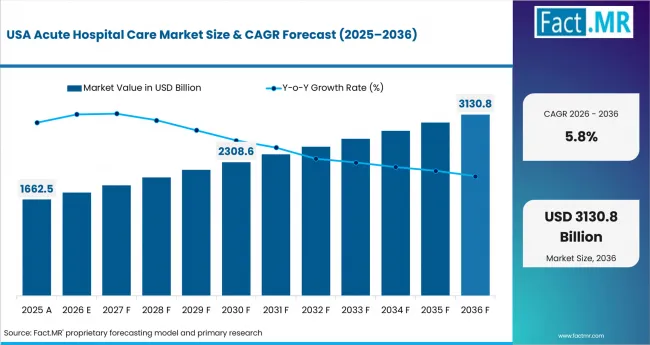
North America demand is led by the United States because acute hospitals manage high emergency volume and complex inpatient cases. Hospital-at-home programs and observation pathways are gaining attention as health systems manage bed pressure. The market is more value-led than access-led.
- United States: The United States is expected to register 5.8% CAGR over the forecast period as high-acuity admissions and hospital-at-home programs support demand. AHA lists 6,100 U.S. hospitals and 907,216 staffed beds in its 2026 fast facts. [3] Hospitals are balancing emergency demand with labor and reimbursement pressure. Providers with better patient flow and payer contracting will hold stronger positions.
Western Europe Acute Hospital Care Market Analysis
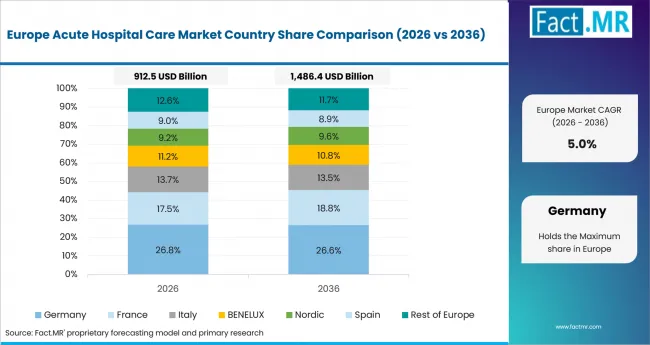
Western Europe demand comes from aging populations and protocol-led acute care. The United Kingdom faces capacity pressure across emergency and inpatient care. Germany has an established hospital system with specialist access. Acute care demand is steady because older patients need hospital-based treatment more often.
- United Kingdom: The United Kingdom is set to record 5.4% CAGR from 2026 to 2036 as NHS capacity pressure and virtual ward programs shape acute care delivery. Hospitals face emergency demand and discharge delays. Virtual wards can support selected patients outside inpatient beds. Acute care demand depends on public funding and workforce availability. Providers need stronger patient flow and community handoff.
- Germany: Germany has an established acute hospital system and specialist capacity. Hospitals provide broad inpatient and emergency services through established care networks. This supports 4.9% CAGR through 2036 because protocol-led acute care and aging demand sustain service use. Payment reform and hospital restructuring may influence bed use. Hospitals will focus on efficiency and quality reporting.
Competitive Aligners for Market Suppliers
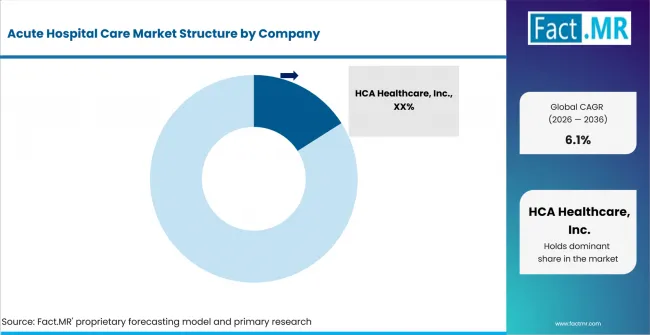
The acute hospital care market is driven by hospital networks and academic medical centers that manage emergency care and intensive care. HCA Healthcare, Inc. has a broad acute care base. The company reported operating 190 hospitals and about 2,500 ambulatory sites as of December 31, 2025. [4] Tenet Healthcare Corporation competes through hospital operations and ambulatory care links. Tenet reported a 7.5% year-over-year rise in same-hospital net patient service revenue per adjusted admission in Q4 2025. [5]
Universal Health Services, Inc. and Community Health Systems, Inc. serve acute care demand through hospital networks across regional markets. Their role is tied to emergency access and service-line availability. Mayo Clinic adds a different competitive position through academic care and specialist-led hospital services.
Through 2036, competition will depend on acuity mix and patient flow. Hospitals need to treat complex patients without adding unnecessary length of stay. Provider networks with emergency access and clear discharge planning will gain better market positions.
Key Companies in Acute Hospital Care Market
- HCA Healthcare, Inc.
- Tenet Healthcare Corporation
- Universal Health Services, Inc.
- Community Health Systems, Inc.
- Mayo Clinic
Bibliography
- [1] Centers for Medicare & Medicaid Services. (2025, July 31). FY 2026 Hospital Inpatient Prospective Payment System and Long-Term Care Hospital Prospective Payment System final rule. Centers for Medicare & Medicaid Services.
- [2] OECD. (2025, November 13). Health at a glance 2025: OECD indicators. OECD Publishing.
- [3] American Hospital Association. (2026, February). Fast facts on U.S. hospitals, 2026. American Hospital Association.
- [4] HCA Healthcare, Inc. (2026, January 27). HCA Healthcare reports fourth quarter 2025 results and provides 2026 guidance. HCA Healthcare.
- [5] Tenet Healthcare Corporation. (2026, February 11). Tenet reports strong fourth quarter and FY 2025 results. Tenet Healthcare Corporation.
This Report Addresses
- Strategic intelligence on acute hospital care demand across service type, care setting, payment model, delivery model, and patient group.
- Forecast mapping from USD 3,621.4 billion in 2026 to USD 6,540.8 billion by 2036.
- Segment analysis covering inpatient acute medical care, general acute care hospitals, public reimbursement, facility-based inpatient care, and geriatric patients.
- Regional outlook covering India, China, the United States, the United Kingdom, and Germany.
- Competitive analysis of HCA Healthcare, Inc., Tenet Healthcare Corporation, Universal Health Services, Inc., Community Health Systems, Inc., Mayo Clinic.
- Service assessment covering emergency care, acute surgery, ICU care, and acute hospital-at-home programs.
- Payment assessment covering public insurance reimbursement, private insurance, out-of-pocket payment, value-based contracts, and charity and uncompensated care.
- Primary interviews, supplier checks, official source review, and acute hospital workflow validation support the forecast.
Acute Hospital Care Market Definition
The acute hospital care market covers urgent and short-term hospital services used to diagnose and treat serious medical conditions. It includes emergency care and hospital-at-home care. The market differs from long-term care because it focuses on immediate treatment and stabilization.
Acute Hospital Care Market Inclusions
The scope includes emergency department care and acute hospital-at-home programs. It includes general acute hospitals and specialty acute facilities. Payment through public insurance and direct payment is included.
Acute Hospital Care Market Exclusions
The scope excludes long-term nursing care and chronic disease management without an acute episode. It excludes home healthcare that does not provide hospital-level acute treatment. It excludes psychiatric hospitals unless the service is tied to acute medical stabilization.
Acute Hospital Care Market Research Methodology
- Primary Research
- Primary research includes interviews with hospital administrators and emergency department leaders. It includes input from acute care physicians and hospital finance managers.
- Desk Research
- Desk research reviews CMS policy updates and official hospital statistics. It covers acute inpatient payment updates and company reporting.
- Market-Sizing and Forecasting
- Forecasting uses service type demand and care setting mix. Payment model movement and patient group demand support the market assessment.
- Data Validation and Update Cycle
- Forecasts are validated through hospital feedback and payer checks. Admissions and hospital-at-home program signals help confirm market direction.
Scope of the Report

| Attribute | Details |
|---|---|
| Quantitative Units | USD 3,621.4 billion in 2026 to USD 6,540.8 billion by 2036 at 6.1% CAGR |
| Market Definition | Urgent and short-term hospital services used to diagnose, stabilize, and treat serious medical conditions |
| Service Type | Inpatient Acute Medical Care, Emergency Care, Acute Surgical Care, Critical Care and ICU Care, Acute Hospital-at-Home |
| Care Setting | General Acute Care Hospitals, Academic Medical Centers, Community Hospitals, Rural Acute Care Hospitals, Specialty Acute Care Hospitals |
| Payment Model | Public Insurance Reimbursement, Private Insurance, Out-of-Pocket Payment, Value-Based Contracts, Charity and Uncompensated Care |
| Delivery Model | Facility-Based Inpatient Care, Emergency Department-Based Care, ICU-Based Care, Observation and Short-Stay Care, Acute Hospital-at-Home |
| Patient Group | Adult Patients, Geriatric Patients, Pediatric Patients, Trauma and Emergency Patients, High-Acuity Chronic Patients |
| Regions Covered | North America, Latin America, Western Europe, Eastern Europe, East Asia, South Asia and Pacific, Middle East and Africa |
| Countries Covered | India, China, United States, United Kingdom, Germany |
| Key Companies Profiled | HCA Healthcare, Inc., Tenet Healthcare Corporation, Universal Health Services, Inc., Community Health Systems, Inc., Mayo Clinic |
| Forecast Period | 2026 to 2036 |
| Approach | Hybrid top-down and bottom-up approach using service type demand, care setting mix, payment model, delivery model, patient group demand, and regional validation |
Acute Hospital Care Market Analysis by Segments
-
By Service Type:
- Inpatient Acute Medical Care
- Emergency Care
- Acute Surgical Care
- Critical Care and ICU Care
- Acute Hospital-at-Home
-
By Care Setting:
- General Acute Care Hospitals
- Academic Medical Centers
- Community Hospitals
- Rural Acute Care Hospitals
- Specialty Acute Care Hospitals
-
By Payment Model:
- Public Insurance Reimbursement
- Private Insurance
- Out-of-Pocket Payment
- Value-Based Contracts
- Charity and Uncompensated Care
-
By Delivery Model:
- Facility-Based Inpatient Care
- Emergency Department-Based Care
- ICU-Based Care
- Observation and Short-Stay Care
- Acute Hospital-at-Home
-
By Patient Group:
- Adult Patients
- Geriatric Patients
- Pediatric Patients
- Trauma and Emergency Patients
- High-Acuity Chronic Patients
-
Region:
- North America
- United States
- Canada
- Europe
- Germany
- United Kingdom
- France
- Italy
- Spain
- Asia Pacific
- China
- Japan
- South Korea
- Taiwan
- Singapore
- Latin America
- Brazil
- Mexico
- Argentina
- Middle East & Africa
- GCC Countries
- South Africa
- Israel
- North America
- Frequently Asked Questions -
What is the Acute Hospital Care Market size in 2026?
The acute hospital care market is estimated to reach USD 3,621.4 billion in 2026.
What will the Acute Hospital Care Market be worth by 2036?
The acute hospital care market is projected to reach USD 6,540.8 billion by 2036 as high-acuity hospital services expand.
What CAGR is projected for the Acute Hospital Care Market?
The acute hospital care market is forecast to record 6.1% CAGR during 2026 to 2036.
Which service type leads the Acute Hospital Care Market?
Inpatient acute medical care leads with 39.0% share in 2026 because hospitals manage serious medical admissions across core departments.
Which country expands fastest in the Acute Hospital Care Market?
India is projected to record 8.3% CAGR through 2036 as private hospital networks and emergency care access expand.
How does China perform in the Acute Hospital Care Market?
China is likely to post 7.6% CAGR through 2036 as tertiary hospitals and acute care infrastructure grow.
How does the United States perform in the Acute Hospital Care Market?
The United States is forecast to register 5.8% CAGR as high-acuity admissions and hospital-at-home programs support demand.
What is the primary driver in the Acute Hospital Care Market?
The primary driver is emergency access. Hospitals need acute capacity for trauma and severe infection.
What is the main restraint in the Acute Hospital Care Market?
The main restraint is staffing pressure. Acute hospitals need trained clinicians to keep beds and ICUs operational.
Why is inpatient acute medical care important in this market?
Inpatient acute medical care is important because serious illness often needs continuous monitoring and rapid treatment adjustment.
Why are general acute care hospitals important in this market?
General acute care hospitals are important because they provide emergency access and broad inpatient care for communities.
Table of Content
- Executive Summary
- Global Market Outlook
- Demand to side Trends
- Supply to side Trends
- Technology Roadmap Analysis
- Analysis and Recommendations
- Market Overview
- Market Coverage / Taxonomy
- Market Definition / Scope / Limitations
- Research Methodology
- Chapter Orientation
- Analytical Lens and Working Hypotheses
- Market Structure, Signals, and Trend Drivers
- Benchmarking and Cross-market Comparability
- Market Sizing, Forecasting, and Opportunity Mapping
- Research Design and Evidence Framework
- Desk Research Programme (Secondary Evidence)
- Company Annual and Sustainability Reports
- Peer-reviewed Journals and Academic Literature
- Corporate Websites, Product Literature, and Technical Notes
- Earnings Decks and Investor Briefings
- Statutory Filings and Regulatory Disclosures
- Technical White Papers and Standards Notes
- Trade Journals, Industry Magazines, and Analyst Briefs
- Conference Proceedings, Webinars, and Seminar Materials
- Government Statistics Portals and Public Data Releases
- Press Releases and Reputable Media Coverage
- Specialist Newsletters and Curated Briefings
- Sector Databases and Reference Repositories
- Fact.MR Internal Proprietary Databases and Historical Market Datasets
- Subscription Datasets and Paid Sources
- Social Channels, Communities, and Digital Listening Inputs
- Additional Desk Sources
- Expert Input and Fieldwork (Primary Evidence)
- Primary Modes
- Qualitative Interviews and Expert Elicitation
- Quantitative Surveys and Structured Data Capture
- Blended Approach
- Why Primary Evidence is Used
- Field Techniques
- Interviews
- Surveys
- Focus Groups
- Observational and In-context Research
- Social and Community Interactions
- Stakeholder Universe Engaged
- C-suite Leaders
- Board Members
- Presidents and Vice Presidents
- R&D and Innovation Heads
- Technical Specialists
- Domain Subject-matter Experts
- Scientists
- Physicians and Other Healthcare Professionals
- Governance, Ethics, and Data Stewardship
- Research Ethics
- Data Integrity and Handling
- Primary Modes
- Tooling, Models, and Reference Databases
- Desk Research Programme (Secondary Evidence)
- Data Engineering and Model Build
- Data Acquisition and Ingestion
- Cleaning, Normalisation, and Verification
- Synthesis, Triangulation, and Analysis
- Quality Assurance and Audit Trail
- Market Background
- Market Dynamics
- Drivers
- Restraints
- Opportunity
- Trends
- Scenario Forecast
- Demand in Optimistic Scenario
- Demand in Likely Scenario
- Demand in Conservative Scenario
- Opportunity Map Analysis
- Product Life Cycle Analysis
- Supply Chain Analysis
- Investment Feasibility Matrix
- Value Chain Analysis
- PESTLE and Porter’s Analysis
- Regulatory Landscape
- Regional Parent Market Outlook
- Production and Consumption Statistics
- Import and Export Statistics
- Market Dynamics
- Global Market Analysis 2021 to 2025 and Forecast, 2026 to 2036
- Historical Market Size Value (USD Million) Analysis, 2021 to 2025
- Current and Future Market Size Value (USD Million) Projections, 2026 to 2036
- Y to o to Y Growth Trend Analysis
- Absolute $ Opportunity Analysis
- Global Market Pricing Analysis 2021 to 2025 and Forecast 2026 to 2036
- Global Market Analysis 2021 to 2025 and Forecast 2026 to 2036, By Disease Type
- Introduction / Key Findings
- Historical Market Size Value (USD Million) Analysis By Disease Type , 2021 to 2025
- Current and Future Market Size Value (USD Million) Analysis and Forecast By Disease Type , 2026 to 2036
- Non-ST-Elevation Myocardial Infarction
- Unstable Angina
- Recurrent ACS
- High-Risk NSTE-ACS
- ST-Elevation Myocardial Infarction
- Non-ST-Elevation Myocardial Infarction
- Y to o to Y Growth Trend Analysis By Disease Type , 2021 to 2025
- Absolute $ Opportunity Analysis By Disease Type , 2026 to 2036
- Global Market Analysis 2021 to 2025 and Forecast 2026 to 2036, By Treatment Type
- Introduction / Key Findings
- Historical Market Size Value (USD Million) Analysis By Treatment Type, 2021 to 2025
- Current and Future Market Size Value (USD Million) Analysis and Forecast By Treatment Type, 2026 to 2036
- Antiplatelet Therapy
- Anticoagulant Therapy
- PCI and Stent-Based Revascularization
- Thrombolytic Therapy
- Lipid-Lowering and Stabilization Therapy
- Antiplatelet Therapy
- Y to o to Y Growth Trend Analysis By Treatment Type, 2021 to 2025
- Absolute $ Opportunity Analysis By Treatment Type, 2026 to 2036
- Global Market Analysis 2021 to 2025 and Forecast 2026 to 2036, By Diagnosis
- Introduction / Key Findings
- Historical Market Size Value (USD Million) Analysis By Diagnosis, 2021 to 2025
- Current and Future Market Size Value (USD Million) Analysis and Forecast By Diagnosis, 2026 to 2036
- Cardiac Troponin Tests
- Electrocardiography
- Echocardiography
- Coronary Angiography
- Risk Stratification Tools
- Cardiac Troponin Tests
- Y to o to Y Growth Trend Analysis By Diagnosis, 2021 to 2025
- Absolute $ Opportunity Analysis By Diagnosis, 2026 to 2036
- Global Market Analysis 2021 to 2025 and Forecast 2026 to 2036, By End User
- Introduction / Key Findings
- Historical Market Size Value (USD Million) Analysis By End User, 2021 to 2025
- Current and Future Market Size Value (USD Million) Analysis and Forecast By End User, 2026 to 2036
- Hospitals
- Cardiac Centers
- Emergency Departments
- Diagnostic Laboratories
- Ambulatory Care Centers
- Hospitals
- Y to o to Y Growth Trend Analysis By End User, 2021 to 2025
- Absolute $ Opportunity Analysis By End User, 2026 to 2036
- Global Market Analysis 2021 to 2025 and Forecast 2026 to 2036, By Sales Channel
- Introduction / Key Findings
- Historical Market Size Value (USD Million) Analysis By Sales Channel, 2021 to 2025
- Current and Future Market Size Value (USD Million) Analysis and Forecast By Sales Channel, 2026 to 2036
- Hospital Pharmacies
- Direct Hospital Procurement
- Retail Pharmacies
- Diagnostic Supply Channels
- Tender and Public Procurement
- Hospital Pharmacies
- Y to o to Y Growth Trend Analysis By Sales Channel, 2021 to 2025
- Absolute $ Opportunity Analysis By Sales Channel, 2026 to 2036
- Global Market Analysis 2021 to 2025 and Forecast 2026 to 2036, By Region
- Introduction
- Historical Market Size Value (USD Million) Analysis By Region, 2021 to 2025
- Current Market Size Value (USD Million) Analysis and Forecast By Region, 2026 to 2036
- North America
- Latin America
- Western Europe
- Eastern Europe
- East Asia
- South Asia and Pacific
- Middle East & Africa
- Market Attractiveness Analysis By Region
- North America Market Analysis 2021 to 2025 and Forecast 2026 to 2036, By Country
- Historical Market Size Value (USD Million) Trend Analysis By Market Taxonomy, 2021 to 2025
- Market Size Value (USD Million) Forecast By Market Taxonomy, 2026 to 2036
- By Country
- USA
- Canada
- Mexico
- By Disease Type
- By Treatment Type
- By Diagnosis
- By End User
- By Sales Channel
- By Country
- Market Attractiveness Analysis
- By Country
- By Disease Type
- By Treatment Type
- By Diagnosis
- By End User
- By Sales Channel
- Key Takeaways
- Latin America Market Analysis 2021 to 2025 and Forecast 2026 to 2036, By Country
- Historical Market Size Value (USD Million) Trend Analysis By Market Taxonomy, 2021 to 2025
- Market Size Value (USD Million) Forecast By Market Taxonomy, 2026 to 2036
- By Country
- Brazil
- Chile
- Rest of Latin America
- By Disease Type
- By Treatment Type
- By Diagnosis
- By End User
- By Sales Channel
- By Country
- Market Attractiveness Analysis
- By Country
- By Disease Type
- By Treatment Type
- By Diagnosis
- By End User
- By Sales Channel
- Key Takeaways
- Western Europe Market Analysis 2021 to 2025 and Forecast 2026 to 2036, By Country
- Historical Market Size Value (USD Million) Trend Analysis By Market Taxonomy, 2021 to 2025
- Market Size Value (USD Million) Forecast By Market Taxonomy, 2026 to 2036
- By Country
- Germany
- UK
- Italy
- Spain
- France
- Nordic
- BENELUX
- Rest of Western Europe
- By Disease Type
- By Treatment Type
- By Diagnosis
- By End User
- By Sales Channel
- By Country
- Market Attractiveness Analysis
- By Country
- By Disease Type
- By Treatment Type
- By Diagnosis
- By End User
- By Sales Channel
- Key Takeaways
- Eastern Europe Market Analysis 2021 to 2025 and Forecast 2026 to 2036, By Country
- Historical Market Size Value (USD Million) Trend Analysis By Market Taxonomy, 2021 to 2025
- Market Size Value (USD Million) Forecast By Market Taxonomy, 2026 to 2036
- By Country
- Russia
- Poland
- Hungary
- Balkan & Baltic
- Rest of Eastern Europe
- By Disease Type
- By Treatment Type
- By Diagnosis
- By End User
- By Sales Channel
- By Country
- Market Attractiveness Analysis
- By Country
- By Disease Type
- By Treatment Type
- By Diagnosis
- By End User
- By Sales Channel
- Key Takeaways
- East Asia Market Analysis 2021 to 2025 and Forecast 2026 to 2036, By Country
- Historical Market Size Value (USD Million) Trend Analysis By Market Taxonomy, 2021 to 2025
- Market Size Value (USD Million) Forecast By Market Taxonomy, 2026 to 2036
- By Country
- China
- Japan
- South Korea
- By Disease Type
- By Treatment Type
- By Diagnosis
- By End User
- By Sales Channel
- By Country
- Market Attractiveness Analysis
- By Country
- By Disease Type
- By Treatment Type
- By Diagnosis
- By End User
- By Sales Channel
- Key Takeaways
- South Asia and Pacific Market Analysis 2021 to 2025 and Forecast 2026 to 2036, By Country
- Historical Market Size Value (USD Million) Trend Analysis By Market Taxonomy, 2021 to 2025
- Market Size Value (USD Million) Forecast By Market Taxonomy, 2026 to 2036
- By Country
- India
- ASEAN
- Australia & New Zealand
- Rest of South Asia and Pacific
- By Disease Type
- By Treatment Type
- By Diagnosis
- By End User
- By Sales Channel
- By Country
- Market Attractiveness Analysis
- By Country
- By Disease Type
- By Treatment Type
- By Diagnosis
- By End User
- By Sales Channel
- Key Takeaways
- Middle East & Africa Market Analysis 2021 to 2025 and Forecast 2026 to 2036, By Country
- Historical Market Size Value (USD Million) Trend Analysis By Market Taxonomy, 2021 to 2025
- Market Size Value (USD Million) Forecast By Market Taxonomy, 2026 to 2036
- By Country
- Kingdom of Saudi Arabia
- Other GCC Countries
- Turkiye
- South Africa
- Other African Union
- Rest of Middle East & Africa
- By Disease Type
- By Treatment Type
- By Diagnosis
- By End User
- By Sales Channel
- By Country
- Market Attractiveness Analysis
- By Country
- By Disease Type
- By Treatment Type
- By Diagnosis
- By End User
- By Sales Channel
- Key Takeaways
- Key Countries Market Analysis
- USA
- Pricing Analysis
- Market Share Analysis, 2025
- By Disease Type
- By Treatment Type
- By Diagnosis
- By End User
- By Sales Channel
- Canada
- Pricing Analysis
- Market Share Analysis, 2025
- By Disease Type
- By Treatment Type
- By Diagnosis
- By End User
- By Sales Channel
- Mexico
- Pricing Analysis
- Market Share Analysis, 2025
- By Disease Type
- By Treatment Type
- By Diagnosis
- By End User
- By Sales Channel
- Brazil
- Pricing Analysis
- Market Share Analysis, 2025
- By Disease Type
- By Treatment Type
- By Diagnosis
- By End User
- By Sales Channel
- Chile
- Pricing Analysis
- Market Share Analysis, 2025
- By Disease Type
- By Treatment Type
- By Diagnosis
- By End User
- By Sales Channel
- Germany
- Pricing Analysis
- Market Share Analysis, 2025
- By Disease Type
- By Treatment Type
- By Diagnosis
- By End User
- By Sales Channel
- UK
- Pricing Analysis
- Market Share Analysis, 2025
- By Disease Type
- By Treatment Type
- By Diagnosis
- By End User
- By Sales Channel
- Italy
- Pricing Analysis
- Market Share Analysis, 2025
- By Disease Type
- By Treatment Type
- By Diagnosis
- By End User
- By Sales Channel
- Spain
- Pricing Analysis
- Market Share Analysis, 2025
- By Disease Type
- By Treatment Type
- By Diagnosis
- By End User
- By Sales Channel
- France
- Pricing Analysis
- Market Share Analysis, 2025
- By Disease Type
- By Treatment Type
- By Diagnosis
- By End User
- By Sales Channel
- India
- Pricing Analysis
- Market Share Analysis, 2025
- By Disease Type
- By Treatment Type
- By Diagnosis
- By End User
- By Sales Channel
- ASEAN
- Pricing Analysis
- Market Share Analysis, 2025
- By Disease Type
- By Treatment Type
- By Diagnosis
- By End User
- By Sales Channel
- Australia & New Zealand
- Pricing Analysis
- Market Share Analysis, 2025
- By Disease Type
- By Treatment Type
- By Diagnosis
- By End User
- By Sales Channel
- China
- Pricing Analysis
- Market Share Analysis, 2025
- By Disease Type
- By Treatment Type
- By Diagnosis
- By End User
- By Sales Channel
- Japan
- Pricing Analysis
- Market Share Analysis, 2025
- By Disease Type
- By Treatment Type
- By Diagnosis
- By End User
- By Sales Channel
- South Korea
- Pricing Analysis
- Market Share Analysis, 2025
- By Disease Type
- By Treatment Type
- By Diagnosis
- By End User
- By Sales Channel
- Russia
- Pricing Analysis
- Market Share Analysis, 2025
- By Disease Type
- By Treatment Type
- By Diagnosis
- By End User
- By Sales Channel
- Poland
- Pricing Analysis
- Market Share Analysis, 2025
- By Disease Type
- By Treatment Type
- By Diagnosis
- By End User
- By Sales Channel
- Hungary
- Pricing Analysis
- Market Share Analysis, 2025
- By Disease Type
- By Treatment Type
- By Diagnosis
- By End User
- By Sales Channel
- Kingdom of Saudi Arabia
- Pricing Analysis
- Market Share Analysis, 2025
- By Disease Type
- By Treatment Type
- By Diagnosis
- By End User
- By Sales Channel
- Turkiye
- Pricing Analysis
- Market Share Analysis, 2025
- By Disease Type
- By Treatment Type
- By Diagnosis
- By End User
- By Sales Channel
- South Africa
- Pricing Analysis
- Market Share Analysis, 2025
- By Disease Type
- By Treatment Type
- By Diagnosis
- By End User
- By Sales Channel
- USA
- Market Structure Analysis
- Competition Dashboard
- Competition Benchmarking
- Market Share Analysis of Top Players
- By Regional
- By Disease Type
- By Treatment Type
- By Diagnosis
- By End User
- By Sales Channel
- Competition Analysis
- Competition Deep Dive
- AstraZeneca plc
- Overview
- Product Portfolio
- Profitability by Market Segments (Product/Age /Sales Channel/Region)
- Sales Footprint
- Strategy Overview
- Marketing Strategy
- Product Strategy
- Channel Strategy
- Bayer AG
- Sanofi S.A.
- Roche Diagnostics
- AstraZeneca plc
- Competition Deep Dive
- Assumptions & Acronyms Used
List Of Table
- Table 1: Global Market Value (USD Million) Forecast by Region, 2021 to 2036
- Table 2: Global Market Value (USD Million) Forecast by Disease Type , 2021 to 2036
- Table 3: Global Market Value (USD Million) Forecast by Treatment Type, 2021 to 2036
- Table 4: Global Market Value (USD Million) Forecast by Diagnosis, 2021 to 2036
- Table 5: Global Market Value (USD Million) Forecast by End User, 2021 to 2036
- Table 6: Global Market Value (USD Million) Forecast by Sales Channel, 2021 to 2036
- Table 7: North America Market Value (USD Million) Forecast by Country, 2021 to 2036
- Table 8: North America Market Value (USD Million) Forecast by Disease Type , 2021 to 2036
- Table 9: North America Market Value (USD Million) Forecast by Treatment Type, 2021 to 2036
- Table 10: North America Market Value (USD Million) Forecast by Diagnosis, 2021 to 2036
- Table 11: North America Market Value (USD Million) Forecast by End User, 2021 to 2036
- Table 12: North America Market Value (USD Million) Forecast by Sales Channel, 2021 to 2036
- Table 13: Latin America Market Value (USD Million) Forecast by Country, 2021 to 2036
- Table 14: Latin America Market Value (USD Million) Forecast by Disease Type , 2021 to 2036
- Table 15: Latin America Market Value (USD Million) Forecast by Treatment Type, 2021 to 2036
- Table 16: Latin America Market Value (USD Million) Forecast by Diagnosis, 2021 to 2036
- Table 17: Latin America Market Value (USD Million) Forecast by End User, 2021 to 2036
- Table 18: Latin America Market Value (USD Million) Forecast by Sales Channel, 2021 to 2036
- Table 19: Western Europe Market Value (USD Million) Forecast by Country, 2021 to 2036
- Table 20: Western Europe Market Value (USD Million) Forecast by Disease Type , 2021 to 2036
- Table 21: Western Europe Market Value (USD Million) Forecast by Treatment Type, 2021 to 2036
- Table 22: Western Europe Market Value (USD Million) Forecast by Diagnosis, 2021 to 2036
- Table 23: Western Europe Market Value (USD Million) Forecast by End User, 2021 to 2036
- Table 24: Western Europe Market Value (USD Million) Forecast by Sales Channel, 2021 to 2036
- Table 25: Eastern Europe Market Value (USD Million) Forecast by Country, 2021 to 2036
- Table 26: Eastern Europe Market Value (USD Million) Forecast by Disease Type , 2021 to 2036
- Table 27: Eastern Europe Market Value (USD Million) Forecast by Treatment Type, 2021 to 2036
- Table 28: Eastern Europe Market Value (USD Million) Forecast by Diagnosis, 2021 to 2036
- Table 29: Eastern Europe Market Value (USD Million) Forecast by End User, 2021 to 2036
- Table 30: Eastern Europe Market Value (USD Million) Forecast by Sales Channel, 2021 to 2036
- Table 31: East Asia Market Value (USD Million) Forecast by Country, 2021 to 2036
- Table 32: East Asia Market Value (USD Million) Forecast by Disease Type , 2021 to 2036
- Table 33: East Asia Market Value (USD Million) Forecast by Treatment Type, 2021 to 2036
- Table 34: East Asia Market Value (USD Million) Forecast by Diagnosis, 2021 to 2036
- Table 35: East Asia Market Value (USD Million) Forecast by End User, 2021 to 2036
- Table 36: East Asia Market Value (USD Million) Forecast by Sales Channel, 2021 to 2036
- Table 37: South Asia and Pacific Market Value (USD Million) Forecast by Country, 2021 to 2036
- Table 38: South Asia and Pacific Market Value (USD Million) Forecast by Disease Type , 2021 to 2036
- Table 39: South Asia and Pacific Market Value (USD Million) Forecast by Treatment Type, 2021 to 2036
- Table 40: South Asia and Pacific Market Value (USD Million) Forecast by Diagnosis, 2021 to 2036
- Table 41: South Asia and Pacific Market Value (USD Million) Forecast by End User, 2021 to 2036
- Table 42: South Asia and Pacific Market Value (USD Million) Forecast by Sales Channel, 2021 to 2036
- Table 43: Middle East & Africa Market Value (USD Million) Forecast by Country, 2021 to 2036
- Table 44: Middle East & Africa Market Value (USD Million) Forecast by Disease Type , 2021 to 2036
- Table 45: Middle East & Africa Market Value (USD Million) Forecast by Treatment Type, 2021 to 2036
- Table 46: Middle East & Africa Market Value (USD Million) Forecast by Diagnosis, 2021 to 2036
- Table 47: Middle East & Africa Market Value (USD Million) Forecast by End User, 2021 to 2036
- Table 48: Middle East & Africa Market Value (USD Million) Forecast by Sales Channel, 2021 to 2036
List Of Figures
- Figure 1: Global Market Pricing Analysis
- Figure 2: Global Market Value (USD Million) Forecast 2021-2036
- Figure 3: Global Market Value Share and BPS Analysis by Disease Type , 2026 and 2036
- Figure 4: Global Market Y-o-Y Growth Comparison by Disease Type , 2026-2036
- Figure 5: Global Market Attractiveness Analysis by Disease Type
- Figure 6: Global Market Value Share and BPS Analysis by Treatment Type, 2026 and 2036
- Figure 7: Global Market Y-o-Y Growth Comparison by Treatment Type, 2026-2036
- Figure 8: Global Market Attractiveness Analysis by Treatment Type
- Figure 9: Global Market Value Share and BPS Analysis by Diagnosis, 2026 and 2036
- Figure 10: Global Market Y-o-Y Growth Comparison by Diagnosis, 2026-2036
- Figure 11: Global Market Attractiveness Analysis by Diagnosis
- Figure 12: Global Market Value Share and BPS Analysis by End User, 2026 and 2036
- Figure 13: Global Market Y-o-Y Growth Comparison by End User, 2026-2036
- Figure 14: Global Market Attractiveness Analysis by End User
- Figure 15: Global Market Value Share and BPS Analysis by Sales Channel, 2026 and 2036
- Figure 16: Global Market Y-o-Y Growth Comparison by Sales Channel, 2026-2036
- Figure 17: Global Market Attractiveness Analysis by Sales Channel
- Figure 18: Global Market Value (USD Million) Share and BPS Analysis by Region, 2026 and 2036
- Figure 19: Global Market Y-o-Y Growth Comparison by Region, 2026-2036
- Figure 20: Global Market Attractiveness Analysis by Region
- Figure 21: North America Market Incremental Dollar Opportunity, 2026-2036
- Figure 22: Latin America Market Incremental Dollar Opportunity, 2026-2036
- Figure 23: Western Europe Market Incremental Dollar Opportunity, 2026-2036
- Figure 24: Eastern Europe Market Incremental Dollar Opportunity, 2026-2036
- Figure 25: East Asia Market Incremental Dollar Opportunity, 2026-2036
- Figure 26: South Asia and Pacific Market Incremental Dollar Opportunity, 2026-2036
- Figure 27: Middle East & Africa Market Incremental Dollar Opportunity, 2026-2036
- Figure 28: North America Market Value Share and BPS Analysis by Country, 2026 and 2036
- Figure 29: North America Market Value Share and BPS Analysis by Disease Type , 2026 and 2036
- Figure 30: North America Market Y-o-Y Growth Comparison by Disease Type , 2026-2036
- Figure 31: North America Market Attractiveness Analysis by Disease Type
- Figure 32: North America Market Value Share and BPS Analysis by Treatment Type, 2026 and 2036
- Figure 33: North America Market Y-o-Y Growth Comparison by Treatment Type, 2026-2036
- Figure 34: North America Market Attractiveness Analysis by Treatment Type
- Figure 35: North America Market Value Share and BPS Analysis by Diagnosis, 2026 and 2036
- Figure 36: North America Market Y-o-Y Growth Comparison by Diagnosis, 2026-2036
- Figure 37: North America Market Attractiveness Analysis by Diagnosis
- Figure 38: North America Market Value Share and BPS Analysis by End User, 2026 and 2036
- Figure 39: North America Market Y-o-Y Growth Comparison by End User, 2026-2036
- Figure 40: North America Market Attractiveness Analysis by End User
- Figure 41: North America Market Value Share and BPS Analysis by Sales Channel, 2026 and 2036
- Figure 42: North America Market Y-o-Y Growth Comparison by Sales Channel, 2026-2036
- Figure 43: North America Market Attractiveness Analysis by Sales Channel
- Figure 44: Latin America Market Value Share and BPS Analysis by Country, 2026 and 2036
- Figure 45: Latin America Market Value Share and BPS Analysis by Disease Type , 2026 and 2036
- Figure 46: Latin America Market Y-o-Y Growth Comparison by Disease Type , 2026-2036
- Figure 47: Latin America Market Attractiveness Analysis by Disease Type
- Figure 48: Latin America Market Value Share and BPS Analysis by Treatment Type, 2026 and 2036
- Figure 49: Latin America Market Y-o-Y Growth Comparison by Treatment Type, 2026-2036
- Figure 50: Latin America Market Attractiveness Analysis by Treatment Type
- Figure 51: Latin America Market Value Share and BPS Analysis by Diagnosis, 2026 and 2036
- Figure 52: Latin America Market Y-o-Y Growth Comparison by Diagnosis, 2026-2036
- Figure 53: Latin America Market Attractiveness Analysis by Diagnosis
- Figure 54: Latin America Market Value Share and BPS Analysis by End User, 2026 and 2036
- Figure 55: Latin America Market Y-o-Y Growth Comparison by End User, 2026-2036
- Figure 56: Latin America Market Attractiveness Analysis by End User
- Figure 57: Latin America Market Value Share and BPS Analysis by Sales Channel, 2026 and 2036
- Figure 58: Latin America Market Y-o-Y Growth Comparison by Sales Channel, 2026-2036
- Figure 59: Latin America Market Attractiveness Analysis by Sales Channel
- Figure 60: Western Europe Market Value Share and BPS Analysis by Country, 2026 and 2036
- Figure 61: Western Europe Market Value Share and BPS Analysis by Disease Type , 2026 and 2036
- Figure 62: Western Europe Market Y-o-Y Growth Comparison by Disease Type , 2026-2036
- Figure 63: Western Europe Market Attractiveness Analysis by Disease Type
- Figure 64: Western Europe Market Value Share and BPS Analysis by Treatment Type, 2026 and 2036
- Figure 65: Western Europe Market Y-o-Y Growth Comparison by Treatment Type, 2026-2036
- Figure 66: Western Europe Market Attractiveness Analysis by Treatment Type
- Figure 67: Western Europe Market Value Share and BPS Analysis by Diagnosis, 2026 and 2036
- Figure 68: Western Europe Market Y-o-Y Growth Comparison by Diagnosis, 2026-2036
- Figure 69: Western Europe Market Attractiveness Analysis by Diagnosis
- Figure 70: Western Europe Market Value Share and BPS Analysis by End User, 2026 and 2036
- Figure 71: Western Europe Market Y-o-Y Growth Comparison by End User, 2026-2036
- Figure 72: Western Europe Market Attractiveness Analysis by End User
- Figure 73: Western Europe Market Value Share and BPS Analysis by Sales Channel, 2026 and 2036
- Figure 74: Western Europe Market Y-o-Y Growth Comparison by Sales Channel, 2026-2036
- Figure 75: Western Europe Market Attractiveness Analysis by Sales Channel
- Figure 76: Eastern Europe Market Value Share and BPS Analysis by Country, 2026 and 2036
- Figure 77: Eastern Europe Market Value Share and BPS Analysis by Disease Type , 2026 and 2036
- Figure 78: Eastern Europe Market Y-o-Y Growth Comparison by Disease Type , 2026-2036
- Figure 79: Eastern Europe Market Attractiveness Analysis by Disease Type
- Figure 80: Eastern Europe Market Value Share and BPS Analysis by Treatment Type, 2026 and 2036
- Figure 81: Eastern Europe Market Y-o-Y Growth Comparison by Treatment Type, 2026-2036
- Figure 82: Eastern Europe Market Attractiveness Analysis by Treatment Type
- Figure 83: Eastern Europe Market Value Share and BPS Analysis by Diagnosis, 2026 and 2036
- Figure 84: Eastern Europe Market Y-o-Y Growth Comparison by Diagnosis, 2026-2036
- Figure 85: Eastern Europe Market Attractiveness Analysis by Diagnosis
- Figure 86: Eastern Europe Market Value Share and BPS Analysis by End User, 2026 and 2036
- Figure 87: Eastern Europe Market Y-o-Y Growth Comparison by End User, 2026-2036
- Figure 88: Eastern Europe Market Attractiveness Analysis by End User
- Figure 89: Eastern Europe Market Value Share and BPS Analysis by Sales Channel, 2026 and 2036
- Figure 90: Eastern Europe Market Y-o-Y Growth Comparison by Sales Channel, 2026-2036
- Figure 91: Eastern Europe Market Attractiveness Analysis by Sales Channel
- Figure 92: East Asia Market Value Share and BPS Analysis by Country, 2026 and 2036
- Figure 93: East Asia Market Value Share and BPS Analysis by Disease Type , 2026 and 2036
- Figure 94: East Asia Market Y-o-Y Growth Comparison by Disease Type , 2026-2036
- Figure 95: East Asia Market Attractiveness Analysis by Disease Type
- Figure 96: East Asia Market Value Share and BPS Analysis by Treatment Type, 2026 and 2036
- Figure 97: East Asia Market Y-o-Y Growth Comparison by Treatment Type, 2026-2036
- Figure 98: East Asia Market Attractiveness Analysis by Treatment Type
- Figure 99: East Asia Market Value Share and BPS Analysis by Diagnosis, 2026 and 2036
- Figure 100: East Asia Market Y-o-Y Growth Comparison by Diagnosis, 2026-2036
- Figure 101: East Asia Market Attractiveness Analysis by Diagnosis
- Figure 102: East Asia Market Value Share and BPS Analysis by End User, 2026 and 2036
- Figure 103: East Asia Market Y-o-Y Growth Comparison by End User, 2026-2036
- Figure 104: East Asia Market Attractiveness Analysis by End User
- Figure 105: East Asia Market Value Share and BPS Analysis by Sales Channel, 2026 and 2036
- Figure 106: East Asia Market Y-o-Y Growth Comparison by Sales Channel, 2026-2036
- Figure 107: East Asia Market Attractiveness Analysis by Sales Channel
- Figure 108: South Asia and Pacific Market Value Share and BPS Analysis by Country, 2026 and 2036
- Figure 109: South Asia and Pacific Market Value Share and BPS Analysis by Disease Type , 2026 and 2036
- Figure 110: South Asia and Pacific Market Y-o-Y Growth Comparison by Disease Type , 2026-2036
- Figure 111: South Asia and Pacific Market Attractiveness Analysis by Disease Type
- Figure 112: South Asia and Pacific Market Value Share and BPS Analysis by Treatment Type, 2026 and 2036
- Figure 113: South Asia and Pacific Market Y-o-Y Growth Comparison by Treatment Type, 2026-2036
- Figure 114: South Asia and Pacific Market Attractiveness Analysis by Treatment Type
- Figure 115: South Asia and Pacific Market Value Share and BPS Analysis by Diagnosis, 2026 and 2036
- Figure 116: South Asia and Pacific Market Y-o-Y Growth Comparison by Diagnosis, 2026-2036
- Figure 117: South Asia and Pacific Market Attractiveness Analysis by Diagnosis
- Figure 118: South Asia and Pacific Market Value Share and BPS Analysis by End User, 2026 and 2036
- Figure 119: South Asia and Pacific Market Y-o-Y Growth Comparison by End User, 2026-2036
- Figure 120: South Asia and Pacific Market Attractiveness Analysis by End User
- Figure 121: South Asia and Pacific Market Value Share and BPS Analysis by Sales Channel, 2026 and 2036
- Figure 122: South Asia and Pacific Market Y-o-Y Growth Comparison by Sales Channel, 2026-2036
- Figure 123: South Asia and Pacific Market Attractiveness Analysis by Sales Channel
- Figure 124: Middle East & Africa Market Value Share and BPS Analysis by Country, 2026 and 2036
- Figure 125: Middle East & Africa Market Value Share and BPS Analysis by Disease Type , 2026 and 2036
- Figure 126: Middle East & Africa Market Y-o-Y Growth Comparison by Disease Type , 2026-2036
- Figure 127: Middle East & Africa Market Attractiveness Analysis by Disease Type
- Figure 128: Middle East & Africa Market Value Share and BPS Analysis by Treatment Type, 2026 and 2036
- Figure 129: Middle East & Africa Market Y-o-Y Growth Comparison by Treatment Type, 2026-2036
- Figure 130: Middle East & Africa Market Attractiveness Analysis by Treatment Type
- Figure 131: Middle East & Africa Market Value Share and BPS Analysis by Diagnosis, 2026 and 2036
- Figure 132: Middle East & Africa Market Y-o-Y Growth Comparison by Diagnosis, 2026-2036
- Figure 133: Middle East & Africa Market Attractiveness Analysis by Diagnosis
- Figure 134: Middle East & Africa Market Value Share and BPS Analysis by End User, 2026 and 2036
- Figure 135: Middle East & Africa Market Y-o-Y Growth Comparison by End User, 2026-2036
- Figure 136: Middle East & Africa Market Attractiveness Analysis by End User
- Figure 137: Middle East & Africa Market Value Share and BPS Analysis by Sales Channel, 2026 and 2036
- Figure 138: Middle East & Africa Market Y-o-Y Growth Comparison by Sales Channel, 2026-2036
- Figure 139: Middle East & Africa Market Attractiveness Analysis by Sales Channel
- Figure 140: Global Market - Tier Structure Analysis
- Figure 141: Global Market - Company Share Analysis