- Market Value (2025): USD 0.6 Bn
- Estimated Value (2026): USD 0.8 Bn
- Forecast Value (2036): USD 16.0 Bn
- CAGR (2026-2036): 34.9%
What is the AI Act conformity assessment services market forecast to be worth by 2036?
- The AI Act conformity assessment services market crossed a valuation of USD 0.6 billion in 2025.
- Demand is expected to increase from USD 0.8 billion in 2026 to USD 16.0 billion by 2036.
- The market is forecast to record 34.9% CAGR from 2026 to 2036 as high-risk AI vendors prepare for EU conformity obligations.
- Notified-body style certification and technical documentation services for high-risk AI systems under the EU AI Act form the core of this market.
- Regulation (EU) 2024/1689 requires providers of high-risk AI systems to keep technical documentation and complete the required conformity assessment before EU placement or use, which makes the service need regulation-created.
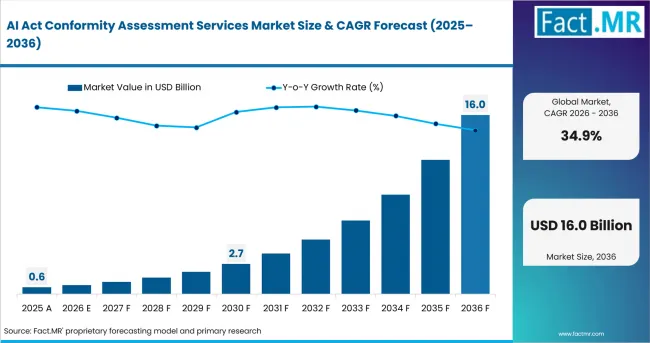
Ai Act Conformity Assessment Services Market Value Analysis | Source: Fact.MR
Summary of AI Act Conformity Assessment Services Market
- Demand Drivers in the Market
- AI compliance officers need classification support before deciding whether a system enters high-risk obligations.
- Product regulatory affairs managers need technical files that match AI Act evidence expectations.
- TIC service teams need repeatable assessment methods for high-risk AI systems.
- AI exporters need CE-marking support before placing covered systems in the EU.
- Key Segments Analyzed
- By Service Type: Technical Documentation and CE-Marking Support is expected to hold 33.0% share in 2026 because technical files are the first evidence bottleneck.
- By Assessment Scope: Standalone High-Risk AI Systems lead because Annex III use cases need clear classification. The segment is projected to capture 31.0% share in 2026.
- By Customer Type: AI System Providers are expected to account for 44.0% share in 2026 because provider obligations trigger the first assessment need.
- By Delivery Model: Advisory and Readiness Projects hold 41.0% share in 2026 as firms prepare before formal notified-body review.
- By Use Case: EU Market Entry is expected to capture 46.0% share in 2026 since conformity readiness directly affects sales access.
- By Geography: Germany is projected to grow at 37.8% CAGR through 2036 because TIC capacity and regulated product expertise support early adoption.
- Analyst Opinion at Fact.MR
- Shambhu Nath Jha, Senior Analyst at Fact.MR, states, “AI Act conformity assessment services will become a market-access layer for high-risk AI. Providers will not compete only on model performance. They will need technical files and assessment evidence that can survive notified-body and regulatory review.”
- Strategic Implications
- AI system providers should classify systems before product launch planning.
- Product manufacturers need AI evidence inside existing conformity workflows.
- TIC firms should build AI-specific technical review capacity before high-risk demand peaks.
- Deployers selling into the EU need proof that supplier systems have assessment-ready records.
| Metric | Details |
|---|---|
| Market Size in 2026 | USD 0.8 billion |
| Market Forecast in 2036 | USD 16.0 billion |
| CAGR 2026 to 2036 | 34.9% |
Source: Fact.MR analysis. Updated Jun 18, 2026
The European Commission states that the AI Act will be fully applicable from 2026 with exceptions and later dates for certain high-risk systems. [2] This timing creates a preparation window for classification and quality management alignment. Providers that wait until the final stage will face documentation pressure and possible market-entry delays.
Germany is expected to record 37.8% CAGR from 2026 to 2036 as TIC capacity and regulated product expertise support early demand. France is likely to post 36.9% CAGR as high-risk AI providers prepare technical files for EU access. The United States is projected to grow at 36.1% CAGR by 2036 because AI exporters need EU conformity routes. The United Kingdom is set to advance at 35.4% CAGR as assurance firms serve cross-border AI providers. The Netherlands is forecast to record 34.6% CAGR as accreditation and assessment activity supports the EU assurance base.
How does the AI Act conformity assessment services market break down by segment?
AI Act Conformity Assessment Services Market Analysis by Service Type
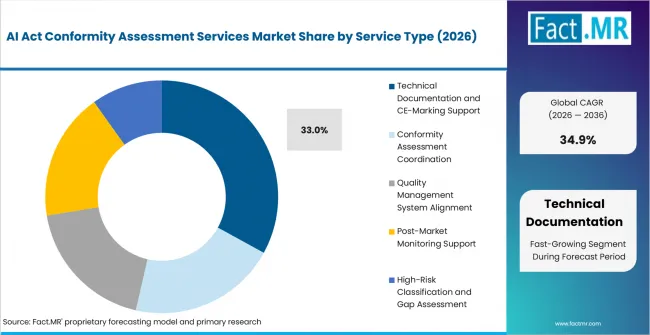
Ai Act Conformity Assessment Services Market Analysis By Service Type | Source: Fact.MR
Technical Documentation and CE-Marking Support is expected to dominate with 33.0% share in 2026. The segment leads because technical files are the first major evidence requirement for high-risk AI providers. Companies need clear records on model design and compliance steps before market access.
- Technical Documentation and CE-Marking Support: Technical file support helps providers organize evidence before assessment.
- High-Risk Classification and Gap Assessment: Classification services determine whether AI systems fall under high-risk rules.
- Conformity Assessment Coordination: Coordination services connect providers with formal review and assessment pathways.
AI Act Conformity Assessment Services Market Analysis by Assessment Scope
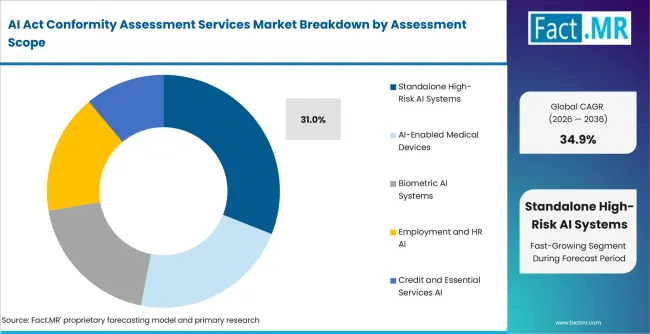
Ai Act Conformity Assessment Services Market Analysis By Assessment Scope | Source: Fact.MR
Standalone high-risk AI systems are projected to dominate with 31.0% share in 2026. The segment leads because Annex III use cases need early classification and review planning. Employment and education AI tools will need stronger evidence before EU market use. AI-enabled medical devices follow because product regulation and AI Act obligations overlap.
- Standalone High-Risk AI Systems: Standalone systems need classification and evidence before EU placement.
- AI-Enabled Medical Devices: Medical AI requires assessment alignment across device and AI rules.
- Biometric AI Systems: Biometric systems need stronger review because the risk classification is sensitive.
AI Act Conformity Assessment Services Market Analysis by Customer Type
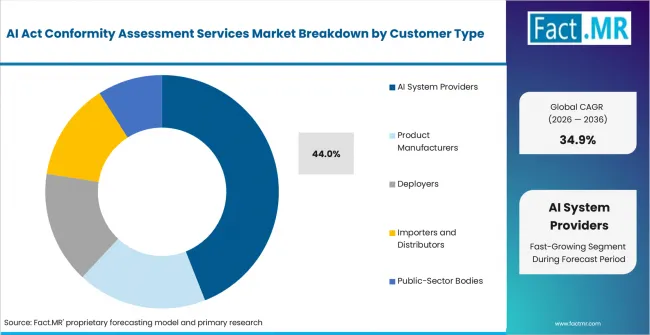
Ai Act Conformity Assessment Services Market Analysis By Customer Type | Source: Fact.MR
AI System Providers are expected to dominate with 44.0% share in 2026. The segment leads because provider obligations create the first need for conformity assessment support. AI developers must prepare technical documentation and compliance files before placing high-risk systems in the EU market.
- AI System Providers: Providers need technical evidence before placing high-risk AI systems in the EU.
- Product Manufacturers: Manufacturers need AI assessment work inside product compliance programs.
- Deployers: Deployers need supplier evidence before using high-risk AI systems.
AI Act Conformity Assessment Services Market Analysis by Delivery Model
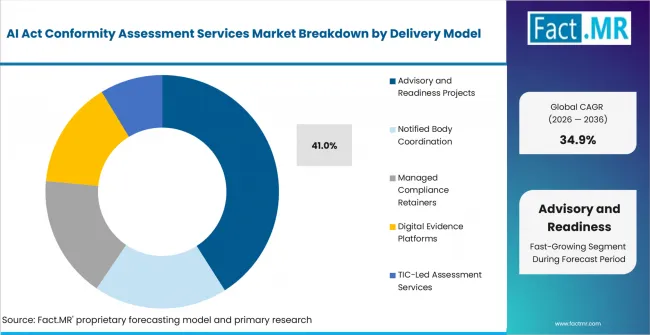
Ai Act Conformity Assessment Services Market Analysis By Delivery Model | Source: Fact.MR
Advisory and readiness projects are expected to dominate with 41.0% share in 2026. The segment leads because firms need preparation support before formal notified-body review. Companies use these projects to check documentation gaps and organize evidence before entering a more formal assessment process.
- Advisory and Readiness Projects: Readiness projects help firms close documentation gaps before formal review.
- TIC-Led Assessment Services: TIC-led services support independent assessment and certification pathways.
- Notified Body Coordination: Coordination helps providers manage assessment timing and evidence requests.
AI Act Conformity Assessment Services Market Analysis by Use Case
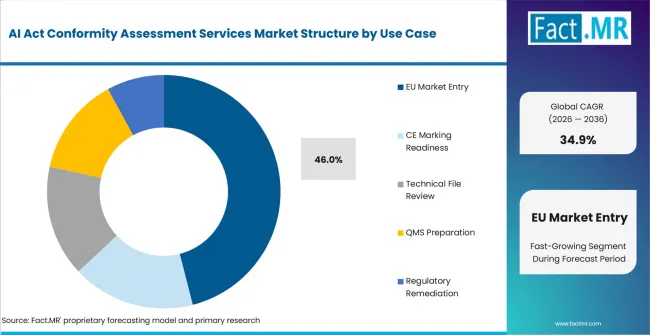
Ai Act Conformity Assessment Services Market Analysis By Use Case | Source: Fact.MR
EU Market Entry is expected to dominate with 46.0% share in 2026. The segment leads because conformity readiness directly affects whether firms can sell high-risk AI systems in the EU market. Companies need early support to organize evidence and prepare market access plans before launch.
- EU Market Entry: Market-entry support helps AI providers prepare systems for EU access.
- CE Marking Readiness: CE readiness connects AI evidence with product approval needs.
- Technical File Review: Technical file review checks whether evidence is complete before assessment.
What is accelerating AI Act conformity assessment services adoption, and what is holding it back?
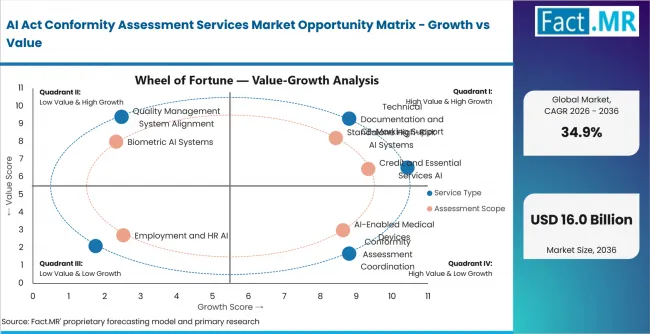
Ai Act Conformity Assessment Services Market Opportunity Matrix Growth Vs Value | Source: Fact.MR
The main driver is the creation of a formal high-risk AI compliance pathway. VDE explains that conformity assessment reviews quality management, risk management, data governance, documentation, logging and oversight. [3] This turns AI compliance into a structured service need rather than a policy note. TIC provider readiness is the another driver. TÜV SÜD now offers voluntary conformity certificates and gap assessments for AI systems ahead of mandatory procedures. [4] BSI obtained temporary accreditation in 2026 to assess high-risk AI biometric systems under the EU AI Act. [5]
The main restraint is assessment capacity. Conformity work needs AI expertise and regulatory knowledge at the same time. Some high-risk AI providers will struggle to prepare complete evidence before formal review.
Opportunities in the AI Act Conformity Assessment Services Market
- Technical File Readiness: Service providers can help AI firms prepare evidence before notified-body review.
- QMS Alignment: TIC firms can support quality management systems tailored to high-risk AI.
- Post-Market Monitoring: Providers can sell monitoring support after conformity work is complete.
Which countries are scaling AI Act conformity assessment services demand fastest?
Based on regional analysis, the AI Act conformity assessment services market is segmented into Europe, North America, East Asia, South Asia and Pacific, Latin America, and Middle East and Africa.
.webp "Top Country Growth Comparison Ai Act Conformity Assessment Services Market Cagr (2026 2036)")
Top Country Growth Comparison Ai Act Conformity Assessment Services Market Cagr (2026 2036) | Source: Fact.MR
| Country | CAGR 2026 to 2036 |
|---|---|
| Germany | 37.8% |
| France | 36.9% |
| United States | 36.1% |
| United Kingdom | 35.4% |
| Netherlands | 34.6% |
Source: Fact.MR analysis. Updated Jun 18, 2026
Source: Fact.MR analysis, based on proprietary forecasting model and primary research.
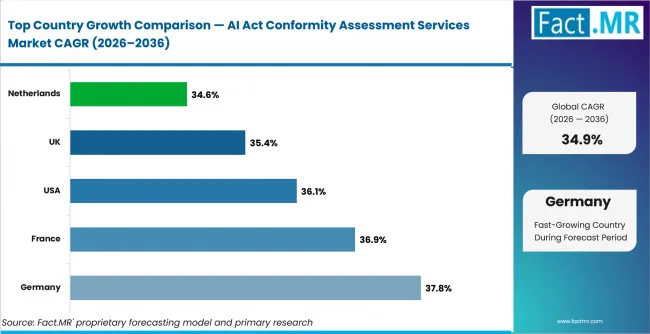
Ai Act Conformity Assessment Services Market Cagr Analysis By Country | Source: Fact.MR
Europe AI Act Conformity Assessment Services Market Analysis
Europe leads demand because the EU AI Act directly creates the conformity pathway. Germany and France form the main early base through regulated product strength and AI compliance readiness.
- Germany: Germany is expected to record 37.8% CAGR from 2026 to 2036 as TIC capacity and regulated product expertise support early demand. The country has a strong base of manufacturers that already work with conformity assessment processes. AI-enabled machinery and industrial systems will need technical evidence that connects AI requirements with product rules. TÜV-linked assessment activity gives local providers a stronger starting point. Service demand will favor documentation review, QMS alignment and technical testing support.
- France: France is likely to post 36.9% CAGR through 2036 as high-risk AI providers prepare technical files for EU access. Public-sector digital programs and healthcare software create demand for conformity support. French AI developers will need help classifying systems before launch. Product teams will also need review of data governance and post-market monitoring evidence. Bureau Veritas activity strengthens the local assurance base. Service providers can gain by offering readiness audits that translate legal obligations into engineering tasks.
North America AI Act Conformity Assessment Services Market Analysis
North America demand comes from AI exporters that sell into the EU. The United States grows quickly because AI vendors need EU access without building internal compliance teams from scratch.
- United States: United States demand is projected to grow at 36.1% CAGR by 2036 because AI exporters need EU conformity routes. Large software vendors and AI system providers will require classification support before selling high-risk tools into Europe. Technical documentation will become a product launch requirement for recruitment, credit and medical AI systems. Providers that combine EU regulatory knowledge with model testing can win faster. U.S. firms will prefer service partners that reduce rework and explain evidence requests clearly.
Europe Outside EU AI Act Core AI Act Conformity Assessment Services Market Analysis
The United Kingdom is outside the EU but supports the market through assurance firms and exporters. UK providers can serve AI companies that need EU conformity planning.
- United Kingdom: The United Kingdom is set to advance at 35.4% CAGR over the forecast period as assurance firms serve cross-border AI providers. UK software firms selling into Europe will need EU-ready technical evidence. Consulting teams can support classification and supplier review before systems reach formal assessment. The market will benefit from strong AI governance consulting and standards expertise. Service demand will center on gap assessment because firms need to understand whether EU obligations apply. Providers that connect legal interpretation with engineering controls can win higher-value work among finance and HR technology firms.
Netherlands AI Act Conformity Assessment Services Market Analysis
The Netherlands supports the EU assurance ecosystem through accreditation and cross-border compliance activity. Its role is smaller than Germany but strategically important.
- Netherlands: The Netherlands is forecast to record 34.6% CAGR through 2036 as accreditation and assessment activity supports the EU assurance base. BSI’s temporary accreditation from the Dutch Raad voor Accreditatie for biometric AI conformity assessments gives the country early relevance. Dutch technology firms and EU market-entry teams will need practical support for technical files and assessment coordination. The country can serve as a compliance gateway for providers entering multiple EU states.
Who leads the AI Act conformity assessment services market landscape?
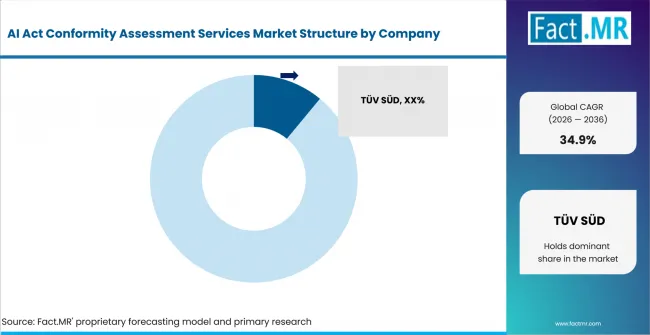
Ai Act Conformity Assessment Services Market Analysis By Company | Source: Fact.MR
The AI Act conformity assessment services market is led by TIC firms with regulatory assessment experience and AI assurance boutiques with technical depth. TÜV SÜD and TÜV Rheinland bring conformity assessment heritage. BSI Group adds standards and accreditation strength. DNV and Bureau Veritas bring assurance credibility across regulated industries. appliedAI supports readiness and implementation work for firms preparing practical AI governance.
Competition will move from broad AI governance advice toward assessment-ready evidence. Providers need to show that they can review technical files and risk controls. TIC firms can win formal assessment work. Boutiques can win early readiness and remediation projects.
Provider strength will come from assessment credibility and technical interpretation through 2036. High-risk AI providers will need a partner that can explain what evidence is missing and how to close the gap. Firms that combine regulatory review with model testing will gain stronger demand.
Which companies are the key players?
- TÜV SÜD
- TÜV Rheinland
- BSI Group
- DNV
- Bureau Veritas
- appliedAI
Bibliography
- [1] European Parliament & Council of the European Union. (2024). Regulation (EU) 2024/1689 of the European Parliament and of the Council of 13 June 2024 laying down harmonised rules on artificial intelligence and amending certain Union legislative acts (Artificial Intelligence Act). Official Journal of the European Union, L, 2024/1689.
- [2] European Commission. (2026, May 11). AI Act. Shaping Europe’s Digital Future.
- [3] VDE. (2026, February 11). Conformity assessment of high-risk AI systems under the EU AI Act: What providers need to know.
- [4] TÜV SÜD. (2025, November 25). New TÜV SÜD services for efficient implementation of the EU AI Act.
- [5] BSI Group. (2026, March 24). BSI secures accreditation to assess high-risk AI biometric systems.
This Report Addresses
- Strategic intelligence on AI Act conformity assessment services.
- Forecast mapping from USD 0.8 billion in 2026 to USD 16.0 billion by 2036.
- Segment analysis covering Technical Documentation and CE-Marking Support.
- Scope review covering Standalone High-Risk AI Systems and AI-Enabled Medical Devices.
- Regional outlook covering Germany, France, United States, United Kingdom and Netherlands.
- Competitive analysis of TÜV SÜD, TÜV Rheinland, BSI Group, DNV, Bureau Veritas and appliedAI.
- Market distinction from general AI governance consulting and cybersecurity audits.
What does the AI Act conformity assessment services market cover?
The AI Act conformity assessment services market covers advisory and assessment support for high-risk AI systems under the EU AI Act. It includes classification and notified-body coordination. The market differs from general AI governance consulting because its central purpose is formal readiness for conformity assessment and EU market access.
AI Act Conformity Assessment Services Market Inclusions
The scope includes high-risk AI classification support and gap assessment. It includes technical documentation review and CE-marking readiness. It covers coordination with notified bodies and TIC firms. It also includes quality management system alignment and corrective action support for AI systems that require formal evidence.
AI Act Conformity Assessment Services Market Exclusions
The scope excludes general AI strategy consulting with no conformity assessment function. It excludes cybersecurity audits unless they support AI Act technical evidence. It excludes standard software testing with no regulatory documentation output. It excludes internal legal review unless it is tied to high-risk AI classification or conformity evidence.
AI Act Conformity Assessment Services Market Research Methodology
- Primary Research:
- Primary research includes discussions with AI compliance officers and product regulatory affairs managers. TIC service leads are reviewed separately.
- Desk Research:
- Desk research reviews EU AI Act obligations and official TIC service announcements. High-risk assessment guidance supports market boundary checks.
- Market-Sizing and Forecasting:
- Market estimates are developed through high-risk AI provider counts and conformity readiness service intensity. TIC project activity supports sizing.
- Data Validation and Update Cycle:
- Forecasts are checked through notified-body readiness signals and company service launches. Regulatory timeline updates support validation.
Segmentation
What is the report’s scope and coverage?
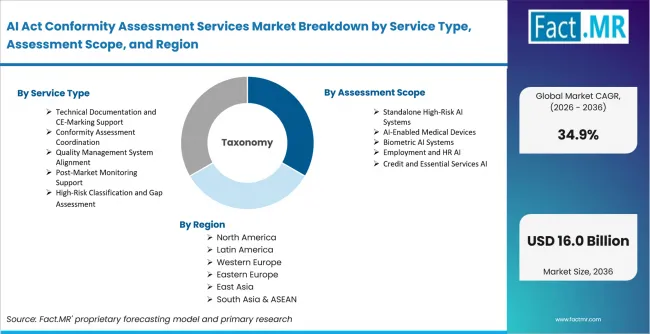
Ai Act Conformity Assessment Services Market Breakdown By Service Type, Assessment Scope, And Region | Source: Fact.MR
| Attribute | Details |
|---|---|
| Quantitative Units | USD 0.8 billion in 2026 to USD 16.0 billion by 2036 at 34.9% CAGR |
| Market Definition | Notified-body style certification, CE-marking support and technical documentation services for high-risk AI systems under the EU AI Act |
| Service Type | High-Risk Classification and Gap Assessment, Technical Documentation and CE-Marking Support, Conformity Assessment Coordination, Quality Management System Alignment, Post-Market Monitoring Support |
| Assessment Scope | Standalone High-Risk AI Systems, AI-Enabled Medical Devices, Biometric AI Systems, Employment and HR AI, Credit and Essential Services AI |
| Customer Type | AI System Providers, Product Manufacturers, Deployers, Importers and Distributors, Public-Sector Bodies |
| Delivery Model | TIC-Led Assessment Services, Advisory and Readiness Projects, Notified Body Coordination, Managed Compliance Retainers, Digital Evidence Platforms |
| Use Case | EU Market Entry, CE Marking Readiness, Technical File Review, QMS Preparation, Regulatory Remediation |
| Regions Covered | Europe, North America, East Asia, South Asia and Pacific, Latin America, Middle East and Africa |
| Countries Covered | Germany, France, United States, United Kingdom, Netherlands |
| Key Companies Profiled | TÜV SÜD, TÜV Rheinland, BSI Group, DNV, Bureau Veritas and appliedAI |
| Forecast Period | 2026 to 2036 |
| Approach | Hybrid top-down and bottom-up approach using high-risk AI system counts, TIC readiness, regulatory timelines and conformity support demand |
Source: Fact.MR analysis. Updated Jun 18, 2026
How is the market segmented?
-
By Service Type:
- High-Risk Classification and Gap Assessment
- Technical Documentation and CE-Marking Support
- Conformity Assessment Coordination
- Quality Management System Alignment
- Post-Market Monitoring Support
-
By Assessment Scope:
- Standalone High-Risk AI Systems
- AI-Enabled Medical Devices
- Biometric AI Systems
- Employment and HR AI
- Credit and Essential Services AI
-
By Customer Type:
- AI System Providers
- Product Manufacturers
- Deployers
- Importers and Distributors
- Public-Sector Bodies
-
By Delivery Model:
- TIC-Led Assessment Services
- Advisory and Readiness Projects
- Notified Body Coordination
- Managed Compliance Retainers
- Digital Evidence Platforms
-
By Use Case:
- EU Market Entry
- CE Marking Readiness
- Technical File Review
- QMS Preparation
- Regulatory Remediation
-
Region:
- Europe
- Germany
- France
- Netherlands
- North America
- United States
- Europe Outside EU AI Act Core
- United Kingdom
- East Asia
- South Asia and Pacific
- Latin America
- Middle East and Africa
Frequently Asked Questions
What is the AI Act Conformity Assessment Services Market size in 2026?
What will the AI Act Conformity Assessment Services Market be worth by 2036?
What CAGR is projected for the AI Act Conformity Assessment Services Market?
Which service type leads the AI Act Conformity Assessment Services Market?
Which country grows fastest in the AI Act Conformity Assessment Services Market?
How does France perform in the AI Act Conformity Assessment Services Market?
How does the United States perform in the AI Act Conformity Assessment Services Market?
How does the United Kingdom perform in the AI Act Conformity Assessment Services Market?
How does the Netherlands perform in the AI Act Conformity Assessment Services Market?
What drives the AI Act Conformity Assessment Services Market?
What restrains the AI Act Conformity Assessment Services Market?
Who worked on this report


Preview the report firsthand - request a free sample
Free SampleGet the brochure for pricing and purchase details
Download PDF