- Market Value (2025): USD 819.5 Mn
- Estimated Value (2026): USD 985.0 Mn
- Forecast Value (2036): USD 6200.0 Mn
- CAGR (2026-2036): 20.2%
What is the AI Health Coaching Platforms Market forecast to be worth by 2036?
USD 985.0 million in 2026 to USD 6,200.0 million by 2036 at 20.2% CAGR.
- The AI Health Coaching Platforms Market reached an estimated USD 819.5 million in 2025.
- Demand is projected to rise from USD 985.0 million in 2026 to USD 6,200.0 million by 2036.
- The market is forecast to record 20.2% CAGR from 2026 to 2036 owing to governed coaching workflows and wearable data use.
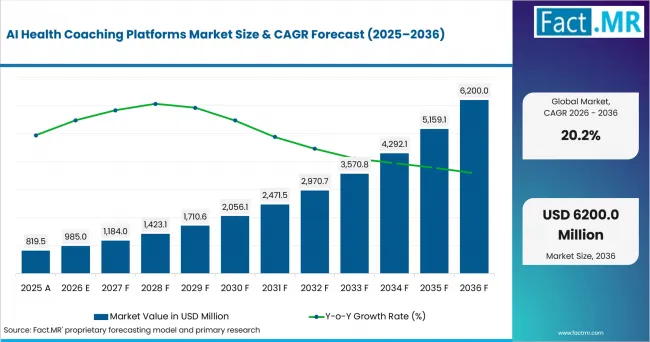
Ai Health Coaching Platforms Market Value Analysis | Source: Fact.MR
What are the defining numbers behind AI Health Coaching Platforms Market growth?
USD 5,215.0 million absolute opportunity is expected by 2036. Predictive personalization and Weight & metabolic programs lead the share base. Standalone consumer apps and Wearable data inputs define the main delivery route.
- Demand Drivers in the Market
- Wearable data gives platforms repeated activity and sleep signals that make coaching prompts more timely.
- Employer and payer programs need coaching tools that guide large covered groups without replacing clinical oversight.
- AI capability improvement is projected to support better triage and adaptive goals when safety limits are visible.
- Key Segments Analyzed
- By AI Capability: Predictive personalization is expected to hold 22.6% share in 2026 as timing and message fit decide routine engagement.
- By Health Domain: Weight & metabolic is projected to account for 38.3% share in 2026 because these programs create frequent coaching moments.
- By Deployment Model: Standalone consumer app is anticipated to capture 43.0% share in 2026 since this route reaches users without integration delay.
- By Personalization Input: Wearable data is estimated to represent 36.5% share in 2026 due to repeated signals from daily use.
- Analyst Opinion at Fact.MR
- Shambhu Nath Jha, Senior Analyst at Fact.MR, states, “AI health coaching platforms need to prove safety boundaries before engagement claims carry commercial weight. Products with visible escalation rules, consent controls and evidence by health domain are expected to hold stronger customer trust than tools built only around conversation volume.”
- Strategic Implications
- Providers need to make human-in-the-loop escalation operational before expanding coaching volume. AI is suited for routine reflection. Clinicians or qualified coaches handle risk and complex decisions. This approach puts coaching closer to governed digital therapeutics when accountability is clear.
- Sponsors need to define wearable data quality before contracting. Activity and sleep signals support timely personalization only when consent limits are built into the service. This creates a stronger fit with digital transformation in healthcare than with wellness content alone.
- Implementation teams need explicit controls for hallucination and unsafe advice. A fluent answer is not enough for health guidance when a user has an untreated condition. Platform reviews therefore depend on escalation paths and safe-response boundaries.
France is projected to record a 25.1% CAGR from 2026 to 2036 due to reimbursement fit and digital-health governance. Italy is anticipated to record a 23.9% CAGR as regional care programs create room for adaptable workflows. The USA is forecast to record an 18.7% CAGR with employer and payer purchasing shaping adoption. The UK is expected to record a 17.7% CAGR where evidence review and NHS pathways guide service fit. Germany is estimated to record a 17.2% CAGR as information-security and evidence rules keep purchasing disciplined.
How does the AI Health Coaching Platforms Market break down by segment?
Predictive personalization leads AI Capability at 22.6% share in 2026. Weight & metabolic leads Health Domain at 38.3% share.
Why does Predictive personalization lead AI Capability?
Predictive personalization is projected to account for 22.6% share in 2026.
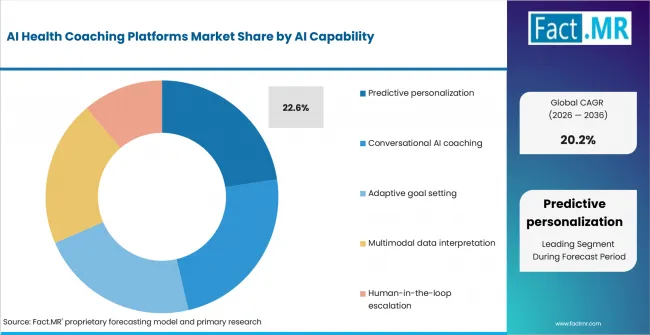
Ai Health Coaching Platforms Market Analysis By Ai Capability | Source: Fact.MR
Prediction improves timing and message relevance before a user asks for support. It helps platforms study activity patterns, past responses and engagement behavior to decide when a reminder or recommendation is most useful. Conversational AI coaching and Adaptive goal setting remain part of the mix by supporting regular interaction and changing targets. Multimodal data interpretation and Human-in-the-loop escalation add safety and context.
Why does Weight & metabolic lead Health Domain?
Weight & metabolic is expected to hold 38.3% share in 2026.
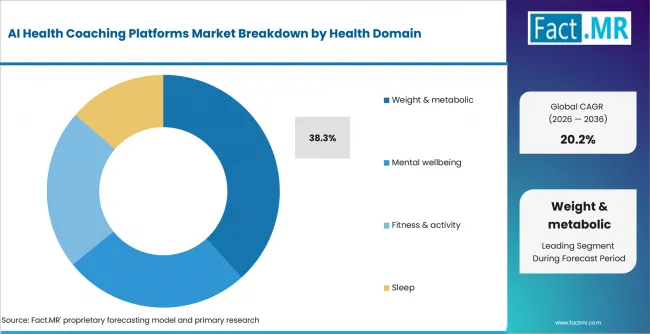
Ai Health Coaching Platforms Market Analysis By Health Domain | Source: Fact.MR
Weight and metabolic programs create regular coaching moments around food, activity, sleep and habit formation. These programs also support obesity management, diabetes prevention and broader metabolic health goals where users need repeated guidance. Medication adherence adds another care routine when the service includes reminders, symptom tracking and clear escalation. Mental wellbeing and Fitness & activity remain important, but weight and metabolic programs combine several measurable behaviors within one pathway. This gives platforms more opportunities to adjust goals, messages and coaching frequency according to user progress.
Why does Standalone consumer app lead Deployment Model?
Standalone consumer app is anticipated to capture 43.0% share in 2026.
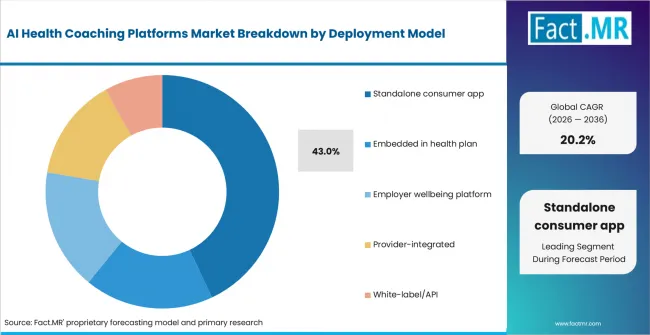
Ai Health Coaching Platforms Market Analysis By Deployment Model | Source: Fact.MR
Consumer apps reach users faster than embedded health-plan or provider-integrated formats because they do not depend on lengthy technical integration or approval processes. Users can download the app, create a profile and begin receiving coaching with limited administrative steps. Employer wellbeing platforms and White-label/API routes remain useful where sponsors want more control over eligibility and delivery. The segment leads because quick onboarding supports early scale, broader geographic access and faster feature updates before deeper integration work begins with insurers, employers or healthcare providers.
Why does Wearable data lead Personalization Input?
Wearable data is estimated to represent 36.5% share in 2026.
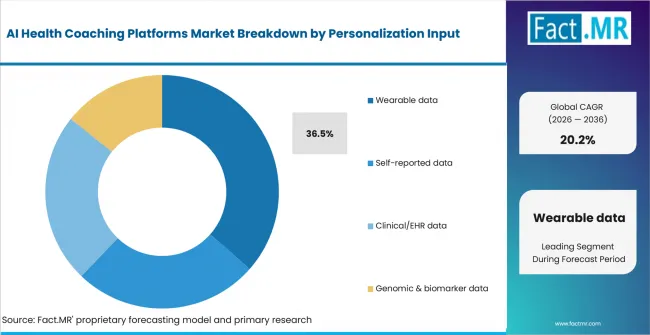
Ai Health Coaching Platforms Market Analysis By Personalization Input | Source: Fact.MR
Wearable inputs provide repeated signals without asking users to log every action. Smartwatches, fitness bands and connected devices can capture steps, heart rate, sleep and exercise patterns that help platforms adjust coaching according to actual behavior. Self-reported data and Clinical/EHR data stay useful for mood, symptoms and medical context. Genomic & biomarker data remains narrower as consent, cost and interpretation are harder. The segment connects with wearable computing devices as coaching shifts toward passive signal capture, frequent updates and more timely personalized feedback.
What is accelerating AI Health Coaching Platforms Market adoption, and what is holding it back?
Demand is expected to be driven by wearable context and always-available support. Adoption is expected to be held back by unsafe advice, opaque personalization and sensitive data aggregation.
Drivers Impact Analysis
| DRIVER | (~) % IMPACT ON CAGR | GEOGRAPHIC RELEVANCE | IMPACT TIMELINE |
|---|---|---|---|
| Growth of wearable data | +4.2% | Global | Short term (<= 2 years) |
| Always-available support | +3.8% | Global | Short term (<= 2 years) |
| Employer and payer automation | +2.7% | USA, UK, Germany | Medium term (2-4 years) |
| AI capability improvement | +2.1% | France and enterprise markets | Medium term (2-4 years) |
| Human oversight integration | +1.4% | Regulated healthcare channels | Long term (>= 4 years) |
Source: Fact.MR analysis. Updated Jul 25, 2026
- Growth of wearable data: Activity and sleep signals are expected to improve the timing of coaching prompts.
- Always-available support: Conversational interfaces are expected to answer routine questions between scheduled coaching sessions.
- Employer and payer automation: Sponsors are projected to use AI coaching to manage large populations with lower service cost pressure.
- AI capability improvement: Language and prediction systems are anticipated to make coaching interactions more adaptive when guardrails are visible.
- Human oversight integration: Escalation rules are expected to help platforms move from wellness use toward governed care programs.
Opportunity Impact Analysis
| OPPORTUNITY | (~) % IMPACT ON CAGR | GEOGRAPHIC RELEVANCE | IMPACT TIMELINE |
|---|---|---|---|
| Human-in-the-loop escalation | +2.4% | Global | Short term (<= 2 years) |
| White-label infrastructure | +1.9% | France and Italy | Medium term (2-4 years) |
| Evaluation by health domain | +1.3% | Payer and provider markets | Medium term (2-4 years) |
| Provider workflow integration | +1.1% | USA, UK, Germany | Long term (>= 4 years) |
Source: Fact.MR analysis. Updated Jul 25, 2026
- Human-in-the-loop escalation: AI is expected to handle routine reflection while qualified staff manage risk and complex decisions.
- White-label infrastructure: Health plans and providers are projected to add governed coaching inside trusted member experiences.
- Evaluation by health domain: Sleep and weight validation is expected to produce clearer proof than one broad claim.
- Provider workflow integration: Coaching tools are anticipated to gain more trust when escalation and documentation fit care workflows.
Restraints Impact Analysis
| RESTRAINT | (~) % IMPACT ON CAGR | GEOGRAPHIC RELEVANCE | IMPACT TIMELINE |
|---|---|---|---|
| Hallucination and unsafe advice | -2.8% | Global | Short term (<= 2 years) |
| Opaque personalization | -1.9% | Regulated and payer-funded markets | Medium term (2-4 years) |
| Sensitive data aggregation | -1.5% | Global | Medium term (2-4 years) |
| Evidence and durability proof | -1.2% | Employer and payer channels | Long term (>= 4 years) |
Source: Fact.MR analysis. Updated Jul 25, 2026
- Hallucination and unsafe advice: A fluent response is expected to remain risky if it misses a user condition or care context.
- Opaque personalization: Users and reviewers often reject recommendations when the reason for a changed prompt is unclear.
- Sensitive data aggregation: Combining wearable and self-reported inputs raises privacy consequences when controls are weak.
- Evidence and durability proof: Employers and payers are expected to require outcome data before renewing larger contracts.
Which countries are scaling AI Health Coaching Platforms Market fastest?
A global growth rate represents the weighted average of all markets included in the AI Health Coaching Platforms Market analysis. It does not need to exceed the growth rate of every country shown. The global figure sits between the upper pair and the remaining markets. The five countries presented are illustrative examples, and their comparison shows how different payment systems and adoption routes shape the combined forecast.
- The countries are distinguished less by repeated CAGR values and more by the spacing between them. France and Italy form a compact upper pair. A pronounced gap separates this pair from the USA. The USA, the UK and Germany remain more closely aligned.
- France holds a notable position because reimbursement fit and digital-health governance support structured evaluation of AI coaching platforms. Italy remains close to France but follows a different route through regional care programs and adaptable provider workflows.
- The USA depends more heavily on employer and payer purchasing where engagement quality and safe escalation influence commercial decisions. The UK follows a care-pathway model shaped by evidence review and clinical responsibility. Germany remains closely aligned with the UK but places greater emphasis on information security and documented personalization controls.
- Markets with broadly similar CAGRs can therefore create different entry conditions for platform providers. Deployment timing depends on reimbursement access, institutional readiness, privacy requirements and the ability to integrate human oversight into coaching workflows.
The full report examines these dynamics for every market included in the study. It provides country-level CAGR analysis across North America, Latin America, Europe, East Asia, South Asia, Oceania, and the Middle East and Africa.
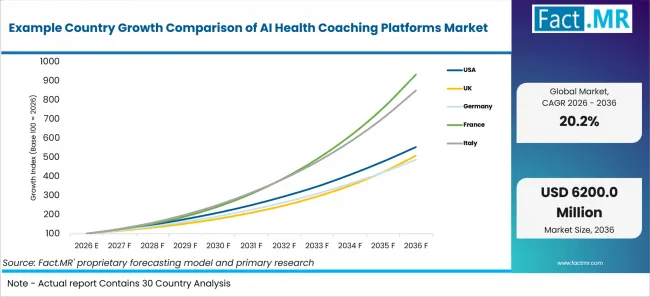
Example Country Growth Comparison Of Ai Health Coaching Platforms Market | Source: Fact.MR
| Country | CAGR (2026-2036) |
|---|---|
| France | 25.1% |
| Italy | 23.9% |
| USA | 18.7% |
| UK | 17.7% |
| Germany | 17.2% |
Source: Fact.MR analysis. Updated Jul 25, 2026
What supports France adoption?
25.1% CAGR, supported by reimbursement fit and digital-health governance.
France’s growth reflects a market where AI coaching platforms must align with structured care pathways and defined service rules. Providers are expected to show clinical value, consent controls and clear human escalation before wider deployment. Platforms that adapt weight management, mental wellbeing and preventive coaching programs to local care delivery are likely to move more effectively through evaluation and reimbursement review.
How is Italy scaling demand?
23.9% CAGR, driven by regional care design and adaptable coaching workflows.
Italy’s growth is tied to regional variation in healthcare delivery and the need for flexible implementation models. AI health coaching platforms are expected to gain relevance when they support local providers, patient follow-up and configurable care programs. White-label services and provider-connected tools may carry more value than a single nationwide consumer model because partnership quality and workflow adaptation influence adoption.
What is driving USA growth from 2026 to 2036?
18.7% CAGR, backed by employer and payer purchasing.
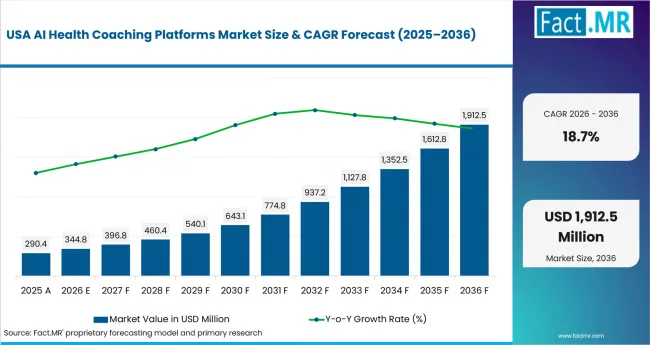
Ai Health Coaching Platforms Market Country Value Analysis | Source: Fact.MR
The USA’s growth reflects a market where employers and health plans use digital coaching to support members between formal care visits. Platforms are expected to prove that personalized prompts improve engagement without replacing qualified professionals. Wearable integration, privacy protections and visible escalation rules are likely to shape purchasing and renewal decisions across weight, metabolic and preventive health programs.
How is the UK developing demand?
17.7% CAGR, supported by pathway fit and evidence review.
The UK’s growth is shaped by demand for digital support that remains connected to clinical responsibility. AI coaching platforms are expected to advance when they fit defined care pathways and leave room for non-digital intervention. Evidence quality, service design and clear boundaries between automated guidance and professional support are likely to determine whether platforms move beyond limited testing.
How does Germany perform?
17.2% CAGR, led by evidence expectations and information-security.
Germany’s growth reflects a disciplined adoption route where digital-health platforms face close review before broader use. Providers need to explain how personalization works, how sensitive data is handled and when human support is activated. Companies with stronger documentation, transparent consent controls and practical security measures are expected to move more efficiently through payer and employer evaluation.
Who leads the AI Health Coaching Platforms Market?
Lark Health and Wysa show the clearest direct relevance, while Ada Health strengthens the clinical AI and care-navigation layer.
Lark Health supports AI health coaching for chronic disease and prevention programs. In July 2026, the company announced a Samsung Health partnership that expands access to AI coaching and covered chronic-care programs for seniors. Wysa supports mental wellbeing where self-guided coaching needs safety boundaries and study review. Ada Health adds clinical AI assessment and care-navigation strength. Hinge Health adds AI care assistant capability for musculoskeletal care. Vida Health extends the weight and metabolic area through an April 2026 Oura partnership that brings biometric inputs into cardiometabolic care programs.
From 2026 to 2036, competition is expected to depend on safe personalization and evidence by health domain. Providers are likely to compare escalation design, privacy controls and member engagement quality before expanding contracts. Platforms that prove where AI stops and human support begins are expected to gain stronger trust from payer and employer channels.
Which companies are the key providers?
Key companies include Lark Health, Wysa, Ada Health, Hinge Health, Vida Health.
- Lark Health
- Wysa
- Ada Health
- Hinge Health
- Vida Health
Bibliography
- Ada Health. (2026, March 23). Ada Health Clinical AI turns symptom uncertainty into appropriate action, finds NEJM AI study conducted with CUF in Portugal.
- Hinge Health, Inc. (2025, October 21). Hinge Health unveils new AI-powered care tools.
- Lark Health. (2026, July 15). Lark Health partners with Samsung to bring AI-powered health coach to U.S. seniors.
- U.S. Department of Health & Human Services. (2025, June 27). Regulatory initiatives.
- U.S. National Library of Medicine. (2026, May 19). Co-designing adaptations of a Digital Mental Health Intervention (Wysa) for adolescent girls with anxiety or depression in rural India.
- Vida Health. (2026, April 14). Vida Health and ŌURA to deliver continuous, personalized metabolic care.
This Report Answers
- The report provides strategic intelligence on the AI health coaching platforms market across AI Capability and Health Domain choices that shape coaching use cases.
- Segment analysis covers Predictive personalization and Weight & metabolic as the share leaders within the 2026 market.
- Country outlook evaluates France and Italy alongside the USA, UK and Germany across the forecast period.
- Competitive analysis profiles Lark Health and Wysa alongside Ada Health and Hinge Health. Vida Health completes the provider set.
- Adoption assessment covers wearable data and standalone consumer apps alongside payer, provider and employer routes.
What does the AI Health Coaching Platforms Market cover?
AI health coaching platforms are used to personalize health goals, coaching conversations, recommendations and follow-up support across everyday wellness and care-related routines.
The AI Health Coaching Platforms Market covers platforms used for weight and metabolic health, mental wellbeing, fitness and sleep. Coverage extends to consumer apps, employer wellbeing programs and payer-supported products. Provider-integrated tools and white-label services are included when AI personalization forms part of the coaching workflow. The market also covers predictive personalization, conversational AI coaching, adaptive goal setting, multimodal data interpretation and human-in-the-loop escalation. Wearable, self-reported, clinical and biomarker inputs are included when they influence coaching content or risk review.
The market differs from general wellness content because commercial value comes from adaptive coaching and personalized intervention. Basic fitness content without AI-based adjustment remains outside the boundary. General appointment booking and unrelated electronic health record software are excluded. Hardware-only health devices are also excluded unless AI coaching software forms the commercial offering.
What is included in the scope?
AI health coaching platforms are used across consumer apps and employer wellbeing programs. Embedded health-plan tools, provider-integrated services and white-label or API models are also included.
The scope includes AI Capability and Health Domain alongside Deployment Model and Personalization Input. Coverage spans predictive personalization, conversational AI coaching, adaptive goal setting, multimodal interpretation and human-in-the-loop escalation. Weight and metabolic health, mental wellbeing, fitness and sleep complete the health-domain scope. Wearable data and self-reported data are included alongside clinical or EHR data and genomic or biomarker inputs. Telemedicine-linked coaching is included when personalized guidance forms part of the service design.
What is excluded from the scope?
General wellness media and non-personalized habit trackers remain outside the scope of this market.
The scope excludes tools that do not personalize coaching content, recommendations or escalation. Standalone medical devices are excluded unless coaching software is the commercial product. Hardware-only fitness and health devices remain outside the market when they do not provide AI coaching. Clinical decision systems used only for diagnosis or treatment selection are excluded. Emergency triage, crisis-care services and pharmaceutical programs also remain outside the scope when AI coaching does not form a meaningful part of the service.
How Was the Analysis Built?
The analysis draws on 120+ sources, 35+ company portfolios, 25+ countries, and more than 20 industry interviews.
- Primary Research: Primary research includes discussions with manufacturers, service providers, technology developers, distributors, end users, procurement teams, and subject-matter experts. These conversations examine purchasing priorities, product adoption, operational challenges, approval requirements, competitive positioning, and the factors that influence wider market acceptance.
- Desk Research: Desk research covers government statistics, regulatory publications, company filings, trade data, technical studies, industry associations, standards, public policy, and other authoritative sources. Every source used in the analysis is documented in the bibliography.
- Market Sizing and Forecasting: Market estimates combine historical performance, demand indicators, pricing and volume trends, segment shares, company participation, country-level growth, adoption patterns, investment activity, and barriers to market expansion.
- Data Validation and Update Cycle: Findings are validated by comparing primary interviews with public data, company activity, regulatory changes, trade patterns, and industry developments. Regular updates review new product launches, capacity changes, partnerships, approvals, procurement trends, and shifts in commercial adoption.
Segmentation
What is the report's scope and coverage?
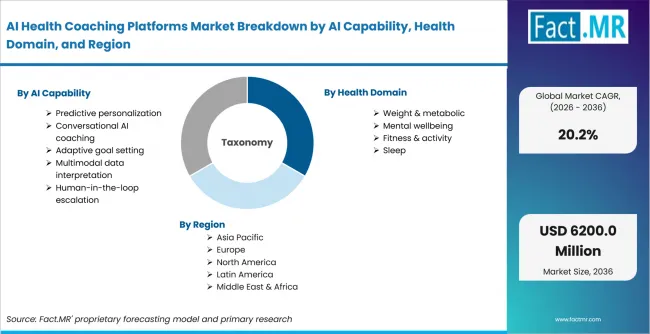
Ai Health Coaching Platforms Market Breakdown By Ai Capability, Health Domain, And Region | Source: Fact.MR
| Attribute | Details |
|---|---|
| Quantitative Units | USD Million in 2026 to USD Million by 2036 at CAGR |
| Market Definition | Platforms that use AI to personalize health goals, conversations, recommendations or escalation across weight, metabolic health, mental wellbeing, fitness and sleep. |
| AI Capability | Predictive personalization; Conversational AI coaching; Adaptive goal setting; Multimodal data interpretation; Human-in-the-loop escalation |
| Health Domain | Weight & metabolic; Mental wellbeing; Fitness & activity; Sleep |
| Deployment Model | Standalone consumer app; Embedded in health plan; Employer wellbeing platform; Provider-integrated; White-label/API |
| Personalization Input | Wearable data; Self-reported data; Clinical/EHR data; Genomic & biomarker data |
| Regions Covered | North America; Latin America; Europe; East Asia; South Asia and Pacific; Middle East and Africa |
| Countries Covered | France; Italy; USA; UK; Germany |
| Key Companies Profiled | Lark Health; Wysa; Ada Health; Hinge Health; Vida Health |
| Forecast Period | 2026 to 2036 |
| Base Year | 2026 |
| Approach | Hybrid top-down and bottom-up approach using the approved market values; AI coaching platform scope; segment shares; country-level growth; company portfolio review; digital-health safety evidence; payer and employer channel review; wearable input use; and care-escalation checks |
Source: Fact.MR analysis. Updated Jul 25, 2026
How is the market segmented?
-
By AI Capability:
- Predictive personalization
- Conversational AI coaching
- Adaptive goal setting
- Multimodal data interpretation
- Human-in-the-loop escalation
-
By Health Domain:
- Weight & metabolic
- Mental wellbeing
- Fitness & activity
- Sleep
-
By Deployment Model:
- Standalone consumer app
- Embedded in health plan
- Employer wellbeing platform
- Provider-integrated
- White-label/API
-
By Personalization Input:
- Wearable data
- Self-reported data
- Clinical/EHR data
- Genomic & biomarker data
-
By Region:
- North America
- Latin America
- Europe
- East Asia
- South Asia & Pacific
- Middle East and Africa
Frequently Asked Questions
Which AI Capability leads the market?
Which Health Domain leads the market?
Which country records the highest listed CAGR?
What is the primary driver in this market?
What is the main restraint?
Why do standalone consumer apps lead deployment?
Who worked on this report


Preview the report firsthand - request a free sample
Free SampleGet the brochure for pricing and purchase details
Download PDF