- Base Value(2026): 1.6 Bn
- Estimated Value(2026): 1.6 Bn
- Forecast Value (2036): 4.3 Bn
- CAGR (2026 - 2036): 10.5%
Allergy Point-of-Care Testing Market Forecast and Outlook 2026 to 2036
The allergy point-of-care testing market is measured at USD 1.6 billion in 2026 and progresses to USD 4.3 billion by 2036, reflecting a 10.50% CAGR over the period.
Allergy Point-of-Care Testing Market Key Takeaways
- Allergy Point-of-Care Testing Market Value (2026): USD 1.6 billion
- Allergy Point-of-Care Testing Market Forecast Value (2036): USD 4.3 billion
- Allergy Point-of-Care Testing Market Forecast CAGR: 10.5%
- Leading Type in Allergy Point-of-Care Testing Market: Rapid specific-IgE kits
- Key Growth Regions in Allergy Point-of-Care Testing Market: North America, Europe, Asia Pacific, Latin America, Middle East & Africa
- Top Players in Allergy Point-of-Care Testing Market: Thermo Fisher Scientific, Abbott Laboratories, Roche Diagnostics, Siemens Healthineers, bioMérieux
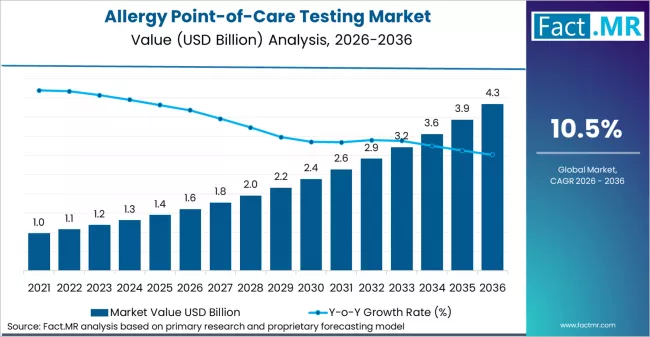
Allergy Point Of Care Testing Market Market Value Analysis | Source: Fact.MR
This segment supports care settings where clinical decisions are made during the same visit rather than after laboratory turnaround. Test formats are selected for clear result presentation, stable performance, and ease of operation across varied staff skill levels. Routine use depends on simple sample handling, short processing time, and consistent output that can be recorded without extra steps.
Once a testing system becomes part of standard practice, it tends to stay in place since any change requires updates to training, quality checks, and documentation workflows. Procurement teams give priority to reliability, continuity of supply, and compatibility with existing record systems. Expansion follows broader use in primary care, earlier screening in patient pathways, and wider acceptance of decentralized testing rather than frequent changes in test platforms.
Allergy Point-of-Care Testing Market
| Metric | Value |
|---|---|
| Market Value (2026) | USD 1.6 billion |
| Forecast Value (2036) | USD 4.3 billion |
| Forecast CAGR 2026 to 2036 | 10.5% |
Source: Fact.MR analysis. Updated Jan 28, 2026
Category
| Category | Segments |
|---|---|
| POC Formats and Consumables | Rapid specific-IgE kits; Skin-prick testing kits; Rapid anaphylaxis kits; Sample collection and POC consumables; Analyzers |
| Use Cases | Primary care triage and referral decisions; Pediatric clinic rapid workups; ER or urgent care allergy event workup support; Occupational health screening; Pharmacy-led testing programs |
| End User or Channel | Speciality clinics; Hospitals; Retail pharmacies; Occupational health providers; Direct-to-consumer |
| Region | North America; Europe; Asia Pacific; Latin America; Middle East & Africa |
Source: Fact.MR analysis. Updated Jan 28, 2026
Allergy Point-of-Care Testing Market Segmental Analysis
Why Do Rapid Specific-IgE Kits Form the Backbone of Point-Of-Care Allergy Testing?
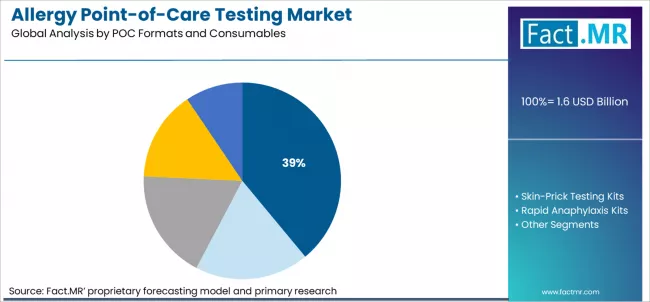
Allergy Point Of Care Testing Market Analysis By Poc Formats And Consumables | Source: Fact.MR
Rapid specific-IgE kits account for 39.0% of POC format usage in the allergy point-of-care testing market. These kits fit clinical settings where immediate answers guide next steps rather than final diagnosis. Staff can run the test during the same visit and record results without sending samples to central laboratories. This short cycle suits clinics that manage mixed caseloads and limited appointment time. Stocking and training requirements remain modest, with single-use formats that avoid instrument dependency. Documentation workflows also remain simple, since outputs can be attached directly to patient records. Skin-prick kits, anaphylaxis kits, and analyzers serve defined scenarios. Most front-line services still rely on rapid IgE kits as the primary screening tool.
Why Does Primary Care Triage and Referral Decision-Making Generate the Highest Testing Volume?
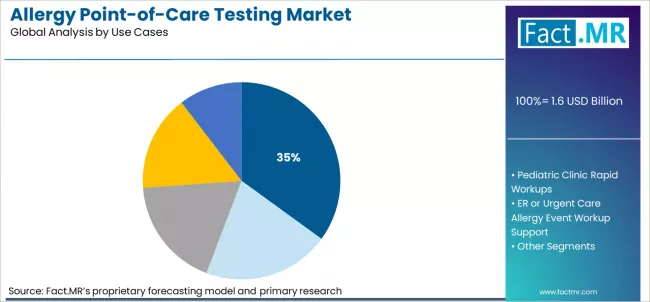
Allergy Point Of Care Testing Market Analysis By Use Cases | Source: Fact.MR
Primary care triage and referral decisions represent 35.00% of use cases in this market. General practitioners see large numbers of patients with non-specific symptoms that require quick sorting rather than full workups. Point-of-care tests support decisions on whether to reassure, treat symptomatically, or refer to specialists. Visit patterns in primary care create steady daily demand rather than episodic surges. Follow-up pathways also depend on initial results recorded during these visits. Pediatric clinics, emergency departments, and occupational programs add volume. The gatekeeping role of primary care keeps this use case as the main driver of point-of-care allergy testing activity.
What are the Drivers, Restraints, and Key Trends of the Allergy Point-of-Care Testing Market?
- Drivers: Demand for rapid, on-site detection of allergic sensitization and immune responses in clinics, urgent care facilities, and pediatric settings supports use of point-of-care testing that delivers results without referral to specialized laboratories.
- Restraint: Variability in test accuracy compared with comprehensive laboratory assessments, reimbursement limitations, and clinician caution regarding interpretation of rapid results restrict uptake in some care environments.
- Trend 1: Development of portable devices and test kits that combine ease of use with multi-allergen screening to broaden applicability in primary care.
- Trend 2: Expansion of connectivity features that link point-of-care results to electronic records and clinical decision pathways for faster treatment planning.
Analysis of the Allergy Point-of-Care Testing Market by Key Country
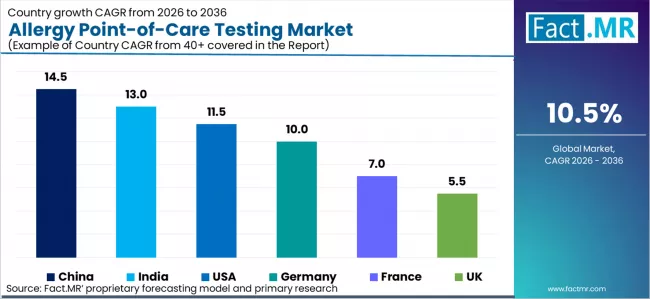
Allergy Point Of Care Testing Market Cagr Analysis By Country | Source: Fact.MR
| Country | CAGR 2026 to 2036 |
|---|---|
| USA | 11.5% |
| China | 14.5% |
| India | 13.0% |
| Germany | 10.0% |
| France | 7.0% |
| UK | 5.5% |
Source: Fact.MR analysis. Updated Jan 28, 2026
The report covers an in-depth analysis of 40+ countries; top-performing countries are highlighted below.
How Are Urgent Care and Retail Clinics Reshaping the Allergy Point-of-Care Testing Market in USA?
At roughly 11.5% per year through 2036, the allergy point-of-care testing market in USA is being pulled by growth of urgent care centers and retail clinics. These settings use quick tests to guide treatment during short visits. Use cases focus on triage and rule-out decisions rather than full allergy profiling. Clinics value short setup time and simple operation more than broad test menus. Purchasing follows network level contracting and standardization. Growth comes from expansion of walk-in care and outpatient chains, not from replacement of laboratory workflows inside hospitals or specialist practices that still depend on centralized equipment and specialist interpretation.
Why Is Hospital System Expansion Driving the Allergy Point-of-Care Testing Market in China?
With an expansion rate near 14.5% per year through 2036, the allergy point-of-care testing market in China follows the buildout of community hospitals and busy outpatient departments. Many facilities use quick tests to manage patient flow rather than to confirm complex diagnoses. The main role is sorting patients before referral to specialists. Buyers care about throughput, device uptime, and supply continuity more than menu breadth. Centralized purchasing favors large vendors with national coverage. Growth follows opening of new facilities and rising patient volumes, not shifts in clinical guidelines or replacement of central laboratories that remain the reference standard for diagnosis.
What Is Making Access and Price the Key Factors in the Allergy Point-of-Care Testing Market in India?
Growth near 13.0% per year through 2036 places the allergy point-of-care testing market in India inside clinics that lack easy access to full laboratories. The main value is same-day answers in small practices and diagnostic centers. Cost per test and device simplicity matter more than analytical depth. Many users rely on basic screening before referring patients onward. Procurement often happens through regional distributors and hospital groups. Expansion follows growth of private outpatient care and diagnostic chains rather than formal integration into hospital treatment pathways or specialist allergy programs in major cities and secondary towns today across regions nationally now widely.
How Do Clinical Rules Limit the Role of the Allergy Point-of-Care Testing Market in Germany?
Running close to 10.0% per year through 2036, the allergy point-of-care testing market in Germany operates within strict clinical pathways and reimbursement rules. Physicians use quick tests mainly as preliminary tools, not as final diagnostic evidence. Guideline acceptance shapes where tests are used and how results are documented. Hospitals and practices prefer documented accuracy over speed in most cases. Purchasing decisions remain conservative and contract based. Growth comes from slow acceptance in primary care, not from widespread decentralization of allergy diagnostics or changes in specialist practice patterns across regions and referral systems over time in everyday care settings nationwide today.
Why Does Public System Control Shape the Allergy Point-of-Care Testing Market in France?
At about 7.0% per year through 2036, the allergy point-of-care testing market in France expands inside a tightly managed public healthcare structure. Use is limited to approved pathways and specific screening needs. Budget control and formal evaluation determine adoption speed. Clinicians rely more on centralized laboratories for definitive answers. Procurement is coordinated and cautious across regions. Growth follows gradual policy adjustments rather than competitive rollout by private clinics or strong demand from patients seeking faster testing during routine visits in outpatient care and selected emergency departments where triage is needed today within public systems nationwide now broadly applied and funded.
How Are Capacity Limits Defining the Allergy Point-of-Care Testing Market in UK?
An annual pace near 5.5% through 2036 leaves the allergy point-of-care testing market in UK constrained by staffing and funding pressure. Quick tests are used mainly to manage waiting lists and triage referrals. Broad screening is not a priority. Decisions on use are made at system level, not by individual practices. Procurement follows national frameworks. Growth depends on small increases in service capacity, not on technological enthusiasm or rapid decentralization of diagnostics across primary care settings within public services where budgets and workforce planning set limits each year across regions today in practice nationwide now consistently applied and monitored closely.
How Do Clinic Workflow Constraints and Result Turnaround Targets Shape Competition in the Allergy Point of Care Testing Market?
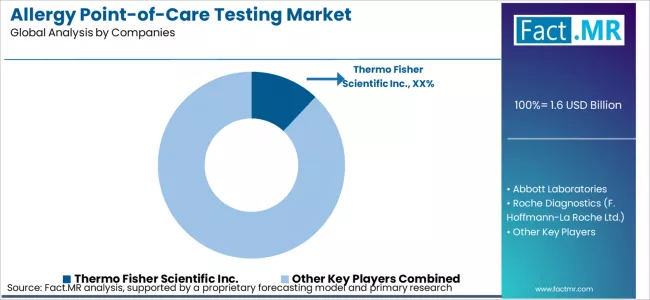
Allergy Point Of Care Testing Market Analysis By Company | Source: Fact.MR
Use of point of care allergy tests is determined by visit length, staffing models, and documentation rules rather than by assay breadth. Clinics and urgent care centers first define acceptable turnaround times, sample handling steps, and result recording pathways before any supplier is considered. Abbott and Roche compete where cartridge based or compact systems fit short consultation windows and limited bench space. Thermo Fisher and Siemens Healthineers participate where connectivity to existing laboratory networks and data systems influences purchasing policy. bioMérieux holds positions where service coverage and instrument placement agreements shape site decisions. Buyers compare suppliers using hands on time, failure rates, lot stability, and ease of quality control. Procurement teams also weigh training burden and consumable logistics across multi-site networks. Once a platform is adopted, switching is limited by staff retraining and protocol updates. Volume growth follows clinic expansion and testing pathway adoption rather than episodic tenders. Competitive movement usually appears after platform refresh cycles or changes in care delivery models.
Key Players in Allergy Point-of-Care Testing Market
- Thermo Fisher Scientific Inc.
- Abbott Laboratories
- Roche Diagnostics (F. Hoffmann-La Roche Ltd.)
- Siemens Healthineers AG
- bioMérieux SA
- Others
References
- U.S. Food and Drug Administration. (2023). In vitro diagnostic (IVD) device studies—Frequently asked questions. U.S. Department of Health and Human Services.
- Medical Device Coordination Group. (2023). MDCG 2023-1: Guidance on the clinical evidence needed for medical devices and in vitro diagnostic medical devices under Regulations (EU) 2017/745 and (EU) 2017/746. European Commission.
- European Commission. (2023). Regulation (EU) 2023/607 amending Regulations (EU) 2017/745 and (EU) 2017/746 as regards transitional provisions for certain medical devices and in vitro diagnostic medical devices.
- Centers for Medicare & Medicaid Services. (2024). CLIA regulations and guidance.
Segmentation
Scope of the Report
| Items | Values |
|---|---|
| Quantitative Units (2026) | USD billion |
| POC Formats and Consumables | Rapid specific-IgE kits, skin-prick testing kits, rapid anaphylaxis kits, sample collection and POC consumables, analyzers |
| Use Cases | Primary care triage and referral decisions, pediatric clinic rapid workups, ER or urgent care allergy event workup support, occupational health screening, pharmacy-led testing programs |
| End User or Channel | Specialty clinics, hospitals, retail pharmacies, occupational health providers, direct-to-consumer |
| Regions Covered | Asia Pacific, Europe, North America, Latin America, Middle East & Africa |
| Countries Covered | United States, Canada, Mexico, Germany, United Kingdom, France, Italy, Spain, China, Japan, South Korea, India, Australia & New Zealand, ASEAN, Brazil, Chile, Saudi Arabia, Turkey, South Africa, and other regional markets |
| Key Companies Profiled | Thermo Fisher Scientific, Abbott Laboratories, Roche Diagnostics, Siemens Healthineers, bioMérieux |
| Additional Attributes | Dollar by sales by POC format, use case, and end user; focus on turnaround time, workflow simplicity, and connectivity to records; demand driven by primary care expansion and decentralized testing pathways |
Source: Fact.MR analysis. Updated Jan 28, 2026
Allergy Point-of-Care Testing Market Segmentation
-
POC Formats and Consumables :
- Rapid Specific-IgE Kits
- Skin-Prick Testing Kits
- Rapid Anaphylaxis Kits
- Sample Collection & POC Consumables
- Analyzers
-
Use Cases :
- Primary Care Triage & Referral Decisions
- Pediatric Clinic Rapid Workups
- ER or Urgent Care Allergy Event Workup Support
- Occupational Health Screening
- Pharmacy-Led Testing Programs
-
End User or Channel :
- Specialty Clinics
- Hospitals
- Retail Pharmacies
- Occupational Health Providers
- Direct-to-Consumer
-
Region :
- Asia Pacific
- China
- Japan
- South Korea
- India
- Australia & New Zealand
- ASEAN
- Rest of Asia Pacific
- Europe
- Germany
- United Kingdom
- France
- Italy
- Spain
- Nordic
- BENELUX
- Rest of Europe
- North America
- United States
- Canada
- Mexico
- Latin America
- Brazil
- Chile
- Rest of Latin America
- Middle East & Africa
- Kingdom of Saudi Arabia
- Other GCC Countries
- Turkey
- South Africa
- Other African Union
- Rest of Middle East & Africa
- Asia Pacific
Frequently Asked Questions
How big is the allergy point-of-care testing market in 2026?
What will be the size of allergy point-of-care testing market in 2036?
How much will be the allergy point-of-care testing market growth between 2026 and 2036?
What are the key product types in the allergy point-of-care testing market?
Which use cases segment to contribute significant share in the allergy point-of-care testing market in 2026?
Who worked on this report


Preview the report firsthand - request a free sample
Free SampleGet the brochure for pricing and purchase details
Download PDF