- Market Value (2025): USD 354.4 Mn
- Estimated Value (2026): USD 380.3 Mn
- Forecast Value (2036): USD 679.3 Mn
- CAGR (2026-2036): 7.3%
What is the Aloe Vera Powder Market forecast to be worth by 2036?
USD 380.3 million in 2026 to USD 679.3 million by 2036 at 7.3% CAGR.
- The aloe vera powder market reached USD 354.4 million in 2025.
- Demand is projected to increase from USD 380.3 million in 2026 to USD 679.3 million by 2036.
- The market is forecast to record 7.3% CAGR from 2026 to 2036.
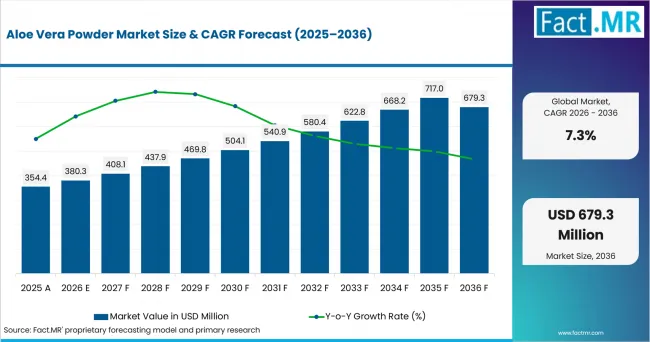
Aloe Vera Powder Market Value Analysis | Source: Fact.MR
What are the defining numbers behind Aloe Vera Powder Market growth?
USD 298.9 million absolute opportunity is expected between 2026 and 2036.
- Demand Drivers in the Market
- Food and beverage manufacturers need aloe vera powder that supports dry blending and finished-product consistency.
- Conventional Aloe Vera Powder is easier to specify for recurring purchases because companies already understand its common processing route.
- Application choice is expected to depend on taste profile and solubility. Label fit then shapes whether aloe powder works in the final product.
- Channel reach is expected to influence repeat demand once brand owners place aloe products across retail shelves and online stores.
- Key Segments Analyzed
- By Type: Conventional Aloe Vera Powder is projected to hold 31.0% share in 2026 due to its broad use across commercial formulations.
- By Application: Food is anticipated to account for 32.6% share in 2026 as formulators use dry aloe inputs in stable products.
- Analyst Opinion at Fact.MR
- Shambhu Nath Jha, Senior Consultant at Fact.MR, states, “Aloe vera powder demand is expected to depend on how clearly manufacturers prove fit across food and beverage use. Companies that protect consistency are expected to win preference. Clear application limits and clean documentation are expected to matter more than broad botanical positioning.”
- Strategic Implications
- Manufacturers can match powder type with the finished product so grade selection follows the formulation requirement.
- Ingredient companies need to explain processing routes and format suitability so buyers understand powder behavior during production.
- Brand owners must align pack claims with the application category because food and beverage labels face different buyer checks.
The UK leads the country comparison with a 9.4% CAGR through 2036. Australia follows at 8.1%, supported by steady market expansion. The USA grows at 7.7%, while Canada reaches 7.2%. Germany completes the listed group with a 7.0% CAGR.
How does the Aloe Vera Powder Market break down by segment?
Conventional Aloe Vera Powder is expected to lead Type at 31.0% share in 2026. Food is projected to lead Application at 32.6% share in 2026.
Why does Conventional Aloe Vera Powder lead Type?
Conventional Aloe Vera Powder is projected to account for 31.0% share in 2026.
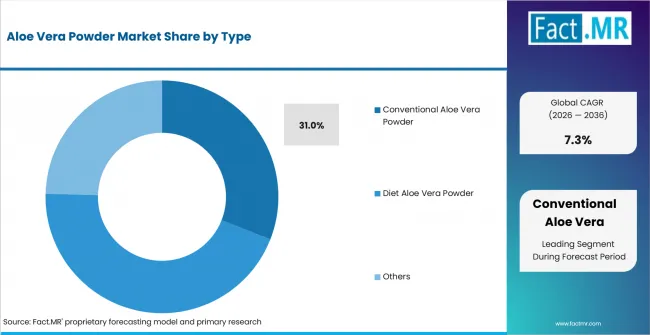
Aloe Vera Powder Market Analysis By Type | Source: Fact.MR
Conventional Aloe Vera Powder holds the largest recorded type share because it gives buyers a familiar input for broad commercial use. Formulators often prefer this option when purchasing teams need clear specifications and stable batch handling. Powder dietary supplements provide a nearby reference for dry-format positioning. Diet Aloe Vera Powder remains part of the market when brands need a narrower product identity.
Why does Food lead Application?
Food is projected to account for 32.6% share in 2026.
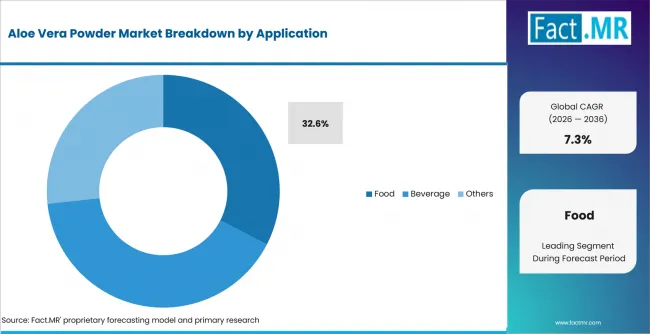
Aloe Vera Powder Market Analysis By Application | Source: Fact.MR
Food leads application demand since aloe vera powder works well in products that need measured dry inclusion. This keeps handling easier for manufacturers that want consistency from one batch to the next. Organic foods and beverages coverage gives context for categories that rely on label cues and repeat consumer review. Beverage applications remain useful when aloe identity supports flavor positioning.
What is accelerating Aloe Vera Powder Market adoption, and what is holding it back?
Demand is expected to rise as manufacturers use dry aloe formats that are easier to handle. Wellness positioning can support adoption. Growth may be limited by uneven raw material quality, unclear specifications and slow label approval.
Drivers Impact Analysis
| DRIVER | (~) % IMPACT ON CAGR | GEOGRAPHIC RELEVANCE | IMPACT TIMELINE |
|---|---|---|---|
| Food formulation use | +1.8% | UK, USA, Australia | Short term (<= 2 years) |
| Dry ingredient handling | +1.5% | North America and Europe | Short term (<= 2 years) |
| Retail and online reach | +1.1% | USA, Canada, UK | Medium term (2-4 years) |
| Application documentation | +0.8% | Germany and developed markets | Medium term (2-4 years) |
Source: Fact.MR analysis. Updated Aug 4, 2026
- Food formulation use: Food makers are expected to prefer aloe powder when dry mixing helps them control ingredient dosing.
- Dry ingredient handling: Powder formats are anticipated to ease storage planning by reducing reliance on fresh aloe material or liquid intermediates.
- Application documentation: Clear grade and processing details are expected to shorten buyer review because formulators can match powder behavior to the finished product.
Opportunity Impact Analysis
| OPPORTUNITY | (~) % IMPACT ON CAGR | GEOGRAPHIC RELEVANCE | IMPACT TIMELINE |
|---|---|---|---|
| Label-friendly product positioning | +1.2% | UK and Germany | Short term (<= 2 years) |
| Food and beverage format expansion | +0.9% | USA and Australia | Medium term (2-4 years) |
| Private-label ingredient sourcing | +0.7% | Canada and Europe | Medium term (2-4 years) |
| Specification-based producer differentiation | +0.5% | Global | Long term (>= 4 years) |
Source: Fact.MR analysis. Updated Aug 4, 2026
- Label-friendly product positioning: Aloe vera powder is expected to help brands use botanical identity without adding complex handling steps. Nutraceuticals coverage gives nearby context for wellness ingredient positioning.
- Food and beverage format expansion: Manufacturers are projected to test aloe powder in formats that need small inclusion levels and simple storage.
- Specification-based producer differentiation: Producers with clear particle and concentration details are expected to build buyer confidence before repeat orders.
Restraints Impact Analysis
| RESTRAINT | (~) % IMPACT ON CAGR | GEOGRAPHIC RELEVANCE | IMPACT TIMELINE |
|---|---|---|---|
| Input quality variability | -1.0% | Global | Short term (<= 2 years) |
| Labeling and compliance review | -0.8% | USA, UK, Germany | Short term (<= 2 years) |
| Application-specific performance limits | -0.6% | Food and beverage markets | Medium term (2-4 years) |
| Switching resistance from established inputs | -0.4% | Mature consumer markets | Long term (>= 4 years) |
Source: Fact.MR analysis. Updated Aug 4, 2026
- Input quality variability: Aloe raw material quality and processing choices are expected to affect powder consistency across purchase cycles.
- Labeling and compliance review: Companies must check how aloe ingredients are presented within local product rules before launch.
- Application-specific performance limits: Some buyers are expected to delay switching when solubility and taste remain uncertain.
Which countries are scaling the Aloe Vera Powder Market fastest?
- The country comparison spans 2.4 percentage points across the listed markets during the forecast period.
- The UK records the top displayed pace because retail fit and product positioning support faster movement.
- Australia follows the UK as food and beverage applications provide room for dry-format trials.
- The USA remains above Canada through broader retail access and repeat consumer product launches.
- Canada stays ahead of Germany because its demand profile is spread across the assessed applications.
Comparable CAGRs can create different entry conditions due to retail structure and labeling review. Application mix changes the route to adoption. Full report coverage includes North America and Latin America. Europe and East Asia are covered. South Asia and Pacific and the Middle East and Africa complete the regional view.
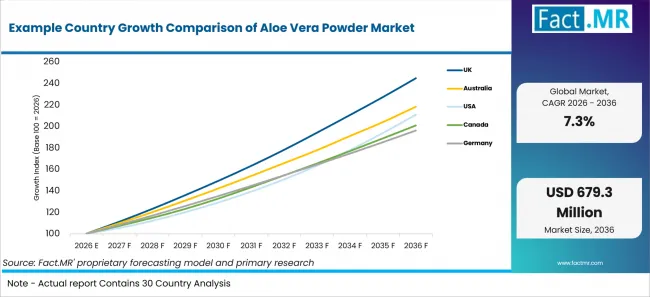
Example Country Growth Comparison Of Aloe Vera Powder Market | Source: Fact.MR
| Country | CAGR (2026-2036) |
|---|---|
| UK | 9.4% |
| Australia | 8.1% |
| USA | 7.7% |
| Canada | 7.2% |
| Germany | 7.0% |
Source: Fact.MR analysis. Updated Aug 4, 2026
What is driving the UK’s growth through 2036?
The UK records 9.4% CAGR through 2036.
The UK leads the displayed country set through retail-ready product positioning and steady interest in botanical ingredients. Food and beverage makers are expected to prefer powder formats when they need measured inclusion and easier storage. Product claims need careful review. This makes clear specification documents useful during buyer evaluation.
What supports Australia’s growth?
Australia is forecast to expand at 8.1% CAGR from 2026 to 2036.
Australia’s growth starts from broad consumer interest in aloe products and practical use in dry formulations. Manufacturers are expected to test powder formats when pilot batches need consistent inputs. Distribution reach shapes the next step because products need visible placement across food and beverage channels.
How is the USA scaling demand?
The USA is projected to record 7.7% CAGR over the assessment period.
The USA benefits from a wide product base and a strong retail channel structure. Buyers are expected to compare aloe powder companies on documentation and consistency before approving repeat use. Online discovery makes clear ingredient positioning more valuable for brands that sell consumer-facing products.
What is driving Canada’s growth?
Canada advances at 7.2% CAGR during the forecast decade.
Canada’s demand is spread across food and beverage uses with no single application controlling the outlook. Import planning and seasonal retail calendars are expected to keep purchasing decisions measured. Manufacturers with reliable supply and clear specification support are expected to gain preference.
How does Germany perform?
Germany is estimated to grow at 7.0% CAGR by the end of 2036.
Germany reflects a careful ingredient market in which buyers review labeling and documentation before expanding use. Product fit remains central to approval. Food manufacturers are expected to value consistent powder behavior during formulation. This keeps demand steady even when switching from established inputs takes longer.
Who leads the Aloe Vera Powder Market?
Competition is shaped by ingredient consistency and aloe sourcing. Processing control and clear documentation support food and beverage customers.
The named company set includes Aloe Laboratories, Inc. and Yunnan Yuanjiang Evergreen Biological Industry (Group) Co., Ltd.. Aloecorp; Terry Laboratories, Inc.; Aloe Jaumave, S.A. de C.V. complete the assessment group. The company section does not show share figures because provider relevance is assessed through product fit and commercial participation.
Which companies are the key providers?
Key companies include Aloe Laboratories, Inc.; Yunnan Yuanjiang Evergreen Biological Industry (Group) Co., Ltd.; Aloecorp; Terry Laboratories, Inc.; Aloe Jaumave, S.A. de C.V.
- Aloe Laboratories, Inc.
- Yunnan Yuanjiang Evergreen Biological Industry (Group) Co., Ltd.
- Aloecorp
- Terry Laboratories, Inc.
- Aloe Jaumave, S.A. de C.V.
Bibliography
- National Center for Complementary and Integrative Health. (2025, February). Aloe vera: Usefulness and safety.
- U.S. Census Bureau. (2026, May 18). Quarterly retail e-commerce sales: 1st quarter 2026.
- U.S. Food and Drug Administration. (2025, December 11). Letter to the dietary supplement industry on the DSHEA disclaimer.
This Report Answers
- The report provides strategic intelligence on the Aloe Vera Powder Market across Type and Application choices that shape commercial product development.
- Segment analysis covers Conventional Aloe Vera Powder and Diet Aloe Vera Powder. Food and Beverage complete the application view.
- Country outlook evaluates the UK and Australia alongside the USA. Canada and Germany complete the forecast comparison.
- Competitive analysis profiles Aloe Laboratories, Inc. and Yunnan Yuanjiang Evergreen Biological Industry (Group) Co., Ltd. alongside Aloecorp. Terry Laboratories, Inc. and Aloe Jaumave, S.A. de C.V. complete the provider set.
What does the Aloe Vera Powder Market cover?
The Aloe Vera Powder Market covers dry aloe vera products used across defined type and application categories. Coverage includes Conventional Aloe Vera Powder and Diet Aloe Vera Powder. Food and Beverage applications are included when aloe powder is used as an ingredient in finished or intermediate products.
The market includes companies that process or market aloe powder for food and beverage use. It covers regional demand patterns affected by product positioning and channel access. Specification support remains part of buyer review. The assessment does not treat every aloe product as part of the same category. Liquids and gels follow different use rules. Extracts and finished consumer products are reviewed separately.
What is included in the scope?
The scope includes aloe vera powder sold in formats that match the listed Type and Application categories. Conventional Aloe Vera Powder and Diet Aloe Vera Powder are included when manufacturers evaluate them for formulation use. Food and Beverage applications are included because they form the stated demand base.
Coverage spans the UK and Australia for country-level CAGR assessment. The USA and Canada complete most of the listed country set. Germany closes the displayed comparison. Regional coverage includes North America and Latin America. Europe and East Asia are covered. South Asia and Pacific and the Middle East and Africa complete the regional view.
What is excluded from the scope?
Products outside the defined type and application categories are excluded from the market scope. Fresh aloe leaves and finished aloe drinks are excluded unless demand depends directly on aloe vera powder as an input. Natural skin care coverage remains separate because topical gels and cosmetics follow different product-use rules.
The scope excludes unrelated botanical powders that do not use aloe vera as the main ingredient. Company revenue from unrelated product lines is not counted unless the activity directly supports aloe vera powder supply or direct use in food and beverage applications.
How Was the Analysis Built?
The analysis draws on 120+ sources and 35+ company portfolios. It reviews 25+ countries and more than 20 industry interviews.
- Primary Research: Primary research includes discussions with manufacturers and distributors. These interviews review purchasing priorities and product adoption. They examine operating challenges and approval needs. Competitive positioning and acceptance factors complete the review.
- Desk Research: Desk research covers government statistics and regulatory publications. Company filings and trade data add demand context. Technical studies and industry associations help define market boundaries.
- Market Sizing and Forecasting: Market estimates combine historical performance and demand indicators. Pricing trends and segment shares are reviewed against company participation. Country-level growth and adoption patterns support the forecast.
- Data Validation and Update Cycle: Findings are validated by comparing primary interviews with public data and company activity. Regular updates review product launches and partnerships. Approvals and procurement trends complete the refresh cycle.
Segmentation
What is the report’s scope and coverage?
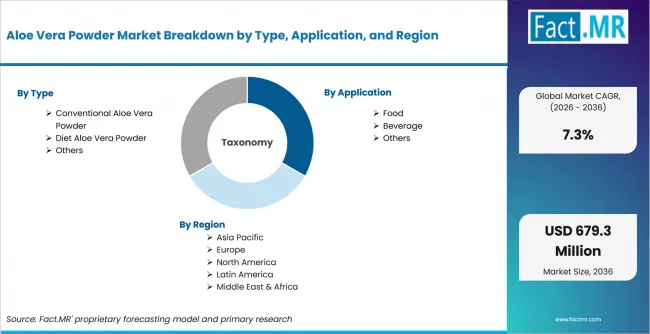
Aloe Vera Powder Market Breakdown By Type, Application, And Region | Source: Fact.MR
| Attribute | Details |
|---|---|
| Quantitative Units | USD million in 2026 to USD million by 2036 at CAGR |
| Market Definition | Dry aloe vera powder ingredients used in food, beverage and wellness formulations where powder solubility, mixing behavior, storage stability, specification consistency and labeling compliance influence product approval and commercial use. |
| Type | Conventional Aloe Vera Powder; Diet Aloe Vera Powder |
| Application | Food; Beverage |
| Regions Covered | North America; Latin America; Europe; East Asia; South Asia and Pacific; Middle East and Africa |
| Countries Covered | UK; Australia; USA; Canada; Germany |
| Key Companies Profiled | Aloe Laboratories, Inc.; Yunnan Yuanjiang Evergreen Biological Industry (Group) Co., Ltd.; Aloecorp; Terry Laboratories, Inc.; Aloe Jaumave, S.A. de C.V. |
| Forecast Period | 2026 to 2036 |
| Approach | Hybrid top-down and bottom-up approach using type demand; application fit; regional channel review; company participation; and producer documentation checks |
Source: Fact.MR analysis. Updated Aug 4, 2026
How is the market segmented?
-
By Type
- Conventional Aloe Vera Powder
- Diet Aloe Vera Powder
-
By Application
- Food
- Beverage
-
By Region
- North America
- Latin America
- Europe
- East Asia
- South Asia and Oceania
- Middle East and Africa
Frequently Asked Questions
Which Type leads the market?
Which Application leads the market?
Which country records the highest listed CAGR?
What is the primary driver in this market?
What is the main restraint?
Who worked on this report


Preview the report firsthand - request a free sample
Free SampleGet the brochure for pricing and purchase details
Download PDF