- Market Value (2025):USD 0.78 Bn
- Estimated Value (2026): USD 0.8 Bn
- Forecast Value (2036):USD 2.3 Bn
- CAGR (2026-2036): 11.1%
What is the anti-flake serum sprays market forecast to be worth by 2036?
USD 0.8 billion in 2026 to USD 2.3 billion by 2036, at 11.1% CAGR.
- The anti-flake serum sprays market crossed a valuation of USD 0.7 billion in 2025.
- Demand is expected to increase from USD 0.8 billion in 2026 to USD 2.3 billion by 2036.
- The market is forecast to record 11.1% CAGR from 2026 to 2036 because scalp-care buyers are adding targeted sprays beside shampoos and conditioners.
What are the defining numbers behind anti-flake serum sprays growth?
USD 1.5 billion absolute opportunity by 2036, led by South Korea and China.
- Demand Drivers in the Market
- Beauty retailers need flake-control productsthat work between wash days and do not leave hair coated.
- Prestige retailers need scalp treatments that sales teams can explain through active purpose and application timing.
- Formulators need leave-on systems that balance keratolytic action with scalp-barrier comfort.
- Online beauty channels need clear product pages that separate dryness flakes from buildup-related flakes.
- Key Segments Analyzed
- By Anti-Flake Active: Salicylic Acid is expected to hold 31.0% share in 2026 because exfoliating scalp claims are easy to explain.
- By Active Base: Niacinamide is projected to account for 27.0% share in 2026 because barrier-care language has moved from facial skin care into scalp care.
- By Hair Concern: Flakes are expected to capture 34.0% share in 2026 because visible shedding creates the clearest purchase trigger.
- By Channel: Prestige Beauty is likely to hold 32.0% share in 2026 because serum sprays need product education and texture demonstration.
- By Positioning: Scalp-First Routines are projected to hold 38.0% share in 2026 because buyers now treat scalp comfort as part of hair appearance.
- By Geography: South Korea is projected to record 12.4% CAGR through 2036 as scalp-care routines and beauty export discipline support faster uptake.
- Analyst Opinion at Fact.MR
- Shambhu Nath Jha, Senior Analyst at Fact.MR, states, “Anti-flake serum sprays now sit between dandruff control and scalp skin care. I see the best products winning when they reduce visible flakes and still leave hair clean after use. Brands that explain active purpose and application timing are expected to gain shelf space before ordinary styling mists.”
- Strategic Implications
- Beauty brands should build anti-flake sprays around clear active purpose and low-residue application.
- Retailers need product education that separates scalp treatment from ordinary hair styling sprays.
- Formulators should document active levels and irritation controls before scaling leave-on formats.
- Ingredient suppliers need support files that connect exfoliation, barrier comfort and preservation stability.
Leave-on and pre-wash scalp treatments form the core of this market. The product sits within the wider scalp health category as consumers connect flakes with dryness, buildup and barrier discomfort.
South Korea is projected to record 12.4% CAGR through 2036 as scalp routines and fast beauty testing support uptake. China is expected to expand at 12.1% CAGR as online beauty discovery raises active-led product trial. India is forecast to grow at 11.8% CAGR as urban consumers add treatment steps to shampoo routines. The United States is expected to advance at 10.9% CAGR as cosmetic listing discipline supports product files. Japan is projected to rise at 10.5% CAGR because low-irritation scalp care favors clear instructions.
How does the anti-flake serum sprays market break down by segment?
Salicylic acid leads at 31.0%. Niacinamide leads at 27.0%.
Which anti-flake active dominates?
Salicylic Acid holds 31.0% share in 2026.
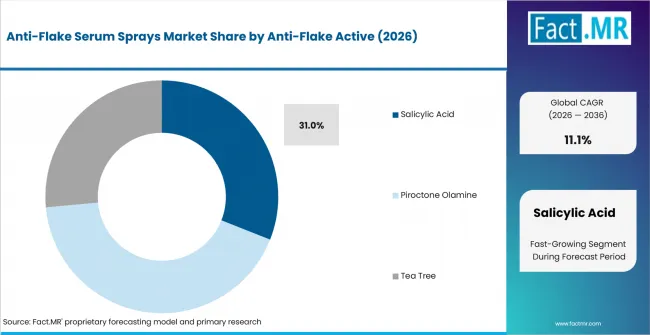
Anti Flake Serum Sprays Market Analysis By Anti Flake Active | Source: Fact.MR
Salicylic Acid leads because brands can explain scalp exfoliation in plain language. Its use also connects anti-flake sprays with skin care ingredients that consumers already recognize from facial routines.
Which active base dominates?
Niacinamide accounts for 27.0% share in 2026.
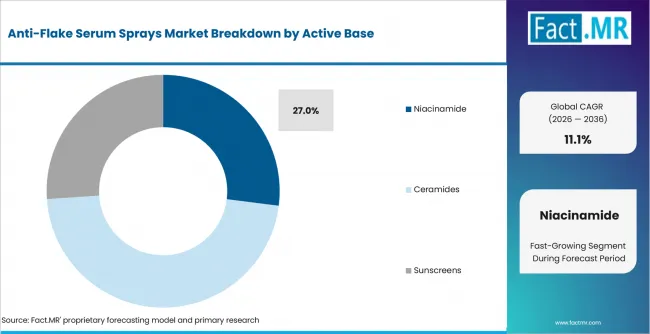
Anti Flake Serum Sprays Market Analysis By Active Base | Source: Fact.MR
Niacinamide leads because scalp treatment buyers now expect comfort support after active exfoliation. Hyaluronic acid and peptides remain important support claims, especially where formulas borrow language from hyaluronic acid skin-care positioning.
Which hair concern dominates?
Flakes hold 34.0% share in 2026.
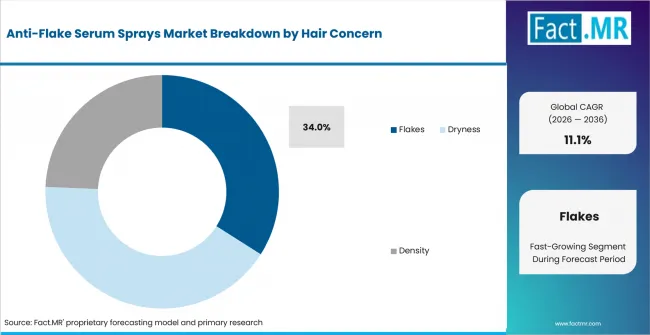
Anti Flake Serum Sprays Market Analysis By Hair Concern | Source: Fact.MR
Flakes lead because consumers can see the problem before they understand whether dryness, sebum or buildup created it. Seborrheic dermatitis affects about three to ten out of every one hundred people, which keeps flake care visible in personal-care routines.
Which channel dominates?
Prestige Beauty leads with 32.0% share in 2026.
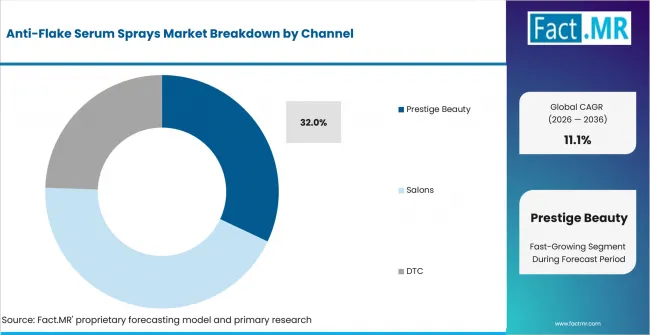
Anti Flake Serum Sprays Market Analysis By Channel | Source: Fact.MR
Prestige Beauty leads because serum sprays require education before shoppers accept another scalp step. The same store logic appears in premium beauty personal care because product education helps justify higher treatment prices.
Which positioning dominates?
Scalp-First Routines hold 38.0% share in 2026.
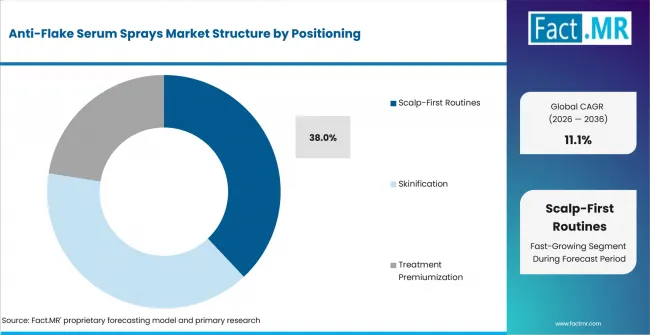
Anti Flake Serum Sprays Market Analysis By Positioning | Source: Fact.MR
Scalp-First Routines lead because buyers increasingly view scalp comfort as part of hair appearance. This position gives sprays a role beside anti-dandruff shampoos without replacing the cleansing step.
What is accelerating anti-flake serum sprays adoption, and what is holding it back?
Scalp routines beyond shampoos and prestige active education drive it, while leave-on irritation risk and dandruff claim limits restrain it.
Drivers Impact Analysis
| DRIVER | (~) % IMPACT ON CAGR |
GEOGRAPHIC RELEVANCE | IMPACT TIMELINE |
|---|---|---|---|
| Scalp routines moving beyond shampoos | +2.4% | South Korea, China, United States | Short term (≤ 2 years) |
| Prestige retailers explaining active purpose | +2.1% | United States, Japan, United Kingdom | Medium term (2-4 years) |
| Barrier-care actives entering haircare | +1.9% | North America, Europe, East Asia | Medium term (2-4 years) |
| Marketplaces supporting product discovery | +1.6% | China, India, South Korea | Short term (≤ 2 years) |
| Salon and dermocosmetic channels validating use | +1.2% | Japan, United States, Germany | Long term (≥ 4 years) |
- Scalp routines moving beyond shampoos:Consumers are adding scalp steps between wash days because flakes often return before the next cleanse. Rinse-off expectations still depend on hair-care surfactants because clean feel remains the baseline for any leave-on scalp treatment.
- Prestige retailers explaining active purpose:Prestige beauty stores give anti-flake sprays a stronger route to trial because shoppers can ask how the product is used. This helps brands reduce confusion between a medicated dandruff claim and a cosmetic scalp comfort claim.
- Barrier-care actives entering haircare:Niacinamide, ceramides and prebiotics support anti-flake spray adoption because shoppers now link barrier comfort with visible scalp appearance. Brands that explain comfort after exfoliation are better placed to win repeat use.
Opportunity Impact Analysis
| OPPORTUNITY | (~) % IMPACT ON CAGR |
GEOGRAPHIC RELEVANCE | IMPACT TIMELINE |
|---|---|---|---|
| Two-step scalp systems | +2.0% | South Korea, United States, Japan | Medium term (2-4 years) |
| Dermocosmetic retail expansion | +1.7% | United States, Japan, Germany | Medium term (2-4 years) |
| Marketplace education pages | +1.5% | China, India, South Korea | Short term (≤ 2 years) |
| Low-residue active bases | +1.3% | Global, strongest in premium channels | Short term (≤ 2 years) |
| Sensitive-scalp positioning | +1.1% | Japan, Europe, United States | Long term (≥ 4 years) |
- Two-step scalp systems:Brands can use pre-wash sprays and leave-on comfort serums as a connected routine. This raises reorder value because the shopper buys a system instead of a single rescue product.
- Dermocosmetic retail expansion:Dermocosmetic channels can support anti-flake sprays when packaging separates cosmetic comfort from medical treatment. Preservation choices matter because cosmetic preservatives must keep water-light textures stable without adding irritation risk.
- Marketplace education pages:Online product pages can explain active function, application timing and expected feel before purchase. This is valuable in China and India, where natural personal care and active-led beauty content both shape product discovery.
Restraints Impact Analysis
| RESTRAINT | (~) % IMPACT ON CAGR |
GEOGRAPHIC RELEVANCE | IMPACT TIMELINE |
|---|---|---|---|
| Irritation risk in leave-on formats | -1.8% | Europe, United States, Japan | Short term (≤ 2 years) |
| Claim limits around dandruff language | -1.5% | United States, Europe, South Korea | Medium term (2-4 years) |
| Residue concerns after application | -1.3% | Global, strongest in humid markets | Short term (≤ 2 years) |
| Consumer confusion with styling sprays | -1.0% | United States, India, China | Medium term (2-4 years) |
| Price gap versus shampoos | -0.9% | India, China, Latin America | Long term (≥ 4 years) |
- Irritation risk in leave-on formats:Leave-on scalp products face higher scrutiny because active contact lasts longer than in rinse-off formats. The European Commission opened a salicylic acid data call in July 2024 to assess aggregate exposure from salicylic esters used in cosmetic products.
- Claim limits around dandruff language:Brands must avoid wording that makes cosmetic sprays sound like prescription scalp medicines. This limits fast claim expansion, but it also helps credible formulas win retailer trust.
- Residue concerns after application:Sprays can lose repeat buyers if the formula leaves roots sticky or flat after use. Cleaner surfactant and solubilizer systems can support gentler textures. Sugar-based surfactants help formulators balance mild feel with clear dispersion.
Which countries are scaling anti-flake serum sprays fastest?
South Korea 12.4%. China 12.1%. India 11.8%. United States 10.9%. Japan 10.5%.
Based on regional analysis, the anti-flake serum sprays market is segmented into North America and Latin America. It also covers Europe and East Asia. South Asia and Pacific and Middle East and Africa complete the regional scope.
| Country | CAGR |
|---|---|
| South Korea | 12.4% |
| China | 12.1% |
| India | 11.8% |
| United States | 10.9% |
| Japan | 10.5% |
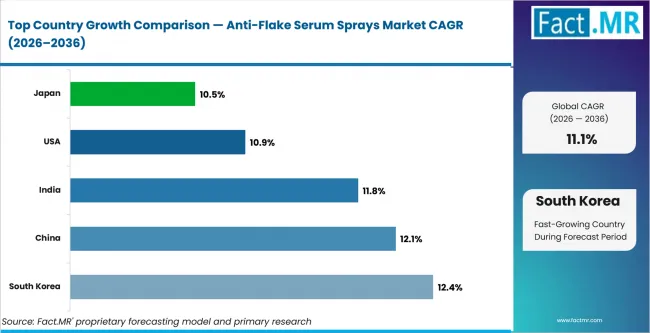
Anti Flake Serum Sprays Market Cagr Analysis By Country | Source: Fact.MR
What is powering South Korea’s lead?
12.4% CAGR, supported by scalp-care routines and cosmetic safety-file discipline.
South Korea has a beauty culture that accepts scalp care as part of routine personal care. The U.S. International Trade Administration reported that South Korea plans safety assessment reports for all cosmetic products by 2031. South Korea is projected to record 12.4% CAGR through 2036 because fast product testing supports active-led scalp routines. Anti-flake serum sprays can fit into pre-wash and leave-on routines because shoppers already use multi-step facial care. Brands that show mildness, fast absorption and visible flake control are expected to gain faster trial in Seoul-led prestige channels.
How is China scaling serum spray demand?
12.1% CAGR, driven by online beauty retail and active-led product discovery.
China’s beauty buyers compare active ingredients through online content before they try a scalp treatment. The National Bureau of Statistics of China reported online retail sales of 15,972.2 billion yuan in 2025. China is expected to expand at 12.1% CAGR through 2036 because marketplaces can explain flakes from dryness and buildup. Anti-flake serum sprays benefit when product pages separate exfoliating pre-wash use from daily comfort use. Suppliers that provide clear instructions and compliant ingredient files can convert online education into repeat purchases.
Why is India moving above the global rate?
11.8% CAGR, supported by marketplace access and urban treatment routines.
India has a large beauty base with visible dandruff need and fast movement from value haircare toward specialist treatments. India Brand Equity Foundation valued India’s beauty and personal care market at USD 28 billion in 2025. India is forecast to grow at 11.8% CAGR through 2036 as marketplaces and premium urban stores expand trial. Anti-flake serum sprays can gain traction when brands price starter packs below salon-only systems. Wider movement depends on simple instructions that show how sprays work between shampoo days.
What supports the United States outlook?
10.9% CAGR, backed by premium scalp care and federal cosmetic listing rules.
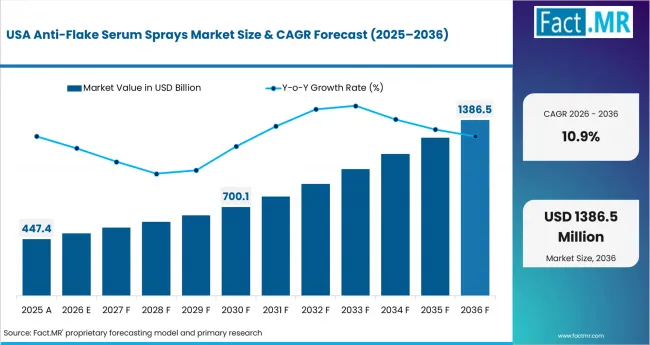
Anti Flake Serum Sprays Market Country Value Analysis | Source: Fact.MR
United States brands are operating under a more visible cosmetic listing system. The United States Food and Drug Administration states that cosmetic facility registrations must be renewed every two years. The United States is expected to advance at 10.9% CAGR through 2036 because brands need stronger product files for leave-on scalp formulas. Buyers are likely to favor products that explain flake type, active purpose and safe usage frequency. The country’s rate remains close to the global average because premium scalp-care education is already developed.
Why is Japan an important serum spray market?
10.5% CAGR, supported by scalp-care familiarity and low-irritation expectations.
Japan has a beauty market where shoppers value low-irritation care and carefully explained product use. Japan Cosmetics Industry Association cited Ministry of Economy Trade and Industry data. The source showed cosmetic shipments of 1,302.4 billion yen in 2023. [8] Japan is projected to rise at 10.5% CAGR through 2036 because scalp-care familiarity supports disciplined product routines. Anti-flake serum sprays can gain traction when they avoid heavy fragrance and residue after application. Providers with precise instructions and mild textures are expected to gain better shelf access.
Who leads the anti-flake serum sprays landscape?
Jupiterand and Head & Shoulders leadthrough active-led scalp positioning, while Briogeo and Kérastase add premium beauty reach.
Jupiterand and Head & Shoulderslead through active-led scalp positioning. Briogeo and Kérastase add premium beauty reach. Jupiter gives buyers a moisture-focused scalp serum reference.
Kérastase and The INKEY List strengthen the active-led side of competition through salicylic acid and piroctone olamine language. Living Proof and Vegamour support comfort and buildup-control positioning, while Dermazen adds barrier-care and peptide language to scalp routines.
Competition through 2036 is expected to depend on active evidence, residue feel and claim control. Suppliers using mild bases and personal care surfactants with reliable preservation support are better placed to serve premium and dermocosmetic channels.
Which companies are the key players?
Jupiterand Head & Shoulders. Briogeo and Kérastase. Living Proof and The INKEY List. Vegamour and Dermazen.
- Jupiter
- Head & Shoulders
- Briogeo
- Kérastase
- Living Proof
- The INKEY List
- Vegamour
- Dermazen
Bibliography
- Institute for Quality and Efficiency in Health Care. (2024, February 1). Overview: Seborrheic dermatitis. InformedHealth.org, National Center for Biotechnology Information.
- European Commission. (2024, July 1). Call for data on ingredients used in cosmetic products. European Commission.
- U.S. International Trade Administration. (2025, September 30). South Korea cosmetics safety regulations. International Trade Administration.
- National Bureau of Statistics of China. (2026, January 20). Total retail sales of consumer goods in December 2025. National Bureau of Statistics of China.
- India Brand Equity Foundation. (2025, February 13). India, you e-beauty! The blush-and-glow of the new billion-dollar boom. IBEF.
- U.S. Food and Drug Administration. (2026, April 14). Registration and listing of cosmetic product facilities and products. FDA.
- Japan Cosmetic Industry Association. (2024, October 11). Statistics: Cosmetic shipments. JCIA.
- Briogeo. (2026). Scalp Revival Charcoal + Tea Tree Buildup Detox Spray. Briogeo.
- Kérastase Paris. (2026). Symbiose Sérum Cellulaire Nuit Anti-Pelliculaire Intensif. Kérastase Paris.
- The INKEY List. (2026). Salicylic Acid Exfoliating Scalp Treatment. The INKEY List.
- Living Proof. (2026). Scalp Care Dry Scalp Treatment. Living Proof.
- Vegamour. (2026). GRO Scalp Detoxifying Serum. Vegamour.
This Report Addresses
- Strategic intelligence on anti-flake serum sprays across anti-flake active, active base and positioning.
- Segment analysis covers salicylic acid and niacinamide. It also covers flakes, prestige beauty and scalp-first routines.
- Regional outlook covers South Korea and China. It also covers India, United States and Japan.
- Competitive analysis covers the eight brands named in the landscape section.
- Product assessment covers spray formats and low-residue scalp application.
- Claim assessment covers scalp comfort and visible flake control.
- Primary interviews and official source review support the forecast.
What does the anti-flake serum sprays market cover?
Leave-on and pre-wash scalp treatment sprays for visible flakes, dryness and scalp comfort.
The anti-flake serum sprays market covers topical scalp products that target visible flakes and discomfort without prescription positioning. It includes sprayable serums and nozzle-based scalp treatments that use exfoliating, soothing and barrier-supporting actives.
What is included in the scope?
Anti-flake sprays and scalp serums form the main scope. Active bases and premium beauty channels are also included.
The scope includes salicylic acid and piroctone olamine positioning. It also covers tea tree and zinc pyrithione alternative positioning. Active bases include niacinamide, ceramide and peptide systems. Sales channels include prestige beauty, salons and dermocosmetic retail. Direct-to-consumer and marketplace channels are included when products are treatment-led.
What is excluded from the scope?
Prescription scalp medicines, rinse-off shampoos and styling sprays without treatment positioning.
The scope excludes prescription dandruff medicines and physician-administered dermatology treatments. It excludes standard rinse-off shampoos unless they are sold with a serum spray system. It also excludes styling sprays, ingestible supplements and scalp devices without topical anti-flake application.
How was the analysis built?
90+ sources were reviewed. 35+ company portfolios were checked. 25+ countries were screened. 18+ interviews informed the assumptions.
- Primary Research:
- Primary research includes interviews with beauty category managers and scalp-care formulators. It includes input from dermatology retail buyers, salon channel specialists and direct-to-consumer brand operators.
- Desk Research:
- Desk research reviews cosmetic regulation sources and company product pages. It covers active positioning and claim language. Retailer education and scalp treatment product architecture were reviewed.
- Market-Sizing and Forecasting:
- Forecasting uses user-provided value anchors and bottom-up checks against premium scalp-care product assortments. Active penetration, channel mix and repeat-use logic support the market assessment.
- Data Validation and Update Cycle:
- Forecasts are validated through brand portfolio checks and retailer assortment review. Regulatory updates and active-level guidance help confirm the forecast direction.
Segmentation
What is the report’s scope and coverage?
| Attribute | Details |
|---|---|
| Quantitative Units |
USD Billion in 2026 to USD Billion by 2036 at CAGR |
| Market Definition | Topical anti-flake serum sprays and nozzle serums used for cosmetic scalp comfort and visible flake control |
| Anti-Flake Active | Zinc Pyrithione Alternatives, Salicylic Acid, Piroctone Olamine, Tea Tree, Microbiome Actives |
| Active Base | Ceramides, Niacinamide, Peptides, Prebiotics, Sunscreens, Fermented Ingredients |
| Hair Concern | Barrier Repair, Dryness, Flakes, Sebum Control, Density, Sensitivity, UV Exposure |
| Channel | Prestige Beauty, Salons, Dermocosmetic Retail, DTC, Marketplaces |
| Positioning | Skinification, Scalp-First Routines, Treatment Premiumization |
| Regions Covered | North America, Latin America, Europe, East Asia, South Asia and Pacific, Middle East and Africa |
| Countries Covered |
South Korea, China, India, United States, Japan |
| Key Companies Profiled |
Jupiter, Head & Shoulders, Briogeo, Kérastase, Living Proof, The INKEY List, Vegamour and Dermazen |
| Forecast Period | 2026 to 2036 |
| Approach | Hybrid top-down and bottom-up approach using internal market value anchors, product portfolio checks, channel review, active-level logic and source validation |
How is the market segmented?
-
By Anti-Flake Active:
- Zinc Pyrithione Alternatives
- Salicylic Acid
- Piroctone Olamine
- Tea Tree
- Microbiome Actives
-
By Active Base:
- Ceramides
- Niacinamide
- Peptides
- Prebiotics
- Sunscreens
- Fermented Ingredients
-
By Hair Concern:
- Barrier Repair
- Dryness
- Flakes
- Sebum Control
- Density
- Sensitivity
- UV Exposure
-
By Channel:
- Prestige Beauty
- Salons
- Dermocosmetic Retail
- DTC
- Marketplaces
-
By Positioning:
- Skinification
- Scalp-First Routines
- Treatment Premiumization
-
By Region
- North America
- United States
- Canada
- Mexico
- Latin America
- Brazil
- Argentina
- Rest of Latin America
- Europe
- Germany
- United Kingdom
- France
- Italy
- Spain
- Rest of Europe
- Asia Pacific
- China
- India
- Japan
- South Korea
- ASEAN
- Middle East & Africa
- GCC Countries
- South Africa
- UAE
- Rest of Middle East & Africa
- North America
Frequently Asked Questions
Which anti-flake active leads the Anti-Flake Serum Sprays Market?
Which country expands fastest in the Anti-Flake Serum Sprays Market?
How does China perform in the Anti-Flake Serum Sprays Market?
How does India perform in the Anti-Flake Serum Sprays Market?
How does the United States perform in the Anti-Flake Serum Sprays Market?
How does Japan perform in the Anti-Flake Serum Sprays Market?
What is the primary driver in the Anti-Flake Serum Sprays Market?
What is the main restraint in the Anti-Flake Serum Sprays Market?
Why are serum sprays important in this market?
Who worked on this report


Preview the report firsthand - request a free sample
Free SampleGet the brochure for pricing and purchase details
Download PDF