Hair Growth Shampoos Market (2026 - 2036)
Hair Growth Shampoos Market Size and Share Forecast Outlook 2026 to 2036
Core Findings
Hair Growth Shampoos Market Forecast and Outlook 2026 to 2036
Hair growth shampoos market is projected at USD 9.9 billion in 2026 and is expected to reach USD 18.1 billion by 2036, reflecting a 6.3% CAGR.
Hair Growth Shampoos Market Key Takeaways
- Hair Growth Shampoos Market Value (2026): USD 9.9 billion
- Hair Growth Shampoos Forecast Value (2036): USD 18.1 billion
- Hair Growth Shampoos Forecast CAGR (2026-2036): 6.3%
- Hair Growth Shampoos Leading Product Type: Anti-hair fall shampoos (39%)
- Hair Growth Shampoos Leading Ingredient Type: Botanical extracts (43%)
- Hair Growth Shampoos Key Growth Regions: China, India, Germany, Brazil, USA
- Hair Growth Shampoos Top Players: L’Oréal, Procter & Gamble, Unilever, Johnson & Johnson, Beiersdorf, Kao Corporation, Himalaya Wellness, Amway
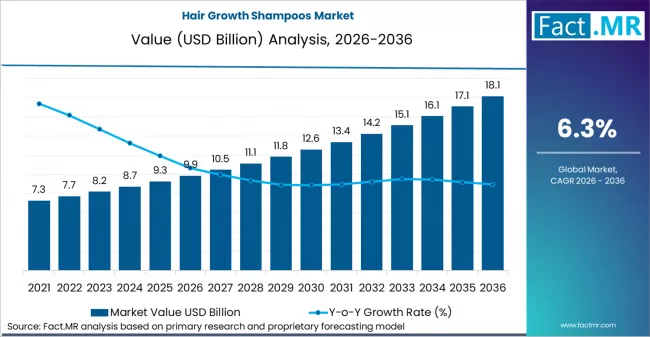
As per Fact.MR analysis, growth is linked to a shift from reactive anti-loss treatments toward preventive scalp and follicle care programs. Competitive approaches vary, with some firms emphasizing performance positioning while others invest in proteomic and epigenetic formulation research. Institutional and retail buyers increasingly standardize formulations and packaging to support volume distribution and consistent supply planning. Portfolio consolidation and expanded channel coverage increased adoption across dermatology-led, direct-to-consumer, and regional wellness segments. Nicolas Hieronimus, CEO of L’Oréal, stated:
“Hair care has emerged as one of the fastest-growing categories, signaling a new era where beauty and longevity intertwine. In the hair growth sector, this shift empowers consumers to move from corrective treatments to preventive care, utilizing science-backed formulations to enhance scalp health and overall hair density.”
Growth reflects rising demand for science-backed hair care products that can be produced and distributed at scale.
Hair Growth Shampoos Market
| Metric | Value |
|---|---|
| Market Value (2026) | USD 9.9 billion |
| Forecast Value (2036) | USD 18.1 billion |
| Forecast CAGR (2026-2036) | 6.3% |
Category
| Category | Segments |
|---|---|
| Product Type | Anti-hair fall shampoos; Medicated hair growth shampoos; Natural and herbal hair growth shampoos; Caffeine based shampoos |
| Ingredient Type | Botanical extracts; Vitamins and minerals; Proteins and peptides; Chemical actives |
| Hair Type | Dry hair; Oily hair; Normal hair; Damaged hair |
| Distribution Channel | Online retail; Supermarkets and hypermarkets; Pharmacies and drug stores; Specialty stores |
| Region | North America; Europe; Asia Pacific; Latin America; Middle East & Africa |
Segmental Analysis
By Product Type, Why Do Anti Hair Fall Shampoos Lead the Market?
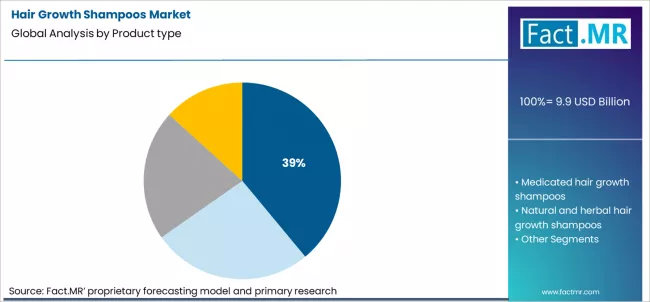
Anti-hair Fall shampoos account for 39% share due to high purchase frequency across retail and e-commerce channels. Demand is supported by frequent replenishment cycles, wide outlet coverage, and concentrated urban consumption. Operational efficiency and predictable inventory cycles are central to channel planning, with large buyers favoring solutions that integrate smoothly into established supply chains. Growth is further supported by increasing awareness of hair health and routine grooming practices. Segment leadership is driven by repeatable ordering patterns and distribution scale rather than formulation differentiation.
By Ingredient Type, Why Do Botanical Extracts Represent the Largest Segment?
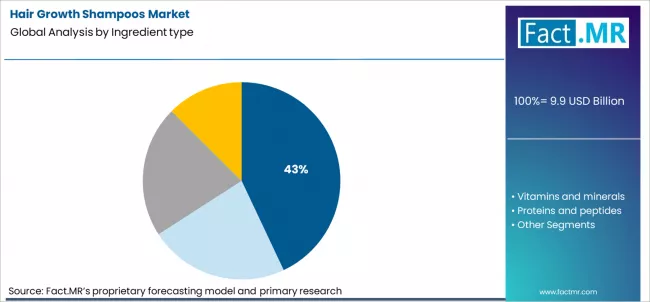
Botanical extracts represent 43% share due to widespread household usage and professional adoption. The market prioritizes formats that support recurring consumption, standardized distribution, and streamlined storage logistics. Suppliers benefit from consistent sourcing, production scalability, and repeatable order cycles across multi-channel networks. Operational planning emphasizes predictable supply and high-frequency turnover. Segment dominance reflects procurement stability and broad availability rather than ingredient-specific performance claims. Botanical extracts dominate because market adoption is guided by repeatable demand patterns and supply chain efficiency.
Key Dynamics Hair Growth Shampoos Market
| Country | Driver | Restraint | Trend |
|---|---|---|---|
| USA | L’Oréal 2025 Dermatological Beauty and CeraVe hair launches → shift from commodity to dermatologist-validated, high-efficacy shampoos | FDA MoCRA 2025 cGMP enforcement → raises CapEx and slows indie brand entry | Growth of premium, clinically substantiated hair growth shampoos |
| India | Quick commerce expansion in 2024 and Unilever Aroma/Serum launches → enables rapid urban penetration | Supply chain and compliance challenges → slow nationwide rollout | Increased availability of ready-to-deliver, urban-targeted hair growth shampoos |
| Brazil | Biodiversity ingredient sourcing → drives differentiated, natural product launches | Complex import and ingredient regulations → increases reformulation costs | Growth of eco-conscious, locally sourced hair growth shampoos |
| Global Trend | Beiersdorf Epicelline® and Nexxus Proteomic expansion → drives “skinification of hair” | High R&D and ingredient compliance → raises barriers for smaller players | Hair growth shampoos positioned as cellular/dermatologic solutions |
Analysis of the Hair Growth Shampoos Market by Key Country
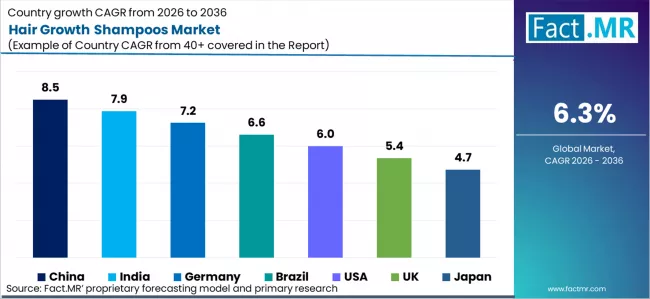
| Country | CAGR (2026-2036) |
|---|---|
| China | 8.5% |
| India | 7.9% |
| Germany | 7.2% |
| Brazil | 6.6% |
| USA | 6.0% |
| UK | 5.4% |
| Japan | 4.7% |
The report covers an in-depth analysis of 40+ countries; top-performing countries are highlighted below.
How Is the Hair Growth Shampoos Market Growing in China?
The hair growth shampoos category in China grows at 8.5% CAGR through 2036. The January 2026 NMPA ban on legacy "Special-Use" hair growth classifications forces manufacturers to pivot towards new efficacy claims or medical registration. Electronic labeling pilots beginning February 2026 increase transparency and traceability. Regulatory enforcement drives investment in product reformulation, clinical validation, and compliance infrastructure. Urban retail and e-commerce adoption accelerates due to heightened consumer trust. Operational improvements focus on standardized manufacturing, digital monitoring, and validated claims. Firms that adapt quickly consolidate market share, while laggards risk market exclusion, creating a regulatory-driven compliance moat that shapes competitive dynamics.
What Is the Growth in Adoption of Hair Growth Shampoos in India?
Growth in adoption of the hair growth shampoos market in India reaches 7.9% CAGR through 2036. The May 2025 CDSCO Borderline Guidelines reclassify high-SPF and active-heavy hair solutions as Drugs, requiring clinical validation via Form COS-1. Unauthorized claims face rapid regulatory cancellation. Manufacturers respond by investing in compliance laboratories and validated clinical studies. Distribution channels standardize product labeling to reflect regulatory conformity. Operational focus emphasizes clinical assurance, traceable production, and risk management rather than volume expansion. Urban wellness segments and premium adoption increase due to heightened consumer confidence in safety and efficacy, allowing compliant companies to strengthen leadership positions nationally.
How Is the Hair Growth Shampoos Market Shaping in Germany?
Outlook on the hair growth shampoos market in Germany grows at 7.2% CAGR through 2036. The November 1, 2025 Retinol restriction forces brands to withdraw non-compliant anti-aging and hair-growth SKUs from shelves. Manufacturers invest in reformulation, sourcing alternative actives, and validating compliance across all production lines. Supply chain adjustments prioritize traceability and packaging updates. Retailers optimize inventory management to handle phased product withdrawals. Operational improvements focus on regulatory adherence, market continuity, and consistent consumer experience rather than facility expansion. Compliance-driven innovation allows leaders to differentiate through verified efficacy and safety while protecting market share in a highly regulated European environment.
How Is the Hair Growth Shampoos Market Evolving in Brazil?
Adoption of the hair growth shampoos market in Brazil grows at 6.6% CAGR through 2036. The February 1, 2026 ANVISA ban on Diphenyl oxide and N, N-dimethyl-p-toluidine triggers mandatory recalls of affected hair-dye and treatment products. Manufacturers pivot to compliant formulations and implement rigorous quality assurance protocols. Operational focus shifts to supply chain traceability, product validation, and consumer safety communications. Regulatory enforcement drives investment in production monitoring, batch tracking, and employee training. Urban and professional haircare channels prioritize compliance assurance, enabling brands that adapt efficiently to consolidate market presence while non-compliant firms face exclusion and operational setbacks.
What Is the Growth in the Hair Growth Shampoos Market in the United States?
Growth in the hair growth shampoos market in the United States reaches 6.0% CAGR through 2036. The December 29, 2025 FDA MoCRA final Cosmetic GMP rules require heavy CapEx investment for compliance, including designated Responsible Persons and pharma-grade tracking systems. Manufacturers restructure operations to meet cGMP standards, standardizing batch documentation and facility audits. Retailers benefit from improved product consistency and safety assurance. Operational improvements prioritize traceability, compliance, and risk mitigation rather than capacity expansion. Companies that meet MoCRA requirements early establish a compliance moat, gaining consumer trust and long-term operational efficiency while competitors face potential regulatory penalties.
How Is the Hair Growth Shampoos Market Growing in Japan?
Outlook on the hair growth shampoos market in Japan grows at 4.7% CAGR through 2036. The August 2025 PMDA Quasi-Drug Marketing Authorization procedures require foreign manufacturers to obtain accreditation before marketing hair growth claims. Compliance necessitates investment in safety reviews, local representation, and quality documentation. Retailers and distributors coordinate with accredited suppliers to ensure market availability. Operational focus emphasizes regulatory alignment, documentation, and risk management rather than scale expansion. Market adoption benefits premium and urban segments as consumer confidence rises. Firms that navigate the accreditation efficiently capture leadership, while laggards face market entry barriers, establishing a compliance-driven hierarchy in Japan.
How Are Market Dynamics and Regulatory Compliance Shaping Competitive Moats in the Hair Growth Shampoos Market?
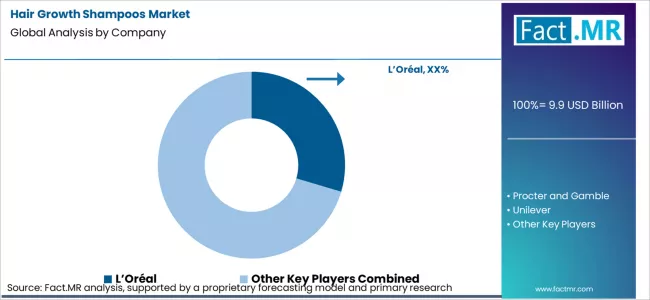
As per Fact.MR analysis, growth has shifted from volume-led expansion in 2024 toward clinically substantiated product positioning. L’Oréal’s acquisition of Color Wow in June 2025 and the 9.3% Q3 2025 growth in its Professional Products Division strengthened premium segment dominance, prompting competitors to enhance scientific validation. Beiersdorf’s September 2025 Epicelline® launch reinforced NIVEA’s cellular repair positioning, influencing professional channel adoption. Unilever’s Nexxus “Trillion Protein Transfusion” and ScalpCeuticals Pro range drove mass-market engagement, aligning with the “Skinification of Scalp” trend in India. P&G’s Pantene Repair & Protect adoption, achieving 95% clinical approval, increased consumer trust and supplier bargaining power. Shiseido’s post-2024 medicalized wellness pivot and Himalaya’s Bhringaraja anti-hair fall campaign reinforced demand for evidence-backed solutions. Amway’s Satinique™ ENERJUVE™ Complex and Kao Corporation’s Global Sharp Top strategy further strengthened direct-to-consumer and environmental positioning. Johnson & Johnson’s regional expansion and AI-driven formulation pilots optimized supply chain responsiveness. Regulatory compliance, clinical validation, and operational discipline now determine competitive positioning.
Recent Developments
Unilever: "Skinification" of Scalp Care with New Power Brand Launches (Dec 2025). Unilever is aggressively pivoting its hair care strategy toward "scalp health" as the primary driver for hair growth and strength. In December 2025, the company highlighted its Dove DermaCare range, which integrates high-end skincare ingredients like Niacinamide, Zinc, and Peptides to nourish follicles and reduce hair fall by up to 95%. This move aligns with a broader market shift where consumers treat the scalp with the same rigor as facial skin to prevent thinning. Source: Unilever - The skinification of scalp care: Unilever’s expertise delivers on demand
L’Oréal: Accelerating Premium Haircare and "Growth Booster" Innovation (July 2025). During its 2025 half-year results, L’Oréal identified hair care as one of its fastest-growing categories, specifically noting the success of the "Growth Booster" range from L’Oréal Paris. The group is leveraging its Professional Products and Consumer divisions to "premiumize" the category, focusing on science-backed formulas that transition consumers from simple cleansing to active "preventive care" for hair density. Source: L’Oréal Finance - 2025 Half-Year Results
Himalaya Wellness: "King of Hair" Campaign and Traditional Herb Integration (July 2025). In mid-2025, Himalaya Wellness launched a major nationwide campaign for its Anti-Hair Fall Shampoo, specifically spotlighting Bhringaraja (traditionally known as the "King of Hair"). This development marks a significant effort by the company to capture the "natural and organic" segment of the hair growth market, combining traditional Ayurvedic medicine with modern retail strategies to address rising consumer "hair fall anxiety." Source: BestMediaInfo - Himalaya Wellness brings friendship into focus with ‘Won’t Let You Fall’
Key Players in Hair Growth Shampoos Market
- L’Oréal
- Procter and Gamble
- Unilever
- Johnson and Johnson
- Beiersdorf
- Kao Corporation
- Himalaya Wellness
- Amway
References
- U.S. Food and Drug Administration. (2024). Cosmetic facility registration and product listing requirements under the Modernization of Cosmetics Regulation Act of 2022 (MoCRA). U.S. Department of Health and Human Services.
- European Commission. (2024). Commission Regulation (EU) 2024/996 amending Annexes II, III, and V of Regulation (EC) No 1223/2009 on cosmetic products. Official Journal of the European Union.
- Scientific Committee on Consumer Safety. (2023). Notes of guidance for the testing of cosmetic ingredients and their safety evaluation (12th revision). European Commission.
Scope of the Report
| Items | Values |
|---|---|
| Quantitative Units (2026) | USD billion |
| Product Type | Anti-hair fall shampoos, Medicated hair growth shampoos, Natural and herbal hair growth shampoos, Caffeine-based shampoos |
| Ingredient Type | Botanical extracts, Vitamins and minerals, Proteins and peptides, Chemical actives |
| Hair Type | Dry hair, Oily hair, Normal hair, Damaged hair |
| Distribution Channel | Online retail, Supermarkets and hypermarkets, Pharmacies and drug stores, Specialty stores |
| Region | Asia Pacific, Europe, North America, Latin America, Middle East & Africa |
| Countries Covered | China, Japan, South Korea, India, Australia & New Zealand, ASEAN, Rest of Asia Pacific, Germany, United Kingdom, France, Italy, Spain, Nordic, BENELUX, Rest of Europe, United States, Canada, Mexico, Brazil, Chile, Rest of Latin America, Kingdom of Saudi Arabia, Other GCC Countries, Turkey, South Africa, Other African Union, Rest of Middle East & Africa |
| Key Companies Profiled | L’Oréal, Procter and Gamble, Unilever, Johnson and Johnson, Beiersdorf, Kao Corporation, Himalaya Wellness, Amway |
| Additional Attributes | Dollar by sales by product type, ingredient type, hair type, and distribution channel; batch traceability, reproducible formulations, and clinical validation; packaging for hygiene, moisture protection, and shelf display; automated filling, capping, and labeling systems for operational efficiency; compliance with MoCRA, CDSCO, NMPA, ANVISA, and PMDA standards; premium, scientifically validated, and dermatologically substantiated formulations; distribution across multi-region e-commerce and retail networks; focus on repeatable supply cycles, high-frequency consumer adoption, and urban wellness segments; sustainability, eco-conscious sourcing, and ingredient transparency integrated into supply chain; operational improvements emphasize consistency, regulatory adherence, and risk mitigation rather than facility expansion. |
Hair Growth Shampoos Market Segmentation
-
Product Type :
- Anti hair fall shampoos
- Medicated hair growth shampoos
- Natural and herbal hair growth shampoos
- Caffeine based shampoos
-
Ingredient Type :
- Botanical extracts
- Vitamins and minerals
- Proteins and peptides
- Chemical actives
-
Hair Type :
- Dry hair
- Oily hair
- Normal hair
- Damaged hair
-
Distribution Channel :
- Online retail
- Supermarkets and hypermarkets
- Pharmacies and drug stores
- Specialty stores
-
Region :
- Asia Pacific
- China
- Japan
- South Korea
- India
- Australia & New Zealand
- ASEAN
- Rest of Asia Pacific
- Europe
- Germany
- United Kingdom
- France
- Italy
- Spain
- Nordic
- BENELUX
- Rest of Europe
- North America
- United States
- Canada
- Mexico
- Latin America
- Brazil
- Chile
- Rest of Latin America
- Middle East & Africa
- Kingdom of Saudi Arabia
- Other GCC Countries
- Turkey
- South Africa
- Other African Union
- Rest of Middle East & Africa
- Asia Pacific
Table of Content
- Executive Summary
- Global Market Outlook
- Demand to side Trends
- Supply to side Trends
- Technology Roadmap Analysis
- Analysis and Recommendations
- Market Overview
- Market Coverage / Taxonomy
- Market Definition / Scope / Limitations
- Research Methodology
- Chapter Orientation
- Analytical Lens and Working Hypotheses
- Market Structure, Signals, and Trend Drivers
- Benchmarking and Cross-market Comparability
- Market Sizing, Forecasting, and Opportunity Mapping
- Research Design and Evidence Framework
- Desk Research Programme (Secondary Evidence)
- Company Annual and Sustainability Reports
- Peer-reviewed Journals and Academic Literature
- Corporate Websites, Product Literature, and Technical Notes
- Earnings Decks and Investor Briefings
- Statutory Filings and Regulatory Disclosures
- Technical White Papers and Standards Notes
- Trade Journals, Industry Magazines, and Analyst Briefs
- Conference Proceedings, Webinars, and Seminar Materials
- Government Statistics Portals and Public Data Releases
- Press Releases and Reputable Media Coverage
- Specialist Newsletters and Curated Briefings
- Additional Desk Sources
- Expert Input and Fieldwork (Primary Evidence)
- Primary Modes
- Qualitative Interviews and Expert Elicitation
- Quantitative Surveys and Structured Data Capture
- Blended Approach
- Why Primary Evidence is Used
- Field Techniques
- Interviews
- Surveys
- Focus Groups
- Observational and In-context Research
- Social and Community Interactions
- Stakeholder Universe Engaged
- C-suite Leaders
- Board Members
- Presidents and Vice Presidents
- R&D and Innovation Heads
- Technical Specialists
- Domain Subject-matter Experts
- Scientists
- Physicians and Other Healthcare Professionals
- Governance, Ethics, and Data Stewardship
- Research Ethics
- Data Integrity and Handling
- Primary Modes
- Tooling, Models, and Reference Databases
- Desk Research Programme (Secondary Evidence)
- Data Engineering and Model Build
- Data Acquisition and Ingestion
- Cleaning, Normalisation, and Verification
- Synthesis, Triangulation, and Analysis
- Quality Assurance and Audit Trail
- Market Background
- Market Dynamics
- Drivers
- Restraints
- Opportunity
- Trends
- Scenario Forecast
- Demand in Optimistic Scenario
- Demand in Likely Scenario
- Demand in Conservative Scenario
- Opportunity Map Analysis
- Product Life Cycle Analysis
- Supply Chain Analysis
- Investment Feasibility Matrix
- Value Chain Analysis
- PESTLE and Porter’s Analysis
- Regulatory Landscape
- Regional Parent Market Outlook
- Production and Consumption Statistics
- Import and Export Statistics
- Market Dynamics
- Global Market Analysis 2021 to 2025 and Forecast, 2026 to 2036
- Historical Market Size Value (USD Million) Analysis, 2021 to 2025
- Current and Future Market Size Value (USD Million) Projections, 2026 to 2036
- Y to o to Y Growth Trend Analysis
- Absolute $ Opportunity Analysis
- Global Market Pricing Analysis 2021 to 2025 and Forecast 2026 to 2036
- Global Market Analysis 2021 to 2025 and Forecast 2026 to 2036, By Product type
- Introduction / Key Findings
- Historical Market Size Value (USD Million) Analysis By Product type, 2021 to 2025
- Current and Future Market Size Value (USD Million) Analysis and Forecast By Product type, 2026 to 2036
- Anti hair fall shampoos
- Medicated hair growth shampoos
- Natural and herbal hair growth shampoos
- Caffeine based shampoos
- Anti hair fall shampoos
- Y to o to Y Growth Trend Analysis By Product type, 2021 to 2025
- Absolute $ Opportunity Analysis By Product type, 2026 to 2036
- Global Market Analysis 2021 to 2025 and Forecast 2026 to 2036, By Ingredient type
- Introduction / Key Findings
- Historical Market Size Value (USD Million) Analysis By Ingredient type, 2021 to 2025
- Current and Future Market Size Value (USD Million) Analysis and Forecast By Ingredient type, 2026 to 2036
- Botanical extracts
- Vitamins and minerals
- Proteins and peptides
- Chemical actives
- Botanical extracts
- Y to o to Y Growth Trend Analysis By Ingredient type, 2021 to 2025
- Absolute $ Opportunity Analysis By Ingredient type, 2026 to 2036
- Global Market Analysis 2021 to 2025 and Forecast 2026 to 2036, By Hair type
- Introduction / Key Findings
- Historical Market Size Value (USD Million) Analysis By Hair type, 2021 to 2025
- Current and Future Market Size Value (USD Million) Analysis and Forecast By Hair type, 2026 to 2036
- Dry hair
- Oily hair
- Normal hair
- Damaged hair
- Dry hair
- Y to o to Y Growth Trend Analysis By Hair type, 2021 to 2025
- Absolute $ Opportunity Analysis By Hair type, 2026 to 2036
- Global Market Analysis 2021 to 2025 and Forecast 2026 to 2036, By Region
- Introduction
- Historical Market Size Value (USD Million) Analysis By Region, 2021 to 2025
- Current Market Size Value (USD Million) Analysis and Forecast By Region, 2026 to 2036
- North America
- Latin America
- Western Europe
- Eastern Europe
- East Asia
- South Asia and Pacific
- Middle East & Africa
- Market Attractiveness Analysis By Region
- North America Market Analysis 2021 to 2025 and Forecast 2026 to 2036, By Country
- Historical Market Size Value (USD Million) Trend Analysis By Market Taxonomy, 2021 to 2025
- Market Size Value (USD Million) Forecast By Market Taxonomy, 2026 to 2036
- By Country
- USA
- Canada
- Mexico
- By Product type
- By Ingredient type
- By Hair type
- By Country
- Market Attractiveness Analysis
- By Country
- By Product type
- By Ingredient type
- By Hair type
- Key Takeaways
- Latin America Market Analysis 2021 to 2025 and Forecast 2026 to 2036, By Country
- Historical Market Size Value (USD Million) Trend Analysis By Market Taxonomy, 2021 to 2025
- Market Size Value (USD Million) Forecast By Market Taxonomy, 2026 to 2036
- By Country
- Brazil
- Chile
- Rest of Latin America
- By Product type
- By Ingredient type
- By Hair type
- By Country
- Market Attractiveness Analysis
- By Country
- By Product type
- By Ingredient type
- By Hair type
- Key Takeaways
- Western Europe Market Analysis 2021 to 2025 and Forecast 2026 to 2036, By Country
- Historical Market Size Value (USD Million) Trend Analysis By Market Taxonomy, 2021 to 2025
- Market Size Value (USD Million) Forecast By Market Taxonomy, 2026 to 2036
- By Country
- Germany
- UK
- Italy
- Spain
- France
- Nordic
- BENELUX
- Rest of Western Europe
- By Product type
- By Ingredient type
- By Hair type
- By Country
- Market Attractiveness Analysis
- By Country
- By Product type
- By Ingredient type
- By Hair type
- Key Takeaways
- Eastern Europe Market Analysis 2021 to 2025 and Forecast 2026 to 2036, By Country
- Historical Market Size Value (USD Million) Trend Analysis By Market Taxonomy, 2021 to 2025
- Market Size Value (USD Million) Forecast By Market Taxonomy, 2026 to 2036
- By Country
- Russia
- Poland
- Hungary
- Balkan & Baltic
- Rest of Eastern Europe
- By Product type
- By Ingredient type
- By Hair type
- By Country
- Market Attractiveness Analysis
- By Country
- By Product type
- By Ingredient type
- By Hair type
- Key Takeaways
- East Asia Market Analysis 2021 to 2025 and Forecast 2026 to 2036, By Country
- Historical Market Size Value (USD Million) Trend Analysis By Market Taxonomy, 2021 to 2025
- Market Size Value (USD Million) Forecast By Market Taxonomy, 2026 to 2036
- By Country
- China
- Japan
- South Korea
- By Product type
- By Ingredient type
- By Hair type
- By Country
- Market Attractiveness Analysis
- By Country
- By Product type
- By Ingredient type
- By Hair type
- Key Takeaways
- South Asia and Pacific Market Analysis 2021 to 2025 and Forecast 2026 to 2036, By Country
- Historical Market Size Value (USD Million) Trend Analysis By Market Taxonomy, 2021 to 2025
- Market Size Value (USD Million) Forecast By Market Taxonomy, 2026 to 2036
- By Country
- India
- ASEAN
- Australia & New Zealand
- Rest of South Asia and Pacific
- By Product type
- By Ingredient type
- By Hair type
- By Country
- Market Attractiveness Analysis
- By Country
- By Product type
- By Ingredient type
- By Hair type
- Key Takeaways
- Middle East & Africa Market Analysis 2021 to 2025 and Forecast 2026 to 2036, By Country
- Historical Market Size Value (USD Million) Trend Analysis By Market Taxonomy, 2021 to 2025
- Market Size Value (USD Million) Forecast By Market Taxonomy, 2026 to 2036
- By Country
- Kingdom of Saudi Arabia
- Other GCC Countries
- Turkiye
- South Africa
- Other African Union
- Rest of Middle East & Africa
- By Product type
- By Ingredient type
- By Hair type
- By Country
- Market Attractiveness Analysis
- By Country
- By Product type
- By Ingredient type
- By Hair type
- Key Takeaways
- Key Countries Market Analysis
- USA
- Pricing Analysis
- Market Share Analysis, 2025
- By Product type
- By Ingredient type
- By Hair type
- Canada
- Pricing Analysis
- Market Share Analysis, 2025
- By Product type
- By Ingredient type
- By Hair type
- Mexico
- Pricing Analysis
- Market Share Analysis, 2025
- By Product type
- By Ingredient type
- By Hair type
- Brazil
- Pricing Analysis
- Market Share Analysis, 2025
- By Product type
- By Ingredient type
- By Hair type
- Chile
- Pricing Analysis
- Market Share Analysis, 2025
- By Product type
- By Ingredient type
- By Hair type
- Germany
- Pricing Analysis
- Market Share Analysis, 2025
- By Product type
- By Ingredient type
- By Hair type
- UK
- Pricing Analysis
- Market Share Analysis, 2025
- By Product type
- By Ingredient type
- By Hair type
- Italy
- Pricing Analysis
- Market Share Analysis, 2025
- By Product type
- By Ingredient type
- By Hair type
- Spain
- Pricing Analysis
- Market Share Analysis, 2025
- By Product type
- By Ingredient type
- By Hair type
- France
- Pricing Analysis
- Market Share Analysis, 2025
- By Product type
- By Ingredient type
- By Hair type
- India
- Pricing Analysis
- Market Share Analysis, 2025
- By Product type
- By Ingredient type
- By Hair type
- ASEAN
- Pricing Analysis
- Market Share Analysis, 2025
- By Product type
- By Ingredient type
- By Hair type
- Australia & New Zealand
- Pricing Analysis
- Market Share Analysis, 2025
- By Product type
- By Ingredient type
- By Hair type
- China
- Pricing Analysis
- Market Share Analysis, 2025
- By Product type
- By Ingredient type
- By Hair type
- Japan
- Pricing Analysis
- Market Share Analysis, 2025
- By Product type
- By Ingredient type
- By Hair type
- South Korea
- Pricing Analysis
- Market Share Analysis, 2025
- By Product type
- By Ingredient type
- By Hair type
- Russia
- Pricing Analysis
- Market Share Analysis, 2025
- By Product type
- By Ingredient type
- By Hair type
- Poland
- Pricing Analysis
- Market Share Analysis, 2025
- By Product type
- By Ingredient type
- By Hair type
- Hungary
- Pricing Analysis
- Market Share Analysis, 2025
- By Product type
- By Ingredient type
- By Hair type
- Kingdom of Saudi Arabia
- Pricing Analysis
- Market Share Analysis, 2025
- By Product type
- By Ingredient type
- By Hair type
- Turkiye
- Pricing Analysis
- Market Share Analysis, 2025
- By Product type
- By Ingredient type
- By Hair type
- South Africa
- Pricing Analysis
- Market Share Analysis, 2025
- By Product type
- By Ingredient type
- By Hair type
- USA
- Market Structure Analysis
- Competition Dashboard
- Competition Benchmarking
- Market Share Analysis of Top Players
- By Regional
- By Product type
- By Ingredient type
- By Hair type
- Competition Analysis
- Competition Deep Dive
- L’Oréal
- Overview
- Product Portfolio
- Profitability by Market Segments (Product/Age /Sales Channel/Region)
- Sales Footprint
- Strategy Overview
- Marketing Strategy
- Product Strategy
- Channel Strategy
- Procter and Gamble
- Unilever
- Johnson and Johnson
- Beiersdorf
- Kao Corporation
- Himalaya Wellness
- Amway
- L’Oréal
- Competition Deep Dive
- Assumptions & Acronyms Used
List Of Table
- Table 1: Global Market Value (USD Million) Forecast by Region, 2021 to 2036
- Table 2: Global Market Value (USD Million) Forecast by Product type, 2021 to 2036
- Table 3: Global Market Value (USD Million) Forecast by Ingredient type, 2021 to 2036
- Table 4: Global Market Value (USD Million) Forecast by Hair type, 2021 to 2036
- Table 5: North America Market Value (USD Million) Forecast by Country, 2021 to 2036
- Table 6: North America Market Value (USD Million) Forecast by Product type, 2021 to 2036
- Table 7: North America Market Value (USD Million) Forecast by Ingredient type, 2021 to 2036
- Table 8: North America Market Value (USD Million) Forecast by Hair type, 2021 to 2036
- Table 9: Latin America Market Value (USD Million) Forecast by Country, 2021 to 2036
- Table 10: Latin America Market Value (USD Million) Forecast by Product type, 2021 to 2036
- Table 11: Latin America Market Value (USD Million) Forecast by Ingredient type, 2021 to 2036
- Table 12: Latin America Market Value (USD Million) Forecast by Hair type, 2021 to 2036
- Table 13: Western Europe Market Value (USD Million) Forecast by Country, 2021 to 2036
- Table 14: Western Europe Market Value (USD Million) Forecast by Product type, 2021 to 2036
- Table 15: Western Europe Market Value (USD Million) Forecast by Ingredient type, 2021 to 2036
- Table 16: Western Europe Market Value (USD Million) Forecast by Hair type, 2021 to 2036
- Table 17: Eastern Europe Market Value (USD Million) Forecast by Country, 2021 to 2036
- Table 18: Eastern Europe Market Value (USD Million) Forecast by Product type, 2021 to 2036
- Table 19: Eastern Europe Market Value (USD Million) Forecast by Ingredient type, 2021 to 2036
- Table 20: Eastern Europe Market Value (USD Million) Forecast by Hair type, 2021 to 2036
- Table 21: East Asia Market Value (USD Million) Forecast by Country, 2021 to 2036
- Table 22: East Asia Market Value (USD Million) Forecast by Product type, 2021 to 2036
- Table 23: East Asia Market Value (USD Million) Forecast by Ingredient type, 2021 to 2036
- Table 24: East Asia Market Value (USD Million) Forecast by Hair type, 2021 to 2036
- Table 25: South Asia and Pacific Market Value (USD Million) Forecast by Country, 2021 to 2036
- Table 26: South Asia and Pacific Market Value (USD Million) Forecast by Product type, 2021 to 2036
- Table 27: South Asia and Pacific Market Value (USD Million) Forecast by Ingredient type, 2021 to 2036
- Table 28: South Asia and Pacific Market Value (USD Million) Forecast by Hair type, 2021 to 2036
- Table 29: Middle East & Africa Market Value (USD Million) Forecast by Country, 2021 to 2036
- Table 30: Middle East & Africa Market Value (USD Million) Forecast by Product type, 2021 to 2036
- Table 31: Middle East & Africa Market Value (USD Million) Forecast by Ingredient type, 2021 to 2036
- Table 32: Middle East & Africa Market Value (USD Million) Forecast by Hair type, 2021 to 2036
List Of Figures
- Figure 1: Global Market Pricing Analysis
- Figure 2: Global Market Value (USD Million) Forecast 2021 to 2036
- Figure 3: Global Market Value Share and BPS Analysis by Product type, 2026 and 2036
- Figure 4: Global Market Y to o to Y Growth Comparison by Product type, 2026 to 2036
- Figure 5: Global Market Attractiveness Analysis by Product type
- Figure 6: Global Market Value Share and BPS Analysis by Ingredient type, 2026 and 2036
- Figure 7: Global Market Y to o to Y Growth Comparison by Ingredient type, 2026 to 2036
- Figure 8: Global Market Attractiveness Analysis by Ingredient type
- Figure 9: Global Market Value Share and BPS Analysis by Hair type, 2026 and 2036
- Figure 10: Global Market Y to o to Y Growth Comparison by Hair type, 2026 to 2036
- Figure 11: Global Market Attractiveness Analysis by Hair type
- Figure 12: Global Market Value (USD Million) Share and BPS Analysis by Region, 2026 and 2036
- Figure 13: Global Market Y to o to Y Growth Comparison by Region, 2026 to 2036
- Figure 14: Global Market Attractiveness Analysis by Region
- Figure 15: North America Market Incremental Dollar Opportunity, 2026 to 2036
- Figure 16: Latin America Market Incremental Dollar Opportunity, 2026 to 2036
- Figure 17: Western Europe Market Incremental Dollar Opportunity, 2026 to 2036
- Figure 18: Eastern Europe Market Incremental Dollar Opportunity, 2026 to 2036
- Figure 19: East Asia Market Incremental Dollar Opportunity, 2026 to 2036
- Figure 20: South Asia and Pacific Market Incremental Dollar Opportunity, 2026 to 2036
- Figure 21: Middle East & Africa Market Incremental Dollar Opportunity, 2026 to 2036
- Figure 22: North America Market Value Share and BPS Analysis by Country, 2026 and 2036
- Figure 23: North America Market Value Share and BPS Analysis by Product type, 2026 and 2036
- Figure 24: North America Market Y to o to Y Growth Comparison by Product type, 2026 to 2036
- Figure 25: North America Market Attractiveness Analysis by Product type
- Figure 26: North America Market Value Share and BPS Analysis by Ingredient type, 2026 and 2036
- Figure 27: North America Market Y to o to Y Growth Comparison by Ingredient type, 2026 to 2036
- Figure 28: North America Market Attractiveness Analysis by Ingredient type
- Figure 29: North America Market Value Share and BPS Analysis by Hair type, 2026 and 2036
- Figure 30: North America Market Y to o to Y Growth Comparison by Hair type, 2026 to 2036
- Figure 31: North America Market Attractiveness Analysis by Hair type
- Figure 32: Latin America Market Value Share and BPS Analysis by Country, 2026 and 2036
- Figure 33: Latin America Market Value Share and BPS Analysis by Product type, 2026 and 2036
- Figure 34: Latin America Market Y to o to Y Growth Comparison by Product type, 2026 to 2036
- Figure 35: Latin America Market Attractiveness Analysis by Product type
- Figure 36: Latin America Market Value Share and BPS Analysis by Ingredient type, 2026 and 2036
- Figure 37: Latin America Market Y to o to Y Growth Comparison by Ingredient type, 2026 to 2036
- Figure 38: Latin America Market Attractiveness Analysis by Ingredient type
- Figure 39: Latin America Market Value Share and BPS Analysis by Hair type, 2026 and 2036
- Figure 40: Latin America Market Y to o to Y Growth Comparison by Hair type, 2026 to 2036
- Figure 41: Latin America Market Attractiveness Analysis by Hair type
- Figure 42: Western Europe Market Value Share and BPS Analysis by Country, 2026 and 2036
- Figure 43: Western Europe Market Value Share and BPS Analysis by Product type, 2026 and 2036
- Figure 44: Western Europe Market Y to o to Y Growth Comparison by Product type, 2026 to 2036
- Figure 45: Western Europe Market Attractiveness Analysis by Product type
- Figure 46: Western Europe Market Value Share and BPS Analysis by Ingredient type, 2026 and 2036
- Figure 47: Western Europe Market Y to o to Y Growth Comparison by Ingredient type, 2026 to 2036
- Figure 48: Western Europe Market Attractiveness Analysis by Ingredient type
- Figure 49: Western Europe Market Value Share and BPS Analysis by Hair type, 2026 and 2036
- Figure 50: Western Europe Market Y to o to Y Growth Comparison by Hair type, 2026 to 2036
- Figure 51: Western Europe Market Attractiveness Analysis by Hair type
- Figure 52: Eastern Europe Market Value Share and BPS Analysis by Country, 2026 and 2036
- Figure 53: Eastern Europe Market Value Share and BPS Analysis by Product type, 2026 and 2036
- Figure 54: Eastern Europe Market Y to o to Y Growth Comparison by Product type, 2026 to 2036
- Figure 55: Eastern Europe Market Attractiveness Analysis by Product type
- Figure 56: Eastern Europe Market Value Share and BPS Analysis by Ingredient type, 2026 and 2036
- Figure 57: Eastern Europe Market Y to o to Y Growth Comparison by Ingredient type, 2026 to 2036
- Figure 58: Eastern Europe Market Attractiveness Analysis by Ingredient type
- Figure 59: Eastern Europe Market Value Share and BPS Analysis by Hair type, 2026 and 2036
- Figure 60: Eastern Europe Market Y to o to Y Growth Comparison by Hair type, 2026 to 2036
- Figure 61: Eastern Europe Market Attractiveness Analysis by Hair type
- Figure 62: East Asia Market Value Share and BPS Analysis by Country, 2026 and 2036
- Figure 63: East Asia Market Value Share and BPS Analysis by Product type, 2026 and 2036
- Figure 64: East Asia Market Y to o to Y Growth Comparison by Product type, 2026 to 2036
- Figure 65: East Asia Market Attractiveness Analysis by Product type
- Figure 66: East Asia Market Value Share and BPS Analysis by Ingredient type, 2026 and 2036
- Figure 67: East Asia Market Y to o to Y Growth Comparison by Ingredient type, 2026 to 2036
- Figure 68: East Asia Market Attractiveness Analysis by Ingredient type
- Figure 69: East Asia Market Value Share and BPS Analysis by Hair type, 2026 and 2036
- Figure 70: East Asia Market Y to o to Y Growth Comparison by Hair type, 2026 to 2036
- Figure 71: East Asia Market Attractiveness Analysis by Hair type
- Figure 72: South Asia and Pacific Market Value Share and BPS Analysis by Country, 2026 and 2036
- Figure 73: South Asia and Pacific Market Value Share and BPS Analysis by Product type, 2026 and 2036
- Figure 74: South Asia and Pacific Market Y to o to Y Growth Comparison by Product type, 2026 to 2036
- Figure 75: South Asia and Pacific Market Attractiveness Analysis by Product type
- Figure 76: South Asia and Pacific Market Value Share and BPS Analysis by Ingredient type, 2026 and 2036
- Figure 77: South Asia and Pacific Market Y to o to Y Growth Comparison by Ingredient type, 2026 to 2036
- Figure 78: South Asia and Pacific Market Attractiveness Analysis by Ingredient type
- Figure 79: South Asia and Pacific Market Value Share and BPS Analysis by Hair type, 2026 and 2036
- Figure 80: South Asia and Pacific Market Y to o to Y Growth Comparison by Hair type, 2026 to 2036
- Figure 81: South Asia and Pacific Market Attractiveness Analysis by Hair type
- Figure 82: Middle East & Africa Market Value Share and BPS Analysis by Country, 2026 and 2036
- Figure 83: Middle East & Africa Market Value Share and BPS Analysis by Product type, 2026 and 2036
- Figure 84: Middle East & Africa Market Y to o to Y Growth Comparison by Product type, 2026 to 2036
- Figure 85: Middle East & Africa Market Attractiveness Analysis by Product type
- Figure 86: Middle East & Africa Market Value Share and BPS Analysis by Ingredient type, 2026 and 2036
- Figure 87: Middle East & Africa Market Y to o to Y Growth Comparison by Ingredient type, 2026 to 2036
- Figure 88: Middle East & Africa Market Attractiveness Analysis by Ingredient type
- Figure 89: Middle East & Africa Market Value Share and BPS Analysis by Hair type, 2026 and 2036
- Figure 90: Middle East & Africa Market Y to o to Y Growth Comparison by Hair type, 2026 to 2036
- Figure 91: Middle East & Africa Market Attractiveness Analysis by Hair type
- Figure 92: Global Market - Tier Structure Analysis
- Figure 93: Global Market - Company Share Analysis
- Frequently Asked Questions -
How big is the hair growth shampoos market in 2026?
The global hair growth shampoos market is estimated to be valued at USD 9.9 billion in 2026.
What will be the size of hair growth shampoos market in 2036?
The market size for the hair growth shampoos market is projected to reach USD 18.1 billion by 2036.
How much will be the hair growth shampoos market growth between 2026 and 2036?
The hair growth shampoos market is expected to grow at a 6.3% CAGR between 2026 and 2036.
What are the key product types in the hair growth shampoos market?
The key product types in hair growth shampoos market are anti hair fall shampoos, medicated hair growth shampoos, natural and herbal hair growth shampoos and caffeine based shampoos.
Which ingredient type segment to contribute significant share in the hair growth shampoos market in 2026?
In terms of ingredient type, botanical extracts segment to command 43.0% share in the hair growth shampoos market in 2026.