- Base Value(2025): 484 Mn
- Forecast Value (2035): 1167 Mn
- CAGR (2035): 9.9%
Arsenic Scavenger Gel Market Outlook 2025 to 2035
The global arsenic scavenger gel market is expected to reach USD 1,167 million by 2035, up from USD 484 million in 2025. During the forecast period 2025 to 2035, the industry is projected to expand at a CAGR of 9.2%.
The arsenic scavenger gel market is experiencing rapid growth that is caused by the tightening of regulatory limits and hence, the municipalities and households are in need of good removal of As (III) / As (V) very efficiently. The rising pollution in South and East Asia, along with NGO and government programs, has led to the increased adoption of point-of-use cartridges. New technologies such as iron-functionalized hydrogels, regenerable beads, and hybrid oxidation-adsorption systems are developing improving selectivity, lifecycle cost, and scalability.
The drivers for industrial applications in this area are wastewater treatment for mining and semiconductor industries. The main challenge is to make the price of the product competitive with activated alumina and ion-exchange products, but on the other hand, falling material costs and circular regeneration models are favoring the uptake.
Quick Stats for Arsenic Scavenger Gel Market
- Industry Value (2025): USD 484 Million
- Projected Value (2035): USD 1,167 Million
- Forecast CAGR (2025 to 2035): 9.2%
- Leading Segment (2025): Iron-Based Gels (45.0% Market Share)
- Fastest Growing Country (2025-2035): India (9.9% CAGR)
- Top Key Players: De Nora, LANXESS (Bayoxide / Lewatit), Watch Water GmbH, Purolite Corporation, and Graver Technologies
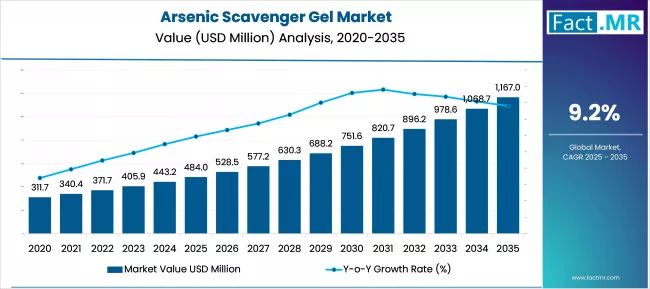
Arsenic Scavenger Gel Market Market Value Analysis | Source: Fact.MR
What are the drivers of the Arsenic Scavenger Gel market?
The market for arsenic scavenger gel is growing fast because of the stricter regulations which are causing both municipal and household demand for effective As(III)/As(V) removal. The development of point-of-use cartridges is mainly driven by rising contamination in South and East Asia together with NGO and government programs. There are technological innovations such as iron-functionalized hydrogels, regenerable beads, and hybrid oxidation-adsorption systems that enhance selectivity, lifecycle cost, and scalability.
The mining and semiconductor wastewater treatment are the main industrial drivers. The market is still facing a challenge in the form of price competitiveness but falling material costs and circular regeneration models have made the situation more favorable. Recurring-revenue cartridge ecosystems and localized manufacturing will be the main factors in growth until 2035. Strong private investments and partnerships will help to commercialize and distribute the products worldwide faster.
What are the regional trends of the Arsenic Scavenger Gel market?
The arsenic scavenger gel market has clear regional patterns that reflect the degree of contamination, existing regulations, and readiness to adopt new technologies. South Asia is the clear leader in growth, stemming from extreme groundwater contamination in India and Bangladesh, and an extremely active non-profit and government presence to enable affordable point-of-use and community systems for safe drinking water.
East Asia is quickly implementing gel-based adsorbents for industrial and municipal wastewater using industrial and municipal wastewater, led by China and Japan, and driven by government regulation and innovation around iron and polymer-based gels. North America and Western Europe are both mature yet steady markets in which growth is purely a regulatory compliance and sustainable, regenerative gel demand.
In Latin America, development is underway in mining regions such as those found in Chile and Peru while small pilot and NGO-backed projects have launched in the Middle East and Africa.
What are the challenges and restraining factors of the Arsenic Scavenger Gel market?
Key market challenges and barriers for arsenic scavenger gel include cost competitiveness, variable performance, limits to regeneration, regulatory inconsistency, and issues with the supply chain. Many gel formulations are still more expensive than legacy treatments (activated alumina, ion exchange, RO), which slows adoption in price-sensitive markets and PMUs.
Performance may depend on arsenic speciation, water pH, presence of competing ions, and fouling of the gel, which make pretreatment or tailored chemistry necessary and drive complexity in the system. Some gels do not have resolution in regeneration and eventual disposal, which complicates the TOC and makes environmental claims less clear.
Regulatory differences across countries impede standardization and entry to the market, slow approval process for municipal procurement, and in some cases, small-scale commercial deployment. The challenges and capacity associated with scaling-up production (and all it entails—sourcing raw material, quality control, and possibly local production) limits availability, particularly in regions that need it the most.
Stakeholder/end-user trust is becoming established, but communities want proven solutions. Limited long-term field data and any examples of large-scale demonstrations further complicate financing and the adoption of OEMs, thus commercialization is slowed, despite the fact a plethora of research shows strong technical evidence.
Country-Wise Insights
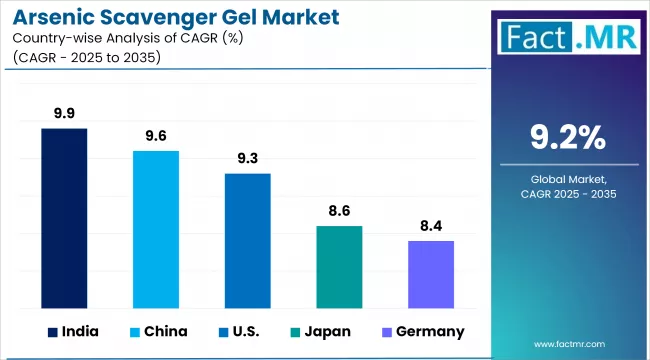
Arsenic Scavenger Gel Market Cagr Analysis By Country | Source: Fact.MR
India is Scaling Arsenic Scavenger Gel Solutions for Rural Water Security
India is quickly rolling out arsenic scavenger gel technologies to address widespread groundwater contamination with a focus on low-cost cartridges for point-of-use and community-level treatment. The public health imperative, particularly in states with greater contamination levels, has spurred collaboration among government programs, non-governmental organizations (NGOs), academic researchers, and local manufacturers to develop, field-test, and evaluate regenerable iron-functionalized gels and cartridge-based units.
Key drivers for rapid adoption in rural communities include affordability, ease of maintenance, and the cartridge exchange supply chain. The decentralized approach for fabricating and supporting regional supply chains also lowers logistics costs, allowing for modified inspection, low-cost quality control, and less complicated repairs and replacements. Pilot projects have demonstrated reliable arsenic removal, even under different pH and competing ion conditions, and informed state purchasing and subsidy programs.
Next steps and concerns include developing adequate regeneration protocols, long-term monitoring, expanding operator training, and establishing predictable financing systems for cartridge replacements. With government support, NGO partnerships, and growing local manufacturing capability, India is well-positioned to expand gel-based remediation, decrease exposure, and stimulate substantial growth in the market, creating significant economic opportunity for domestic manufacturers.
China is Fast-Tracking Commercial-Scale Arsenic Scavenger Gels Through Industrial Deployment and Local Manufacturing
China is transitioning arsenic scavenger gel technology from a laboratory setting to widespread manufacturing and municipal use, driven by robust wastewater regulations and continued local manufacturing and government funding for targeted environmental initiatives. Domestic research institutes and companies have developed commercialization opportunities with iron-functionalized hydrogels, composite beads, and regenerable cartridges that are specific for regional groundwater chemistry and heavy-industrial streams.
Large pilot tests in mining, electroplating, and textiles not only confirm performance, but also build scale for supply-chain development, allowing for a decrease in unit price and an increase in quality control. Provincial clean-water programs and procurement encourage utilities and industrial operators to absorb the technology, while partnerships between universities and manufacturers reduce the time frame to commercialization. Export orientation will complement volume manufacturing, making Chinese manufacturers a competitive supplier of affordable gel solutions in the global market.
Remaining obstacles for Chinese commercial manufacturing include national standardization, long-term field data on regeneration and disposal, and working within a decentralized distribution framework; however, China's manufacturing scale and government policy support will continue to make it the dominant growth engine for gel-based arsenic removal in the region.
U.S. Accelerates Commercial Rollout of Arsenic Scavenger Gels via Regulatory Support and Pilot Deployments
In the United States, there is a transition from laboratory-tested arsenic removal gel solutions to proven ones in the field, as regulators, utilities, and startups are coalescing around adsorbents characterized by sustainable scalablility and low waste. New drinking-water regulations, grant funding to assist small community water systems with compliance, and municipal programs to retrofit public systems is stimulating demand for compact, cartridge-based gel solutions that directly streamline point-of-entry and community water system interactions.
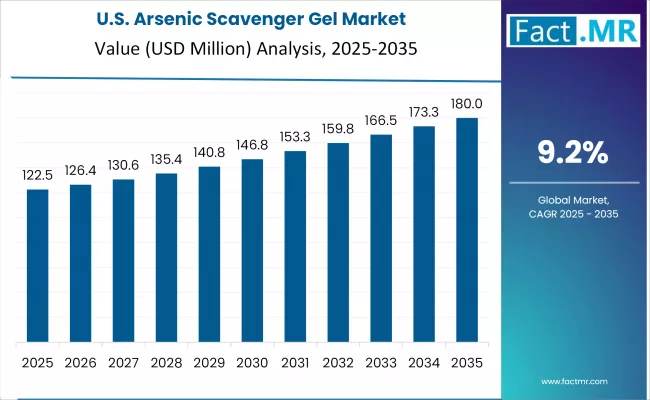
Arsenic Scavenger Gel Market Country Value Analysis | Source: Fact.MR
Federal and state pilots help mitigate technology risk and formalize the long-term performance data that investors and utilities are seeking. U.S. manufacturers and laboratories are focused on regenerable, low-sludge gel chemistry, to mitigate life-cycle costs and disposal concerns, while partnerships with original-equipment-manufacturers mitigate time to integration into current housing and monitoring technologies.
The ongoing commercialization process continues to be driven by distributed manufacturing and standardized monitoring processes, as well as finally developing business models for cartridge replacement that create a continuous revenue stream.
Category-Wise Analysis
Iron-Based Gels Are the Backbone of Arsenic Scavenger Solutions
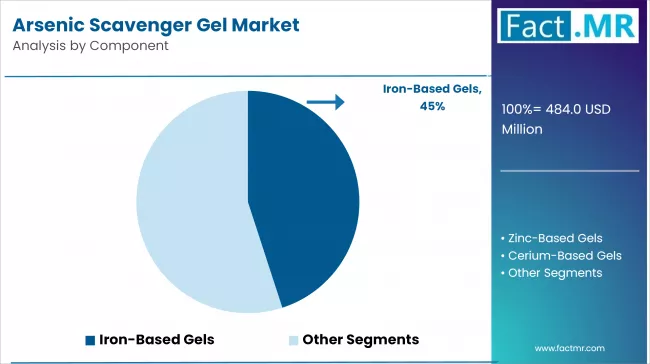
Arsenic Scavenger Gel Market Analysis By Component | Source: Fact.MR
The arsenic scavenger gel segment is anchored by iron-based gels due to iron-oxide sites' strong affinity towards both As(III) and As(V) associated with tunable kinetics and low-cost raw-materials. These gels are scalable from lab scale adsorption chemistry into practical formats- cartridges, beads, packed beds- suitable for household, community, and industrial applications.
Their strengths are high selectivity in complicated water matrices, ease of regeneration, and application in hybrid oxidation-adsorption systems that can treat As(III) with comparatively low harsh chemical inputs.
On the commercial side, these gels made by scalable synthesis- iron precursors are common- can be relatively easy to build into existing housings and have lower secondary-waste compared to some alternatives. There are challenges to address not the least to maintain good adsorption capacity at varying pH and competing ions, robust mechanical factors to hold shape, and to show long term field regenerability.
Despite these barriers, polymer supports, iron dispersion, and structured bead coatings are constantly evolving reducing costs and increasing lifecycle value, making iron-based gels the practical workhorse in the market while driving growth in arsenic-remediation moistly toward larger, real-world applications.
Cartridge Segment Emerges as the Growth Engine of the Arsenic Scavenger Gel Market
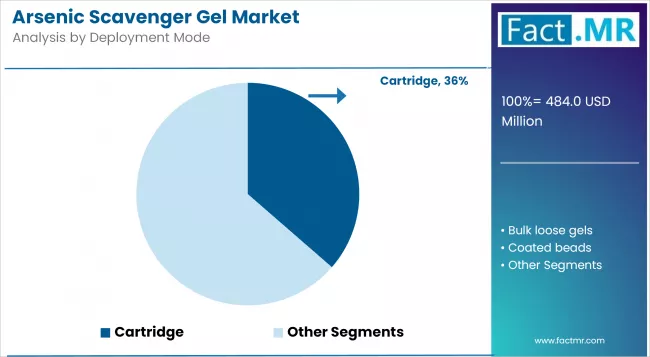
Arsenic Scavenger Gel Market Analysis By Deployment Mode | Source: Fact.MR
The cartridge category is quickly becoming the predominant growth area in the arsenic scavenger gel market, as it contains modular, replaceable units that are simple to use to remove arsenic at both the household (e.g., Réservoir) and community level (e.g., Medentech system). Modular systems encasing gels in standardized cartridges are designed to generate consistent performance, reduced contamination, and simplified installation in existing filtration systems while being preferred in developing regions with limited technical or infrastructure development due to their predictable replacement intervals (minimal maintenance).
Affordable disposable cartridges can also create recurrent revenue potential for replacement units, thereby incentivizing additional research and development into regenerable and/or high-capacity gel chemistries. Cartridges can also aid in logistics and regulatory compliance (e.g., factory-sealed) for transportation and performance assessment. Technology-enabled cartridges can create significant barriers to entry, as factory-sealed cartridges provide quality assurance (e.g., better performance than home-made gels) and a record of the date and batch the cartridge was manufactured (e.g., correct regulatory compliance).
Competitive Analysis
Key players in the Arsenic Scavenger Gel market are De Nora, LANXESS (Bayoxide / Lewatit), Watch Water GmbH, Purolite Corporation, Graver Technologies, Evoqua Water Technologies, Veolia Water Technologies (SUEZ), Culligan International, Silicycle Inc., Biotage AB, Fujisilysia Chemical Ltd., Alfa Chemistry, Alfa Aesar (Thermo Fisher Scientific), Dewpure Engineering Pvt. Ltd.
The market for arsenic scavenger gel has average competition and increasing technological differentiation. Companies are working on more advanced gel formulations, a higher degree of adsorption efficiency and lower cost of regenerating the media to build their market position. Competition among companies is based on new product innovation, partnerships with water treatment system integrators, and entry in the higher growth regions such as Asia and Latin America. There is a strong trend toward sustainability, non-toxic, and recyclable gels that comply with environmental regulations. Companies are also investing in localized production and a cartridge delivery format to provide wider access, lower logistics costs, and ensure continuity of supply for a variety of end use industries.
Recent Development
- In May 2024, Grundfos has entered into an agreement to acquire Culligan’s Commercial & Industrial business in Italy, France and the UK. The acquired business is headquartered out of Bologna, Italy, has around 400 employees, and had a 2023 turnover of more than EUR 100m. This marks another important milestone in Grundfos’ ongoing effort to pioneer solutions that tackle global water challenges.
Fact.MR has provided detailed information about the price points of key manufacturers of Arsenic Scavenger Gel Market positioned across regions, sales growth, production capacity, and speculative technological expansion, in the recently published report.
Methodology and Industry Tracking Approach
Fact.MR's Global Arsenic Scavenger Gel Market Report for 2025 is based on feedback from more than 1,200 stakeholders across 12 countries, with at least 75 complete responses from each individual. Roughly 65% of respondents were end users (e.g., municipal water utilities, industrial wastewater operators, original equipment manufacturers [OEMs] of filtration systems, and environmental services firms) while about 35% consisted of supply chain participants, consultants of water quality, and sustainability policy outcomes.
Fieldwork, which occurred between September 2024 and August 2025, was focused on arsenic removal efficiency, regulatory capacity, regeneration possibilities of materials, operational readiness of technologies, and supply chain scaling ability. A calibrated balance was maintained so that all regions of North America, Europe and Asia were represented accurately.
The report drew on validated data sources of more than 95 records, which includes audits of water treatment, tested performance of adsorbant media, government and state water safety records, and sustainability assessments. Fact.MR has applied multi-variable regression and scenario modeling to provide analytical rigor. Observing market activity since 2018 provides a continuing lane of strategic foresight for future innovation, competitive advantages, and sustainable growth for the overall global ecosystem of arsenic removal activities and well-being.
Segmentation
Segmentation of Arsenic Scavenger Gel Market
-
By Product Type :
- Iron-Based Gels
- Zinc-Based Gels
- Cerium-Based Gels
- Hybrid/Multi-Metal Gels
- Other
-
By Arsenic Species :
- Arsenate (As(V))
- Arsenite (As(III))
-
By Form :
- Cartridge
- Bulk loose gels
- Coated beads
- Powdered gel
-
By Application :
- Drinking water
- Wastewater treatment
- Industrial Effluent
- Mining
- Mobile treatment
-
By End-use Industry :
- Oil & Gas
- Mining & Metallurgy
- Municipal Water Treatment
- Industrial & Manufacturing
- Residential/Point-of-Use
-
By Region :
- North America
- Latin America
- Western Europe
- Eastern Europe
- East Asia
- South Asia & Pacific
- Middle East & Africa
Frequently Asked Questions
What was the Global Arsenic Scavenger Gel Market Size Reported by Fact.MR for 2025?
Who are the Major Players Operating in the Arsenic Scavenger Gel Market?
What is the Estimated Valuation of the Arsenic Scavenger Gel Market in 2035?
What Value CAGR did the Arsenic Scavenger Gel Market Exhibit Over the Last Five Years?
Who worked on this report


Preview the report firsthand - request a free sample
Free SampleGet the brochure for pricing and purchase details
Download PDF