- Base Value(2026): 1.3 Bn
- Estimated Value(2026): 1.3 Bn
- Forecast Value (2036): 2.4 Bn
- CAGR (2026 - 2036): 6.2%
Arthroscopic Burrs and Blades Market Forecast and Outlook 2026 to 2036
The global arthroscopic burrs and blades market is projected to total USD 1.32 billion in 2026, advancing to USD 2.41 billion by 2036, progressing at a CAGR of 6.2%. The increasing volume of minimally invasive orthopedic procedures and a strong preference for single-use instruments to enhance surgical safety underpins this growth.
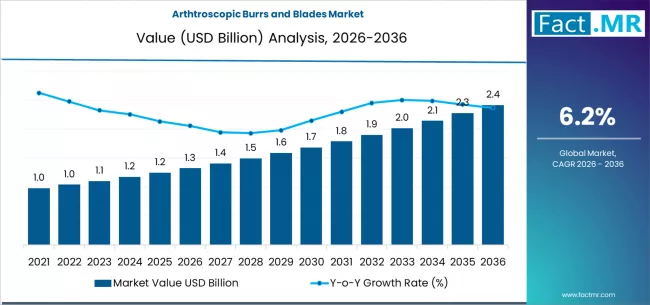
Arthtroscopic Burrs And Blades Market Market Value Analysis | Source: Fact.MR
Summary of Arthroscopic Burrs and Blades Market
- Market Snapshot
-
Global arthroscopic burrs and blades market revenue is estimated at approximately USD 1.32 billion in 2026 and is forecast to reach USD 2.27 billion by 2036.
-
At a 5.6% CAGR from 2026 to 2036, this market is set to expand 1.7x in value, adding USD 0.95 billion in absolute opportunity.
-
Growth is being driven by the expanding adoption of arthroscopic and minimally invasiveorthopedicprocedures, where high-precision cutting, resection, and debridement tools such as burrs and blades are essential for procedural accuracy and efficiency.
-
Increasing procedural volumes across sports injuries, degenerative joint disorders, and aging-related musculoskeletal conditions are positioning arthroscopic burrs and blades as critical consumables withinorthopedicsurgical workflows.
-
- Demand and Growth Drivers
-
Accelerating global shift toward minimally invasiveorthopedicsurgeries, particularly arthroscopy, is driving consistent demand for precision cutting instruments that enable reduced tissue damage, faster recovery, and improved surgical outcomes.
-
Rising prevalence of musculoskeletal disorders, sports injuries, and age-related joint degeneration is increasing the volume of knee, shoulder, and hip arthroscopic procedures globally, directly translating into higher consumption of burrs and blades.
-
Increasing preference for single-use and disposable surgical accessories to minimize infection risk and enhance patient safety is supporting recurring demand for arthroscopic blades and burrs across hospital settings.
-
Advancements in powered arthroscopic systems and precision instrumentation are enabling higher procedural efficiency and improved surgeon control, increasing reliance on high-performance burr and blade systems integrated within shaver platforms.
-
Expansion of ambulatory surgicalcenters(ASCs) and outpatientorthopedicprocedures is further driving demand for cost-effective, reliable, and easy-to-use arthroscopic consumables.
-
- Product and Segment View
-
Arthroscopic bladesrepresentthe leading product segment, driven by their widespread use in soft tissue resection, synovial removal, and general joint debridement procedures across knee, shoulder, and hip arthroscopy.
-
Arthroscopic burrs are gaining strong adoption, particularly in bone resection and contouring applications, supported by increasing complexity oforthopedicinterventions and need for precision shaping of hard tissues.
-
Knee arthroscopy accounts for the dominant application share, supported by high incidence of ligament injuries, meniscal tears, and osteoarthritis-related interventions globally.
-
Hospitalsremainthe leading end-use segment, driven by high surgical volumes, availability of advanced arthroscopic systems, and concentration of specializedorthopedicsurgeons.
-
Ambulatory surgicalcentersareemergingas a high-growth segment, supported by the shift toward outpatientorthopedicprocedures and cost optimization across healthcare systems.
-
- Geography and Competitive Outlook
-
North Americaremainsthe leading regional market, supported by high adoption of advanced arthroscopic procedures, strong reimbursement frameworks, and presence of leadingorthopedicdevice manufacturers.
-
Europe continues toexhibitsteady growth, driven by increasing procedural volumes and rising demand for minimally invasiveorthopedictreatments.
-
Asia Pacific is projected to be the fastest-growing region, with strong expansion in countries such as China and India driven by improving healthcare infrastructure, rising sports injury incidence, and growing access toorthopediccare.
-
Key companies active in this market include Stryker, Arthrex, CONMED, Smith & Nephew, and Zimmer Biomet.
-
Arthroscopic Burrs and Blades Market — At a Glance
| Attribute | Details |
|---|---|
| Market Value 2026 | USD 1.32 billion |
| Market Value 2036 | USD 2.27 billion |
| Absolute Dollar Opportunity 2026–2036 | USD 0.95 billion |
| Total Growth 2026–2036 | 72.0% |
| CAGR 2026–2036 | 5.6% |
| Growth Multiple | 1.7x |
| Key Demand Theme | Increasing adoption of arthroscopic procedures and rising demand for precision surgical cutting and resection tools in minimally invasiveorthopedic interventions |
| Leading Segment by Product Type (2026) | Arthroscopic Blades |
| Leading Segment by Application (2026) | Knee Arthroscopy |
| Leading Segment by End Use (2026) | Hospitals |
| Fastest Growing Region | Asia Pacific |
| Key Growth Regions | North America, Europe, Asia Pacific |
| Top Companies | Stryker, Arthrex, CONMED, Smith & Nephew, Zimmer Biomet |
| Segmentation by Product Type | Arthroscopic Blades, Arthroscopic Burrs |
| Segmentation by Application | Knee, Shoulder, Hip, Others |
| Segmentation by End Use | Hospitals, Ambulatory SurgicalCenters |
| Segmentation by Region | North America, Europe, Asia Pacific, Latin America, Middle East & Africa |
Source: Fact.MR analysis. Updated Mar 31, 2026
The market is characterized by the overwhelming dominance of disposable burrs, which hold a 59.9% share, primarily driven by their use in knee arthroscopy procedures that account for 48.3% of applications. Hospitals remain the central end-user, constituting 62.0% of the market, as they perform the majority of complex surgical interventions.
Geographically, India and China show the highest growth momentum with CAGRs of 9.6% and 9.3% respectively, fueled by expanding access to advanced surgical care. The USA follows at 8.3%, while Germany and France grow at 6.4% and 6.3%.
Demand is linked to the rising global prevalence of sports injuries and osteoarthritis, the cost-effectiveness of outpatient arthroscopy, and the continuous technological refinement of instrument design for improved precision and tissue preservation.
Category
| Category | Segments |
|---|---|
| Type | Disposable Burrs, Reusable Burrs, Specialty Blades |
| Application | Knee Arthroscopy, Shoulder Arthroscopy, Hip & Others |
| End User | Hospitals, ASCs, Orthopedic Clinics |
| Region | North America, Latin America, Western Europe, Eastern Europe, East Asia, South Asia & Pacific, MEA |
Source: Fact.MR analysis. Updated Mar 31, 2026
Segmental Analysis
By Type, Which Product Segment is driven by Infection Control Protocols?
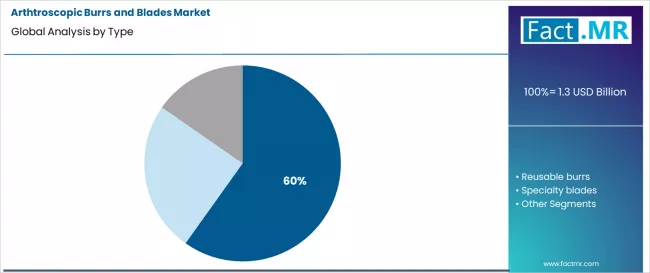
Arthtroscopic Burrs And Blades Market Analysis By Type | Source: Fact.MR
Disposable burrs command a dominant 59.9% share. This overwhelming preference is driven by stringent hospital infection control protocols that prioritize single-use instruments to eliminate cross-contamination risks and guarantee sharpness for every procedure.
The shift to disposables also removes costs associated with reprocessing, such as sterilization, maintenance, and inventory tracking, offering predictable per-procedure costing despite higher per-unit volume.
By Application, Which Joint Procedure Represents the Highest Volume?
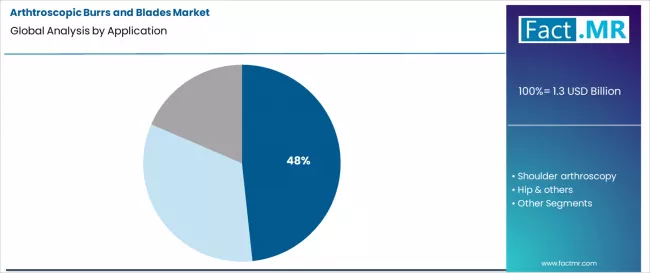
Arthtroscopic Burrs And Blades Market Analysis By Application | Source: Fact.MR
Knee arthroscopy is the leading application with a 48.3% share. The high incidence of meniscal tears, ligament injuries, and osteoarthritis of the knee makes it the most frequently performed arthroscopic procedure globally.
This volume drives consistent, high-volume demand for burrs and blades tailored for chondroplasty, notchplasty, and meniscal resection, solidifying its position as the core application for instrument design and innovation.
Where are the Most Complex Procedures involving Arthroscopic Burrs and Blades Performed?
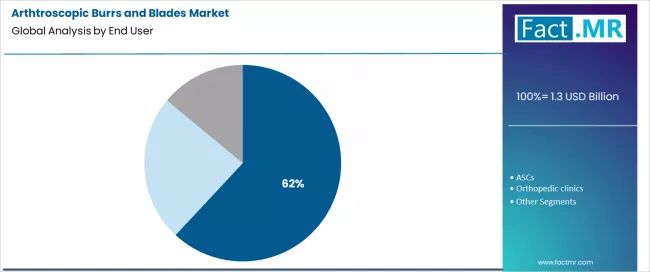
Arthtroscopic Burrs And Blades Market Analysis By End User | Source: Fact.MR
Hospitals constitute the primary end-user segment at 62.0%. These facilities handle the majority of complex, multi-ligament, or revision arthroscopic surgeries that require advanced instrumentation and support services.
Their centralized role in surgical training and higher-acuity care ensures they are the primary site for adopting new technologies and the largest purchasers of instrument sets and disposable components.
What are the Principal Drivers, Constraints, and Evolving Dynamics of this Market?
The primary driver is the global shift towards disposable arthroscopic instruments, fueled by stringent sterilization standards and the operational need for guaranteed performance, which elevates sales volume.
A major restraint is the intense pricing pressure from healthcare procurement systems and group purchasing organizations, which compresses manufacturer margins, particularly on commoditized disposable items.
A major opportunity lies in the expansion of arthroscopic procedures into ambulatory surgical centers, creating demand for cost-optimized, efficient instrument systems tailored for high-turnover outpatient settings.
The dominant trend is technological innovation focused on enhancing surgical efficiency, such as the development of smarter blades with improved cutting geometries and integrated debris management systems to maintain visual clarity during surgery.
Analysis of the Arthroscopic Burrs and Blades Market by Key Countries
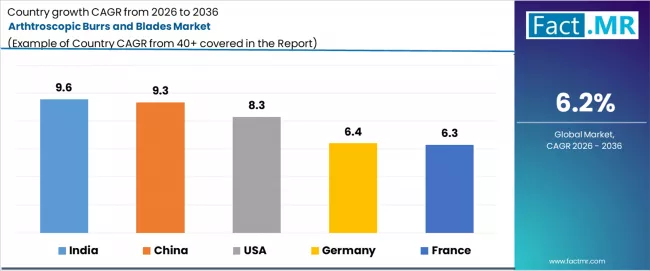
Arthtroscopic Burrs And Blades Market Cagr Analysis By Country | Source: Fact.MR
| Country | CAGR 2026 to 2036 |
|---|---|
| India | 9.6% |
| China | 9.3% |
| USA | 8.3% |
| Germany | 6.4% |
| France | 6.3% |
Source: Fact.MR analysis. Updated Mar 31, 2026
How does the USA's Outpatient Migration and Reimbursement Shape the Market?
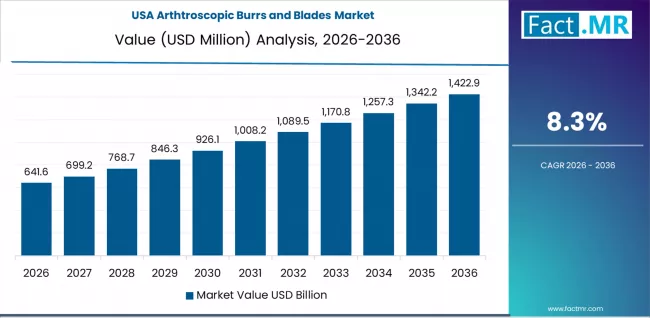
Arthtroscopic Burrs And Blades Market Country Value Analysis | Source: Fact.MR
The USA's strong 8.3% CAGR is propelled by the massive migration of arthroscopic procedures from inpatient hospitals to ambulatory surgical centers, driven by favorable reimbursement. This shift creates specific demand for streamlined, cost-effective disposable instrument systems that support fast surgical turnover.
Growth is further sustained by high sports injury rates and an active aging population seeking joint preservation, with market dynamics heavily influenced by negotiations with large group purchasing organizations that consolidate purchasing power.
What Factors Underpin China's Rapid Adoption of Minimally Invasive Techniques?
China's robust 9.3% CAGR is driven by the rapid modernization of its orthopedic care infrastructure and a growing surgeon preference for minimally invasive techniques. Increasing health insurance coverage for such procedures is making them accessible to a larger patient base.
The market growth is characterized by a dual demand: top-tier hospitals adopting premium disposable systems from global players, while a burgeoning domestic device industry focuses on producing value-engineered alternatives for broader market penetration.
How is India's Growing Medical Infrastructure and Patient Pool Influencing Demand?
India's leading CAGR of 9.6% is fueled by a vast and growing patient population requiring orthopedic care, coupled with a significant expansion in the number of hospitals and surgical centers equipped for advanced procedures.
Growth is driven by rising health awareness, increasing disposable income, and a growing cadre of surgeons trained in arthroscopy. The price-sensitive nature of the market also fosters demand for competitively priced disposable products, attracting both multinational and domestic manufacturers.
What Characterizes the Mature European Markets of Germany and France?
Germany's 6.4% and France's 6.3% CAGRs reflect mature, stable markets characterized by high procedural standards and rigorous cost-containment policies. Steady procedure volumes for sports injuries and degenerative joint disease in aging populations drive growth.
The focus in these markets is on premium, innovative products that offer demonstrable improvements in outcomes or efficiency to justify their cost within tightly regulated healthcare budgets, with a continued but measured shift from reusable to disposable systems.
Competitive Landscape of the Arthroscopic Burrs and Blades Market

Arthtroscopic Burrs And Blades Market Analysis By Company | Source: Fact.MR
The competitive landscape is dominated by integrated orthopedic giants that bundle these instruments with larger surgical systems, including scopes, shavers, and implants. Competition is significant, centering on product performance, reliability, and the strength of distributor networks. Success is tied to the ability to offer a comprehensive procedural solution and to navigate cost-containment pressures through value-based contracts.
| Strategic Imperative | Rationale & Action |
|---|---|
| Diversify Portfolio for ASCs | Develop cost-optimized, procedure-specific kits for high-volume outpatient settings. |
| Enhance Blade/Burr Material Science | Invest in coatings and alloys for longer sharpness life in disposables and reusables. |
| Strengthen Emerging Market Distribution | Build direct in-country teams and local partnerships in high-growth regions like India. |
| Pursue Value-Added Bundling | Combine instruments with compatible fluid management or visualization systems. |
Source: Fact.MR analysis. Updated Mar 31, 2026
Key Players in the Arthroscopic Burrs and Blades Market
- Stryker Corporation
- Smith & Nephew plc.
- Arthrex
- DePuy Synthes
- ConMed
- Others
References
- American Academy of Orthopaedic Surgeons. (2025). Clinical Practice Guideline on the Management of Osteoarthritis of the Knee. AAOS.
- International Society of Arthroscopy, Knee Surgery and Orthopaedic Sports Medicine. (2024). Global Trends in Arthroscopic Procedures. ISAKOS.
- Medical Device Regulation (EU) 2017/745. (2024). Regulatory Framework for Reusable Surgical Instruments. European Commission.
- Orthopedic Surgical Manufacturers Association. (2025). Market Analysis for Minimally Invasive Surgical Devices. OSMA.
- U.S. Food and Drug Administration. (2024). Guidance for Industry and FDA Staff: Reprocessing of Reusable Medical Devices. FDA.
Segmentation
Scope of Report
| Items | Values |
|---|---|
| Quantitative Units | USD Billion |
| Type | Disposable Burrs, Reusable Burrs, Specialty Blades |
| Application | Knee Arthroscopy, Shoulder Arthroscopy, Hip & Others |
| End User | Hospitals, ASCs, Orthopedic Clinics |
| Key Countries | India, China, USA, Germany, France |
| Key Companies | Stryker Corporation, Smith & Nephew plc., Arthrex, DePuy Synthes, ConMed, Others |
| Additional Analysis | Comparative analysis of wear rates and cutting efficiency; study of reprocessing costs vs. disposable pricing; impact of instrument design on surgical procedure time; analysis of regulatory pathways for disposable versus reusable classifications; assessment of sustainability initiatives and instrument recycling programs. |
Source: Fact.MR analysis. Updated Mar 31, 2026
Market by Segments
-
Type :
- Disposable Burrs
- Reusable Burrs
- Specialty Blades
-
Application :
- Knee Arthroscopy
- Shoulder Arthroscopy
- Hip & Others
-
End User :
- Hospitals
- ASCs
- Orthopedic Clinics
-
Region :
-
North America
- USA
- Canada
-
Latin America
- Brazil
- Mexico
- Argentina
- Rest of Latin America
-
Western Europe
- Germany
- France
- Italy
- Spain
- UK
- BENELUX
- Rest of Western Europe
-
Eastern Europe
- Russia
- Poland
- Czech Republic
- Rest of Eastern Europe
-
East Asia
- China
- Japan
- South Korea
- Rest of East Asia
-
South Asia & Pacific
- India
- ASEAN
- Australia
- Rest of South Asia & Pacific
-
MEA
- GCC Countries
- South Africa
- Turkiye
- Rest of MEA
-
Frequently Asked Questions
How big is the arthtroscopic burrs and blades market in 2026?
What will be the size of arthtroscopic burrs and blades market in 2036?
How much will be the arthtroscopic burrs and blades market growth between 2026 and 2036?
What are the key product types in the arthtroscopic burrs and blades market?
Which application segment to contribute significant share in the arthtroscopic burrs and blades market in 2026?
Who worked on this report


Preview the report firsthand - request a free sample
Free SampleGet the brochure for pricing and purchase details
Download PDF