- Base Value(2025): 6.3 Bn
- Forecast Value (2035): 22.2 Bn
- CAGR (2035): 14.8%
Portable Imaging Systems Market Outlook 2025 to 2035
Global portable imaging systems market is expected to reach USD 22.2 billion by 2035, up from USD 6.3 billion in 2025. During the forecast period 2025 to 2035, the industry is projected to expand at a CAGR of 13.4%.
The portable imaging systems market is growing due to the rising need for timely diagnostics in chronic diseases, technological advancements that make devices more compact and efficient, and increased demand for home healthcare and remote medical services. Such systems facilitate imaging that is timely, flexible, and accessible from hospitals to clinics to patients' homes, thereby enhancing care delivery and workflow efficiency.
Quick Stats for Portable Imaging Systems Market
- Industry Value (2025): USD 6.3 billion
- Projected Value (2035): USD 22.2 billion
- Forecast CAGR (2025 to 2035): 13.4%
- Leading Segment (2025): Hospitals (41.0% Market Share)
- Fastest Growing Country (2025-2035): China (14.1% CAGR)
- Top Key Players: Philips Healthcare, Siemens Healthineers, Fufifilm Global, GE Healthcare, Mindray, and Hitachi Healthcareport
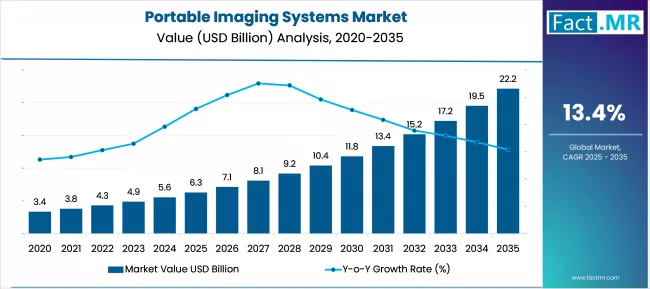
Portable Imaging Systems Market Market Value Analysis | Source: Fact.MR
What are the drivers of the portable imaging systems market?
Rising prevalence of chronic diseases and increasing requirement of early diagnosis is trending the demand for portable imaging systems. Hospitals and medical centers are concentrating on early detection and long-term monitoring of diseases such as cardiovascular disease, cancer and neurological disorders for which imaging solutions which provided not only high efficiency but also the ability to adapt to the changing needs have received increasing attention. Portable generation of images directly at the bedside has given clinicians the opportunity to overcome transportation and delay in clinical decision-making that would otherwise have resulted from transport to an imaging modality.
Over time, handheld imaging devices have evolved to become larger, more accurate, and easier to use, with incredible innovations resulting from technology. The advancements in digital imaging technology, wireless technologies, and battery life have improved the flexibility of handheld imaging systems enabling clinical researchers to obtain high-quality images for examination in multiple environments. In addition to improved imaging quality, these advancements lower running costs and increase the efficiency of the workflow, thus the greater acceptance in developed and developing.
Increasing requirement of home healthcare and telemedicine services are some additional factors that are propelling the market for portable imaging devices. With the advent of patient-focused healthcare, there is a growing requirement for away-from-hospital diagnostics tools.
What are the regional trends of the portable imaging systems market?
Portable imaging systems are best in North America due to numerous reasons, among them being the well-developed health care, adoption of new medical technology fast and high investment on research and development. The imaging devices are in high demand as there is an increased demand in the point-of-care and home health services.
Europe is also witnessing steady growth in portable imaging systems consistent with an aging population, the growing prevalence of chronic diseases, the presence of well-established healthcare systems; and the ongoing emphasis in hospitals and clinics to facilitate the use of effective and portable diagnostic solutions will drive the uptake of these devices.
Asia-Pacific is developing rapidly due to the growing healthcare infrastructure, growing healthcare expenditure, and increased awareness of detecting diseases early. Demand for cost-effective and portable imaging systems is being fueled specifically in cities, and on a household basis, in areas of the companies of emerging economies, such as India and China.
In Latin America, there are indications of further acceptance of portable imaging systems, facilitated by greater access to health care, and initiatives to improve diagnostic capacity. Demand mainly comes from a need for mobile and point of care diagnostic solutions in sparsely populated areas.
The Middle East and Africa are seeing moderate growth as the modernization of healthcare and government investment continues to improve medical services. Portable imaging devices will help rectify the very limited access to advanced diagnostic equipment in rural and underserved areas.
What are the challenges and restraining factors of portable imaging systems market?
Challenges to the larger uptake of portable imaging systems exist, including high upfront expenditures and maintenance costs, especially for small clinics or financially strained healthcare facilities. In addition, the need for trained personnel to operate and read results adds another layer to the implementation challenges, resulting in a lengthier adoption time in some markets.
Poor infrastructure in rural or underdeveloped regions also presents a barrier to implementation. For example, portable imaging systems generally require reliable electricity, the internet, and also additional equipment in order to work effectively. Under these circumstances, the healthcare workforce is unable to use these devices to the same level of acuity in remote and resource-limited regions.
A major limitation in the market is the strict regulatory requirements for medical devices, which can extend approval timelines as well as lead to higher compliance costs. Complying with varying and complex regulations across different countries is a time-consuming and resource-intensive process for manufacturers looking to enter or expand in the market.
Country-Wise Insights
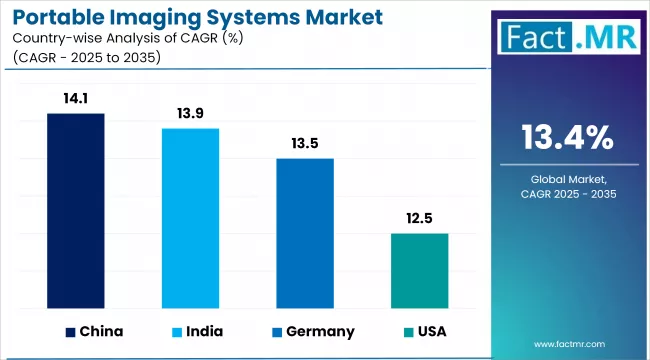
Portable Imaging Systems Market Cagr Analysis By Country | Source: Fact.MR
Rising demand for timely and flexible diagnostics drives the USA portable imaging systems market
In the USA, the portable imaging systems market has entered in maturity, with demand for speedy point-of-care diagnostic solutions at hospitals, clinics, and in the home healthcare setting. An aging population coupled with an increasing prevalence of chronic disease like cardiovascular disease, cancer, and neurological disease, is increasing demand for portable systems to provide rapid and accurate imaging capabilities.
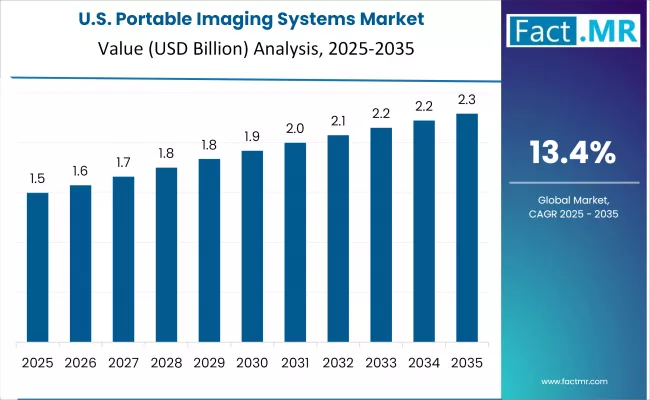
Portable Imaging Systems Market Country Value Analysis | Source: Fact.MR
In addition to this emerging customer source, healthcare worker preference is increasingly trending towards complicated devices that provide high-quality imaging, but are also portable, wireless, and improve workflow and patient care. New technology advances are delivering enhanced sensing capabilities and longer life for the device with new digital health and applications combine to add functionality to portable imaging systems.
Growing demand for efficient diagnostics drives the Germany portable imaging systems market
There has been steady growth in the German market for portable imaging systems, largely due in part to the presence of an advanced health care infrastructure and the prevalence of chronic diseases. Hospitals, clinics and outpatient care providers utilize portable imaging devices to improve the timeliness of diagnosis and accuracy at the point of care.
The growth is driven by new technological advances in device design, connectivity and image quality which support operational efficiency and improve patient care in the workflow. Other significant factors influencing the development, commercialization and adoption of next-generation portable imaging systems for health care applications in Germany include an aging population, appropriate regulations for health care and encouraging governmental attention for medical technology uses.
Rising healthcare infrastructure and awareness drive the China portable imaging systems market
The market for portable imaging systems in China is ramping up quickly due to healthcare infrastructure being expanded, increased expenditure on health care, and increased awareness of early detection of disease. Portable imaging is being utilized in hospitals, clinics and especially in new home health services for better diagnostic speed, accuracy and flexibility.
Growth of the market is being driven by the development of small design, improved wireless connectivity and imaging performance, enabling more efficient and accessible care. Importantly government initiatives to modernize healthcare, even greater demand in urban and rural areas, and the advancements by Chinese and global medical device manufacturing have supported the development, commercialization and widespread adoption of next generation portable imaging systems in the Chinese healthcare ecosystem.
Category-Wise Analysis
Rising demand for rapid and point-of-care diagnostics drives the portable X-Ray systems market
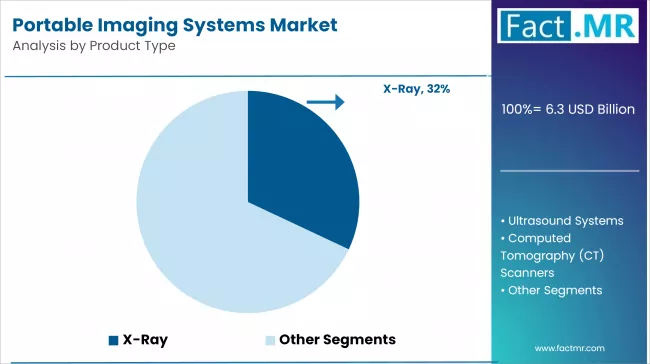
Portable Imaging Systems Market Analysis By Product Type | Source: Fact.MR
Portable X-Ray market is experiencing a significant growth mainly because of the ability of the technology to provide timely and precise imaging at the point of care. More often, hospitals, outpatient locations, and emergency departments are buying portable x-rays to minimize patient transportation, shorten the patient diagnostic process, and generate efficiencies in the workflow.
The end-user usability and trust are facilitated by technological advances, which include lightweight technology, image quality, and wireless capabilities. The home health care, remote diagnostics, and critical care are the areas where demand keeps increasing along with the health care infrastructure and the major manufacturers remain active in supporting the development, commercialization, and adoption of next-generation portable x-ray systems in all forms of health care facilities.
Increasing demand for efficient point-of-care diagnostics drives portable imaging adoption in hospitals
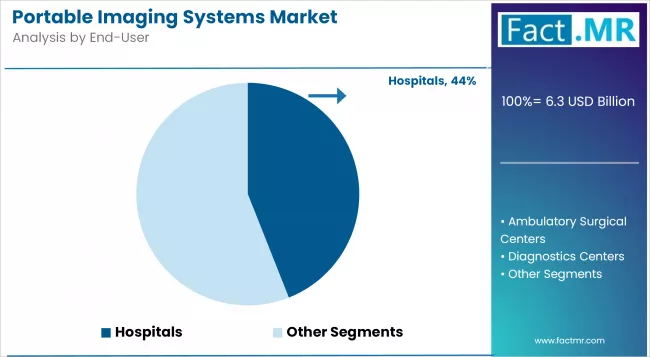
Portable Imaging Systems Market Analysis By End User | Source: Fact.MR
Hospitals are a vital end user of portable imaging systems, as there is a constant need for timely, accurate, and flexible diagnostic solutions in multiple environments, including the ER, ICU, and hospital ward. Portable imaging solutions result in less patient transport, quicker clinical decision making, and more efficient hospital workflow for clinical staff.
Enhanced portability of the device, imaging capability, and connectivity is supportive of ease of use and integration into hospital information systems. The increasing value on patient-centered care, increasing prevalence of chronic disease, and robust healthcare systems are encouraging the acceptance, development, and commercialization of next-generation portable imaging systems within hospital environments.
Competitive Analysis
The global market for portable imaging systems is very competitive because all major manufacturers are attempting to differentiate themselves through innovations in portability, image fidelity, and connectivity. Due to regulatory frameworks that provide opportunities for innovation, the expansion of healthcare infrastructures, and increasing stakeholder demand for portable point-of-care-assessed point-of-care diagnostics throughout hospitals, clinics and home healthcare environments, the world is adopting portable imaging more rapidly.
Increasingly, manufacturers are embedding digital health platforms, mobile applications, and solutions for cloud-based access to improve usability, expand workflow capacity, and provide real-time access to imaging data. Growth will occur through over-the-counter solutions and collaboration between device manufacturers and the healthcare marketplace for commercialization, adoption and development of next-generation portable imaging systems in a global marketplace.
Key players in the portable imaging systems market are Philips Healthcare, Siemens Healthineers, Fufifilm Global, GE Healthcare, Mindray, Hitachi Healthcareport, and others.
Recent Developments
- In July 2025, Fujifilm Launches FDR Go iQ Portable Digital Radiography System
- In January 2025, Siemens Healthineers, a leading medical devices company, showcased a comprehensive range of diagnostic imaging solutions at Asian Oceanian Congress of Radiology (AOCR) in Chennai
Fact.MR has provided detailed information about the price points of key manufacturers of Portable Imaging Systems Market positioned across regions, sales growth, production capacity, and speculative technological expansion, in the recently published report.
Methodology and Industry Tracking Approach
The report on the Global Portable Imaging Systems Market 2025 comes from a broad study with business professionals within the healthcare sector in areas like diagnostic imaging, medical device industry, digital health, and in hospital and home care settings. The sample will consist of radiologists, biomedical engineers, clinical researchers, regulatory affairs, quality control, and supply chain professionals engaged in the development, manufacturer, and commercialization of portable imaging systems.
The report will use a horizontal research method through the use of structured questionnaires that will be implemented from September 2024 through August 2025. The report will cover topics including trends in adoption; device portability; imaging quality; integrating with digital health platforms; increasing workflow efficiency; and usability for healthcare providers. The research will analyze various technologies, including portable X-ray systems, portable ultrasound systems, and portable MRI systems, across hospital and clinic settings, outpatient acute settings, and home healthcare.
With Fact.MR monitoring consumer behavior, product efficacy, industry trends, and market opportunities since 2018, this report is becoming an authoritative source of information that stakeholders can rely on.
Segmentation
Segmentation of Portable Imaging Systems Market
-
By Product Type :
- X-Ray
- Computed Tomography (CT) Scanners
- Ultrasound Systems
- Others
-
By End-User :
- Hospitals
- Ambulatory Surgical Centers
- Speciality Clinics
- Diagnostics Centers
- Others
-
By Region :
- North America
- Latin America
- Western Europe
- Eastern Europe
- East Asia
- South Asia & Pacific
- Middle East & Africa
Frequently Asked Questions
What was the portable imaging systems market size reported by Fact.MR for 2025?
Who are the major players operating in the portable imaging systems market?
What is the estimated valuation of the portable imaging systems market in 2035?
What value CAGR did the portable imaging systems market exhibit over the last five years?
Who worked on this report


Preview the report firsthand - request a free sample
Free SampleGet the brochure for pricing and purchase details
Download PDF