Automotive Control Arm Assemblies Market (2026 - 2036)
Automotive Control Arm Assemblies Market Size and Share Forecast Outlook 2026 to 2036
Core Findings
Automotive Control Arm Assemblies Market Forecast Outlook 2026 to 2036
The automotive control arm assemblies market is expected to reach USD 9.6 billion in 2026 and USD 13.6 billion by 2036, growing at a compound annual growth rate (CAGR) of 3.5%. This market holds strategic importance within the broader automotive industry, as control arms are critical for vehicle suspension systems, influencing both vehicle handling and safety.
Key Takeaways from Automotive Control Arm Assemblies Market
- Automotive Control Arm Assemblies Market Value (2026): USD 9.6 billion
- Automotive Control Arm Assemblies Market Forecast Value (2036): USD 13.6 billion
- Automotive Control Arm Assemblies Market Forecast CAGR 2026 to 2036: 3.5%
- Leading Segment in Automotive Control Arm Assemblies Market: Front Axle (61%)
- Key Growth Region in Automotive Control Arm Assemblies Market: Asia Pacific
- Key Players in Automotive Control Arm Assemblies Market: ZF Friedrichshafen AG (ZF), Magna International Inc., Schaeffler AG, Benteler International AG, Gestamp Automoción, S.A., TRW Automotive (a brand now under ZF Friedrichshafen AG), Dorman Products, Inc., Aisin Corporation, Mando Corporation, thyssenkrupp AG
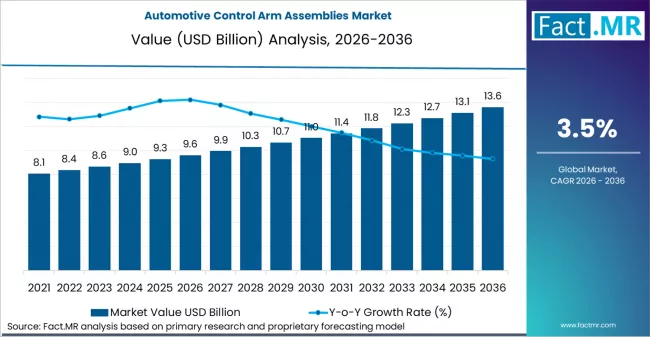
Key control points in this sector include the integration of lightweight materials and advancements in manufacturing processes that enhance durability and performance. Dependency on raw materials such as steel and aluminum, along with the need for precise engineering to meet evolving automotive standards, will shape market outcomes. Strategic trade-offs involve balancing cost efficiency with the demand for higher-performance components, especially as vehicle designs shift toward electric and autonomous platforms. Manufacturers must navigate these factors to maintain competitive advantages, responding to both market demands for innovation and pressures to optimize production costs.
Automotive Control Arm Assemblies Market
| Metric | Value |
|---|---|
| Estimated Value in (2026E) | USD 9.6 billion |
| Forecast Value in (2036F) | USD 13.6 billion |
| Forecast CAGR (2026 to 2036) | 3.5% |
Category
| Category | Segments |
|---|---|
| Sales Channel | First Fit (OEM); Aftermarket |
| Material | Steel; Aluminium; Composite or Other |
| Axle | Front; Rear |
| Vehicle Type | Passenger Cars; LCV; HCV |
| Manufacturing | Stamped or Welded; Forged; Cast |
| Region | North America; Europe; Asia Pacific; Latin America; Middle East & Africa |
Segmental Analysis
How is the Manufacturing Landscape Shaping the Automotive Control Arm Assemblies Market?
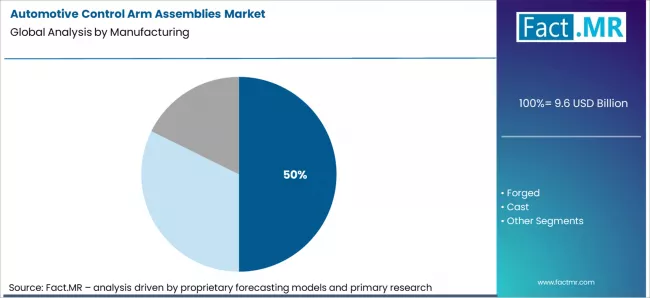
The stamped or welded manufacturing process leads the automotive control arm assemblies market, accounting for 50% of the share in 2026. This is driven by its cost-effectiveness and suitability for high-volume production, particularly in mass-market vehicles. Forged control arms also hold a significant portion of the market due to their superior strength and durability, while cast control arms are gaining traction in certain vehicle segments for their ability to provide complex shapes at lower production costs.
What is the Material Composition of Automotive Control Arm Assemblies?
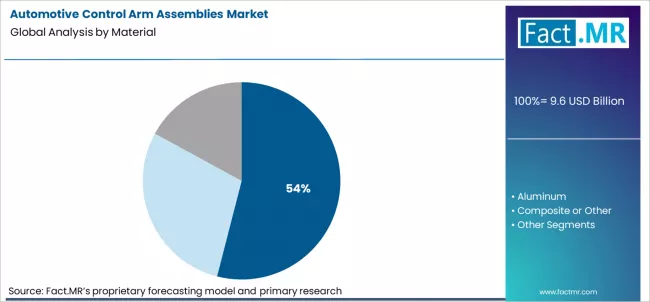
Steel remains the dominant material in automotive control arm assemblies, holding 54% of the market share in 2026. Steel's strength, durability, and cost-effectiveness make it the preferred material, especially for heavy-duty applications. Aluminum is increasingly used in premium and lightweight vehicle segments due to its reduced weight, contributing to fuel efficiency. Additionally, composite or other materials are gaining ground in niche markets where weight reduction and performance optimization are critical, although their adoption remains smaller compared to steel and aluminum.
Automotive Control Arm Assemblies Market - Drivers, Restraints & Trends
| Country | Drivers | Restraints | Trends |
|---|---|---|---|
| USA | High production of passenger cars, SUVs, and light trucks with front and rear multi link suspensions increases demand for control arm assemblies. | EV adoption and integrated e axle designs may reduce demand for traditional suspension arm components over time. | Increased use of lightweight materials to improve fuel economy and reduce unsprung mass. |
| China | World’s largest vehicle market with rising production of passenger and commercial vehicles drives control arm assembly uptake. | Price sensitivity in mass market models can limit adoption of high end, precision control arms. | Localization of production and adoption of advanced suspension designs in mid to premium segments. |
| India | Growing automotive production and rising consumer preference for SUVs and ride comfort fuels demand. | Cost constraints restrict use of advanced materials and high precision assemblies. | Aftermarket expansion as aging vehicle fleets require replacement control arms. |
| Germany | Premium and performance vehicle production maintains strong demand for high quality control arm assemblies tailored to dynamic handling. | Focus on electrification and steer by wire architectures may temper future growth of traditional suspension components. | Use of forged and high strength alloys for improved durability and performance. |
| Japan | Established OEM base with emphasis on reliability and ride comfort supports steady demand. | Slower growth in traditional ICE segments limits incremental volume expansion. | Refinement of control arm designs for compact and hybrid powertrain vehicles |
Analysis of the Automotive Control Arm Assemblies Market by Key Country
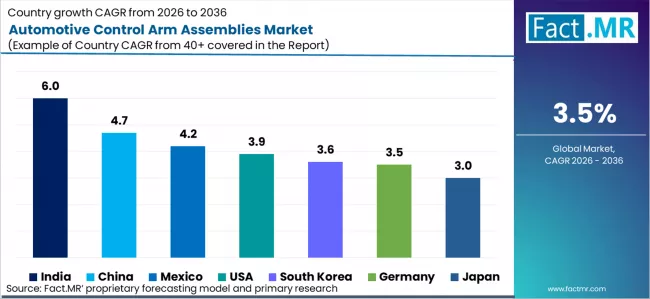
| Country | CAGR (Forecast Period) |
|---|---|
| USA | 3.9% |
| China | 4.7% |
| India | 6% |
| Germany | 3.5% |
| Japan | 3% |
| South Korea | 3.6% |
| Mexico | 4.2% |
What Drives the 3.9% Growth in the USA Automotive Control Arm Assemblies Market?
The USA automotive control arm assemblies market is growing at 3.9%, driven by increased demand for light trucks and SUVs. These vehicles typically require more robust suspension components, including control arm assemblies, to manage their heavier weight and provide better ride comfort. Additionally, the electrification of vehicles and the rise of electric trucks are further pushing the demand for durable suspension systems. Manufacturers are integrating lightweight materials such as aluminum to reduce vehicle weight and improve fuel efficiency while maintaining the strength and durability needed for heavy-duty applications like off-road driving. The market is also benefiting from the growing popularity of aftermarket replacements, as the average age of vehicles in the USA continues to rise, prompting frequent repairs and replacements.
Why is the China Automotive Control Arm Assemblies Market Projected to Expand at a 4.7% Rate?
The China automotive control arm assemblies market is projected to grow at 4.7% due to the country’s large and growing automotive production capacity and its shift toward New Energy Vehicles (NEVs). With a rising number of electric vehicles and hybrids, which require more sophisticated suspension components, the demand for control arm assemblies is increasing. Additionally, Chinese automakers are producing lighter control arm assemblies to enhance vehicle efficiency and meet government-imposed fuel economy standards. The government's push for technological self-sufficiency and local production has also led to an increase in domestic manufacturing of control arm assemblies, lowering costs and improving supply chain reliability. Furthermore, the increasing number of luxury vehicles and SUVs in China is further driving demand for higher-performance suspension systems.
How Does the 6% Growth Reflect the India Automotive Control Arm Assemblies Market Expansion?
India’s 6% growth in the automotive control arm assemblies market reflects the premiumization of the domestic automotive sector. With a growing middle class and increasing urbanization, the demand for SUVs and premium vehicles has surged. These vehicles, which typically feature more advanced suspension systems, are driving growth in the market for high-quality control arm assemblies. The Production Linked Incentive (PLI) Scheme has encouraged global suppliers to set up manufacturing bases in India, improving the availability of cost-effective and high-performance suspension parts. Additionally, as BS6 Phase 2 (RDE) norms are implemented, Indian vehicles are increasingly required to meet stricter emissions and performance standards, further boosting the need for high-quality suspension systems that ensure stability and safety.
What Drives the 3.5% Growth for the Germany Automotive Control Arm Assemblies Market?
Germany’s 3.5% growth in the automotive control arm assemblies market is influenced by the country’s strong automotive sector, particularly in the luxury and high-performance vehicle segments. German automakers like Volkswagen, BMW, and Mercedes-Benz continue to develop advanced suspension systems that incorporate high-quality control arm assemblies for optimal ride comfort and handling. The upcoming Euro 7 regulations, focusing on improving vehicle efficiency and reducing emissions, are further driving the demand for lightweight suspension components. Germany’s focus on electric vehicle development is also a key factor, as EVs and hybrids require more robust suspension systems to support their increased weight while ensuring a smooth driving experience.
How Does Japan Achieve 3% Growth in the Automotive Control Arm Assemblies Market?
Japan’s 3% growth in the automotive control arm assemblies market is shaped by the country’s continued leadership in hybrid and electric vehicle technologies. The demand for lightweight and durable suspension components is growing as hybrids and electric vehicles gain popularity. Japanese manufacturers are focusing on innovative materials like aluminum and composite alloys to reduce the weight of control arm assemblies while maintaining high strength and durability. Additionally, Japan’s aging population is driving the adoption of compact cars and K-cars, which demand smaller yet highly efficient control arm assemblies that can maintain handling and ride quality despite their reduced size.
Why Does South Korea Exhibit 3.6% Growth in Automotive Control Arm Assemblies?
South Korea’s 3.6% growth in the automotive control arm assemblies market is primarily driven by the country’s focus on electric vehicle (EV) production and advanced suspension systems. South Korean automakers like Hyundai and Kia are rapidly expanding their EV lineups, increasing demand for sophisticated suspension components. The need for lightweight and high-strength control arm assemblies is growing, especially in electric SUVs and luxury vehicles. The K-Mobility Strategy is also promoting innovative suspension systems as part of next-generation vehicles, pushing for smart and efficient components that improve both ride quality and vehicle stability.
How is the Mexico Automotive Control Arm Assemblies Market Maintaining a 4.2% Rate?
Mexico’s 4.2% growth in the automotive control arm assemblies market is supported by its role as a key manufacturing hub in North America. With the USMCA in place, which mandates a 75% regional value content for tariff-free access to the U.S. market, Mexico has seen increased investment from global Tier-1 suppliers. These suppliers are relocating their production lines to Mexico’s automotive hubs like Querétaro and Guanajuato to meet regional content requirements. Additionally, as the demand for pickup trucks and SUVs in the U.S. continues to grow, Mexico remains a critical supplier for high-performance suspension parts used in these vehicles, which require strong and durable control arm assemblies.
How Are Participants Competing in the Automotive Control Arm Assemblies Market?
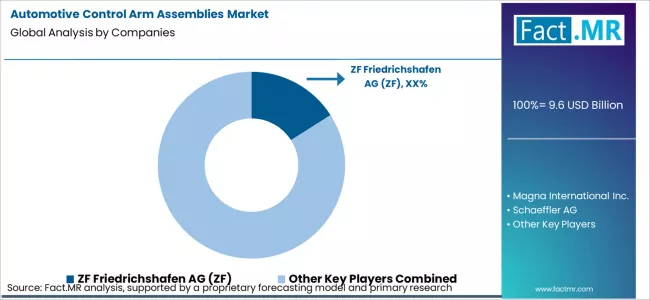
In the automotive control arm assemblies market, competition is defined by structural integrity, lightweight design, and integration into broader chassis control systems. ZF leverages its systems expertise (including TRW assets) to deliver control arms engineered for high load, safety critical architectures, aligning with its broader chassis solutions portfolio. Magna International emphasizes modular manufacturing scale and automated production to serve global OEM platforms efficiently. Schaeffler combines precision bearing technology with control arm modules to improve NVH and longevity. Benteler International and Gestamp Automoción compete on high strength steel and tailored architectures for diverse passenger and commercial vehicle segments. Aisin Corporation and Mando Corporation focus on integrating control arms with steering and suspension subsystems to support advanced ride and handling characteristics. thyssenkrupp AG targets high volume OEM programs with cost optimized, high durability designs. Dorman Products serves the aftermarket with robust, direct fit replacements ensuring coverage across legacy platforms. Across these suppliers, differentiation is achieved through material innovation (e.g., high strength, lightweight alloys), manufacturing efficiency, and system integration capabilities that support evolving chassis dynamics in electrified and autonomous vehicles.
Recent Developments
- Patent (Published Dec 19 2023 / Active Nov 25 2025): A vehicle control arm and inspection tool with adjustable length/angle and an inspection method was published, showing recent innovation in control arm design and quality/maintenance tooling. ???? Automobile control arm, its inspection tool, and control arm inspection method - Patent CN117246084B: https://patents.google.com/patent/CN117246084B/en?utm_source=chatgpt.com (Google Patents)
- Patent (Filed Oct 14 2024): A suspension control arm with a quick-release/quick-dismantling function was filed, enabling easier maintenance and replacement of control arm assemblies in vehicles - an engineering improvement in suspension component design. ???? Suspension swing arm (control arm) with quick-dismantling function and vehicle - Patent CN119142081B: https://patents.google.com/patent/CN119142081B/en?utm_source=chatgpt.com (Google Patents)
- Ongoing Patent Activity (2025 filings): Multiple active patents categorized under lateral control arms (suspension arms) - including upper/lower control arms with various mounting and structural features - show continued core IP development in control arm technology. ???? Lateral control arm/suspension arm patent classification (USPTO listings): https://patents.justia.com/patents-by-us-classification/280/124.134 (patents.justia.com)
Key Players of the Automotive Control Arm Assemblies Market
- ZF Friedrichshafen AG (ZF)
- Magna International Inc.
- Schaeffler AG
- Benteler International AG
- Gestamp Automoción, S.A.
- TRW Automotive (a brand now under ZF Friedrichshafen AG)
- Dorman Products, Inc.
- Aisin Corporation
- Mando Corporation
- thyssenkrupp AG
Bibliographies
- Society of Automotive Engineers (SAE). (2024). Suspension kinematics and control arm design for optimized wheel geometry and vehicle handling. SAE Technical Paper Series.
- International Organization for Standardization. (2023). ISO 1940-1: Mechanical vibration - Balance quality requirements for rotors in a constant (rigid) state. ISO.
- United Nations Economic Commission for Europe (UNECE). (2024). Vehicle suspension integrity and performance considerations under UN Regulation No. 13. UNECE Transport Division.
- National Highway Traffic Safety Administration (NHTSA). (2023). Suspension system durability, wheel control, and vehicle safety performance. U.S. Department of Transportation.
- Institute of Electrical and Electronics Engineers (IEEE). (2024). Load path analysis and dynamic response of suspension control arms in passenger vehicles. IEEE Xplore Digital Library.
Scope of the Report
| Items | Values |
|---|---|
| Quantitative Units (2026) | USD Billion |
| Sales Channel | First Fit (OEM), Aftermarket |
| Material | Steel, Aluminum, Composite or Other |
| Axle | Front, Rear |
| Vehicle Type | Passenger Cars, LCV, HCV |
| Manufacturing | Stamped or Welded, Forged, Cast |
| Regions Covered | North America, Europe, Asia Pacific, Latin America, Middle East & Africa |
| Countries Covered | United States, Canada, Mexico, Germany, United Kingdom, France, Japan, South Korea, China, India, Brazil, and other countries |
| Key Companies Profiled | ZF Friedrichshafen AG (ZF), Magna International Inc., Schaeffler AG, Benteler International AG, Gestamp Automoción, S.A., TRW Automotive (a brand now under ZF Friedrichshafen AG), Dorman Products, Inc., Aisin Corporation, Mando Corporation, thyssenkrupp AG |
| Additional Attributes | Dollar revenue by sales channel, material, axle, vehicle type, manufacturing, and region; regional demand trends, competitive landscape, technological advancements in automotive control arm assemblies, operational performance optimization initiatives, and product development strategies |
Automotive Control Arm Assemblies Market Key Segments
-
Sales Channel :
- First Fit (OEM)
- Aftermarket
-
Material :
- Steel
- Aluminum
- Composite or Other
-
Axle :
- Front
- Rear
-
Vehicle Type :
- Passenger Cars
- LCV (Light Commercial Vehicle)
- HCV (Heavy Commercial Vehicle)
-
Manufacturing :
- Stamped or Welded
- Forged
- Cast
-
Region :
- North America
- USA
- Canada
- Mexico
- Europe
- Germany
- UK
- France
- Italy
- Spain
- Nordic Countries
- BENELUX
- Rest of Europe
- Asia Pacific
- China
- Japan
- South Korea
- India
- Australia
- Rest of Asia Pacific
- Latin America
- Brazil
- Argentina
- Rest of Latin America
- Middle East and Africa
- Kingdom of Saudi Arabia
- United Arab Emirates
- South Africa
- Rest of Middle East and Africa
- Other Regions
- Oceania
- Central Asia
- Other Markets
- North America
Table of Content
- Executive Summary
- Global Market Outlook
- Demand to side Trends
- Supply to side Trends
- Technology Roadmap Analysis
- Analysis and Recommendations
- Market Overview
- Market Coverage / Taxonomy
- Market Definition / Scope / Limitations
- Research Methodology
- Chapter Orientation
- Analytical Lens and Working Hypotheses
- Market Structure, Signals, and Trend Drivers
- Benchmarking and Cross-market Comparability
- Market Sizing, Forecasting, and Opportunity Mapping
- Research Design and Evidence Framework
- Desk Research Programme (Secondary Evidence)
- Company Annual and Sustainability Reports
- Peer-reviewed Journals and Academic Literature
- Corporate Websites, Product Literature, and Technical Notes
- Earnings Decks and Investor Briefings
- Statutory Filings and Regulatory Disclosures
- Technical White Papers and Standards Notes
- Trade Journals, Industry Magazines, and Analyst Briefs
- Conference Proceedings, Webinars, and Seminar Materials
- Government Statistics Portals and Public Data Releases
- Press Releases and Reputable Media Coverage
- Specialist Newsletters and Curated Briefings
- Sector Databases and Reference Repositories
- FMR Internal Proprietary Databases and Historical Market Datasets
- Subscription Datasets and Paid Sources
- Social Channels, Communities, and Digital Listening Inputs
- Additional Desk Sources
- Expert Input and Fieldwork (Primary Evidence)
- Primary Modes
- Qualitative Interviews and Expert Elicitation
- Quantitative Surveys and Structured Data Capture
- Blended Approach
- Why Primary Evidence is Used
- Field Techniques
- Interviews
- Surveys
- Focus Groups
- Observational and In-context Research
- Social and Community Interactions
- Stakeholder Universe Engaged
- C-suite Leaders
- Board Members
- Presidents and Vice Presidents
- R&D and Innovation Heads
- Technical Specialists
- Domain Subject-matter Experts
- Scientists
- Physicians and Other Healthcare Professionals
- Governance, Ethics, and Data Stewardship
- Research Ethics
- Data Integrity and Handling
- Primary Modes
- Tooling, Models, and Reference Databases
- Desk Research Programme (Secondary Evidence)
- Data Engineering and Model Build
- Data Acquisition and Ingestion
- Cleaning, Normalisation, and Verification
- Synthesis, Triangulation, and Analysis
- Quality Assurance and Audit Trail
- Market Background
- Market Dynamics
- Drivers
- Restraints
- Opportunity
- Trends
- Scenario Forecast
- Demand in Optimistic Scenario
- Demand in Likely Scenario
- Demand in Conservative Scenario
- Opportunity Map Analysis
- Product Life Cycle Analysis
- Supply Chain Analysis
- Investment Feasibility Matrix
- Value Chain Analysis
- PESTLE and Porter’s Analysis
- Regulatory Landscape
- Regional Parent Market Outlook
- Production and Consumption Statistics
- Import and Export Statistics
- Market Dynamics
- Global Market Analysis 2021 to 2025 and Forecast, 2026 to 2036
- Historical Market Size Value (USD Million) Analysis, 2021 to 2025
- Current and Future Market Size Value (USD Million) Projections, 2026 to 2036
- Y to o to Y Growth Trend Analysis
- Absolute $ Opportunity Analysis
- Global Market Pricing Analysis 2021 to 2025 and Forecast 2026 to 2036
- Global Market Analysis 2021 to 2025 and Forecast 2026 to 2036, By Sales Channel
- Introduction / Key Findings
- Historical Market Size Value (USD Million) Analysis By Sales Channel, 2021 to 2025
- Current and Future Market Size Value (USD Million) Analysis and Forecast By Sales Channel, 2026 to 2036
- First Fit (OEM)
- Aftermarket
- First Fit (OEM)
- Y to o to Y Growth Trend Analysis By Sales Channel, 2021 to 2025
- Absolute $ Opportunity Analysis By Sales Channel, 2026 to 2036
- Global Market Analysis 2021 to 2025 and Forecast 2026 to 2036, By Material
- Introduction / Key Findings
- Historical Market Size Value (USD Million) Analysis By Material, 2021 to 2025
- Current and Future Market Size Value (USD Million) Analysis and Forecast By Material, 2026 to 2036
- Steel
- Aluminum
- Composite or Other
- Steel
- Y to o to Y Growth Trend Analysis By Material, 2021 to 2025
- Absolute $ Opportunity Analysis By Material, 2026 to 2036
- Global Market Analysis 2021 to 2025 and Forecast 2026 to 2036, By Axle
- Introduction / Key Findings
- Historical Market Size Value (USD Million) Analysis By Axle, 2021 to 2025
- Current and Future Market Size Value (USD Million) Analysis and Forecast By Axle, 2026 to 2036
- Front
- Rear
- Front
- Y to o to Y Growth Trend Analysis By Axle, 2021 to 2025
- Absolute $ Opportunity Analysis By Axle, 2026 to 2036
- Global Market Analysis 2021 to 2025 and Forecast 2026 to 2036, By Vehicle Type
- Introduction / Key Findings
- Historical Market Size Value (USD Million) Analysis By Vehicle Type, 2021 to 2025
- Current and Future Market Size Value (USD Million) Analysis and Forecast By Vehicle Type, 2026 to 2036
- Passenger Cars
- LCV
- HCV
- Passenger Cars
- Y to o to Y Growth Trend Analysis By Vehicle Type, 2021 to 2025
- Absolute $ Opportunity Analysis By Vehicle Type, 2026 to 2036
- Global Market Analysis 2021 to 2025 and Forecast 2026 to 2036, By Manufacturing
- Introduction / Key Findings
- Historical Market Size Value (USD Million) Analysis By Manufacturing, 2021 to 2025
- Current and Future Market Size Value (USD Million) Analysis and Forecast By Manufacturing, 2026 to 2036
- Stamped or Welded
- Forged
- Cast
- Stamped or Welded
- Y to o to Y Growth Trend Analysis By Manufacturing, 2021 to 2025
- Absolute $ Opportunity Analysis By Manufacturing, 2026 to 2036
- Global Market Analysis 2021 to 2025 and Forecast 2026 to 2036, By Region
- Introduction
- Historical Market Size Value (USD Million) Analysis By Region, 2021 to 2025
- Current Market Size Value (USD Million) Analysis and Forecast By Region, 2026 to 2036
- North America
- Latin America
- Western Europe
- Eastern Europe
- East Asia
- South Asia and Pacific
- Middle East & Africa
- Market Attractiveness Analysis By Region
- North America Market Analysis 2021 to 2025 and Forecast 2026 to 2036, By Country
- Historical Market Size Value (USD Million) Trend Analysis By Market Taxonomy, 2021 to 2025
- Market Size Value (USD Million) Forecast By Market Taxonomy, 2026 to 2036
- By Country
- USA
- Canada
- Mexico
- By Sales Channel
- By Material
- By Axle
- By Vehicle Type
- By Manufacturing
- By Country
- Market Attractiveness Analysis
- By Country
- By Sales Channel
- By Material
- By Axle
- By Vehicle Type
- By Manufacturing
- Key Takeaways
- Latin America Market Analysis 2021 to 2025 and Forecast 2026 to 2036, By Country
- Historical Market Size Value (USD Million) Trend Analysis By Market Taxonomy, 2021 to 2025
- Market Size Value (USD Million) Forecast By Market Taxonomy, 2026 to 2036
- By Country
- Brazil
- Chile
- Rest of Latin America
- By Sales Channel
- By Material
- By Axle
- By Vehicle Type
- By Manufacturing
- By Country
- Market Attractiveness Analysis
- By Country
- By Sales Channel
- By Material
- By Axle
- By Vehicle Type
- By Manufacturing
- Key Takeaways
- Western Europe Market Analysis 2021 to 2025 and Forecast 2026 to 2036, By Country
- Historical Market Size Value (USD Million) Trend Analysis By Market Taxonomy, 2021 to 2025
- Market Size Value (USD Million) Forecast By Market Taxonomy, 2026 to 2036
- By Country
- Germany
- UK
- Italy
- Spain
- France
- Nordic
- BENELUX
- Rest of Western Europe
- By Sales Channel
- By Material
- By Axle
- By Vehicle Type
- By Manufacturing
- By Country
- Market Attractiveness Analysis
- By Country
- By Sales Channel
- By Material
- By Axle
- By Vehicle Type
- By Manufacturing
- Key Takeaways
- Eastern Europe Market Analysis 2021 to 2025 and Forecast 2026 to 2036, By Country
- Historical Market Size Value (USD Million) Trend Analysis By Market Taxonomy, 2021 to 2025
- Market Size Value (USD Million) Forecast By Market Taxonomy, 2026 to 2036
- By Country
- Russia
- Poland
- Hungary
- Balkan & Baltic
- Rest of Eastern Europe
- By Sales Channel
- By Material
- By Axle
- By Vehicle Type
- By Manufacturing
- By Country
- Market Attractiveness Analysis
- By Country
- By Sales Channel
- By Material
- By Axle
- By Vehicle Type
- By Manufacturing
- Key Takeaways
- East Asia Market Analysis 2021 to 2025 and Forecast 2026 to 2036, By Country
- Historical Market Size Value (USD Million) Trend Analysis By Market Taxonomy, 2021 to 2025
- Market Size Value (USD Million) Forecast By Market Taxonomy, 2026 to 2036
- By Country
- China
- Japan
- South Korea
- By Sales Channel
- By Material
- By Axle
- By Vehicle Type
- By Manufacturing
- By Country
- Market Attractiveness Analysis
- By Country
- By Sales Channel
- By Material
- By Axle
- By Vehicle Type
- By Manufacturing
- Key Takeaways
- South Asia and Pacific Market Analysis 2021 to 2025 and Forecast 2026 to 2036, By Country
- Historical Market Size Value (USD Million) Trend Analysis By Market Taxonomy, 2021 to 2025
- Market Size Value (USD Million) Forecast By Market Taxonomy, 2026 to 2036
- By Country
- India
- ASEAN
- Australia & New Zealand
- Rest of South Asia and Pacific
- By Sales Channel
- By Material
- By Axle
- By Vehicle Type
- By Manufacturing
- By Country
- Market Attractiveness Analysis
- By Country
- By Sales Channel
- By Material
- By Axle
- By Vehicle Type
- By Manufacturing
- Key Takeaways
- Middle East & Africa Market Analysis 2021 to 2025 and Forecast 2026 to 2036, By Country
- Historical Market Size Value (USD Million) Trend Analysis By Market Taxonomy, 2021 to 2025
- Market Size Value (USD Million) Forecast By Market Taxonomy, 2026 to 2036
- By Country
- Kingdom of Saudi Arabia
- Other GCC Countries
- Turkiye
- South Africa
- Other African Union
- Rest of Middle East & Africa
- By Sales Channel
- By Material
- By Axle
- By Vehicle Type
- By Manufacturing
- By Country
- Market Attractiveness Analysis
- By Country
- By Sales Channel
- By Material
- By Axle
- By Vehicle Type
- By Manufacturing
- Key Takeaways
- Key Countries Market Analysis
- USA
- Pricing Analysis
- Market Share Analysis, 2025
- By Sales Channel
- By Material
- By Axle
- By Vehicle Type
- By Manufacturing
- Canada
- Pricing Analysis
- Market Share Analysis, 2025
- By Sales Channel
- By Material
- By Axle
- By Vehicle Type
- By Manufacturing
- Mexico
- Pricing Analysis
- Market Share Analysis, 2025
- By Sales Channel
- By Material
- By Axle
- By Vehicle Type
- By Manufacturing
- Brazil
- Pricing Analysis
- Market Share Analysis, 2025
- By Sales Channel
- By Material
- By Axle
- By Vehicle Type
- By Manufacturing
- Chile
- Pricing Analysis
- Market Share Analysis, 2025
- By Sales Channel
- By Material
- By Axle
- By Vehicle Type
- By Manufacturing
- Germany
- Pricing Analysis
- Market Share Analysis, 2025
- By Sales Channel
- By Material
- By Axle
- By Vehicle Type
- By Manufacturing
- UK
- Pricing Analysis
- Market Share Analysis, 2025
- By Sales Channel
- By Material
- By Axle
- By Vehicle Type
- By Manufacturing
- Italy
- Pricing Analysis
- Market Share Analysis, 2025
- By Sales Channel
- By Material
- By Axle
- By Vehicle Type
- By Manufacturing
- Spain
- Pricing Analysis
- Market Share Analysis, 2025
- By Sales Channel
- By Material
- By Axle
- By Vehicle Type
- By Manufacturing
- France
- Pricing Analysis
- Market Share Analysis, 2025
- By Sales Channel
- By Material
- By Axle
- By Vehicle Type
- By Manufacturing
- India
- Pricing Analysis
- Market Share Analysis, 2025
- By Sales Channel
- By Material
- By Axle
- By Vehicle Type
- By Manufacturing
- ASEAN
- Pricing Analysis
- Market Share Analysis, 2025
- By Sales Channel
- By Material
- By Axle
- By Vehicle Type
- By Manufacturing
- Australia & New Zealand
- Pricing Analysis
- Market Share Analysis, 2025
- By Sales Channel
- By Material
- By Axle
- By Vehicle Type
- By Manufacturing
- China
- Pricing Analysis
- Market Share Analysis, 2025
- By Sales Channel
- By Material
- By Axle
- By Vehicle Type
- By Manufacturing
- Japan
- Pricing Analysis
- Market Share Analysis, 2025
- By Sales Channel
- By Material
- By Axle
- By Vehicle Type
- By Manufacturing
- South Korea
- Pricing Analysis
- Market Share Analysis, 2025
- By Sales Channel
- By Material
- By Axle
- By Vehicle Type
- By Manufacturing
- Russia
- Pricing Analysis
- Market Share Analysis, 2025
- By Sales Channel
- By Material
- By Axle
- By Vehicle Type
- By Manufacturing
- Poland
- Pricing Analysis
- Market Share Analysis, 2025
- By Sales Channel
- By Material
- By Axle
- By Vehicle Type
- By Manufacturing
- Hungary
- Pricing Analysis
- Market Share Analysis, 2025
- By Sales Channel
- By Material
- By Axle
- By Vehicle Type
- By Manufacturing
- Kingdom of Saudi Arabia
- Pricing Analysis
- Market Share Analysis, 2025
- By Sales Channel
- By Material
- By Axle
- By Vehicle Type
- By Manufacturing
- Turkiye
- Pricing Analysis
- Market Share Analysis, 2025
- By Sales Channel
- By Material
- By Axle
- By Vehicle Type
- By Manufacturing
- South Africa
- Pricing Analysis
- Market Share Analysis, 2025
- By Sales Channel
- By Material
- By Axle
- By Vehicle Type
- By Manufacturing
- USA
- Market Structure Analysis
- Competition Dashboard
- Competition Benchmarking
- Market Share Analysis of Top Players
- By Regional
- By Sales Channel
- By Material
- By Axle
- By Vehicle Type
- By Manufacturing
- Competition Analysis
- Competition Deep Dive
- ZF Friedrichshafen AG (ZF)
- Overview
- Product Portfolio
- Profitability by Market Segments (Product/Age /Sales Channel/Region)
- Sales Footprint
- Strategy Overview
- Marketing Strategy
- Product Strategy
- Channel Strategy
- Magna International Inc.
- Schaeffler AG
- Benteler International AG
- Gestamp Automoción, S.A.
- TRW Automotive (a brand now under ZF Friedrichshafen AG)
- Dorman Products, Inc.
- Aisin Corporation
- Mando Corporation
- thyssenkrupp AG
- ZF Friedrichshafen AG (ZF)
- Competition Deep Dive
- Assumptions & Acronyms Used
List Of Table
- Table 1: Global Market Value (USD Million) Forecast by Region, 2021 to 2036
- Table 2: Global Market Value (USD Million) Forecast by Sales Channel, 2021 to 2036
- Table 3: Global Market Value (USD Million) Forecast by Material, 2021 to 2036
- Table 4: Global Market Value (USD Million) Forecast by Axle, 2021 to 2036
- Table 5: Global Market Value (USD Million) Forecast by Vehicle Type, 2021 to 2036
- Table 6: Global Market Value (USD Million) Forecast by Manufacturing, 2021 to 2036
- Table 7: North America Market Value (USD Million) Forecast by Country, 2021 to 2036
- Table 8: North America Market Value (USD Million) Forecast by Sales Channel, 2021 to 2036
- Table 9: North America Market Value (USD Million) Forecast by Material, 2021 to 2036
- Table 10: North America Market Value (USD Million) Forecast by Axle, 2021 to 2036
- Table 11: North America Market Value (USD Million) Forecast by Vehicle Type, 2021 to 2036
- Table 12: North America Market Value (USD Million) Forecast by Manufacturing, 2021 to 2036
- Table 13: Latin America Market Value (USD Million) Forecast by Country, 2021 to 2036
- Table 14: Latin America Market Value (USD Million) Forecast by Sales Channel, 2021 to 2036
- Table 15: Latin America Market Value (USD Million) Forecast by Material, 2021 to 2036
- Table 16: Latin America Market Value (USD Million) Forecast by Axle, 2021 to 2036
- Table 17: Latin America Market Value (USD Million) Forecast by Vehicle Type, 2021 to 2036
- Table 18: Latin America Market Value (USD Million) Forecast by Manufacturing, 2021 to 2036
- Table 19: Western Europe Market Value (USD Million) Forecast by Country, 2021 to 2036
- Table 20: Western Europe Market Value (USD Million) Forecast by Sales Channel, 2021 to 2036
- Table 21: Western Europe Market Value (USD Million) Forecast by Material, 2021 to 2036
- Table 22: Western Europe Market Value (USD Million) Forecast by Axle, 2021 to 2036
- Table 23: Western Europe Market Value (USD Million) Forecast by Vehicle Type, 2021 to 2036
- Table 24: Western Europe Market Value (USD Million) Forecast by Manufacturing, 2021 to 2036
- Table 25: Eastern Europe Market Value (USD Million) Forecast by Country, 2021 to 2036
- Table 26: Eastern Europe Market Value (USD Million) Forecast by Sales Channel, 2021 to 2036
- Table 27: Eastern Europe Market Value (USD Million) Forecast by Material, 2021 to 2036
- Table 28: Eastern Europe Market Value (USD Million) Forecast by Axle, 2021 to 2036
- Table 29: Eastern Europe Market Value (USD Million) Forecast by Vehicle Type, 2021 to 2036
- Table 30: Eastern Europe Market Value (USD Million) Forecast by Manufacturing, 2021 to 2036
- Table 31: East Asia Market Value (USD Million) Forecast by Country, 2021 to 2036
- Table 32: East Asia Market Value (USD Million) Forecast by Sales Channel, 2021 to 2036
- Table 33: East Asia Market Value (USD Million) Forecast by Material, 2021 to 2036
- Table 34: East Asia Market Value (USD Million) Forecast by Axle, 2021 to 2036
- Table 35: East Asia Market Value (USD Million) Forecast by Vehicle Type, 2021 to 2036
- Table 36: East Asia Market Value (USD Million) Forecast by Manufacturing, 2021 to 2036
- Table 37: South Asia and Pacific Market Value (USD Million) Forecast by Country, 2021 to 2036
- Table 38: South Asia and Pacific Market Value (USD Million) Forecast by Sales Channel, 2021 to 2036
- Table 39: South Asia and Pacific Market Value (USD Million) Forecast by Material, 2021 to 2036
- Table 40: South Asia and Pacific Market Value (USD Million) Forecast by Axle, 2021 to 2036
- Table 41: South Asia and Pacific Market Value (USD Million) Forecast by Vehicle Type, 2021 to 2036
- Table 42: South Asia and Pacific Market Value (USD Million) Forecast by Manufacturing, 2021 to 2036
- Table 43: Middle East & Africa Market Value (USD Million) Forecast by Country, 2021 to 2036
- Table 44: Middle East & Africa Market Value (USD Million) Forecast by Sales Channel, 2021 to 2036
- Table 45: Middle East & Africa Market Value (USD Million) Forecast by Material, 2021 to 2036
- Table 46: Middle East & Africa Market Value (USD Million) Forecast by Axle, 2021 to 2036
- Table 47: Middle East & Africa Market Value (USD Million) Forecast by Vehicle Type, 2021 to 2036
- Table 48: Middle East & Africa Market Value (USD Million) Forecast by Manufacturing, 2021 to 2036
List Of Figures
- Figure 1: Global Market Pricing Analysis
- Figure 2: Global Market Value (USD Million) Forecast 2021 to 2036
- Figure 3: Global Market Value Share and BPS Analysis by Sales Channel, 2026 and 2036
- Figure 4: Global Market Y to o to Y Growth Comparison by Sales Channel, 2026 to 2036
- Figure 5: Global Market Attractiveness Analysis by Sales Channel
- Figure 6: Global Market Value Share and BPS Analysis by Material, 2026 and 2036
- Figure 7: Global Market Y to o to Y Growth Comparison by Material, 2026 to 2036
- Figure 8: Global Market Attractiveness Analysis by Material
- Figure 9: Global Market Value Share and BPS Analysis by Axle, 2026 and 2036
- Figure 10: Global Market Y to o to Y Growth Comparison by Axle, 2026 to 2036
- Figure 11: Global Market Attractiveness Analysis by Axle
- Figure 12: Global Market Value Share and BPS Analysis by Vehicle Type, 2026 and 2036
- Figure 13: Global Market Y to o to Y Growth Comparison by Vehicle Type, 2026 to 2036
- Figure 14: Global Market Attractiveness Analysis by Vehicle Type
- Figure 15: Global Market Value Share and BPS Analysis by Manufacturing, 2026 and 2036
- Figure 16: Global Market Y to o to Y Growth Comparison by Manufacturing, 2026 to 2036
- Figure 17: Global Market Attractiveness Analysis by Manufacturing
- Figure 18: Global Market Value (USD Million) Share and BPS Analysis by Region, 2026 and 2036
- Figure 19: Global Market Y to o to Y Growth Comparison by Region, 2026 to 2036
- Figure 20: Global Market Attractiveness Analysis by Region
- Figure 21: North America Market Incremental Dollar Opportunity, 2026 to 2036
- Figure 22: Latin America Market Incremental Dollar Opportunity, 2026 to 2036
- Figure 23: Western Europe Market Incremental Dollar Opportunity, 2026 to 2036
- Figure 24: Eastern Europe Market Incremental Dollar Opportunity, 2026 to 2036
- Figure 25: East Asia Market Incremental Dollar Opportunity, 2026 to 2036
- Figure 26: South Asia and Pacific Market Incremental Dollar Opportunity, 2026 to 2036
- Figure 27: Middle East & Africa Market Incremental Dollar Opportunity, 2026 to 2036
- Figure 28: North America Market Value Share and BPS Analysis by Country, 2026 and 2036
- Figure 29: North America Market Value Share and BPS Analysis by Sales Channel, 2026 and 2036
- Figure 30: North America Market Y to o to Y Growth Comparison by Sales Channel, 2026 to 2036
- Figure 31: North America Market Attractiveness Analysis by Sales Channel
- Figure 32: North America Market Value Share and BPS Analysis by Material, 2026 and 2036
- Figure 33: North America Market Y to o to Y Growth Comparison by Material, 2026 to 2036
- Figure 34: North America Market Attractiveness Analysis by Material
- Figure 35: North America Market Value Share and BPS Analysis by Axle, 2026 and 2036
- Figure 36: North America Market Y to o to Y Growth Comparison by Axle, 2026 to 2036
- Figure 37: North America Market Attractiveness Analysis by Axle
- Figure 38: North America Market Value Share and BPS Analysis by Vehicle Type, 2026 and 2036
- Figure 39: North America Market Y to o to Y Growth Comparison by Vehicle Type, 2026 to 2036
- Figure 40: North America Market Attractiveness Analysis by Vehicle Type
- Figure 41: North America Market Value Share and BPS Analysis by Manufacturing, 2026 and 2036
- Figure 42: North America Market Y to o to Y Growth Comparison by Manufacturing, 2026 to 2036
- Figure 43: North America Market Attractiveness Analysis by Manufacturing
- Figure 44: Latin America Market Value Share and BPS Analysis by Country, 2026 and 2036
- Figure 45: Latin America Market Value Share and BPS Analysis by Sales Channel, 2026 and 2036
- Figure 46: Latin America Market Y to o to Y Growth Comparison by Sales Channel, 2026 to 2036
- Figure 47: Latin America Market Attractiveness Analysis by Sales Channel
- Figure 48: Latin America Market Value Share and BPS Analysis by Material, 2026 and 2036
- Figure 49: Latin America Market Y to o to Y Growth Comparison by Material, 2026 to 2036
- Figure 50: Latin America Market Attractiveness Analysis by Material
- Figure 51: Latin America Market Value Share and BPS Analysis by Axle, 2026 and 2036
- Figure 52: Latin America Market Y to o to Y Growth Comparison by Axle, 2026 to 2036
- Figure 53: Latin America Market Attractiveness Analysis by Axle
- Figure 54: Latin America Market Value Share and BPS Analysis by Vehicle Type, 2026 and 2036
- Figure 55: Latin America Market Y to o to Y Growth Comparison by Vehicle Type, 2026 to 2036
- Figure 56: Latin America Market Attractiveness Analysis by Vehicle Type
- Figure 57: Latin America Market Value Share and BPS Analysis by Manufacturing, 2026 and 2036
- Figure 58: Latin America Market Y to o to Y Growth Comparison by Manufacturing, 2026 to 2036
- Figure 59: Latin America Market Attractiveness Analysis by Manufacturing
- Figure 60: Western Europe Market Value Share and BPS Analysis by Country, 2026 and 2036
- Figure 61: Western Europe Market Value Share and BPS Analysis by Sales Channel, 2026 and 2036
- Figure 62: Western Europe Market Y to o to Y Growth Comparison by Sales Channel, 2026 to 2036
- Figure 63: Western Europe Market Attractiveness Analysis by Sales Channel
- Figure 64: Western Europe Market Value Share and BPS Analysis by Material, 2026 and 2036
- Figure 65: Western Europe Market Y to o to Y Growth Comparison by Material, 2026 to 2036
- Figure 66: Western Europe Market Attractiveness Analysis by Material
- Figure 67: Western Europe Market Value Share and BPS Analysis by Axle, 2026 and 2036
- Figure 68: Western Europe Market Y to o to Y Growth Comparison by Axle, 2026 to 2036
- Figure 69: Western Europe Market Attractiveness Analysis by Axle
- Figure 70: Western Europe Market Value Share and BPS Analysis by Vehicle Type, 2026 and 2036
- Figure 71: Western Europe Market Y to o to Y Growth Comparison by Vehicle Type, 2026 to 2036
- Figure 72: Western Europe Market Attractiveness Analysis by Vehicle Type
- Figure 73: Western Europe Market Value Share and BPS Analysis by Manufacturing, 2026 and 2036
- Figure 74: Western Europe Market Y to o to Y Growth Comparison by Manufacturing, 2026 to 2036
- Figure 75: Western Europe Market Attractiveness Analysis by Manufacturing
- Figure 76: Eastern Europe Market Value Share and BPS Analysis by Country, 2026 and 2036
- Figure 77: Eastern Europe Market Value Share and BPS Analysis by Sales Channel, 2026 and 2036
- Figure 78: Eastern Europe Market Y to o to Y Growth Comparison by Sales Channel, 2026 to 2036
- Figure 79: Eastern Europe Market Attractiveness Analysis by Sales Channel
- Figure 80: Eastern Europe Market Value Share and BPS Analysis by Material, 2026 and 2036
- Figure 81: Eastern Europe Market Y to o to Y Growth Comparison by Material, 2026 to 2036
- Figure 82: Eastern Europe Market Attractiveness Analysis by Material
- Figure 83: Eastern Europe Market Value Share and BPS Analysis by Axle, 2026 and 2036
- Figure 84: Eastern Europe Market Y to o to Y Growth Comparison by Axle, 2026 to 2036
- Figure 85: Eastern Europe Market Attractiveness Analysis by Axle
- Figure 86: Eastern Europe Market Value Share and BPS Analysis by Vehicle Type, 2026 and 2036
- Figure 87: Eastern Europe Market Y to o to Y Growth Comparison by Vehicle Type, 2026 to 2036
- Figure 88: Eastern Europe Market Attractiveness Analysis by Vehicle Type
- Figure 89: Eastern Europe Market Value Share and BPS Analysis by Manufacturing, 2026 and 2036
- Figure 90: Eastern Europe Market Y to o to Y Growth Comparison by Manufacturing, 2026 to 2036
- Figure 91: Eastern Europe Market Attractiveness Analysis by Manufacturing
- Figure 92: East Asia Market Value Share and BPS Analysis by Country, 2026 and 2036
- Figure 93: East Asia Market Value Share and BPS Analysis by Sales Channel, 2026 and 2036
- Figure 94: East Asia Market Y to o to Y Growth Comparison by Sales Channel, 2026 to 2036
- Figure 95: East Asia Market Attractiveness Analysis by Sales Channel
- Figure 96: East Asia Market Value Share and BPS Analysis by Material, 2026 and 2036
- Figure 97: East Asia Market Y to o to Y Growth Comparison by Material, 2026 to 2036
- Figure 98: East Asia Market Attractiveness Analysis by Material
- Figure 99: East Asia Market Value Share and BPS Analysis by Axle, 2026 and 2036
- Figure 100: East Asia Market Y to o to Y Growth Comparison by Axle, 2026 to 2036
- Figure 101: East Asia Market Attractiveness Analysis by Axle
- Figure 102: East Asia Market Value Share and BPS Analysis by Vehicle Type, 2026 and 2036
- Figure 103: East Asia Market Y to o to Y Growth Comparison by Vehicle Type, 2026 to 2036
- Figure 104: East Asia Market Attractiveness Analysis by Vehicle Type
- Figure 105: East Asia Market Value Share and BPS Analysis by Manufacturing, 2026 and 2036
- Figure 106: East Asia Market Y to o to Y Growth Comparison by Manufacturing, 2026 to 2036
- Figure 107: East Asia Market Attractiveness Analysis by Manufacturing
- Figure 108: South Asia and Pacific Market Value Share and BPS Analysis by Country, 2026 and 2036
- Figure 109: South Asia and Pacific Market Value Share and BPS Analysis by Sales Channel, 2026 and 2036
- Figure 110: South Asia and Pacific Market Y to o to Y Growth Comparison by Sales Channel, 2026 to 2036
- Figure 111: South Asia and Pacific Market Attractiveness Analysis by Sales Channel
- Figure 112: South Asia and Pacific Market Value Share and BPS Analysis by Material, 2026 and 2036
- Figure 113: South Asia and Pacific Market Y to o to Y Growth Comparison by Material, 2026 to 2036
- Figure 114: South Asia and Pacific Market Attractiveness Analysis by Material
- Figure 115: South Asia and Pacific Market Value Share and BPS Analysis by Axle, 2026 and 2036
- Figure 116: South Asia and Pacific Market Y to o to Y Growth Comparison by Axle, 2026 to 2036
- Figure 117: South Asia and Pacific Market Attractiveness Analysis by Axle
- Figure 118: South Asia and Pacific Market Value Share and BPS Analysis by Vehicle Type, 2026 and 2036
- Figure 119: South Asia and Pacific Market Y to o to Y Growth Comparison by Vehicle Type, 2026 to 2036
- Figure 120: South Asia and Pacific Market Attractiveness Analysis by Vehicle Type
- Figure 121: South Asia and Pacific Market Value Share and BPS Analysis by Manufacturing, 2026 and 2036
- Figure 122: South Asia and Pacific Market Y to o to Y Growth Comparison by Manufacturing, 2026 to 2036
- Figure 123: South Asia and Pacific Market Attractiveness Analysis by Manufacturing
- Figure 124: Middle East & Africa Market Value Share and BPS Analysis by Country, 2026 and 2036
- Figure 125: Middle East & Africa Market Value Share and BPS Analysis by Sales Channel, 2026 and 2036
- Figure 126: Middle East & Africa Market Y to o to Y Growth Comparison by Sales Channel, 2026 to 2036
- Figure 127: Middle East & Africa Market Attractiveness Analysis by Sales Channel
- Figure 128: Middle East & Africa Market Value Share and BPS Analysis by Material, 2026 and 2036
- Figure 129: Middle East & Africa Market Y to o to Y Growth Comparison by Material, 2026 to 2036
- Figure 130: Middle East & Africa Market Attractiveness Analysis by Material
- Figure 131: Middle East & Africa Market Value Share and BPS Analysis by Axle, 2026 and 2036
- Figure 132: Middle East & Africa Market Y to o to Y Growth Comparison by Axle, 2026 to 2036
- Figure 133: Middle East & Africa Market Attractiveness Analysis by Axle
- Figure 134: Middle East & Africa Market Value Share and BPS Analysis by Vehicle Type, 2026 and 2036
- Figure 135: Middle East & Africa Market Y to o to Y Growth Comparison by Vehicle Type, 2026 to 2036
- Figure 136: Middle East & Africa Market Attractiveness Analysis by Vehicle Type
- Figure 137: Middle East & Africa Market Value Share and BPS Analysis by Manufacturing, 2026 and 2036
- Figure 138: Middle East & Africa Market Y to o to Y Growth Comparison by Manufacturing, 2026 to 2036
- Figure 139: Middle East & Africa Market Attractiveness Analysis by Manufacturing
- Figure 140: Global Market - Tier Structure Analysis
- Figure 141: Global Market - Company Share Analysis
- Frequently Asked Questions -
How big is the automotive control arm assemblies market in 2026?
The global automotive control arm assemblies market is estimated to be valued at USD 9.6 billion in 2026.
What will be the size of automotive control arm assemblies market in 2036?
The market size for the automotive control arm assemblies market is projected to reach USD 13.6 billion by 2036.
How much will be the automotive control arm assemblies market growth between 2026 and 2036?
The automotive control arm assemblies market is expected to grow at a 3.5?GR between 2026 and 2036.
What are the key product types in the automotive control arm assemblies market?
The key product types in automotive control arm assemblies market are first fit (oem) and aftermarket.
Which material segment to contribute significant share in the automotive control arm assemblies market in 2026?
In terms of material, steel segment to command 54.0% share in the automotive control arm assemblies market in 2026.