- Base Value(2025): 2.00 Bn
- Estimated Value(2026): 2.12 Bn
- Forecast Value (2036): 3.84 Bn
- CAGR (2026 - 2036): 6.1%
Automotive Launch Control System Market Size, Market Forecast and Outlook By Fact.MR
The automotive launch control system market was valued at USD 2.00 billion in 2025, projected to reach USD 2.12 billion in 2026, and is forecast to expand to USD 3.84 billion by 2036 at a 6.1% CAGR. The proliferation of turbocharged engines and dual-clutch transmission (DCT) platforms across mainstream vehicle segments has lowered the technical barrier for launch control integration from a bespoke motorsport feature to a software-defined function deployable through existing powertrain control architecture. Modern launch control activation requires no additional hardware beyond the standard ECU, accelerometer, wheel speed sensors, and transmission actuators already present on vehicles equipped with electronic stability control and automatic transmissions. This means the incremental cost of launch control is primarily a software calibration and validation expense, typically USD 15 to USD 40 per vehicle at production scale, making it economically viable as a standard feature on vehicles retailing above USD 35,000.
Mexico leads growth at a 6.1% CAGR, driven by performance vehicle production assembly for North American markets. The USA follows at 6.0%, supported by strong consumer demand for performance SUV and sports sedan platforms where launch control is a marketed differentiator. Germany expands at 5.5% as BMW M, Mercedes-AMG, and Porsche continue to set benchmark acceleration standards that cascade to mainstream model lines. South Korea tracks at 5.3% driven by Hyundai N and Kia GT performance sub-brand expansion. France registers 5.2% growth with Alpine and Peugeot Sport variants. The UK advances at 5.0% and Japan at 4.9%, where Nissan GT-R, Toyota GR, and Honda Type R programs sustain demand for precision launch management systems.
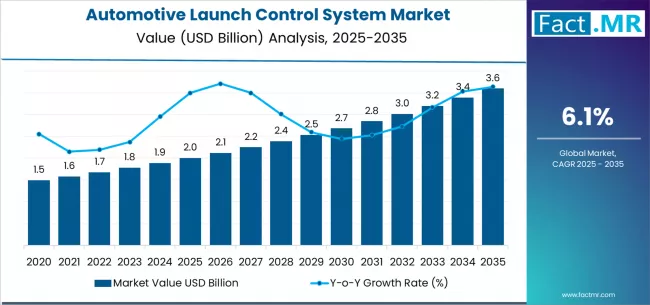
Automotive Launch Control System Market Market Value Analysis | Source: Fact.MR
Automotive Launch Control System Market Key Takeaways
| Metric | Details |
|---|---|
| Industry Size (2026) | USD 2.12 billion |
| Industry Value (2036) | USD 3.84 billion |
| CAGR (2026 to 2036) | 6.1% |
Source: Fact.MR analysis. Updated Mar 20, 2026
Automotive Launch Control System Market Definition
The automotive launch control system market covers electronic powertrain management modules that optimize vehicle acceleration from a standing start by coordinating engine torque delivery, transmission shift timing, traction control intervention, and differential lock engagement. These systems use dedicated ECU algorithms that manage wheel slip, clutch engagement pressure, and turbocharger boost profiles to minimize 0 to 100 km/h acceleration times while protecting drivetrain components from excessive mechanical stress. Originally developed for motorsport applications, launch control is now available across premium sports cars, performance SUVs, and increasingly mid-range vehicles with turbocharged or electrified powertrains.
Automotive Launch Control System Market Inclusions
The report covers global and regional market sizes for automotive launch control systems, forecast projections from 2026 to 2036, segment breakdowns by vehicle type (passenger car, commercial vehicle) and component (ECU, sensors, actuators). Per-vehicle system integration cost and OEM adoption rate analysis are included.
Automotive Launch Control System Market Exclusions
Standalone racing ECU hardware designed exclusively for track-only competition vehicles without road type-approval is excluded. Anti-lock braking system (ABS) and electronic stability control (ESC) modules are not covered unless their algorithms are specifically modified for launch control coordination. Aftermarket ECU tuning devices that override factory launch control calibrations fall outside the scope.
Automotive Launch Control System Market Research Methodology
Primary Research: Fact.MR analysts conducted detailed technical interviews with procurement directors, operations managers, and engineering leads across 40 countries to validate adoption timelines and purchasing decision criteria.
Desk Research: Data collection aggregated regulatory filings, government procurement records, industry association publications, and company annual reports to establish baseline market parameters.
Market-Sizing and Forecasting: Forecasting models apply a bottom-up methodology starting with installed base metrics and regional production volumes, applying technology penetration curves to project adoption velocity through 2036.
Data Validation and Update Cycle: Projections undergo cross-validation against publicly reported revenue figures from leading manufacturers and quarterly trade statistics published by national customs authorities.
Summary of Automotive Launch Control System Market
- Automotive Launch Control System Market Definition
- The automotive launch control system market covers electronic powertrain management modules that optimize vehicle acceleration from a standing start by coordinating engine torque delivery, transmission shift timing, traction control intervention, and differential lock engagement. These systems use dedicated ECU algorithms that manage wheel slip, clutch engagement pressure, and turbocharger boost profiles to minimize 0 to 100 km/h acceleration times while protecting drivetrain components from excessive mechanical stress.
- Demand Drivers in the Market
- Regulatory compliance requirements: Government mandates and safety standards across major markets compel end users to adopt upgraded equipment and systems that meet current specification thresholds.
- Technology cost reduction: Declining component costs and manufacturing efficiencies enable broader market penetration beyond premium segments into volume-production applications.
- Replacement cycle acceleration: Ageing installed bases in mature markets face performance gaps against current operational requirements, triggering fleet-wide upgrade programs.
- Key Segments Analyzed in the Fact.MR Report
- Passenger Car (Vehicle): 60.0% share in 2026, reflecting dominant adoption across primary use cases.
- ECU (Component): 50.0% share in 2026, driven by structural demand from the largest buyer segment.
- Analyst Opinion at Fact.MR
- The automotive launch control system market is positioned for sustained expansion through 2036 as regulatory mandates, technology maturation, and capital replacement cycles converge to create a multi-year procurement environment. Fact.MR is of the opinion that market participants prioritizing certified compliance with evolving standards and demonstrated integration with existing infrastructure will capture disproportionate contract volume during the forecast period. Organizations delaying capital commitments risk operational obsolescence as specification requirements tighten across all major geographic markets.
- Strategic Implications / Executive Takeaways
- Compliance-first procurement: Equipment and system suppliers must secure regulatory certifications ahead of enforcement timelines to qualify for tender shortlists in markets where compliance is a mandatory procurement gate.
- Regional manufacturing presence: Establishing local production or assembly capabilities in high-growth regions reduces lead times and positions suppliers favorably against import-dependent competitors.
- Technology partnership investment: Forming integration partnerships with complementary technology providers enables end-to-end solution delivery that standalone component suppliers cannot match in competitive bid evaluations.
- Methodology
- Primary Research: Fact.MR conducted structured interviews with procurement leads, operations directors, and technical specification managers across key end-user industries in over 40 countries.
- Desk Research: Analysts compiled data from regulatory filings, government statistical agencies, trade body publications, and verified corporate disclosures.
- Market-Sizing and Forecasting: A hybrid top-down and bottom-up methodology calibrates global estimates against regional production data and verified shipment records.
Why is the Automotive Launch Control System Market Growing?
Market expansion is being supported by the increasing global demand for advanced vehicle performance systems and the corresponding need for launch control technologies that can provide superior acceleration benefits and control advantages while enabling enhanced vehicle performance and extended compatibility across various passenger car and commercial vehicle applications.
Contemporary automotive manufacturers and control system specialists are increasingly focused on implementing proven acceleration technologies that can deliver effective performance optimization, minimize traditional launch limitations, and provide consistent performance throughout complex vehicle configurations and diverse driving conditions.
Automotive launch control systems proven ability to deliver exceptional acceleration control against traditional alternatives, enable advanced vehicle integration, and support modern performance protocols makes it an essential component for contemporary passenger car and commercial vehicle operations.
The growing emphasis on vehicle performance optimization and acceleration control is driving demand for control systems that can support large-scale automotive requirements, improve vehicle outcomes, and enable advanced automotive systems. Preference for technologies that combine effective acceleration control with proven reliability and performance enhancement benefits is creating opportunities for innovative launch control implementations.
The rising influence of performance automotive trends and vehicle control awareness is also contributing to increased demand for launch control systems that can provide advanced features, seamless automotive integration, and reliable performance across extended driving cycles.
Opportunity Pathways - Automotive Launch Control System Market
The automotive launch control system market is poised for steady growth and technological advancement. As automotive facilities across North America, Europe, Asia-Pacific, and emerging markets seek technologies that deliver exceptional acceleration characteristics, advanced control capabilities, and reliable vehicle options, launch control solutions are gaining prominence not just as automotive components but as strategic enablers of performance technologies and advanced vehicle functionality.
Rising passenger car adoption in performance systems and expanding commercial vehicle enhancement initiatives globally amplify demand, while manufacturers are leveraging innovations in ECU engineering, advanced control integration, and performance optimization technologies.
- Pathway A - Passenger Car Performance Implementations. Premium automotive and performance vehicle manufacturers increasingly require control solutions with passenger car optimization and advanced acceleration profiles for enhanced vehicle appeal and performance positioning capabilities. Technology developers who develop passenger car platforms with superior control standards can command premium pricing. Expected revenue pool: USD 1.2 billion - USD 2.2 billion.
- Pathway B - ECU Integration Platforms. Growing demand for ECU applications, high-performance capabilities, and unique control features drives need for advanced ECU capabilities with specialized automotive integration. Opportunity: USD 1.0 billion - USD 1.8 billion.
- Pathway C - Commercial Vehicle Applications. Advanced commercial vehicle formulations capable of meeting specific performance requirements, vehicle compatibility, and specialized control profiles enable market expansion and enhanced vehicle appeal for commercial-focused operations. Revenue lift: USD 0.8 billion - USD 1.4 billion.
- Pathway D - Sensor Technology Integration. Expanding reach into sensor applications with optimized control delivery, advanced sensor capabilities, and extended functionality features. Manufacturers will seek partners who supply integrated sensor solutions with complete control functionality. Pool: USD 0.7 billion - USD 1.3 billion.
- Pathway E - Geographic Expansion & Local Manufacturing. Strong growth in APAC, particularly China, India, and Southeast Asia. Local manufacturing lowers costs, reduces transportation complexity, and enables faster response to regional automotive preferences. Expected upside: USD 0.7 billion - USD 1.3 billion.
- Pathway F - Actuator Systems Development. Increasing demand for actuator control systems, application-specific functionality, and specialized performance profiles with validated control characteristics for automotive applications. USD 0.3 billion - USD 0.5 billion.
- Pathway G - Electric Vehicle Adaptation. Developing comprehensive electric vehicle control solutions, EV performance services, and enhancement programs creates differentiation and addresses specialized requirements for electric vehicle applications and automotive operators. Growing demand from independent automotive services. Pool: USD 0.4 billion - USD 0.7 billion.
Segmental Analysis
The market is segmented by vehicle, component, and region. By vehicle, the market is divided into passenger car and commercial vehicle categories. By component, it covers ECU, sensors, and actuators segments. Regionally, the market is divided into North America, Europe, and Asia-Pacific.
By Vehicle, the Passenger Car Segment Accounts for 60.0% Market Share
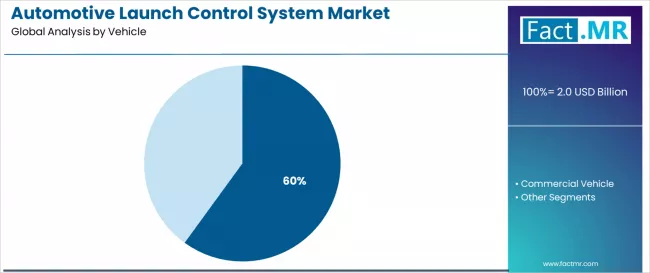
Automotive Launch Control System Market Analysis By Vehicle | Source: Fact.MR
The passenger car segment is projected to account for 60.0% of the automotive launch control system market in 2025, reaffirming its position as the leading vehicle category. Automotive facilities and control system integrators increasingly utilize passenger car implementations for their superior performance characteristics when operating across diverse vehicle platforms, excellent acceleration properties, and widespread acceptance in applications ranging from basic performance enhancement to premium sports car operations. Passenger car launch control technology's established integration methods and proven performance capabilities directly address the facility requirements for dependable control solutions in complex automotive environments.
This vehicle segment forms the foundation of modern automotive adoption patterns, as it represents the implementation with the greatest market penetration and established manufacturer acceptance across multiple vehicle categories and performance segments. Facility investments in passenger car launch control standardization and system consistency continue to strengthen adoption among automotive producers and performance vehicle companies. With manufacturers prioritizing acceleration performance and vehicle control, passenger car implementations align with both functionality preferences and cost expectations, making them the central component of comprehensive vehicle performance strategies.
By Component, the ECU Segment Accounts for 50.0% Market Share

Automotive Launch Control System Market Analysis By Component | Source: Fact.MR
ECU applications are projected to represent 50.0% of automotive launch control system demand in 2025, underscoring their critical role as the primary component type for control enhancement across vehicle manufacturing operations. Automotive facilities prefer ECUs for launch control use for their exceptional processing characteristics, scalable control options, and ability to enhance vehicle performance while ensuring consistent system quality throughout diverse vehicle platforms and automotive operations. Positioned as essential control components for modern launch control systems, ECU solutions offer both technological advantages and processing efficiency benefits.
The segment is supported by continuous innovation in ECU technologies and the growing availability of specialized implementations that enable diverse automotive requirements with enhanced control uniformity and extended reliability capabilities. Additionally, automotive facilities are investing in advanced technologies to support large-scale control integration and system development. As automotive automation trends become more prevalent and performance control awareness increases, ECU applications will continue to represent a major implementation market while supporting advanced vehicle utilization and technology integration strategies.
By Component, the Sensors Segment Accounts for 35.0% Market Share
The sensors segment is expected to capture 35.0% of the automotive launch control system market in 2025, driven by increasing demand for precision control systems that enhance vehicle performance while maintaining safety standards. Automotive manufacturers are increasingly adopting advanced sensors for wheel speed monitoring, throttle position sensing, and engine parameter detection due to their superior accuracy and real-time feedback capabilities. The segment benefits from growing automotive electronics integration and continuous innovation in sensor formulations tailored for launch control applications.
What are the Drivers, Restraints, and Key Trends of the Automotive Launch Control System Market?
The automotive launch control system market is advancing steadily due to increasing demand for advanced vehicle performance technologies and growing adoption of launch control systems that provide superior acceleration characteristics and control benefits while enabling enhanced vehicle performance across diverse passenger car and commercial vehicle applications.
The market faces challenges, including complex integration requirements, evolving safety standards, and the need for specialized control system expertise and calibration programs. Innovation in control methods and advanced ECU systems continues to influence product development and market expansion patterns.
Expansion of Vehicle Performance Technologies and Automotive Integration
The growing adoption of advanced vehicle performance, sophisticated control capabilities, and automotive efficiency awareness is enabling technology developers to produce advanced launch control solutions with superior acceleration positioning, enhanced control profiles, and seamless integration functionalities. Advanced vehicle performance systems provide improved automotive outcomes while allowing more efficient vehicle workflows and reliable performance across various automotive applications and driving conditions. Developers are increasingly recognizing the competitive advantages of automotive integration capabilities for market differentiation and control system positioning.
Integration of Advanced Control Methods and ECU Engineering
Modern launch control manufacturers are incorporating advanced control technology, ECU integration, and sophisticated automotive solutions to enhance product appeal, enable intelligent acceleration features, and deliver value-added solutions to automotive customers.
These technologies improve launch control performance while enabling new market opportunities, including multi-parameter control systems, optimized ECU treatments, and enhanced acceleration characteristics. Advanced ECU integration also allows developers to support comprehensive automotive technologies and market expansion beyond traditional control approaches.
Analysis of the Automotive Launch Control System Market by Key Countries
.webp "Top Country Growth Comparison Automotive Launch Control System Market Cagr (2026 2036)")
Top Country Growth Comparison Automotive Launch Control System Market Cagr (2026 2036) | Source: Fact.MR
| Country | CAGR (2026-2036) |
|---|---|
| USA | 6.0% |
| Mexico | 6.1% |
| Germany | 5.5% |
| South Korea | 5.3% |
| France | 5.2% |
| UK | 5.0% |
| Japan | 4.9% |
Source: Fact.MR analysis. Updated Mar 20, 2026
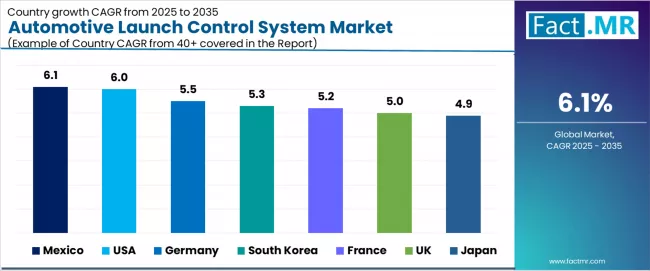
Automotive Launch Control System Market Cagr Analysis By Country | Source: Fact.MR
The automotive launch control system market is experiencing robust growth globally, with the USA leading at a 6.0% CAGR through 2036, driven by expanding automotive technology capacity, growing performance vehicle development programs, and significant investment in control system technology development. Mexico follows at 6.1%, supported by increasing automotive production expansion, growing control system integration patterns, and expanding automotive manufacturing infrastructure. Germany shows growth at 5.5%, emphasizing automotive technology leadership and control system development.
South Korea records 5.3%, focusing on expanding automotive capabilities and control technology modernization. France exhibits 5.2% growth, emphasizing automotive innovation excellence and premium control development. The UK demonstrates 5.0% growth, prioritizing advanced automotive technology development and quality-focused control patterns. Japan shows 4.9% growth, supported by automotive innovation initiatives and quality-focused control patterns.
USA Leads Global Market Growth with Automotive Technology Expansion
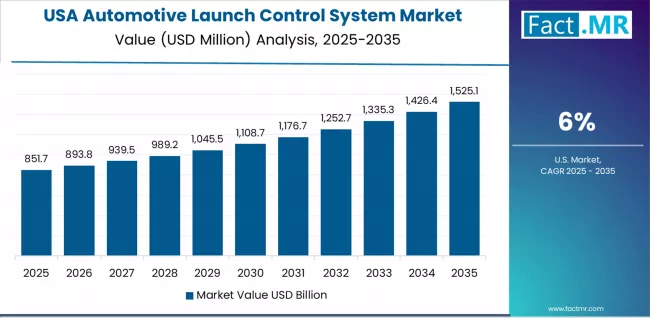
Automotive Launch Control System Market Country Value Analysis | Source: Fact.MR
Revenue from automotive launch control systems in the USA is projected to exhibit robust growth with a CAGR of 6.0% through 2036, driven by expanding automotive technology capacity and rapidly growing performance vehicle integration supported by government initiatives promoting automotive control technology development. The country's strong position in automotive innovation and increasing investment in performance infrastructure are creating substantial demand for advanced launch control implementations. Major automotive facilities and technology companies are establishing comprehensive control capabilities to serve both domestic automotive demand and expanding performance markets.
Government support for automotive innovation initiatives and performance vehicle development is driving demand for advanced control systems throughout major automotive regions and technology centers across the country. Strong automotive growth and an expanding network of technology-focused producers are supporting the rapid adoption of launch control systems among manufacturers seeking advanced performance capabilities and integrated control technologies.
Mexico Demonstrates Strong Automotive Growth and Manufacturing Expansion
Revenue from automotive launch control systems in Mexico is growing at a CAGR of 6.1%, driven by the country's expanding automotive sector, growing manufacturing capacity, and increasing adoption of control technologies. The country's initiatives promoting automotive modernization and growing technology development awareness are driving requirements for technology-integrated control systems. International launch control providers and domestic automotive companies are establishing extensive manufacturing and integration capabilities to address the growing demand for advanced control solutions.
Strong automotive expansion and expanding modern manufacturing operations are driving adoption of integrated performance systems with superior control capabilities and advanced integration among large automotive producers and progressive manufacturing operations. Growing technology diversity and increasing automotive enhancement adoption are supporting market expansion for advanced launch control implementations with seamless integration profiles and modern control delivery throughout the country's automotive regions. Mexico's strategic location and cost-effective manufacturing capabilities make it an attractive destination for control system processing facilities serving both domestic and North American markets.
Germany Demonstrates Automotive Technology Leadership with Innovation Growth
Revenue from automotive launch control systems in Germany is expanding at a CAGR of 5.5%, supported by the country's automotive technology heritage, strong emphasis on control system technology, and robust demand for advanced launch control systems in passenger car and commercial vehicle applications. The nation's mature automotive sector and technology-focused operations are driving sophisticated control implementations throughout the industry. Leading facilities and automotive specialists are investing extensively in control development and advanced integration technologies to serve both domestic and international markets.
Rising demand for vehicle performance technologies and advanced automotive systems is creating requirements for sophisticated launch control solutions with exceptional control capabilities among quality-conscious facilities seeking enhanced automotive experiences and advanced integration methods. Strong automotive tradition and growing investment in control technologies are supporting adoption of quality launch control platforms with advanced development methods and enhanced performance profiles across automotive operations in major technology regions.
South Korea Demonstrates Strong Automotive Integration and Technology Development
Revenue from automotive launch control systems in South Korea is growing at a CAGR of 5.3%, driven by the country's expanding automotive sector, growing technology integration capacity, and increasing adoption of control technologies. The country's initiatives promoting automotive modernization and growing vehicle development awareness are driving requirements for technology-integrated control systems. International launch control providers and domestic automotive companies are establishing extensive manufacturing and integration capabilities to address the growing demand for advanced control solutions.
Rising automotive requirements and expanding technology programs are creating opportunities for launch control adoption across automotive centers, progressive producers, and modern vehicle facilities in major automotive regions. Growing focus on control integration and performance improvement features is driving adoption of launch control platforms among manufacturers seeking enhanced performance capabilities and advanced control experiences.
France Focuses on Automotive Development and Technology Enhancement Programs
Revenue from automotive launch control systems in France is growing at a CAGR of 5.2%, driven by the country's expanding automotive sector, growing technology development programs, and increasing investment in control system technology development. France's large automotive market and commitment to technology advancement are supporting demand for diverse launch control solutions across multiple automotive segments. Control system providers are establishing comprehensive integration capabilities to serve the growing domestic market and expanding automotive opportunities.
Strong automotive expansion and expanding modern technology operations are driving adoption of integrated performance systems with superior control capabilities and advanced integration among large automotive producers and progressive technology operations. Growing technology diversity and increasing automotive enhancement adoption are supporting market expansion for advanced launch control implementations with seamless integration profiles and modern control delivery throughout the country's automotive regions.
UK Exhibits Automotive Technology Development and Premium Innovation Growth
Revenue from automotive launch control systems in the UK is growing at a CAGR of 5.0%, driven by the country's focus on automotive technology advancement, emphasis on premium vehicle innovation, and strong position in control system development. The UK's established automotive innovation capabilities and commitment to technology diversification are supporting investment in specialized launch control technologies throughout major automotive regions. Industry leaders are establishing comprehensive technology integration systems to serve domestic premium automotive production and enhancement applications.
Innovations in control platforms and automotive integration capabilities are creating demand for advanced launch control implementations with exceptional performance properties among progressive automotive facilities seeking enhanced technology differentiation and vehicle appeal. Growing premium automotive adoption and increasing focus on technology innovation are driving adoption of advanced launch control platforms with integrated performance delivery and control optimization across automotive enterprises throughout the country.
Japan Shows Quality Processing Focus and Technology-Driven Automotive Systems
Revenue from automotive launch control systems in Japan is expanding at a CAGR of 4.9%, supported by the country's automotive excellence initiatives, growing quality technology sector, and strategic emphasis on advanced control development. Japan's advanced quality control capabilities and integrated automotive systems are driving demand for high-quality launch control platforms in premium applications, automotive technology, and advanced vehicle applications. Leading facilities are investing in specialized capabilities to serve the stringent requirements of technology-focused automotive and premium vehicle producers.
Quality automotive advancement and technology-focused development are creating requirements for specialized launch control solutions with superior quality integration, exceptional performance capabilities, and advanced control features among quality-conscious automotive operations and premium vehicle producers. Strong position in automotive technology innovation is supporting adoption of advanced launch control systems with validated performance characteristics and quality integration capabilities throughout the country's automotive technology sector.
Europe Market Split by Countries
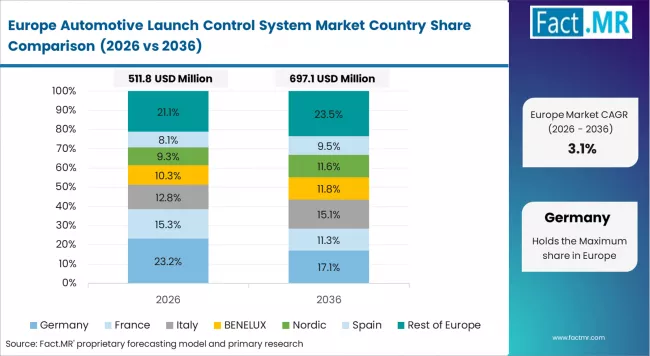
Automotive Launch Control System Market Europe Country Market Share Analysis, 2026 & 2036 | Source: Fact.MR
The automotive launch control system market in Europe is projected to grow from USD 0.6 billion in 2026 to USD 1.1 billion by 2036, registering a CAGR of 5.4% over the forecast period. Germany is expected to maintain its leadership position with a 35.0% market share in 2026, growing to 36.2% by 2036, supported by its strong automotive engineering culture, sophisticated vehicle manufacturing capabilities, and comprehensive automotive sector serving diverse launch control applications across Europe.
France follows with a 22.0% share in 2026, projected to reach 22.8% by 2036, driven by robust demand for automotive technologies in vehicle applications, advanced automotive development programs, and performance enhancement markets, combined with established automotive infrastructure and technology integration expertise. The UK holds a 18.0% share in 2026, expected to reach 17.5% by 2036, supported by strong automotive technology sector and growing premium vehicle activities.
Italy commands a 12.0% share in 2026, projected to reach 11.5% by 2036, while Netherlands accounts for 8.0% in 2026, expected to reach 8.5% by 2036. The Rest of Europe region is anticipated to maintain momentum, with its collective share moving from 5.0% to 3.5% by 2036, attributed to increasing automotive modernization and growing technology penetration implementing advanced control programs.
Competitive Landscape of the Automotive Launch Control System Market
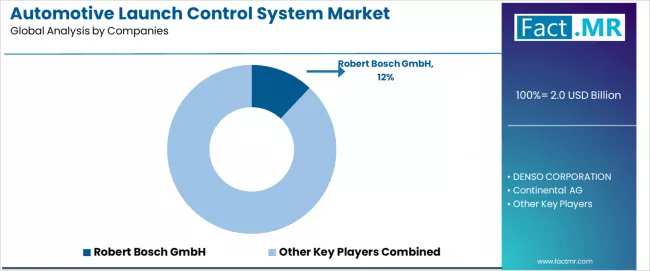
Automotive Launch Control System Market Analysis By Company | Source: Fact.MR
The automotive launch control system market is characterized by competition among established automotive suppliers, specialized control system manufacturers, and integrated vehicle technology solution providers. Companies are investing in control technology research, performance optimization, advanced automotive system development, and comprehensive launch control portfolios to deliver consistent, high-quality, and application-specific control solutions. Innovation in advanced control integration, performance enhancement, and automotive compatibility improvement is central to strengthening market position and competitive advantage.
Robert Bosch GmbH leads the market with a 12% market share, offering comprehensive control solutions including quality ECU platforms and advanced launch control systems with a focus on premium and passenger car applications. Denso provides specialized automotive capabilities with an emphasis on advanced launch control implementations and innovative vehicle control solutions. Continental delivers comprehensive automotive services with a focus on integrated platforms and large-scale vehicle applications. ZF specializes in advanced control technologies and specialized launch control implementations for premium applications. Magneti Marelli focuses on passenger car-oriented control integration and innovative technology solutions.
The competitive landscape is further strengthened by companies like Delphi, which brings expertise in advanced automotive electronics and control systems, while Hella focuses on sensor and actuator solutions for specialized applications. Valeo emphasizes automotive system integration and component manufacturing, and Aptiv specializes in advanced vehicle architecture and control solutions. These companies continue to invest in research and development, strategic partnerships, and manufacturing capacity expansion to maintain their market positions and capture emerging opportunities in the growing automotive launch control system sector.
Key Players in the Automotive Launch Control System Market
- Robert Bosch GmbH
- DENSO CORPORATION
- Continental AG
- ZF Friedrichshafen AG
- Marelli Holdings Co., Ltd. (formerly Magneti Marelli)
- Delphi Technologies plc
- HELLA GmbH & Co. KGaA
- Valeo SA
- Aptiv PLC
- Mitsubishi Electric Corporation
- Hitachi Astemo, Ltd.
Bibliography
- BMW AG. (2024). Annual Report 2023: M Performance and Digital Services. BMW AG.
- Porsche AG. (2024). Annual Report 2023: Taycan Launch Control Technology. Porsche AG.
- Hyundai Motor Group. (2024). Annual Report 2023: N Brand Performance Division. Hyundai Motor Company.
- SAE International. (2024). SAE J2945: Vehicle Launch Performance Test Procedure. SAE.
- Tesla, Inc. (2024). Annual Report 2023 (10-K Filing). U.S. Securities and Exchange Commission.
- International Organization of Motor Vehicle Manufacturers (OICA). (2024). 2024 Production Statistics. OICA.
- This bibliography is provided for reader reference. The full Fact.MR report contains the complete reference list with primary research documentation.
This Report Addresses
- Market sizing and quantitative forecast metrics detailing industry revenue projections for the automotive launch control system market through 2036.
- Segmentation analysis identifying adoption patterns across Vehicle, Component segments and evaluating structural demand drivers.
- Regional deployment intelligence comparing growth dynamics across 7 key countries and broader geographic markets.
- Regulatory compliance assessment analyzing policy frameworks and standards that affect market adoption and procurement specifications.
- Competitive landscape evaluation profiling 11 companies and their strategic positioning across technology and geographic dimensions.
- Strategic investment guidance identifying infrastructure requirements and procurement specifications for market participants.
- Supply chain and operational analysis identifying capacity constraints, lead time factors, and sourcing patterns that influence market dynamics.
- Data delivery formats including PDF narrative reports, Excel datasets, interactive dashboards, and presentation files.
Segmentation
Scope of the Report
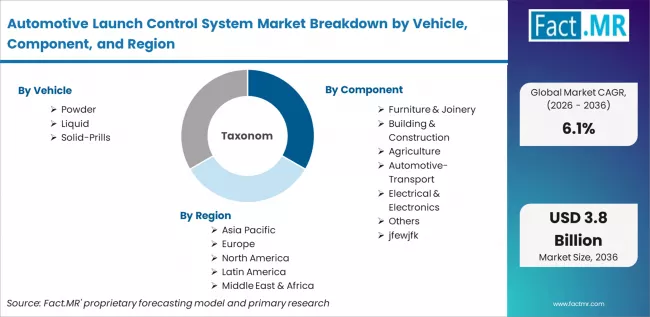
Automotive Launch Control System Market Breakdown By Vehicle, Component, And Region | Source: Fact.MR
| Metric | Value |
|---|---|
| Quantitative Units | USD 2.12 billion to USD 3.84 billion, at a CAGR of 6.1% |
| Market Definition | The automotive launch control system market covers electronic powertrain management modules that optimize vehicle acceleration from a standing start by coordinating engine torque delivery, transmission shift timing, traction control intervention, and differential lock engagement. These systems use dedicated ECU algorithms that manage wheel slip, clutch engagement pressure, and turbocharger boost profiles to minimize 0 to 100 km/h acceleration times while protecting drivetrain components from excessive mechanical stress. |
| Segmentation | Vehicle (Passenger Car, Commercial Vehicle), Component (ECU, Sensors, Actuators) |
| Regions Covered | North America, Latin America, Europe, East Asia, South Asia, Oceania, Middle East & Africa |
| Countries Covered | Mexico, USA, Germany, South Korea, France, UK, Japan, and 40 plus countries |
| Key Companies Profiled | Robert Bosch GmbH, DENSO Corporation, Continental AG, ZF Friedrichshafen AG, Marelli Holdings Co., Ltd., Delphi Technologies plc, HELLA GmbH & Co. KGaA, Valeo SA, Aptiv PLC, Mitsubishi Electric Corporation, Hitachi Astemo, Ltd. |
| Forecast Period | 2026 to 2036 |
| Approach | Forecasting models apply a hybrid top-down and bottom-up methodology, calibrating global estimates against regional production data and verified shipment records to project market trajectory through 2036. |
Source: Fact.MR analysis. Updated Mar 20, 2026
Automotive Launch Control System Market by Segments
-
Vehicle :
- Passenger Car
- Commercial Vehicle
-
Component :
- ECU
- Sensors
- Actuators
-
Region :
-
North America
- USA
- Canada
- Mexico
-
Europe
- Germany
- UK
- France
- Italy
- Spain
- Nordic
- BENELUX
- Rest of Europe
-
Asia-Pacific
- China
- Japan
- South Korea
- India
- ASEAN
- Australia & New Zealand
- Rest of Asia-Pacific
-
Frequently Asked Questions
How large is the demand for Automotive Launch Control System Market in the global market in 2026?
What will be the market size of Automotive Launch Control System Market by 2036?
What is the expected demand growth for Automotive Launch Control System Market between 2026 and 2036?
Which Vehicle is poised to lead global sales by 2026?
How significant is the role of ECU in the Automotive Launch Control System Market?
What is the growth outlook for Mexico in this report?
What is the growth outlook for USA?
Does the report cover France in its regional analysis?
What is Automotive Launch Control System Market and what is it mainly used for?
What is included in the scope of this report?
What is excluded from the scope of this report?
How does Fact.MR build and validate the Automotive Launch Control System Market forecast?
What regions are covered in this report?
Which companies are profiled in this report?
How large is the demand for Automotive Launch Control System Market in the global market in 2026?
What will be the market size of Automotive Launch Control System Market by 2036?
What is the expected demand growth for Automotive Launch Control System Market between 2026 and 2036?
Which Vehicle is poised to lead global sales by 2026?
How significant is the role of ECU in the Automotive Launch Control System Market?
What is the growth outlook for Mexico in this report?
What is the growth outlook for USA?
Does the report cover France in its regional analysis?
What is Automotive Launch Control System Market and what is it mainly used for?
What is included in the scope of this report?
What is excluded from the scope of this report?
How does Fact.MR build and validate the Automotive Launch Control System Market forecast?
What regions are covered in this report?
Which companies are profiled in this report?
Who worked on this report


Preview the report firsthand - request a free sample
Free SampleGet the brochure for pricing and purchase details
Download PDF